Monthly Archives: March 2023

Flock of cedar waxwings provides ‘berry’ exciting observation

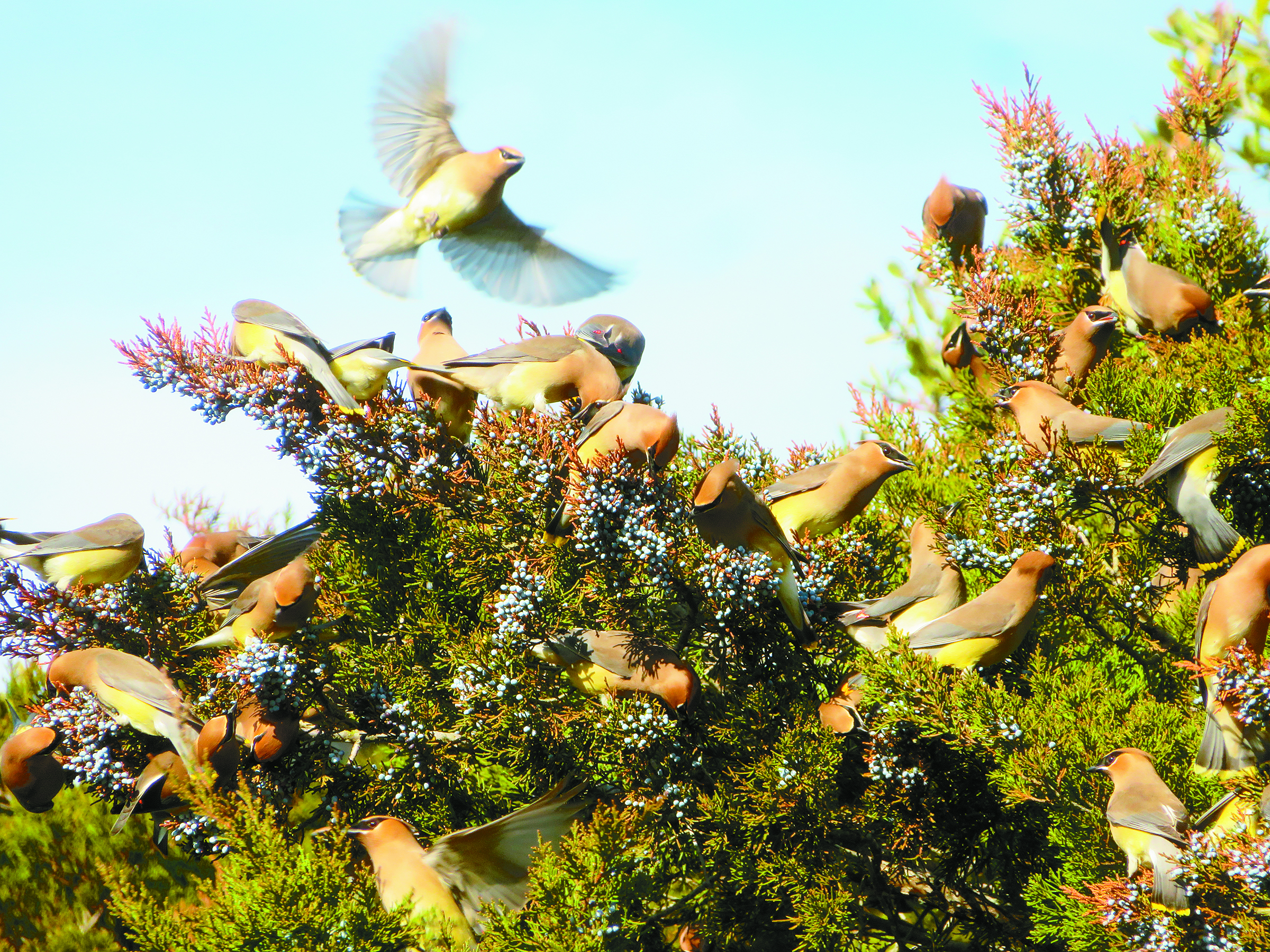
Photo Courtesy of Jim Kroll • Cedar waxwings form large flocks that are capable of stripping berries off trees in a matter of hours when these hungry birds descend on berry-producing trees and shrubs.

Jim Kroll emailed me awhile back to share an observation he made when he and his wife visited Garden City, South Carolina. According to Jim, while riding their bicycles they had the good luck to see a flock of cedar waxwing feasting on berries in a large tree.

“This tree was probably 20 feet tall, and loaded with blue berries,” he wrote.

He also shared a photo of the flock. “There are around 30 waxwings plucking berries,” he said in describing the photo.

He estimated that the flock numbered well over 100 waxwings.

“They left the tree top several times, as if startled, but they would return within a minute and continue their feast,” Jim wrote. “The thing that first caught our attention as we rode under the tree, is that my wife noticed a lot of small pieces of green limbs laying in the road directly under the tree. We turned around to see why the road had so many green limbs and noticed the waxwing flock feasting.”

They made it a point to ride by the tree again on the following two days, hoping to see the waxwing flock again, but did not see them again.

They also discovered that no berries remained on the tree’s branches. The waxwings had consumed all of the berries.

“I looked at an article on the South Carolina Public Radio website that said this is the time of the year that waxwings were migrating south through South Carolina,” Jim wrote.

I replied to Jim’s email and shared an account of an observation I made several years ago at Erwin Fishery Park.

On that occasion, my mom and I watched a couple of mockingbirds wage a losing battle to keep a flock of at least 100 waxwings out of a holly tree laden with berries. The mockingbirds might chase off a dozen waxwings, but there were always a few dozen ready to swoop in and take their place. That tree, too, was stripped of berries. The next time I stopped by I could not detect a single berry still on the tree.

After I shared my waxwing story, Jim replied with some more observations.

“I can see the mockingbirds that you mentioned trying to protect their berry stash,” he wrote. “We regularly see mockingbirds, seemingly being aggressive.”

Jim said that he has also re-named blue jays that visit his bird feeders.

“I call them ‘bully birds’ because they swoop in intentionally trying to scare off the other birds at the feeder,” he wrote.

I thought it interesting that my brother, Mark, told me about a flock of waxwings that he and his wife, Amy, saw at their home in Murrells Inlet, South Carolina. His story was similar to the one Jim shared.

Mark said a flock of waxwings arrived in his yard and swiftly stripped a berry-producing tree of its berries.

Waxwings have a brown and gray silky plumage, a black mask and a perky crest. Some of the wing feathers show red tips. The similarity of these wing tips to melted drops of wax gives these birds the common name of waxwing.

The cedar waxwing has few relatives. Worldwide, there are only two other species: the Bohemian waxwing, of the northern forests of Eurasia and North America; and the Japanese waxwing, found in such northeast Asian countries as Japan, Korea and China.

Although it’s classified as a songbird, the cedar waxwing doesn’t truly produce a vocalization that anyone would contend qualifies as a song. They are, however, very vocal birds, producing shrill, high-pitched notes as they pass through the upper branches of tall trees.

As much as the waxwing has a fondness for fruit, it’s also a bird that would have made an excellent flycatcher. Flocks of these birds will often congregate in trees near the edge of a pond, garden or yard — anywhere winged insects might be found in good numbers — in order to hawk insects on the wing. A waxwing will sally forth from a branch, snatch its prey in mid-air, and return to its perch for a quick snack.

Waxwings are rather nomadic, coming and going with a maddening unpredictability.

Other birds are more dependable, arriving and departing at roughly the same time year after year.

Over the next few weeks, we can expect the spring arrivals of a vast variety of birds. To share a sighting, make a comment or ask a question, email me at ahoodedwarbler@aol.com.

Photo by Bryan Stevens • The waxy tips to the wing feathers are evident in this photograph of a cedar waxwing.

Look for red-winged blackbirds near cattails, other wetland areas

Photo by Howard Walsh/Pixabay * A male red-winged blackbird guards his territory in the spring while attracting potential mates.

Photo by Howard Walsh/Pixabay * A male red-winged blackbird guards his territory in the spring while attracting potential mates.


If it is March or April in Northeast Tennessee or Southwest Virginia or Western North Carolina, for that matter, some birds are making their return after a season-long absence.

On one recent morning, a loud, familiar “kon-ke-ree” sounded from the tops of the cypress trees at the fish pond. In an instant, I realized that the resident male red-winged blackbird was back for another nesting season.

Red-winged blackbirds return yearly every March and begin to seek out nesting habitat in local wetland areas, such as the cattail marshes near my fish pond.

Last year, my first returning male red-winged blackbird arrived on the evening of March 3. This year, the first red-winged blackbird arrived on the morning of March 6. I heard his unmistakable song from inside my house.

The showy and loud red-winged blackbird male that’s once again taken up residence at my fish pond and adjacent stands of cattails has made himself right at home.

Male blackbirds arrive ahead of the females. My recent spring arrival perches daily in the willows and cypresses by the pond and has been singing every day since his return, but he’s still waiting for his intended audience to arrive. Female blackbirds lag a week or so behind the males in returning to their familiar territory.

Any wet field or marsh, especially those offering a stand of cattails, is almost certain to attract red-winged blackbirds at this time of year. I’d almost wager on that certainty.

The blackbirds arriving in spring behave much differently than the quiet, furtive flocks that often make brief visits to feeders during late winter snowstorms.

“The kon-ke-ree song of the male red-winged blackbird is a sure indication that spring is on the way,” according to a profile located at the Tennessee Watchable Wildlife website.

At this time of year, the male red-winged blackbirds seek elevated perches to display and vocalize. Their loud antics are not designed solely to attract mates. Male red-winged blackbirds also sing to warn rival males from intruding into their territories.

The male red-winged blackbird is a very aptly named bird. Glossy black males sport red wing patches that are often trimmed with a narrow band of yellow feathers. By contrast, female red-winged blackbirds are mostly brown birds that could easily be mistaken for large sparrows. Both sexes have sharply pointed bills.

Red-winged blackbirds are fond of wetlands. Any marsh or even a damp field or flooded pasture is likely to attract a few resident red-winged blackbirds. Females choose nesting locations in cattails or other marsh vegetation. She usually lays three or four eggs. Although she does receive some help from the male, most of the responsibility for raising the young is left to her.

There is a reason that male red-winged blackbirds are not always quite as engaged as females in feeding and tending their young. Males are often polygynous, which means that males will often court multiple mates. His time is often occupied defending females and their respective nests from the advances of other male red-winged blackbirds.

According to the website All About Birds, male red-winged blackbirds spend much of the breeding season sitting on a high perch over their territories and singing almost without ceasing from dawn to dusk.

The website also notes that female blackbirds shirk the high profile of the males. They tend to skulk in wetland vegetation as they collect food or nest material.

Both males and females defend nests from intruders and predators. They take this duty quite seriously, as I know personally from being dive-bombed by parent blackbirds when I have gotten a little too close to their nests.

Other relatives of the red-winged blackbird in the United States include the tricolored blackbird found along the Pacific Coast and the yellow-headed blackbird resident in wetlands west of the Great Lakes. Rusty blackbird, common grackle and brown-headed cowbird are other species of blackbirds found in Tennessee, Virginia and North Carolina.

Share a sighting, ask a question or make a comment by emailing me at ahoodedwarbler@aol.com.

Female red-winged blackbirds lack the splashy plumage of males.


Spring signs less clear than in seasons past

Photo by Bryan Stevens * A male mallard lounges by the edge of a fish pond in a previous spring season.

Signs of spring are, as the old saying goes, popping up all over. Daffodils and crocuses unfurling their blooms, a pair of mallards paying a visit to my fish pond and the blue skies overhead on sunny days have signaled the transition toward spring as surely as the turning of the calendar page to March.

Some of these familiar sights have been hazy for me during this season of transition. In early February I lost vision in my right eye. After visits to various medical experts, an MRI, blood tests and other procedures, I got a diagnosis of optic papillitis, a form of optic neuritis. In simpler terms, I suffered a stroke of the eye that aggravated and inflamed the optic nerve.

The good news, as I see it, tests have not found any evidence of underlying conditions like cancer or a brain tumor. The bad news, also as I see it, is that recovery is not guaranteed and can take time. The process is usually measured in weeks and months, not days.

It’s been unsettling, to describe it mildly. Reading requires the assistance of a magnifying glass. Too much time focused on a bright screen brings discomfort.

I’m carrying on with birding as best I can. Binoculars, as birders know, are made for use by two eyes. I have feeders to lure the birds in close, but my favorite cardinals, chickadees and wrens are a bit blurry.

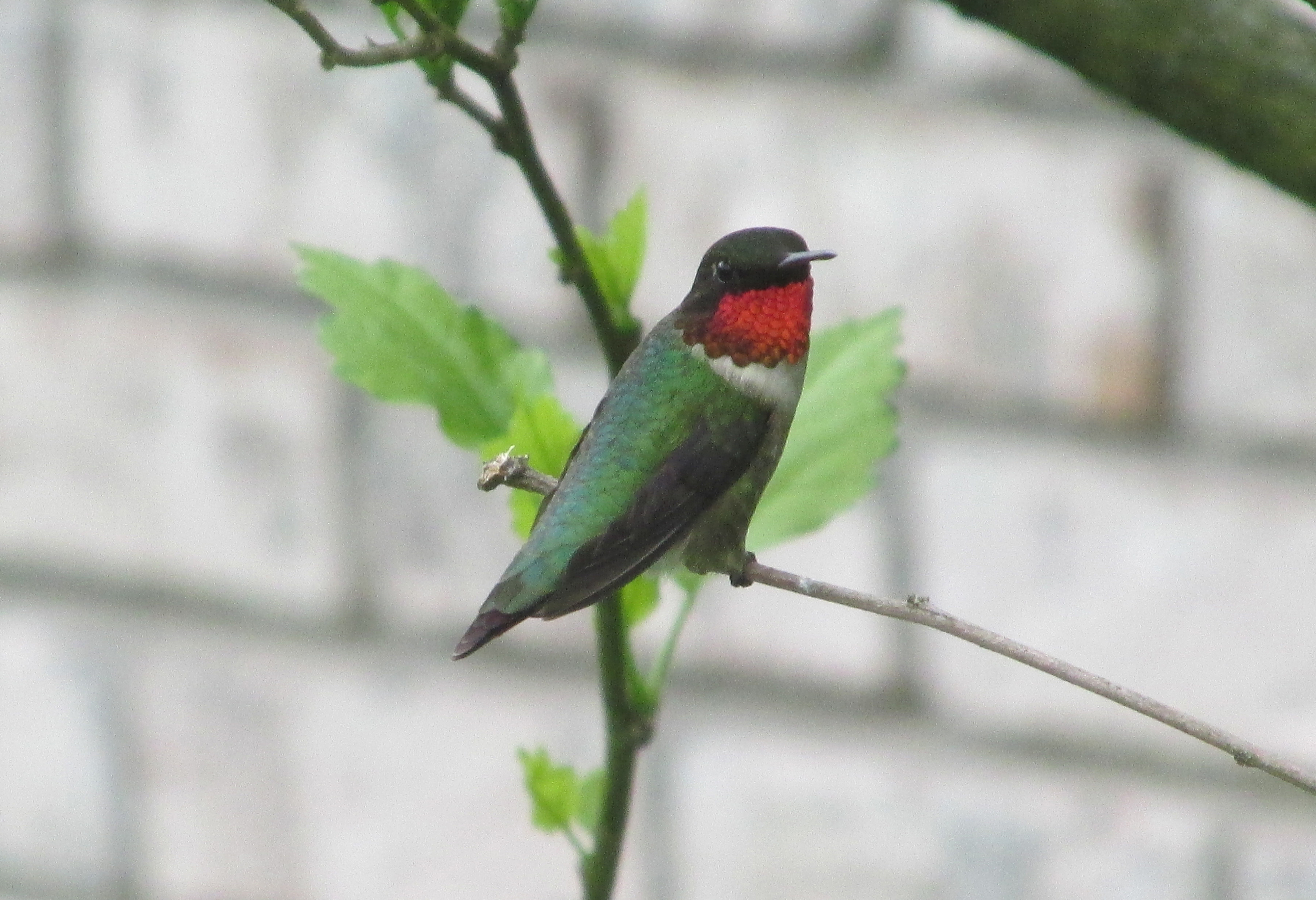
I’ve always tried to stay optimistic. I’m hopeful that by the time the ruby-throated hummingbirds return for a sip of sugar water at my feeders in April, my sight will be good enough to enjoy the beauty of their green and white plumage and the brilliant red throat if the visiting hummer is a male.

Photo by Bryan Stevens • Male ruby-throated hummingbird show the namesake red throat. The feathers on a male’s throat are iridescent, which means they can change when seen from different angles. In poor light, the ruby-red throat can look almost black.

If spring’s too soon, I’ll push the goal farther along in the 2023 calendar and hope to be ready to identify the annual fall parade of warblers.

As I wait, nothing’s stopping me from enjoying the sounds of spring. On rainy days, the chorus of spring peepers produce their amphibious cacophany at dusk and throughout the night. Many of the birds are also singing their hearts out. Eastern phoebes, tufted titmice, Carolina chickadees and Northern cardinals all make their presence with their loud, persistent songs.

On Monday, Feb. 20, I watched as the fuzzy shapes of two dozen red-winged blackbirds dropped down into the cattails in the marshy area near the fish pond. It’s not February for me until I’ve seen a migrating flock of blackbirds benefitting from an overnight stay in the cattails.

Photo by Bryan Stevens * A mallard drake looks vibrant with his green, glossy head.

On Sunday, Feb. 26, a mallard pair visited the fish pond. They were the first mallards that I’ve observed at my fish pond for many years. In full disclosure, my mom spotted them and informed me of their arrival. Mallards are big enough that I saw the male of the pair easily enough. His green head and chestnut breast stood out from the brown cattails and other vegetation bordering the pond. The female mallard blended nicely with the background and evaded my gaze. Regardless, I was thrilled to welcome mallards back to the pond. They only lingered for a single day, but they have me hoping that other ducks, such as blue-winged teal or wood ducks, will make similar visits as the season progresses.

On March 1, I saw my first spring butterfly. The seasonal first was a spring azure, a tiny, delicate butterfly. The sighting reminded me that nature will provide plenty of incentive to work on regaining my full vision. I still have more butterflies, as well as dragonflies, damselflies, moths and June bugs to look forward to seeing as we progress through spring and summer.

I’ve always believed that nature is a restorative force. Now I am going to test that theory in my goal to have my vision back at or near normal capacity by the time I hear the buzzy whir of hummingbird wings in April.

In the meantime, there will still be plenty of time to focus on our myriad feathered friends. I have someone who has been great at taking down my dictated words for my weekly column.

As always, make a comment, share an observation or ask a question by emailing me at ahoodedwarbler@aol.com.


Early morning bird encounter may have been type of shorebird


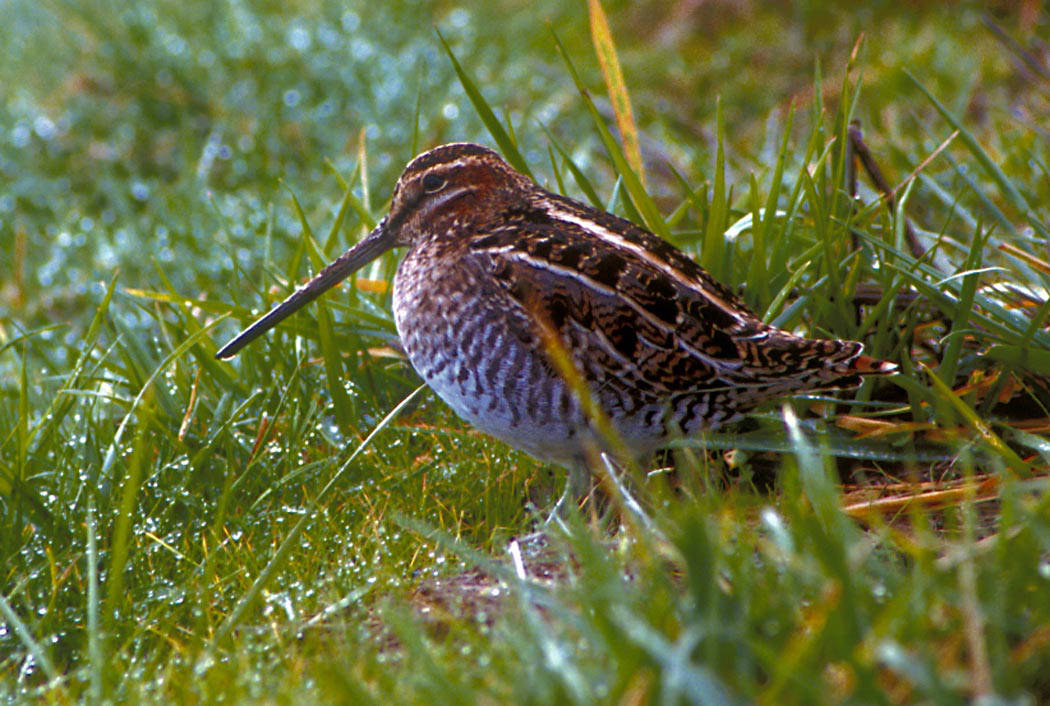
Photo by Patty Browne/USFWS • A Wilson’s snipe seeks out concealing cover in a wet field.

Lynda Carter of Jonesborough sent me an email asking for help making sense of a pre-dawn close encounter of the feathered variety.

“My sister and I were walking this morning before daylight and had a startling experience,” Lynda wrote. “We had started down a gravel drive when a bird flushed right at our feet. The bird flew away at about a 45 degree angle and made quite a bit of sound.”

Lynda wrote that she and her sister agreed the sound was wing noise rather than a call, which ruled out the screech owl they sometimes see on the drive. It would also be unusual for a screech owl to roost on the ground.

Lynda described the noise as louder than a dove taking off.

“I have never noticed doves on the ground at night,” she added before asking me for my best guess regarding the bird’s identity.

I cannot conclusively identify the bird, but I did offer some possibilities in a response to Lynda’s email.

If the location is near woods, I would go out on a limb and make three guesses: Wilson’s snipe, American woodcock or ruffed grouse.

The first two birds are each active both night and day, but the ruffed grouse is usually not active at night. Roosting on a gravel road is also not its style. I included it because a grouse’s wings make quite a lot of noise when they take off.

Wilson’s snipe and American woodcock are atypical shorebirds with long legs and bills. Both are also often active around dusk and dawn. Their plumage lets them blend remarkably well with their surroundings, whether those be wetlands, fields or woodland floors.

Wilson’s snipe looks stocky, thanks in part to the extra-large pectoral (breast) muscles that make up nearly a quarter of the bird’s weight, a feat unmatched by any other shorebird, according to the All About Birds website. Using these massive flight muscles, a snipe can reach speeds estimated at 60 miles an hour.

Photo by Bryan Stevens * A Wilson’s snipe ventures from cover to forage on a muddy bank.

According to All About Birds, the American woodcock nests in young, shrubby, deciduous forests, old fields and mixed forest-agricultural-urban areas across the eastern United States and southern Canada.

In late winter and early spring, these dumpy shorebirds are famous for their nuptial displays conducted in forest openings and old fields. They take flight, and their feathers produce an eerie sound as they make their descent back to the ground.

If the bird flushed from hiding by Lynda and her sister had been vocal, I would have guessed killdeer. But Lynda didn’t hear anything but the apparent noise from the wings, which in my mind rules out the killdeer and its loud vocalizations.

I cautioned Lynda that my guesses were not definitive. Alas, her encounter may remain a mystery, but the unexpected interaction with the unknown bird does sound like it made for a dramatic experience.

To ask a question, make a comment or share a sighting, email me at ahoodedwarbler@aol.com.