Monthly Archives: June 2023

Man’s return to birding yields scissor-tailed flycatcher sighting


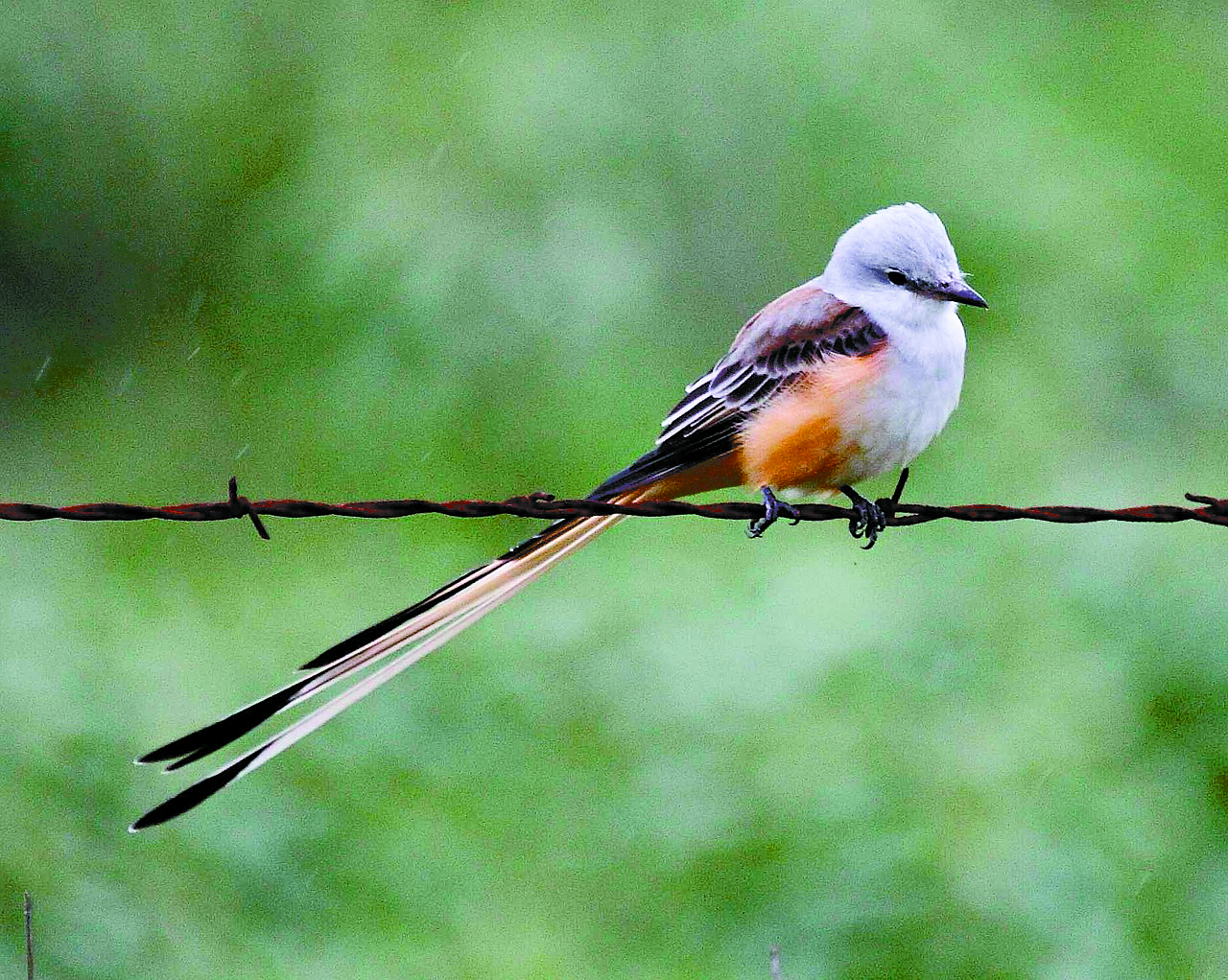
Photo by Pixabay • The scissor-tailed flycatcher is the state bird of Oklahoma and not a species often found within the borders of the Volunteer State. Nevertheless, one such flycatcher was recently spotted by Dan Huffine as he baled hay in a field in Jonesborough.

Birding is a lot like riding a bike. Once you learn how, it’s always going to stick with you.

That’s certainly been the case for Jonesborough resident Dan Huffine, who got his start in birding back in the last decade of the 20th century.

“I was very active in birding back in early ’90s,” Huffine said.

He’s now emerging after a long hiatus from birding, and he’s done so in a big way with a recent sighting of a scissor-tailed flycatcher.

He wasn’t even actively looking for birds — he was simply baling some hay in a field in Jonesborough.
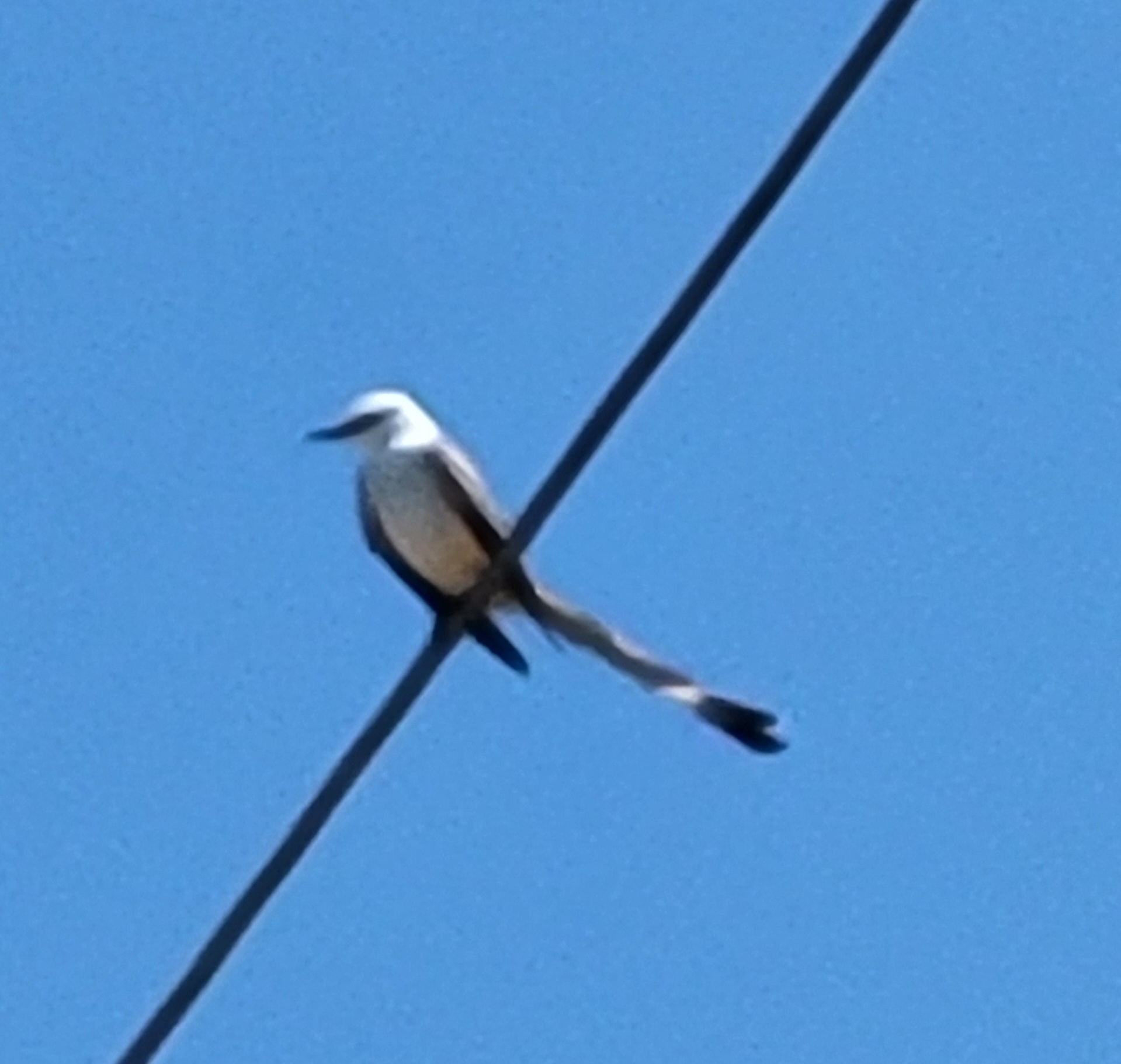
Photo by Danny Huffine • On a subsequent trip to look for the scissor-tailed flycatcher, Dan Huffine was rewarded with a chance to snap a photo of the bird perched on a wire.

“The bird was sitting on a windrow of hay facing me as i approached it on a tractor and round baler,” he explained.

He noted that his first impression was, “Wow! That mockingbird has a really white-looking head.”

As he got closer, the bird flew and revealed that it was definitely not a Northern mockingbird.

“It had that unmistakable long tail with some pinkish color under the wings,” Huffine said.

He stopped the tractor, not believing what he had just seen.

“My immediate thought was no one will believe me,” Huffine said. “I got some poor quality cell phone pictures. I got a better shot later in the day. I so wanted others to confirm my sighting.”

Toward that end, he contacted me and sought out my help in getting him in touch with Rick Knight and Fred Alsop, two very accomplished and well-known birders in the region.

Huffine’s excitement was contagious. Some other birders have now observed the flycatcher, which is a bird much more likely to be found in Oklahoma or Texas rather than Northeast Tennessee.

In fact, Huffine’s sighting became only the third-ever sighting of a scissor-tailed flycatcher in Northeast Tennessee. All of the sightings have taken place in Washington County.

According to the website “All About Birds,” scissor-tailed flycatcher numbers declined by about 31% between 1966 and 2014. The estimate comes from statistics gathered by the North American Breeding Bird Survey.

The website also noted that Partners in Flight estimates a global breeding population of 9.5 million scissor-tailed flycatchers, with 92% breeding in the United States, and 50% spending some part of the year in Mexico.

A scissor-tailed flycatcher is unlikely to be confused with any other bird. Adult males are pale gray birds with blackish wings and black tails with white edges. Adults show salmon-pink flanks that extend to underwing patches that are very conspicuous in flight. As is the case with so many species of birds, males are more colorful than females.

The bird’s body is about the size of an American robin, but it looks bigger due to the long tail that gives this species its common name.

The “All About Birds” website notes that the scissor-tailed flycatcher doesn’t always stay within its expected range.
This species tends to wander widely on their way to and from the wintering grounds, a habit they share with relatives like the fork-tailed flycatcher and tropical kingbirds. During spring and fall, scissor-tailed flycatchers may show up almost anywhere in North America, as far north

as British Columbia and Nova Scotia — or Northeast Tennessee.
One place that the bird is expected is Oklahoma. Since May 26, 1951, the scissor-tailed flycatcher has been the officially designated Oklahoma state bird.
Even during Huffine’s hiatus from birding, he still managed to see some fantastic birds, including a snowy owl in Beckley, West Virginia, back in 2014.
“I started an ebird account in early 2022,” he said.

“I am starting over with my life list.”

The only bird that he has kept on his list is the aforementioned snowy owl.
“Birding is much easier now than it was 30 years ago,” Huffine said. “We have better optics.”

He noted that birding apps have also proliferated, including eBird and Merlin.
“Just don’t over trust Merlin,” Huffine cautioned.

He has some target species that he’d like to find in east Tennessee, including Northern saw-whet owl and ruffed grouse.

“Ruffed grouse has become a much harder species i(to find) in the last 30 years,” Huffine said.

He has some solid advice for anyone who would like to replicate his success.
“It’s is easy to dream about far-off places to visit, but look for everything that is present where you are,” he said. “You might find a scissor-tailed flycatcher.”


Kingbird earns its status as avian tyrant

Photo by Diana Roberts from Pixabay • A dark tail bordered with an edge of white feathers is a field mark that helps the Eastern kingbird stand apart from other flycatchers.


Erwin resident David Bailey contacted me on Facebook for some assistance with identifying a bird that he observed recently. He provided some photos that helped establish the bird in question as an Eastern kingbird.

Here’s some more information on the Eastern kingbird. First, kingbirds are a part of an extensive family of birds known as flycatchers that are exclusively found in the New World.

The Eastern kingbird is easy to recognize and identify. The bird’s plumage is a study in contrast, being black above and white below. In addition, there’s a noticeable white edge to the tip of the bird’s otherwise all-black tail. There is a red patch of feathers on top of the bird’s head, which gives this pint-sized tyrant a “crown,” but most birders would tell you that this colorful patch is rarely seen and is instead kept concealed at most times.

The scientific name of the Eastern kingbird is Tyrannus tyrannus, a good clue to the bird’s militant nature. Kingbirds, which are about the size of an American robin, are famous for displaying aggressive behavior against much larger birds such as crows and hawks.

Photo by Bryan Stevens • An Eastern kingbird perches on a post in a Limestone Cove field near Unicoi.

While some birds are all bluff, the Eastern kingbird often follows through with its attacks. According to the website All About Birds, kingbirds have been known to knock blue jays right out of a tree.

I’ve observed kingbirds tormenting such large birds as red-tailed hawks and turkey vultures. I once watched a kingbird get so close to a red-tailed hawk that it almost looked like the smaller bird was hitching a ride on the hawk’s back. I suspect the hawk lost a feather or two in the encounter, not to mention its dignity.

Other North American kingbirds include Western kingbird, tropical kingbird, Couch’s kingbird, Cassin’s kingbird and the thick-billed kingbird. On a trip to Salt Lake City in Utah many years back, I got the chance to see a Western kingbird, the counterpart to the Eastern kingbird in that part of the country.

Look for the Eastern kingbird in open terrain that offers plenty of perches. These birds spend most of their time chasing and catching flying insects, which provide the bulk of the bird’s food during the summer months.

While the kingbird is probably to be lauded for helping control populations of insect pests, they are not discriminating in their choice of prey. As a result, kingbirds feed on beneficial insects, such as dragonflies and bees, as well as pests like flies.

Other flycatchers that are relatively common in the region include Eastern phoebe and Eastern wood-pewee. The region is also home to some pint-sized flycatchers during the warmer months, including least flycatcher, Acadian flycatcher, willow flycatcher and alder flycatcher.


Don’t judge the tyrannical kingbird too harshly. These birds are motivated to show aggression to other species due to an inordinate need to protect mates, young and territory. It’s not their fault that they are quite masterful at fulfilling this task.

Kingbirds are not the only birds to exhibit bold, brash behavior. Mockingbirds, brown thrashers and red-winged blackbirds are also quite pugnacious. At home, the male red-winged blackbirds have made numerous attacks on the resident red-shouldered hawks whenever these larger raptors venture too close to the cattail domain of the blackbirds.

To share a sighting, ask a question or make a comment, send me an email at ahoodedwarbler@aol.com.


Region’s orioles are part of blackbird clan

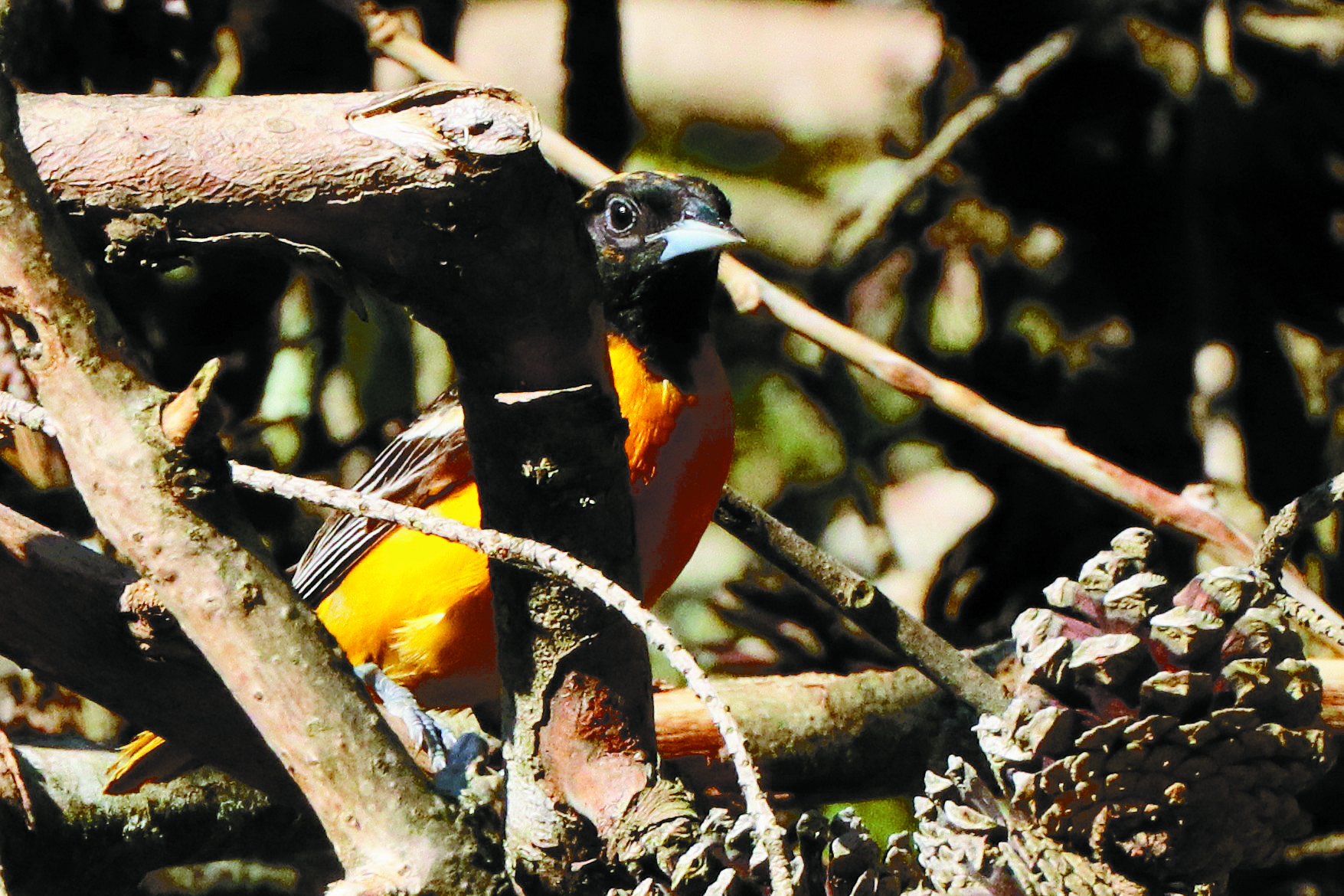
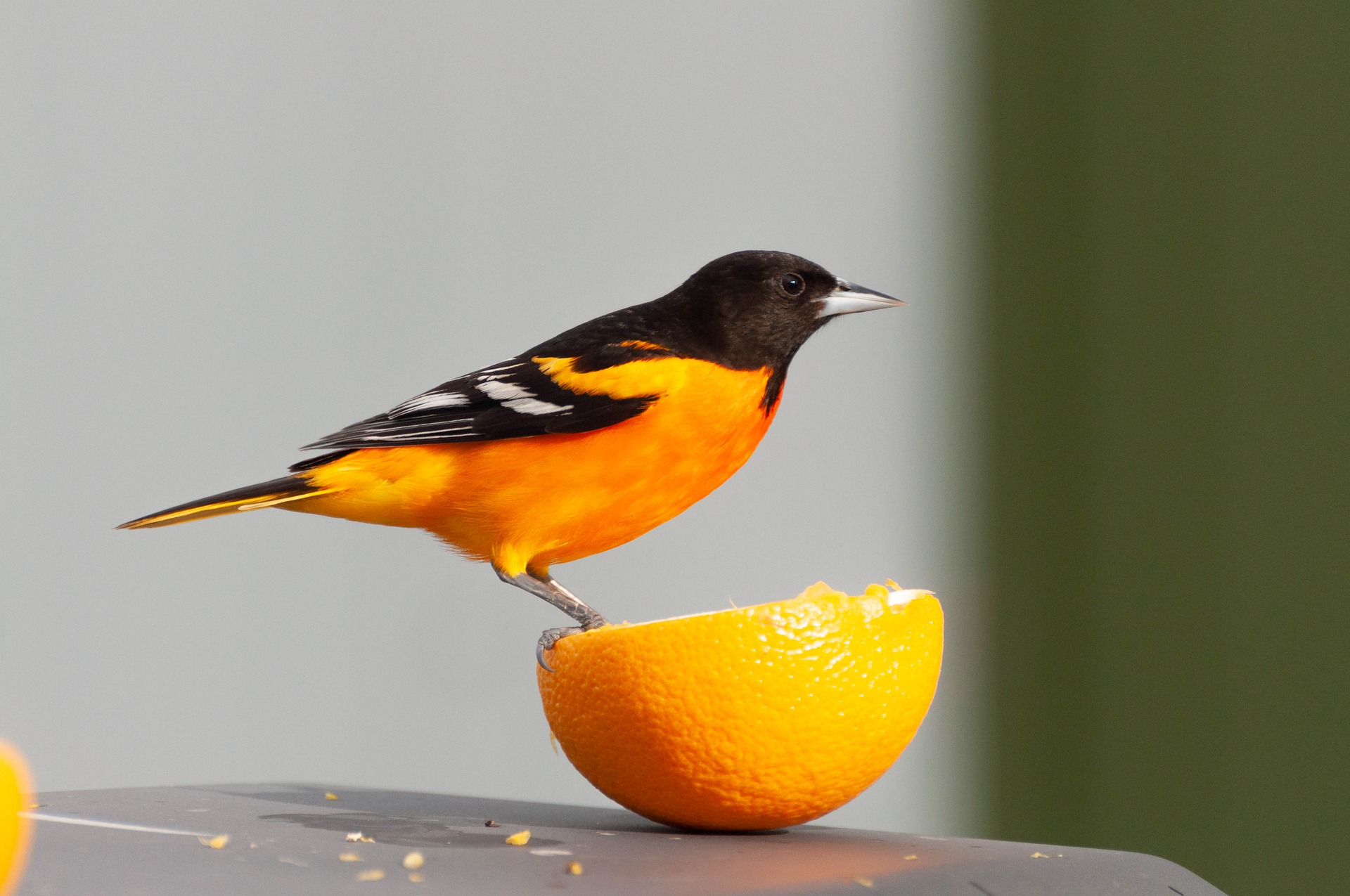
A Baltimore oriole gathers nesting material. • Photo courtesy of Kaylynn Sanford Wilster

Kaylynn Sanford Wilster shared on Facebook her observation of Baltmore orioles gathering nesting materials at her lakeside home in Piney Flats. She also noted that, although she offers oriole feeders, she has had no takers so far.
“They were gathering nesting materials so doubt if I will see them there again, but I was thrilled,” she informed me.

She also noted that observing the birds in person makes clear that the colors of their feathers do not always match the images contained in some bird books.
Her Merlin app, which can identify birds through recording made of their songs, has detected both Baltimore and orchard orioles on a few occasions.
In addition to Kaylynn’s sighting, Lindsay Anne McAuliffe saw and photographed a male Baltimore oriole in Jonesborough. Her friend, Serina Marshall, shared the sighting with me.

These sightings are more examples of the excitement of spring migration when a new bird could be just around the corner.

The Baltimore oriole, despite its bright plumage, is a member of one of the blackbird clans, known in scientific circles as the Icterus genus. In his book, “Birds of Forest, Yard, and Thicket,” John Eastman notes that there are 26 species in the genus, eight of which nest in the United States.

Photo by Bryan Stevens • Orchard orioles, like this bird, as well as Baltimore orioles, were found on the Spring Bird Count.

In the Eastern United States, there are only two orioles — the Baltimore oriole and its smaller relative, the orchard oriole. The western half of the nation is home to a half dozen orioles, including Bullock’s oriole, Scott’s oriole, Audubon’s oriole, hooded oriole and Altamira oriole.

I saw several gaudy, noisy Bullock’s orioles during a trip to Utah in May of 2006.I actually have better luck finding the orchard oriole closer to home. I have learned that tall trees are an essential part of the Baltimore oriole’s favored habitat. Baltimore orioles are well-known for their colorful appearance, but their fame also rests with a sack-like nest that Eastman describes as a “durable marvel of tight-woven plant fibers” in his informational book. Eastman also notes that during another era in America, the Baltimore oriole often built its marvelous nests in American elms before Dutch elm disease almost eradicated these trees from the landscape. He reports that maples, willows and apples have served as nesting trees in the absence of elms. Once the hard-working female oriole sets to work, she may spend eight days or longer weaving plant fibers into a strong pouch suspended from the outer ends of drooping branches. The durability of the nest means that other birds, including house finches, may occupy the old nest once abandoned by the original inhabitant.

Orioles are present in the region from April to October, generally retreating to the American tropics for the cold months of winter. There they may live on plantations that produce such much-coveted crops as bananas, coffee and cacao, which is the essential ingredient for chocolate

The Baltimore oriole is named in honor of one of the founding fathers of the state of Maryland. George Calvert, or Baron Baltimore, was an influential English colonist instrumental in establishing the colony of Maryland. His servants wore orange and black uniforms, which inspired early American naturalist Mark Catesby to name the bird the Baltimore oriole. The bird’s association with the the city of Baltimore and the state of Maryland has continued to this day. The bird is also famous as the namesake of one of America’s professional baseball teams.

Baltimore orioles eat insects and fruit, but these adaptive birds have also developed a fondness for sweet nectar. Orioles no longer have to raid sugar water feeders meant for hummingbirds. Many manufacturers of bird-feeding equipment now produce affordable sugar water feeders specifically designed for use by orioles. Many bird enthusiasts also use orange slices and grape jelly to lure orioles into their yards. I’ve tried these tricks, but I’ve attracted more gray catbirds and scarlet tanagers than I have orioles.

If you’re fortunate enough to have a Baltimore oriole as a neighbor, it isn’t only their bright coloration and elaborate nest building that recommend these birds. They’re also one of the few birds willing to eat the hairy tent caterpillars that are often a blight on the landscape. Back in the late 1990s, I observed a male Baltimore oriole visiting a large caterpillar tent in the branches of a cherry tree. The bird methodically plucked the caterpillars from the silken tent, eating them one after the other. While many birds avoid some of the spiny and hairy caterpillars, orioles actively seek them out and do a great service of reducing the damage these hungry caterpillars can inflict on the environment.

To share a sighting, email me at ahoodedwarbler@aol.com.

Plumage, behavior help American redstart stand out from most other warblers

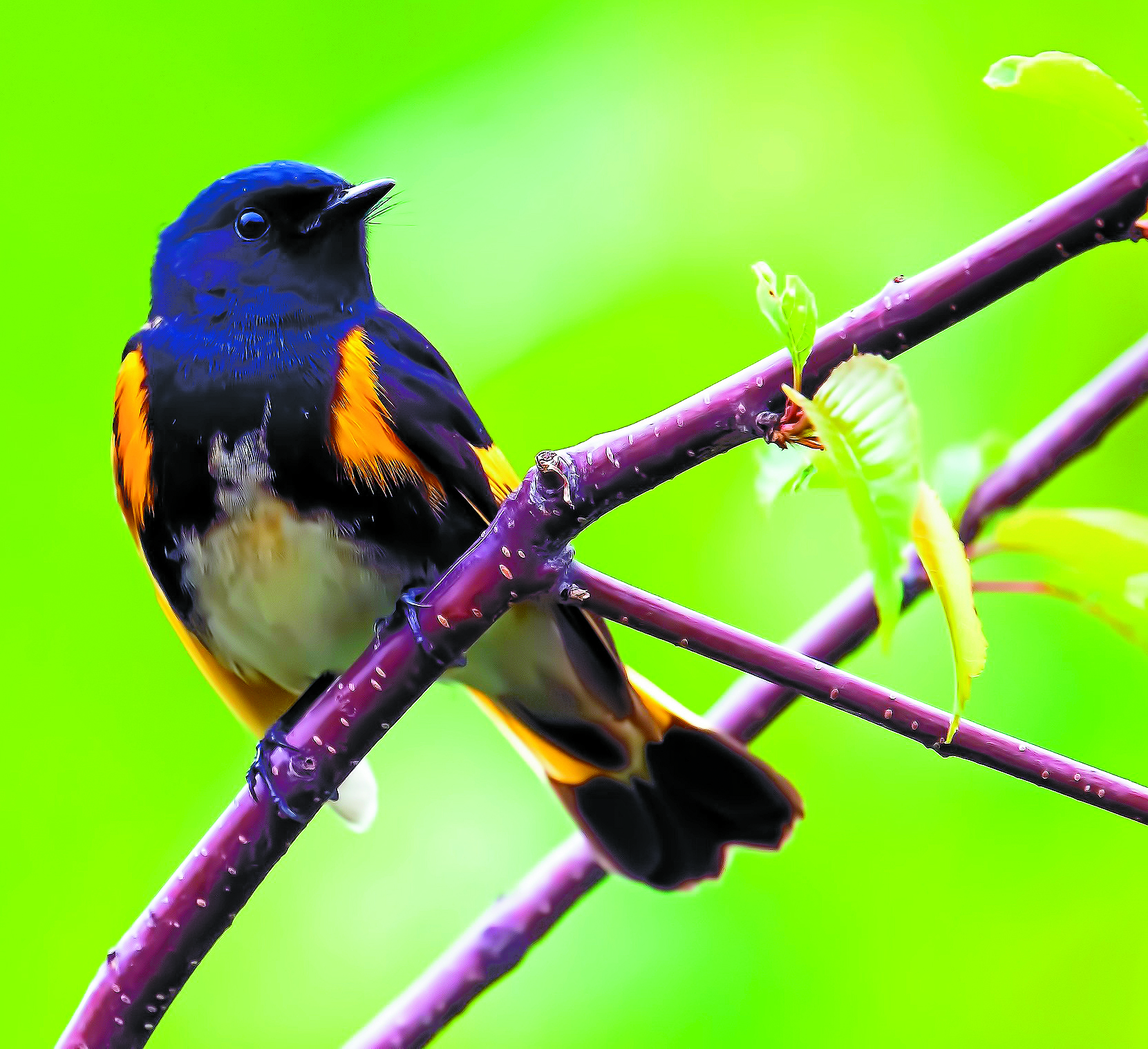
Photo by Hans Toom / Pixabay * Male American redstarts are vibrant birds with a plumage pattern of black, orange and white feathers.

I’ve written about some of our more showy birds in my past few columns. Some of the birds I’ve spotlighted have included scarlet tanagers and rose-breasted grosbeak. This week, I want to introduce one of the more flamboyant members of the warbler family.

Travis Jarrell in Cookeville, Tennessee, contacted me on Facebook for help with identifying a bird, which led to this week’s column.

He also provided a brief video of the little bird as it bathed in a puddle on the flagstones at his home.

His video provided all I needed to identify his bird as a warbler known as an American redstart. Male and female redstarts are both colorful, active birds. Young males also take two years to acquire their adult plumage, showing a plumage intermediate between an adult male and an adult female. I believe that the video Travis captured showed a young male likely born in last year’s nesting season.

I responded with my identification, and Travis replied.

“I had never seen one before, and yes, he was smaller, like a warbler,” he wrote. “It was a thrilling and lovely moment for me, watching him splash in the puddle while the cardinals rumbled in and out of the bird bath. His tail fanning was delightful!”


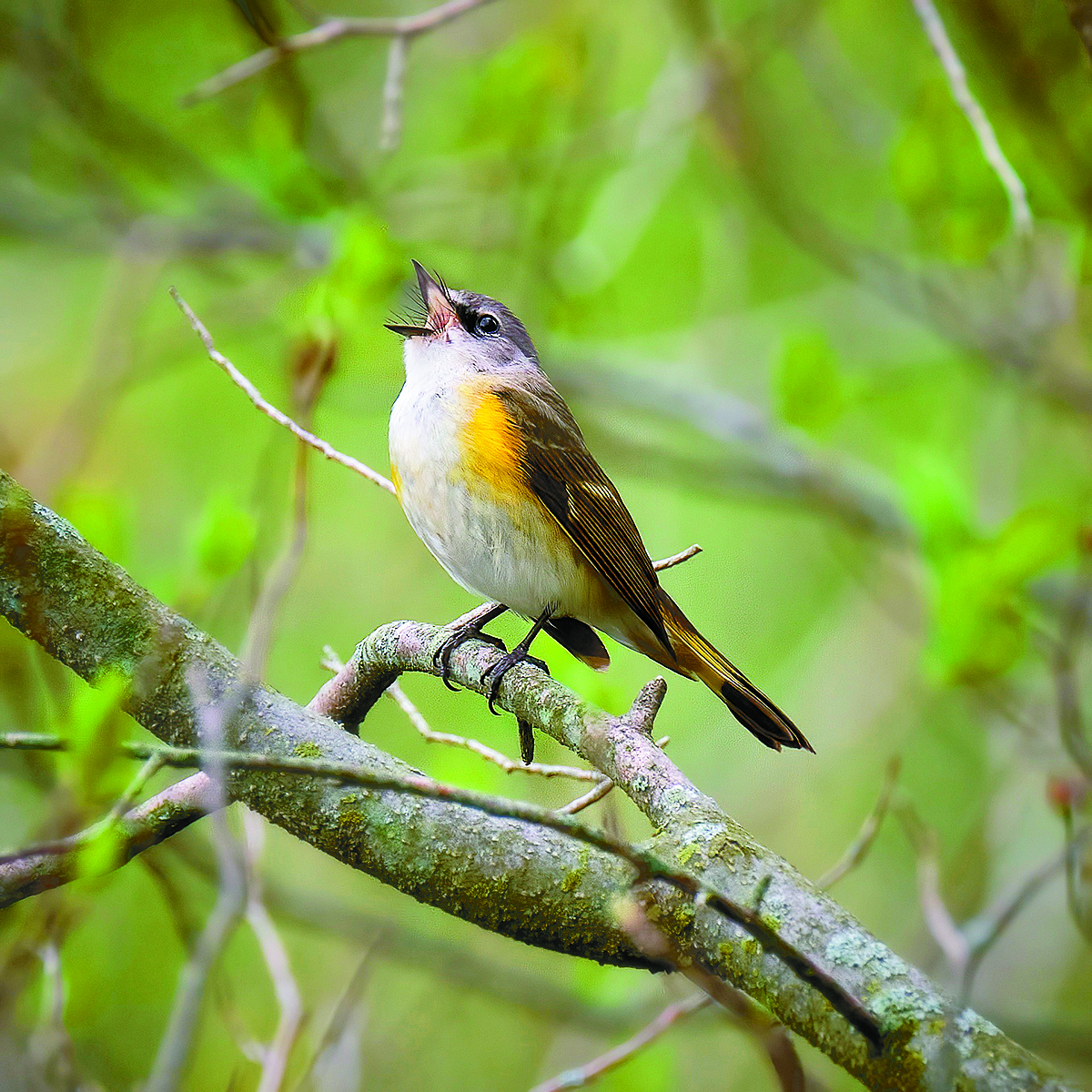
Photo by Howard Walsh / Pixabay * Female American redstarts are a paler imitation of the male. Females show gray, yellow and white in their plumage instead of the bright orange, black and white of the male.

The tail fanning mentioned by Travis is also a key behavioral trait of American redstarts. They are always fanning their tail feather while on the move. Most experts believe the flashes of color in the tail help the birds to flush prey insects into flight. According to the website, “All About Birds,” American redstarts consume more flying insects than most other warbler species. Their dietary preference for winged insects also brings them into competition with other flycatching species, such as least flycatcher.

American redstarts are among the many neotropical migrants that return to the region each year. Redstarts nest in the region’s mountains up to an elevation of about 4,000 feet and are fairly common from spring to fall. Most American redstarts arrive each spring in late April and immediately get down to the business of raising young. I’ve seen American redstarts constructing nests as early as late April.

The American redstart, even more so than its kin, strikes me as a hyperactive songbird—always on the go, flitting from branch to branch, fanning out its tail feathers and snatching insects flushed from cover. During the nesting season, the male sings a jumbled crescendo of buzzy notes.

There are 115 species of warblers found in the New World, but the American redstart is one of a handful that doesn’t include the word “warbler” in its common name.

The adult male American redstart is unmistakable. His mostly black feathers are accented with bright orange-red patches on the sides, wings and tail. There’s a patch of white on the lower belly and under the tail. For beginners who despair of learning the so-called “confusing fall warblers,” an adult male American redstart is so easily recognized that a sighting of one can produce a big confidence boost.

Females show a similar pattern, being gray-olive where the males are black; females are also lemony yellow where the males are orange, and both have with the same white underparts. A female redstart works alone at nest construction and also does solo duty incubating up to five eggs.

American redstarts nest in in damp woodlands across much of the eastern and northern United States and southern Canada. This warbler becomes much more general in its habitat preferences during the winter and can be found in Central and South America, as well as the Caribbean. Winter habitat ranges from mangrove forests and scrub thickets to plantations for coffee and citrus fruits. A few even take up residence in wooded sections of urban areas.

An occasional American redstart defies the odds and achieves a long life for a songbird. The oldest known American redstart was a male more than 10 years old. According to the website, “All About Birds,” that individual was recaptured and rereleased by a Canadian banding station.

Early French and Spanish explorers gave this pretty songbird some names to match its appearance. From the French, the American redstart received the name “paruline flamboyante,” or flamboyant warbler. The Spanish bestowed the name “candelita Norteña,” or Northern candlelight.

The warblers are one of the families of birds that got me hooked on birding. They make the spring season an exciting time of the year. Get outdoors and enjoy migration. You may be surprised what birds visit your own yard. Don’t delay. As the calendar advances into June, migration’s coming to a close, at least until the start of fall migration in a few months.