
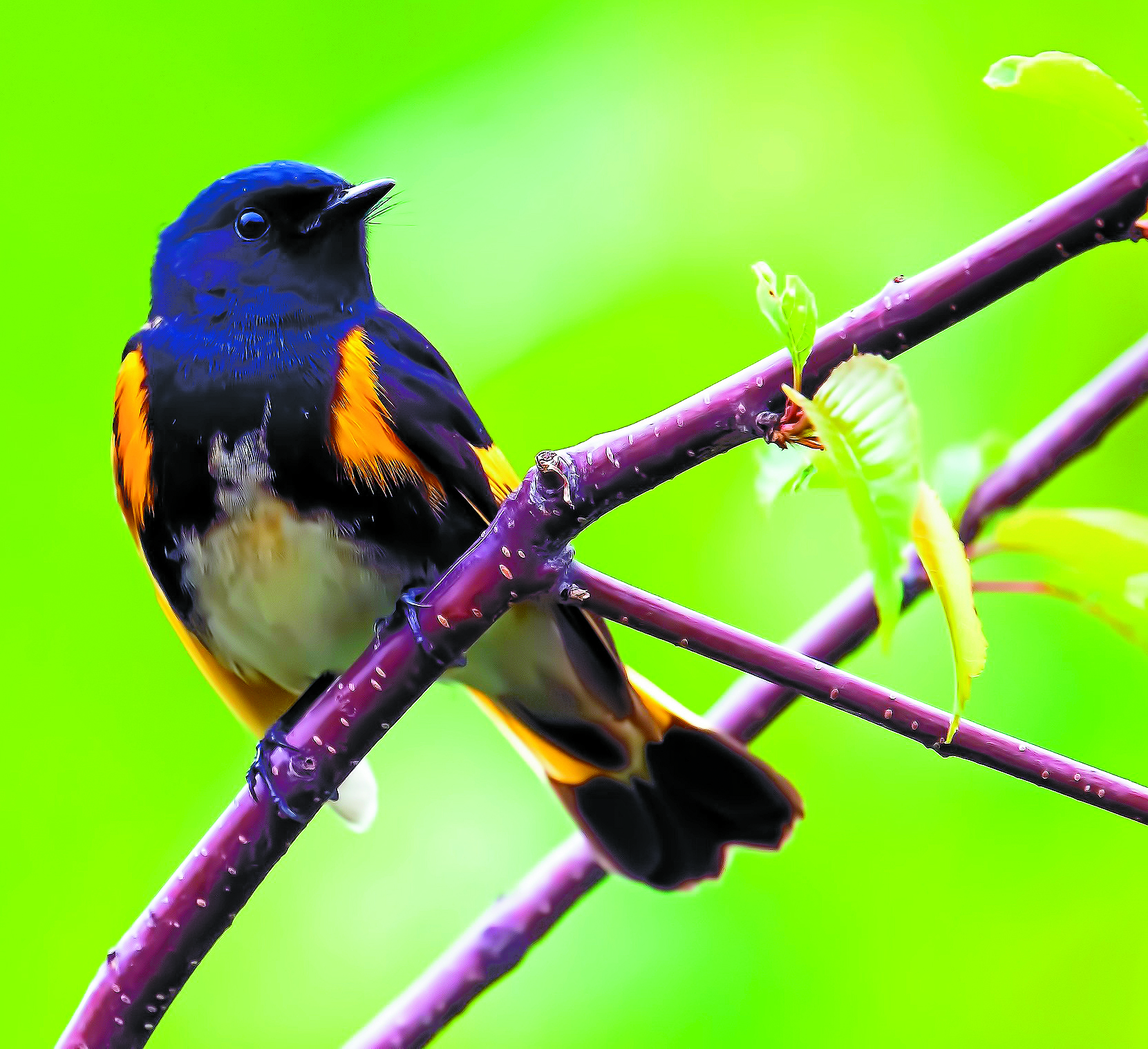
Photo by Hans Toom / Pixabay * Male American redstarts are vibrant birds with a plumage pattern of black, orange and white feathers.
I’ve written about some of our more showy birds in my past few columns. Some of the birds I’ve spotlighted have included scarlet tanagers and rose-breasted grosbeak. This week, I want to introduce one of the more flamboyant members of the warbler family.
Travis Jarrell in Cookeville, Tennessee, contacted me on Facebook for help with identifying a bird, which led to this week’s column.
He also provided a brief video of the little bird as it bathed in a puddle on the flagstones at his home.
His video provided all I needed to identify his bird as a warbler known as an American redstart. Male and female redstarts are both colorful, active birds. Young males also take two years to acquire their adult plumage, showing a plumage intermediate between an adult male and an adult female. I believe that the video Travis captured showed a young male likely born in last year’s nesting season.
I responded with my identification, and Travis replied.
“I had never seen one before, and yes, he was smaller, like a warbler,” he wrote. “It was a thrilling and lovely moment for me, watching him splash in the puddle while the cardinals rumbled in and out of the bird bath. His tail fanning was delightful!”
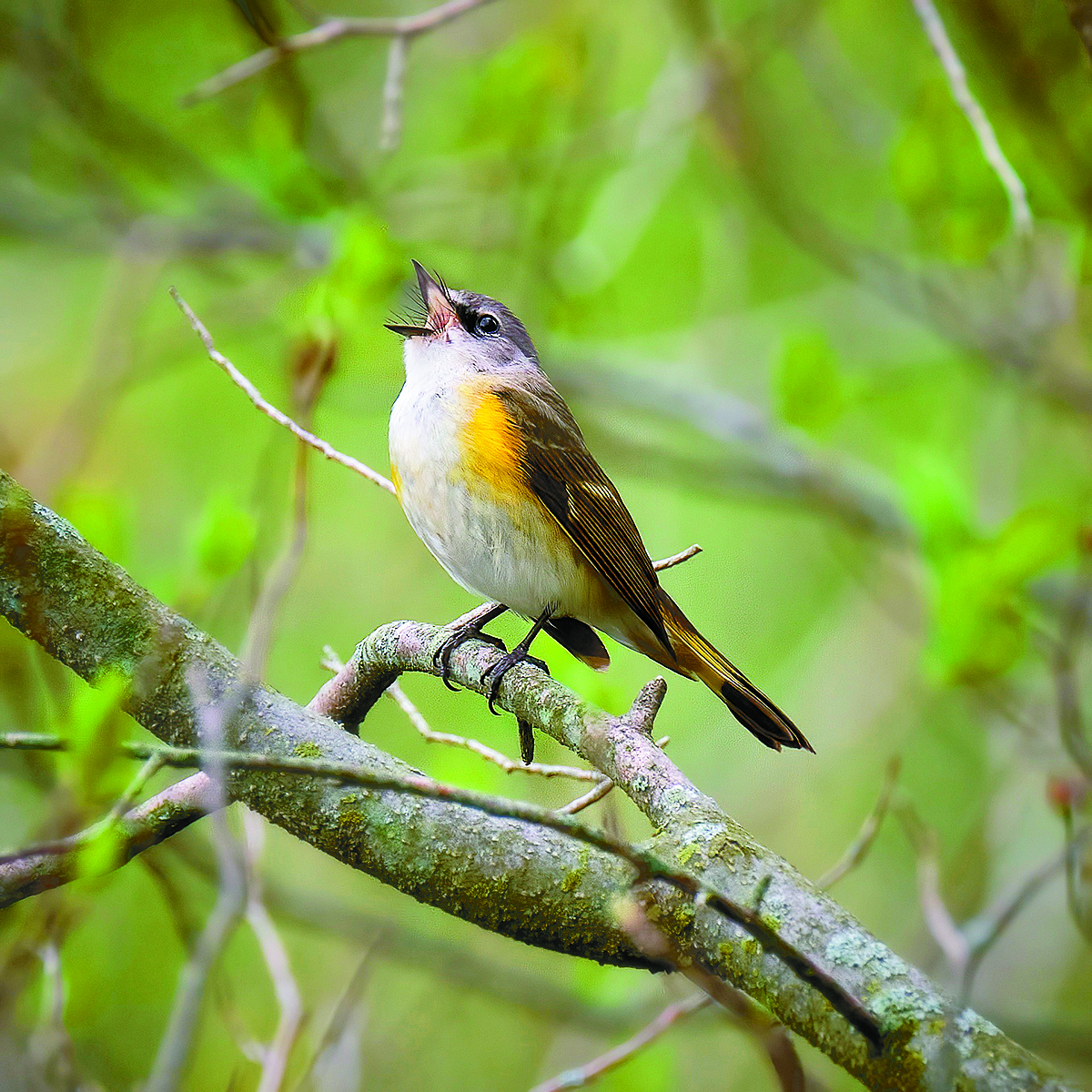
Photo by Howard Walsh / Pixabay * Female American redstarts are a paler imitation of the male. Females show gray, yellow and white in their plumage instead of the bright orange, black and white of the male.
The tail fanning mentioned by Travis is also a key behavioral trait of American redstarts. They are always fanning their tail feather while on the move. Most experts believe the flashes of color in the tail help the birds to flush prey insects into flight. According to the website, “All About Birds,” American redstarts consume more flying insects than most other warbler species. Their dietary preference for winged insects also brings them into competition with other flycatching species, such as least flycatcher.
American redstarts are among the many neotropical migrants that return to the region each year. Redstarts nest in the region’s mountains up to an elevation of about 4,000 feet and are fairly common from spring to fall. Most American redstarts arrive each spring in late April and immediately get down to the business of raising young. I’ve seen American redstarts constructing nests as early as late April.
The American redstart, even more so than its kin, strikes me as a hyperactive songbird—always on the go, flitting from branch to branch, fanning out its tail feathers and snatching insects flushed from cover. During the nesting season, the male sings a jumbled crescendo of buzzy notes.
There are 115 species of warblers found in the New World, but the American redstart is one of a handful that doesn’t include the word “warbler” in its common name.
The adult male American redstart is unmistakable. His mostly black feathers are accented with bright orange-red patches on the sides, wings and tail. There’s a patch of white on the lower belly and under the tail. For beginners who despair of learning the so-called “confusing fall warblers,” an adult male American redstart is so easily recognized that a sighting of one can produce a big confidence boost.
Females show a similar pattern, being gray-olive where the males are black; females are also lemony yellow where the males are orange, and both have with the same white underparts. A female redstart works alone at nest construction and also does solo duty incubating up to five eggs.
American redstarts nest in in damp woodlands across much of the eastern and northern United States and southern Canada. This warbler becomes much more general in its habitat preferences during the winter and can be found in Central and South America, as well as the Caribbean. Winter habitat ranges from mangrove forests and scrub thickets to plantations for coffee and citrus fruits. A few even take up residence in wooded sections of urban areas.
An occasional American redstart defies the odds and achieves a long life for a songbird. The oldest known American redstart was a male more than 10 years old. According to the website, “All About Birds,” that individual was recaptured and rereleased by a Canadian banding station.
Early French and Spanish explorers gave this pretty songbird some names to match its appearance. From the French, the American redstart received the name “paruline flamboyante,” or flamboyant warbler. The Spanish bestowed the name “candelita Norteña,” or Northern candlelight.
The warblers are one of the families of birds that got me hooked on birding. They make the spring season an exciting time of the year. Get outdoors and enjoy migration. You may be surprised what birds visit your own yard. Don’t delay. As the calendar advances into June, migration’s coming to a close, at least until the start of fall migration in a few months.
 Our Fine Feathered Friends