Monthly Archives: September 2023

Flamingo Fallout: Local couple makes two long-distance trips to see flamingos displaced by Hurricane Idalia

Photo by Cathy McNeil • A lone American flamingo wades along the edge of a farm pond in Wayne County, Tennessee. The bird, and others of its kind, were displaced by Hurricane Idalia, blown from the Yucatan to 10 U.S. states, including Tennessee and the Carolinas.


I can’t say it often enough: Birds have wings! That’s the joy of birding. An unexpected bird can show up in the most unlikely locations, all thanks to the power of flight.

On occasion, Mother Nature lends a hand, too, as in the case with displaced American flamingos that have been found in at least 10 U.S. states, including Tennessee and North Carolina, in recent weeks. These refugees from the storm have found themselves achieving celebrity status as birders from across the country have flocked to find them after rare bird alerts popped up in several states.

“This has definitely been a flamingo week in the eastern United States,” Tom McNeil posted on his Facebook page. “Following the passage of Hurricane Idalia, displaced American flamingos have been located in ten or more states!”

On Sunday, Sept. 3, McNeil and his wife, Cathy, made a round-trip trek of 670 miles to see 11 American flamingos that had been found in the Outer Banks of North Carolina. The birds had been discovered on Sept 2.

“If I had not already been in North Carolina, I would have probably chosen to go see the five birds that had been found in Wayne County, Tennessee, on the same day,” McNeil wrote on Facebook.

“Lucky for us, one of the Tennessee birds stayed until Sept. 6 and we were able to go see it,” McNeil said.

The McNeils left their home in Carter County, Tennessee, at 3 a.m. and made the 830-mile round-trip drive to visit with a young flamingo for a few minutes.

That’s a lot of miles, but the McNeils enjoy chasing after rare or unexpected birds. Cathy McNeil even got a photo of the young flamingo.

It’s not even their first dash to the Outer Banks this year. Back on July 28, the couple traveled there to add a Pacific golden-plover to their life lists. “We were successful!” McNeil noted in a Facebook post.

He added some other interesting details.

“This is the fifth year that this bird has made a late July appearance in the Cape Point region of Hatteras Island,” he wrote. “It is thought to be the same bird. Luckily we were able to chase it this year.”

To add to the luck, this year the bird spent a lot of time in the Cape Point Campground.

“We were able to get it from the air-conditioned comfort of the car,” McNeil wrote. “No sand-marching required!”

Photo by Bryan Stevens • A Chilean flamingo at Zoo Atlanta. Pink Floyd, an escaped Chilean flamingo, haunted the Great Salt Lake in Utah for many years.

Once again, it bears repeating: Birds have wings!

The first storm-driven flamingos were spotted in Ohio. Afterwards, these birds showed up in North and South Carolina, Tennessee, Virginia, Alabama, Texas, Kentucky and even as far north as Pennsylvania.

National Public Radio even put the birds on air, so to speak, in a feature by Dustin Jones posted to the NPR website on Sept. 7. In that article, Nate Swick, digital communications manager for the American Birding Association, addressed the flamingo fallout.

As for the flamingos, these refugees from Hurricane Idalia will have to do their best to straggle home.

Swick noted that flamingos are big, strong birds, more than capable of making their way back home, just as they did in 2019 following Hurricane Barry when that storm hit the northern part of the Gulf of Mexico and drove a handful of flamingos to western Tennessee and Missouri.

Swick said that the consensus is that the flamingos swept up by Hurricane Idalia were likely birds from the Yucatan Peninsula, which separates the Gulf of Mexico and the Caribbean Sea.

Despite their name, American flamingos are not birds one is ever likely to find in the continental United States with the possible exception of Florida. Also known as the Caribbean flamingo, this bird lives in and around brackish water and saltwater environments, including marshes, estuaries and coastlines. Based on the range of this species, Caribbean flamingo is a more accurate name.

The species did once live wild in the Sunshine State, but the Florida population was hunted into extermination by the early 1900s. Most Florida American flamingos today are captive birds that have managed to escape from zoos and aviaries. A few are probably wandering individuals from the Caribbean.

There are six flamingo species found worldwide, but the American (Caribbean) flamingo is the only species native to North America. The other species are greater flamingo, lesser flamingo, Chilean flamingo, James’s flamingo and Andean flamingo.

Another famous flamingo vagrant by the name of Pink Floyd haunted the Great Salt Lake in Utah from 1988 to 2005. Pink Floyd was a captive Chilean flamingo living at the Tracy Aviary in downtown Salt Lake City who escaped and found that he was content to live life in the wild for 17 years.

I visited Tracy Aviary during a visit to Salt Lake City in 2008, a few years after the last sighting of Pink Floyd. Although the captive birds in Pink Floyd’s flock had their wing feathers clipped on a regular basis, Pink Floyd apparently avoided these sessions.

I think he had his escape in mind all along. The Great Salt Lake, teeming with brine shrimp, a favorite food of flamingos, beckoned him to spread his wings and fly to freedom. In the process, he became a local legend. Although he’s probably gone – it has been close to 20 years since the last sighting – keep in mind Chilean flamingos can live 40 to 50 years. If Pink Floyd is still living the life of a free bird, he might only be in his late 30s.

Once again, and everyone keep this in mind: Birds have wings! They can and do show up in the most unlikely places. Keep your eyes open.

Photo by Bryan Stevens • Chilean flamingos at Zoo Atlanta.
Nomadic crossbills are cone specialists


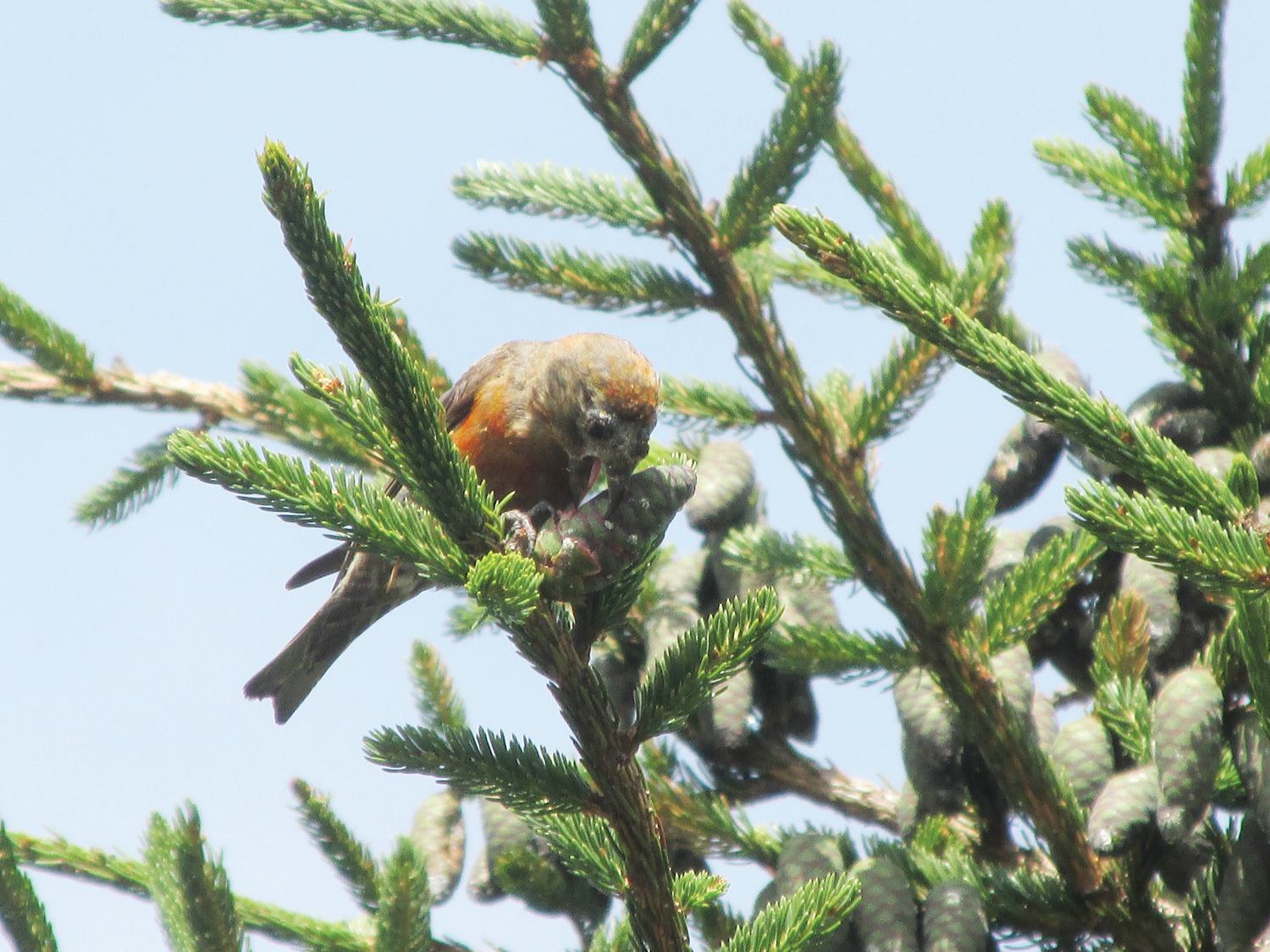
Photo by Bryan Stevens • As cone specialists, red crossbills have evolved twisted beaks to get the job done.

This column originally ran Sept. 10, 2013, in The Erwin Record.

am seeing green herons on almost every visit I make to any local body of water. In the last week, I have seen this small heron at the pond at Erwin Fishery Park, at Musick’s Campground on South Holston Lake in Bristol and from the boardwalk over the pond along the linear trail near Erwin’s Riverview Industrial Park.

A green heron at Erwin Fishery Park was stalking dragonflies along the edge of the pond and appeared to be having good success at capturing these winged insects.

I saw the heron catch and eat several dragonflies while observing it.

•••

My mother and I made a trip to Carver’s Gap on Roan Mountain on Saturday, Aug. 3. We hadn’t even gotten out of the car when my mom noticed some red crossbills perched in the upper branches of some of the Fraser firs near the parking area at Carver’s Gap. We continued to watch the crossbills and counted a total of seven birds, although the flock may have consisted of a few additional members.

The observation of the red crossbills allowed me to add this bird to my 2013 list as Bird No. 170 for the year.

It’s going to be a challenge to get those other 30 species to reach the 200 mark for the year, but I am looking forward to it.

The crossbills were all busy ripping apart the new cones on the firs to get at the seeds. Feeding on cones must be a messy business because the feathers around their heads appeared matted in a few spots. I had never thought about it, but these birds must constantly get pine resin on their feathers as they use their crossed bills to pry open cones. One of the male crossbills made quick work of several cones, using his bill to take them apart with exquisite precision. He had the process honed into a science.

The red crossbill, known by the scientific name Loxia curvirostra, is a member of the finch family, which includes such well-known feeder-visiting birds as American goldfinch, house finch, purple finch and pine siksin. In Europe, the species is known by the name common crossbill.

Crossbills have distinctive beaks, which cross at the tips, enabling them to skillfully extract seeds from conifer cones and other fruits.

Red crossbills are rather nomadic and breed in areas with an abundant crop of cones. These birds may wander widely between years to find a good cone crop. Perhaps because of this year’s wet weather, there’s a bounty of new cones on the trees at Carver’s Gap, so it has been a good summer to look for red crossbills.

For many years, this was one of my “nemesis” birds. No matter how hard I tried, I kept striking out in attempts to observe the species. I made many trips to Unaka Mountain and to Carver’s Gap on Roan Mountain to look for this bird before I finally got a good look at a pair of birds picking up grit from gravel at the edge of the Carver’s Gap parking lot.

Experts debate how many species of crossbills exist, but the current consensus is that there are five species worldwide. In addition to the red crossbill, the white-winged crossbill lives in North America but is an even more rare visitor to Northeast Tennessee.

The other three species are the parrot crossbill of northwest Europe and western Russia, the Scottish crossbill of the Caledonian Forests of Scotland and the Hispaniolan crossbill of the Caribbean island of Haiti and the Dominican Republic.

After observing the crossbills and taking several photos, we made the ascent to the grassy balds to look for other birds. I held some hope of finding a vesper sparrow, but these small birds never made an appearance.

I did observe common yellowthroats, golden- crowned kinglets, American robins, gray catbirds, cedar waxwings, dark-eyed juncos and Northern ravens during my hike on the balds.

When we returned to the parking lot at Carver’s Gap, we found some stands of blooming bee balm, which attracted visits from several ruby-throated hummingbirds.

•••

I received an email this past week from Crystal Miller about a fascinating observation of bald eagles on Friday, July 26, 2013.

“I was rafting down the lower Nolichucky River, in Tennessee, just past the Devil’s Looking Glass,” Crystal wrote. She was rafting with five other people when they saw a huge nest on the right side of the river. She said the nest was fully occupied, except for one parent circling overhead.

“The other parent was a few feet from the nest, while other younger eagles were closer, inside and around the nest,” she wrote. “We paddled against the current as long as the river would allow before we succumbed to the river.”

Crystal said others on the raft took pictures of the eagles and the nest.

“None of the younger eagles had white, or bald heads, but one I noticed had incredibly large legs,” she wrote.

She described her rafting adventure as the “best trip ever.”

Crystal also shared that her mother was born and grew up along the river and that her grandmother still lives in a house near the river.

“That eagle nest made me happy,” she concluded.

Crystal’s sighting of this family of eagles is more evidence that this once endangered national bird is indeed fully recovered and thriving.

Earlier this year, I learned of reports of a bald eagle nest in Unicoi County near the Devil’s Looking Glass. It’s very likely Crystal’s story provides more evidence that the nesting was successful.

Other eagles also successfully nested in Sullivan County and Washington County. A nest at Wilbur Lake in Carter County, unfortunately, was destroyed during a powerful storm this past spring.

•••

Bryan Stevens has written about birds since 1995. Email him at ahoodedwarbler@aol.com to share a sighting, ask a question or make a comment.

Readers share recent hummingbird observations as summer draws to a close

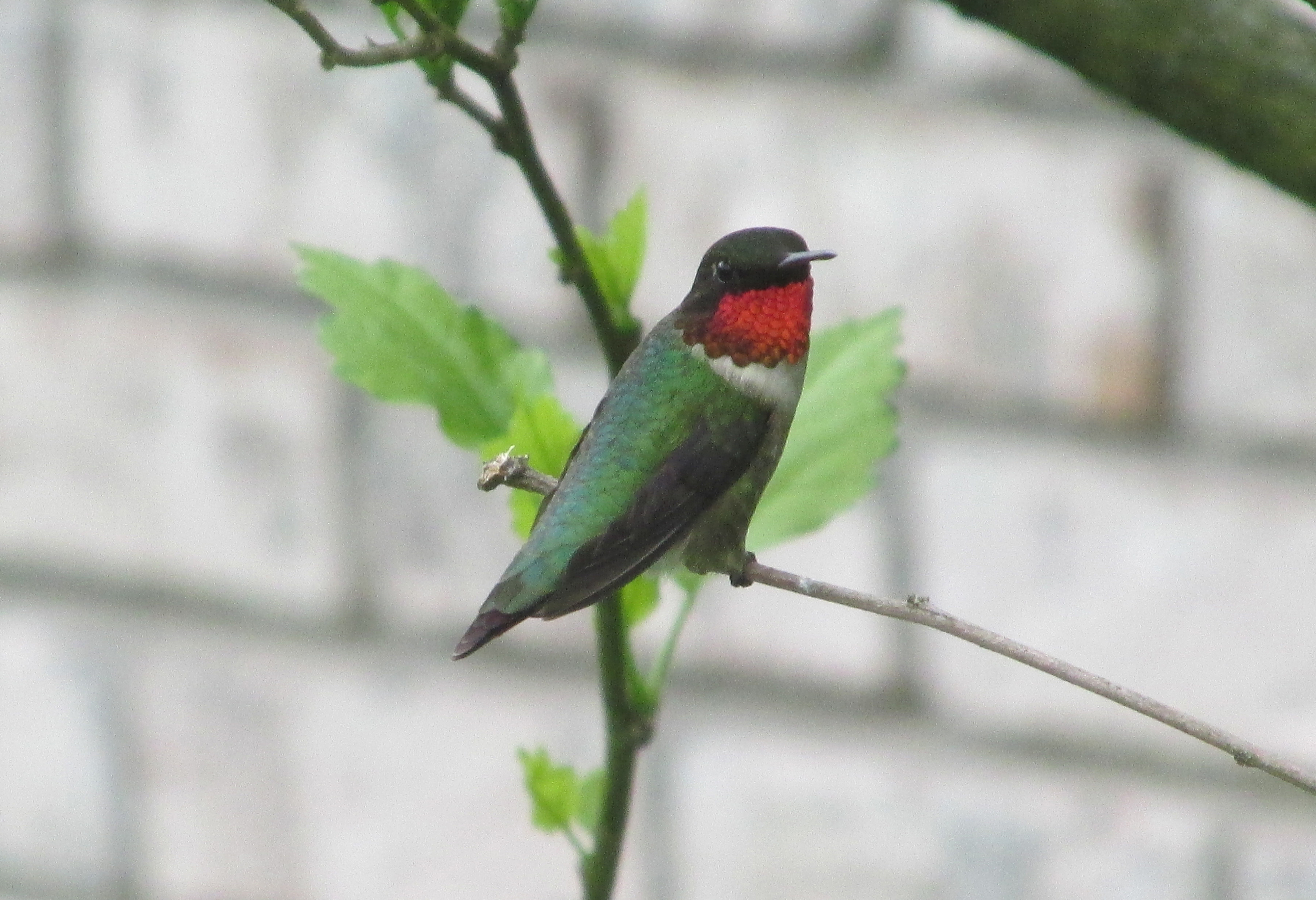
Photo by Bryan Stevens • The bright red throat patch, or gorget, of a male ruby-throated hummingbird makes the bird stand out. Female and young hummingbirds lack the bright throat color on the throat.

For the past week or so, I cannot step onto my front porch without hearing the whir of hummingbird wings or the twitters of this tiny bird’s fussy vocalizations.

I had written about hummingbirds recently, which prompted several readers to share some of their own stories or ask questions about these birds.

Laurie Philhower posted a comment on Facebook after reading my recent column about hummingbirds.

“I live in Middle Tennessee,” she noted. “I have five hummingbird feeders out, and they are full every day.”

I have the same number of feeders filled and available at my own home, and I’ve had no shortage of hummingbirds eager to line up for sugary sips.

•••

Carole Franklin also commented via Facebook after reading the column on hummingbirds.

“My feeder has been more busy the last couple of weeks than it has all summer,” she wrote. “Keep looking for different ones in the mix. I keep the feeder filled and fresh until the first freeze. Then put it back out afterwards just in case.”

I applaud Carole for her diligence. Every autumn, some western hummingbirds venture into the region. To date, species such as rufous hummingbird and Allen’s hummingbird have been documented. They are, however, almost always present at a location with a hummingbird feeder.

•••

Photo by Bryan Stevens • A male ruby-throated hummingbird perches at a feeder for a sip of sugar water.

Jewel Bentley contacted me with an interesting question after reading the hummingbird column.

“I have read that we need to increase the amount of sugar in hummingbird feeders right before they begin their migration south. Is this true?”

I wrote back and suggested that she refrain from making the sugar formula stronger. The four parts water to one part sugar is a formula designed to imitate the sugar content of flower nectar. There’s really no need to boost it.

•••

Lorraine Henderson sent me an email regarding my column.

“Thanks so much for the information about hummingbirds,” she wrote. “I will plant some more flowers.”

Right now, my hummingbirds cannot get enough of the jewelweed in bloom along the edges of my yard. They love to visit the abundant tiny orange blooms on each jewelweed plant. The best thing about jewelweed is that it’s wild and springs up each year without any need of my assistance.

•••

I also heard from Paulette Calli, who emailed me from California.

“Just wanted to thank you for your wonderful article on these lovely birds,” Paulette wrote. “I was curious about their life as well as migration. I am in Southern California, and my neighbor and I sit outside in the early evening and watch them play. They sometimes get so close to our faces but never hurt us. I think they are thanking us for their birdbath and sugar water.”

Her thoughts on hummingbird gratitude make sense to me. I also enjoyed hearing about her hummingbirds hovering in her face.

I do think that hummingbirds, as well as other birds, are often just as curious about us as we are about them.

Photo by Bryan Stevens • A ruby-throated hummingbird visits a feeder for a sip of sugar water.

•••

I also received an email from John Rush in Dewey, Arizona.

“I think Central Arizona is one of the last places you’d expect for bird sightings,” he wrote.

But, he added, “if you feed them, they will come,” which is certainly true.

“Right now I am enjoying four species of hummingbirds: Anna’s, rufous, black-chinned and broad-tailed,” he wrote. “Sometimes as many as 20 at a time, letting me get so close that I can feel the wind on my face from their wings.”

John certainly has a yard that seems a magnet for birds.

“In my yard I have spotted Northern flickers, gila and ladderback woodpeckers, vermilion flycatchers, Western bluebirds, juncos, blue grosbeaks and many other species,” he wrote.

He added that he is visited daily by raptors, including red-tailed hawk, Cooper’s hawk and American kestrels, as well as the occasional great blue heron.

“Just down the road from my home I spotted a ferruginous hawk,” he noted.

At Lynx Lake, which is about 15 miles from his home, he had watched a pair of mated bald eagles almost weekly.

“So, as you can see, this is a great place to see so many birds,” he said. “It’s crazy! And I omitted quite a few.”

I wrote back and congratulated John for the diversity he enjoys at his Arizona home.

His location is ideal for hummingbirds. Many birders wanting to add hummingbirds to their life lists head to Arizona.

I confessed that I would love to see Anna’s and broad-tailed hummingbirds, two species that have so far evaded being added to my list.

•••

Linda Dabney from Louisville, Kentucky, also emailed me with an inquiry about whether all ruby-throated hummingbirds have the namesake ruby-red throat.

It’s a good question. I see many more female and young hummingbirds than adult males, yet it’s only those adult males that sport the bright red throat.

Females and young hummingbirds are still ruby-throated hummingbirds, but they lack the red throat patch, or gorget, that the males use to dazzle onlookers.

•••

Laura Huggins in Englewood, Tennessee, posted a comment on Facebook after reading the column.

“They come visit us often,” she said. “My husband and I enjoy them very much.”

Laura’s observation gets right to the heart of the appeal of these tiny birds. They are special visitors during their all-too-brief seasonal stay. In exchange for providing them with sips of sugar water, they offer us hours of entertainment and fun memories.

September’s going to see many more ruby-throated hummingbirds winging their way through East Tennessee, Southwest Virginia and western North Carolina. In the western United States, in states like California and Arizona, a similar migration schedule will take place. I hope some of these tiny voyagers stop and linger. Make the most of these final few weeks to enjoy their feisty attitudes and sizzling antics.

•••

Bryan Stevens has written about birds since 1995. To ask a question, make a comment or share a sighting, please email him at ahoodedwarbler@aol.com.

Photo by Bryan Stevens • Male ruby-throated hummingbird show the namesake red throat. The feathers on a male’s throat are iridescent, which means they can change when seen from different angles. In poor light, the ruby-red throat can look almost black.

Fewer ducks may fly south this winter

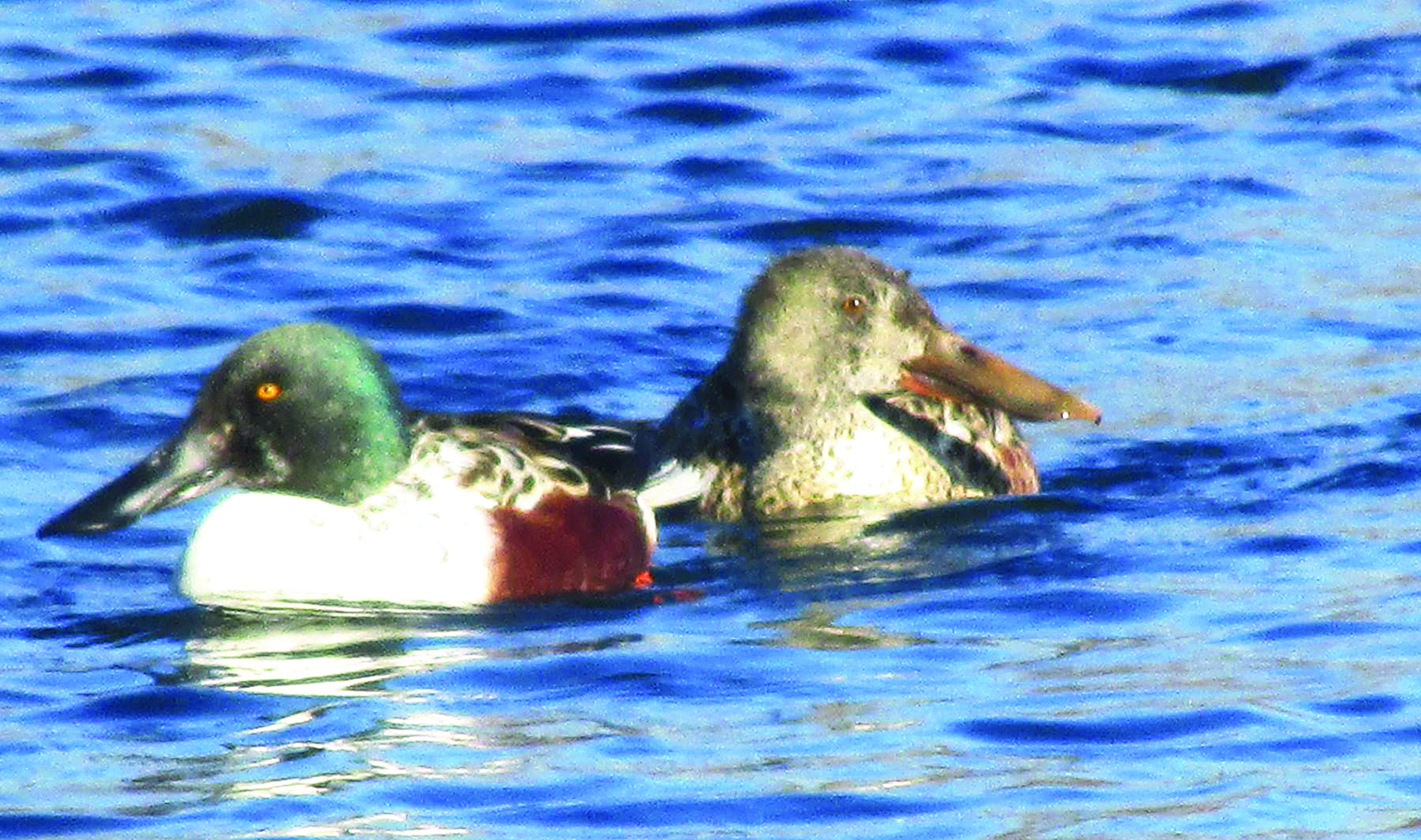
Photo by Bryan Stevens • A pair of Northern shovelers made a stop at the pond at Erwin Fishery Park in a previous winter season.

The website Ducks Unlimited reported that there may be fewer ducks and other waterfowl flying south in late fall and early winter, according to the recently released 2023 Waterfowl Population Status report by the U.S. Fish and Wildlife Service.
The report, based on surveys conducted in May and early June by FWS, Canadian Wildlife Service and other partners,
Total populations were estimated at 32.3 million breeding ducks in the traditional survey area, a 7% drop from 2022’s estimate of 34.7 million and 9% below the long-term average compiled since 1955.
While most duck species showed declines, two species actually boosted their numbers. The population of canvasback, a species of diving duck, increased by 6% from 2022. Northern pintail, a species of dabbling duck, showed an even more dramatic increase with total numbers of this duck spiking by 24% since last year’s survey.
In Northeast Tennessee, Western North Carolina and Southwest Virginia both canvasback and Northern pintail are uncommon winter visitors, so this report gives cause for some optimism for birders hoping to see these two species during the winter of 2023-24.
In addition, North America’s smallest duck – green-winged teal – saw a 17% increase in its population. This pint-sized duck is only about 14 inches long and weighs 17.5 ounces at the most. To put that in some perspective, this duck weighs just a little more than a regulation football.
Waterfowl migration is rather erratic in the region. It’s usually possible to see a variety of waterfowl species between November and March in the region. Lake, rivers and ponds are essential habitat for finding these birds.
Some well-known waterfowl observation locations in Northeast Tennessee include Wilbur Lake in Carter County and Osceola Island Recreation Area near Bristol. In Erwin, the large pond at Fishery Park has attracted some unusual ducks in past winters.
If water remains open and unfrozen farther north, some ducks are reluctant to fly south. So, hoping for a successful waterfowl viewing season in our region requires hoping for a severe winter farther north around the Great Lakes and in Canada.
I enjoy turning my attention to waterfowl when the winter season arrives and there are fewer birds present at my home and my favorite birding spots. Some of my favorite ducks include Northern shoveler, canvasback, bufflehead and ring-necked duck.
A few species of ducks nest in the region. These breeding ducks include mallard, wood duck and common merganser. I hope the cold weather is not too early this year, but the arrival of ducks and other waterfowl is always a silver lining that takes the edge off the arrival of ice and snow.
•••
At home, I am still enjoying the frantic daily antics of several ruby-throated hummingbirds. I’m still waiting for fall warblers, but I know I can expect to see them fairly soon. Join me in keeping alert and enjoying the possibilities of some unexpected avian visitors during the coming migratory seasons.
•••

To ask a question, make a comment or share a sighting, please email me at ahoodewabler@aol.com.