

Photo by Bryan Stevens • The bright red throat patch, or gorget, of a male ruby-throated hummingbird makes the bird stand out. Female and young hummingbirds lack the bright throat color on the throat.
For the past week or so, I cannot step onto my front porch without hearing the whir of hummingbird wings or the twitters of this tiny bird’s fussy vocalizations.
I had written about hummingbirds recently, which prompted several readers to share some of their own stories or ask questions about these birds.
Laurie Philhower posted a comment on Facebook after reading my recent column about hummingbirds.
“I live in Middle Tennessee,” she noted. “I have five hummingbird feeders out, and they are full every day.”
I have the same number of feeders filled and available at my own home, and I’ve had no shortage of hummingbirds eager to line up for sugary sips.
•••
Carole Franklin also commented via Facebook after reading the column on hummingbirds.
“My feeder has been more busy the last couple of weeks than it has all summer,” she wrote. “Keep looking for different ones in the mix. I keep the feeder filled and fresh until the first freeze. Then put it back out afterwards just in case.”
I applaud Carole for her diligence. Every autumn, some western hummingbirds venture into the region. To date, species such as rufous hummingbird and Allen’s hummingbird have been documented. They are, however, almost always present at a location with a hummingbird feeder.
•••

Photo by Bryan Stevens • A male ruby-throated hummingbird perches at a feeder for a sip of sugar water.
Jewel Bentley contacted me with an interesting question after reading the hummingbird column.
“I have read that we need to increase the amount of sugar in hummingbird feeders right before they begin their migration south. Is this true?”
I wrote back and suggested that she refrain from making the sugar formula stronger. The four parts water to one part sugar is a formula designed to imitate the sugar content of flower nectar. There’s really no need to boost it.
•••
Lorraine Henderson sent me an email regarding my column.
“Thanks so much for the information about hummingbirds,” she wrote. “I will plant some more flowers.”
Right now, my hummingbirds cannot get enough of the jewelweed in bloom along the edges of my yard. They love to visit the abundant tiny orange blooms on each jewelweed plant. The best thing about jewelweed is that it’s wild and springs up each year without any need of my assistance.
•••
I also heard from Paulette Calli, who emailed me from California.
“Just wanted to thank you for your wonderful article on these lovely birds,” Paulette wrote. “I was curious about their life as well as migration. I am in Southern California, and my neighbor and I sit outside in the early evening and watch them play. They sometimes get so close to our faces but never hurt us. I think they are thanking us for their birdbath and sugar water.”
Her thoughts on hummingbird gratitude make sense to me. I also enjoyed hearing about her hummingbirds hovering in her face.
I do think that hummingbirds, as well as other birds, are often just as curious about us as we are about them.

Photo by Bryan Stevens • A ruby-throated hummingbird visits a feeder for a sip of sugar water.
•••
I also received an email from John Rush in Dewey, Arizona.
“I think Central Arizona is one of the last places you’d expect for bird sightings,” he wrote.
But, he added, “if you feed them, they will come,” which is certainly true.
“Right now I am enjoying four species of hummingbirds: Anna’s, rufous, black-chinned and broad-tailed,” he wrote. “Sometimes as many as 20 at a time, letting me get so close that I can feel the wind on my face from their wings.”
John certainly has a yard that seems a magnet for birds.
“In my yard I have spotted Northern flickers, gila and ladderback woodpeckers, vermilion flycatchers, Western bluebirds, juncos, blue grosbeaks and many other species,” he wrote.
He added that he is visited daily by raptors, including red-tailed hawk, Cooper’s hawk and American kestrels, as well as the occasional great blue heron.
“Just down the road from my home I spotted a ferruginous hawk,” he noted.
At Lynx Lake, which is about 15 miles from his home, he had watched a pair of mated bald eagles almost weekly.
“So, as you can see, this is a great place to see so many birds,” he said. “It’s crazy! And I omitted quite a few.”
I wrote back and congratulated John for the diversity he enjoys at his Arizona home.
His location is ideal for hummingbirds. Many birders wanting to add hummingbirds to their life lists head to Arizona.
I confessed that I would love to see Anna’s and broad-tailed hummingbirds, two species that have so far evaded being added to my list.
•••
Linda Dabney from Louisville, Kentucky, also emailed me with an inquiry about whether all ruby-throated hummingbirds have the namesake ruby-red throat.
It’s a good question. I see many more female and young hummingbirds than adult males, yet it’s only those adult males that sport the bright red throat.
Females and young hummingbirds are still ruby-throated hummingbirds, but they lack the red throat patch, or gorget, that the males use to dazzle onlookers.
•••
Laura Huggins in Englewood, Tennessee, posted a comment on Facebook after reading the column.
“They come visit us often,” she said. “My husband and I enjoy them very much.”
Laura’s observation gets right to the heart of the appeal of these tiny birds. They are special visitors during their all-too-brief seasonal stay. In exchange for providing them with sips of sugar water, they offer us hours of entertainment and fun memories.
September’s going to see many more ruby-throated hummingbirds winging their way through East Tennessee, Southwest Virginia and western North Carolina. In the western United States, in states like California and Arizona, a similar migration schedule will take place. I hope some of these tiny voyagers stop and linger. Make the most of these final few weeks to enjoy their feisty attitudes and sizzling antics.
•••
Bryan Stevens has written about birds since 1995. To ask a question, make a comment or share a sighting, please email him at ahoodedwarbler@aol.com.
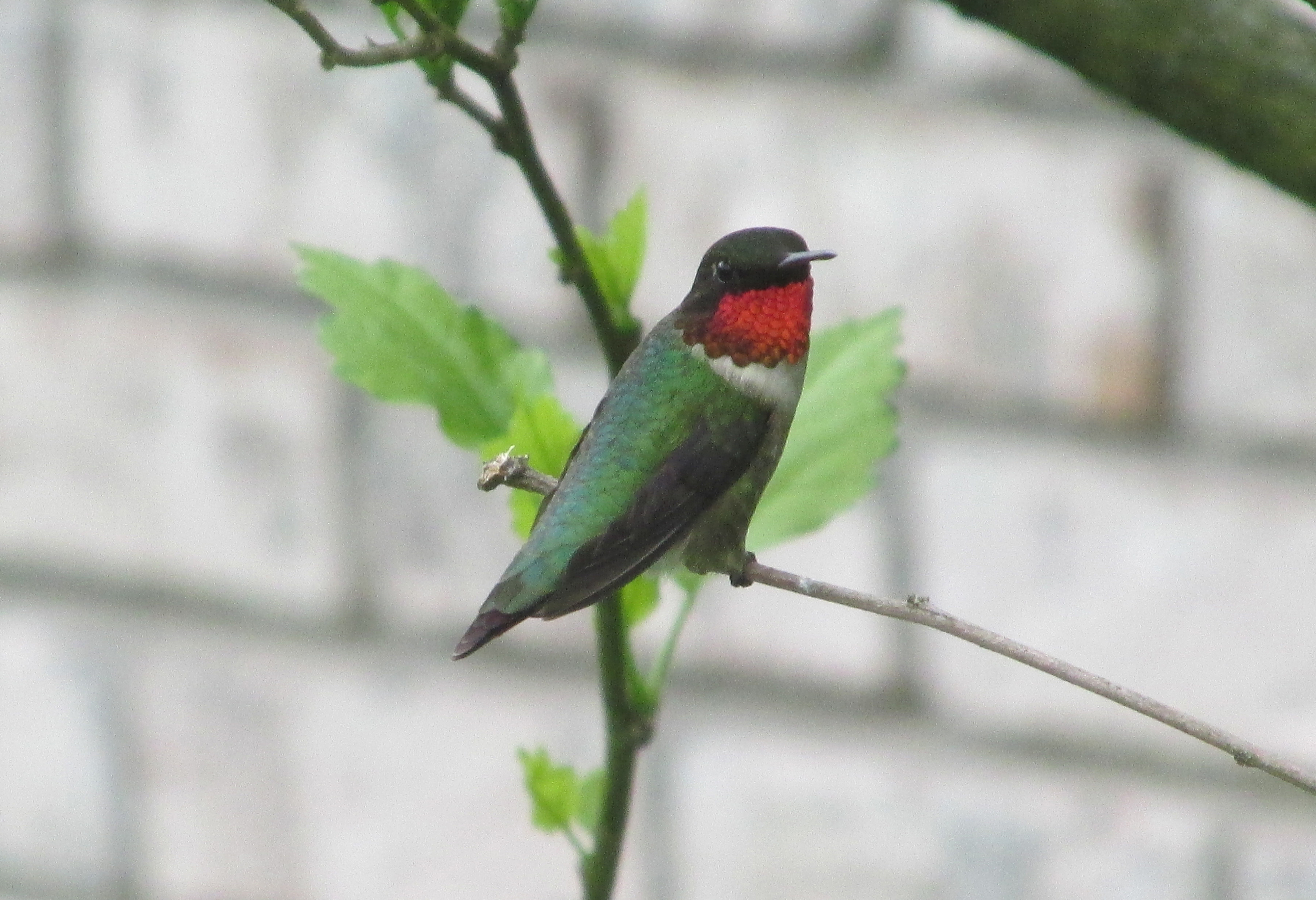
Photo by Bryan Stevens • Male ruby-throated hummingbird show the namesake red throat. The feathers on a male’s throat are iridescent, which means they can change when seen from different angles. In poor light, the ruby-red throat can look almost black.
 Our Fine Feathered Friends