

TParadis/Pixabay • A male Northern cardinal braves snow and ice during the winter months when these birds are frequent visitors to backyard bird feeders.
Christmas 2023 is almost upon us. As is my usual custom, I want to share my enthusiasm for the Northern cardinal, one of my favorite birds.
Earlier in the month, I became concerned when December arrived with not a cardinal in sight at my home.
We’ve had a couple of cold spells, however, and that seems to have motivated my cardinals to return. In particular, one male cardinal has learned that I’m his easy meal ticket. When I arrive home in the evenings, I always add some sunflower seeds to the feeders so all the birds can have a quick treat before heading off to their nighttime roosts. This particular cardinal is usually waiting on the edge of the feeder even before I can get outdoors with a canister containing the sunflower seeds.
I have always enjoyed watching cardinals. The beauty of both male and female cardinals is undeniable. They’re usually nervous, twitchy birds, so it has been fun watching this particular male cardinal grow accepting of my presence.
The Northern cardinal, especially the brilliant red male, stands out against a winter backdrop of snow white, deep green or drab gray. Over the years, the cardinal has also become associated with the Christmas season. How many Christmas cards have you received this holiday season with a cardinal featured in the artwork? I’d wager that at least a few cards in any assortment of holiday greetings will feature the likeness of a Northern cardinal.
There is a possible reason that male cardinals try to outshine each other when it comes to their bright red plumage. According to the website Tennessee Watchable Wildlife, brighter red male cardinals are able to hold territories that have denser vegetation, feed young at higher rates and have greater reproductive success than males with feathers of a duller hue.

Photo by Bryan Stevens • A total of 15 Northern Cardinals were found the day of the Roan Mountain Christmas Bird Count last month.
The Northern cardinal belongs to a genus of birds known as Cardinalis in the family Cardinalidae. There are only two other species in this genus, and they range across North America and into northern South America. The two relatives are the pyrrhuloxia, or Cardinalis sinuatus, of the southwestern United States, and the Vermilion cardinal, or phoeniceus, a bird found in Colombia and Venezuela.
The Northern cardinal is a native and abundant bird. Cardinals are a widespread species, ranging westward to the Dakotas and south to the Gulf Coast and Texas. The southeastern United States was once the stronghold of the cardinal population. In the past century, however, cardinals have expanded their range into New England and Canada.
The cardinal accepts a wide variety of food at feeders. Sunflower seed is probably their favorite, but they will also sample safflower seed, cracked corn, peanuts, millet, bakery scraps and even suet. While we may get the idea that cardinals feed largely on seed, that is a misconception based on our observation of the birds at our feeders. Cardinals away from our feeders eat insects and fruit, including the berries of mulberry, holly, pokeberry, elderberry, Russian olive, dogwood and sumac.
The cardinal uses its large beak to efficiently hull sunflower seeds or deal with other foods foraged in field and forest away from our feeders. The large, heavy beak hints at the cardinal’s kinship with birds such as tanagers and grosbeaks. In fact, some of America’s early naturalists referred to the bird as “cardinal grosbeak.” Other common names include the apt “redbird” moniker and “Virginia nightingale.”
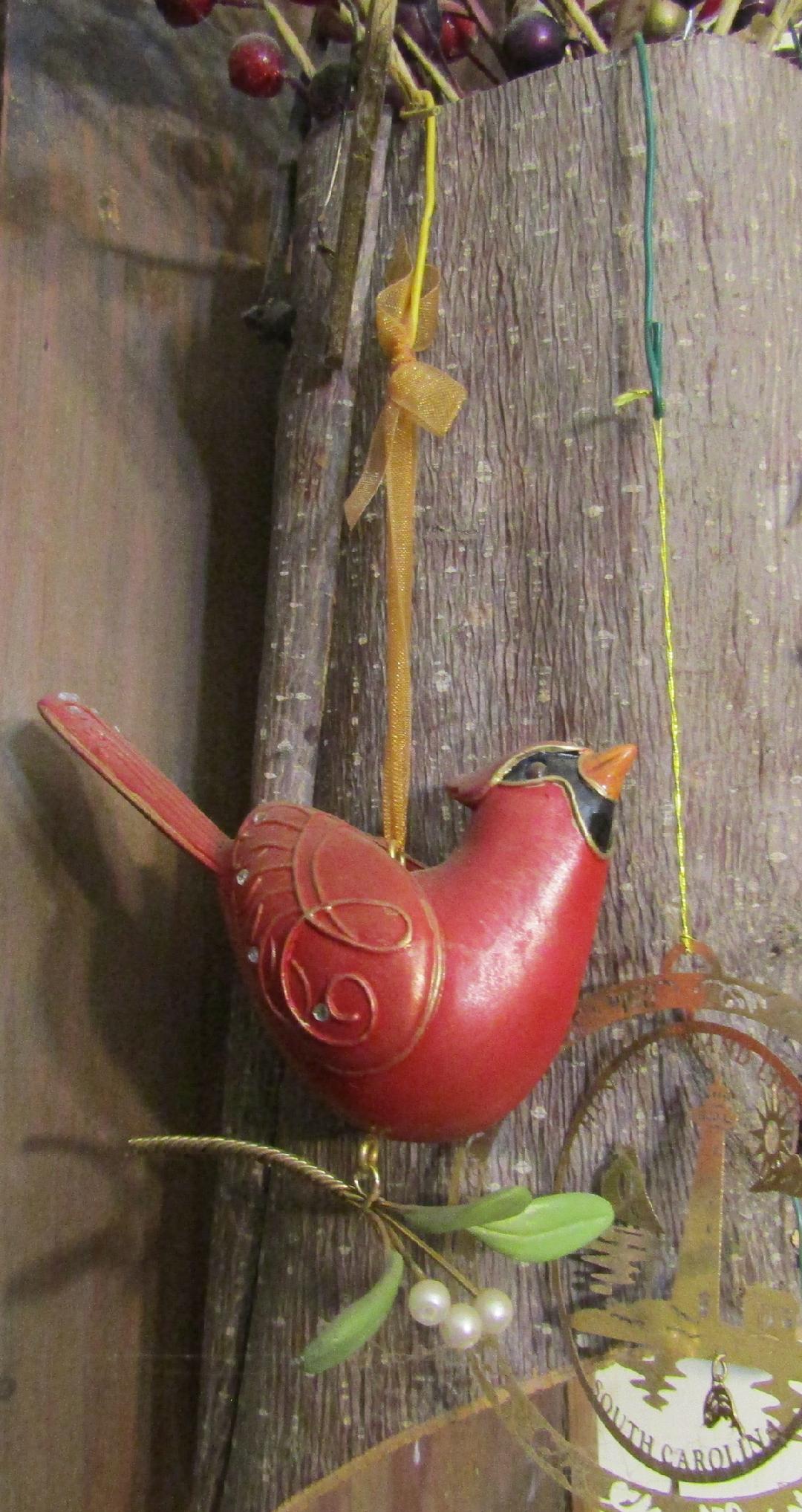
Photo by Bryan Stevens • Northern cardinals are a favorite for makers of Christmas ornaments.
Even once the holidays are past, there’s nothing like a glimpse of a Northern cardinal to add some cheer to a bleak winter day. It’s not surprising that such a popular bird has also become associated with many trappings of the Christmas season.
“You see cardinals on greeting cards, stationery, paper plates, paper napkins and tablecloths, doormats, light switch plates, candles, candle holders, coffee mugs, plates, glasses, Christmas tree ornaments and lights, bookmarks, mailboxes, Christmas jewelry,” writes June Osborne in “The Cardinal,” a book about this popular bird.
“And the list goes on,” Osborne writes. “Cardinals have become an integral part of the way that many people celebrate the holiday season.”
I can be included among such people. My Christmas decorations include an assortment of cardinal figurines and ornaments. There are other birds — doves and penguins for example — associated with the holiday season, but for me the holidays magnify the importance of one of my favorite birds. The cardinal, in its festive red plumage, appears made to order for a symbol of the holiday season.
Merry Christmas to all the readers of this column and best wishes for 2024.
•••
To ask a question, share a sighting or make a comment, email me at ahoodedwarbler@aol.com.



 Our Fine Feathered Friends