

Photo by Jake Bonello/USFWS • A ruby-crowned kinglet living up to its name by displaying its cap of red feathers.
Most of winter’s resident birds have settled in for the season at my home.
From red-shouldered hawk to winter wren to dark-eyed junco and white-throated sparrow, many seasonal residents have all become part of the daily backdrop. These winter arrivals join such year-round residents as Northern cardinal, Carolina chickadee, tufted titmouse, Carolina wren and downy woodpecker.
Some other tiny birds are also a little more abundant this season. I’m hearing kinglets almost everywhere I go.
The ruby-crowned kinglet, one of North America’s smallest birds, is typically about four inches long and doesn’t even weigh half an ounce. A close relative is the golden-crowned kinglet, which is typically just under four inches in length, which makes the species the shortest of North America’s songbirds.
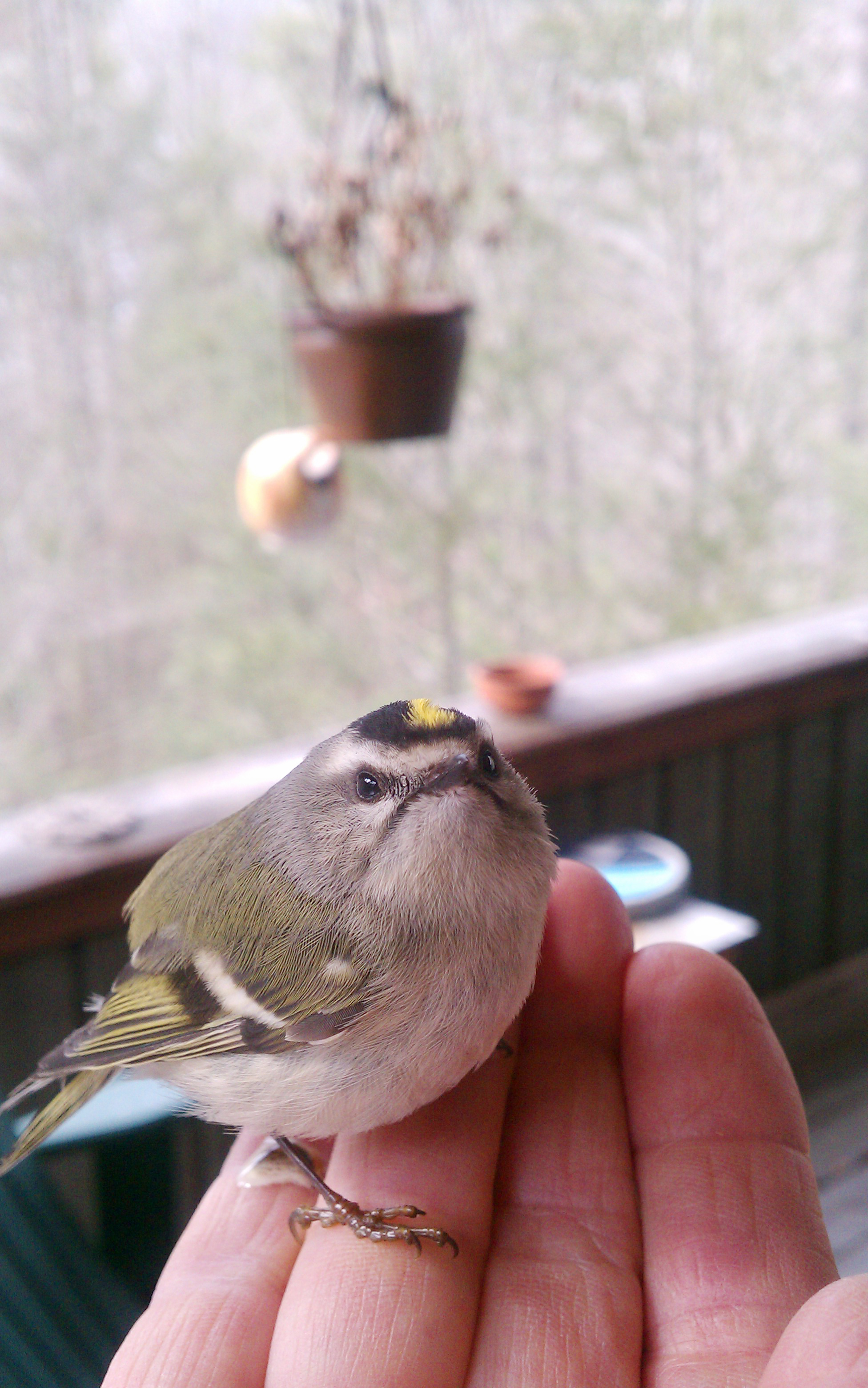
Photo by Beth McPherson • A golden-crowned kinglet being held carefully after a window strike.
How is it that the kinglets, among the smallest of North American birds, invariably choose to spend the harsh cold months of winter in our yards and gardens?
Chickadees, titmice and other familiar winter birds eke out an existence by supplementing some of their diet with fare from bird feeders. Although kinglets often associate with roaming flocks comprise of a mix of different species, the kinglets are not usually interested in the offerings at our feeders.
Kinglets are dedicated to gleaning tiny insects and spiders, as well as insects eggs and larvae, from branches and plantings in our yards. They’re so successful at it that they don’t need to turn to even a well-stocked feeder. A kinglet will on occasion sample an offering of suet or peanut butter, but this bird doesn’t make a habit of visiting feeders.
Kinglets are surprisingly tame at times and often exhibit as much curiosity about us as we display toward them. They’re very active birds, however, constantly moving from perch to perch. These bursts of hyperactivity can make them difficult to observe since they so rarely remain still.
In addition to the two North American species, kinglets, referred to in other parts of the world as firecrests, flamecrests or goldcrests, range throughout temperate North America, Europe and Asia, as well as northernmost Africa, Macaronesia and the Himalayas.
It’s the colorful crest of feathers atop their heads that have given all of them their common names. Kinglets belong to the family, Regulidae, and the genus, Regulus. The family and genus names are derived from a Latin word, regulus, which means “rex,”or “king” The name was apparently inspired by the colorful crown patches, often red, orange or gold, that resemble the royal “crowns” of kings.

This year’s bird calendar features a pair of tree swallows on the cover.
Although small in size, these birds more than compensate for it with a feisty spirit that does them well through the harsher weather of the winter months. It’s that indomitable spirit, curious nature and frantic antics that makes them such welcome companions during the bleak, cold months.
•••
The Lee & Lois Herndon Chapter of the Tennessee Ornithological Society is taking orders for its 2024 bird calendar.
The calendar will feature a photo of a pair of tree swallows on the front cover. The photo was taken by chapter members Eric Middlemas, who also contributed numerous other photographs for the calendar.
The inside pages of the professionally-produced calendar feature dozens more full-color photographs and an informative and educational grid. These calendars sell for $15 plus $2 for shipping. All sales help the club fund birding programs, public park feeders, conservation efforts and other activities in upper Northeast Tennessee. For more information on how to obtain a calendar, email ahoodedwarbler@aol.com.
•••
To share a sighting, ask a question or make a comment, please email me at ahoodedwarbler@aol.com.
 Our Fine Feathered Friends