Monthly Archives: January 2024

Nuthatches have embraced a topsy-turvy lifestyle

Photo by Jack Bulmer/Pixabay • White-breasted nuthatches live topsy-turvy lifes and are just fine with it.

The passage of Winter Storm Heather delivered the first significant snowfall of 2024 to Unicoi County and the surrounding area. The storm’s wind, snow and ice also brought birds flocking to my feeders.

Ground-feeding dark-eyed juncos, song sparrows and white-throated sparrows jostled with each other while foraging. Carolina chickadees and tufted titmice made repeated sorties to the feeders, grabbed a single sunflower seed or peanut and carried off the prize. Northern cardinals and American goldfinches perched on my hanging feeders, hulling sunflower seeds as quickly as they could. Red-bellied woodpeckers and downy woodpeckers visited special hanging suet feeders. Carolina wrens skulked, scolded and settled for scraps dropped by other birds. Among these feathered visitors was another resident bird that is definitely worth a second look.

The power of flight gives white-breasted nuthatches, like most birds, a perfectly valid reason to disregard the power of gravity. The family of tree-clinging birds known as nuthatches lives an even more topsy-turvy lifestyle than many of their winged kin. Nuthatches prefer a headfirst stance as they search for food in the nooks and crannies in tree trunks and branches.

The United States is home to four species of nuthatches: white-breasted, red-breasted, brown-headed and pygmy. White-breasted nuthatches are probably the most familiar nuthatch to backyard birders in this area.

Because of their gravity-defying antics, the white-breasted nuthatch and other members of the family can provide hours of entertainment at our bird feeders. Individual white-breasted nuthatches will follow a single-minded path along the trunk of a tree or a branch on the way to a feeder. An individual nuthatch rarely varies from this path. It’s amusing to watch the jerky progress along the trunk as this bird prepares for a flight to a feeder holding sunflower seeds or a hanging wire basket of suet.

At my home, nuthatches typically remain aloof from the rivalry always ongoing between the chickadees and titmice. The white-breasted nuthatch is also a no-nonsense visitor. Rarely distracted by disturbances among other birds, this nuthatch is content to hang on to the wire frame of a suet basket and peck off chunks of suet or grab a single sunflower seed and go.

The more numerous titmice and chickadees give way when a white-breasted nuthatch claims a feeder. At times, however, among the frantic activity, a tufted titmouse or a Carolina chickadee will forget itself and fly to a position on a feeder already claimed by a nuthatch. If surprised enough to retreat to a nearby perch, the nuthatch will go through a rather comical little dance to express its displeasure. Wings spread out in a rigid pose, the bird will turn around in tight circles, showing definite resentment at being displaced by an offending chickadee or titmouse.

These displays are usually brief, unless they are directed toward another white-breasted nuthatch. A male-female pair of these nuthatches can peaceably visit a feeding area at the same time. Two male nuthatches — or two female nuthatches for that matter — show little toleration for each other. Their little dances of defiance are in these cases demonstrated for each other. Eventually, one nuthatch will give way, but these are stubborn birds, much more set in their ways than chickadees and titmice.

In our region, the stubby red-breasted nuthatch is another member of the family that occasionally finds its way to our yards. Smaller than the related white-breasted nuthatch and, as far as I can tell, complacent in the company of chickadees and titmice, the red-breasted nuthatch is always a welcome visitor. It has a tell-tale “yank yank” call that it produces when excited that sounds very much like little tin horns. The red-breasted nuthatch, perhaps because it spends so much of the year in more remote areas, can also be amazingly tame when it pays a winter visit.

Both of these nuthatches can be attracted to feeders by offering peanuts, sunflower seeds and suet. They are also cavity-nesting birds, but are more reluctant about accepting a nesting box as a place to rear young. They will gladly accept an old woodpecker hole or other natural cavity in a tree.

The brown-headed nuthatch is a specialist of pine woodlands throughout the southeastern United States, favoring loblolly-shortleaf pines and longleaf-slash pines. This nuthatch requires standing dead trees for nesting and roosting. They forage for food, however, on live pines. The birds are more abundant in older pine stands.

This small nuthatch is not at all common in the region, but there are some records. I’ve had much better luck finding the brown-headed nuthatch during visits to coastal South Carolina or suburban Atlanta in Georgia. In these southern locations, it can be a quite common bird.

These small birds will occasionally forage close to the ground, but they are often in the upper branches of pine trees. Their presence is often revealed by their call, which sounds amazingly like a squeeze toy. They produce their “squeaky toy” call persistently when agitated or curious. Brown-headed nuthatches often associate with mixed flocks in company with Carolina chickadees, tufted titmice, pine warblers and other small songbirds.

I also want to complete my list of North American nuthatches by adding the fourth species — pygmy nuthatch — to my life list. I have made two trips to western North America, where this species ranges, but haven’t managed to find this bird. Both the pygmy and brown-headed are among the smallest members of the nuthatch family.

On the other end of the size scale is the appropriately named giant nuthatch, which reaches a length of almost eight inches. The giant nuthatch ranges through China, Thailand and Burma. This nuthatch is bigger than a downy woodpecker, one of our more common visitors at backyard feeders in our region.

Worldwide, there are about 25 species of nuthatches, some of which have surprisingly descriptive names for birds that spend most of their lives creeping in obscurity along the trunks and branches of trees. Some of the more creative common names for these little birds include beautiful nuthatch, velvet-fronted nuthatch, sulphur-billed nuthatch, chestnut-bellied nuthatch, snowy-browed nuthatch and chestnut-vented nuthatch.

These birds are named “nuthatch” for the habit of some species to wedge a large seed in a crack and hack at it with their strong bills. I like to refer to them as “upside-down birds” because gravity doesn’t seem much of a factor in their daily lives. They are content to walk headfirst down a tree trunk or probe the underside of a large branch. It must give them an interesting perspective on the world around them.

•••

Mary Anna Wheat will present a program on a trip to Arizona, Utah, Colorado and New Mexico in late September and early October 2023 at the next meeting of the Elizabethton Bird Club.

She traveled with a friend and former co-worker from Sept. 19 to Oct. 16, 2023, in those four states. Their focus was on scenery, archeology (Wheat’s friend is an archaeologist with experience doing archaeological work at Canyon de Chelly National Monument) and the annular solar eclipse. Birding was incidental, although Wheat noted that they saw or heard more than 60 species.

The club’s meeting will be held Tuesday, Feb. 6, at the Northeast State Community College’s Elizabethton campus at 7 p.m. The front desk can direct visitors to the meeting room.

•••

Bryan Stevens has been writing about birds and birding since 1995. Email him at ahoodedwarbler@aol.com to ask a questing, share a sighting or make a comment.

Snow goose sighting on Dec. 31 concludes birding year

Photo by Bryan Stevens • A  snow goose hanging out with a flock of Canada geese was found at a well-known Elizabethton pond on the last day of 2023.

The Elizabethton Bird Club’s 2024 calendars arrived just ahead of the new year, so I held a distribution on New Year’s Eve for people wanting to pick up a calendar at the parking lot at the Elizabethton campus of Northeast State Community College.

As I drove into the parking lot with my box of calendars I noticed a lone white goose sticking out like a proverbial sore thumb among several dozen Canada geese foraging in the grassy margins around the parking lot.

After a quick study, I determined the goose was a snow goose – the first that I have seen locally since December of 2022 when Erwin resident Joe McGuiness, who is also a fellow member of the Elizabethton Bird Club, alerted me to the presence of a snow goose at a farm pond along Massachusetts Avenue in Unicoi.

That snow goose, just like the one I saw at Northeast State, was hanging out with a flock of Canada geese.


Everyone arriving to pick up a calendar got to see the goose. In addition, the goose attracted some other onlookers. A driver of a tractor-trailer pulled into the parking lot, rolled down his window and leaned out of the cab of his truck with a pair of binoculars for a look at the snow goose. He had apparently seen the goose while driving past the pond.

Of the geese found in the region, the well-known Canada goose is nearly ubiquitous. Surprisingly, that’s not always been the case. In his book, “The Birds of Northeast Tennessee,” Rick Knight points out that the Canada geese now present throughout the year resulted from stocking programs conducted in the 1970s and 1980s. In earlier decades, the Canada goose was considered a rare winter visitor to the region. Seeing the Canada goose in every sort of habitat from golf courses to grassy margins along city walking trails, it’s hard to imagine a time when this goose wasn’t one of the region’s most common waterfowl.

The snow goose can still be considered an uncommon visitor to the region, but they do show up almost regularly every winter.

The world’s geese are not as numerous as ducks, but there are still about 20 species of geese worldwide, compared to about 120 species of ducks. While both ducks and geese are lumped together as waterfowl, most geese are more terrestrial than ducks. Birders are just as likely to spot geese in a pasture or on the greens of a golf course as they are on a lake or pond.

Photo by Bryan Stevens • A snow goose swims amid Canada geese at the pond at Fishery Park in Erwin, Tennessee.

The snow goose breeds in regions in the far north, including Alaska, Canada, Greenland and even the northeastern tip of Siberia. They may spend the winter as far south as Texas and Mexico, although some will migrate no farther than southwestern British Columbia in Canada.

The snow goose bucks the trends that show many species of waterfowl declining. Recent surveys show that the population of the snow goose exceeds five million birds, which is an increase of more than 300% since the mid-1970s. In fact, this goose is thriving to such a degree that the large population has begun to inflict damage on its breeding habitat in some tundra regions.

A smaller relative to the snow goose is the Ross’s goose, which for all practical purposes looks like a snow goose in miniature. The common name of this goose honors Bernard R. Ross, who was associated with the Hudson’s Bay Company in Canada’s Northwest Territories.

Here’s a quick history lesson. Hudson’s Bay Company is the oldest commercial corporation in North America. The company has been in continuous operation for more than 340 years, which ranks it as one of the oldest in the world. The company began as a fur-trading enterprise, thanks to an English royal charter in back in 1670 during the reign of King Charles II. These days, Hudson’s Bay Company owns and operates retail stores throughout Canada and the United States.

In addition to his trade in furs, Ross collected specimens for the Smithsonian Institution in Washington, D.C. Ross is responsible for giving the goose that now bears his name one of its early common names – the Horned Wavy Goose of Hearne. I wonder why that name never caught on?
Ross repeatedly insisted that this small goose was a species distinct from the related and larger lesser snow goose and greater snow goose. His vouching for this small white goose eventually convinced other experts that this bird was indeed its own species.

Ross was born in Ireland in 1827. He died in Toronto, Ontario, in 1874. He was described by other prominent early naturalists as “enthusiastic” and “a careful observer” in the employ of Hudson’s Bay Company. When John Cassin gave the Ross’s Goose its first scientific name of Anser rossii in 1861, he paid tribute to the Hudson’s Bay Company’s Ross.

•••

The large pond adjacent to the Northeast State Community College’s Elizabethton campus – known by many birders as the “Great Lakes” pond – has been a magnet for some unusual birds. Some of the more unusual birds found at this pond have included canvasback, American avocet, semipalmated plover, great egret, greater white-fronted goose and red-necked grebe. It’s also a reliable location for birds such as great blue herons and killdeers.

•••
To share a sighting, ask a question or make a comment, email me at ahoodedwarbler@aol.com.

Pileated woodpecker never fails to make spectacular first impression

Photo by Jason Gillman from Pixabay • The pileated woodpecker is the largest woodpecker in the region, reaching a length of about 19 inches. By comparison, the region’s smallest, the downy woodpecker, is only about 7 inches long.

The ivory-billed woodpecker barely escaped a declaration of extinction in 2023. Whether this woodpecker, the largest in North America, is still alive is a matter for debate, but a slightly smaller relative remains an abundant and rather visible bird.

Over the years, many readers have emailed me about their encounters with pileated woodpeckers, which can be impressive and even startling when a sighting is unexpected.

The pileated woodpecker has actually had an abundance of common names associated with it. English naturalist Mark Catesby, who died in 1749, gave this large bird the name of “large red-crested woodpecker.” The Swedish botanist Carl Linnaeus apparently gave the woodpecker the scientific name of Dryocopus pileatus.

Another English naturalist, John Latham, apparently gave the bird the common name of pileated woodpecker, basing the name on the scientific name established by Linnaeus. Beyond this history of how the bird eventually got the name pileated woodpecker, there are a lot of folk names for this particular bird, including such interesting ones as “king of the woods” and “stump breaker.”

The loud vocalization of this woodpecker has also inspired names such as “wood hen.” Other names along these lines include “Indian hen” and “laughing woodpecker.” If anyone knows of other common names for the pileated woodpecker, I’d enjoy hearing about them.

Depending on whether you believe that the ivory-billed woodpecker still exists somewhere in Cuba, Arkansas or some other remote pocket of its former range, the pileated woodpecker is the largest of North America’s woodpeckers.

Pileated woodpeckers are cavity-nesting birds, and they use their large, stout bills to efficiently excavate their own nesting cavities in dead or dying trees. These cavities can be used in later nesting seasons by other cavity-nesting birds, such as Eastern screech-owls and wood ducks, that are incapable of excavating their own nesting cavities.

Photo by Bryan Stevens • A pileated woodpecker perches on a branch of a walnut tree.

Male pileated woodpecker show a red whisker stripe on the side of the face that is absent in the female. Otherwise, they look similar.

These large woodpeckers — they can reach a length of about 19 inches — often forage close to the ground on old stumps or fallen logs.

The pileated woodpecker is widespread in the United States and Canada, favoring wooded areas in both countries. This woodpecker has proven adaptable, now thriving even in suburban areas offering sufficient woodland habitat.

•••

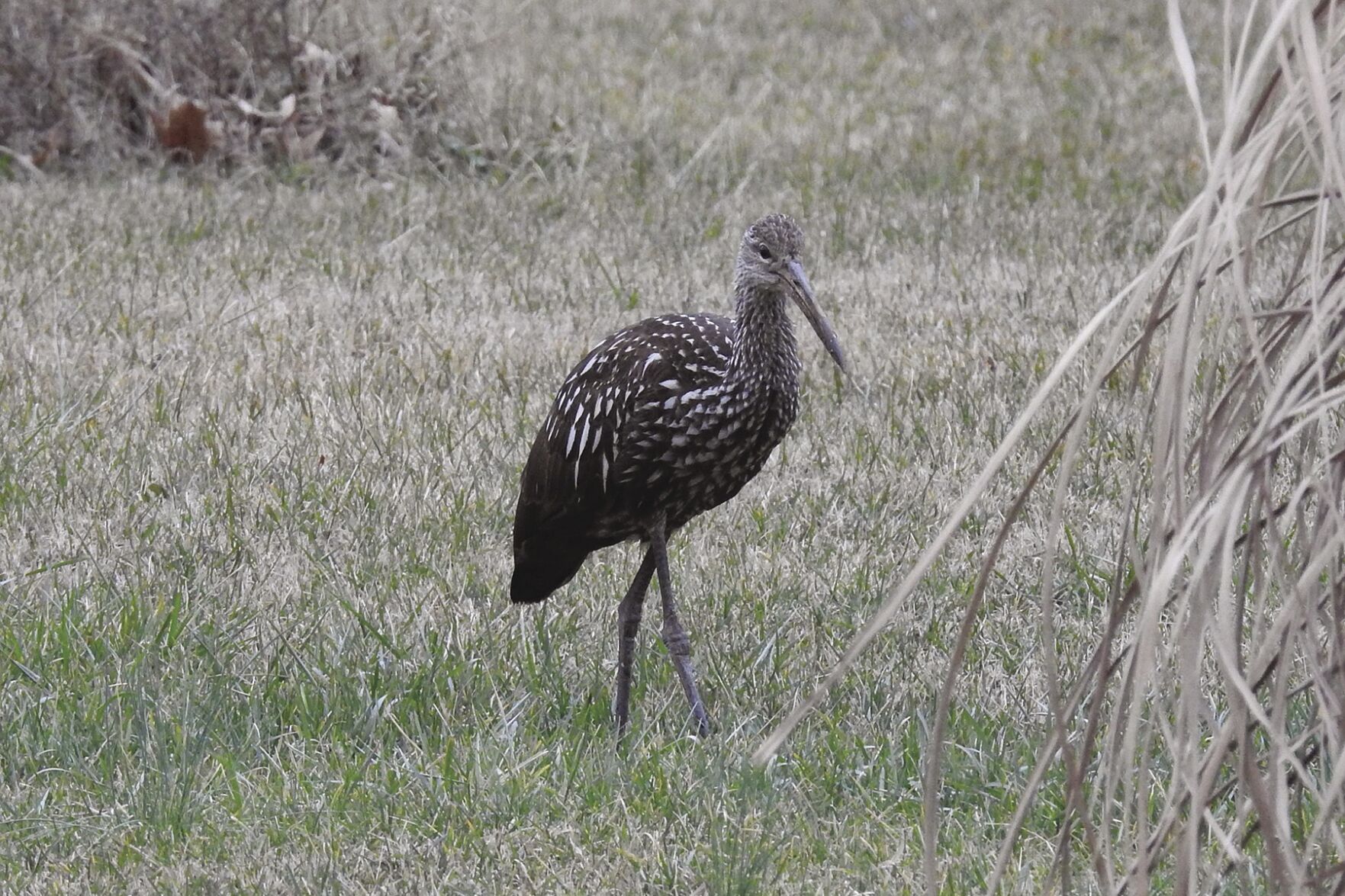
I wrote last week about the limpkin in Hampton. Over the Christmas holiday, I managed to observe this remarkable bird. My mom and I both watched the bird while it foraged for food in a yard at a trailer park. Usually not found beyond Florida, this winter visitor has created quite a sensation in the local birding community. Getting to observe this unusual visitor made our holidays a bit brighter.

•••

Share a sighting, ask a question or make a comment by emailing me at ahoodedwarbler@aol.com.

Photo by Bryan Stevens • A limpkin roams in a yard at the River’s Edge trailer park in Hampton, Tennessee, on Christmas Eve 2023.

Limpkin discovery in December caps off the year in birding

Photo courtesy of Tom and Cathy McNeil • A limpkin in Hampton, Tennessee, stunned the local birding community with its appearance in a most unlikely location.

At the end of the year, it’s a good time to look back. All years deliver some surprises when it comes to bird sightings, but 2023 seemed to truly produce some unusual and totally unexpected sightings for birders in Northeast Tennessee and beyond.

In the waning days of December, one of the biggest local bird surprises of the year took place in Hampton in Carter County when the birding community got word of a limpkin hanging out on the Doe River behind a trailer park. The bird, which usually ranges no farther north than Florida, is not exactly one that would be expected in Northeast Tennessee in the final days before Christmas.


Tom McNeil, a fellow birder, posted the news on his Facebook page.

“A big thanks to my brother, Ed McNeil, for alerting the Hampton community to keep an eye out for this limpkin that has been sneaking around since probably October,” Tom wrote.

Regular readers of this column will recall that Tom and his wife, Cathy, have seen several unusual birds this year, including storm-driven American flamingos in Tennessee and North Carolina, as well as an ancient murrelet at Chickamauga Dam near Chattanooga. Then, just as the year’s winding down, up pops a limpkin practically in their back yard.

According to Tom’s post, David Vines first reported the limpkin in November, but it has remained quite elusive.  However, Ashley Taylor spotted the bird on Dec. 17 and let Tom’s brother know that she saw it at the Rivers Edge community.

“I texted Brookie and Jean Potter,” Tom wrote. “They were on it in no time. Cathy and I rushed down and added it to our Carter County life list.”

Tom credited some awesome networking in the birding community and beyond in bringing the limpkin’s presence to light.

Photo by Bryan Stevens • A limpkin wanders near a canal in Orlando, Fla., in October-November of 2007.

The limpkin, known by the scientific Aramus guarauna, is also called carrao, courlan and crying bird. It’s a large wading bird related to rails and cranes, and the only species in the family Aramidae. Limpkins are found mostly in wetlands in warm parts of the Americas, from Florida to northern Argentina, but has been spotted as far north as Wisconsin.

These birds feed on mollusks, with the diet dominated by apple snails. Its name derives from its “limping” gait when it walks.

I’ve seen and heard limpkins on numerous occasions during visits to Florida. They are unique birds and can become so acclimated to humans that I have observed several limpkins at some of the busy Disney theme parks near Orlando, Florida.

Photo by Bryan Stevens • The limpkin remained present in the River’s Edge trailer park in Hampton on Christmas Eve, 2023. The bird has been spotted in different locations around the small town of Hampton since October.

My mom and I got to see the visiting limpkin on Christmas Eve. On a whim, we drove through the trailer park that had been the location for previous sightings. We drove all the way to the end of the road and were headed back out when we found the bird busy feeding in a yard of one of the trailers.

Why this bird is haunting the Doe River in Carter County, apparently for the past couple of months, is a bit of a mystery. It’s not likely to find apple snails in the Doe, but there are probably crayfish, small fish and plenty of aquatic invertebrates that will keep a limpkin nourished. The recent dip in temperatures hasn’t seemed to affect the bird, although it would not often be exposed to such cold in its usual range.

It’s like I’ve indicated many times in this column. Birds have wings, and they know how to use them. They can show up in some of the most unlikely places. Keep your eyes open and you may be surprised by what you find. Best wishes to all the readers of this column. I hope everyone sees plenty of good birds in 2024.

•••

To share a sighting, make a comment or ask a question, email ahoodedwarbler@aol.com.