
Photo by Bryan Stevens
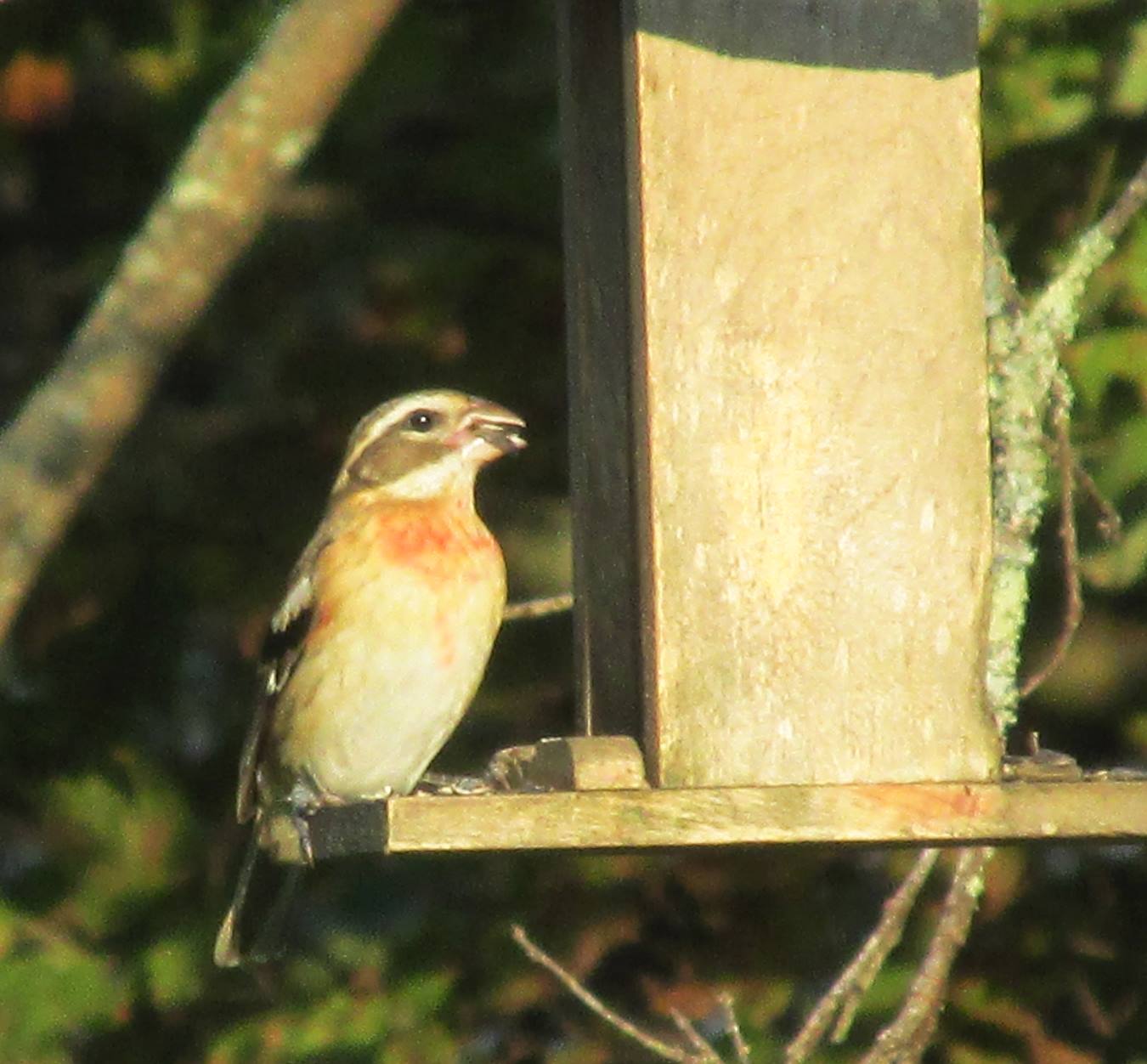
A young male Rose-breasted Grosbeak visits a feeder in September of 2013. Young males resemble females but show a splash of orange on the breast that will be replaced the following spring by the familiar rosy-red patch.
Kaylynn Sanford Wilster hosted some refugees from Hurricane Helene at her feeders on Sept. 27. She notified me of their arrival with a post to my Facebook page.
Kaylynn lives in Piney Flats near Boone Lake and sees plenty of birds and other wildlife at her home. She shared photos on my Facebook page of Northern cardinals sharing a feeder with rose-breasted grosbeaks. While the cardinals are found here throughout the year, rose-breasted grosbeaks are mostly spring and fall migrants in the region.
The photos captured the dark and rain of the early part of the day on Sept. 27 as remnants of Hurricane Helene barreled through the region. I suspect that the rose-breasted grosbeaks that landed on her feeders were hoping to ride out the storm with easy access to food.
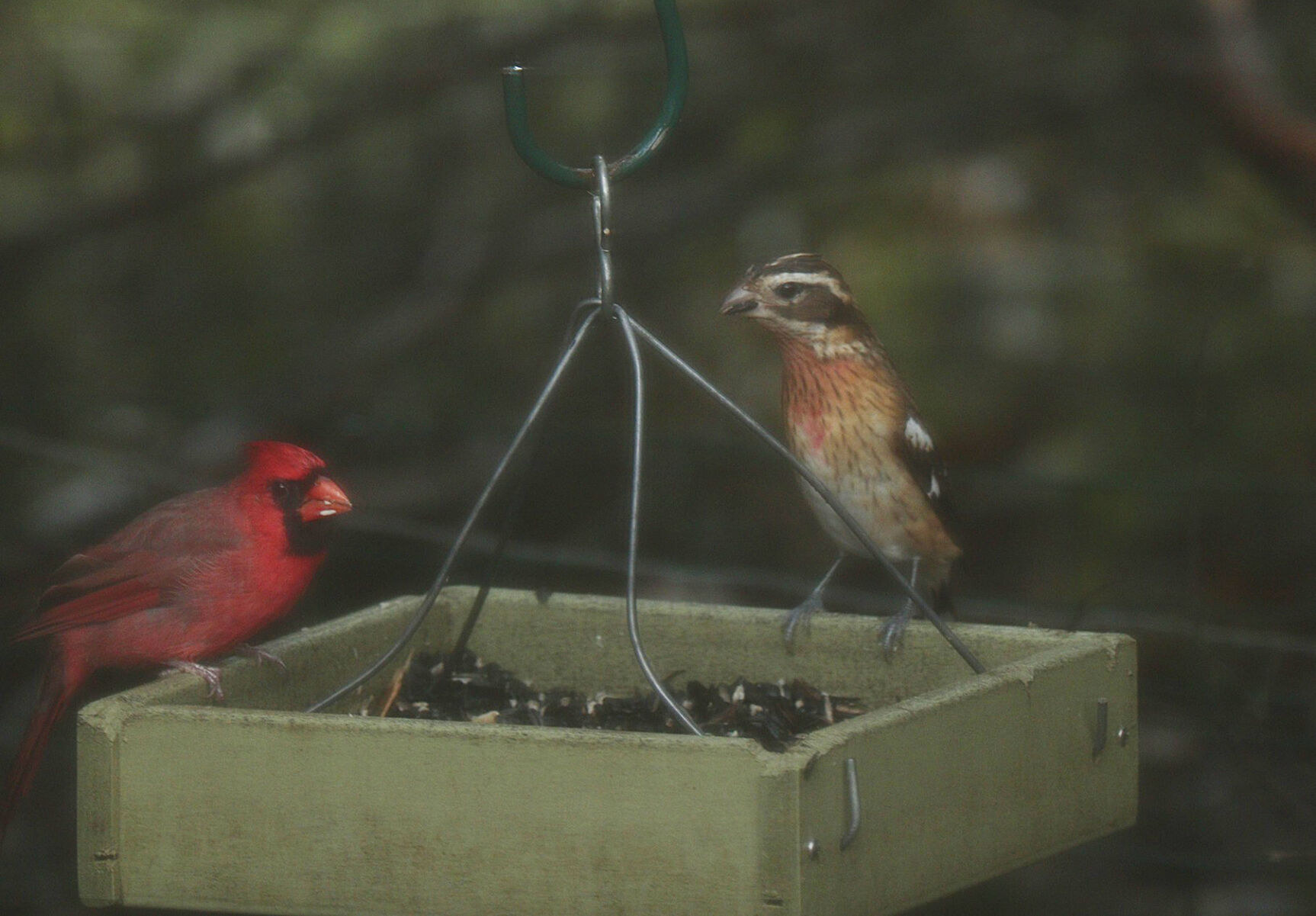
Photo Courtesy of Kaylynn Sanford Wilster • A young male rose-breasted grosbeak, right, shares space on a feeder with an adult male Northern cardinal.
Plenty of rose-breasted grosbeaks pass through northeast Tennessee, southwest Virginia and western North Carolina every spring and fall. These songbirds also make their summer home on local mountains. Rose-breasted grosbeaks birds spread out widely across the eastern half of the North American continent, ranging from northeastern British Columbia to Quebec and Nova Scotia in Canada. They also range south from New Jersey to Georgia. The rose-breasted grosbeak also reaches Colorado, Oklahoma and Kansas.
For the most part, however, the rose-breasted grosbeak is replaced in the western United States by the closely related black-headed grosbeak.
As fall approaches, the rose-breasted grosbeak migrates south to a winter range that spans central Mexico, Central America and northern South America. As they depart, many of these migrating birds will make autumn visits to again partake of offerings of sunflower seeds at backyard feeders. So, if you didn’t get to see these showy birds in the spring, local bird enthusiasts get another chance to see them in September and October.
The male rose-breasted grosbeak gives this species it name. Males are the epitome of the birds that make their home for part of the year in the American tropics. The contrasting black and white plumage is emphasized by a triangular slash of rosy-red color on the breast. Put all those elements together and the male rose-breasted grosbeak is not a bird that would be mistaken for any other.
The female grosbeak, however, doesn’t stand out in the same way. She is much less colorful than the male. With her brown and white plumage, she is often mistaken for a large sparrow or finch.
Both sexes have a massive bill, which they use to hull sunflower seeds at feeders or glean insects from leaves and branches. It’s the heavy, blunt bill for which the term “grosbeak” is derived. “Gros” is a German term for large or big, so grosbeak simply means a large-beaked bird. People who band birds to further the study of them will tell you that rose-breasted grosbeaks can inflict a wicked nip. In Northeast Tennessee, bird banders frequently encounter rose-breasted grosbeaks in their mist nets — and bear the scars to prove it.
With some birds, males play only a minor role in the nesting process. That’s not the case with the rose-breasted grosbeak male. The males help with nest-building chores and share responsibility with the female for incubating the eggs.
The female lays three to five eggs in a cup-shaped nest. It’s not easy to locate the nests since the birds usually place them in trees at least 20 feet above the ground. Within two weeks, the eggs have hatched and the parents are kept extremely busy finding enough food to satisfy the voracious nestlings. Well fed by both parents, the young grow quickly and usually are ready to leave the nest within 12 days.
Often, when a first brood of young departs the nest, the male will care for the rowdy group of fledglings as the female starts a second nest to capitalize on the long days of summer.
Away from our feeders, rose-breasted grosbeaks feed on insects, seeds, fruit and even some leaf buds and flowers. I’ve seen these birds satisfying a sweet tooth — or should that be sweet beak? — by feeding on jewelweed flowers and apple blossoms. If sugar’s good for hummingbirds, I am sure it is a valuable energy source for rose-breasted grosbeaks, too.
Some of the grosbeaks in Kaylynn’s photos were young male grosbeaks that didn’t yet have the stunning plumage of an adult male. They were making their first migration, heading south to spend the winter on the same wintering grounds as their parents. An interruption of that migration by a hurricane must have been an unwelcome one, but the birds at her feathers didn’t appear to have even a feather out of place.
Like people, birds can be extremely resilient, even in the face of something like a hurricane. Whether you see rose-breasted grosbeaks in the spring or the fall, these songbirds are cherished visitors that can add some excitement to a gloomy day.

Photo by Bryan Stevens • A migrating rose-breasted grosbeak rests and recuperates after a collision with a. window.
 Our Fine Feathered Friends