

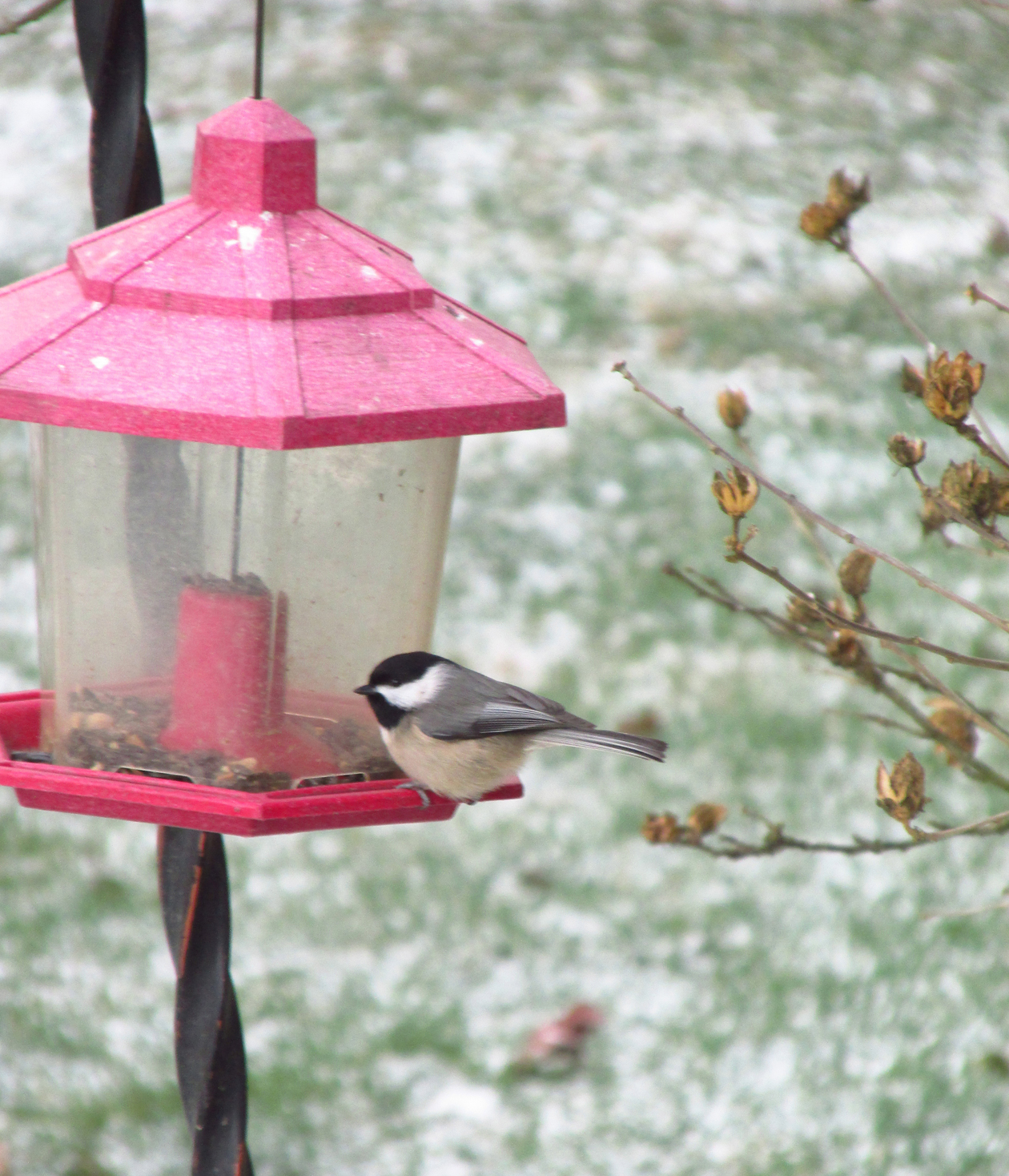
Photo by Bryan Stevens • A Carolina chickadee visits a feeder for sunflower seeds.
I’ve learned not to leave my house without an offering for the local birds. Should I neglect to bring sunflower seed to fill the feeders in the yard as I leave for work in the morning, I must face a scolding from the resident Carolina chickadees.
I think I’ve become familiar enough with these tiny black, white and gray birds that I can tell the difference between a disappointed scolding, the result of leaving the house empty handed, and their jubilant and excited chattering as they invite other birds near and far to come and partake of the bounty when I remember to fill the feeders.
Chickadees have a namesake scolding vocalization — a strident chick-a-dee-dee-dee — that they use to communicate with each other as the move through dreary winter woodlands.
They and the tufted titmice, a closely related species, are among the birds most easily acclimated to human presence and activity.

Photo by Bryan Stevens • A Carolina chickadee endures a cold winter’s day.
On the mornings when I remember their sunflower seeds, the waiting chickadees are doing tiny hoppity dances in the branches of nearby trees and shrubs, barely able to contain their excitement. They barely give me time to move away from the feeders before they dart in, grab a seed and carry it off to quickly shell on a safe perch.
In the spring, the Carolina chickadee has a familiar “fee-bee-fee-bo” song that rings out in the woodlands around my home. Cavity-nesters, chickadees readily take to nest boxes provided by human landlords. We are about five months away from spring of 2025, but that’s all right. Early winter is a great time to make the acquaintance of the Carolina chickadee.
This diminutive songbird is at home in mixed or deciduous woods in the United States from New Jersey west to southern Kansas and south to Florida and Texas. The Carolina chickadee also ranges along the Appalachian Mountains, but on some of the higher peaks they are replaced by their cousin, the black-capped chickadee. In Tennessee, birders need to visit some of the higher peaks in the Great Smoky Mountains National Park in order to find black-capped chickadees.
Sunflower seeds are a favorite offering. They are also attracted by peanuts, suet and other varieties of bird seed. They comprise the nucleus of mixed flocks of various species, so they will also bring other birds into your yard and within easy viewing range. Some other members of the flock might include wrens, nuthatches, titmice and perhaps a couple of kinglets or a downy woodpecker.
It’s easy to attract chickadees to your yard. Shrubs and small trees, feeders stocked with sunflower seeds and perhaps a mesh cage offering a suet cake are sure to make these small birds feel welcome. If you want to witness the family life of chickadees, build or buy a box suitable for wrens and other smaller birds. That task can wait until February of March of next year. Chickadees will happily take up residence in the offered nesting boxes.
Once a pair of chickadees settles down into domestic bliss in the spring, they almost at once start work on the construction of a nest. These little songbirds, looking quite smart in their handsome black, white and gray feathers, build an exquisite nest. The primary nesting material is green moss, which they stuff into a natural cavity or bird box in great quantities. The female chickadee fashions a depression in the collection of moss. She lines this shallow basin with plant fibers as well as strands of fur or hair to provide soft cushioning for her eggs.
A female chickadee can lay a large number of eggs, with the clutch size ranging between three and ten eggs. Once the young hatch, both parents are kept busy delivering food to a large brood of hungry, noisy chicks. The young grow quickly, but they take advantage of the safety of their cavity nest and don’t depart for the wider world until 20 days after their hatching.
North America’s other chickadees include the aforementioned black-capped chickadee, as well as boreal chickadee, chestnut-backed chickadee, grey-headed chickadee, Mexican chickadee, and mountain chickadee. On a trip to Utah in 2003 and 2006, I saw both black-capped chickadees and mountain chickadees.
In other parts of the world, chickadees are known as “tits,” which is from an Old English word denoting small size. Worldwide, there are about 60 species of chickadees and tits, which are classified collectively under the scientific family name, Paridae. Other members of this family range into Europe, Asia and Africa, including species with colorful names like fire-capped tit, yellow-bellied tit, azure tit, green-backed tit and cinnamon-breasted tit.
Alas, in Northeast Tennessee, western North Carolina and southwest Virginia, we have only the Carolina chickadee, but these entertaining birds are sure to become the star attractions in yard and garden once they discover your feeders and begin providing their cheerful antics.
•••
If you have a question, wish to make a comment or share a sighting, email me at ahoodedwarbler@aol.com.

Photo by Bryan Stevens • A young Carolina chickadee, not long out of the nest, explores the world.
 Our Fine Feathered Friends