
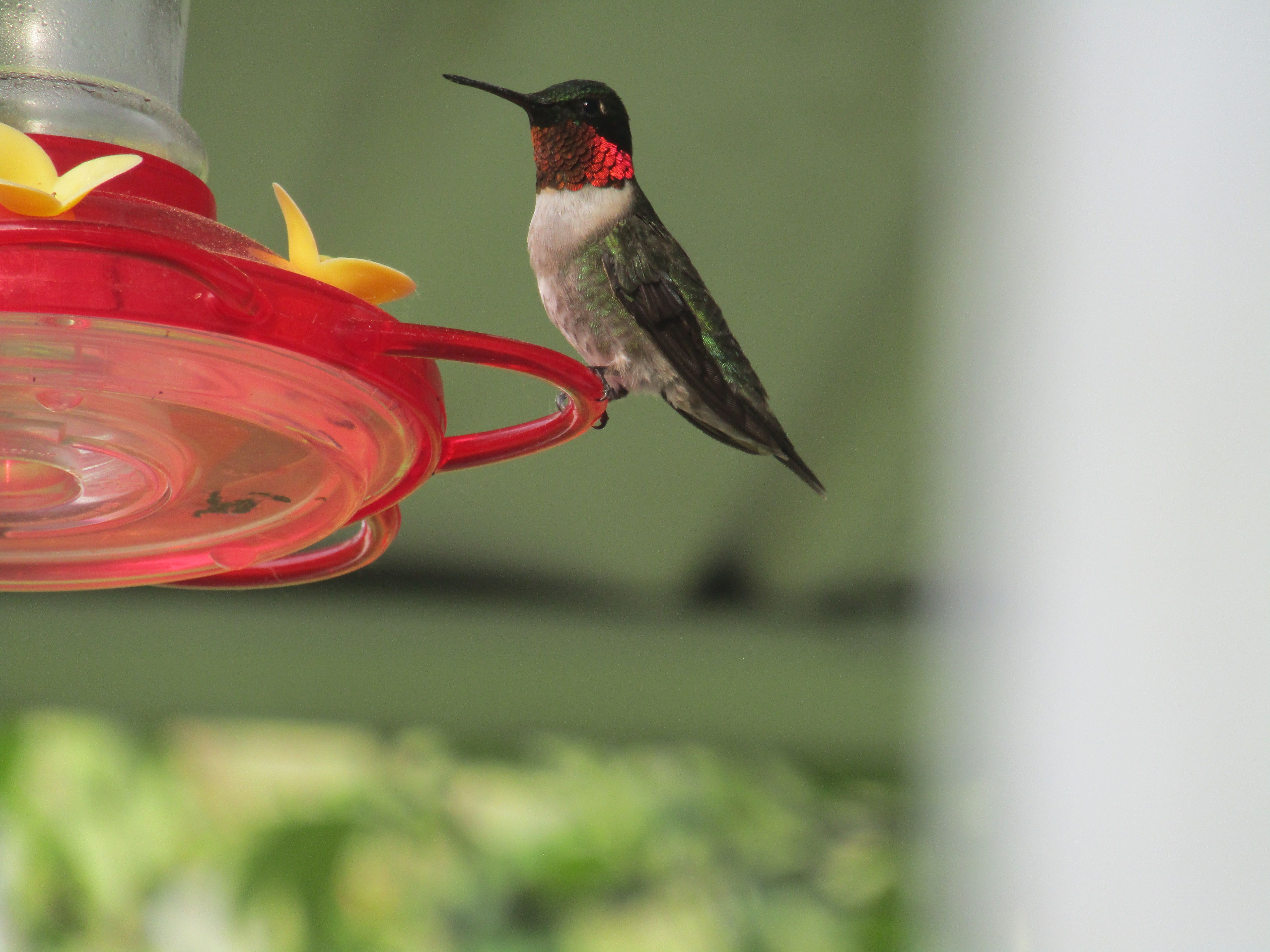
Photo by Bryan Stevens • Welcoming back hummingbirds also involves making sure that they remain healthy and safe while spending the next six months in our yards and gardens. Readers are also invited to share the time and date of their first spring hummingbird arrivals.
We’ve reached the middle of March. Some of our favorite birds are on their way back to spend the warmer months with us. I’ve always been impressed that our smallest birds — ruby-throated hummingbird, blue-grey gnatcatcher and ruby-crowned kinglets — lead the charge in returning to the region after an absence of several months.
Of course, a few larger birds also tend to arrive early. The most prominent of these is probably the broad-winged hawk. These medium-sized raptors usually arrive in late March and early April.
But it’s the noisy and bold brigade of tiny birds that will capture our attention. By the end of March, the blue-grey gnatcatcher will be back, buzzing its zee-zee notes as it flits about branches budding with new green leaves. These tiny birds seem to time their arrival to coincide with the emergence of some of the first greenery of the season.
In the first days of April, ruby-throated hummingbirds will return, checking to see whether the feeders or a stand of early spring flowers are still in place.
Ruby-crowned kinglets, which make a similar passage in the fall, will transit through the region again in the spring as they make their way north to breeding grounds in spruce-fir forests in the northern regions of the United States and Canada.
These are not the only small “early birds.” Some other pint-sized songbirds that arrive in early spring include Louisiana waterthrush and yellow-throated warbler.
There are 17 species of gnatcatchers. Most of these species reside in Central and South America. Some of the other species found in North America include California gnatcatcher and black-capped gnatcatcher.
Kinglets are very active birds. If warblers can be described as energetic, the kinglets are downright frenetic in their activities. The kinglets almost never pause for long, flitting from branch to branch in trees and shrubs as they constantly flick their wings over their backs. These bursts of hyperactivity can make them difficult to observe. Although small in size, these birds more than compensate for it with a feisty spirit that does them well through the harsh winter months.
Gnatcatchers are also constantly on the move, flicking their tails and darting through the branches of trees just starting to put out new green leaves. They glean caterpillars and small insects from the undersides of leaves to help fuel a demanding metabolism.

Photo Courtesy of Jean Potter • Blue-gray Gnatcatchers are tiny, energetic bundles of feathers.
Kinglets and gnatcatchers often join mixed flocks comprised of other species of birds, some of which are regular feeder visitors. Perhaps by observing their flock counterparts, some kinglets have learned to accept feeder fare such as suet, meal worms and chopped nuts. Away from feeders, kinglets mostly feed on a range of small insects and arachnids. Gnatcatchers are strictly eaters of insects, but while a feeder holds no attraction for them, their curious nature often makes these tiny birds quite approachable.
Normally, kinglets have a rather fleeting lifespan. They pay a price for their frantic, fast-paced lifestyles and can be considered old if they live three or four years. There are always exceptions. The oldest golden-crowned kinglet on record was six years and four months old. That individual, a male, was documented by a bird bander in 1976, according to the website All About Birds.
Likewise, gnatcatchers live brief lives. The oldest known blue-gray gnatcatcher was a male, and at least four years, two months old, when it was recaptured at a banding station in Pennsylvania and rereleased, according to the All About Birds website.
Of course, the smallest of the small is the ruby-throated hummingbird, which is officially the most diminutive of all birds found in the Eastern United States. This hummingbird is only 2.8 to 3.5 inches in length and weighs less than half an ounce.
The oldest known ruby-throated hummingbird, according to All About Birds, was a female, and at least 9 years, 2 months old when she was recaptured and rereleased in 2014 during banding operations in West Virginia.
The effort these tiny birds expend to return each year to entertain us during the warmer months is nothing short of extraordinary.
Information on the website for Perky Pet, which markets hummingbird feeders and other items for birds, describes the stages of spring migration. Once they respond to the urge to head north, most ruby-throated hummingbirds have reached Mexico’s Yucatan Peninsula by February.
The jungles of the Yucatan are rich with food and these tiny birds begin to feast on insects as they prepare for one of the toughest migrations for any bird. The majority of these hummingbirds will make a nonstop crossing of the Gulf of Mexico. This epic journey can take them 18 to 22 hours to complete. Some individuals cross the Gulf as early as February, but most of these little birds will wait to cross in March. A month or so later, the first wave of these migrants have usually reached Northeast Tennessee, Southwest Virginia and Western North Carolina.
•••
As always, I like to track the arrival dates of ruby-throated hummingbirds and appreciate readers sharing this information with me every spring. To share your first hummingbird sighting of spring, email me at ahoodedwarbler@aol.com. Please provide the date and time of the bird’s arrival. Other details, such as whether the bird is a male or female, is also appreciated.
•••
Bryan Stevens has written about birds and birding since 1995. Contact him at ahoodedwarbler@aol.com.


 Our Fine Feathered Friends