
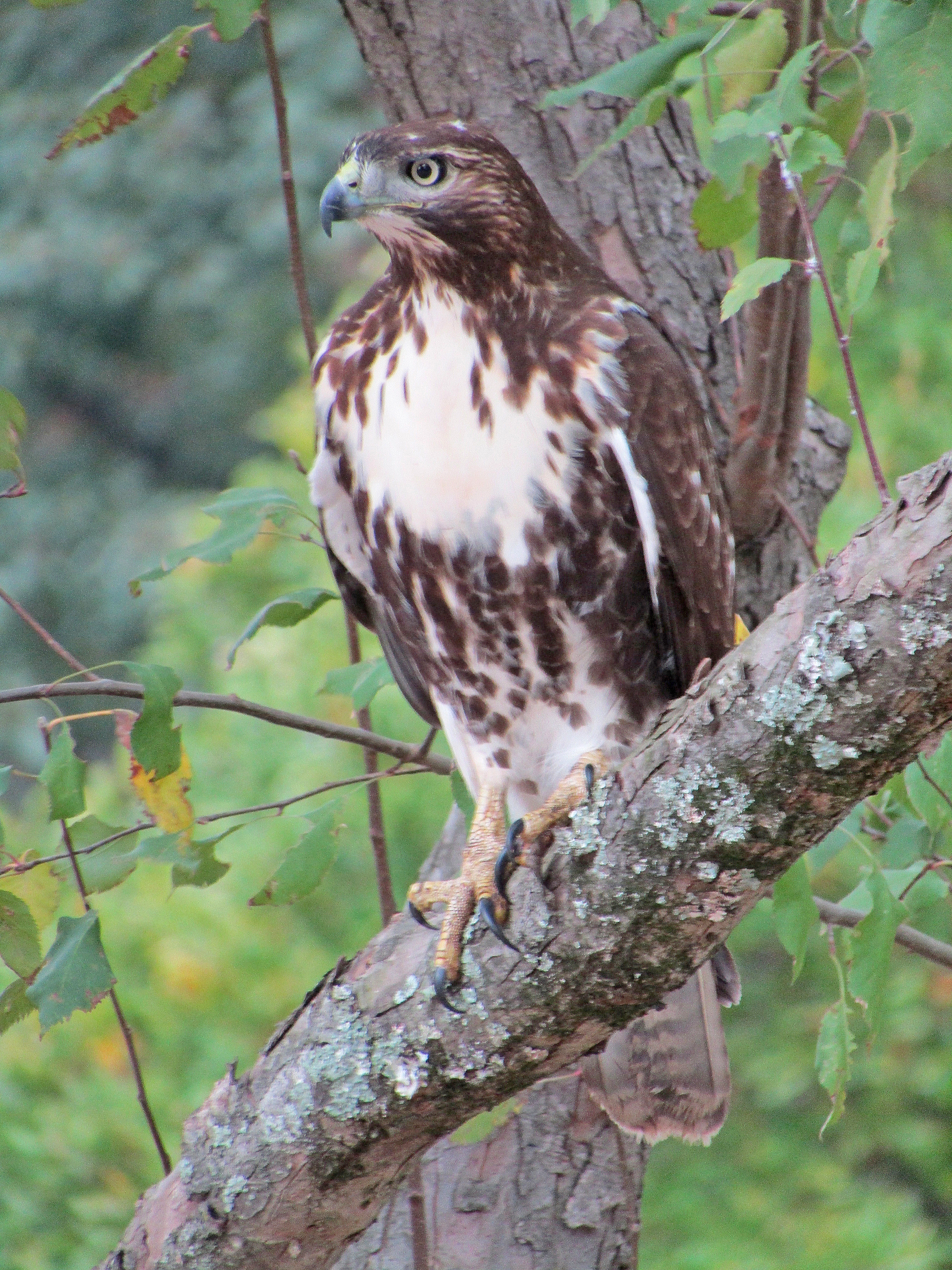
Photo by Bryan Stevens • Raptors, like this Red-tailed Hawk, proved plentiful on count day. Broad-winged Hawk, a relative of the Red-tailed Hawk, even set a new record for most individuals found.
Birds of a feather, as the old saying goes, tend to flock together, but what happens when a member of the flock stands out from the rest? Although conventional wisdom mandates that being conspicuous is not helpful for most wild creatures, some of them can’t help but get attention.
Bigger birds are more conspicuous than smaller songbirds, but an all-white (or nearly so) red-tailed hawk sticks out more than its kin with regular plumage.
I stepped into the back parking lot behind The Erwin Record on Oct. 22 and immediately heard American crows feuding with something, causing quite the commotion. When I looked up I saw the crows tagging a large white hawk. I studied the hawk and noticed that, with the light shining from the other side, the tail feathers revealed an almost translucent hint of red. It was a red-tailed hawk but other than the faint color evident in the tail it was entirely white.
This is my first sighting of an albino (or close to it) red-tailed hawk in Unicoi County. Years ago I used to notice an albino red-tailed near the state line between Tennessee and North Carolina when traveling to Asheville on Interstate 26.
Albinism is a genetic, or inherited, condition resulting in a complete lack of production of pigmentation. Albino birds are, for the most part, extremely uncommon. I’ve heard of a variety of birds, ranging from hummingbirds and American robins to various ducks and swallows, that have a tendency to produce albino individuals.
Leucism is another genetic mutation that causes affected birds to grow feathers that are pale or whitish overall. A faint pattern may be visible. Leucism is also uncommon, but is more common that albinism. The fact that I could detect a faint hint of red in the bird’s tail feathers means that the hawk I saw in Erwin was, technically, affected by leucism and not albinism.
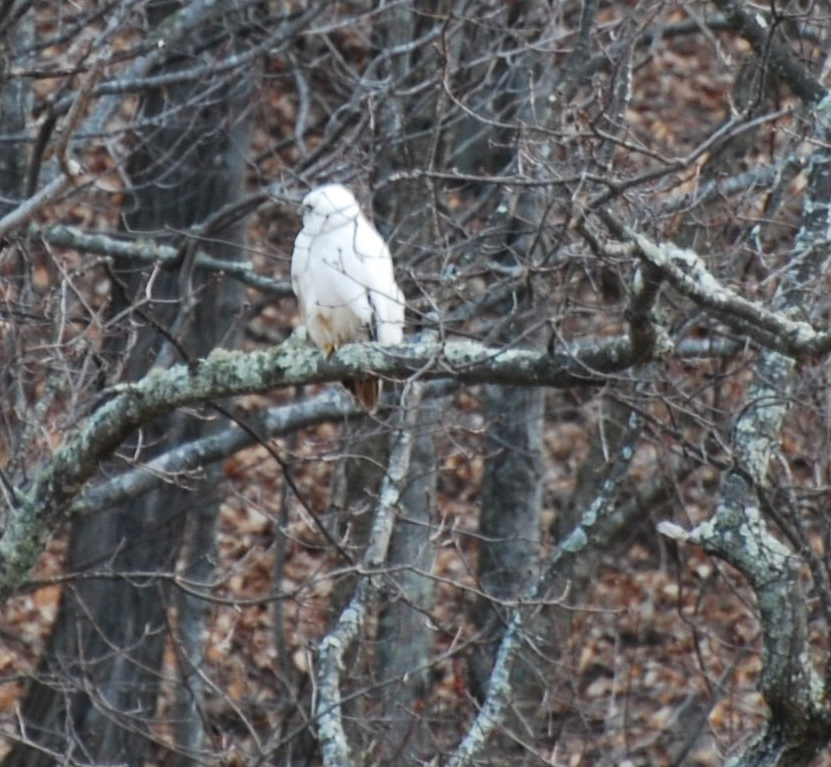
Photo by Jean Potter • This partial albino red-tailed hawk was spotted for several years near the state line dividing northeast Tennessee and western North Carolina.
Albinism and leucism are not the only conditions that can affect pigment in a bird’s feathers. Some birds have the opposite problem in that they produce too much pigment, resulting in a much darker bird than what would be typical. The plumage of such affected birds is described as melanistic, which is in stark contrast to an albino bird. With a melanistic bird, the feathers are much darker than usual because of an abundance of pigment. In rare albino birds, the opposite occurs and the lack of pigment in the feathers leave them looking white. Completely albino birds also tend to have red eyes. It’s probably better for a bird to be melanistic. Albino birds tend to stick out like sore thumbs, attracting the attention of predators.
I’ve only seen a few albino or partial albino birds in person, although I have observed videos and photographs of such birds. During a trip to Salt Lake City, Utah, in 2006, I observed an albino Brewer’s blackbird. An albino blackbird is almost an oxymoron. This particular blackbird had a white upper body and head and a black lower body. At first, I thought it might be a small tern, but closer observation — and identification of the birds with which it was associating — eventually confirmed that it was a Brewer’s blackbird, a common species in Salt Lake City.
These observations remain my best looks at albino birds in the wild. I’ve also seen partial albinos, including an American crow with white feathers in its wings that inhabited the woodlands and fields at my home for several years. I’ve also observed a couple of American goldfinches over the years that would probably qualify as leucistic birds.
A few years ago, I saw an albino red-tailed hawk while driving between Erwin, Tennessee, and Asheville, North Carolina, on Interstate 26. The hawk was often present near the North Carolina Visitors Center.
The red-tailed hawk is one of the most widespread and commonly observed hawks in Tennessee, according to a profile on the Tennessee Wildlife Resources Agency’s website. These large raptors frequently perch in trees along roadsides and is more likely to nest in wooded residential neighborhoods than other hawks.
During my teaching days at East Tennessee State University, I became familiar with a pair of hawks that chose some of the larger trees on campus as regular perching sites.
Small to medium sized mammals, birds, and snakes, with occasional insects and fresh carrion make up the bulk of a red-tailed hawk’s diet. I figured that the ETSU hawks helped keep the local squirrel population in check.
The breeding range of the red-tailed hawk extends across North America from Alaska to Florida and southward to Panama and the Caribbean. The raptor is found in Tennessee year round and migrants from the northern parts of the range join resident birds in winter.
As in most birds, the conditions of albinism and leucism are somewhat rare. I’ve also heard from readers over the years about birds such as American goldfinches and downy woodpeckers exhibiting albino tendencies.
These issues involving the absence or abundance of pigment can complicate bird identification. After all, all-white birds, from snowy owls and tundra swans to great egrets and snow geese, do exist in nature. Even in these birds, however, there’s usually some other color present to break up the uniformity of the bird’s plumage. Keep in mind that such rarities as albino individuals of such common species as house finches and American robins can show up at your feeders or in your yard. It’s just another way birds constantly surprise us.
•••••
To learn more about birds and other topics from the natural world, friend Bryan Stevens on Facebook at https://www.facebook.com/ahoodedwarbler. He is always posting about local birds, wildlife, flowers, insects and much more.
 Our Fine Feathered Friends