Monthly Archives: July 2025

Carter County Summer Bird Count tallies 117 species

Hans Toom/Pixabay • A couple of Canada warbler got tallied with this year’s Carter County Summer Bird Count.

The Lee and Lois Herndon Chapter of Tennessee Ornithological Society, also known as the Elizabethton Bird Club, held its 32nd annual Carter County Summer Bird Count on Saturday, June 7 with 20 observers in nine parties.

Participants tallied 117 species, which is slightly above the average of 114 species.

Most unusual was a Mississippi kite seen for the first time on one of the chapter’s summer bird count. The kite was seen in the Toll Branch vicinity, according to the count’s longtime compiler Rick Knight. He also indicated that other notable finds included common merganser and red crossbill. In addition, counter found 18 species of warblers.

The list:

Canada goose, 90; wood duck, 8; mallard, 56; and common merganser, 2.

Wild turkey, 13; rock Pigeon, 36; Eurasian collared-dove, 3; mourning dove, 142; yellow-billed cuckoo, 5; chuck-will’s-widow, 4; Eastern whip-poor-will, 8; chimney swift, 55; and ruby-throated hummingbird, 20.

Killdeer, 8; double-crested cormorant, 5; green heron, 2; great blue heron, 10; black vulture, 14; and turkey vulture, 46.

Osprey, 3; sharp-shinned hawk, 1; Cooper’s hawk, 3.

Bald eagle, 2; Mississippi kite, 1; red-shouldered hawk, 4; broad-winged hawk, 5; red-tailed hawk, 14; Eastern screech owl, 3; great horned owl, 1; and barred owl, 1.

Belted kingfisher, 9; red-bellied woodpecker, 18; downy woodpecker, 10; hairy woodpecker, 1; Northern flicker, 24; and pileated woodpecker, 16.

Simard Francois/Pixabay • A great crested flycatcher perches on a horizontal branch.

American kestrel, 2; great crested flycatcher, 8; Eastern kingbird, 16; Eastern wood-pewee, 26; Acadian flycatcher, 23; alder flycatcher, 1; least flycatcher, 9; and Eastern phoebe, 46.

White-eyed vireo, 11; yellow-throated vireo, 1; blue-headed vireo, 20; warbling vireo, 4; red-eyed vireo, 130; blue jay, 104; American crow, 180; fish crow, 4; and common raven, 2.

Carolina chickadee, 57; tufted titmouse, 78; tree swallow, 101; Northern rough-winged swallow, 58; purple martin, 23; barn swallow, 106; and cliff swallow, 127.

Golden-crowned kinglet, 2; cedar waxwing, 69; red-breasted nuthatch, 3; white-breasted nuthatch, 13; blue-gray gnatcatcher, 13; Carolina wren, 78; house wren, 23; and winter wren, 1.

Gray catbird, 34; brown thrasher, 31; Northern mockingbird, 83; European starling, 660; Eastern bluebird, 102; veery, 10; hermit thrush, 1; wood thrush, 35; and American robin, 417.

House sparrow, 27; house finch, 84; red crossbill, 3; pine siskin, 5; American goldfinch, 117; chipping sparrow, 91; field sparrow, 26; dark-eyed junco, 34; song sparrow, 204; and Eastern towhee, 105.

Yellow-breasted chat, 4; Eastern meadowlark, 11; orrchard oriole, 8; Baltimore oriole, 6; red-winged blackbird, 88; brown-headed cowbird, 43; and common grackle, 109.

Ovenbird, 65; worm-eating warbler, 5; Louisiana waterthrush, 15; golden-winged warbler, 3; black-and-white warbler, 34; Swainson’s warbler, 9; common yellowthroat, 19; hooded warbler, 104; American redstart, 24; Northern parula, 65; Blackburnian warbler, 6; Yellow warbler, 9; chestnut-sided warbler, 31; black-throated blue warbler, 33; pine warbler, 3; yellow-throated warbler, 20; black-throated green warbler, 27; and Canada warbler, 2.

Scarlet tanager, 34; Northern cardinal, 160; rose-breasted grosbeak, 7; blue grosbeak, 6; and indigo bunting, 154.

Knight noted that it seems like a few species are often missed on a one-day count. He explained that these misses are usually low-density or localized species. Weather or other circumstances may contribute to these misses, as well.

Several species of herons were found for this year’s Summer  Bird Count, but yell0w crowned night-heron was missed. 

Missed species this year included ruffed grouse, common nighthawk, America woodcock, yellow-crowned night-heron, yellow-bellied sapsucker, brown creeper, Kentucky warbler and magnolia warbler.

The chapter will resume meeting in September for its 2025-2026 calendar year. Meetings are usually held the first Tuesday of each month on the Elizabethton campus of Northeast State Community College. Meetings are accompanied by a program on birds, birding and other nature-related topics and begin at 7 p.m. For details, or to share a sighting, ask a question or make a comment, email me at ahoodedwarbler@aol.com.

•••

Bryan Stevens has written about birds and birding since 1995. His weekly “Feathered Friends” column will celebrate its 30th anniversary this year.

Scissor-tailed flycatcher’s tale takes a twist in Jonesborough

Photo by Lowell Christian • The female scissor-tailed flycatcher in Jonesbrough perches attentively next to a nest containing young Eastern kingbirds. The bird’s maternal behaviour with the young kingbirds has attracted a lot of speculation from local birders.

Last week, I wrote about Jonesborough’s scissor-tailed flycatchers. This week, I am writing about the lone scissor-tailed flycatcher visiting Tennessee’s oldest town for the summer. Yes, there’s been a definite twist in this tale.

I attended the Elizabethton Bird Club’s annual summer picnic on July 12 at Sycamore Shoals State Historic Park in Elizabethton. The amazing nesting efforts of the scissor-tailed flycatcher was a major topic of conversation.

There is apparently only a single scissor-tailed flycatcher, a solitary female with strong maternal instincts. She has taken a strong interest in a nest built and tended by a pair of Eastern kingbirds.

So, why did I feel certain I had seen two scissor-tailed flycatchers? First, as I’ve lamented in previous columns, my eyesight is a bit hazy these days. Second, I spent most of my time monitoring my camera’s view screen as I attempted to get photos of the flycatchers. I did see two birds, but I must have been detecting one of the Eastern kingbirds.

About the time I visited the nesting site on July 5, other birders in the area began to suspect something a bit strange. Some background might be in order.

The scissor-tailed flycatcher is a species belonging to the flycatcher genus Tyrannus, which includes the kingbirds. Other relatives in North America include Eastern kingbird, Western kingbird, tropical kingbird, Couch’s kingbird and Cassin’s kingbird. There’s also a giant kingbird native to Cuba and a loggerhead kingbird that is found throughout the Caribbean and on rare occasions in Florida.

Kingbirds are famous for their pugnacious behavior, not hesitating to attack larger birds such as hawks, vultures and crows in defense of their territory. Scissor-tailed flycatchers are also considered aggressive toward a variety of other birds.

A profile of the scissor-tailed flycatcher on the wildlife section of the website for Tennessee Wildlife Resources Agency offers some tantalising tidbits about the relationships that can develop among species in the Tyrannus genus.

“While scissor-tailed flycatchers and Western kingbirds look quite different, they are known to hybridize and produce fertile offspring,” according to information from the TWRA website.

Scissor-tailed/Western kingbird hybrids have been recorded in Shelby County, Tennessee, successfully nesting with both scissor-tailed flycatcher and Western kingbird mates, according to the website.

In the Western United States, there are several species of Tyrannus flycatchers, and scissor-tailed flycatchers are known to have hybridized with several of them, including Western kingbird, Couch’s kingbird and tropical kingbird.

Photo by Bryan Stevens • An Eastern kingbird perches on a fence on the campus of East Tennessee State University.

Hybridization with Eastern kingbirds is a hazy area. Perhaps now that their ranges are beginning to overlap more, especially in Tennessee, it bears more study.

So far, it is not confirmed that the female scissor-tailed flycatcher in Jonesborough is part of a hybridized nesting attempt. She could just be a female scissor-tailed flycatcher, thwarted from finding a mate of her own species and driven by her maternal instinct to “adopt and help” tend the nestlings of a pair of Eastern kingbirds.

I’ve used quotes around the words adopt and help because, based on the observations of some birders, the Eastern kingbird do not exactly seem to welcome the presence of the female scissor-tailed flycatcher. Some people have described seeing evidence of bickering between the female scissor-tailed flycatcher and the kingbirds.

The female scissor-tailed flycatcher is far from her usual range in states like Texas and Oklahoma. She is making the best of her situation. The hungry Eastern kingbirds are not likely to reject a few extra morsels smuggled in by their unsolicited foster mother.

It’s an interesting wrinkle to the story. I am hopeful that this female flycatcher may visit next year and, perhaps, succeed in attracting a mate of her own kind.

I’m still thrilled to have finally added the species to my life list. I’d like to see this species in their native range, so I suppose a visit to Texas or Oklahoma will eventually be in order. Here’s an interesting tidbit to close things out. A now obsolete name for the scissor-tailed flycatcher was swallow-tailed flycatcher. Both name are fairly descriptive, but I think the best name won out.

•••

Bryan Stevens has written about birds and birding since 1995. To share a sighting, make a comment or ask a question, email him at ahoodedwarbler@aol.com.

Photo by Bryan Stevens • Jonesborough’s visiting female scissor-tailed flycatcher has led some to speculate she may have attempted a mating with an Eastern kingbird.

Scissor-tailed flycatchers making Jonesborough a summer home

Photo Courtesy of Lowell Christian • The female scissor-tailed flycatcher in Jonesborough shows the namesake tail feathers and some colorful plumage while in flight.

It’s been a good while since I’ve seen a new life bird to add to my species list.

“Life birds” are simply a new species that a birder has never encountered. Many birders list their “lifers,” which I do in a casual manner. My “lifers” are always documented in my weekly birding column.

I encountered my last life bird back in May 2020 during the pandemic when I observed my first-ever Mississippi Kite at Sycamore Shoals State Historic Park in Elizabethton.

Now, after a trip to Jonesborough, I’ve added scissor-tailed flycatcher. It’s a bird that I’ve wanted to see since I began birding back in the 1990s. I figured I’d have to make a trip to Texas or Oklahoma to add this to my list, however. I never imagined seeing this bird so close to home.

Photo by Bryan Stevens • The tail of the scissor-tailed flycatcher makes it difficult to confuse this bird with any other.

I actually saw two birds, a mated pair, tending their nest in Tennessee’s oldest town. The scissor-tailed flycatcher is the official state bird of Oklahoma, where this species would normally be expected.

This is the third consecutive summer season that this flycatcher’s been confirmed in Washington County. This streak of annual sightings started in 2023 when Dan Huffine, a sharp-eyed birder, saw one while baling hay.

A profile of the species on the Tennessee Wildlife Resources Agency website observes that the scissor-tailed flycatcher has significantly expanded its breeding range in the past several decades and now nests in Tennessee.

The first scissor-tailed flycatcher was reported in the state in 1964, the first nesting attempt was discovered in 1978 and the first successful nest was documented in 1983 in Rutherford County, according to the TWRA website.

I want to thank fellow birder Lowell Christian for providing great directions for finding the parents and their nest. He’s also a fantastic bird photographer. Check out his photos on his Facebook page.

The scissor-tailed flycatcher feeds largely on winged insects, earning its place within the flycatcher family. However, this species will also eat fruit when its available.

Photo Courtesy of Lowell Christian • The female scissor-tailed flycatcher forages in a parking lot.

This flycatcher is placed by experts within the genus Tyrannus, which includes the kingbirds. Other relatives in North America include Eastern kingbird, Western kingbird, tropical kingbird, Couch’s kingbird and Cassin’s kingbird. There’s also a giant kingbird native to Cuba and a loggerhead kingbird that is found throughout the Caribbean and on rare occasions in Florida.

Kingbirds are famous for their pugnacious behavior, not hesitating to attack larger birds such as hawks, vultures and crows in defense of their territory. Scissor-tailed flycatchers are also considered aggressive toward a variety of other birds.

Photo by Bryan Stevens • An Eastern kingbird perches on a fence post.

According to the website All About Birds, scissor-tailed flycatcher numbers declined by about 31% between 1966 and 2014. The estimate comes from statistics gathered by the North American Breeding Bird Survey.

The website also noted that Partners in Flight estimates a global breeding population of 9.5 million scissor-tailed flycatchers, with 92% breeding in the United States, and 50% spending some part of the year in Mexico.

A scissor-tailed flycatcher is unlikely to be confused with any other bird. Adult males are pale gray birds with blackish wings and black tails with white edges. Adults show salmon-pink flanks that extend to underwing patches that are very conspicuous in flight.

As is the case with so many species of birds, males are more colorful than females. The bird’s body is about the size of an American robin, but it looks bigger due to the long tail that gives this species its common name.

The All About Birds website notes that the scissor-tailed flycatcher isn’t always content to stay within its expected range. As I’ve mention on previous occasions in this column, birds have wings and will fly where they wish to fly.

The species tends “to wander widely on their way to and from the wintering grounds, a habit they share with relatives like the fork-tailed flycatcher and tropical kingbirds,” according to a profile of the species on the website.

Scissor-tailed flycatchers may makes appearances almost anywhere in North America, according to the website. I’m delighted to report that evidently also holds true for Northeast Tennessee.

One place that the bird is definitely expected is Oklahoma. Since May 26, 1951, the scissor-tailed flycatcher has been the officially designated Oklahoma state bird.

Jonesborough is known for storytelling, and I hope you agree that these Oklahoma migrants making a new home for themselves and their young in Tennessee’s oldest town is a terrific tale.

•••

Bryan Stevens has written about birds and birding since 1995. To ask a question, make a comment or share a sighting, email him at ahoodedwarbler@aol.com.

Bald eagles, always impressive, not an uncommon sight in region

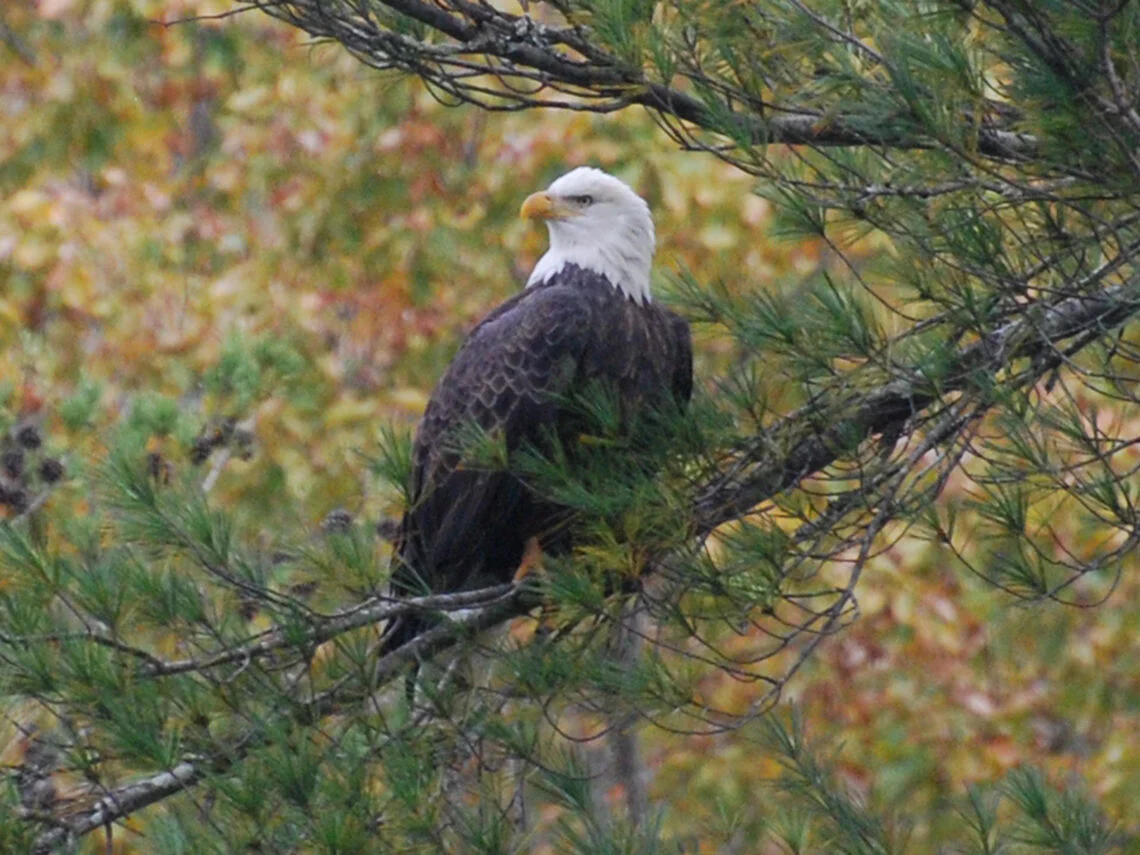
Photo by Jean Potter • A sighting of a bald eagle in the wild is always a memorable moment for the lucky observer.

I hope everyone had a wonderful Fourth of July filled with plenty of red, white and blue. For those who ventured onto area lakes and rivers, I’m hopeful that they perhaps got to glimpse the nation’s official bird.

The bald eagle been recognized as the penultimate bird in the United States of America since the latter decades of the 18th century. I’ve seen many bald eagles in my lifetime, and a sighting of one of these magnificent raptors never disappoints. The resurgence of the once-endangered bald eagle in the lower 48 states has been a laudable accomplishment that all Americans should view with pride.

Photo by Bryan Stevens • The Endangered Species Act has helped save birds like the Bald Eagle from possible extinction.

While the recent Independence Day remains fresh in memory, I thought it might be a good time to share some interesting information on our national bird, the American bald eagle, which officially became the national emblem in 1782 when the great seal of the United States was adopted. Although Benjamin Franklin famously expressed reservations about making the bald eagle our national bird, in hindsight it’s clear that Americans made the right choice.

Despite elevating this native bird to such lofty status, we have not always been kind to the bald eagle. We allowed habitat destruction and toxic pesticides to bring this eagle to the brink of extinction. With well-deserved protection, however, the bald eagle rebounded, and the Department of Interior finally took the eagle off the threatened species list on June 28, 2007.

The bald eagle has been more frequently observed by birders in Northeast Tennessee in recent years. Some of the region’s rivers and lakes are good places to look for bald eagles, particularly in the fall and winter. A few lakes even regularly host nesting bald eagles. I’ve observed bald eagles in Tennessee, South Carolina, Florida and Virginia.

The bald eagle (Haliaeetus leucocephalus) is a member of a genus known as Haliaeetus, or sea eagles. There are seven other living species in the genus: the white-bellied sea eagle, Sanford’s sea eagle, African fish eagle, Madagascar fish eagle, Pallas’s fish eagle, white-tailed eagle and Steller’s sea eagle. The eagles are incredibly majestic birds and important symbols of the value of natural places and creatures.

Steller’s sea eagle is named for the German naturalist Georg Wilhelm Steller, who is renowned for his work as a pioneer in the natural history of Alaska. The 49th state to join the union is also the stronghold for the bald eagle. On occasion, Steller’s sea eagle has strayed into U.S. territory at Alaskan locations including the Pribilof Islands and Kodiak Island. Steller’s sea eagle is bigger than the bald eagle. In fact, it is the largest member of the Haliaeetus genus of eagles, making this bird one of the largest raptors in the entire world.

Ben Franklin wasn’t enthusiastic about the bald eagle as the national bird, but perhaps, considering he favored the Wild Turkey, it’s best we don’t eat our national bird every Thanksgiving.

The naturalist for which this eagle is named has also been honored by the naming of other creatures, including Steller’s sea lion and the now-extinct Steller’s sea cow, as well as several birds, including Steller’s jay and Steller’s eider. He was the first naturalist to describe several creatures native to Alaska, although two of these, the sea cow (a relative of the manatees) and the spectacled cormorant, are now extinct. The latter, which was the largest cormorant to ever live, is a particularly sad story. These cormorants were basically eaten into extinction, exploited as a food source by sailors and fur traders. The last spectacled cormorants perished around 1850 on a Russian island off the coast of the Kamchatka Peninsula.

Fortunately, we have proven a little more far-sighted in our treatment of the bald eagle, which was removed from the U.S. government’s list of endangered species on July 12, 1995, and transferred to the list of threatened species. In 2007, bald eagle numbers had rebounded enough in the Lower 48 states to also allow for the bald eagle to be removed from the list of threatened species.

Male and female adult bald eagles have a blackish-brown back and breast; a white head, neck and tail; and yellow feet and bill. Juvenile bald eagles are a mixture of brown and white and reach full maturity in four to five years. The female bald eagle is 35 to 37 inches in length, slightly larger than the male, with a wingspan that ranges from 72 to 90 inches. Bald eagles weigh from 10 to 14 pounds. The bald eagle’s diet consists mostly of fish, some of which are scavenged, but these large raptors are also capable of preying on everything from muskrats and ducks to rabbits and snakes. The bald eagle will also feed on carrion.

More than 240 years after it was declared an official emblem of the United States, the bald eagle has become an instantly recognizable American symbol. Long may the eagles fly.

•••

Bryan Stevens has written about birds and birding since 1995. To ask a question, make a comment or share a sighting, email him at ahoodedwarbler@aol.com.