

Kaleomanuiwa Wong/USFWS • A sooty tern clings to a rocky perch. Hurricane Frances blew a sooty tern to Holston Lake in Bristol on Sept. 8, 2004.
During a program I presented on birds and birding at the Elizabethton/Carter County Public Library many years ago, an attendee asked me if I knew what happens to birds in a hurricane?
The question, no doubt prompted by the 2017 hurricanes Harvey and Irma, is of particular concern now that many of our favorite birds are migrating south along paths that could take them into harm’s way.
Hurricanes are often a factor that fall migrants must face. In 2004, Hurricane Frances blew some unusual tropical birds to Holston Lake in Bristol. Severe storms also present devastating obstacles for other birds.
Well-known birder and author Kenn Kaufman shared his knowledge about birds and hurricanes when interviewed back in 2011 on the Audubon website. Among some fascinating insight he shared, Kaufman noted that the way intense storms affect birds depends on the species. He noted that a whimbrel, a large shorebird, would be more likely to fly through a major hurricane and live to tell the tale. On the other hand, such a storm would likely prove lethal for songbirds like warblers and thrushes.
To the questioner at my program, I also admitted that dedicated birders are, at times, rather atypical people. For a birder looking to find a totally unexpected bird, every hurricane comes with a proverbial silver lining. In the case of birders, that lining involves some of those stronger flyers — birds like whimbrels, noddies, terns, jaegers or tropicbirds — that get swept into the eye of the storm, carried far inland and dropped onto large lakes as the storm weakens.
My first direct observation of one of these hurricane-transported displaced birds took place back on Sept. 8, 2004. I had been drawn to Musick’s Campground on South Holston Lake by reports of an incredible fallout of such birds, which included species like whimbrel and red knot. More than a dozen fellow birders were present in the swirl of wind, mist and rain when a graceful bird with a dramatic two-toned black and white plumage flew overhead.
I had no idea of the bird’s identity, but I knew instantly it was a species I’d never observed. I heard someone yell “sooty tern” — the identity of the shouter turned out to be area birding legend Rick Knight — and then pandemonium broke out as birders in rain gear got their binoculars into position to track the bird before it flew out of sight.
We needn’t have worried. The bird lingered long enough for all those present to get a good look. I was accompanied that day by the late Howard P. Langridge, a well-known birder in both Florida and Tennessee. Howard had seen sooty terns, but he had found them when visiting the islands of the Dry Tortugas, west of the Florida Keys.
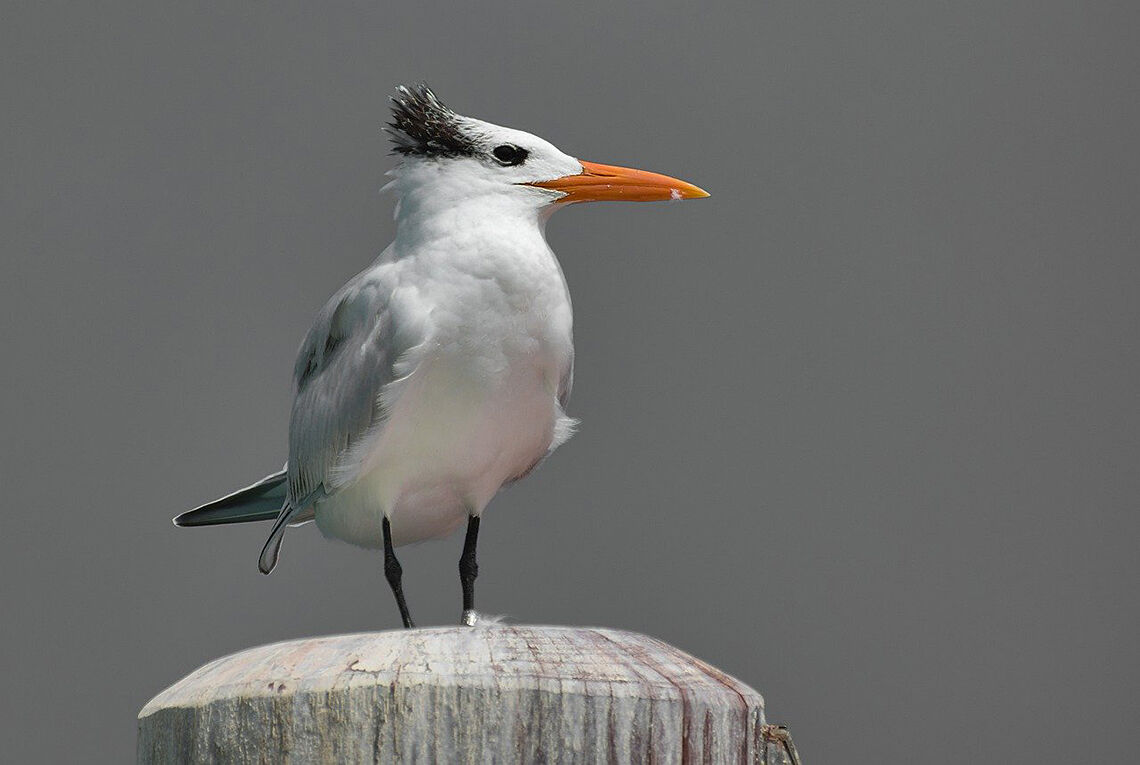
Ronald Plett/Pixabay • Royal terns, like the individual pictured, usually stay close to coastlines. In 1989, Hurricane Hugo blew a royal tern all the way to Watauga Lake, establishing the first record for the species in the state.
Two months after the exciting observation of that sooty tern, Howard passed away at age 81. So, even to this day, memories of that bird are tinged with some bittersweetness from the fact it was one of my last birding adventures with a man who served as a bit of a birding mentor for me.
On our drive back home after that exciting encounter with the storm-driven tern, Howard talked excitedly about sooty terns and some of the other rare birds he had seen in a birding career that spanned more than 50 years.
In addition, we learned a valuable lesson that day. It’s an accepted fact that no bird is worth risking life or limb. It’s also a good idea to be careful where you park when going out to a rain-drenched lakeshore to look for birds from a diminished hurricane. Howard and I lingered after the other birders departed. When we started to leave, he discovered his car’s back tires had gotten stuck in the clay mud. With Howard behind the wheel, I pushed his car as the tires spun madly for traction. I ruined a new pair of denim jeans, but I got the car out of the mud. It’s one more memory that will put a smile on my face to this day.
The sooty tern, blown to a Bristol lake in 2004 by Hurricane Frances, remains a highlight of my birding; however, it’s hardly the only unusual bird to be dumped on area lakes thanks to hurricanes that formed in tropic waters.
Hurricane Hugo back in 1989 remains one of the most legendary storms in the minds of most long-time birders in the area. I hadn’t yet taken up birding at that time, but birders like Howard made sure I knew all about the bird bounty stirred up by Hugo. Two species of jaegers — parasitic and pomarine — were among the birds blown inland to Watauga Lake in Carter County. Seeing these birds usually requires a seat on a boat capable of traveling far out to sea to look for birds that hardly ever venture near the shoreline except for nesting.
Hurricane Hugo also blew more than 50 Forster’s terns — a record number for the region — to Watauga Lake. In addition, a single royal tern — a first record for Tennessee — was also detected by birders looking for birds displaced by Hurricane Hugo.
Much farther back, a high count of Caspian terns was recorded Sept. 5, 1964, at Boone Lake in the wake of Hurricane Cleo. The late Wallace Coffey, a well-known birder in Bristol, was present to witness those 130 Caspian terns. Both Caspian and royal terns are birds usually found along the Atlantic Coast in places like Florida, Georgia and the Carolinas.
As I write this week’s post, I did some digging online to see if Hurricane Helene caused any problems for migrating birds.
It’s possible that the storm did drive some unusual species inland. Common gallinules have been spotted in Oak Ridge, as well as Roane County and Anderson County in the days after the storm. American avocets have also shown up in locations across the Volunteer State in the same time period.
Cornell Laboratory of Ornithology did report some displaced birds in the wake of Hurricane Helene, but the reports came mostly from coastal areas that saw some off-shore species like sooty shearwater, Audubon’s shearwater, magnificent frigatebird, brown noddy, bridled tern, sooty tern, Bermuda petrel and American flamingo driven closer to coastlines.
I haven’t heard of any regional migrant fallouts, but then Helene was a rather horrific storm. Even dedicated birders know when to hunker down and look for birds another day.
•••
Email me at ahoodedwarbler@aol.com to share a sighting, make a comment or ask a question.


 Our Fine Feathered Friends