
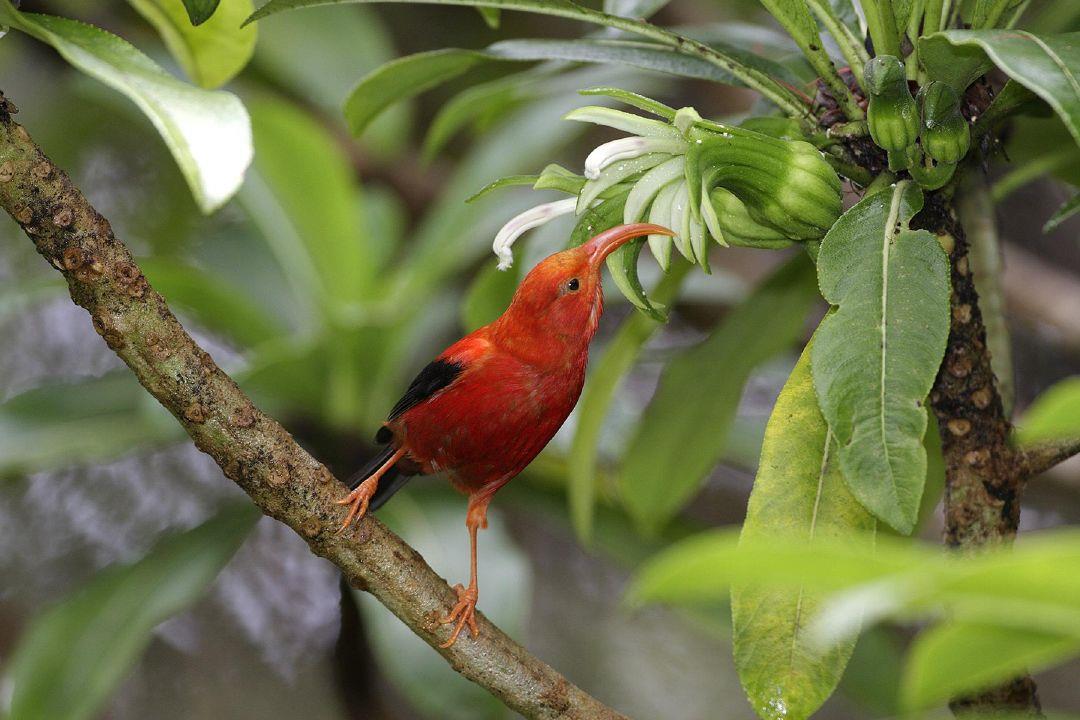
Photo by Jack Jeffrey/USFWS • A po’ouli relative, an ‘I’iwi forages in the Hakalau Forest National Wildlife Refuge, Hawaii. The bird’s long, downcurved, orange bill is specialized for sipping nectar from tubular flowers.
I’m celebrating 30 years of writing my weekly “Feathered Friends” column by occasionally showcasing some vintage compositions from throughout that time period. I published this column on Jan. 2, 2005. I’ve made some revisions and edits to this version. I’m more saddened now than at the time I wrote the original column, but I still think there is some cause for optimism that we’ll be able to share the planet without causing any more tragic stories for our birds. I think that message is just as important as ever.
•••
A tiny bird called the po’ouli, no bigger than some of the sparrows that visit bird feeders here in East Tennessee, failed to move forward into the year 2005.
A bird native to the Hawaiian island of Maui, the po’ouli went undiscovered by modern science until 1973. Barely three decades later, what may very well have been the last po’ouli in the world died Nov. 26, 2004.
The exact date of the demise of both the species and this last survivor can be known because the individual bird had been living in captivity in a research center on Maui. The hope had been to secure two other individuals known to exist in the wild in order to initiate a last-ditch attempt to save the po’ouli through a captive breeding program.
Nature moved faster than man. The other two po’ouli living in the wild hadn’t been seen in several months when the search launched. The lives of all small birds are fleeting and precarious. In all likelihood, these two individuals were gone even before the search commenced. With their demise, another thread had simply been snipped from nature’s tapestry.
The irony is that we knew this small bird, seen in the wild by a relatively small number of people, for only a blink in the overall scope of the universe. We did manage to learn a few things about the po’ouli in the span of time from 1973 to its extinction in late 2004.
According to a U.S. Fish and Wildlife Service press release, the po’ouli’s name in Hawaiian meant “black head,” a reference to the bird’s black mask and its other common name of black-faced honeycreeper. Its scientific name was Melamprosops phaeosoma. A Po’ouli’s most distinctive feature was a large black face mask accented by white cheeks, throat and underparts with brown wings and back; no other Hawaiian forest bird was similarly colored. Females were similar in appearance, displaying a grayish throat and breast.
The po’ouli belonged to a family known as the Hawaiian honeycreepers. Unlike other forest birds in Hawaii, the po’ouli’s diet included many native tree snails. The fact that many Hawaiian tree snails are endangered or threatened may have played a role in the rapid decline of the po’ouli.
The U.S. Fish and Wildlife Service tried to look for a silver lining in the wake of this tragedy.
“Our goal of saving the po’ouli is now very difficult and may not be achievable,” said Gina Shultz, acting field supervisor for the Fish and Wildlife Service’s Pacific Islands office, in a remark that can be fairly described as classic understatement.
She added, “But we must continue to try to save the species we have left.”
At that time, Hawaii had 31 other endangered bird species threatened by loss of habitat, introduced predators and disease.
In the years since 2004, eight more species have been lost, including the Maui ʻakepa, Maui nukupuʻu, Kauai ʻŌʻō, Kauai akialoa, large Kauai thrush, Kauai nukupuʻu and Molokai creeper, also known as Kākāwahie. Some of these species had not been seen for decades when officially declared extinct in 2023.
The demise of the little-known po’ouli probably didn’t mean much to many people. It’s hard to get excited about a small, drab bird that once lived on an island thousands of miles away.
We should, however, learn a lesson from its story. When it comes to the rapid decline in birds, we’re a major part of the problem. We’re going to need to be a part of the solution, too.
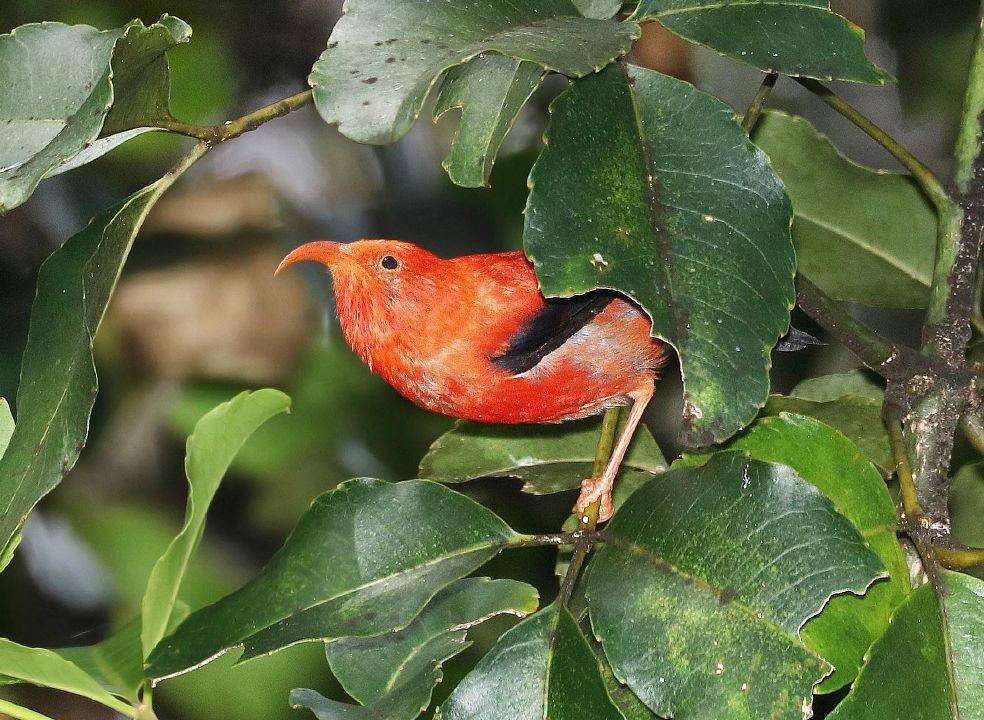
Photo by Alan Schmierer • The ‘I’iwi, a relative of the po’ouli, is another of the Hawaiian honeycreeper species. These birds evolved in the forests of Hawai’i and are found nowhere else in the world. Unlike ‘the po’ouli, a few thousand I’iwi still survive but face existential threats that have intensified in recent years.
What will we do? Will we wait until another bird species dwindles to a mere three individuals in the entire world and take desperate, unsuccessful measures?
We are more than a quarter way through this new century. These problems require new thinking. The issues are too complex to be more than hinted at in one column. But perhaps we can adopt a slogan: “Remember the po’ouli.” Keep this lost little bird in mind to help us in this constant battle to see to it that no other birds follow the po’ouli into the darkness of extinction.
•••
Bryan Stevens has been writing about birds, birding and birders since 1995. Email him at ahoodedwarbler@aol.com to share a sighting, ask a question or make a comment.
 Our Fine Feathered Friends