Category Archives: Ruby-throated Hummingbird

Get ready to welcome spring’s returning hummingbirds

All bird enthusiasts have their personal favorites among our feathered friends. Cardinals, bluebirds, robins and chickadees would certainly find a place in any Top 10 lists. What bird would top the list? I have no qualms predicting that the ruby-throated hummingbird would be a frontrunner for such a ranking.
rubythroated_hummingbird

A male Ruby-throated Hummingbird seeks nectar at tiny blooms. — Photo by U.S. Fish & Wildlife Service


The popularity of hummingbirds in general, and the ruby-throated hummingbird specifically, is simple to understand. These tiny birds are perfectly willing to insert themselves into our lives, offering hours of fascinating entertainment as they visit our gardens, duel at our sugar water feeders and occasionally even nest in trees and shrubs in our yards.

Individuals who feed birds know that it can be an expensive undertaking. The cost of providing sunflower seeds and suet cakes for hungry flocks during the winter months can nibble at the monthly budget, but hardly anyone would begrudge the sparrows, finches, wrens and woodpeckers. After all, they return the favor, putting on daily shows just outside our windows.

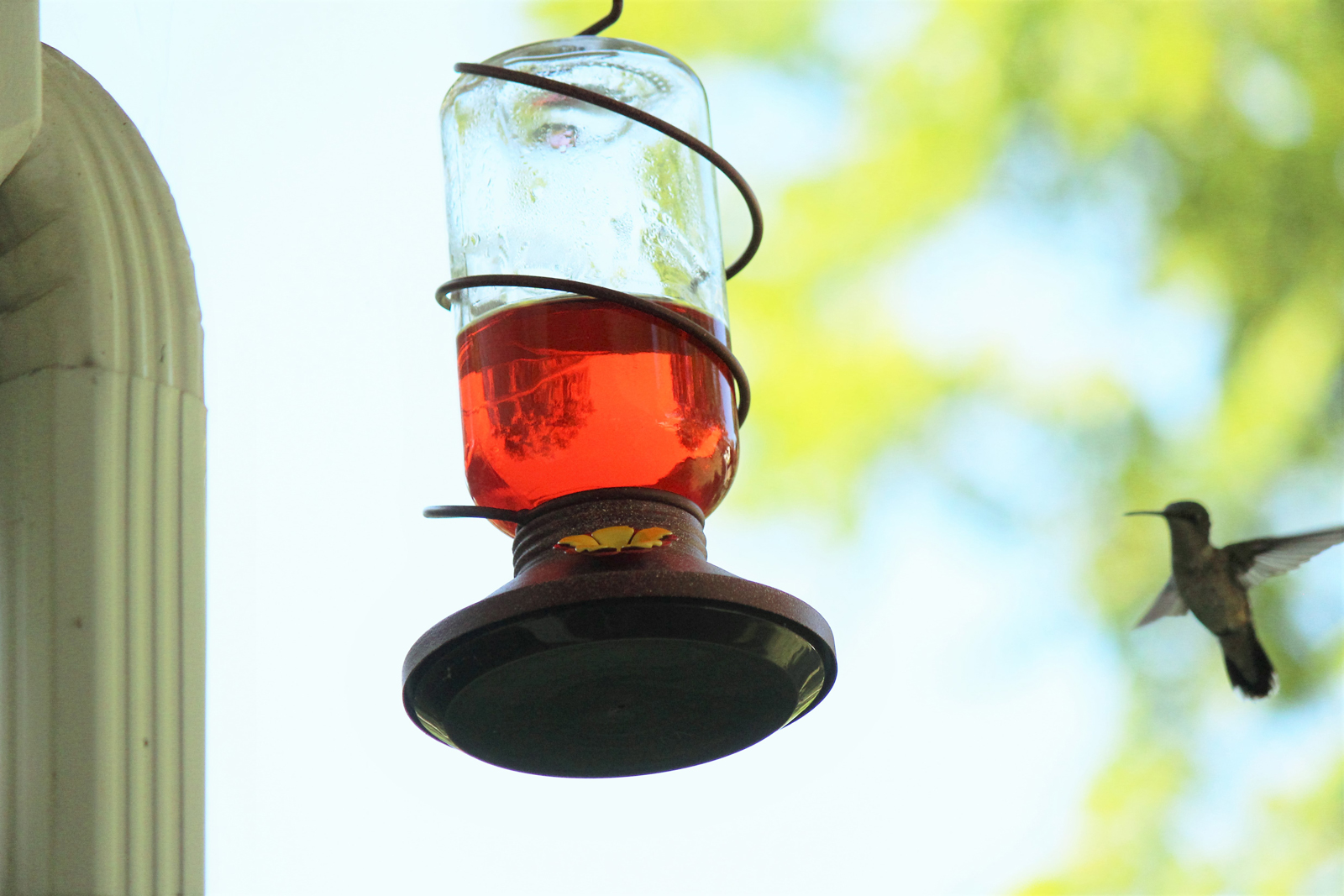
Attracting hummingbirds is generally much less expensive than feeding other birds. After all, you need only a mixture of sugar water — four parts water to one part sugar — to fill a feeder and catch the attention of a visiting hummer. A few pounds of sugar will last a lot longer than that bag of sunflower seeds and it’s much less expensive to purchase at the grocery store.

If you do want to take extra steps to attract these diminutive, feathered saccharine junkies, consider supplementing your landscape with a variety of flowering plants. To explore some of the best choices for flowers to tempt hummingbirds, visit the website of The Hummingbird Society at http://www.hummingbirdsociety.org.

Hummer-CloserUp

A male ruby-throated hummingbird surveys his territory from a convenient perch. — Photo by Bryan Stevens

Nevertheless, few bird enthusiasts are truly frugal when it comes to our feathered friends. Even if the cost of bringing hummingbirds and other birds was much higher, I don’t think we would abandon the undertaking. Quite simply, the birds mean too much to us. They fascinate us with their speed and agility, their pugnacious relations with each other, and of course their tiny size. The irony is that, although hummingbirds are so small, they don’t seem to recognize that fact as they zig and zag through yard and garden.

While the ruby-throated hummingbird is the only hummer that nests in the eastern United States, which is what brings these tiny birds into our lives every year from April to October, there are more than 300 species of hummingbirds. Much creativity has gone into giving each of these hummingbirds a descriptive common name.

Sometimes, words fail. Mere adjectives are somewhat inadequate in providing common names for many of the world’s more than 300 hummingbirds, but that doesn’t keep us from trying to give descriptive names to each hummingbird species. For instance, we have the beautiful hummingbird of Mexico; the charming hummingbird of Costa Rica and Panama; the festive coquette of northwestern South America; and the magnificent hummingbird of the southwestern United States.

Other names are even more elaborate and occasionally outlandish, such as the white-tufted sunbeam of Peru; the violet-throated metaltail of Ecuador; the violet-throated starfrontlet of Peru and Bolivia; the hyacinth visorbearer of Brazil; and the rainbow-bearded thornbill of Colombia and Ecuador.

RT-Male-April15

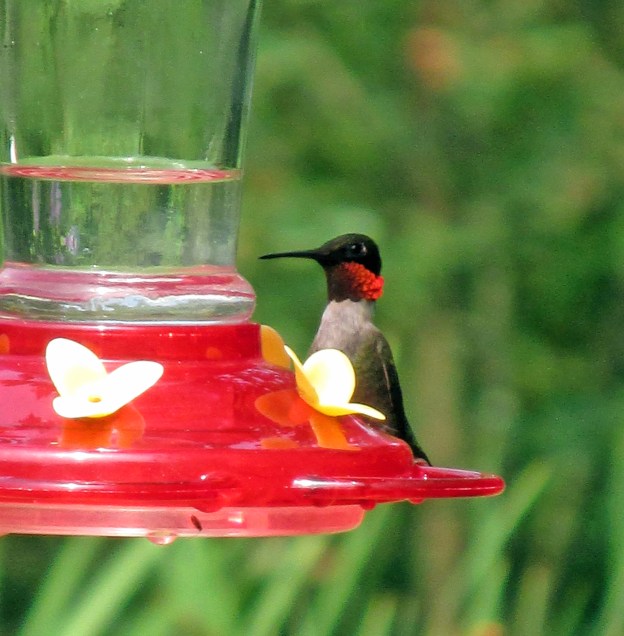
A male ruby-throated hummingbird ignores honeybees for a sip of sugar water. — Photo by Bryan Stevens

It would seem then that our own ruby-throated hummingbird is in good company. After spending the winter months in Central America, ruby-throated hummingbirds are already streaming north. Just to reach the United States, these tiny birds undertake an arduous journey. Most of these tiny birds, which are barely four inches long, make a non-stop flight of more than 500 miles across the Gulf of Mexico. The journey can take almost an entire day!

Sightings are already being reported, and ruby-throats typically arrive in the region in early April. In fact, a male ruby-throated hummingbird showed up at my feeders on Saturday, April 15.

If you don’t have your feeders outdoors and waiting for them, it’s time to do so. As always, I love to hear from readers about their first hummingbird sighting of the year. Jot down the time and date and contact me by email at ahoodedwarbler@aol.com. I can hardly wait for one of our favorite birds to get back. Let’s give them a hearty welcome.

••••••

To learn more about birds and other topics from the natural world, friend Bryan Stevens on Facebook at https://www.facebook.com/ahoodedwarbler. He is always posting about local birds, wildlife, flowers, insects and much more.
 

Woman gets glimpse into life of a nesting ruby-throated hummingbird

eggs-in-nest

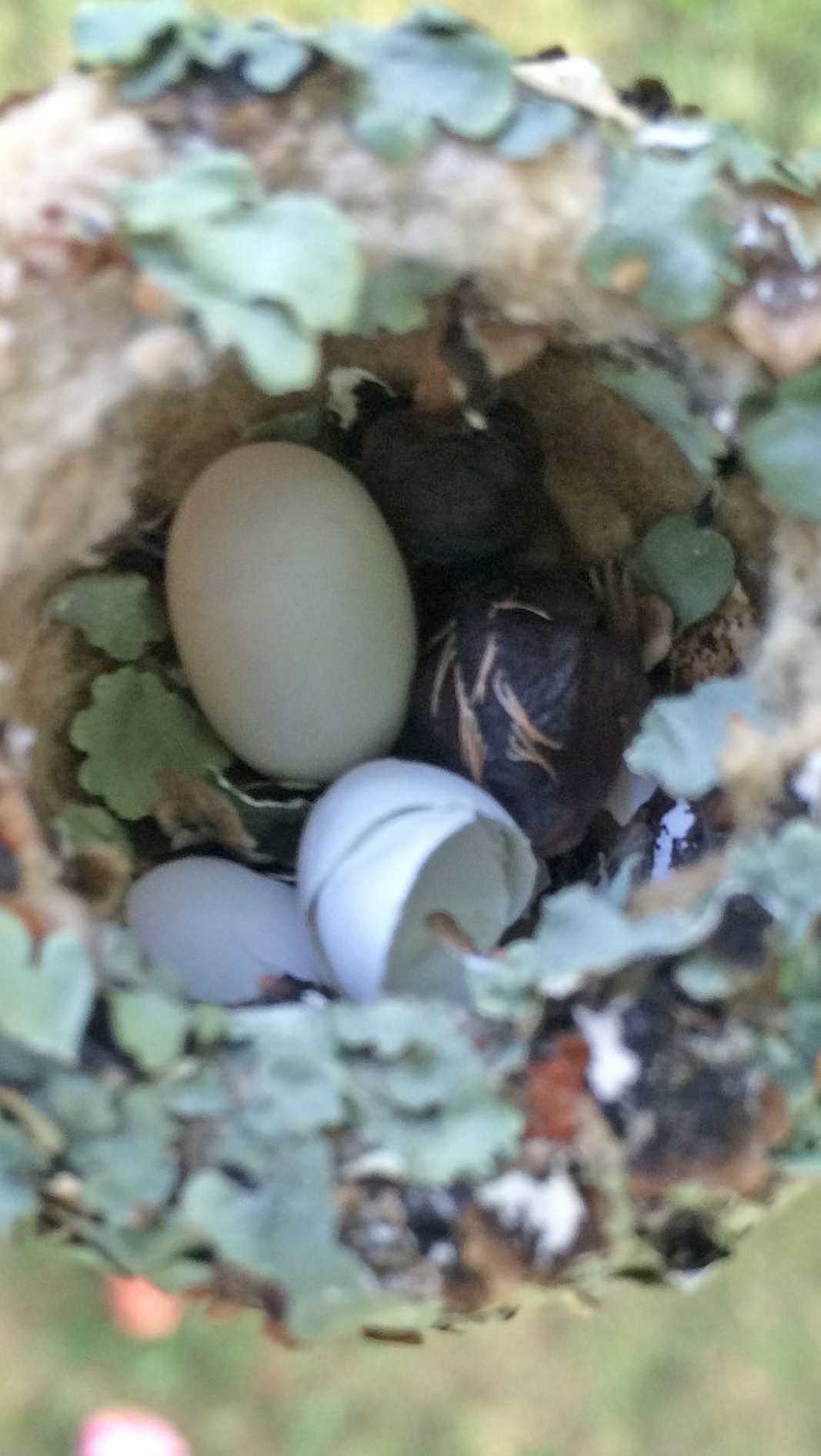
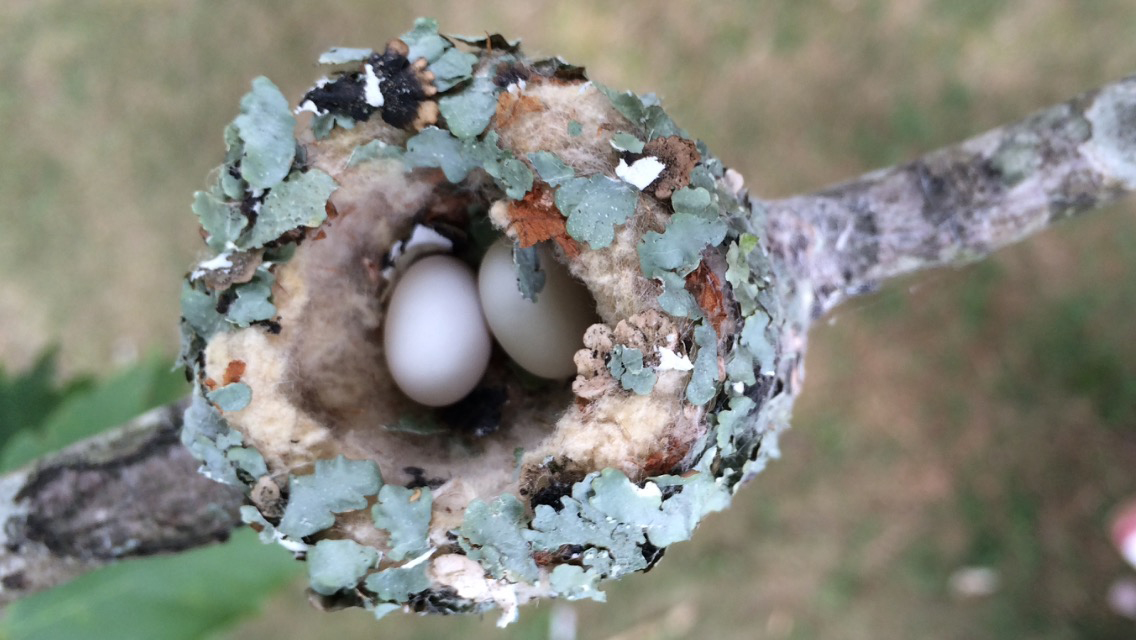
Photo Courtesy of Donna Ottinger                        This nest, filled with two tiny eggs, was discovered in a maple tree in a Bluff City yard by Donna Ottinger.

For Bluff City, Tennessee, resident Donna Ottinger, the show in her front yard beats anything you might find on television this summer. Since late July, Donna has been watching a female ruby-throated hummingbird that she has named Bliss carry out her nesting duties.

bliss-feeder

Photo Courtesy of Donna Ottinger                  Bliss the ruby-throated hummingbird visits a feeder for a sip of sugar water.

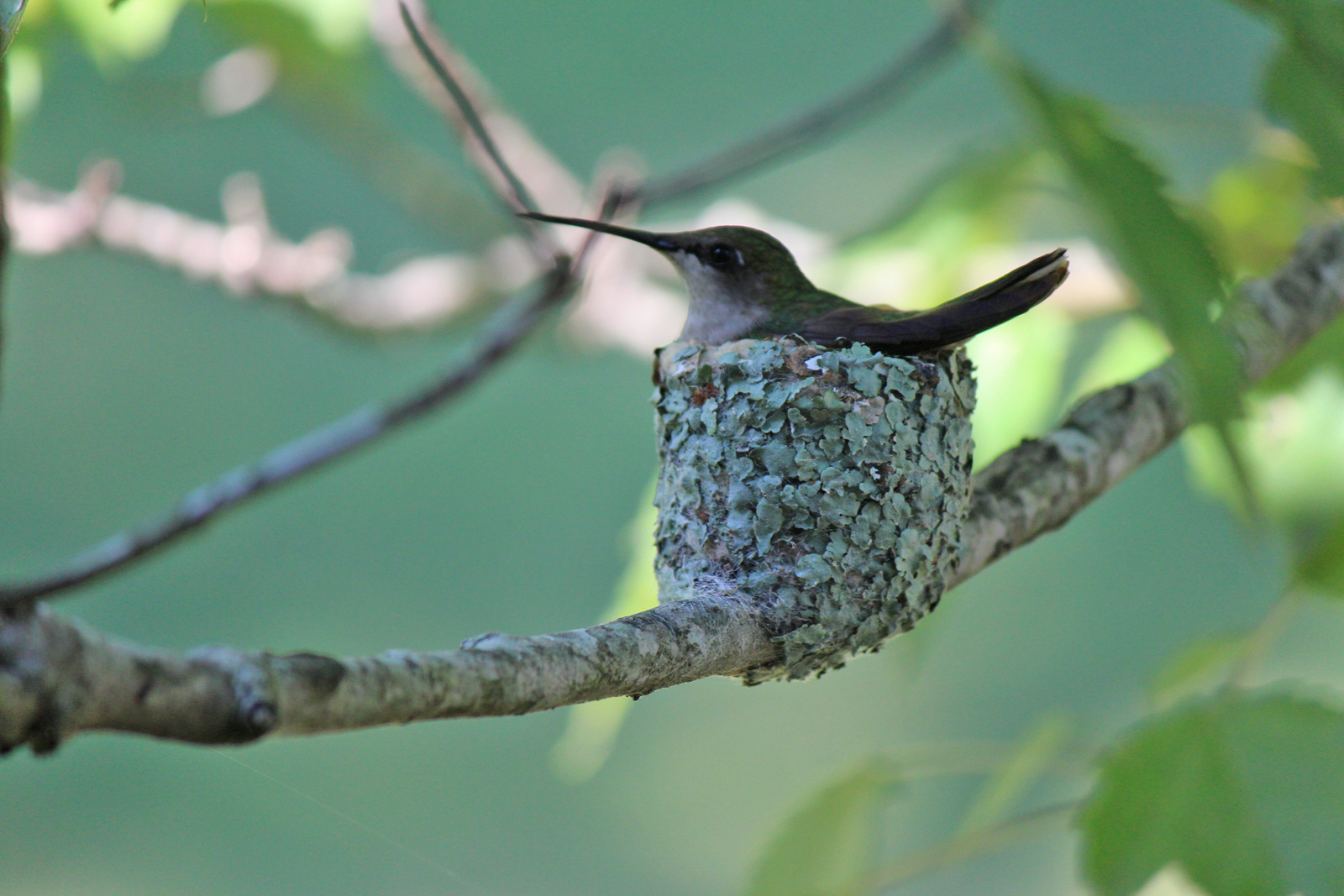
Like all female ruby-throated hummingbirds, Bliss produced two eggs for containment in a delicate nest of spiderweb, lichen and plant fibers woven onto a maple tree branch. There are some reasons why it’s always a pair of eggs for hummingbirds. First, the nest is so small — about the size of a walnut half-shell — that there is barely room for two eggs, let alone more. Second, once the young hatch, the nest has just enough room to accommodate them as they grow, fed well by their mother. Third, feeding two hungry young hummingbirds is a demanding task. A female hummingbird has to find enough food to fuel her own body and help her young in the nest grow and thrive. It’s a full-time job during the daylight hours. She’s pressed hard to succeed at raising two young. Attempting to rear more would most likely prove impossible.

Donna compared the two tiny eggs to Tic Tac mints. The entire process — from building the nest to incubating eggs to tending hatchlings — requires a commitment of more than two months. Donna noted that even after the young hummingbirds hatched, Bliss continued to reinforce the nest with collected silk from spider webs.

Donna kept the nest under observation after she discovered it in late July. As she noted on her Facebook page, finding a hummingbird nest is not an everyday occurrence. The nest is on one of the lower branches of a large maple tree in her front yard only a short distance from her porch. She was able to sit comfortably while watching Bliss come and go to her tiny nest.

bliss-incubating

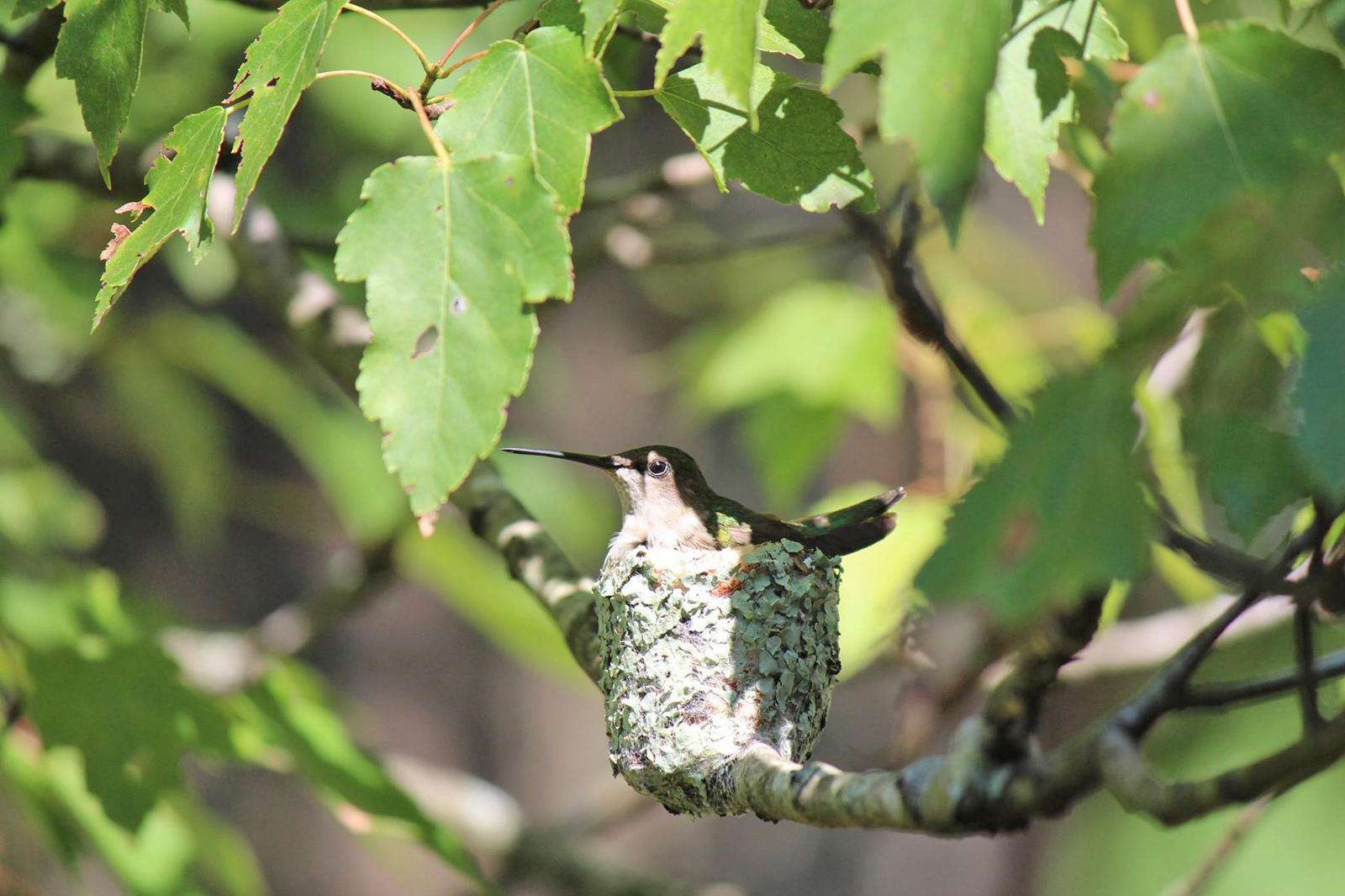
Photo Courtesy of Donna Ottinger                                           Bliss, a ruby-throated hummingbird, sits on her nest to incubate her two eggs.

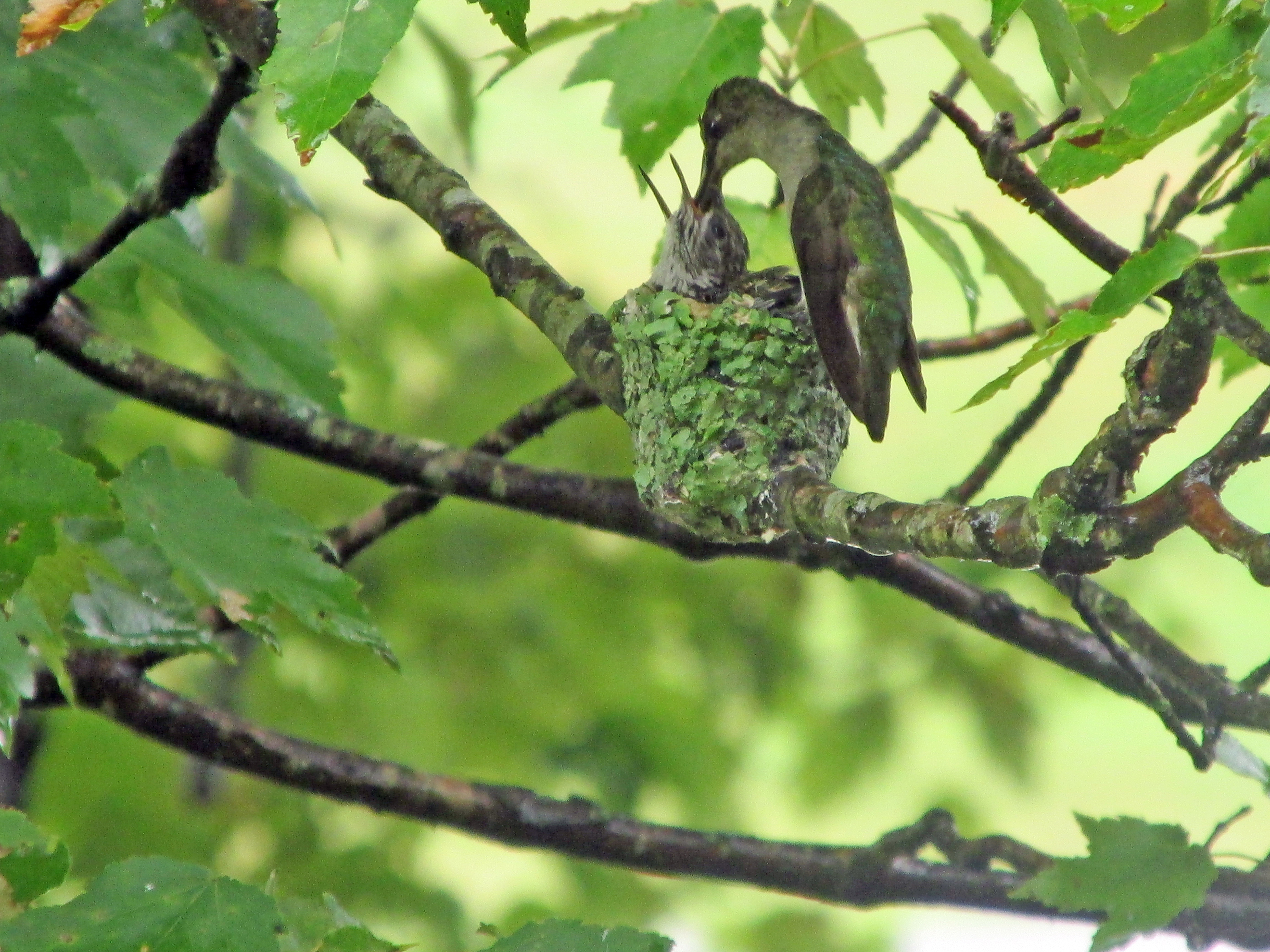
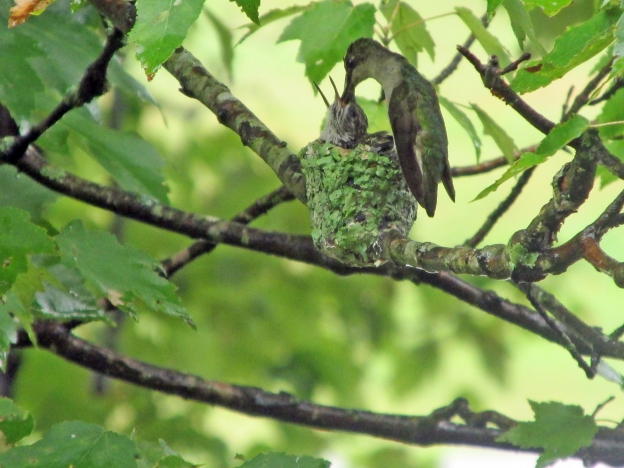
“It’s been a real blessing,” Donna told me when we met in person on Aug. 19. She was gracious enough to permit my mom and me to sit on her front porch and enjoy the show. During our visit, we got to watch as Bliss arrived to feed the babies. It’s not a spectacle for the squeamish. Bliss plunged her long bill deep into the throats of each baby bird in turn and pumped some nutritious contents into the growing youngsters. Despite the fact that it looked like she could easily impale the babies, they suffered no ill effects and looked quite full and satisfied after the visit.

aug-1-monday-just-hatched-this-morning

Photo Courtesy of Donna Ottinger              On Aug. 1, one chick hatched. The second chick hatched the following day, making for a very full nest.

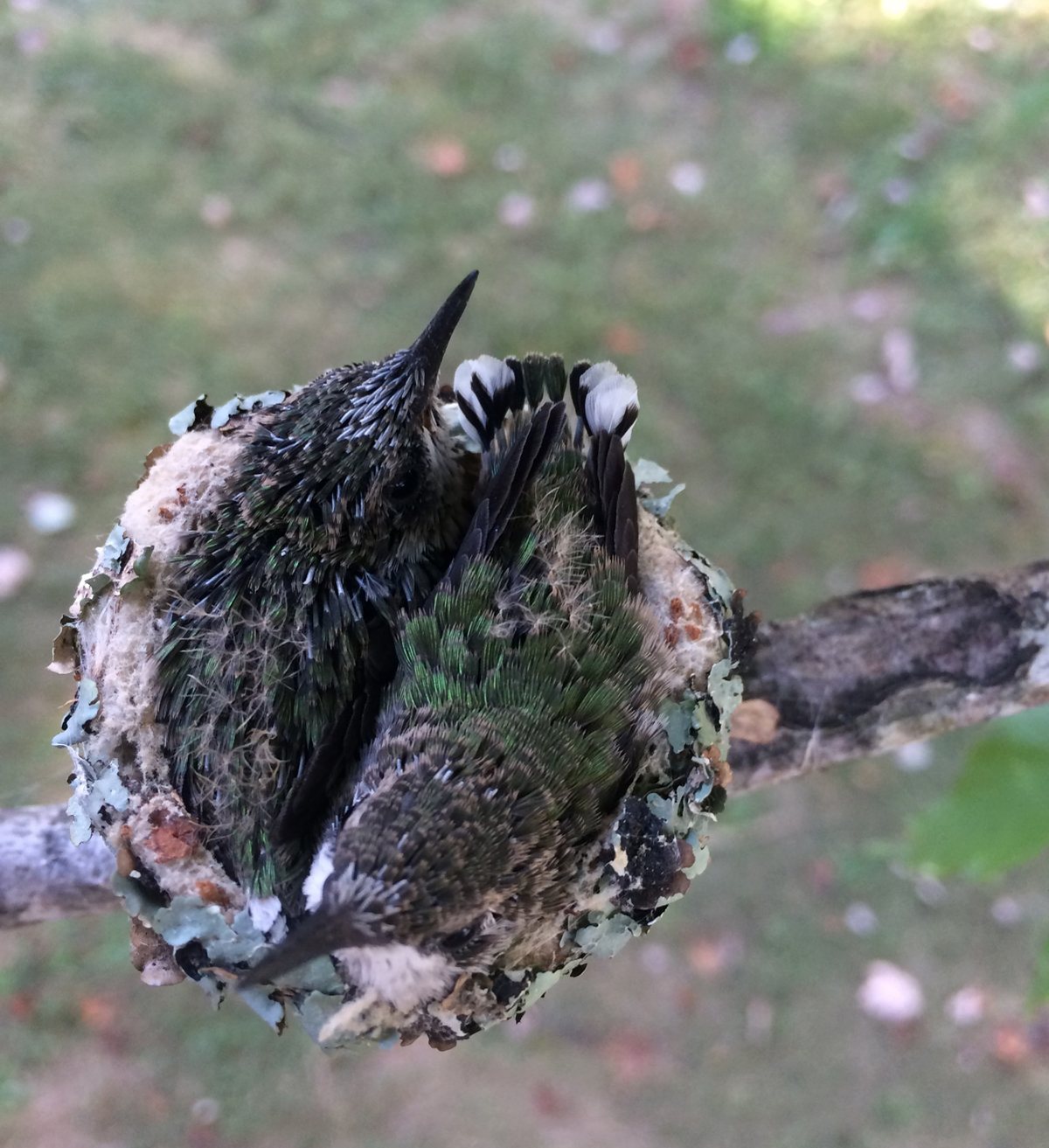
The two babies were hatched on Aug. 1 and Aug. 2, respectively. The staggered hatching reflects the fact that Bliss also laid the eggs on separate days. Not knowing the gender of the babies, Donna named the Aug. 1 hatchling Monday for the day of the week hatching took place. In turn, the second baby, which escaped its shell on Aug. 2, was named Tuesday.

Once hatched, young hummingbirds remain in the nest about 28 days (nearly a month) and depend on their mother to bring them regular meals. If that’s not enough, the ruby-throated hummingbird is known to nest twice in a season. It certainly must rank a female hummingbird as one of the busiest of our summer birds. At the time I wrote this column, Monday and Tuesday had still not left the nest.

The young hummers have grown at an astonishing rate and Donna has witnessed their progress day by day. She noted that young hummers start off life with a short bill. Like the rest of their bodies, however, their bills have grown accordingly as Monday and Tuesday received regular feedings from Bliss.

aug-13-monday-and-tuesday-with-more-feathers

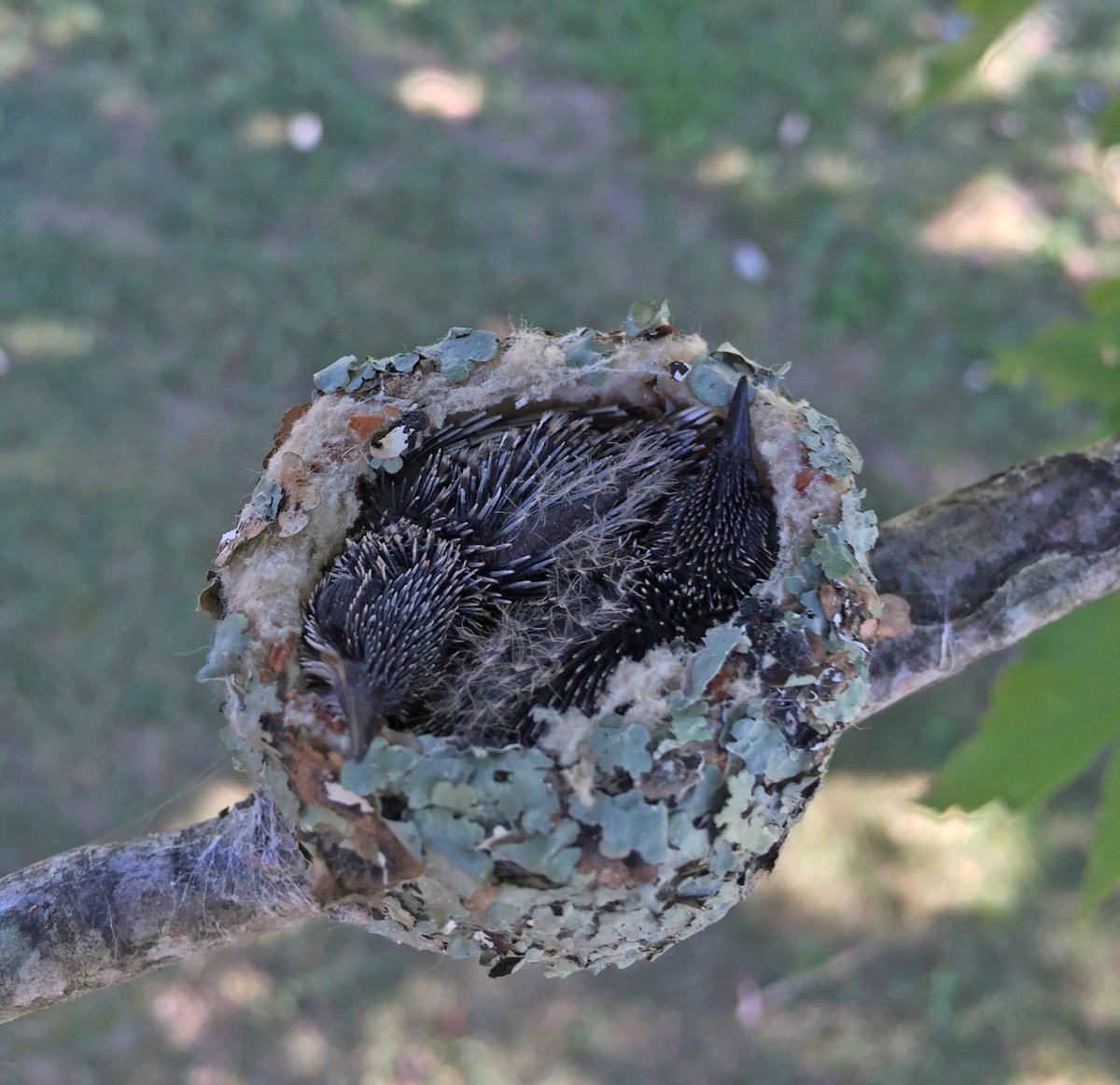
Photo Courtesy of Donna Ottinger                Having grown at a rapid pace, hummingbird chicks Monday and Tuesday find their nest growing rather cramped by mid-August.

Female hummingbirds receive no assistance from their mates. Males don’t assist with the rearing of their own young. For male hummingbirds, summer is mainly a time to thrive on the abundance of nectar-bearing blooms, as well as a profusion of tiny insects and spiders that also make up a good portion of their diet.

When I saw them, I knew that little Monday and Tuesday would be out of the nest in a short time. It would also be necessary for them to soon begin fall migration. On Aug. 23, Donna reported on her Facebook page that the young hummers had left the nest.

hummer-mother

Photo by Bryan Stevens                                   Bliss feeds her two young hummingbirds.

“Just three weeks after hatching, the baby hummers have both left the nest,” she wrote in her post. “They didn’t go far, and Bliss is still feeding them in a nearby tree where they have taken up new residence.”

The next generation of hummingbirds always helps swell the number of these tiny birds in our yards in late summer and early fall. Keeping visiting ruby-throated hummingbirds can be as simple as planting an abundance of the flowers they love, but offering multiple sugar water feeders also helps. Keep the sugar water mix at a four parts water to one part sugar ratio. Don’t offer honey in your feeders. When mixed with water, it can spoil and spread fungal diseases. Remember that hummingbirds don’t subsist on sugar water alone. They also eat numerous tiny insects and spiders to obtain the protein they need for their dietary needs, so don’t use insecticides near feeders or flowers that hummers are likely to visit.

aug-17-monday-and-tuesday-with-color-showing-on-feathers

Photo Courtesy of Donna Ottinger  Monday and Tuesday find the nest increasingly crowded in the days before they fledged.

It was absolutely wondrous to observe Bliss and her babies. The experience has motivated me to keep a closer watch on the hummingbirds in my yard. There are female hummers present every summer. They have to be nesting somewhere, and I’d like to find a nest in my own yard.

•••••

To learn more about birds and other topics from the natural world, friend Stevens on Facebook at https://www.facebook.com/ahoodedwarbler. He is always posting about local birds, wildlife, flowers, insects and much more. If you have a question, wish to make a comment or share a sighting, email ahoodedwarbler@aol.com.
aug-13-monday-and-tuesday-with-more-feathers

Photos Courtesy of Donna Ottinger            Monday and Tuesday share a compact nest.

13661895_1230239206996666_2874895669499226165_o

Bliss incubates her eggs at her nest in Bluff City, Tennessee.