Tag Archives: Carter County Compass

Look for herons along edges of local ponds, rivers

I enjoyed a recent trip to Atlanta, Ga. The extended weekend visited gave me the opportunity to see some birds I don’t see often at home in Northeast Tennessee, including Brown-headed Nuthatch and Pine Warbler.

Photo by Bryan Stevens A Great Egret resting on a spit of land in a lake at Murphy Candler Park in Brookhaven, Ga.

Photo by Bryan Stevens
A Great Egret resting on a spit of land in a lake at Murphy Candler Park in Brookhaven, Ga.

I observed a Great Egret at Murphey Candler Park in Brookhaven, Georgia. Hiking trails around a small lake at this park offer some convenient locations for scanning the lake for wading birds and waterfowl. The egret was the first Great Egret I’ve observed in the Atlanta area.

I had visited this park hoping to find dragonflies, but for the most part struck out on finding these winged insects. I was compensated not only with the egret, but with observations of Double-crested Cormorants, Canada Geese, Mallards, Belted Kingfishers, Cedar Waxwings and Song Sparrows.

Photo by Bryan Stevens A Great Blue Heron moves stealthily through a wetland.

Photo by Bryan Stevens
A Great Blue Heron moves stealthily through a wetland.

Egrets are members of a family of birds known as Ardeidae, which includes herons, bitterns and egrets. The Great Egret is a very stately, graceful bird with white plumage, long legs and a sharp, yellow bill. It is smaller than the Great Blue Heron. The Great Egret stands 3.3 feet tall and has a wingspan of 52 to 67 inches. On average, however, they weigh only about 2.2 pounds.

Photo by Bryan Stevens A large flock of Great Egrets flies over the Watauga River in Elizabethton.

Photo by Bryan Stevens
A large flock of Great Egrets flies over the Watauga River in Elizabethton.

These egrets nest in large colonies. In the late 1800s and early 1900s, the colonial nesting habits of these birds made them particularly vulnerable to humans who slaughtered the birds in the millions to harvest their feathers for use in the fashion industry. The Great Egret and other wading birds were almost decimated in order to decorate fashionable hats for women.

The National Audubon Society was founded in 1905, largely as an effort to combat the unregulated slaughter of birds like Great Egrets, Snowy Egrets and Roseate Spoonbills. Now, more than a century later, the Great Egret still serves as the official logo for the National Audubon Society. In addition, the Great Egret has rebounded from those dark years. In fact, this bird now ranges as far north as southern Canada in appropriate wetland habitats. During spring and fall migration, Great Egrets also pass through northeast Tennessee. Look for them along rivers, lakes and on small farm ponds.

During visits to favorite birding locations in Elizabethton and Erwin, I have also observed Green Herons and Great Blue Herons.
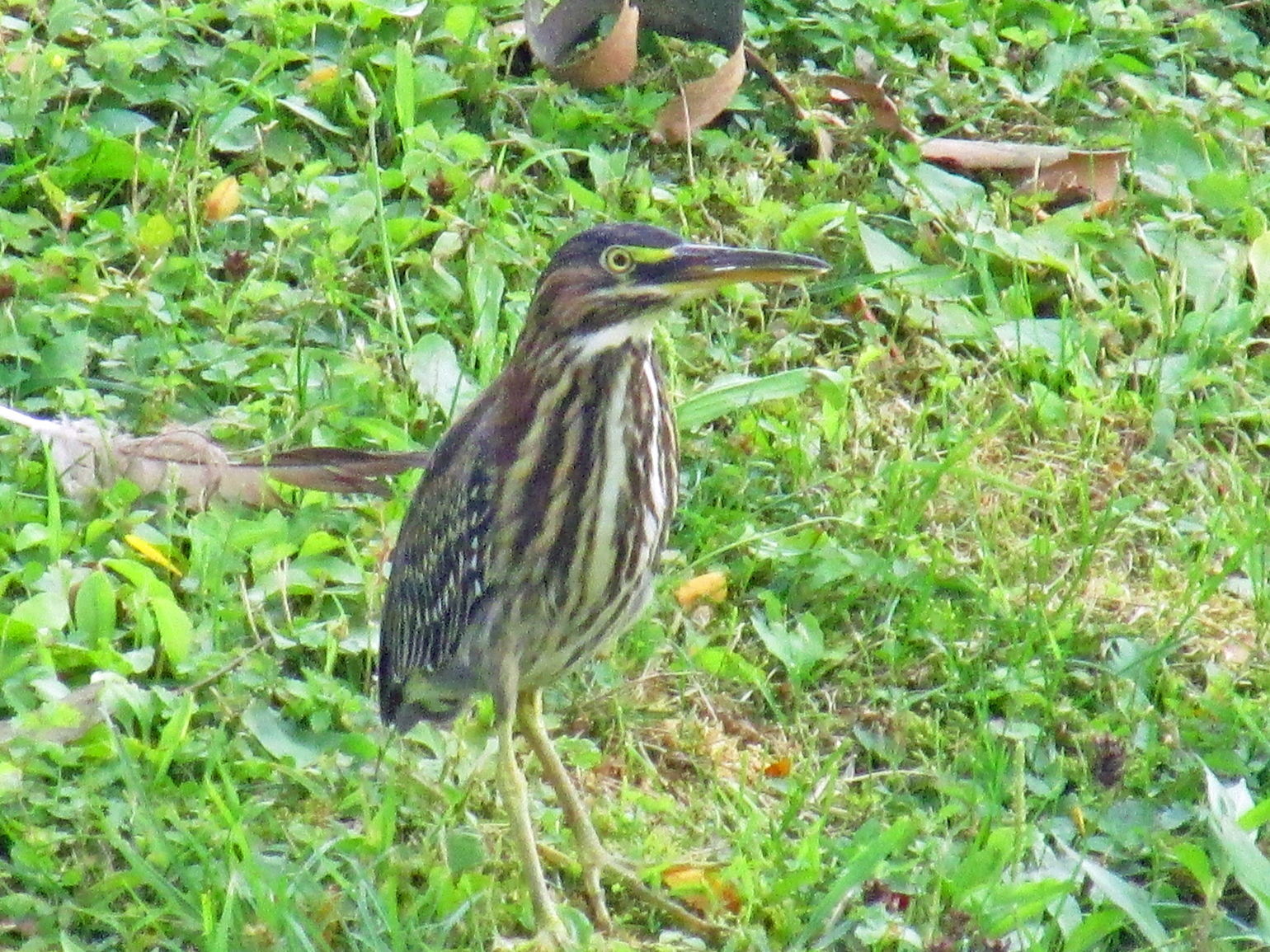
Photo by Bryan Stevens A young Green Heron rests at the edge of a pond.

Photo by Bryan Stevens
A young Green Heron rests at the edge of a pond.

The Green Heron can easily be overlooked as it lurks near a stream’s banks or the edges of a pond. This heron is not tall and stately like the Great Egret or Great Blue Heron. The bird is a patient ambush predator capable of remaining motionless for extended periods as it waits for prey to move within reach of its sharp, pointed bill. I’m always flushing these herons from cover before I even realize they are present.

I do get fortunate on occasion, however, and manage to approach a Green Heron without panicking the bird into a hasty flight. If you stand very still and don’t make sudden movements, you can manage to observe this bird from a respectful distance.

Such was the case of a Green Heron that I found stalking the edges of the pond at Erwin Fishery Park. I had my camera, so I snapped some photographs as I watched the heron’s slow, deliberate steps along the pond’s edge. Then, with a lightning-quick motion, the bird lunged its bill into the water and snatched a large tadpole. The heron required a brief time to get the wiggling tadpole positioned. After that technicality was resolved, the heron swallowed the plump tadpole quickly and almost immediately resumed search for more prey.
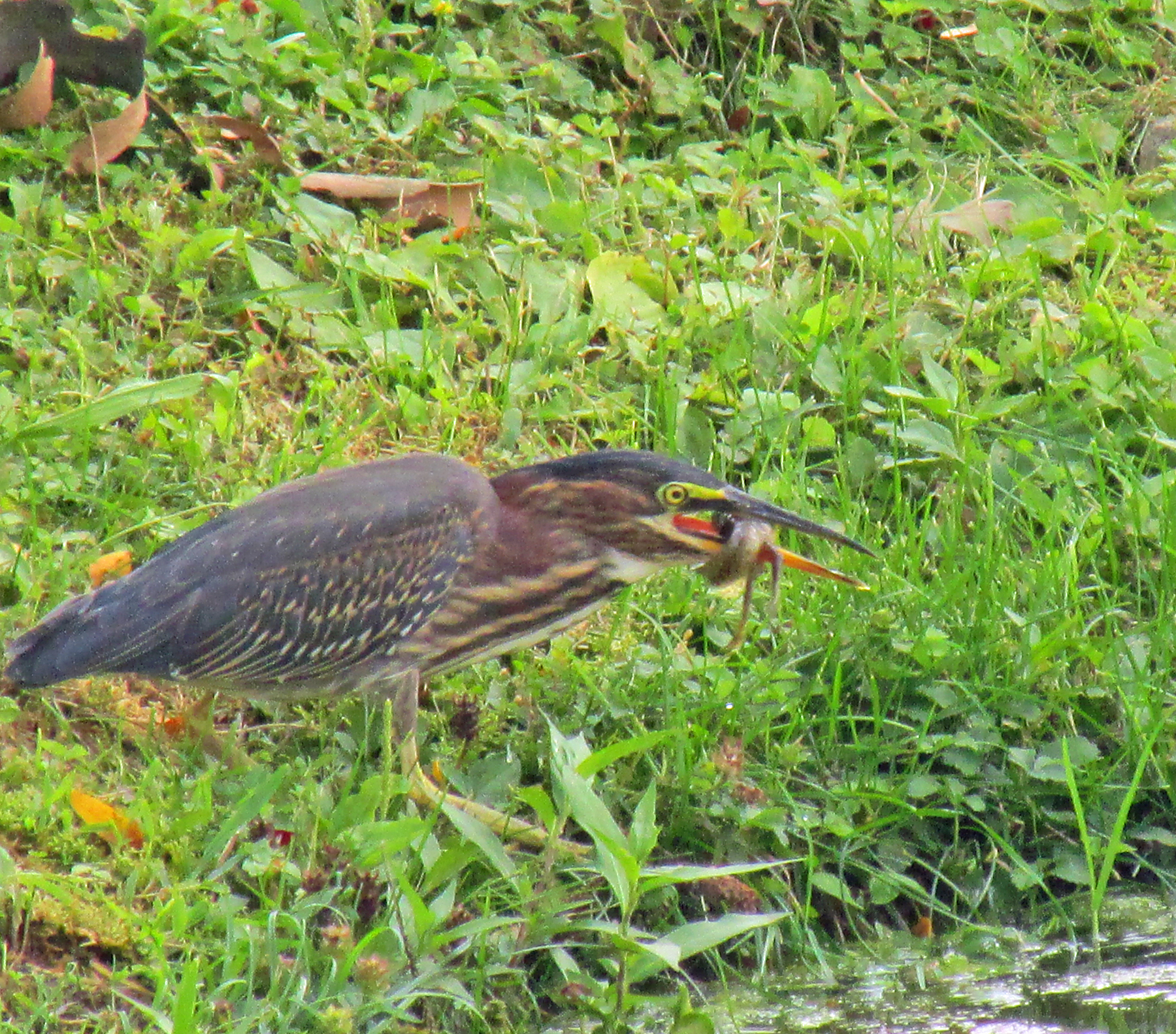
Photo by Bryan Stevens A Green Heron finesses a captured tadpole in its bill.

Photo by Bryan Stevens
A Green Heron finesses a captured tadpole in its bill.

The unfortunate tadpole had developed hind legs, which did not prove an obstacle for the bird swallowing it, but still had a tail. Although it was very close to achieving frog-hood, this particular tadpole instead became part of the varied diet of a Green Heron, which can also include fish, crustaceans, insects and even mice. At this same Erwin pond, I once watched another Green Heron patiently stalking and successfully snatching dragonflies that perched on pond vegetation within reach of the bird’s bill.
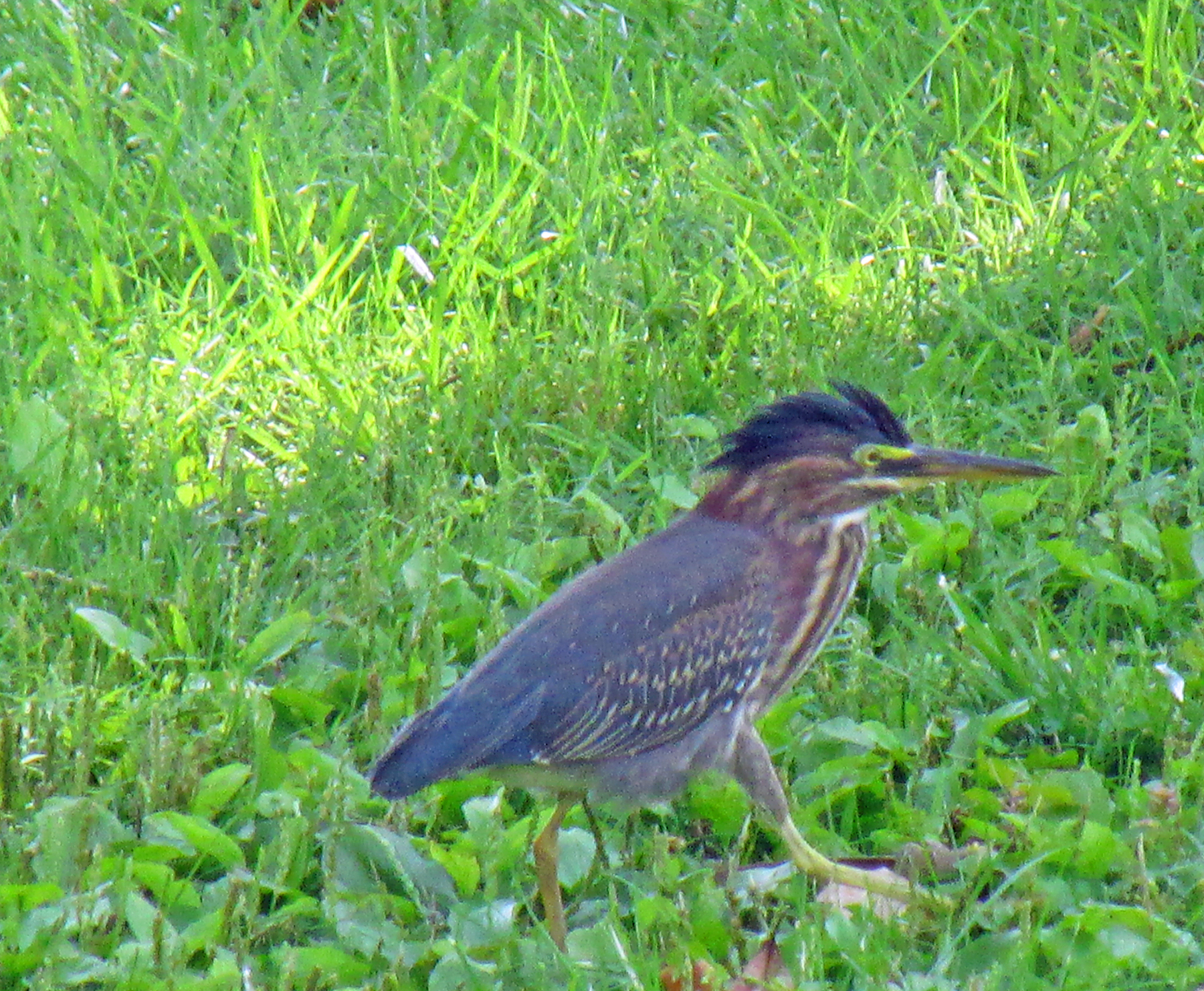
Photo by Bryan Stevens A Green Heron elevates a shaggy crest of feathers, a behavior often initiated when the bird feels alarmed.

Photo by Bryan Stevens
A Green Heron elevates a shaggy crest of feathers, a behavior often initiated when the bird feels alarmed.

The Green Heron is usually present in Northeast Tennessee from April to October. The bird migrates to Central America for the winter months. A few other herons, including the Great Blue Heron and the Black-crowned Night-Heron, live year-round in the region.
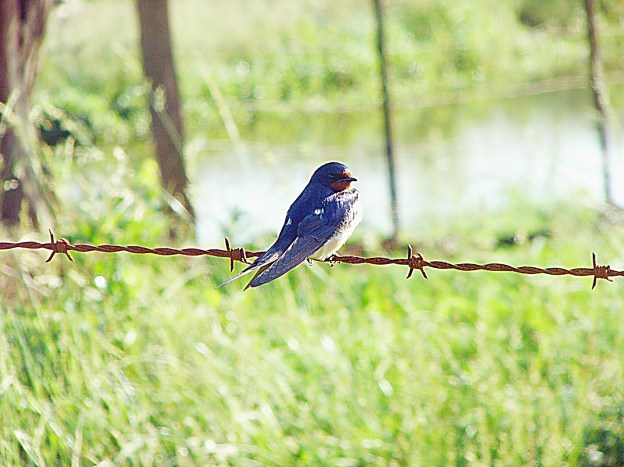
Summer is the season of the swallow


No matter where you live, you probably don’t have to go far to see one of the members of the swallow family. These graceful, aerodynamic birds are quite familiar to most people. If you spend much time at all outdoors during the summer months, chances are you’ve observed some members of this family.

Overall, it’s been a good year for swallows. It’s usually not too difficult to find five of the six species that are known to make Northeast Tennessee and Southwest Virginia their home from spring to fall. In addition to barn and tree swallows, I have seen purple martins, cliff swallows and northern rough-winged swallows so far this year.

Photo courtesy of Mary Taylor Beierle A tree swallow peeks inside a nest box at the Beierle home.

Photo courtesy of Mary Taylor Beierle
 A tree swallow peeks inside a nest box at the Beierle home.

Barn swallow and tree swallow are the two members of the family that are probably best known to people. They have adapted to life in both suburban and rural areas, which brings them into frequent contact with people.

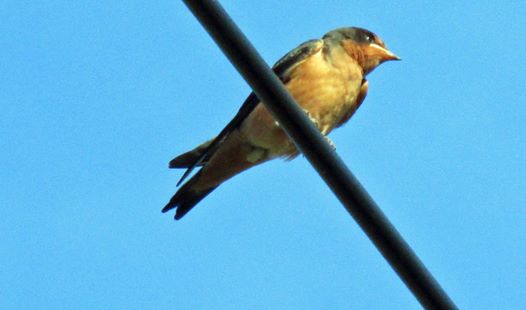
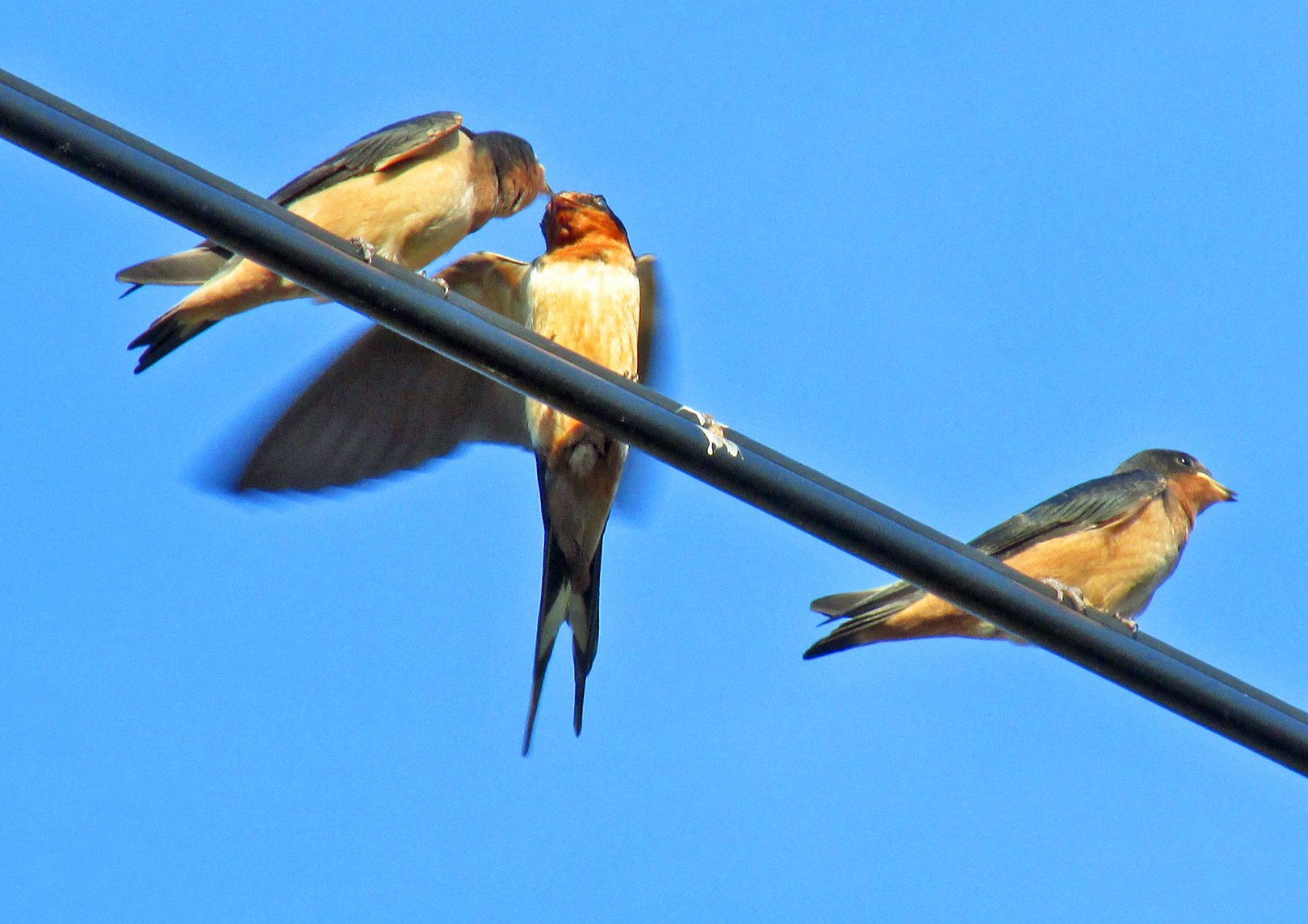
These days, the barn swallow is as apt to nest in a parking garage or on an apartment balcony as inside a barn in the countryside. Once young swallows leave the nest, parents will park them on a perch as they continue to feed the still dependent young. Adults fly over nearby fields, foraging for insects that they catch on the wing and deliver back to the waiting, always hungry, young birds.

A freshly mown field is a magnet for swallows. I don’t know how the word spreads so quickly among these birds, but I’ve observed dozens of these birds descending on fields soon after they have been mowed for hay. At times, the birds arrive while the mowing is still taking place, swooping after insects stirred up in the tractor’s wake.

I haven’t observed any bank swallows in the region this year, but these members of the swallow family are rather hit-or-miss in the region. Because of their specialized nesting needs, bank swallows are localized in their distribution and not as widespread as their kin.

Cliff swallows nest beneath many local bridges. These swallows, which at one time nested primarily on rocky cliffs, hence their name, now frequently nest under man-made structures. These swallows make their jug-shaped nests out of mud and clay. These nesting “jugs” are all located in clusters beneath bridges and other structures. It’s a wonder that the parents flying in with food are able to tell their nests apart from the nearby seemingly identical nests of their neighbors.

NRW-Swallow

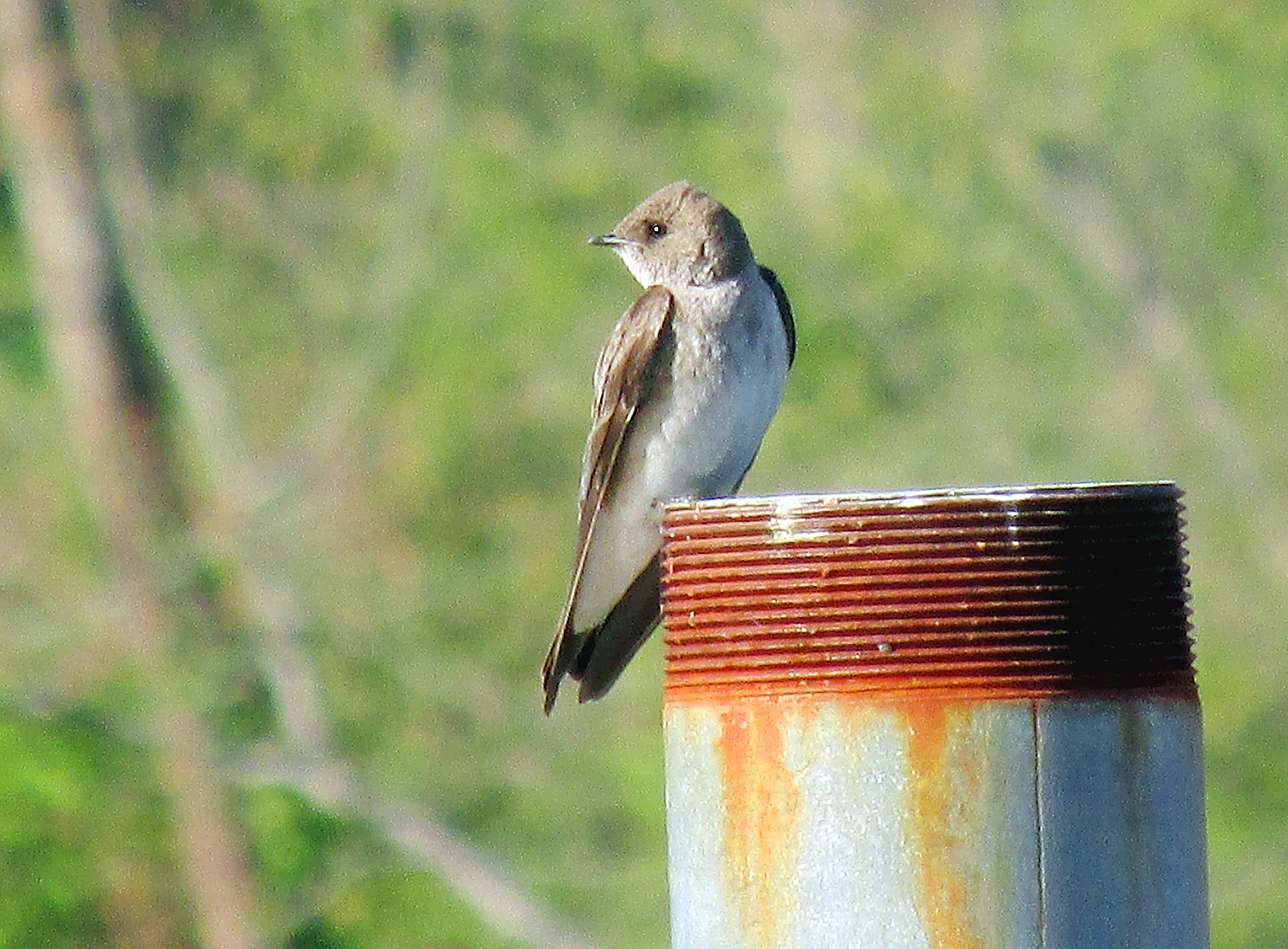
Photo by Bryan Stevens                                  For such a small bird, the Northern rough-winged Swallow has a long name.

Northern rough-winged swallows are opportunists when it comes to nesting. According to a profile written by Mark Johns with North Carolina Wesleyan College, this small swallow nests near rocky gorges, shale banks, stony road cuts, railroad embankments, gravel pits, eroded margins of streams and other exposed banks of clay, sand or gravel. They will also nest in old kingfisher burrows, protruding drainpipes, crevices in brick or stone structures such as dams, bridges or tunnels, gutters and culverts. Their nests are often built near open water.

The Northern rough-winged swallow ranks as one of the species with the longest common names in North America. It’s name consists of 26 letters and a hyphen, which ranks it one letter below both the Northern beardless-tyrannulet and a recently-created species — the saltmarsh sharp-tailed sparrow — which each have 27 letters and a hyphen. Formerly known as sharp-tailed sparrow, the species was renamed with “salt marsh” added to distinguish it from a relative, Nelson’s sparrow.

TreeSwallow-MaryBierlie

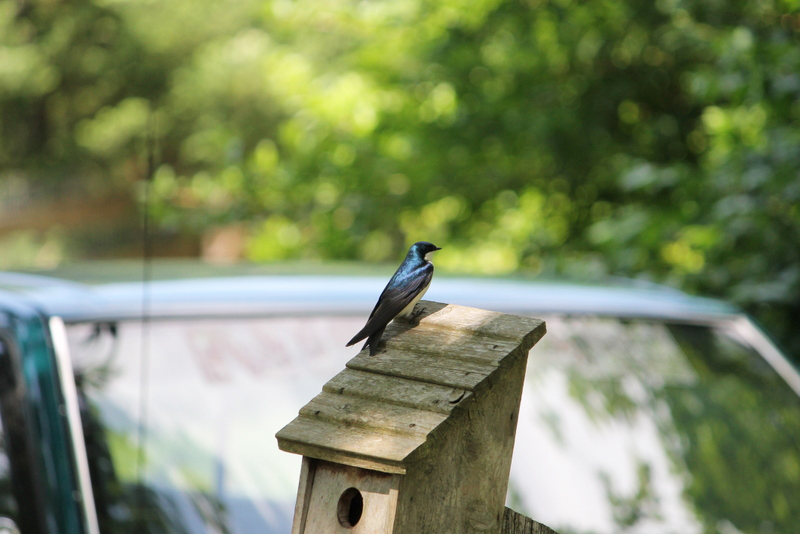
Photo courtesy of Mary Taylor Beierle                                      A male Tree Swallow surveys his territory from atop a nesting box.

Purple martins, which rank as the largest species in the swallow family in North America, are famous for nesting in large colonies. Nesting facilities range from groupings of natural or artificial gourds fashioned into a nesting chamber, as well as large, multi-level condominium dwellings tailored for the specific needs of this communal bird. A colony can consist of several dozen to several hundred pairs of these birds. Only the adult male purple martin shows the iridescent, dark blue-purple plumage that provides the species with its name.

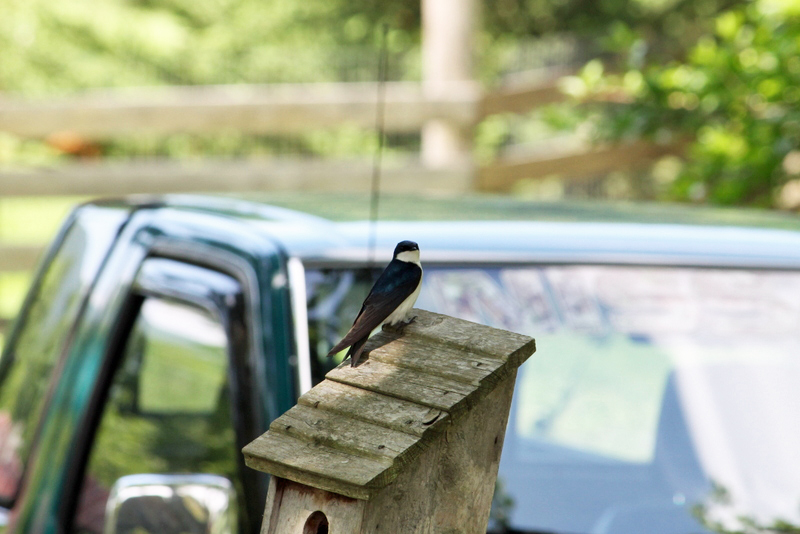
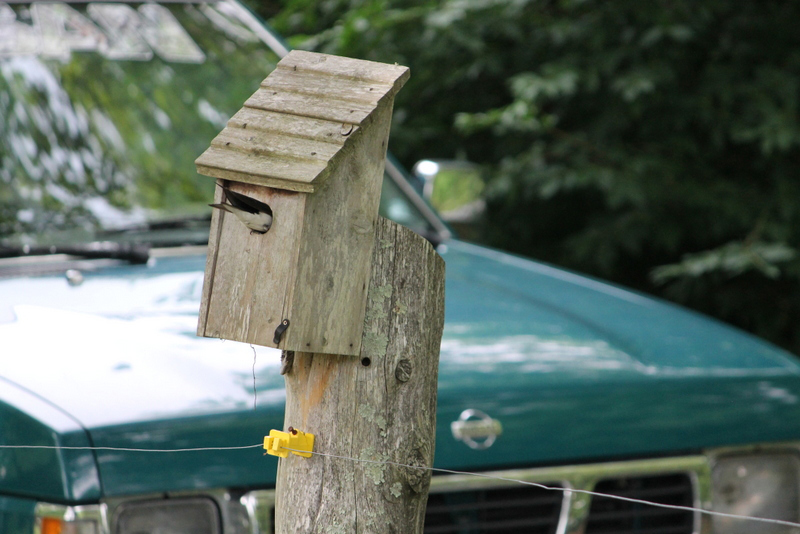
The tree swallow is my favorite, probably because a pair of these birds has nested in my yard for many years. Unlike other swallows, these cavity-nesting birds will readily accept nesting boxes. They compete with Eastern bluebirds for boxes, but the two species usually can work out a truce and settle down to nest in close proximity to each other. The iridescent blue-green male tree swallow, complete with white underparts and a forked tail, is a handsome bird and a welcome addition to the bird population in any yard or garden. Tree swallows enjoy water, so a nearby pond or creek is a boon for attracting these birds.

TreeSwallowPerched-Bierlie

Photo courtesy of Mary Taylor Beierle          Tree swallows readily accept human-provided nesting boxes. They also make delightful neighbors during the summer season.

While only a few swallows range into the United States and Canada, a total of 83 species of swallows can be found worldwide. Some of the common names for these different swallows (and martins) are quite descriptive. A sampling includes white-eyed river martin, square-tailed saw-wing, white-headed saw-wing, grey-rumped swallow, white-backed swallow, banded martin, violet-green swallow, golden swallow, brown-chested martin, brown-bellied swallow, pale-footed swallow, white-bibbed swallow, pearl-breasted swallow, greater striped swallow, mosque swallow, fairy martin and chestnut-collared swallow.

••••••

Several of the photos this week were provided by Mary Taylor Beierle, a resident of Stoney Creek in Carter County. Mary is also the author of the book, “Edmond The Daddy Turkey,” a delightful story about a male turkey who learns how to be a father.

Mary emailed me the photos with a brief note about her visiting swallows.  “I am thrilled to have them here as we had never seen them before,” she said. “Good thing I have several bird books so I could identify them.”

To learn more about Mary’s book, visit http://www.amazon.com/Edmond-Daddy-Turkey-Taylor-Beierle/dp/0985986123

10441231_838490356179548_1093306511537972714_n

Photo by Bryan Stevens A Barn Swallow perches on a utility wire over a field.

Summer counts reflect busy time of year for local birds

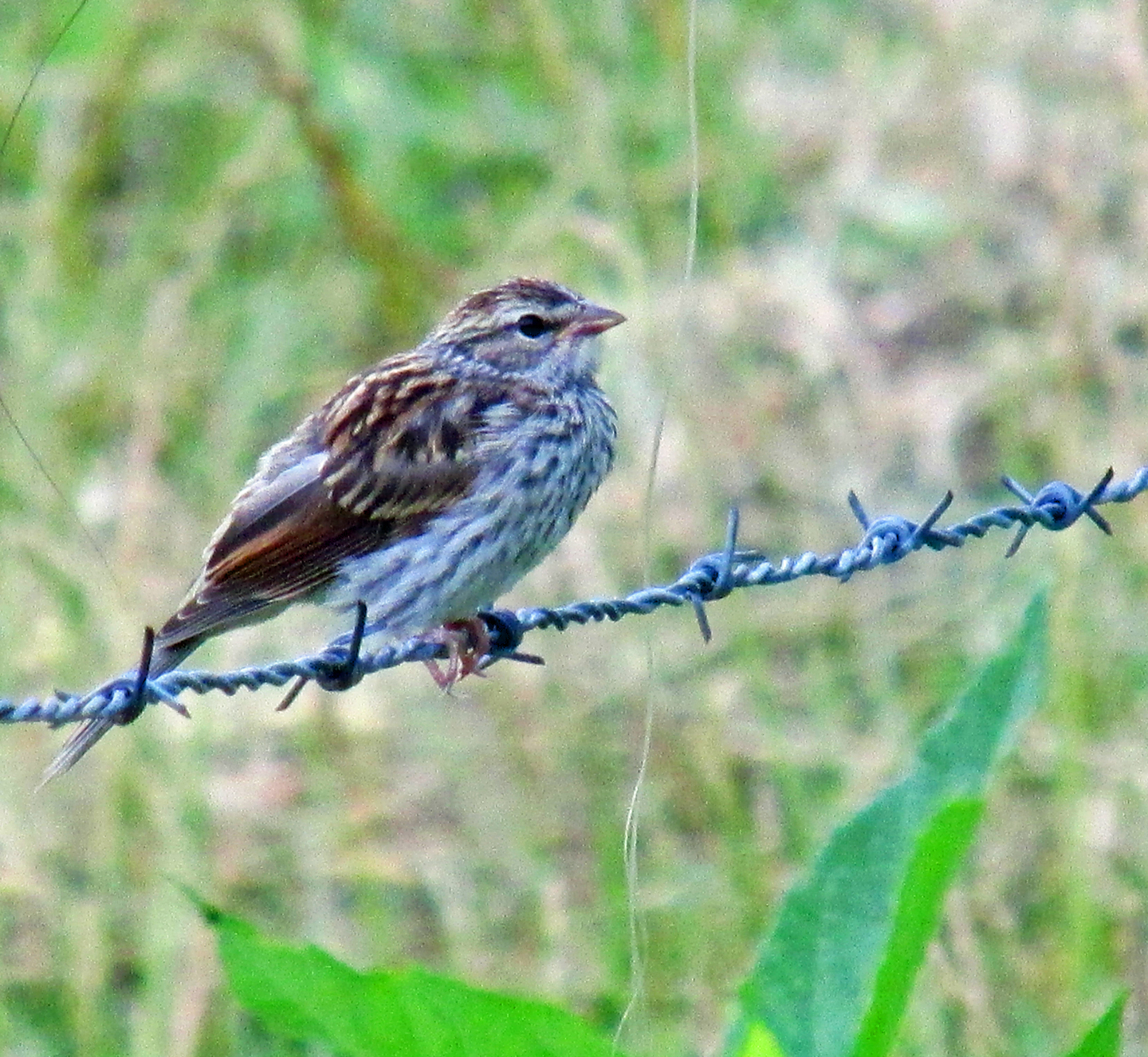
Photo by Bryan Stevens  Many young birds, such as this Chipping Sparrow on a barbed wire fence in Limestone Cove in Unicoi County, look almost nothing like their parent.

Photo by Bryan Stevens
Above: Many young birds, such as this Chipping Sparrow on a barbed wire fence in Limestone Cove in Unicoi County, look almost nothing like their parent. Upper: Young Tree Swallows test perching skills.

I took part in the two Summer Bird Counts conducted recently by the Lee and Lois Herndon Chapter of Tennessee Ornithological Society in Carter County and Unicoi County on consecutive June Saturdays.

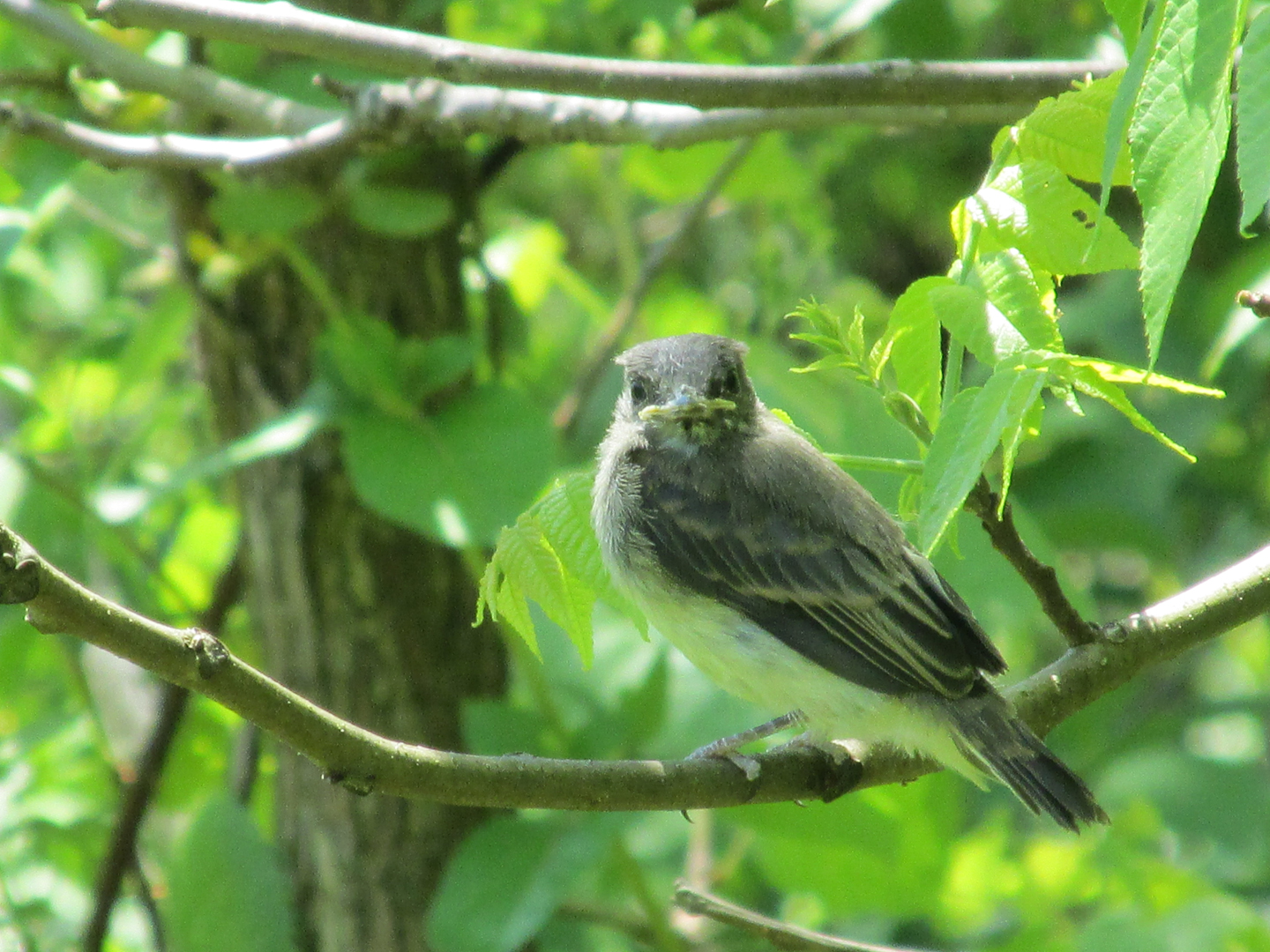
Photo by Bryan Stevens A young Eastern Phoebe perches patiently on a branch while waiting for a parent to bring food.

Photo by Bryan Stevens
A young Eastern Phoebe perches patiently on a branch while waiting for a parent to bring food.

One thing I enjoy about participating in Summer Bird Counts is the prevalence of young birds. It’s only to be expected since the summer season is the time when most local birds build nest, lay eggs and rear young. Some birds got started with the business of raising young back in April and are already attempting second nestings.

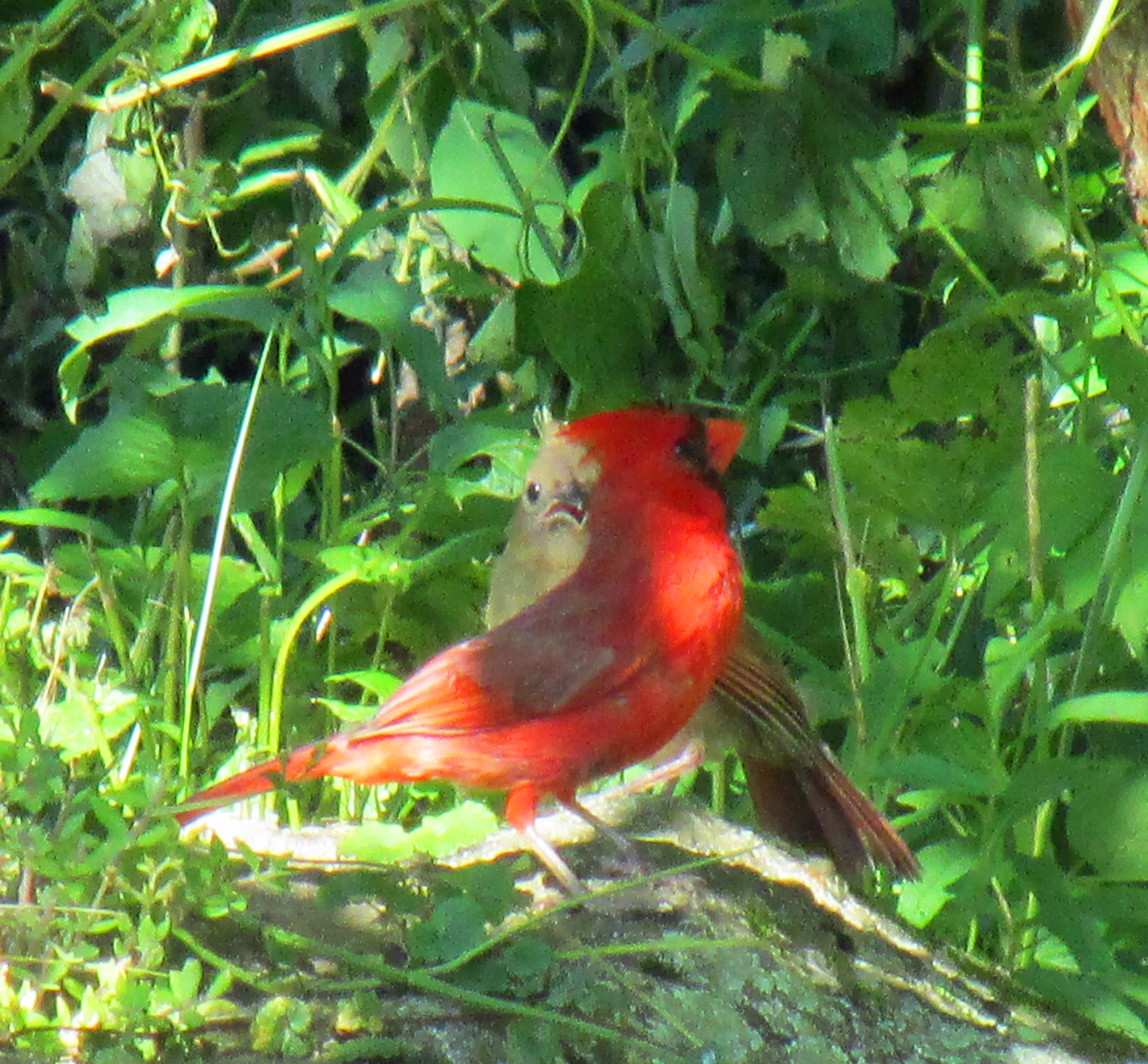
Photo by Bryan Stevens A male Northern Cardinal tends to a fledgling hidden near the ground in thick brush.

Photo by Bryan Stevens
A male Northern Cardinal tends to a fledgling hidden near the ground in thick brush.

This year’s counts reported a variety of young birds among the totals, including numerous Wild Turkey poults, as well as species as diverse as Ruffed Grouse and Chipping Sparrow to Northern Cardinal and Barn Swallow.

I counted birds on Holston Mountain in Elizabethton with Chris Soto and Robert Armistead during the Carter County survey. For the Unicoi County, I teamed with Gary Wallace and John Whinery to count birds in the community of Limestone Cove.

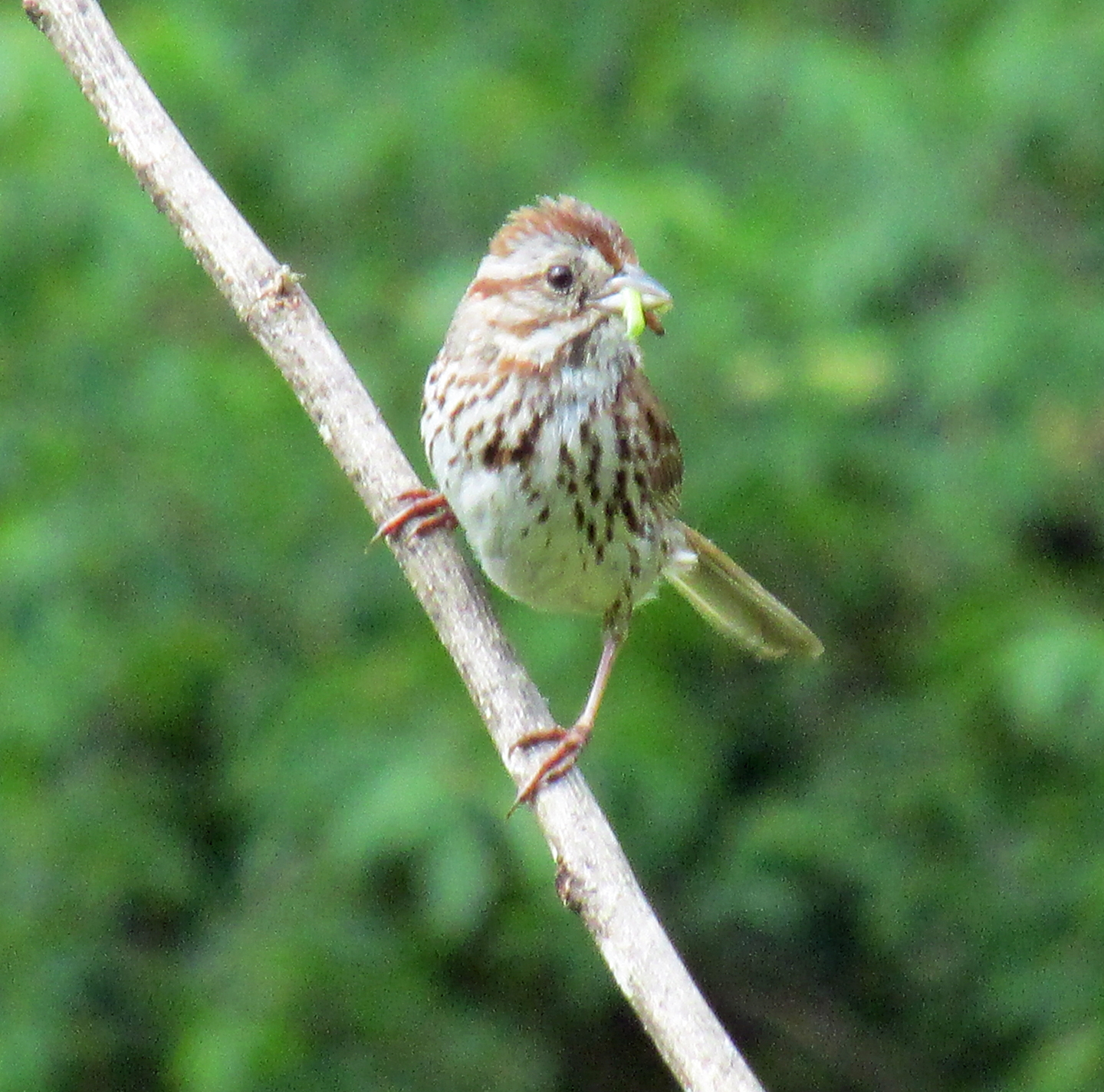
Photo by Bryan Stevens A Song Sparrow brings a beakful of caterpillars back to the nest to feed young.

Photo by Bryan Stevens
A Song Sparrow brings a beakful of caterpillars back to the nest to feed young.

The Carter County and Unicoi County Summer Bird Counts are the only surveys conducted during the summer in Northeast Tennessee and Southwest Virginia. Christmas Bird Counts are more common and include the long-running Bristol CBC and more recent surveys such as the Glade Spring CBC and Shady Valley CBC.

In next week’s post, I will explore the results of the counts in more detail. You might very well be surprised what birds can be found in the region. I know I always am!

Photo by Bryan Stevens A Barn Swallow makes a food delivery to young waiting somewhat patiently on a utility line.

Photo by Bryan Stevens
A Barn Swallow makes a food delivery to young waiting somewhat patiently on a utility line.

Happiness is an Eastern Bluebird


Bluebirds make good neighbors. A pair of Eastern Bluebirds in your yard or garden will have no trouble with minor intrusions into their lives as they go about their daily routine, and the payoff for you is hours of free entertainment.

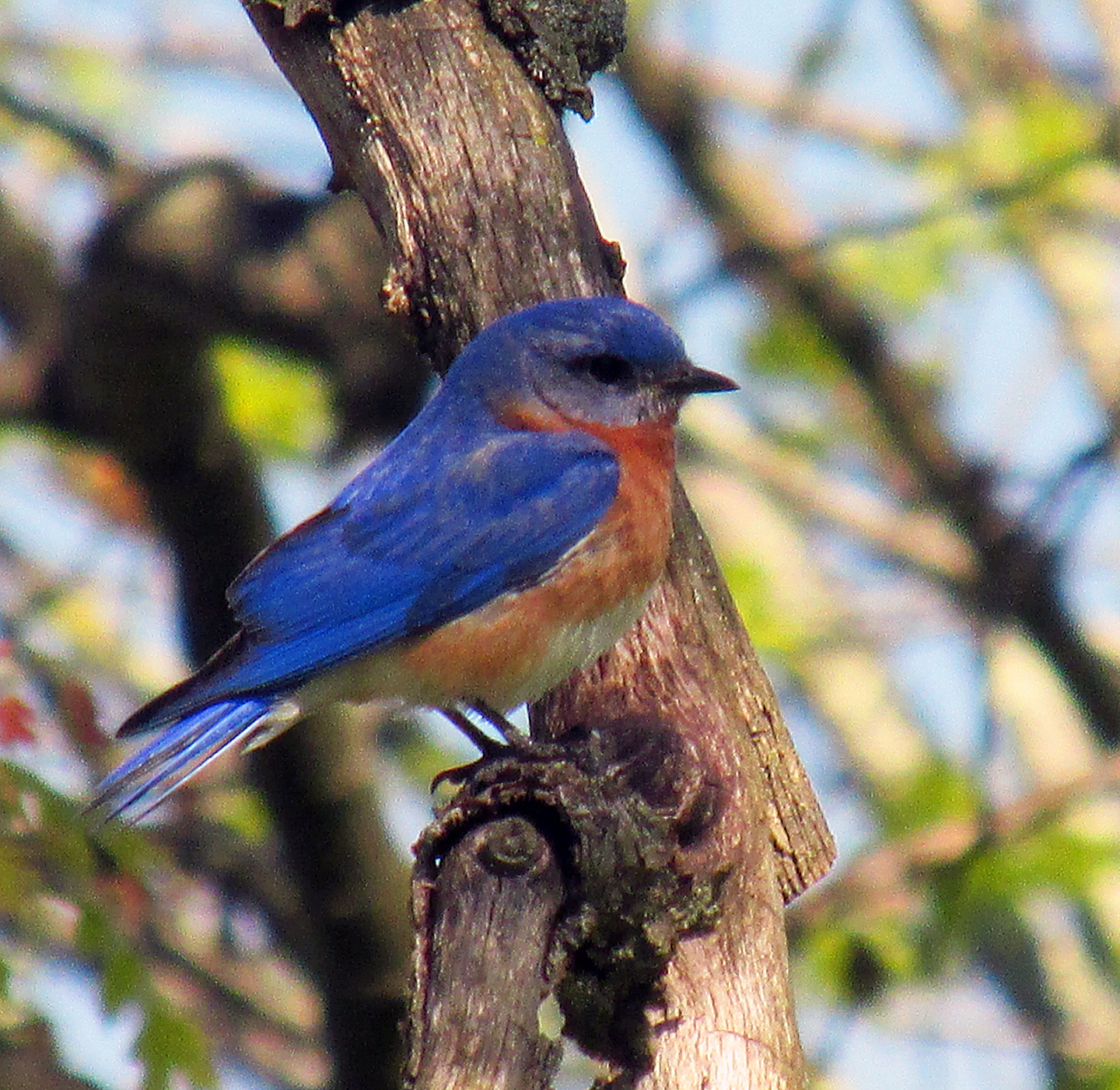
Photo by Bryan Stevens A male Eastern Bluebird perched on playground equipment at Winged Deer Park in Johnson City.

Photo by Bryan Stevens
A male Eastern Bluebird perched on playground equipment at Winged Deer Park in Johnson City.

I’m pleased to report that the first of the season’s young Eastern Bluebirds have left the security of their nest box in our yard – the only home they’ve known since hatching – for the wider world of field and woodland.

As has usually been the case, I didn’t witness their departure. In the days after the fledglings departed the wooden nest box, I’ve observed them perched and waiting, impatiently usually, for their parents to arrive with caterpillars, moths or other morsels of food.

The Eastern Bluebird is one of North America’s best-known cavity-nesting birds. About 85 species of North American birds use cavities in trees for nesting purposes. Cavity-nesters include ducks, such as Buffleheads and Wood Ducks, as well as birds of prey such as Eastern Screech-owls and American Kestrels.

Some of these species, such as woodpeckers and nuthatches, can excavate their own cavity in a dead or decaying tree. Others, such as the bluebirds, must find a cavity already in existence. Such cavities are scarce real estate and can be subject to some intense competition. The Eastern Bluebird is at a disadvantage when forced to compete with non-native introduced birds such as aggressive European Starlings and the House Sparrows.

Photo by Bryan Stevens A male Eastern Bluebird inspects a nesting cavity in a wooden fence post.

Photo by Bryan Stevens
A male Eastern Bluebird inspects a nesting cavity in a wooden fence post.

Last month, I found bluebirds nesting in a cavity in a wooden fence post that was part of an enclosure for a field. The fence post nest reinforced how changing landscapes have also affected these birds. Instead of wooden fence posts, many farmers now use metal ones. Dead or dying trees – a much sought-after resource for cavity-nesting birds — are often removed from woodlands.

Fortunately for bluebirds, this species will also accept lodging in a nest box, or birdhouse, provided for them by human landlords. Because of their trusting nature when it comes to their human neighbors, the Eastern Bluebird is one of our most beloved birds. In fact, bluebirds are such popular birds that interest in them and their well-being has inspired the foundation of such organizations as the North American Bluebird Society. The Eastern Bluebird has also been designated the official state bird for New York and Missouri.

There are two other species of bluebirds found in North America.

The Western Bluebird is found throughout the year in California, the southern Rocky Mountains, Arizona and New Mexico, as wells part of Mexico. The species ranges in the summer as far north as the Pacific Northwest, British Columbia and Montana.

The Mountain Bluebird nests in open country in the western United States as far north as Alaska. They are short-distance migrants, retreating as far south as Mexico during the winter season.

Except for a whitish-grayish belly, the male Mountain Bluebird is a brilliant sky blue above with paler blue on his underparts. The female looks similar if duller in her coloration.

Some people in the region mistakenly assume that Eastern Bluebirds are “mountain” bluebirds because they will reside in higher elevation open areas. The simplest way to tell the two species apart — although not necessary since the range of the Mountain Bluebirds is hundreds of miles to the west — is the reddish undersides of both sexes of the Eastern Bluebird.

The states of Nevada and Idaho have selected the Mountain Bluebird as their official state bird. I saw this species in 2006 during a trip that took me to Utah and Idaho.

Bluebirds are members of the extended family of thrushes, making them relatives of such birds as American Robin, Wood Thrush and Veery. The relationship of the Eastern Bluebird to the American Robin can be seen in the red breast sported by both species. In addition, young robins and bluebirds both have spotted breasts, providing more evidence of their affinity with many of the thrushes. The thrush family numbers more than 100 species worldwide and extends into Europe, Asia and Africa, as well as various islands.

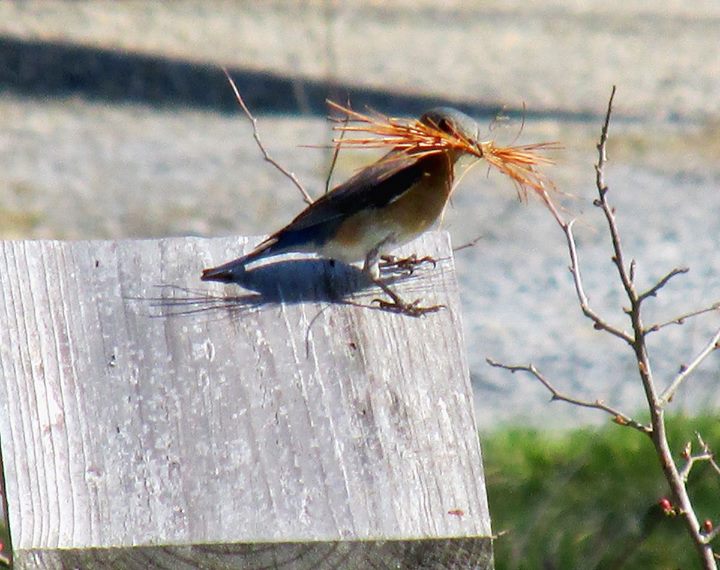
Photo by Bryan Stevens A female Eastern Bluebird gathers pine needles to use as nesting material.

Photo by Bryan Stevens
A female Eastern Bluebird gathers pine needles to use as nesting material.

Inviting the Eastern Bluebird into your yard and gardens is not usually too difficult. It helps if you live in an open, spacious habitat bordered with small trees. Providing a nesting box constructed to the specifications for this bird is another way to attract them. With natural cavities in trees and fence posts a rare commodity, this bird will readily accept boxes. It’s not a sure-fire means of bring bluebirds closer. Plenty of other native birds, including Carolina Chickadees, Tree Swallows and House Wrens, will also make use of a box designated for bluebirds.

The NABS recommends a box that is well ventilated, watertight and equipped with drainage holes. The box should also be easy to open, monitor and clean.

For more specific and very valuable information about becoming a landlord for bluebirds, please visit http://www.nabluebirdsociety.org/PDF/FAQ/NABS%20factsheet%20-%20Getting%20Started%20-%2024May12%20DRAFT.pdf to access an informative fact sheet.

Starlings and House Sparrows are not native species and are not protected by law. When present, these two introduced species will probably be your biggest challenge to successfully hosting Eastern Bluebirds. On its website, NABS encourages the control of starlings and House Sparrows. The website – http://www.sialis.org – also provides beneficial information for would-be bluebird landlords.

Tree Swallows and House Wrens, both native birds, will probably be the biggest rivals for nesting boxes intended for Eastern Bluebirds. If you should find that a pair of Tree Swallows or House Wrens has claimed a box, consider yourself fortunate and benefit from the opportunity to view the habits of these two interesting species for a few weeks.

In addition to housing, food and water can be used to lure Eastern Bluebirds closer. This bird doesn’t eat seeds, but it can be attracted with an offering of mealworms — live or freeze-dried – or commercially prepared peanut butter nuggets. A water feature in a yard is also a magnet for bluebirds and a host of other bird species.

If your home doesn’t provide suitable bluebird habitat, it’s still easy to enjoy these beautiful birds. An afternoon or evening drive into open country, such as agricultural farmland, is likely to yield sightings of this bird on fences and utility lines. Golf courses, some of which go the extra mile to accommodate bluebirds, also provide habitat for these lovely birds.

The Eastern Bluebird is present in the region in any season and is one of our more common birds. If you’re already an experienced landlord and host for these birds, you probably already know they joys they can bring. If not, why not try to attract them closer to you? Most bluebirds in the region have already completed the first nesting of the season, but these birds are known to nest two or even three times in a single season. There’s still time to place a nest box or two on your property to get their attention.

Photo by Bryan Stevens The female Eastern Bluebird is not quite as brightly colored as her mate.

Photo by Bryan Stevens
The female Eastern Bluebird is not quite as brightly colored as her mate.

Landscaping with fruit-bearing trees and shrubs can also pay dividends when its comes to the Eastern Bluebird. Although this bird feeds heavily on insects, almost a third of its diet consists of fruits, including blackberry, mulberry and pokeberry.

Inviting bluebirds to become a part of your life isn’t difficult, and you’ll be delighted to have them. Trust someone who has lived with bluebirds in his yard and gardens for more than 20 years.

•••••

To ask a question, make a comment or share a bird observation, reach me at ahoodedwarbler@aol.com.

Photo by Bryan Stevens The male Eastern Bluebird is beloved by many bird enthusiasts.

Photo by Bryan Stevens
The male Eastern Bluebird is beloved by many bird enthusiasts.


‘Wind birds’ make their way through region during annual migrations

Since the Volunteer State has no access to the sea, it is sometimes amazing how many birds affiliated with coastal areas can be found if you know when and where to look.

A recent seven-day visit to coastal South Carolina reinforced the romance of a group of related birds known collectively as shorebirds or, in a somewhat more adventuresome context, “wind birds.” This diverse family of birds range in size from sparrow-sized sandpipers to larger species such as American Avocet, Long-billed Curlew and Marbled Godwit.

During daily visits to Huntington Beach State Park, located within five minutes of my brother’s new home on Pawleys Island, S.C., I observed plenty of these “wind birds.” I saw a range of species, including Wilson’s Plover, Short-billed and Long-billed Dowitcher, Greater Yellowlegs, Sanderling, Least Sandpiper, Ruddy Turnstone, Spotted Sandpiper, Semipalmated Sandpiper, Black-bellied Plover, Semipalmated Plover, Dunlin and even the gangly Black-necked Stilt.

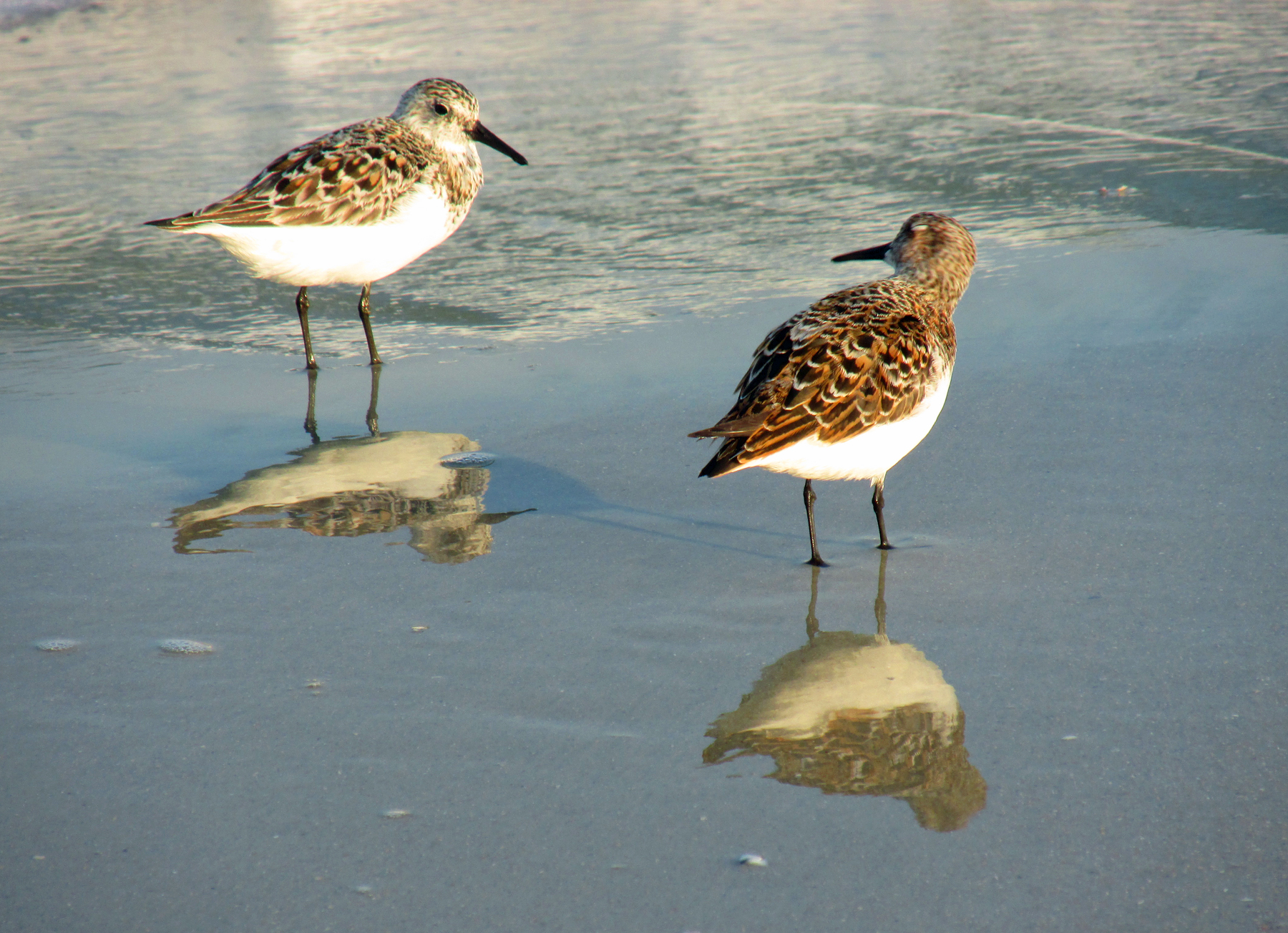
Photo by Bryan Stevens A pair of Sanderlings at surf's edge at Huntington Beach State Park.

Photo by Bryan Stevens
A pair of Sanderlings at surf’s edge at Huntington Beach State Park.

Known as “wind birds” for the propensity of many members of this extended family to stage long-distance migrations, some species fly through Northeast Tennessee each spring and fall as they migrate to and from distant nesting grounds.

I have seen several species — Wilson’s Snipe, Greater Yellowlegs, Pectoral Sandpiper, Least Sandpiper, Solitary Sandpiper and Spotted Sandpiper — in the region this spring. Their stays are usually of brief duration as they are eager to push farther north. Many of them will not stop until they reach the edge of the Arctic tundra.

While I was enjoying seeing a wide range of shorebirds in South Carolina, two Stilt Sandpipers put in a rare appearance in Northeast Tennessee. I hated to miss them. I’ve only seen one other Stilt Sandpiper in the region, and that observation took place back in 2000 at Austin Springs on Boone Lake.

The Stilt Sandpipers were found by Brookie and Jean Potter on the Watauga River at Rasar’s Farm in Elizabethton. The couple reported that it was their first spring sighting of Stilt Sandpipers, as well as their first Carter County sighting of this species. The photo at the start of the column, provided by Jean Potter, shows the two Stilt Sandpipers bordered by a pair of Greater Yellowlegs.

Stilt Sandpipers making migration stops in Tennessee still have a long way to travel. These shorebirds nest on the Arctic tundra beyond the tree line. Wet sedge-meadows with raised ridges and hummocks provide nesting habitat. After the nesting season they fly south as far as northern South America and can be found at fresh water ponds, marshes, lagoons and flooded fields.

This medium-sized sandpiper stands out from most of the sandpipers in its size range. It has long, greenish legs, as well as a long neck and bill, which is drooped at the tip. In breeding plumage, this shorebird has a distinctive chestnut cheek patch.

••••••

During my South Carolina stay, I didn’t encounter any Stilt Sandpipers. I did, however, find three Black-necked Stilts.

The only time I have seen this unusual shorebird in Tennessee took place on Oct. 13, 2004, at Austin Springs on Boone Lake in Washington County. The bird, first found by Rick Knight, drew many excited birders to the location for looks at this shorebird before it departed to continue its migration flight south.

Photo by Bryan Stevens Two Black-necked Stilts forage along the causeway wetland at Huntington Beach State Park.

Photo by Bryan Stevens
Two Black-necked Stilts forage along the causeway wetland at Huntington Beach State Park.

I have also seen Black-necked Stilt on Fripp Island, S.C, as well as in Utah.

The world of shorebirds has produced many look-alike species, including many of the small sandpipers often collectively labeled as “peeps” by birders. The Black-necked Stilt, however, is not at all likely to be confused with any other shorebird. It is a slender bird atop a pair of extremely long pink legs. It has a two-tone appearance with black upper parts and white underparts. The black and white dichotomy continues along the bird’s long neck and head. This bird also has a thin, needle-shaped bill that it uses to delicately pluck aquatic insects and other prey from water or mud.

I first spied the Black-necked Stilts at Huntington Beach State Park while walking on a marsh boardwalk near the park’s Nature Center. They flew toward the causeway, so I got into my car and drove there to try to re-locate them. I did find two of the stilts feeding along the causeway, but I never managed to find the third bird.

I watched the two Black-necked Stilts foraging for food in shallow water shared by egrets and alligators. The two birds, despite a somewhat gangly appearance, moved with elegantly efficient strides on their long pink legs. This bird feeds on an assortment of aquatic creatures, including small fish, insects and tadpoles. The seeds of aquatic plants also provides some of the food in its diet.

I also saw several plovers, another group of shorebirds, while in South Carolina. Wilson’s Plover was one that stood out during my visits to Huntington Beach State Park. Wilson’s Plover is a coastal shorebird that breeds on both coasts of the Americas from the equator northwards. Its range extends north to include much of the U.S. eastern seaboard as well as the Pacific coast of Mexico.

A Wilson's Plover in the dunes at Huntington Beach State Park in South Carolina.

A Wilson’s Plover in the dunes at Huntington Beach State Park in South Carolina.

I’ve observed Wilson’s Plovers on Fripp Island, S.C., in the past, but those sightings have been rather sporadic. I have also observed this bird at one other location — at Douglas Lake in Cocke County back in the late 1990s.

The Wilson’s Plovers at Huntington Beach State Park were nesting in the dunes, which also gave me an opportunity to see some young plovers. A young Wilson’s Plover looks like a ball of downy feathers standing on toothpicks. This plover nests on a bare scrape on sandy beaches or sandbars. To protect the plovers, as well as other nesting species, this section of dunes on Huntington Beach State Park bars the entry of dogs. It is also roped off to prevent accidental intrusion by people.

Photo by Bryan Stevens A pair of Wilson's Plover chicks at Huntington Beach State Park in South Carolina.

Photo by Bryan Stevens
A pair of Wilson’s Plover chicks at Huntington Beach State Park in South Carolina.

Most of the Wilson’s Plovers that spend the summer in the United States retreat each fall, although a few migrate only as far as Florida. The rest spend the winter as far south as Brazil.

For a small shorebird, the Wilson’s Plover sports a thick, blunt and relatively large bill. In fact, this bill — that looks too big for its body — is a good way to identify this shorebird at a glance. The Wilson’s Plover forages for food on beaches. It has a fondness for crabs, which may explain the size and shape of its bill, but this bird will also eat insects, marine worms and other small organisms.

The Wilson’s Plover is larger than the related Semipalmated Plover and Piping Plover but considerably smaller than such relatives as Killdeer and Black-bellied Plover. This shorebird weighs only a couple of ounces, with a length of about eight inches and a wingspan of 19 inches. The Wilson’s Plover has a dark neck ring, grayish-brown upper parts, a white underside and pinkish legs.

This bird was named after the Scottish-American ornithologist Alexander Wilson. Wilson collected the type specimen during a trip in May of 1813 to Cape May, N.J. Other birds named for this pioneering bird expert include Wilson’s Warbler, Wilson’s Phalarope, Wilson’s Snipe and Wilson’s Storm Petrel.

•••••

With a few exceptions, most of the shorebirds that I have found along the Atlantic Coast I have also observed here in land-locked Tennessee during spring and fall migration. It’s one of those little known facts I enjoy sharing with people, who are often surprised that these “beach birds” also make visits to our state.

•••••

Make a comment, ask a question or share an observation by sending an email to ahoodedwarbler@aol.com or posting a comment here on my blog. I am also on Facebook.

A mixed flock of Short-billed and Long-billed Dowitchers and a Ruddy Turnstone at Huntington Beach State Park.

A mixed flock of Short-billed and Long-billed Dowitchers and a Ruddy Turnstone at Huntington Beach State Park.


Taste of tropics arrives with Scarlet Tanagers

In late April and early May, once the oaks, the maples, the poplars begin spreading out new green leaves to create a concealing woodland canopy, a familiar song can be heard from the treetops. Upon first hearing it, listeners might mistake the hidden singer for an American Robin. Listen a little closer, however, and the song sounds as if it is being delivered by a hoarse robin with a sore throat.

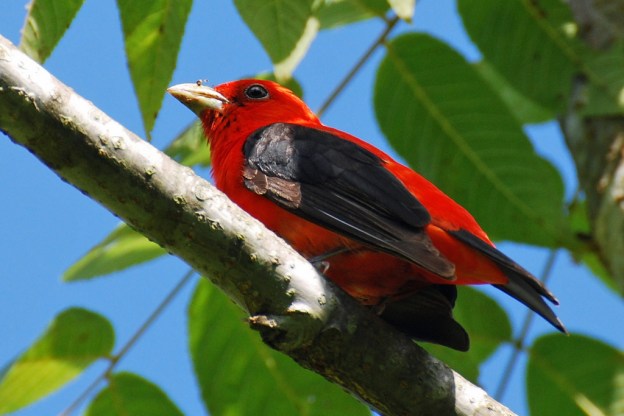
The producer of the hoarse but melodic song is a Scarlet Tanager, one of the most showy birds of Eastern woodlands from April to early October. Like the warblers, vireos, flycatchers and other songbirds, the Scarlet Tanager is migratory. They spend the winter months in the tropical forests of Central and South America. The Scarlet Tanager is better attired than most birds to provide us a glimpse of what life must be like in the tropical rain forests, which are a riot of color and sound.

A print of Scarlet Tanagers by early North American naturalist and painter John James Audubon.

A print of Scarlet Tanagers by early North American naturalist and painter John James Audubon.

It takes only one sighting to sear the vision of these vibrant birds into our retinas, as well as into our memories. The Scarlet Tanager boasts a brilliant plumage of crimson red paired with black wings and tail. Of course, this is the male. The female Scarlet Tanager makes no real claim to the common name with her comparatively drab greenish plumage. However, the scientific name, Piranga olivacea, gives a nod to the olive-green plumage of females, young males and even adult males when molting their feathers.

Although once nominated as a candidate for state bird by the school children of Minnesota, the Scarlet Tanager ultimately failed to gain the designation. Instead, as perhaps is fitting for the “Land of 10,000 Lakes,” the Common Loon represents Minnesota as official state bird.

The related Summer Tanager is less widespread in Northeast Tennessee, but males of this species are no less dramatic in appearance than the Scarlet Tanager. Male Summer Tanagers are a rosy-red over all their body. Females, with a dull greenish plumage, are relegated to the background. She can be distinguished from her counterpart, the Scarlet Tanager, because of their darker wings and larger bills.

Photo Courtesy of Jean Potter The Summer Tanager is the only all-red bird in North America. It is less common in Northeast Tennessee than the related Scarlet Tanager.

Photo Courtesy of Jean Potter
The Summer Tanager is the only all-red bird in North America. It is less common in Northeast Tennessee than the related Scarlet Tanager.

The Summer Tanager holds the distinction of being the only all-red bird in North America. Birds like Northern Cardinals and Scarlet Tanagers also have some black in their plumage.

I’ve seen Summer Tanagers at Steele Creek Park in Bristol and Willow Springs Park in Johnson City. Sadly, over the years my sightings of this attractive songbird have been few and far between. My best sighting of a male Summer Tanager took place during a spring visit to Fripp Island, S.C., many years ago. Most of the Summer Tanagers I have observed in Northeast Tennessee have been females.

On the other hand, I usually have a few Scarlet Tanagers in residence around my home during the summer months. If the woodlands at my home fail to attract this bird, I can usually make a visit to higher elevations on Roan Mountain and Holston Mountain to gain an exciting glimpse of this beautiful bird.

Worldwide, there have traditionally been about 240 species of tanagers. Experts have changed some of the ways they classify tanagers, so that figure is no longer set in stone. Tanagers are a New World family of birds, concentrated mainly in the tropics.

In the western United States, the Scarlet and Summer Tanagers are replaced by Western Tanagers and Hepatic Tanagers. During a visit to Salt Lake City in Utah in 2006 I saw several Western Tanagers.

Some of the world’s other tanagers are known by extremely descriptive names, including Flame-colored Tanager, Green-headed Tanager, Golden-chevroned Tanager, Azure-shouldered Tanager, Fawn-breasted Tanager, Saffron-crowned Tanager, Metallic-green Tanager, Turquoise Tanager, Scarlet-bellied Mountain Tanager and Diademed Tanager.

Scientists, who have to occupy themselves, have recently given fresh consideration to the relationship of many tanagers to the other birds of the world. As a result, many of the North American tanagers are now closely allied with such birds as Northern Cardinals and more remote from tropical tanagers.

The Scarlet Tanager is not typically a feeder visitor, but you can lure these birds with orange slices placed in special feeders or simply spiked onto the branches of backyard trees. As an added bonus, orange slices can also attract birds such as Baltimore Orioles and Gray Catbirds.

Fond of fruit, the Scarlet Tanager incorporates various berries into its diet. Landscape around your home with fruit-bearing trees such as mulberry, serviceberry and wild cherry to make your yard more inviting to these elusive bird.

Yes, the Scarlet Tanager is more often heard than seen, but it is a bird worth seeking out. A sighting of one will amaze you.

•••••

I love to hear from readers. Just post comments on my blog at ourfinefeatheredfriends.wordpress.com. You can also reach me on Facebook or send email to ahoodedwarbler@aol.com. Please share the link to the blog with others who might be interested in the topic of birds and birding in Northeast Tennessee.


Rose-breasted Grosbeaks provide splash of springtime excitement


Other than Ruby-throated Hummingbirds, the one bird whose return in the spring is guaranteed to generate excitement is the Rose-breasted Grosbeak. Every spring, I get phone calls and emails from people wanting to share the thrill of seeing these vibrant birds in their back yards.

Photo by Bryan Stevens A Rose-breasted Grosbeak finds a meal of sunflower seeds at a feeder.

Photo by Bryan Stevens
A Rose-breasted Grosbeak finds a meal of sunflower seeds at a feeder.

The spring arrival of Rose-breasted Grosbeaks is a temporary visit. Finding the arrangements, which can consist of well-stocked feeders and perhaps a convenient water source, the migrating birds may linger for several days. These birds nest at higher elevations, however, and are usually impatient to continue the journey to where they will spend the summer months tending to their young.

This year, my first Rose-breasted Grosbeak arrived at my home on Simerly Creek Road in Hampton around 3:30 p.m. on Friday, April 25. I saw a glimpse of black and white with a hint of red that lifted my spirits instantly. I had been hoping for about a week that migrating grosbeaks would visit as they often do in the spring. The lone male settled onto a small hanging feeder and began enjoying an offering of black-oil sunflower seeds. He made repeated trips throughout the afternoon and evening, allowing me to take several photos through a window.

Some of my posted photos drew enthusiastic comments from my Facebook friends. Dani Sue Thompson shared that the beautiful Rose-breasted Grosbeak is one of her favorite birds. Her mother, the late Donna Adams, was a huge fan of the related Blue Grosbeak, which is a less common visitor to Northeast Tennessee than the related Rose-breasted Grosbeak. Donna and I share many a grosbeak story over the years.

Byron Tucker, a friend from Atlanta, notified me on Facebook the day before the Rose-breasted Grosbeak arrived at my home that he was hosting them in Georgia. From a single bird to a flock of three males and three females, these visitors were a first for Byron. He was excited to host these colorful birds for several days at his feeders.

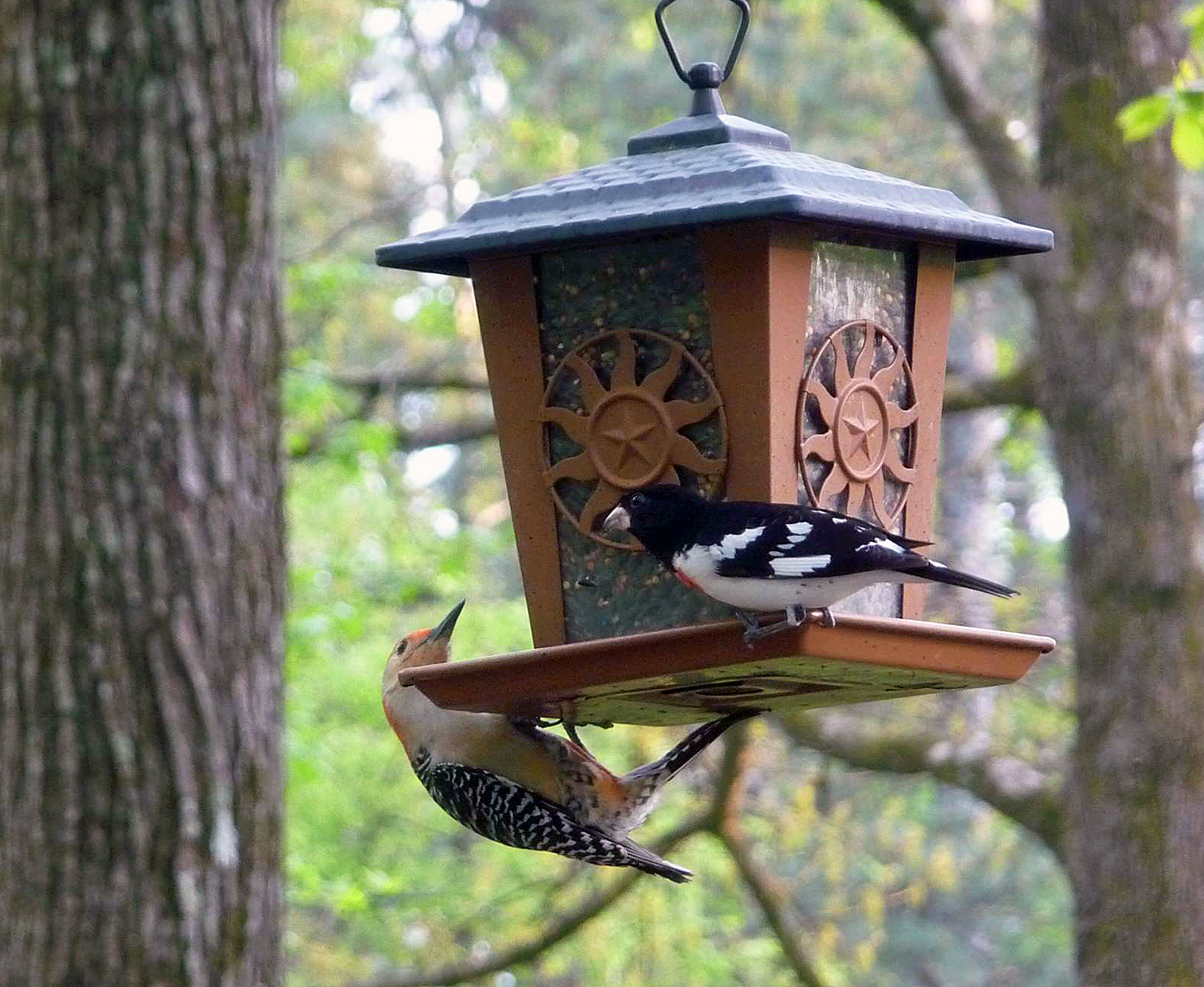
Photo Courtesy of Byron Tucker A Rose-breasted Grosbeak joins a Red-bellied Woodpecker at a feeder in Atlanta.

Photo Courtesy of Byron Tucker
A Rose-breasted Grosbeak joins a Red-bellied Woodpecker at a feeder in Atlanta.

Single birds are occasionally the first to arrive, but Rose-breasted Grosbeaks do form flocks when migrating. Even if a scout shows up alone at your feeders, he will often soon be joined by other grosbeaks. My recent visit by a single male led to two and then three males visiting the feeders. Eventually a female Rose-breasted Grosbeak also made an appearance.

Plenty of Rose-breasted Grosbeaks pass through Northeast Tennessee, and a few even decide to make mountains like Unaka, Holston and Roan their home for the summer. However, these birds spread out widely across the eastern half of the North American continent, ranging from northeastern British Columbia to Quebec and Nova Scotia in Canada. They also range south from New Jersey to Georgia. The Rose-breasted Grosbeak also reaches Colorado, Oklahoma and Kansas.

For the most part, however, the Rose-breasted Grosbeak is replaced in the western United States by the closely related Black-headed Grosbeak.

As fall approaches, the Rose-breasted Grosbeak migrates south to a winter range that spans central Mexico, Central America and northern South America. As they depart, many of these migrating birds will make autumn visits to again partake of offerings of sunflower seeds at backyard feeders. So, if you don’t get to see these showy birds in the spring, you get another chance in September and October.

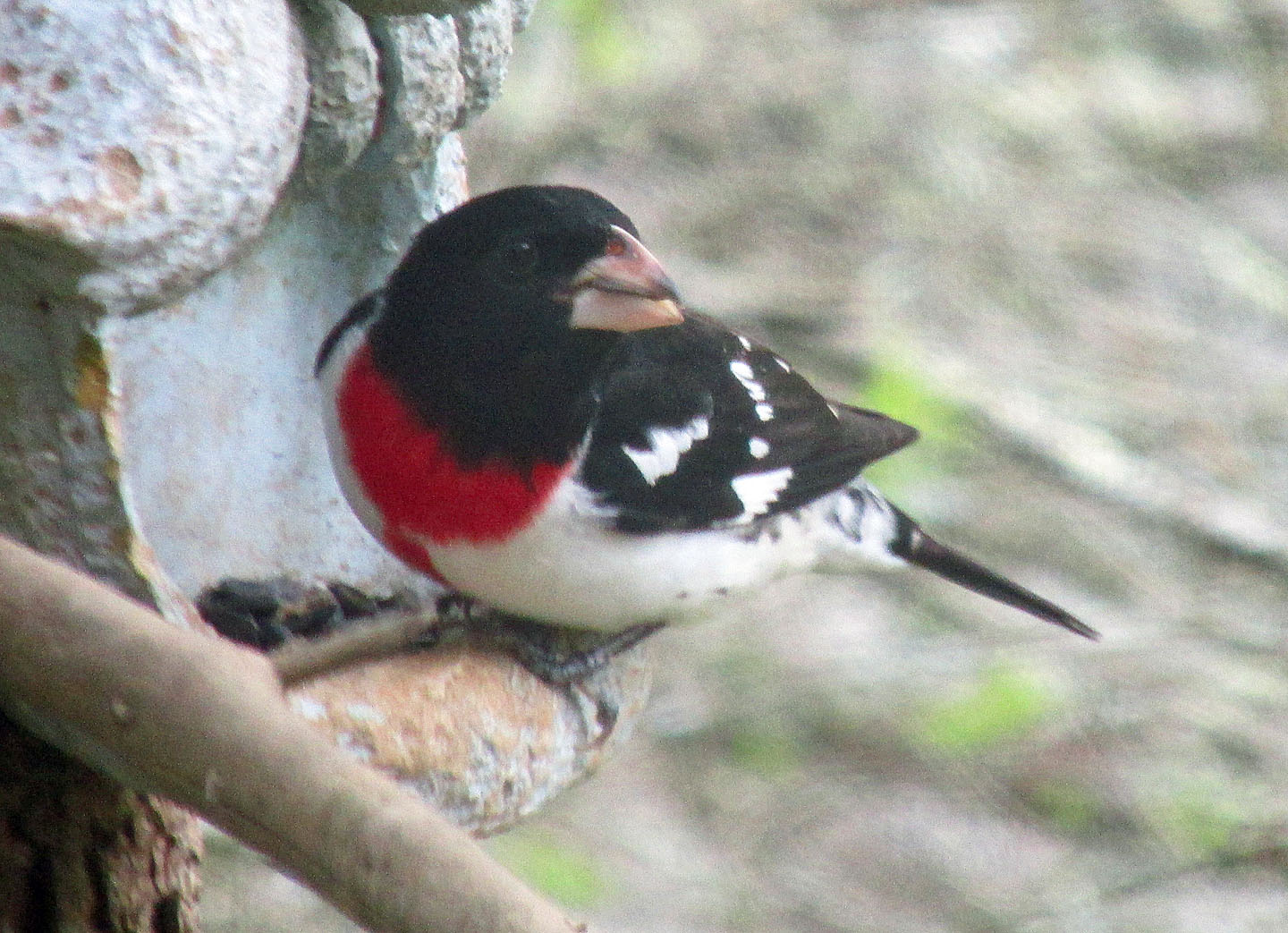
The male Rose-breasted Grosbeak gives this species it name. Males are the epitome of the birds that make their home for part of the year in the American tropics. The contrasting black and white plumage is emphasized by a triangular slash of rosy-red color on the breast. Put all those elements together and the male Rose-breasted Grosbeak is not a bird that would be mistaken for any other.

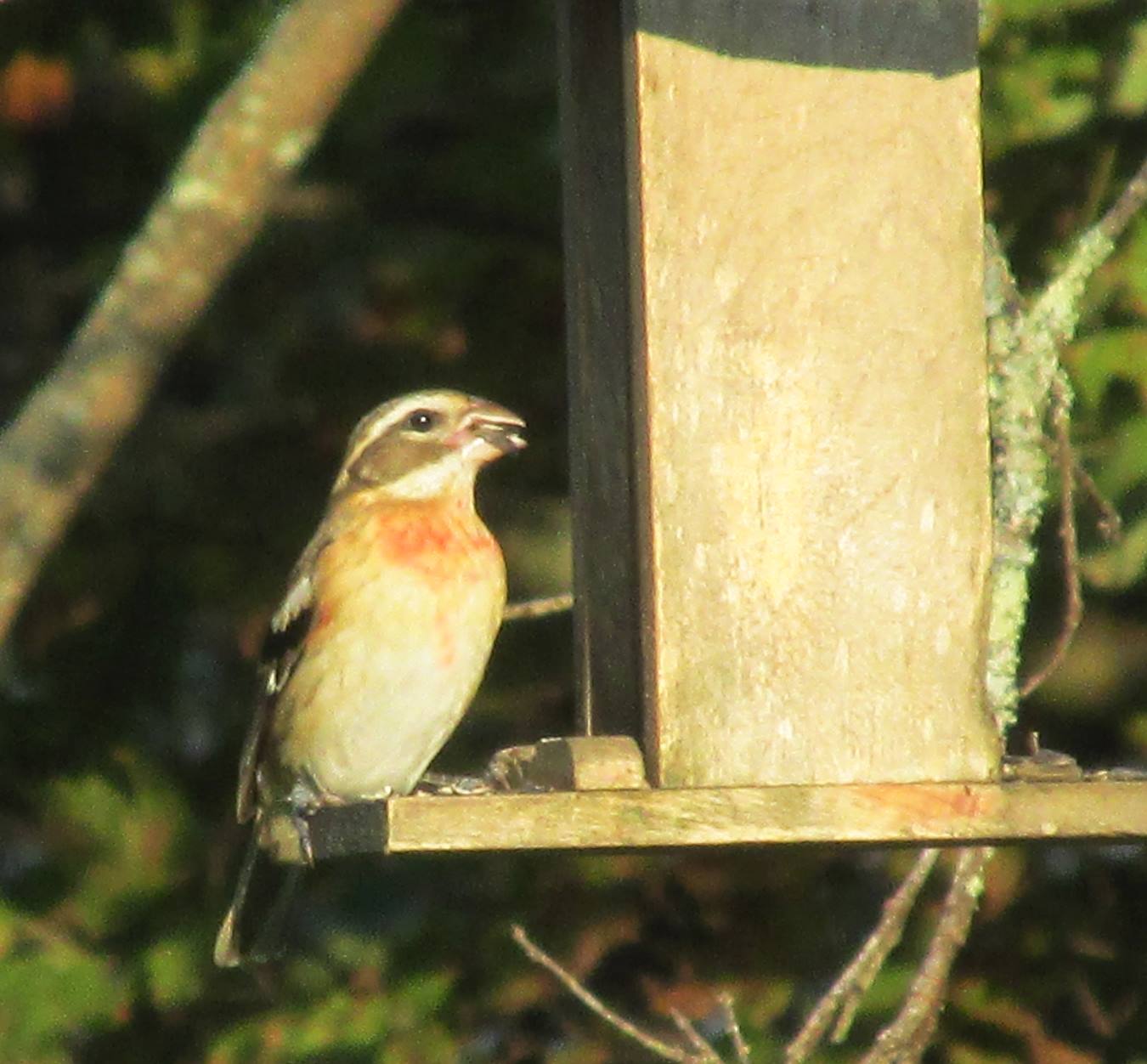
The female grosbeak, however, doesn’t quite stand out in the same way. She is much less colorful than the male. With her brown and white plumage, she is often mistaken for a large sparrow or finch.

Photo by Bryan Stevens A young male Rose-breasted Grosbeak visits a feeder in September of 2013. Young males resemble females but show a splash of orange on the breast that will be replaced the following spring by the familiar rosy-red patch.

Photo by Bryan Stevens
A young male Rose-breasted Grosbeak visits a feeder in September of 2013. Young males resemble females but show a splash of orange on the breast that will be replaced the following spring by the familiar rosy-red patch.

Both sexes have a massive bill, which they use to hull sunflower seeds at feeders or glean insects from leaves and branches. It’s the heavy, blunt bill for which the term “grosbeak” is derived. “Gros” is a German term for large or big, so grosbeak simply means a large-beaked bird. People who band birds to further the study of them will tell you that Rose-breasted Grosbeaks have a wicked bite and are capable of delivering quite a nip. In Northeast Tennessee, bird banders frequently encounter Rose-breasted Grosbeaks in their mist nets — and bear the scars to prove it.

With some birds, males play only a minor role in the nesting process. That’s not the case with the Rose-breasted Grosbeak male. The males help with nest-building chores and share responsibility with the female for incubating the eggs.

The female lays three to five eggs in a cup-shaped nest. It’s not easy to locate the nests since the birds usually place them in trees at least 20 feet above the ground. Within two weeks, the eggs have hatched and the parents are kept extremely busy finding enough food to satisfy the voracious nestlings. Well fed by both parents, the young grow quickly and usually are ready to leave the nest within 12 days. Often, when a first brood of young departs the nest, the male will care for the rowdy group of fledglings as the female starts a second nest to capitalize on the long days of summer.

Away from our feeders, Rose-breasted Grosbeaks feed on insects, seeds, fruit and even some leaf buds and flowers. I’ve seen these birds satisfying a sweet tooth — or should that be sweet beak? — by feeding on jewelweed flowers and apple blossoms. If sugar’s good for hummingbirds, I am sure it is a valuable energy source for Rose-breasted Grosbeaks, too.

The Rose-breasted Grosbeak is a cherished spring visitor that never fails to disappoint by bringing a hint of the tropics to the mountains of Northeast Tennessee. I’m hoping many readers are also enjoying their own opportunities for hosting this delightful songbird.

•••••

The bird walk at Tipton-Haynes Historic Site on Saturday, April 26, yielded a good range of birds, including American Robin, House Wren, Cardinal, Song Sparrow, Carolina Chickadee, American Goldfinch, Tufted Titmouse, Crow, Canada Goose, Chimney Swift, Brown Thrasher, Barn Swallow, Eastern Towhee, European Starling, Yellow-rumped Warbler, Chipping Sparrow, Mallard, Red-winged Blackbird, Red-bellied Woodpecker, Turkey Vulture, Black Vulture, Northern Flicker, Grackle, Gray Catbird, Blue Jay, Mourning Dove and Eastern Bluebird.

Photo by Bryan Stevens A pair of Brown Thrashers provided quite a show for attendees at a recent bird walk at Tipton-Haynes Historic Site.

Photo by Bryan Stevens
A pair of Brown Thrashers provided quite a show for attendees at a recent bird walk at Tipton-Haynes Historic Site.

Attending the walk were Heather Jones, Charles Moore, David Thometz and myself. We enjoyed perfect spring weather and also admired the many wildflowers in the gardens and woodlands at the Johnson City historic site.

Members of the Lee and Lois Herndon Chapter of the Tennessee Ornithological Society will also hold a bird walk at 8 a.m. on Saturday, May 10, at Sycamore Shoals State Historic Park in Elizabethton. This walk is held in honor of International Migratory Bird Day and should provide participants with an excellent opportunity for seeing some fine birds.

•••••

I enjoy hearing from readers. Share a sighting, ask a question or make a comment by emailing me at ahoodedwarbler@aol.com or posting to my Facebook page.

Photo by Bryan Stevens The Rose-breasted Grosbeak never fails to impress.

Photo by Bryan Stevens
The Rose-breasted Grosbeak never fails to impress.