Tag Archives: Cooper’s hawk

Region is home for several species of hawks

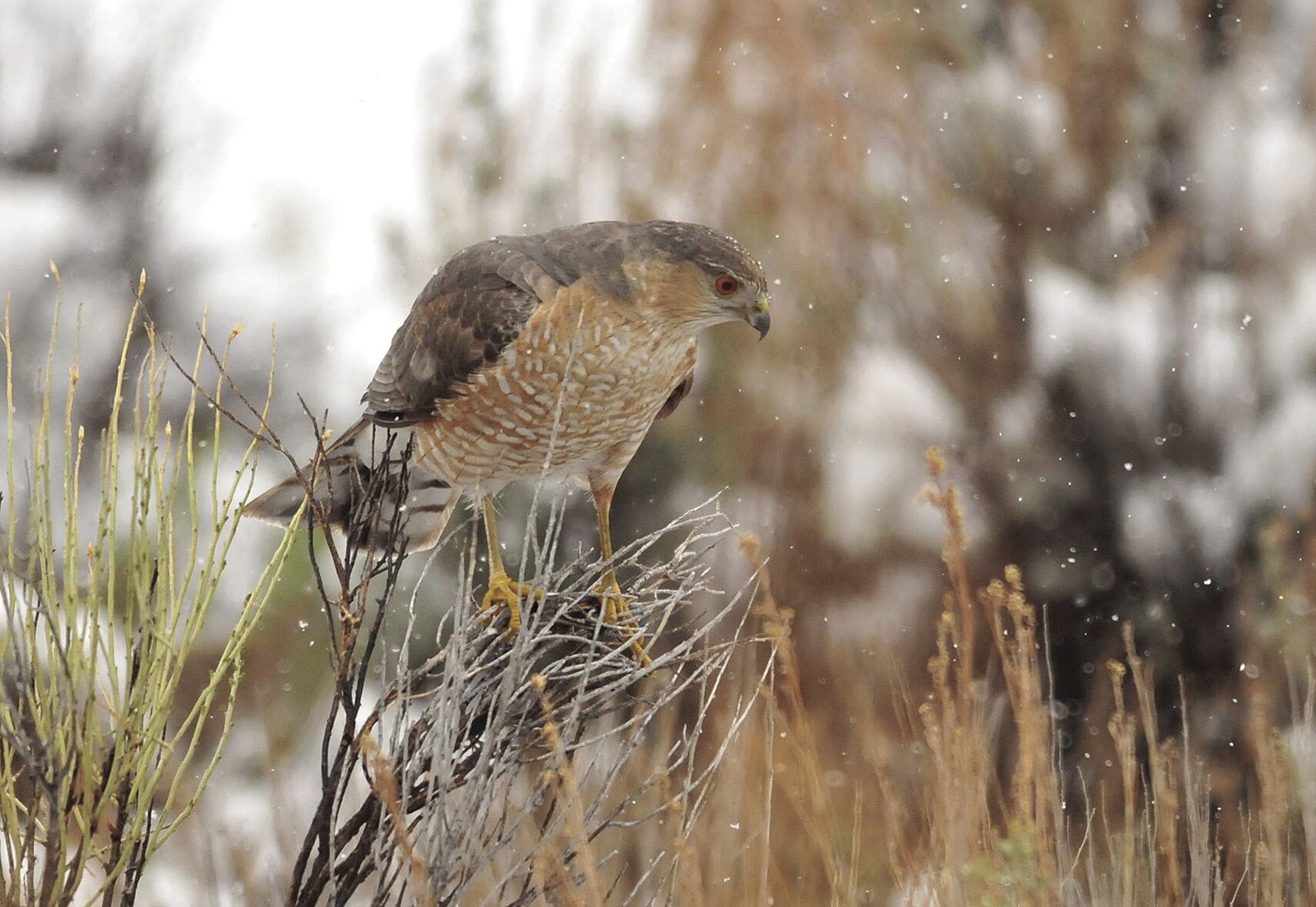
Tom Koerner/USFWS • An adult Cooper’s hawk, such as this individual, is a crow-sized woodland raptor that breeds throughout much of the United States, southern Canada and northern Mexico.

Barbara Lake, a resident in Hampton, emailed me recently to share a sighting of a large hawk in her yard.

“This hawk was in our yard today and flew up to a tree when I opened the door,” she wrote. “(Its) back and the back of the head are black and the rest appears to be white. He didn’t cooperate by turning around.”

Barbara enclosed some photos with her email. I’ve known Barbara for about 20 years. We first met when she invited me to her home to view some nesting bluebirds on a television screen. She had placed nest cams in some of her bluebird nesting boxes, capturing real-time footage of the nesting activity of these songbirds.

I’ve enjoyed some observations of the region’s larger raptors, including red-tailed hawks and red-shouldered hawks, as winter has settled in for the long haul. I’ve also spotted a few American kestrels.

Based on the raptor’s relatively long tail in the photos provided by Barbara, I hazarded a guess that her visiting raptor was a Cooper’s hawk.

Anyone who travels along the region’s Interstate Highway System has probably noticed hawks perched in trees or on utility lines adjacent to the roadway. The section of Interstate 26 that runs between Unicoi and Johnson City is often a productive area for keeping alert for raptors. The raptor I have most often observed along this stretch of road is the red-tailed hawk, although I have also observed Cooper’s hawk, sharp-shinned hawk and American kestrel. In the time of spring and fall migration, it’s also possible to observe broad-winged hawks.
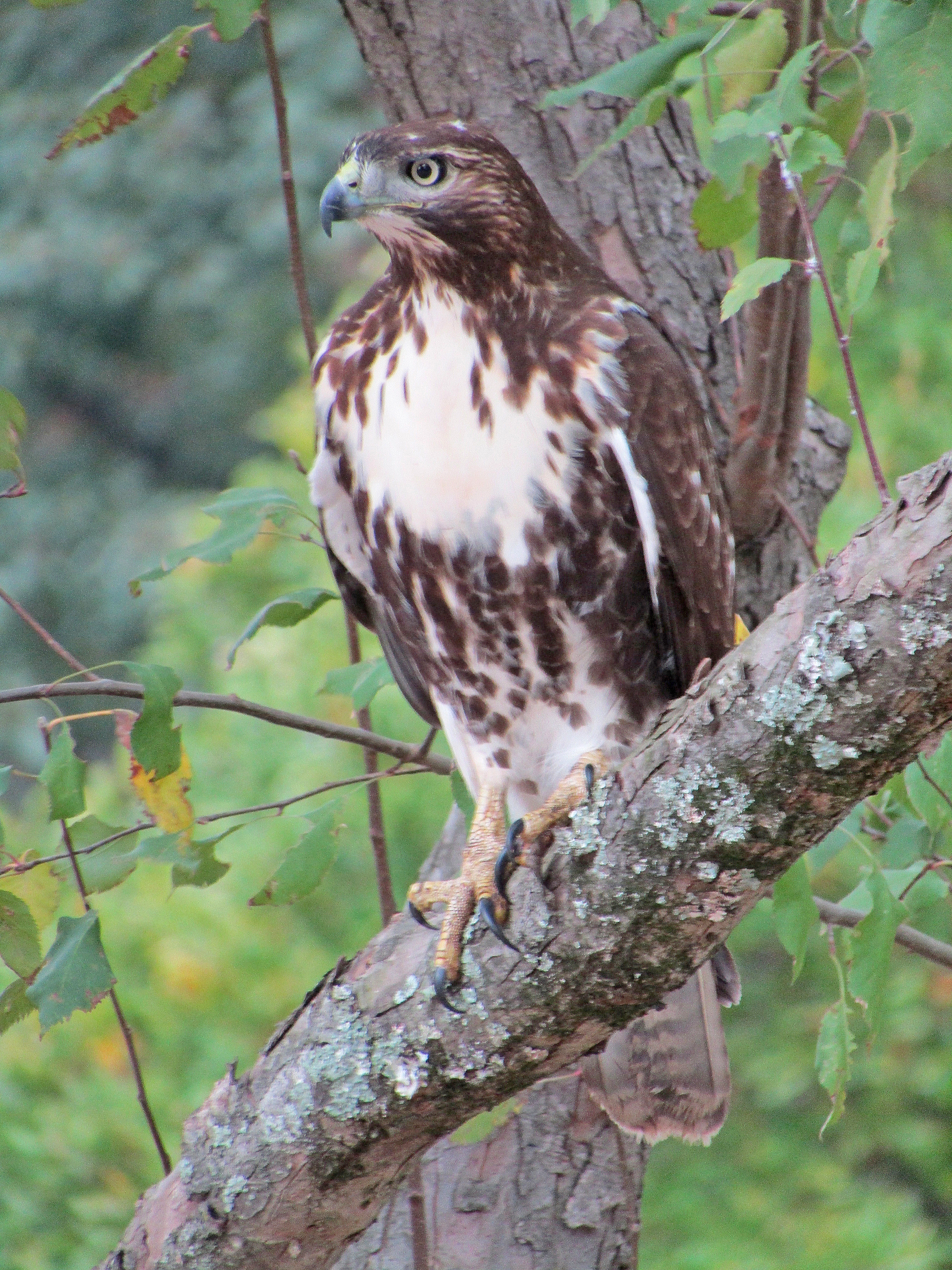
Photo by Bryan Stevens • Raptors, like this red-tailed hawk, are  plentiful oin the region.

The red-tailed hawk is named for its prominent red tail. However, only adults show the characteristic red tail. The affinity red-tailed hawks demonstrate for roadsides is a double-edged sword. Viewing a large hawk from your car is an easy way to watch birds. For inexperienced or careless raptors, however, roadside living is often rife with the chance for a collision with a car or truck. The red-tailed hawk, which prefers open countryside, is attracted to the margins of roads and highways because these locations also attract their favorite prey, which includes rodents like rats, squirrels and mice and other small mammals such as rabbits.

Human behavior contributes to some of the problems that hawks encounter in the zone that brings them too close for comfort to motorized vehicles. When people toss trash from a car, the scent of the litter will lure curious and hungry rodents. In turn, hunting hawks are brought to the edges of roads in search of their preferred prey, increasing the likelihood of colliding with automobiles.

The Cooper’s hawk is a large accipiter hawk. A smaller relative, the sharp-shinned hawk, is also found in the region. The accipiter hawks are graceful and aerodynamic, designed to pursue prey through woodlands. Buteo hawks, such as the red-tailed hawk and red-shouldered hawk, are more of an ambush predator and not designed for the agile maneuvers that the accipiters can use to capture prey.

Some of the buteo species have adapted to life on islands, including the Galapagos hawk and the Hawaiian hawk. Some of these hawks have quite descriptive names, including the white-throated hawk, gray-lined hawk, zone-tailed hawk and short-tailed hawk. Outside the United States, raptors in the buteo genus are often known as “buzzards.” When the first European colonists came to the New World, they applied the term buzzard to types of native vultures as well as the large raptors like Swainson’s hawk and broad-winged hawk that reminded them of the ones back in Europe.

USFWS • An immature Cooper’s hawk perches on a branch in a tree located in the Klamath Basin National Wildlife Refuge Complex.

Accipiter hawks are also widespread. Accipiter is a genus of birds of prey in the family Accipitridae. With 49 recognized species, it is the most diverse genus in its family. Most species are called goshawks or sparrowhawks, although almost all New World species (excepting the Northern goshawk) are simply known as hawks.

Most accipiter hawks, including Cooper’s and sharp-shinned, prey mostly on other birds. The website All About Birds notes that small songbirds are usually safe around a Cooper’s hawk. Medium-sized birds, however, are not. Studies list European starlings, mourning doves and rock pigeons as common prey. Other birds that are often targeted by Cooper’s hawk include American robins, blue jay, Northern flicker, quail, grouse and pheasants. Cooper’s hawks sometimes rob nests and also eat chipmunks, rabbits, mice, squirrels and bats. According to All About Birds, mammals are more common in diets of Cooper’s hawks in the western United States.

Some of the more descriptively named accipiter hawks include crested goshawk, grey-bellied hawk, spot-tailed sparrowhawk, plain-brested hawk and little sparrowhawk.

All too often, our large hawks don’t receive the love they deserve from the public. They may even run afoul of misinformed individuals who may regard all predatory birds as “bad.” The reality is that all hawks are valuable components of a healthy, working ecosystem, with each species filling a certain niche.

•••

To share a sighting, ask a question or make a comment, email me at ahoodedwarbler@aol.com.


Hawk spoils start of winter bird feeding season

According to a recent Census Report, Americans are feeding birds in epic numbers — 63 million people in this country make life less of a struggle for birds by filling bird feeders with sunflower seeds, peanuts and other goodies. In fact, watching and feeding birds ranks second only to gardening as one of America’s popular pastimes.

Unfortunately, bringing wild birds into our lives means we are occasional witnesses to the darker side of nature that dictates there’s a survival of the fittest competition taking place in our own backyards and gardens.

sharp-shinned-hawk-dbadry

Photo by Dbadry/Pixabay.com • A sharp-shinned hawk visits a bird bath during the Christmas season. These small hawks, designed to prey on songbirds, sometimes learn to stalk feeders, which creates distress for the human landlords.

Welcoming birds into our yards and lives means inviting all birds, include predatory raptors such as sharp-shinned hawk, merlin, Cooper’s hawk and American kestrel. It’s a problem Elizabeth Laing has had to cope with in recent weeks. We’ve commiserated over Facebook about her conflicted feelings about the predatory nature of the hawk that’s been stalking birds at her feeders.

Elizabeth sent me a message via Facebook on Nov. 21 about a situation unfolding at her home in Abingdon, Virginia.

“Please help me to know what to do,” she wrote as the start of her message. “Right now I an absolutely devastated and in tears. I have about eight feeders up year round. I feed a lot of small birds in my backyard and even crows in my front yard. I have at least 15 American goldfinches right now at several sunflower chip feeders.”

Elizabeth noted that for the past few days she had seen a small hawk in her backyard for the first time ever.

“I was worried and tried to scare it off,” she wrote. “I realize they have to eat, too, and are beautiful birds, but I don’t want them killing birds on my feeders.”

1-sharp-shinned-hawk-john-james-audubon

John James Audubon painted this pair of sharp-shinned hawk and shows the size difference between males and females. Many people are surprised to learn that female hawks are typically much larger than males, which is also true of the Cooper’s hawk.

Unfortunately, that’s what happened right as she watched through a window as a goldfinch feeding at her feeder.

“The hawk swooped in and grabbed him off the feeder,” she reported.In the wake of the hawk’s action, Elizabeth took some sensible steps, including immediately taking down her feeders.

Some of her birds, such as the tufted titmice, came back quickly and perched on the empty feeder poles. “I felt so bad,” she said. “I want to feed them, but I can’t stand the thought of them being snatched off my feeders.”

She concluded her message by asking my advice. I responded and told her that when hawks do make a habit of raiding feeders, it can be necessary to curtail feeding for a couple of weeks or longer. Most authorities on birding insist that the hawks will lose interest and move to more productive feeding grounds. Unfortunately, the raptor visiting Elizabeth’s yard proved persistent.

bird-2154147_1920

Photo by NatureLady/Pixabay.com Immature sharp-shinned hawk look different than adults, but once they learn to hunt, they are very efficient predators.


“I wanted to update you on my hawk problem,” Elizabeth wrote back in another message on Nov. 26. “I took all my feeders down, but not long enough. After five days, I put them back.

She had also invested in brand new, expensive caged feeders. She purchased the caged feeders thinking the goldfinches would be safe inside.

For flocking birds, like American goldfinches, the caged feeders offered security only to birds inside the caging. Those birds waiting outside of the caging for their own turns at the feeder remained vulnerable.

“I found feathers on the side of one cage this morning,” she wrote. “Then, as I was watching a bunch eat, that hawk swooped in and took another one off the side.”

The entire situation has made her discouraged and sad. “I hope this doesn’t mean I will have to stop feeding birds entirely. I actually have bags of seeds and peanuts (for the titmice) coming in the mail later this week,” she wrote.

In the wake of the latest attacks, she has taken down the feeders again. “I will leave them down for two weeks this time,” she wrote. “I know the hawk has to eat, too, and it’s a beautiful bird, but I can’t do this to my little goldfinches.”

I agreed that it would be senseless, as well as rather cruel, to provide food for songbirds while knowing a hawk is lurking in the vicinity.

FirstHawk

Photo by Bryan Stevens • A sharp-shinned hawk photographed after capturing and killing a Northern cardinal feeding on the ground beneath a feeder.


Elizabeth also asked if I have had birds killed at my feeders. Although it has been a thankfully rare occurrence, hawks have snatched birds visiting my feeders. I’ve not often witnessed the actual predation, often finding only a pile of feathers on the ground as evidence of the hawk’s success.

A few years ago, however, I witnessed a rather dramatic attack on New Year’s Day. As I watched a female Northern cardinal feeding on sunflower seeds spilled onto the ground by the birds visiting a hanging feeder, a sharp-shinned hawk suddenly slammed into the cardinal. In an instant, I saw my first and second bird species of the New Year. The cardinal, however, didn’t get to live and enjoy the unfolding year.

The website allaboutbirds.org described the sharp-shinned hawk as “a tiny hawk that appears in a blur of motion — and often disappears in a flurry of feathers.” It’s an apt description of this pint-sized predatory bird.

The website also notes that studies indicate that feeders don’t make it more likely that our favorite songbirds will be preyed upon by a sharp-shinned hawk or other raptor. Although feeders might temporarily attract a raptor, these birds will catch the majority of their prey elsewhere.

The sharp-shinned hawk belongs to a genus of raptors known as accipiters, which are slender raptors with rounded wings and long tails. They are highly maneuverable in flight. A characteristic of accipiters is long legs and sharp talons. In fact, the genus is named from the Latin word for hawk, “accipere,” which can be translated as, “to grasp.”

shikra-336751_1920

Photo by Sarangib/Pixabay.com • A shikra (Accipiter badius) is a small bird of prey in the family Accipitridae found widely distributed in Asia and Africa where it is also called the little banded goshawk.

Other members of the accipiters in North America include the Cooper’s hawk and Northern goshawk. Other accipiters around the world include such raptors as chestnut goshawk, red-chested goshawk, crested goshawk, little sparrowhawk, spot-tailed sparrowhawk, black sparrowhawk and red-thighed sparrowhawk.

Elizabeth sent me one other message, informing me that she had also advised her neighbor to take down his feeder, which he did. Shortly after he did so, Elizabeth saw the hawk attack a squirrel, which, thanks to Elizabeth rapping on a windowpane, apparently survived the attack.

coopers-hawk-570341_1920

Photo by Skeeze/Pixabay.com The Cooper’s hawk, like this individual, is a larger relative of the sharp-shinned hawk. It’s larger size allows this raptor to prey on larger birds, such as mourning doves.

In addition, if the hawk in her yard is attacking squirrels, her visitor is probably a Cooper’s hawk, a bird almost identical to a sharp-shinned hawk except for its larger size. I’m hopeful that an extended hiatus will convince the hawk to leave Elizabeth and her goldfinches in peace.

It’s still good to remember that hawks view smaller birds flocking to a feeder in the same way those small songbirds view the abundance of seeds. For both hawks and songbirds, our offerings represent easy meals. It’s not easy, but the best choice is to co-exist — if not at peace, then at terms with nature’s reality.

CalendarCover

Bird club selling calendars

The Lee & Lois Herndon Chapter of Tennessee Ornithological Society is selling its 2019 calendar for $15 each. All proceeds are used to support birding opportunities and bird-related causes in Northeast Tennessee. The calendar’s pages feature more than 80 full-color photographs of area birds, including common favorites and some not-so-common visitors. The front cover features a dazzling photograph of a gorgeous male rose-breasted grosbeak. If you’re interested in obtaining a calendar, contact ahoodedwarbler@aol.com by email or send a message via Facebook at http://www.facebook.com/ahoodedwarbler. Calendars can be mailed to any destination in the United States for an additional charge of $2 for shipping and postage.