Tag Archives: Crossbills

Roan Mountain Christmas Bird Count finds 43 species plus another during ‘count week’

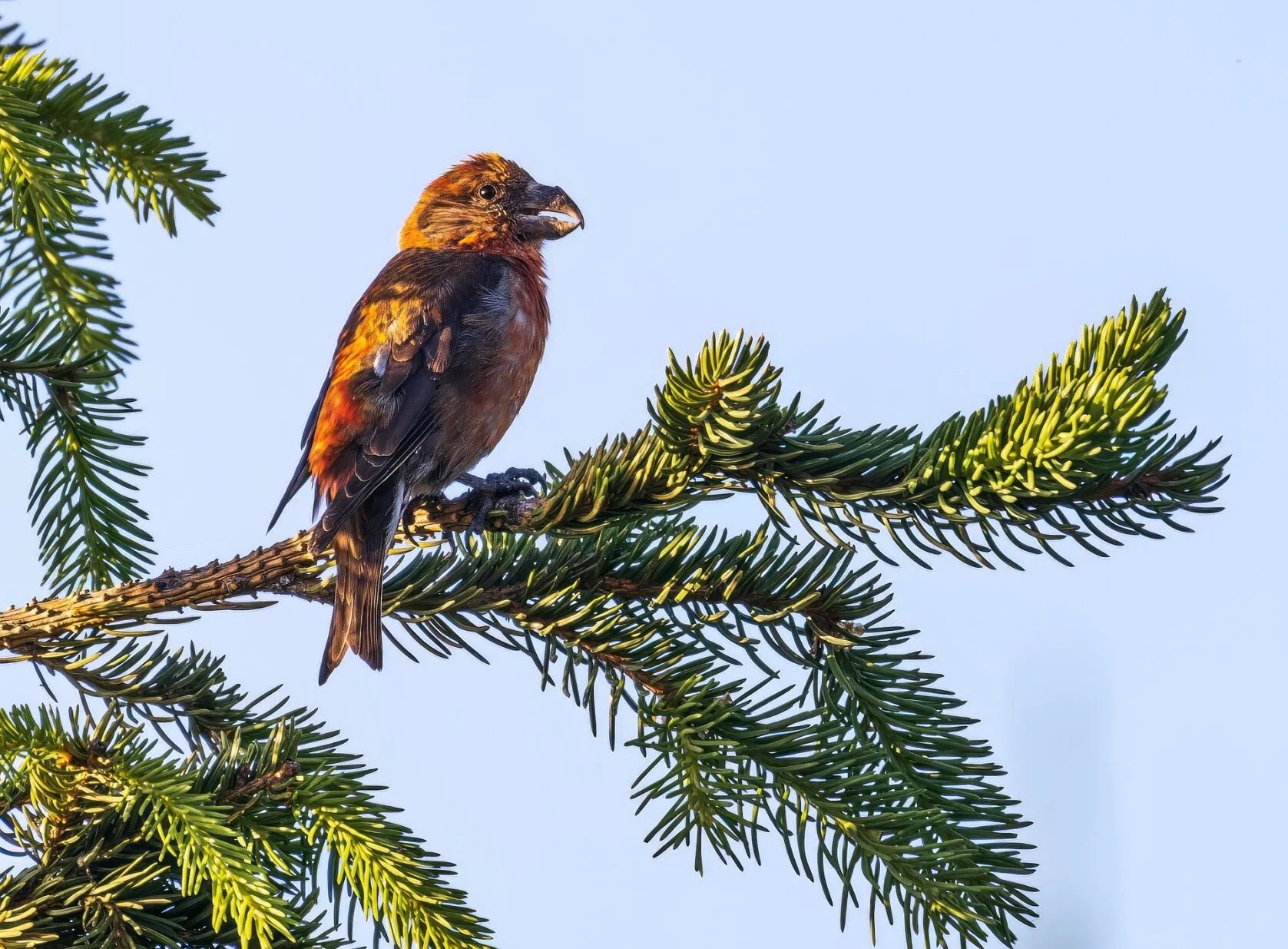
GYRLI1981/Pixabay • With its high elevation and unique habitats, Roan Mountain often produces good birds, such as red crossbills, for Christmas Bird Counts. Many of the species are difficult to find in other locations.

Unpredictable December weather makes the Roan Mountain Christmas Bird Count one of Tennessee’s most challenging surveys. This year was no exception, and the count had to postponed to a later date when a winter storm impacted the region.

The 73rd Roan Mountain Christmas Bird Count was eventually held Tuesday, Dec. 16, with six observers in two parties.

Count compiler Rick Knight noted that weather for this count was generally favorable (clear conditions and a temperature range from 17 to 46 degrees), but it was quite windy on top of the mountain making bird-finding difficult. At lower elevations, the winds were light. One to four inches of snow covered the ground, but roads were clear.

Participants tallied 43 species, plus one species added during the count week.

The list:

Canada goose, 30; American black duck, 17; wild turkey, 11; mourning dove, 17.

Sharp-shinned hawk, 1; Cooper’s hawk, 1; red-shouldered hawk, 2; and red-tailed hawk, 2.
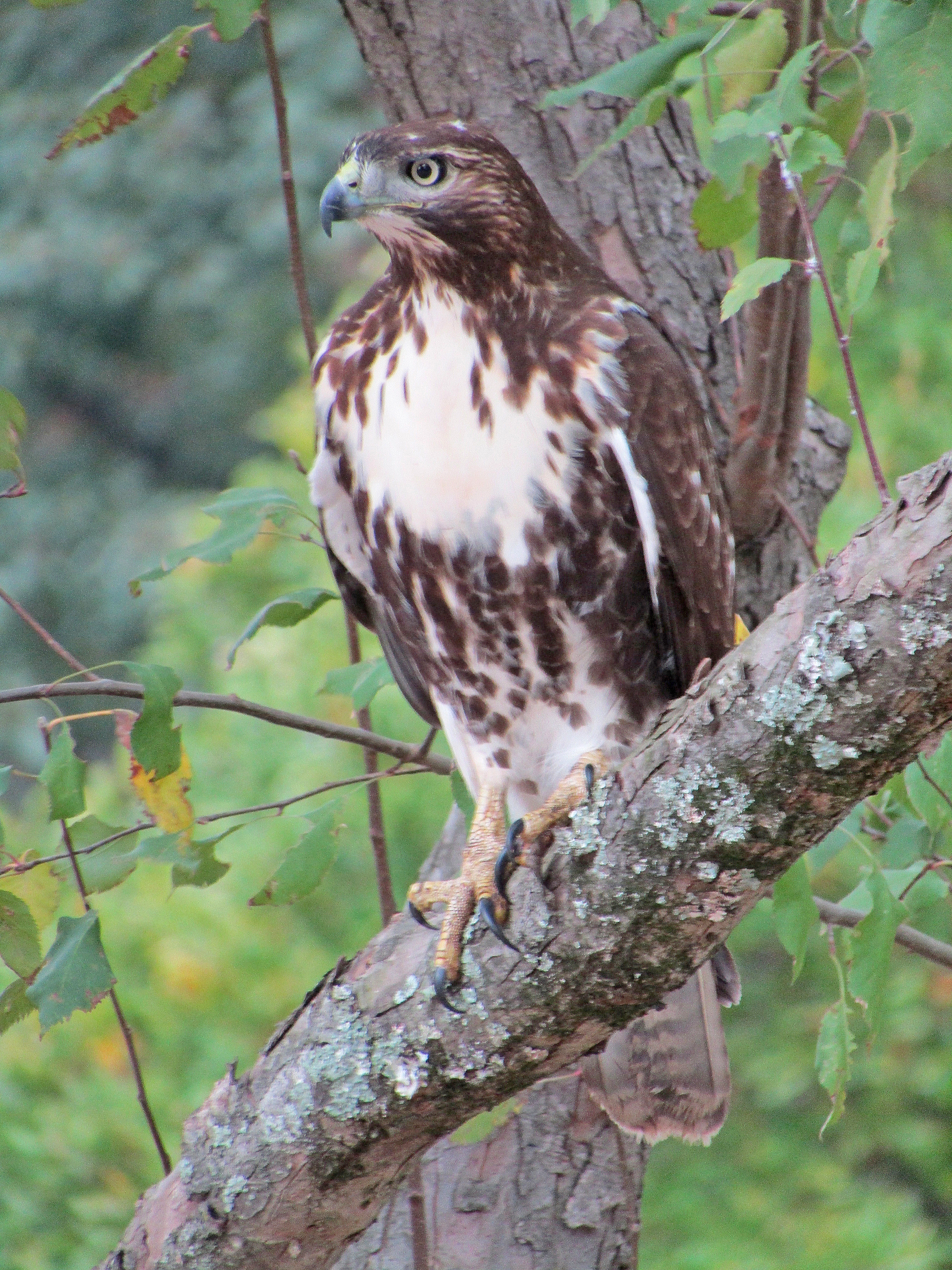
Photo by Bryan Stevens • Two red-tailed hawks made this year’s Roan Mountain CBC. 

Red-bellied woodpecker, 6; yellow-bellied sapsucker, 1; downy woodpecker, 4; hairy woodpecker,1; Northern flicker, 1: and pileated woodpecker, 3.

Eastern phoebe, 1; blue jay, 25; American crow, 120; and common raven, 8.

Carolina chickadee, 21; tufted titmouse, 24; golden-crowned kinglet, 6; red-breasted nuthatch, 3; white-breasted nuthatch, 14; brown creeper, 1; Carolina wren, 5; and winter wren, 2.

Northern mockingbird, 7; Eurasian starling, 23; Eastern bluebird, 8; and American robin, 2.

House sparrow, 5; house finch, 5; red crossbill, 2; pine siskin, 2; and American goldfinch, 119.

Field sparrow, 7; fox sparrow, 4; dark-eyed junco, 25, white-throated sparrow, 5; song sparrow, 35; Eastern towhee, 5; yellow-rumped warbler, 1; and Northern cardinal, 22.

In addition, a purple finch was found during the count week. CBC circles do accept birds seen during “Count Week, which is defined as the three days before and after the official count day, but they are recorded separately as count week birds and do not count towards the official count day totals. Their inclusion still provides important data.

The first Christmas Bird Counts were conducted on Christmas Day (Dec. 25) in 1900. The annual census arose from a proposal made by famed ornithologist Frank M. Chapman. According to Audubon.org, these yearly counts, conducted throughout the country, have provided a wealth of data over the past century.

Observations made due to CBCs have helped Audubon researchers, conservation biologists, wildlife agencies and other interested individuals to study the long-term health and status of bird populations across North America. When combined with other surveys such as the Breeding Bird Survey, the data provides a picture of how the continent’s bird populations have changed in time and space over the past hundred years.
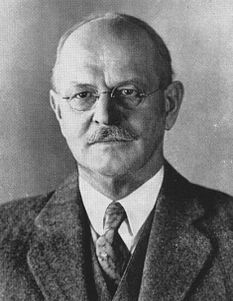
Frank W. Chapman

The concept of the Christmas Bird Count, according to the website for the National Audubon Society, arose from a less than bird-friendly custom prevalent at the turn of the 20th century. So-called sportsmen would conduct a “Side Hunt,” a rather blood-thirsty Christmas custom that saw hunters competing to see who could score the largest amount of feathered and furred corpses.

The annual holiday bird survey may even have arisen from an earlier custom with roots in Europe that came to the United States of America with early colonists. The “Side Hunt” has some similarity to a peculiar celebration in Ireland and other European countries known as “Wren Day” or “Hunt the Wren Day.” The event was conducted the day after Christmas, the date of Dec. 26 being consigned as Saint Stephen’s Day. By the 20th century, the hunt consisted of tracking down a fake wren carried atop a decorated pole. Crowds would parade through towns in masks and colorful attire. These groups were referred to as “wren boys.”

Whether or not the “Side Hunt and “Wren Hunt” shared any connections, it was a huge step forward for conservation when Chapman, the preeminent ornithologist of his day, proposed a new holiday tradition. His radical idea was to count birds during the Christmas season rather than hunting and killing them.

I will report on the total for the Elizabethton Christmas Bird Count in next week’s column.

•••

Bryan Stevens has written about birds, birders and birding since 1995. Email him at ahoodedwarbler@aol.com.
Nomadic crossbills are cone specialists


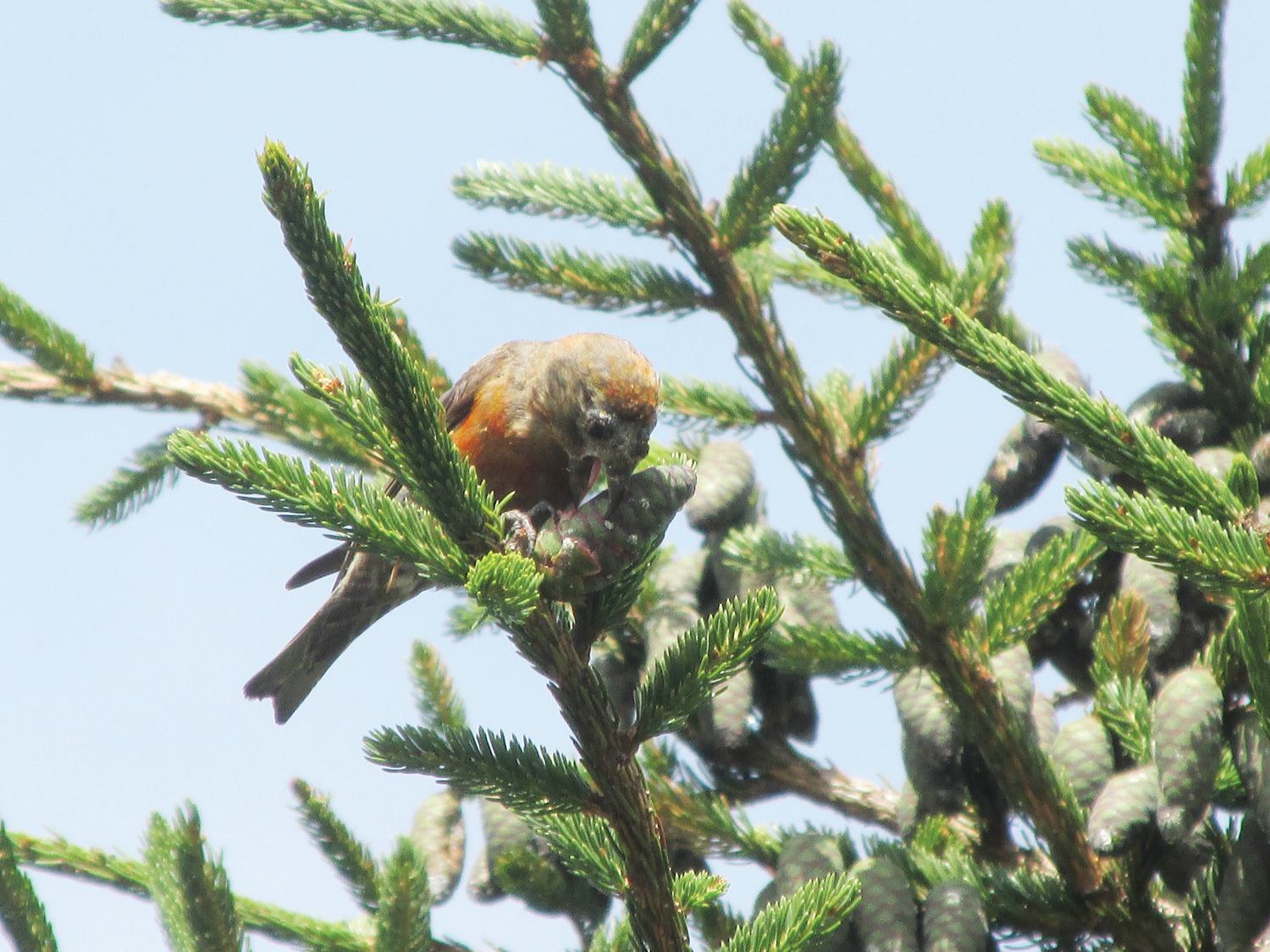
Photo by Bryan Stevens • As cone specialists, red crossbills have evolved twisted beaks to get the job done.

This column originally ran Sept. 10, 2013, in The Erwin Record.

am seeing green herons on almost every visit I make to any local body of water. In the last week, I have seen this small heron at the pond at Erwin Fishery Park, at Musick’s Campground on South Holston Lake in Bristol and from the boardwalk over the pond along the linear trail near Erwin’s Riverview Industrial Park.

A green heron at Erwin Fishery Park was stalking dragonflies along the edge of the pond and appeared to be having good success at capturing these winged insects.

I saw the heron catch and eat several dragonflies while observing it.

•••

My mother and I made a trip to Carver’s Gap on Roan Mountain on Saturday, Aug. 3. We hadn’t even gotten out of the car when my mom noticed some red crossbills perched in the upper branches of some of the Fraser firs near the parking area at Carver’s Gap. We continued to watch the crossbills and counted a total of seven birds, although the flock may have consisted of a few additional members.

The observation of the red crossbills allowed me to add this bird to my 2013 list as Bird No. 170 for the year.

It’s going to be a challenge to get those other 30 species to reach the 200 mark for the year, but I am looking forward to it.

The crossbills were all busy ripping apart the new cones on the firs to get at the seeds. Feeding on cones must be a messy business because the feathers around their heads appeared matted in a few spots. I had never thought about it, but these birds must constantly get pine resin on their feathers as they use their crossed bills to pry open cones. One of the male crossbills made quick work of several cones, using his bill to take them apart with exquisite precision. He had the process honed into a science.

The red crossbill, known by the scientific name Loxia curvirostra, is a member of the finch family, which includes such well-known feeder-visiting birds as American goldfinch, house finch, purple finch and pine siksin. In Europe, the species is known by the name common crossbill.

Crossbills have distinctive beaks, which cross at the tips, enabling them to skillfully extract seeds from conifer cones and other fruits.

Red crossbills are rather nomadic and breed in areas with an abundant crop of cones. These birds may wander widely between years to find a good cone crop. Perhaps because of this year’s wet weather, there’s a bounty of new cones on the trees at Carver’s Gap, so it has been a good summer to look for red crossbills.

For many years, this was one of my “nemesis” birds. No matter how hard I tried, I kept striking out in attempts to observe the species. I made many trips to Unaka Mountain and to Carver’s Gap on Roan Mountain to look for this bird before I finally got a good look at a pair of birds picking up grit from gravel at the edge of the Carver’s Gap parking lot.

Experts debate how many species of crossbills exist, but the current consensus is that there are five species worldwide. In addition to the red crossbill, the white-winged crossbill lives in North America but is an even more rare visitor to Northeast Tennessee.

The other three species are the parrot crossbill of northwest Europe and western Russia, the Scottish crossbill of the Caledonian Forests of Scotland and the Hispaniolan crossbill of the Caribbean island of Haiti and the Dominican Republic.

After observing the crossbills and taking several photos, we made the ascent to the grassy balds to look for other birds. I held some hope of finding a vesper sparrow, but these small birds never made an appearance.

I did observe common yellowthroats, golden- crowned kinglets, American robins, gray catbirds, cedar waxwings, dark-eyed juncos and Northern ravens during my hike on the balds.

When we returned to the parking lot at Carver’s Gap, we found some stands of blooming bee balm, which attracted visits from several ruby-throated hummingbirds.

•••

I received an email this past week from Crystal Miller about a fascinating observation of bald eagles on Friday, July 26, 2013.

“I was rafting down the lower Nolichucky River, in Tennessee, just past the Devil’s Looking Glass,” Crystal wrote. She was rafting with five other people when they saw a huge nest on the right side of the river. She said the nest was fully occupied, except for one parent circling overhead.

“The other parent was a few feet from the nest, while other younger eagles were closer, inside and around the nest,” she wrote. “We paddled against the current as long as the river would allow before we succumbed to the river.”

Crystal said others on the raft took pictures of the eagles and the nest.

“None of the younger eagles had white, or bald heads, but one I noticed had incredibly large legs,” she wrote.

She described her rafting adventure as the “best trip ever.”

Crystal also shared that her mother was born and grew up along the river and that her grandmother still lives in a house near the river.

“That eagle nest made me happy,” she concluded.

Crystal’s sighting of this family of eagles is more evidence that this once endangered national bird is indeed fully recovered and thriving.

Earlier this year, I learned of reports of a bald eagle nest in Unicoi County near the Devil’s Looking Glass. It’s very likely Crystal’s story provides more evidence that the nesting was successful.

Other eagles also successfully nested in Sullivan County and Washington County. A nest at Wilbur Lake in Carter County, unfortunately, was destroyed during a powerful storm this past spring.

•••

Bryan Stevens has written about birds since 1995. Email him at ahoodedwarbler@aol.com to share a sighting, ask a question or make a comment.