Tag Archives: flycatchers

Man’s return to birding yields scissor-tailed flycatcher sighting


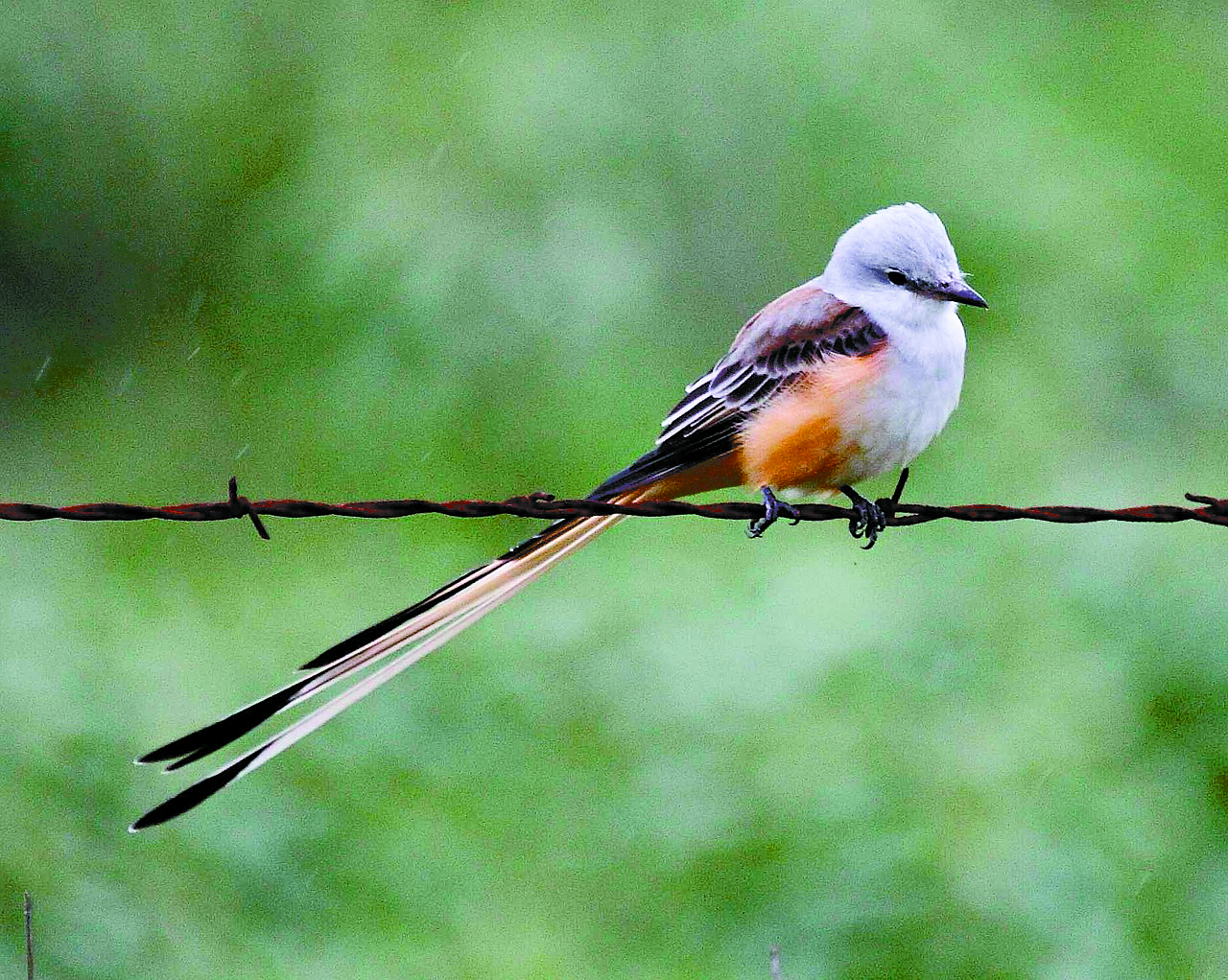
Photo by Pixabay • The scissor-tailed flycatcher is the state bird of Oklahoma and not a species often found within the borders of the Volunteer State. Nevertheless, one such flycatcher was recently spotted by Dan Huffine as he baled hay in a field in Jonesborough.

Birding is a lot like riding a bike. Once you learn how, it’s always going to stick with you.

That’s certainly been the case for Jonesborough resident Dan Huffine, who got his start in birding back in the last decade of the 20th century.

“I was very active in birding back in early ’90s,” Huffine said.

He’s now emerging after a long hiatus from birding, and he’s done so in a big way with a recent sighting of a scissor-tailed flycatcher.

He wasn’t even actively looking for birds — he was simply baling some hay in a field in Jonesborough.
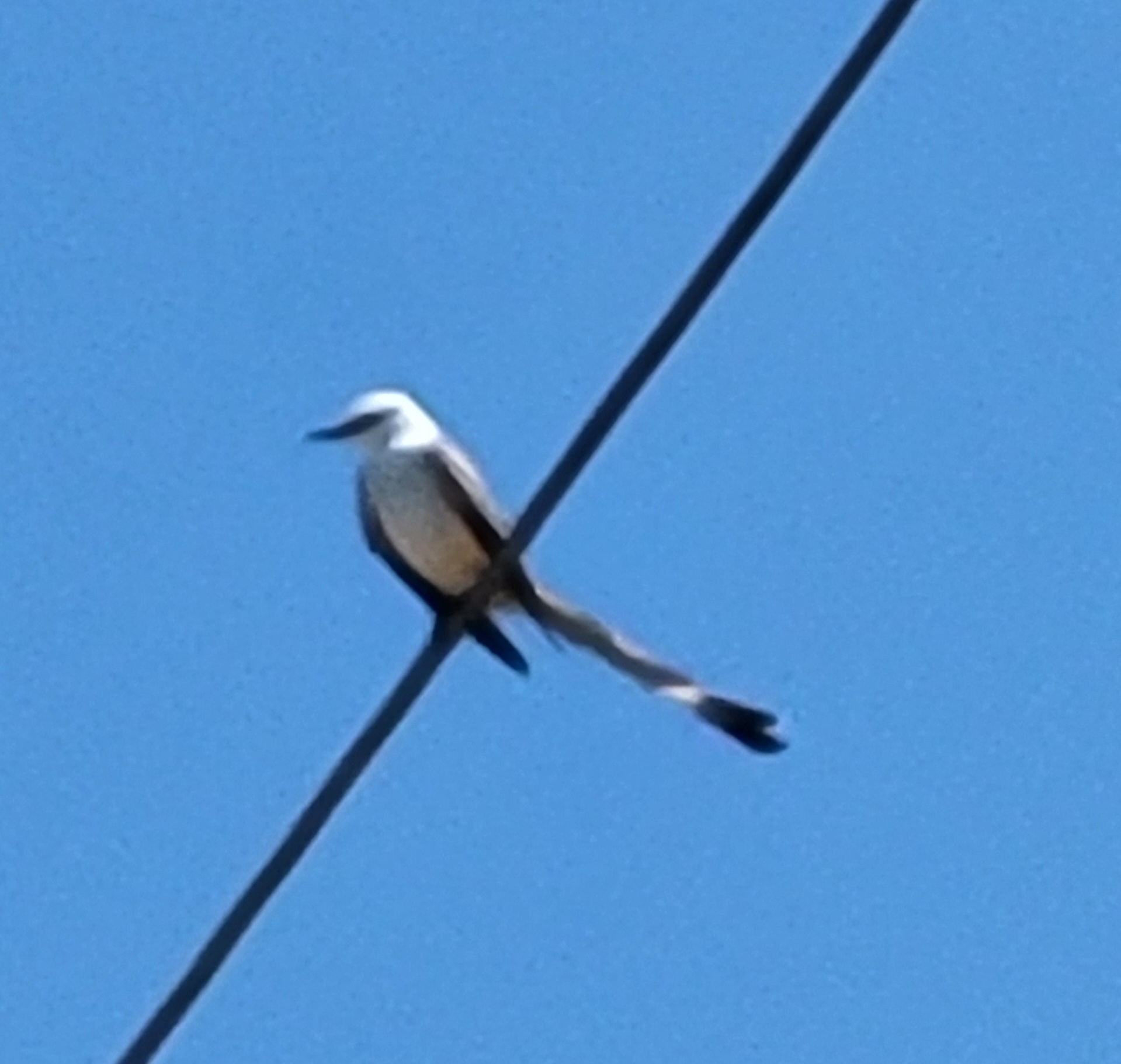
Photo by Danny Huffine • On a subsequent trip to look for the scissor-tailed flycatcher, Dan Huffine was rewarded with a chance to snap a photo of the bird perched on a wire.

“The bird was sitting on a windrow of hay facing me as i approached it on a tractor and round baler,” he explained.

He noted that his first impression was, “Wow! That mockingbird has a really white-looking head.”

As he got closer, the bird flew and revealed that it was definitely not a Northern mockingbird.

“It had that unmistakable long tail with some pinkish color under the wings,” Huffine said.

He stopped the tractor, not believing what he had just seen.

“My immediate thought was no one will believe me,” Huffine said. “I got some poor quality cell phone pictures. I got a better shot later in the day. I so wanted others to confirm my sighting.”

Toward that end, he contacted me and sought out my help in getting him in touch with Rick Knight and Fred Alsop, two very accomplished and well-known birders in the region.

Huffine’s excitement was contagious. Some other birders have now observed the flycatcher, which is a bird much more likely to be found in Oklahoma or Texas rather than Northeast Tennessee.

In fact, Huffine’s sighting became only the third-ever sighting of a scissor-tailed flycatcher in Northeast Tennessee. All of the sightings have taken place in Washington County.

According to the website “All About Birds,” scissor-tailed flycatcher numbers declined by about 31% between 1966 and 2014. The estimate comes from statistics gathered by the North American Breeding Bird Survey.

The website also noted that Partners in Flight estimates a global breeding population of 9.5 million scissor-tailed flycatchers, with 92% breeding in the United States, and 50% spending some part of the year in Mexico.

A scissor-tailed flycatcher is unlikely to be confused with any other bird. Adult males are pale gray birds with blackish wings and black tails with white edges. Adults show salmon-pink flanks that extend to underwing patches that are very conspicuous in flight. As is the case with so many species of birds, males are more colorful than females.

The bird’s body is about the size of an American robin, but it looks bigger due to the long tail that gives this species its common name.

The “All About Birds” website notes that the scissor-tailed flycatcher doesn’t always stay within its expected range.
This species tends to wander widely on their way to and from the wintering grounds, a habit they share with relatives like the fork-tailed flycatcher and tropical kingbirds. During spring and fall, scissor-tailed flycatchers may show up almost anywhere in North America, as far north

as British Columbia and Nova Scotia — or Northeast Tennessee.
One place that the bird is expected is Oklahoma. Since May 26, 1951, the scissor-tailed flycatcher has been the officially designated Oklahoma state bird.
Even during Huffine’s hiatus from birding, he still managed to see some fantastic birds, including a snowy owl in Beckley, West Virginia, back in 2014.
“I started an ebird account in early 2022,” he said.

“I am starting over with my life list.”

The only bird that he has kept on his list is the aforementioned snowy owl.
“Birding is much easier now than it was 30 years ago,” Huffine said. “We have better optics.”

He noted that birding apps have also proliferated, including eBird and Merlin.
“Just don’t over trust Merlin,” Huffine cautioned.

He has some target species that he’d like to find in east Tennessee, including Northern saw-whet owl and ruffed grouse.

“Ruffed grouse has become a much harder species i(to find) in the last 30 years,” Huffine said.

He has some solid advice for anyone who would like to replicate his success.
“It’s is easy to dream about far-off places to visit, but look for everything that is present where you are,” he said. “You might find a scissor-tailed flycatcher.”
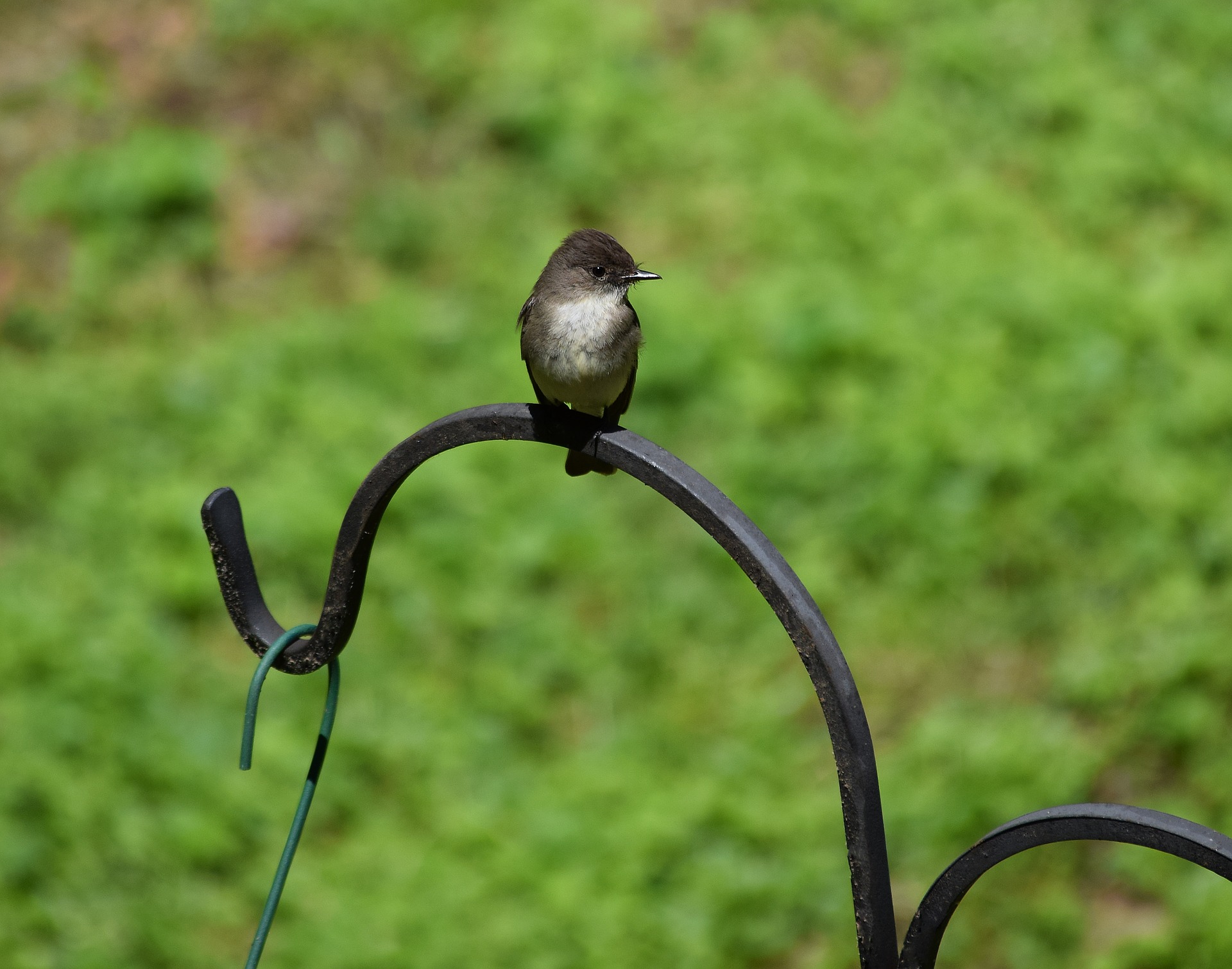
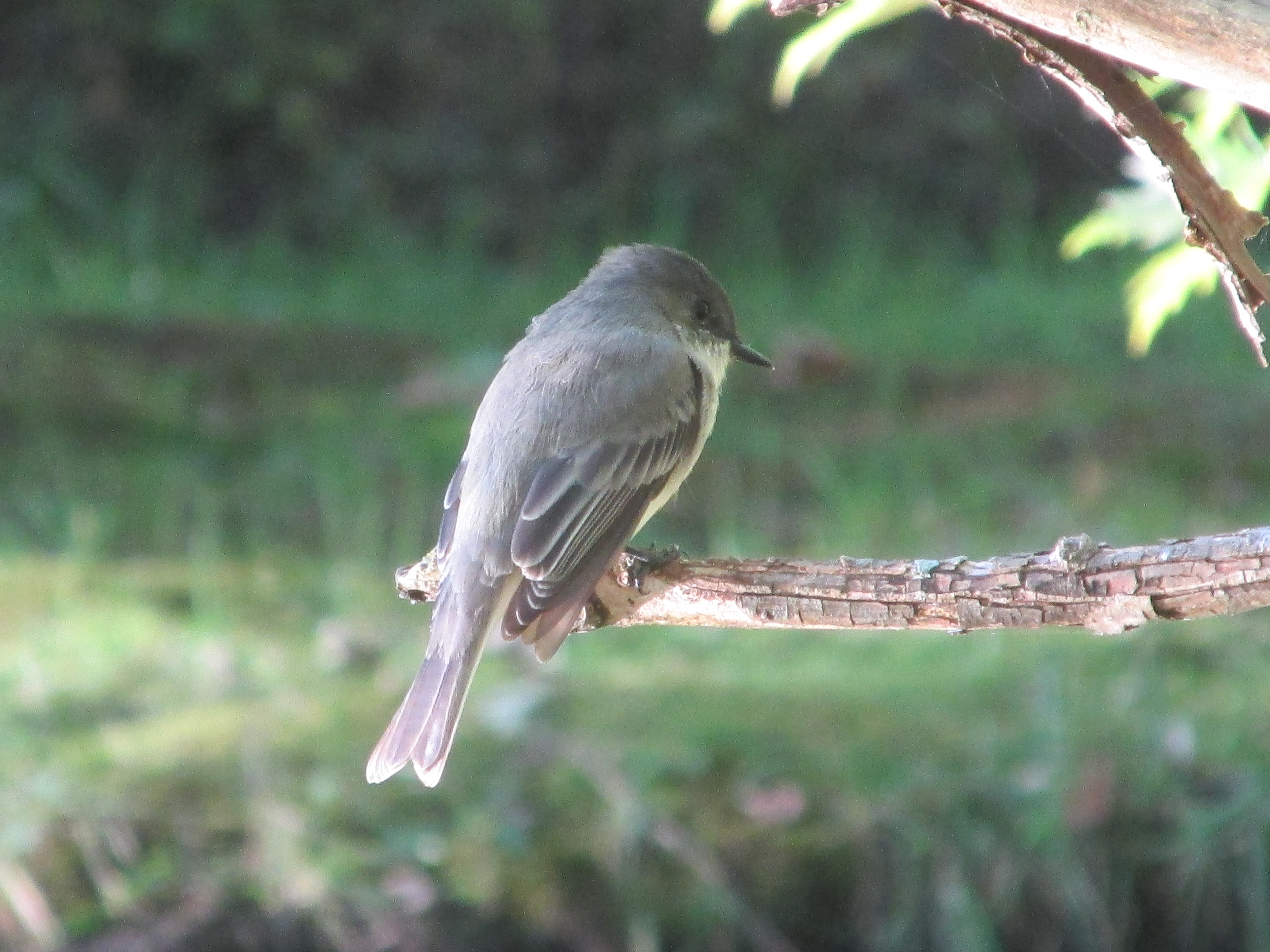
 

Eastern phoebe belongs to extensive flycatcher family

Photo by leoleobobeo/Pixabay.com • An Eastern phoebe perches on a garden shepherd’s hook. Phoebes, a member of the extensive New World flycatcher family, are adept at capturing flying insect prey by utilizing elevated perches.

Jill Henderson, who resides in Saltville, Virginia, emailed me recently with a question about a bird nesting atop a column on her back porch.

Jill provided me with four photographs attached to her email that greatly assisted in identifying the nesting birds on her back porch. 

“It seems to enjoy the water in my pool,” she added. Indeed, a couple of the photos showed the bird perched poolside on one of her lawn chairs. 

The nesting birds turned out to be Eastern phoebes, which are a member of the extensive family of birds known as “tyrant flycatchers.” The information about the pool assisted with the identification. Phoebes show an affinity for water, whether the source is a creek, pond or even a residential swimming pool.

Photo by Bryan Stevens • An Eastern phoebe scans from a perch for flying insect prey.

Considering the bright finery worn by some of the more colorful spring arrivals, it’s understandable if the return of Eastern phoebes escape immediate notice each year. In comparison with vibrant birds like rose-breasted grosbeak, ruby-throated hummingbird, scarlet tanager and yellow warbler, the Eastern phoebe is downright drab with its gray-black and dingy white plumage. Nevertheless, this member of the flycatcher clan has earned itself a favorite spot in the hearts of many a birdwatcher. It’s one of those birds that even beginning birders find surprisingly easy to recognize and identify after a bit of study. While it may not have a dramatic plumage pattern to hint at its identity, the Eastern phoebe is quite at home around human dwellings and comes into close contact with people going about their daily routines. Rather tame — or at least not too bothered by close proximity with humans — the Eastern phoebe has one behavior that sets it apart from all the other similar flycatchers. When this bird lands on a perch, it cannot resist a vigorous bobbing of its tail. Every time a phoebe lands on a perch, it will produce this easily recognized tail dip and rise. It’s a behavior that makes this bird almost instantly recognizable among birders with a knowledge of the trait.

Photo by Bryan Stevens • An Eastern phoebe fledgling only recently out of the nest.

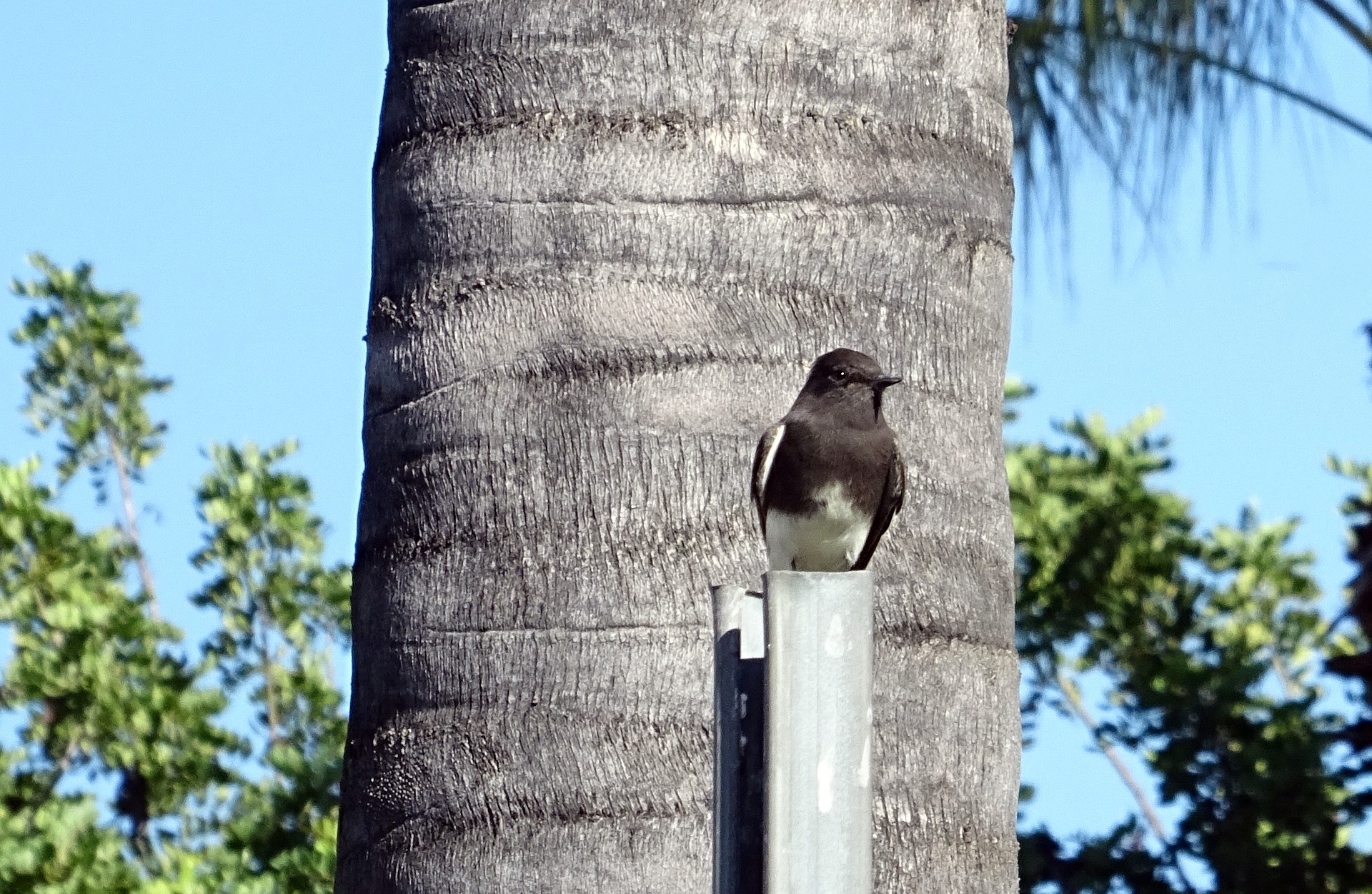
Photo by Sarangib/Pixabay.com • A black phoebe perches on a post near a palm tree.

The Eastern phoebe is also an enthusiastic springtime singer, and the song it chooses to sing is an oft-repeated two-syllable call “FEE-bee” that provides the inspiration for this bird’s common name. The Eastern phoebe, known by the scientific name of Sayornis phoebe, has two relatives in the genus Sayornis. The genus is named after Thomas Say, an American naturalist. The Eastern phoebe’s close relatives include the black phoebe and Say’s phoebe. The black phoebe ranges throughout Oregon, Washington and California and as far south as Central and South America. As its name suggests, this bird has mostly black feathers instead of the gray plumage of its relatives. The Say’s phoebe, also named for the man who gave the genus its name, is the western counterpart to the Eastern phoebe.

The phoebes belong to the the world’s largest family of birds, which is known collectively as the “tyrant flycatchers.” With more than 400 species, this family of birds consists of species known as tyrannulets, elaenias, pygmy tyrants, tody-flycatchers, spadebills, flatbills, attilas, kingbirds and kiskadees. 

Since they belong to the vast family of New World flycatchers, it’s probably no surprise that these phoebes feed largely on insects. The birds will often perch patiently until an insect’s flight brings it within easy range. A quick flight from its perch usually allows the skillful bird to return with a morsel snatched on the wing. In the winter months, the Eastern phoebe also eats berries and other small fruit. Phoebes can even feed on poison ivy berries without risk of ill effects.

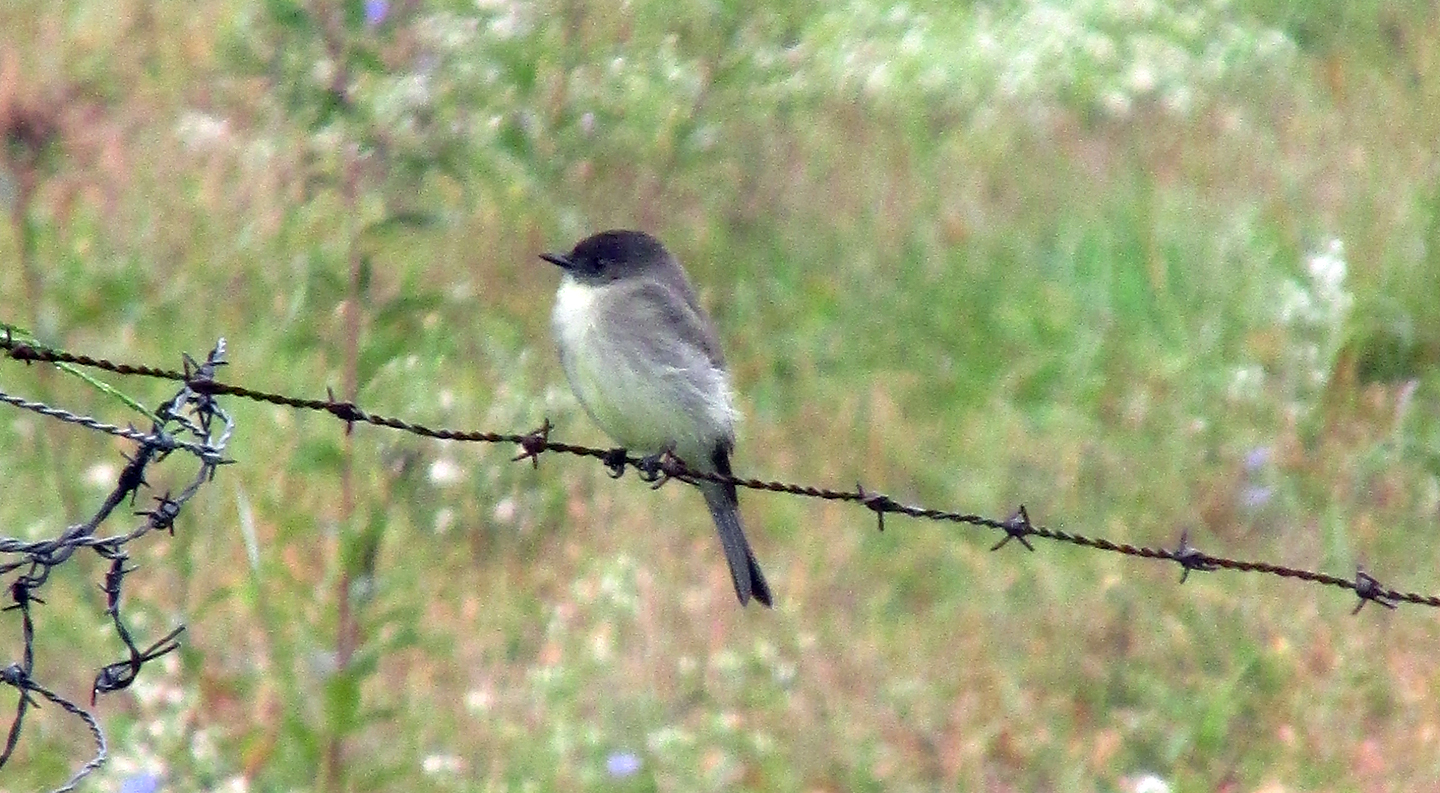
Photo by Bryan Stevens • An Eastern Phoebe perches on barbed wire.

Phoebes are fond of nesting on human structures, including culverts, bridges and houses. With the latter, they were once known for their habit of placing their nests under sheltering eaves. At my home, a pair of Eastern phoebes often chooses to nest on the wooden rafters in my family’s garage.  Although the species is migratory, a few hardy individuals will usually try to tough out winters in the region. The others that depart in the autumn will migrate to the southern United States and as far south as Central America. On some rare occasions, Eastern phoebes have flown far off their usual course and ended up in western Europe. I can usually count on Eastern phoebes returning to my home in early March, making them one of the first migrants to return each year. Their arrival rarely goes unnoticed since the males tend to start singing persistently as soon as they arrive.

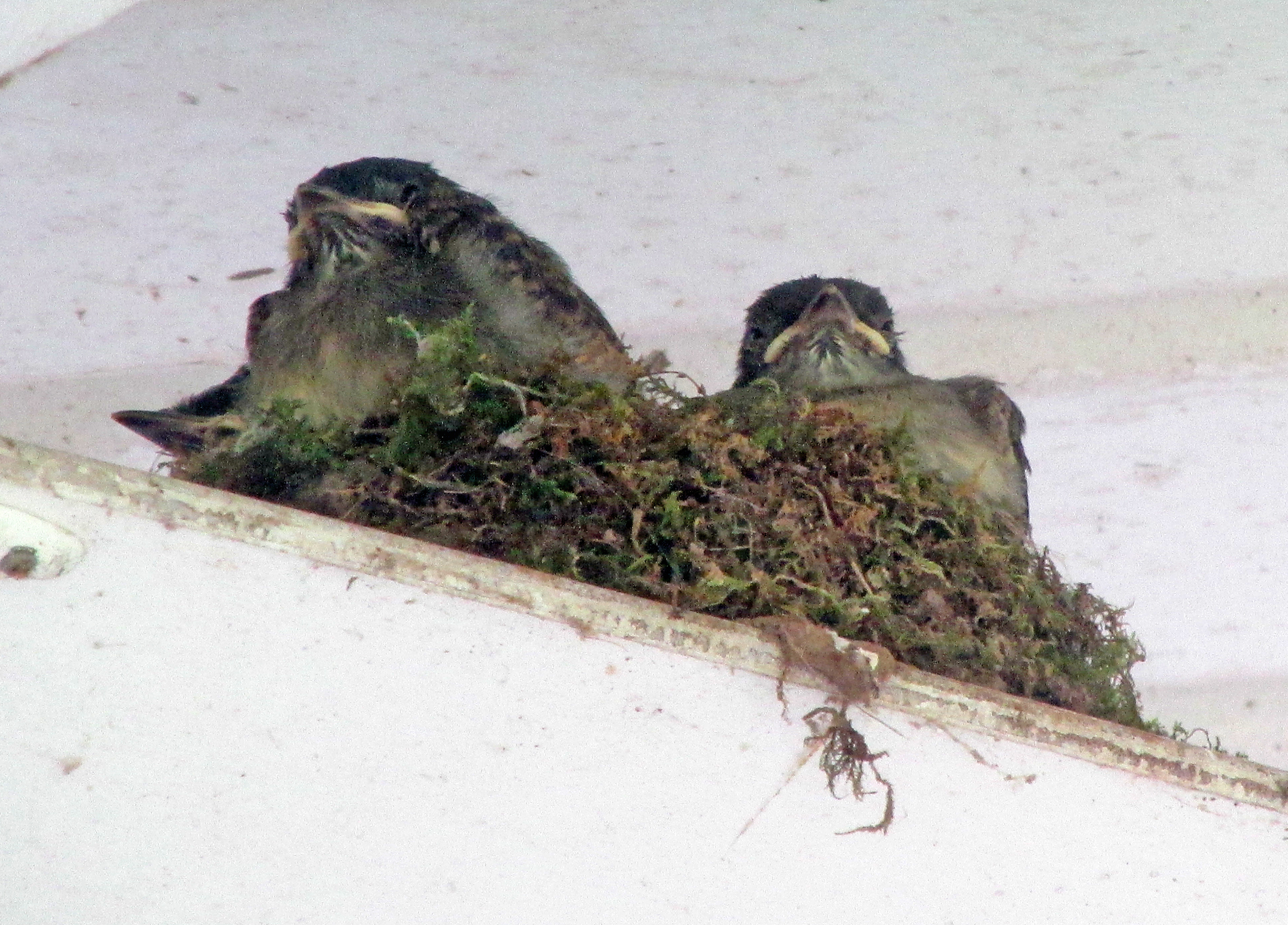
Photo by Bryan Stevens • Eastern phoebe nestlings stay in their nest atop a blade on an outdoor ceiling fan.


John James Audubon, an early naturalist and famed painter of North America’s birds, conducted an experiment with some young phoebes that represents the first-ever bird banding in the United States of America. His novel experiment, which he carried out in 1803, involved tying some silver thread to the legs of the phoebes he captured near his home in Pennsylvania. He wanted to answer a question he had about whether birds are faithful to home locations from year to year. The following year, Audubon again captured two phoebes and found the silver thread had remained attached to their legs. Today, ornithologists still conduct bird banding to gather information on birds and the mystery of their migrations. So, that pair of phoebes that returned to your backyard this spring — they just might be the same ones that have spent past summer seasons providing you with an enlightening glimpse into their lives.

Jill reminded me that she had written to me a few years back and had mentioned difficulty with hummingbird feeders and bears. “I am happy to report that so far this summer, there have been no incidents,” she wrote.

Her email also reminded me of a recent surprise. I awoke recently to the sound of a disturbance outside my bedroom window. I figured rambunctious squirrels were raiding my feeders. I raised the blind and surprised myself and a young black bear. Standing on his hind legs, the bear had managed to hook its paws on one of my feeders that hangs about four feet off the ground. The bear, probably a yearling based on its size, fled the scene, which probably spared my feeder. 

If you have a question, wish to comment on a column or share an observation, email me at ahoodedwarbler@aol.com. If you want help with identification, photographs definitely help.

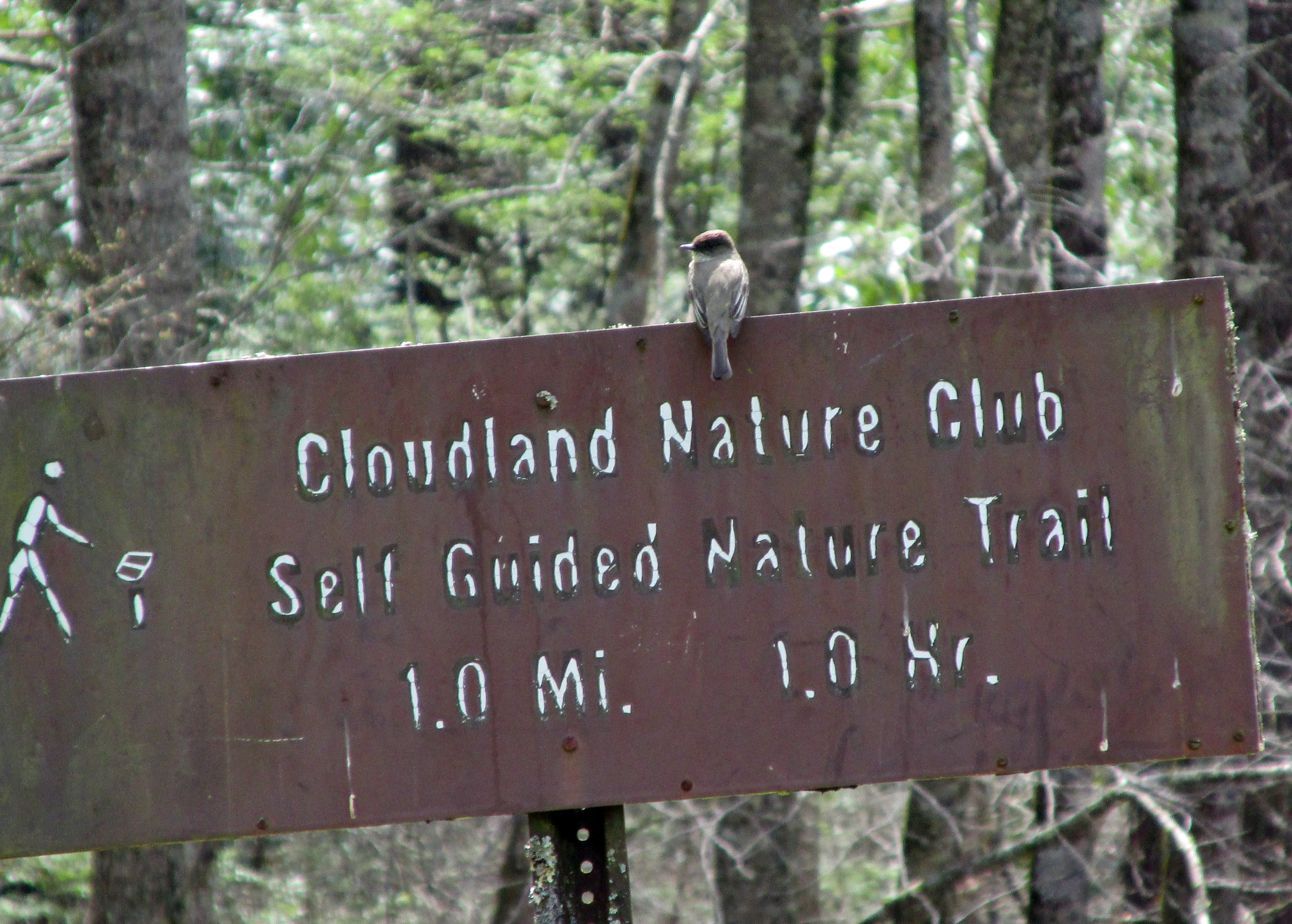
Photo by Bryan Stevens • An Eastern phoebe utilizes a hiking trail sign as an elevated perch.

Eastern phoebe easily wins friends with its trusting nature

Considering the bright finery worn by some of the more colorful spring arrivals, I could hardly blame you if the return of the Eastern phoebes escaped your notice. In comparison with vibrant birds like rose-breasted grosbeak, ruby-throated hummingbird, scarlet tanager and yellow warbler, the Eastern phoebe is downright drab.

Phoebe-Baby

Photo by Bryan Stevens                                      This fledgling Eastern phoebe waits patiently on a branch for a parent to bring it a morsel of food. Phoebe-Baby

Phoebe-Two

Photo by Bryan Stevens                                                               The Eastern phoebe is a common bird in much of the Eastern United States.

Nevertheless, this member of the flycatcher clan has earned itself a favorite spot in the hearts of many a birdwatcher. It’s one of those birds that even beginning birders find surprisingly easy to recognize and identify. While it may not have a dramatic plumage pattern to hint at its identity, the Eastern phoebe is quite at home around human dwellings and comes into close contact with people going about their daily routines. Rather tame — or at least not too bothered by close proximity with humans — the Eastern phoebe has one behaviorism that sets it apart from all the other similar flycatchers. When this bird lands on a perch, it cannot resist a vigorous bobbing of its tail. Every time that a phoebe lands on a perch, it will produce this easily recognized tail wag. It’s a behavior that makes this bird almost instantly recognizable among birders with the knowledge of this behavioral trait.

The Eastern phoebe is also an enthusiastic springtime singer, and the song it chooses to sing is an oft-repeated two-syllable call “FEE-bee” that provides the inspiration for this bird’s common name.

Octavos500_set12

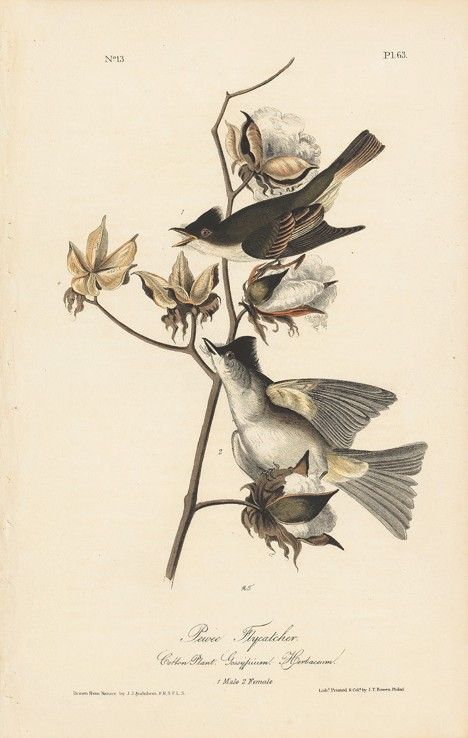
A painting by John James Audubon of Eastern phoebes, or, as he knew them, pewee flycatchers.

Thomas_Say

Thomas Say

The Eastern phoebe, known by the scientific name of Sayornis phoebe, has two relatives in the genus Sayornis. The genus is named after Thomas Say, an American naturalist. The Eastern phoebe’s close relatives include the black phoebe and Say’s phoebe. The black phoebe ranges throughout Oregon, Washington and California and as far south as Central and South America. As its name suggests, this bird has mostly black feathers instead of the gray plumage of its relatives. The Say’s phoebe, also named for the man who gave the genus its name, is the western counterpart to the Eastern phoebe.

Since they belong to the vast family of New World flycatchers, it’s probably no surprise that these phoebes feed largely on insects. The birds will often perch patiently until an insect’s flight brings it within easy range. A quick flight from its perch usually allows the skillful bird to return with a morsel snatched on the wing. In the winter months, the Eastern phoebe also eats berries and other small fruit.

Phoebe-WIllow

Photo by Bryan Stevens                                      An Eastern phoebe forages for insects in the branches of a willow tree.

Phoebes are fond of nesting on human structures, including culverts, bridges and houses. With the latter, they were once known for their habit of placing their nests under sheltering eaves. At my home, a pair of Eastern phoebes often chooses to nest on the wooden rafters in my family’s garage. Phoebes also like to reside near a water source, such as a creek, stream or pond.

Although the species is migratory, a few hardy individuals will usually try to tough out winters in the region. The others that depart in the autumn will migrate to the southern United States and as far south as Central America. On some rare occasions, Eastern phoebes have flown far off their usual course and ended up in western Europe. I can usually count on Eastern phoebes returning to my home in early March, making them one of the first migrants to return each year. Their arrival rarely goes unnoticed since the males tend to start singing persistently as soon as they arrive.

Phoebe-Sign

Photo by Bryan Stevens                                                            An Eastern Phoebe perches on a sign at Roan Mountain State Park in Roan Mountain, Tennessee.

A few weeks ago I wrote about opportunities to take part in citizen science projects for the benefit of birds. The concept of ordinary citizens making a difference in scientific discovery isn’t a new one. More than two centuries ago, one of the most influential birders in history and the namesake of the National Audubon Society used Eastern phoebes to help add to the knowledge of bird migration.

Phoebe-Sept18

Photo by Bryan Stevens            An Eastern phoebe during the fall of the year.

John James Audubon, an early naturalist and famed painter of North America’s birds, conducted an experiment with some young phoebes that represents the first-ever bird banding in the United States of America. His novel experiment, which he carried out in 1803, involved tying some silver thread to the legs of the phoebes he captured near his home in Pennsylvania. He wanted to answer a question he had about whether birds are faithful to home locations from year to year. The following year Audubon again captured two phoebes and found the silver thread had remained attached to their legs. Today ornithologists still conduct bird banding to gather information on birds and the mystery of their migrations.

So, that pair of phoebes that returned to your backyard this spring — they just might be the same ones that have spent past summer seasons providing you with an enlightening glimpse into their lives.

••••••

To learn more about birds and other topics from the natural world, friend Bryan Stevens on Facebook at https://www.facebook.com/ahoodedwarbler. He is always posting about local birds, wildlife, flowers, insects and much more. If you have a question, wish to make a comment or share a sighting, email ahoodedwarbler@aol.com.

4934813732_fa115579d3_o

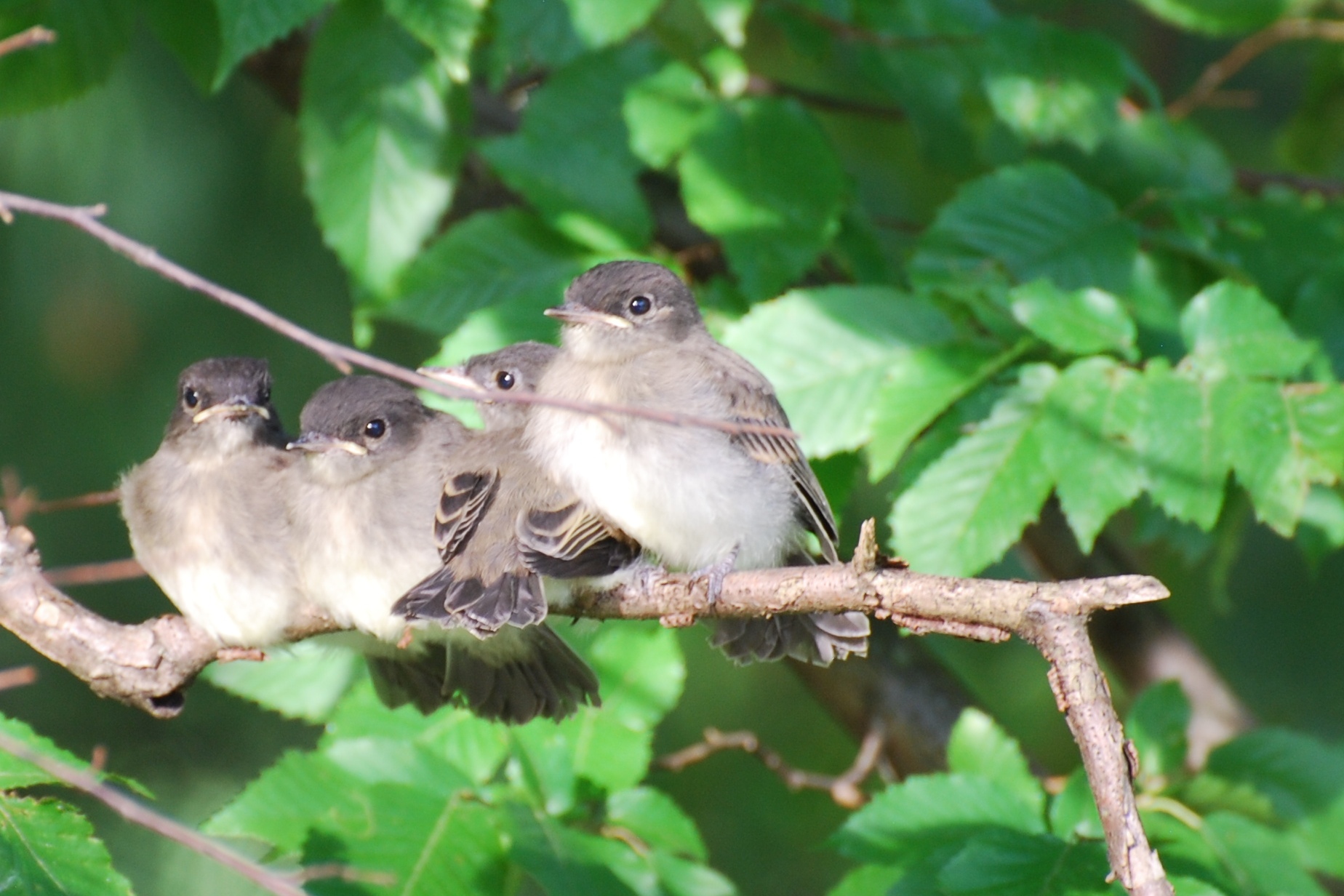
Photo Courtesy of Jean Potter                                                                                                          A family of young Eastern Phoebes shares a perch.