Bryan Stevens lives in Northeast Tennessee. He is an editor, writer and columnist. He has written food columns for the Johnson City Press, Elizabethton Star and Carter County Compass since 2003.
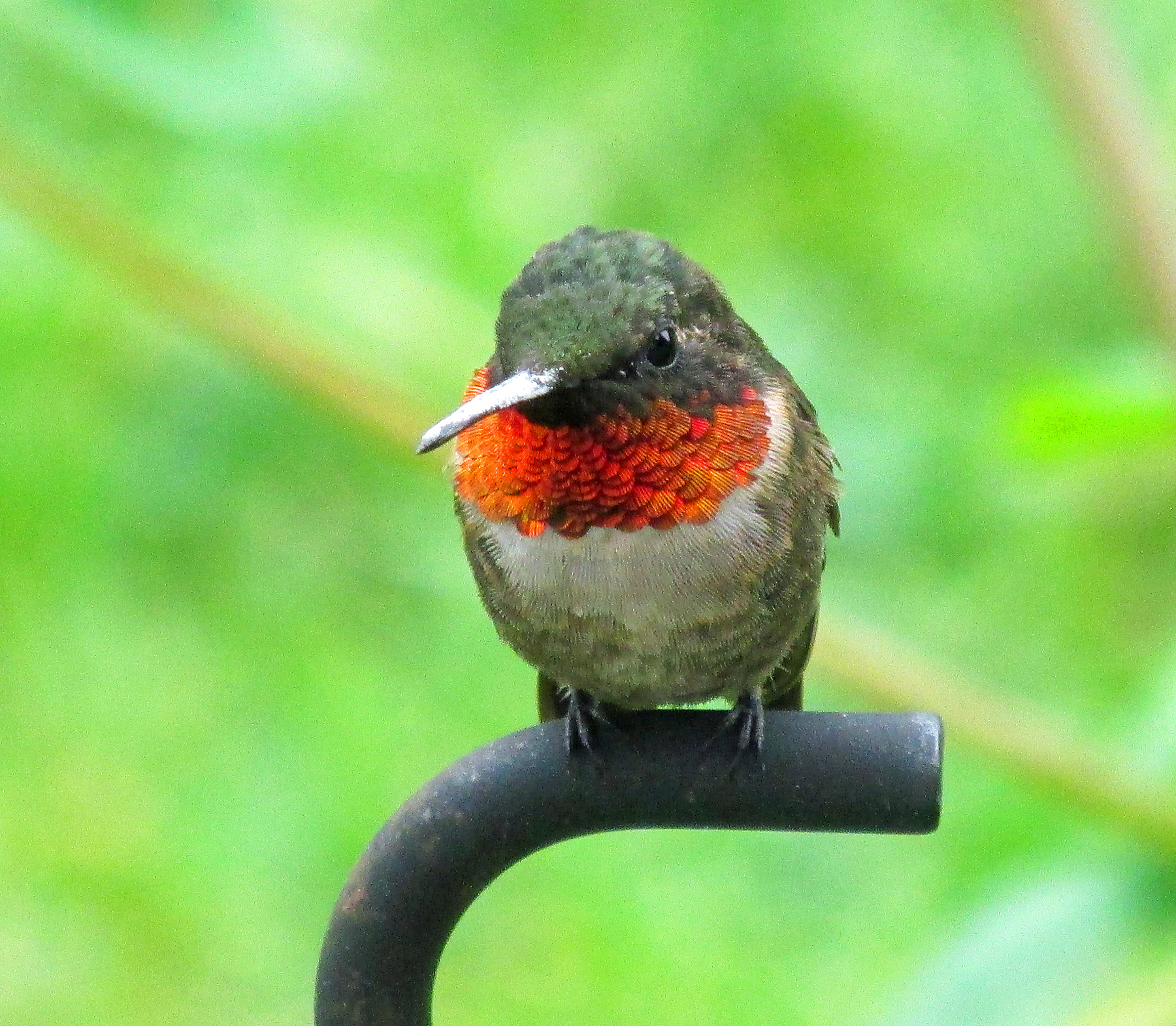
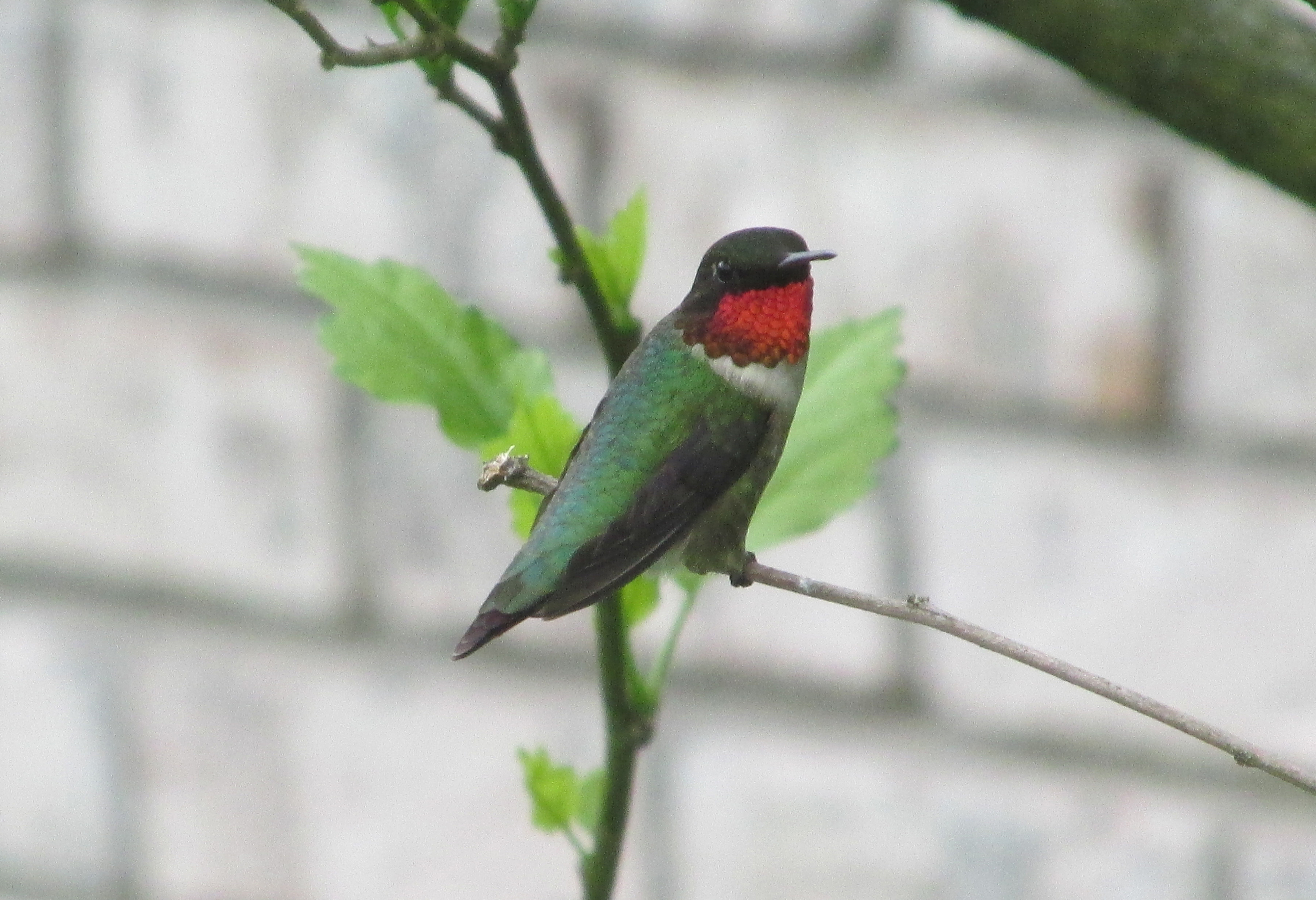
Photo by Bryan Stevens • Ruby-throated hummingbirds such as this male are returning to the region.
I thought I’d give a timely progress report. I wrote recently about a vision problem that has afflicted my left eye. During my most recent visit to my doctor, he noticed the same improvement that I had already been gradually detecting.
He was surprised and admitted he had not expected any improvement. He also noted, perhaps jokingly, that the better vision was not due to anything he had done or prescribed. I contemplated asking, jokingly, if that meant I shouldn’t have to pay for the multiple visits.
Without any more undue digression, I wrote back in February that my goal was to be able to see a ruby-throated hummingbird once they returned in April.
I saw my hope fulfilled when I had a brief glimpse of one on Sunday, April 9, but it was one of those speedy “blink-and-you-missed-it” affairs.
On the next evening. my mom and I watched a male ruby-throated hummingbird feeding at one of her feeders.
Using binoculars, I was able to see the bird fairly clearly. The image is still soft around the edges, but I clearly saw the gleaming red throat when the light hit just right.
By the way, mom had already seen two hummingbirds dueling around her feeders, but that evening’s visitor was solo. We also watched Northern cardinals, Eastern towhees, red-winged blackbirds, song sparrows, and white-throated sparrows, Carolina chickadees, tufted titmice and Carolina wrens.
I’m not where I want to be in regards to having an “eagle eye” for birding, but I’m thankful to have reached this stage and remain optimistic improvement will continue.
Photo by Bryan Stevens • A ruby-throated hummingbird lifts its wings to shake water droplets off its back.
In the meantime, readers continue to share their own first hummingbird sightings of spring.
••••
“I had my first hummingbird April 18 at 6:58 p.m. in Richlands, Virginia,” wrote Helen Whited.
She also shared some other exciting spring sightings.
She reported that she has already seen a rose -breasted grosbeak and a Baltimore oriole.
••••
“I had one ruby-throated hummingbird this past week,” Jeri Layne wrote to me on April 19. “It stopped at the feeder and I haven’t seen any since. Usually I have several by now.”
••••
I saw my first hummers in Roan Mountain April 11,” wrote Cherie Beth. “They were the male ruby-throats.”
••••
“Our first little guy showed up April 15 at 4:30 p.m. here in Stoney Creek near Elizabethton, Tennessee,“ wrote Mary Beierle. “I’m so excited! Can’t wait for a mate to show up also.”
••••
“Saw first ruby-throated humming bird on April 8 at 11 a.m. in Fancy Farm, Kentucky,” wrote Olif Perkins.
••••
Felicia Mitchell in Emory, Virginia, messaged me on Facebook. “First hummingbird spotted at feeder at 6:58 p.m. on April 14,” she wrote.
••••
Rhonda and Randal Eller their first sighting of a male hummingbird on April 19 at their home on the outskirts of Chilhowie, Virginia.
••••
Cheri Miller in Roan Mountain, Tennessee, shared that she saw her first spring hummingbird on April 16.
••••
Nancy Vernon in Bristol, Tennessee, shared that she saw her first hummingbirds (three of them) on April 17. She reported she had only put out the feeder the day before the sightings took place.
••••
Janice Frasier Martin reported her first hummer on April 20. Formerly of Bristol, Tennessee, Janice now lives in Shepherdsville, Kentucky.
••••
Hummingbirds and other migrants are arriving daily. To share sightings, ask questions or make comments, email me at ahoodedwarbler@aol.com.
Photo by Bryan Stevens • Despite a perceived disadvantage of size, ruby-throated hummingbirds are quite capable of thriving in a giant world.
Photo by Janet Woodward • This male ruby-throated hummingbird arrived at the home of Janet Woodward on April 3. She resides near the Pamlico River in Bath, North Carolina.
My yearly roundup of the first hummingbird sightings of spring has been a doozy so far. I’ve heard from readers in the states of Washington, New Mexico, Texas, Arkansas and Alabama. Closer to home, I’ve also gotten reports from readers in the Carolinas, Georgia and Tennessee. I’ll continue the round-up next week and will keep fingers crossed that perhaps I will have spotted my own first spring hummingbird at my home in Hampton, Tennessee, by then.
••••
Mike Haynes saw his first hummingbird in early March, but he lives a tad outside the region in Odessa, Texas.
“A note to let you know we get hummingbirds here in west Texas around March 5 each year,” he wrote in an email.
Mike is apparently not getting visits from male hummingbirds with their bright red throats.
“They all are unattractive gray birds,” he noted. “We get zero pretty birds.”
Regardless, he makes the best of it and pays close attention to their actions.
“They nest high in the trees,” he wrote. “They are here all summer.”
He also noted that the hummingbirds are “very hostile little guys” and noted that in In the hot (108 degrees) days, they drink a lot. “
“All of these guys are very skittish and fly off even if you open a door,” he said. But it’s all we have.”
Mike shared that he grows tons of bright and colorful flowers and plants to attract hummingbirds.
“We bring our feeders in on Nov. 1 each year,” he wrote.
••••
Patsy Stewart emailed me to report that she saw ruby-throated hummingbirds on March 30 and April 2. The visits took place early in the morning and late in the evening at Patsy’s home in Rossville, Tennessee.
••••
Wanda Dugan shared that she saw a male ruby-throated hummingbird on March 31 at her home in western North Carolina.
••••
“I saw my first hummingbird April 1,” Judy Steele wrote in an email. “Possibly he had been here before I spotted him. I have had a feeder out for a couple of weeks and change it every five to six days and notice less feed when I go out to exchange my feeder. “
All doubts were erased on Saturday, April 1, when she saw a visiting male hummingbird. “He stayed at the feeder for half a minute or so,” she added.
Judy noted that she lives in Loudon, Tennessee, close to Watts Bar Lake.
••••
“Saw the first hummingbird in Gainesboro, Tennessee, today (April 2),” Glenda Stafford wrote in an email. She helpfully noted that Gainesboro is located 100 miles between Nashville and Knoxville.
“We just got our first hummingbird yesterday,” Donna Snyder wrote to me by email. on April 3. “I’ve had our feeders out for two weeks, and I’m so excited to finally have one arrive.” She noted that her family resides in Kings Mountain, North Carolina, in the western part of the state.
••••
“I saw my first hummingbird April, 2 in Albany, Georgia,” wrote Rena Parker in an email to me.
••••
Debra Roy reported her first sighting of a male ruby-throated hummer on April 3 at her home in Richmond Hill, Georgia.
••••
“Saw our first this afternoon (April 3) at 5:57 p.m. central time in Clarksville, Arkansas,” wrote Dr. Buckley T. Foster in an email about his first spring hummingbird sighting.
••••
Reader Janie Balzano lives in New Mexico, so her first spring sighting was not of the ruby-throated hummingbird prevalent in the eastern United States.
“First sighting on Monday (April 3),” Janie wrote. “The feeders were put out three days prior.”
Janie resides at Seven Rivers, New Mexico, halfway between Carlsbad and Artesia.
“We are seeing three males,” she noted.
She shared that two of the tiny visitors are Anna’s hummingbirds and the third is a rufous hummingbird.
••••
Elaine Hallgarth, also of New Mexico, shared that she saw two black-chinned hummingbirds on April 3 at her feeders. An earlier sighting by a non-birder on March 31 was also likely a black-chinned hummingbird. Elaine resides in San Lorenzo, New Mexico.
••••
“The juice is out,” reported Mark Praschak in North Carolina.
“I’ve had my feeder out in New Bern, North Carolina, for a week now,” he wrote on April 3. “No arrivals yet. Their nest from last year is still pretty exposed. Giving it another week or so before the leaves can hide it better. Will advise.”
••••
Fred Rauh of Myrtle Beach, South Carolina, emailed me to let me know that he saw his first spring hummingbird on March 25 at 3 p.m.••••
Frank Alegria emailed me that he saw his first spring hummingbird on March 30 at his home in Pottsboro, Texas.
••••
Rufus Milam in Jacksonville, North Carolina, wrote that he put his feeder out last week and saw one hummingbird on Thursday, March 30. On April 3, he also had a visitor at his feeder on and off since about 9 a.m.
••••
Eleanor Donahue wrote to me to share her first spring sighting.
“Male ruby-throated hummer feeding at our lake home on High Rock Lake, Lexington North Carolina, on April 2 around 3 p.m.,” she noted.
••••
Cody Songs in Foley, Alabama, shared his hummingbird sightings. On April 3, he saw one male.The following day, two males showed up at his feeder.
••••
Richard in Williston, South Carolina, reported that he saw his first spring hummingbird, a male, on March 31.
••••
Lynette Feldbush takes the honors for earliest sighting. She saw a hummingbird back on Feb 28. “I had this one for only two days,” she noted.
Lynette, who lives at Moses Lake, Washington, said she felt saddened when the brief visit ended. Now she is waiting for another hummingbird to arrive. As Lynette lives along the West Coast, her visitor is probably one of about a half dozen different species, including rufous hummingbird, black-chinned hummingbird and broad-tailed hummingbird. In Washington, the Anna’s hummingbird is a year-round resident.
She did share a viideo of her tiny visitor.
••••
Carl Davenport of Calera, Alabama, wrote me on April 5 to inform me that he has had three hummingbirds regularly visiting his feeders since March 30.
••••
Janet Woodward also wrote to share news of the first hummingbird’s arrival.
“I love my hummers and can’t wait for them each year,” she wrote. “Last year I was blessed to see then first on my birthday, March 23, but this year my first sighting was April 3.”
Janet shared that she resides near the Pamlico River in Bath, North Carolina.
••••
Anar Mirkar in Raleigh, North Carolina, shared the news of a first spring hummingbird sighting, which took place on April 4.
••••
Chris Holroyd in Bridgeport, Texas, has seen hummingbird numbers rising since their arrival. “First noticed March 30,” Chris wrote to me on April 4. “Now we have five!
••••
Ellen Decker has had hummingbirds at her feeder since March 23 when they arrived at about 10 a.m. “I am in Longs, South Carolina,” she added. “I see them every day now.”
••••
Cathy Miller in Brevard, North Carolina, got a visit from her first spring hummingbird at 4:45 p.m. on April 5. “It makes me so happy when I see one,” she shared.
••••
“After reading your article about hummers, we put our feeder out and just spotted our first visitor on April 12,” wrote Rick Newell of Jonesborough, Tennessee,
••••
Lydia Davidson reported her first hummingbird at 9 a.m. on April 7 at her home in the Sulphur Springs area of Washington County, Tennessee. “This was a week earlier than 2022,” she noted.
••••
Mary Ellen Higinbotham shared that her first hummingbird arrived at 4:50 p.m. on April 10 at her home on Little Dry Run between Butler and Mountain City, Tennessee.
“I was ready and waiting, thanks to your promptings,” she added.
••••
Photo by Bryan Stevens • A ruby-throated hummingbird visits a feeder for a sip of sugar water.
“Saw our first hummingbird, a male, today (April 13),” Peggy Rogers of Trade, Tennessee, shared. “Just put the feeder out yesterday.
••••
Gail Rogers from Enterprise, Alabama, sent me an email on April 10 about her first hummingbird sighting of spring. She also shared a video of the bird, which happened to be a female ruby-throated hummingbird.
••••
The Mayfields of Forest Falls, California, wrote about their first hummingbird sighting. The Mayfields live at an elevation of 4,800 feet. “Saw our first hummingbird on Easter (April 9) at 2:30 p.m. How exciting. I filled our feeder immediately.”
Being in California, the Mayfields would have seen a different species than the ruby-throated hummingbird, but they did not specify.
••••
Carolyn Keifer of Roswell, Georgia, saw her first hummingbird on April 5.
••••
Linda Vollmoeller in Pittsboro, North Carolina, shared that her first visit from a hummingbird took place April 6. “I’ve put the first of several feeders out,” she wrote. “So excited!”
••••
Linda Dousharm, who lives in South River, North Carolina, saw her first hummingbird on March 28.
••••
Theresa Nelson saw her first hummingbird (a male) in Charlotte, Tennessee, on April 3. She also shared a movie of her tiny visitor.
••••
Denis Young of Morristown, Tennessee, saw the first spring hummer on April 6, the same arrival date that Denis recorded last year. Denis also reported hosting between 30 and 40 hummingbirds each year.
••••
Linda Gomez of Toano, Virginia, reported two male ruby-throated hummingbirds feeding at her feeder on April 6 at 6 p.m.
••••
“After reading your column in the Herald & Tribune, we put out our feeder on March 30,” wrote Dan M. Johnson of White Oak Court, Johnson City. “I just saw the first hummingbird this morning (April 8).”
••••
Jill LeVin of Loudon, Tennessee, spotted her first hummingbird on April 8.
••••
Dorothy Lane saw a ruby-throated hummingbird on April 4 in Lufkin in East Texas.
••••
J. saw a male ruby-throated hummingbird in Knoxville, Tennessee, on April 8.
••••
Shellye Stone of Decatur Texas, saw a single hummingbird on April 5 and saw two hummingbirds the following day.
Photo by TheSOARnet / Pixabay.com • Male ruby-throated hummingbirds usually migrate ahead of females. These tiny birds must cross the Gulf of Mexico, without stopping, to reach their nesting grounds in the eastern United States. The journey across the Gulf can take them 18 to 22 hours, dependent on weather conditions.
••••
Sharon Underwood of Woodlands, Texas, saw her first hummer feeding on the patio at her home on March 31.
••••
Donald Frazell reported three families of hummingbirds battling on April 9 from his balcony eight miles from downtown Los Angeles.
••••
Paul Isgett of Florence, South Carolina, saw his first spring hummingbirds on April 7.
••••
Steve Ritter shared that his first hummingbird arrived April 9 at his home in Scottsboro, Alabama.
••••
Emil Kunze reported a male ruby-throated hummingbird at mid-day April 9 in Tuscaloosa, Alabama.
••••
Cherie Ramsey hadn’t yet seen a hummingbird, but she shared a nice note. “Thank you for the information on hummingbirds,” she wrote. “This year is the first time I’m putting out a feeder for them. I can’t wait to see them feed.”
••••
Jane Weems reported that she had her first ruby-throated hummingbird on April 6 in Hayden, Alabama. “Beautiful!” Jane wrote.
••••
Ernest Ragan reported his first hummingbird in Ruidoso, New Mexico, on April 8.
••••
Val Bennett noticed a first-of-spring hummingbird at the feeder on April 3. Val lives in Walling, Tennessee.
••••
Cindy Pye saw her first hummingbird on the morning of April 9 at her home in Hephzibah, Georgia.
“So excited,” Cindy wrote. “Waiting for the others.”
••••
Della shared that she saw a male ruby-throated hummingbird on April 6 in Harriman, Tennessee.
••••
Diana Fischer, no address provided, noted that a male ruby-throated hummingbird visited her feeders at 10 a.m. on Easter (April 9).
••••
Nancy Monk has had hummingbirds for awhile at her home in Las Vegas, Nevada. “We have nests with babies,” she wrote. “Babies are two weeks old. Anxiously awaiting flight training to start.”
••••
Ginger Brackins in Erwin, Tennessee, sent me an email about her first sighting. “I just wanted to let you know that I saw my first hummingbird April 11 on Valley Avenue.”
••••
“Spotted male at the feeder on April 5 after a rain,” wrote Patty Everding. The bird returned for the next two days after its arrival, she noted. Patty lives in Central Virginia in Appomattox County.
••••
Lisa Freiss shared that her first hummingbird, a small male, arrived April 7. Lisa lives on William Hawkins Lane, off of Pleasant Valley Road in Mountain City, Tennessee. She also posted her sighting on Facebook. “Then I saw two at the feeder a couple days later,” she added. “Only see them early morning or dusk.”
Of course, the birds were not about to share the feeder. Lisa noted that they chased each other away.
This is the second year her hummers have returned on April 7. She also noted she puts out her feeder on April 5.
••••
Dale Reynolds, who lives just outside Mountain City, Tennessee, saw male ruby-throated hummingbirds on April 11-12.
••••
Alicia R. in Tucker, Georgia, had a visit from a male hummingbird at her two feeders on April 8.
••••
Phillip Jones in Savannah, Georgia, reported in an email on April 8 three sightings of a ruby-throated hummingbird feeding at his feeders during the week.
••••
“I live in the mountains of Western North Carolina, in Canton,” wrote Debby James. “I have had my feeder up for about two weeks.” She saw her first hummingbird on April 7.
Her tiny red-throated visitor arrived on a cold morning with the temperature at 41 degrees. “I enjoy watching these little birds,” she added. “They are amazing.”
••••
Sissy in Eddyville, Kentucky, shared a photo of her first hummingbird of spring in an email sent on April 8.
A photo of Sissy’s hummingbird.
••••
Karen O’Cain wrote that she saw her first hummingbird on April 6 in Nebo, North Carolina, near Marion, North Carolina, in the foothills.
••••
Rebecca Chester saw her first hummingbird on April 6. “I am in Bethesda, Tennessee. I saw your article and you said to let you know when we saw our first hummingbird,” she added.
••••
Mark Bronder reported that ruby-throated hummingbirds arrived at his feeders April 6 at his Asheville, North Carolina, residence at Mills Gap and Pinner’s Cove Road.
••••
The Rogers family of Marshall, North Carolina, reported that the first hummingbird arrived April 6.
••••
Shelia Boyd saw her first hummingbird on April 6 in Northern Mcdowell County, North Carolina. “It was a male ruby-throated,” she added. “I have yet to spot a female.”
••••
Starr Yeager wrote on April 12 that she has seen two hummers in Clarktown in Carter County, Tennessee.
••••
The response has been so incredible I will continue sharing sightings in next week’s column. Keep sharing those stories of first arrivals by emailing me at ahoodedwarbler@aol.com.
Photo by Bryan Stevens • Keep hummingbirds happy with a sugar water solution of four parts water to one part sugar.
Photo by Pixabay • Holding a precious clutch of eggs, this American robin’s nest is anchored on a foundation of mud. The nest itself is made from twigs and lined with finely woven grass and other plant material.
We’ll celebrate Easter on Sunday, April 9. This holiday has long been associated with eggs due to the symbolism of the egg with such concepts as life and renewal.
The nesting season is ready to go into full swing for most of the bird species that breed in eastern North America.
Although they may employ a variety of strategies to ensure nesting success, they all start off their attempts with a clutch of eggs.
It’s the egg that separates birds from most mammals while still linking them to their reptilian kin. Let’s leave the question of which came first, the prototypical chicken or the proverbial egg, to philosophers and instead take a look at the differences birds employ when it comes to the precious life-giving egg in its fragile yet protective shell.
A few birds devote an enormous investment of time to a single egg. For instance, the American flamingo lays only a single egg, which is incubated for about a month atop a nest made from a mound of mud. This flamingo breeds extensively through the islands of the Galápagos, coastal Colombia, Venezuela and nearby islands, Trinidad and Tobago, along the northern coast of the Yucatán Peninsula, Cuba, Hispaniola, the Bahamas, Virgin Islands and the Turks and Caicos Islands. While other flamingo species are common attractions at zoos, the American flamingo was considered extinct in the United States by 1900. However, recent research indicates that wild birds still make their way into southern Florida. As recently as 2014, a large flock of about 150 wild American flamingos spent time in the Sunshine State.
While there are more than 300 species of hummingbird distributed throughout the New World, the offspring of these tiny birds all emerge, just like all other birds, from an egg — albeit a very small one. Most hummingbirds are “twins,” hatched with a single sibling that will share their nest and the care of a dutiful mother. The female ruby-throated hummingbird lays two eggs. A female hummingbird gets no assistance from the male and has to find enough food to fuel her own body and help her young in the nest grow and thrive.
Most birds lay multiple eggs, although the number in a clutch may vary dramatically from species to species. A female American robin will usually lay three to five eggs in a nest that she builds in the fork between tree branches. The size of her clutch of eggs is fairly typical for many songbirds.
Some songbirds are even more prolific. A female house wren, although a rather small bird, may lay as many as eight or nine eggs. Likewise, the golden-crowned kinglet is one of North America’s smallest songbirds, but the female kinglet may lay as many as 11 eggs in a small nest woven of moss, spider’s silk, lichens and strips of bark. By comparison, the female blue-gray gnatcatcher, while similar in size to a kinglet, attempts to lay no more than three to five eggs.
On the other hand, some birds adjust clutch size depending on the resources available to them. In years when their food — a type of caterpillar often injurious to spruce trees — is abundant, the Cape May warbler may lay as many as nine eggs. In years when the aforementioned spruce budworms are scarce, the female warbler may reduce her clutch size to a mere four eggs.
Photo by Bryan Stevens • American robin sitting on its nest in the shelter of a side of a bridge spanning the Doe River in Elizabethton, Tennessee.
Eggs look fragile, but are actually surprisingly strong. Egg-shaped or “ovoid” objects are considered to be among the strongest shapes in nature. However, strength is no guarantee against a host of hungry predators. Many birds rely on camouflage to protect their eggs. For instance, the female ruffed grouse will usually lay 9 to 14 eggs in a no-fuss nest constructed of leaves in a basin on the forest floor. While incubating her eggs, the grouse hen’s mottled brown plumage makes her almost invisible.
In a similar fashion, the female Eastern whip-poor-will does not build a nest and invariably lays only a pair of eggs, which are placed directly on the forest floor. Her plumage helps her blend with her surroundings, making it extremely difficult to discover a whip-poor-will incubating her eggs.
Many species of ducks are prolific layers of eggs. The wood duck hen may lay as many as 16 eggs in her nest, which may be in a natural tree cavity or a human-made nesting box.
However, not all waterfowl lay a large clutch of eggs. The common loon usually lays only one or two eggs. Once young loons hatch from their eggs, the parents are devoted caregivers, providing food and protection for the one-month period required for young loons to achieve a degree of independence.
Most of our common birds lay eggs that are significantly smaller than the egg of a chicken. Wild turkey hens lay eggs — as many as 17 eggs in some cases — that are noticeably larger than an average chicken egg.
Who takes the prize for largest egg? That distinction, not surprisingly, goes to the world’s largest bird. Africa’s common ostrich hen, which can weigh as much as 220 pounds, lays the largest known bird egg. Furthermore, a female common ostrich will usually incubate about 20 of these large eggs, which can reach a diameter of six inches and weigh three pounds.
Whether a bird’s eggs are small or large, these fragile shells — when all goes well — break open to release some amazing miracles. I think anyone who enjoys sitting on the porch and listening to owls call after dark or watching the antics of birds visiting a feeder will readily agree.
•••
Remember to share your first spring sighting of hummingbirds by emailing me at ahoodedwarbler@aol.com. Please include the date, time and any other details.
The website Journey North noted in a post on March 15, that hummingbird migration along the Pacific Coast has been impacted by the crazy weather that California has experienced in recent weeks.
In the eastern United States, however, the annual migration of ruby-throated hummingbirds is proceeding pretty much on schedule.
According to Journey North, volunteers along the Gulf Coast and in the Southeast have been reporting arriving ruby-throated hummingbirds since early March.
I fully expect that ruby-throated hummingbird migration will bring the first individuals to Northeast Tennessee, Southwest Virginia, and Western North Carolina in early April.
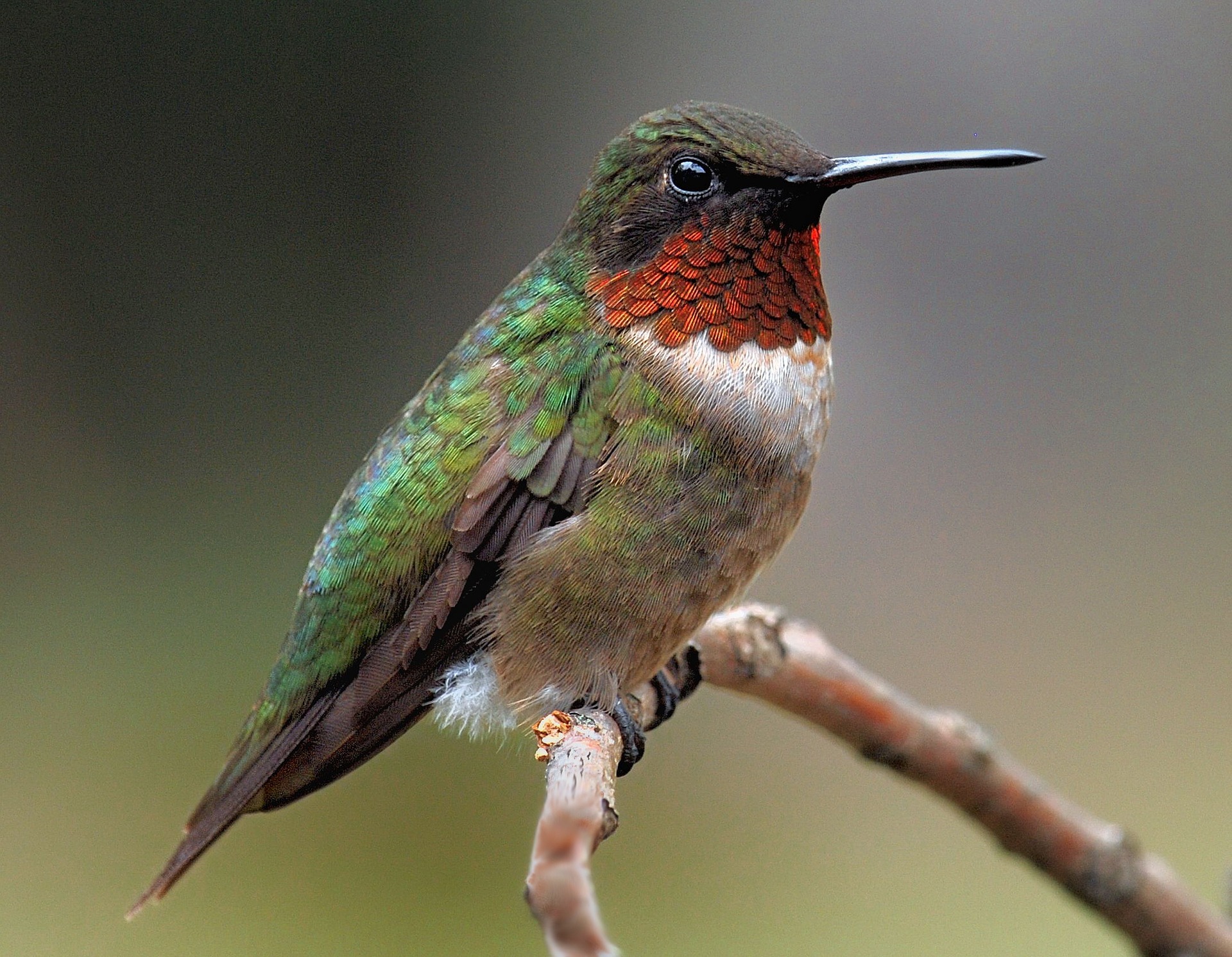
Photo by Bryan Stevens • Male ruby-throated hummingbird show the namesake red throat. The feathers on a male’s throat are iridescent, which means they can change when seen from different angles. In poor light, the ruby-red throat can look almost black.
According to the website, most first spring observations of hummingbirds are males, although a few females are being spotted. Male hummingbirds, the posting noted, arrive first so they can find and defend a territory.
As always, spring migration can be a challenging time for hummingbirds. Temperature, wind patterns and storms can influence the pace of migration.
Even once these tiny birds make their epic spring crossing of the Gulf of Mexico, they will need time to rest and refuel before moving northward. By mid-March, the advance of ruby-throated hummingbirds has usually reached states as Georgia and South Carolina. By the end of March, these tiny flying gems have reached states such as Tennessee and North Carolina.
It’s time to get those sugar water feeders outside and waiting for the early arrivals. Once the chance of late-season freezes has passed, consider planting some colorful native flowers to provide nectar sources for hummingbirds.
Northeast Tennessee usually gets its first spring hummingbirds the first week of April. If you’re seeing hummingbirds, I’d love to know. I have tracked arrivals for several years now. To share your first spring sighting of a ruby-throated hummingbird, email me at ahoodedwarbler@aol.com or contact me on Facebook at http://www.facebook.com/ahoodedwarbler. Please include the date and time of your sighting. I also welcome the sharing of other details about your sightings.
In the meantime, take steps now to welcome hummingbirds back and keep them safe during their stay.
Some ways of ensuring that our hummingbird guests are kept healthy and secure are simply common sense. For instance, don’t use pesticides, herbicides or any other sort of toxin anywhere close to the vicinity of a sugar water feeder or a flower garden. Hummingbirds are such tiny creatures with such intense metabolisms that it only takes a small amount of any harmful substance to sicken or kill one of these little flying gems.
Feeding hummingbirds is easy, but many people try to complicate the process. Only common, pure cane sugar, mixed to a ratio of four parts water to one part sugar, is a safe choice for these birds.
For emphasis, I’ll repeat again that only common, pure cane sugar is safe for hummingbirds. There are no safe substitutes. Do not use organic, raw or brown sugar. Confectioner’s sugar, which contains an anti-caking substance (often corn starch, silicates or stearate salts), is also hazardous to hummingbirds.
The ratio of four parts water to one part sugar utilizing pure cane sugar most closely duplicates the nectar that hummingbirds obtain from some of their favorite flowers. Why try to mess with nature’s perfection?
I cannot imagine why anyone would supplement sugar water for hummingbirds with such human beverages as a sports drink or Kool-aid, but there have been reports of people doing so. Be aware that such additives will only risk the health of these tiny birds.
Photo by Bryan Stevens • Despite a perceived disadvantage of size, ruby-throated hummingbirds are quite capable of thriving in a giant world.
Most experts also suggest avoiding red dyes or food colorings, which are often found in commercially marketed hummingbird sugar water. Don’t risk the health of hummingbirds for a little convenience.
It’s easy to make your own sugar water mix, which can be stored in the refrigerator in an empty plastic juice jug. Boil some water and then add one cup of sugar for every four cups of water in your pot. Stir thoroughly. Bottle the mixture until it cools. Fill your feeders and store any remaining sugar water in the fridge in the aforementioned jug. Refrigerated, the mix should stay good to use for at least a week.
In our milder spring weather, changing the sugar water in feeders can probably be done on a weekly basis. When hotter summer temperatures prevail, it’s usually necessary to change the sugar water every two or three days.
•••
Remember to send me those first sightings of returning spring hummingbirds. I’ll be doing my usual roundup to share who gets graced with a visit from one of these tiny beauties.
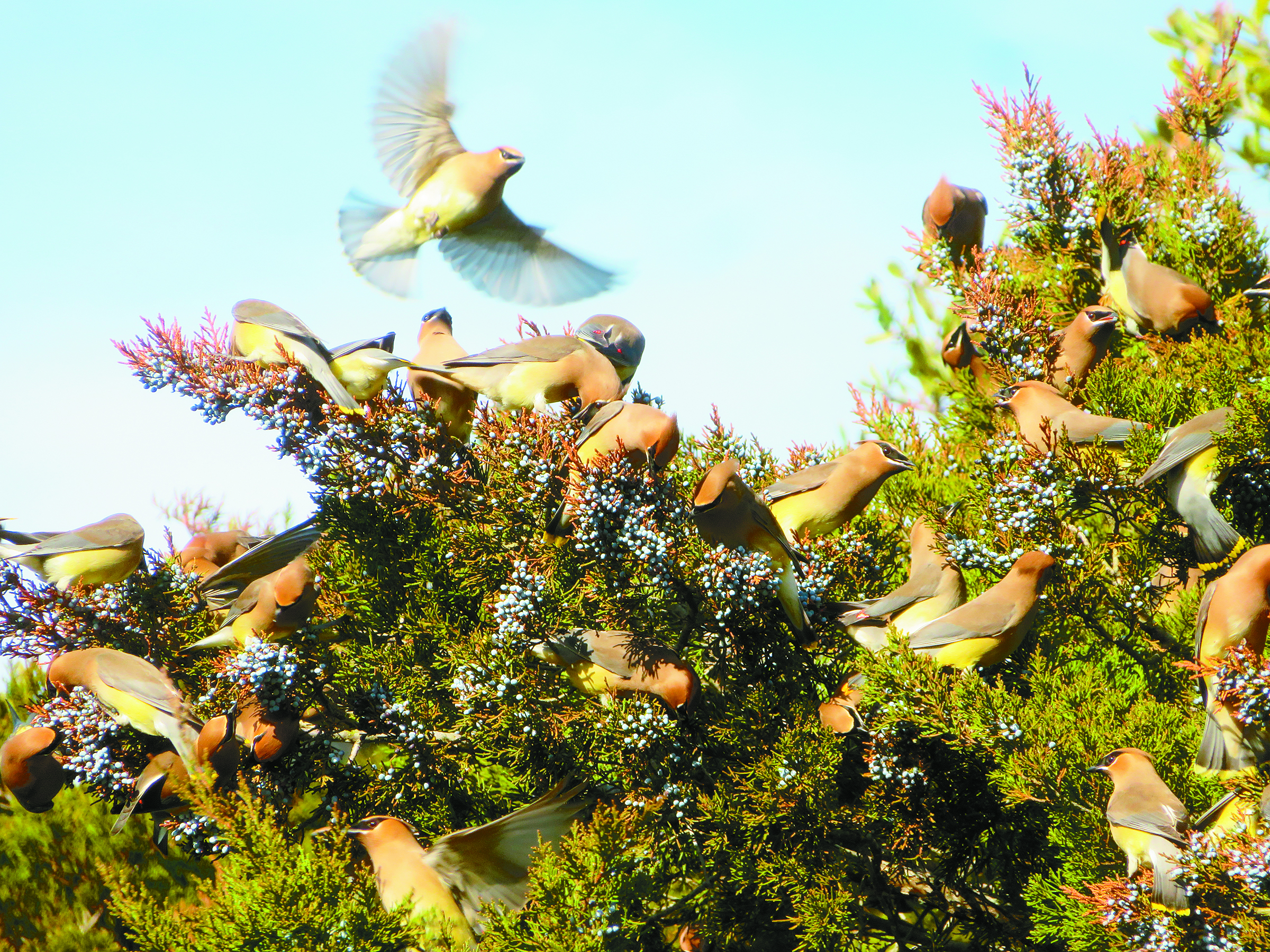
Photo Courtesy of Jim Kroll • Cedar waxwings form large flocks that are capable of stripping berries off trees in a matter of hours when these hungry birds descend on berry-producing trees and shrubs.
Jim Kroll emailed me awhile back to share an observation he made when he and his wife visited Garden City, South Carolina. According to Jim, while riding their bicycles they had the good luck to see a flock of cedar waxwing feasting on berries in a large tree.
“This tree was probably 20 feet tall, and loaded with blue berries,” he wrote.
He also shared a photo of the flock. “There are around 30 waxwings plucking berries,” he said in describing the photo.
He estimated that the flock numbered well over 100 waxwings.
“They left the tree top several times, as if startled, but they would return within a minute and continue their feast,” Jim wrote. “The thing that first caught our attention as we rode under the tree, is that my wife noticed a lot of small pieces of green limbs laying in the road directly under the tree. We turned around to see why the road had so many green limbs and noticed the waxwing flock feasting.”
They made it a point to ride by the tree again on the following two days, hoping to see the waxwing flock again, but did not see them again.
They also discovered that no berries remained on the tree’s branches. The waxwings had consumed all of the berries.
“I looked at an article on the South Carolina Public Radio website that said this is the time of the year that waxwings were migrating south through South Carolina,” Jim wrote.
I replied to Jim’s email and shared an account of an observation I made several years ago at Erwin Fishery Park.
On that occasion, my mom and I watched a couple of mockingbirds wage a losing battle to keep a flock of at least 100 waxwings out of a holly tree laden with berries. The mockingbirds might chase off a dozen waxwings, but there were always a few dozen ready to swoop in and take their place. That tree, too, was stripped of berries. The next time I stopped by I could not detect a single berry still on the tree.
After I shared my waxwing story, Jim replied with some more observations.
“I can see the mockingbirds that you mentioned trying to protect their berry stash,” he wrote. “We regularly see mockingbirds, seemingly being aggressive.”
Jim said that he has also re-named blue jays that visit his bird feeders.
“I call them ‘bully birds’ because they swoop in intentionally trying to scare off the other birds at the feeder,” he wrote.
I thought it interesting that my brother, Mark, told me about a flock of waxwings that he and his wife, Amy, saw at their home in Murrells Inlet, South Carolina. His story was similar to the one Jim shared.
Mark said a flock of waxwings arrived in his yard and swiftly stripped a berry-producing tree of its berries.
Waxwings have a brown and gray silky plumage, a black mask and a perky crest. Some of the wing feathers show red tips. The similarity of these wing tips to melted drops of wax gives these birds the common name of waxwing.
The cedar waxwing has few relatives. Worldwide, there are only two other species: the Bohemian waxwing, of the northern forests of Eurasia and North America; and the Japanese waxwing, found in such northeast Asian countries as Japan, Korea and China.
Although it’s classified as a songbird, the cedar waxwing doesn’t truly produce a vocalization that anyone would contend qualifies as a song. They are, however, very vocal birds, producing shrill, high-pitched notes as they pass through the upper branches of tall trees.
As much as the waxwing has a fondness for fruit, it’s also a bird that would have made an excellent flycatcher. Flocks of these birds will often congregate in trees near the edge of a pond, garden or yard — anywhere winged insects might be found in good numbers — in order to hawk insects on the wing. A waxwing will sally forth from a branch, snatch its prey in mid-air, and return to its perch for a quick snack.
Waxwings are rather nomadic, coming and going with a maddening unpredictability.
Other birds are more dependable, arriving and departing at roughly the same time year after year.
Over the next few weeks, we can expect the spring arrivals of a vast variety of birds. To share a sighting, make a comment or ask a question, email me at ahoodedwarbler@aol.com.
Photo by Bryan Stevens • The waxy tips to the wing feathers are evident in this photograph of a cedar waxwing.
Photo by Howard Walsh/Pixabay * A male red-winged blackbird guards his territory in the spring while attracting potential mates.
If it is March or April in Northeast Tennessee or Southwest Virginia or Western North Carolina, for that matter, some birds are making their return after a season-long absence.
On one recent morning, a loud, familiar “kon-ke-ree” sounded from the tops of the cypress trees at the fish pond. In an instant, I realized that the resident male red-winged blackbird was back for another nesting season.
Red-winged blackbirds return yearly every March and begin to seek out nesting habitat in local wetland areas, such as the cattail marshes near my fish pond.
Last year, my first returning male red-winged blackbird arrived on the evening of March 3. This year, the first red-winged blackbird arrived on the morning of March 6. I heard his unmistakable song from inside my house.
The showy and loud red-winged blackbird male that’s once again taken up residence at my fish pond and adjacent stands of cattails has made himself right at home.
Male blackbirds arrive ahead of the females. My recent spring arrival perches daily in the willows and cypresses by the pond and has been singing every day since his return, but he’s still waiting for his intended audience to arrive. Female blackbirds lag a week or so behind the males in returning to their familiar territory.
Any wet field or marsh, especially those offering a stand of cattails, is almost certain to attract red-winged blackbirds at this time of year. I’d almost wager on that certainty.
The blackbirds arriving in spring behave much differently than the quiet, furtive flocks that often make brief visits to feeders during late winter snowstorms.
“The kon-ke-ree song of the male red-winged blackbird is a sure indication that spring is on the way,” according to a profile located at the Tennessee Watchable Wildlife website.
At this time of year, the male red-winged blackbirds seek elevated perches to display and vocalize. Their loud antics are not designed solely to attract mates. Male red-winged blackbirds also sing to warn rival males from intruding into their territories.
The male red-winged blackbird is a very aptly named bird. Glossy black males sport red wing patches that are often trimmed with a narrow band of yellow feathers. By contrast, female red-winged blackbirds are mostly brown birds that could easily be mistaken for large sparrows. Both sexes have sharply pointed bills.
Red-winged blackbirds are fond of wetlands. Any marsh or even a damp field or flooded pasture is likely to attract a few resident red-winged blackbirds. Females choose nesting locations in cattails or other marsh vegetation. She usually lays three or four eggs. Although she does receive some help from the male, most of the responsibility for raising the young is left to her.
There is a reason that male red-winged blackbirds are not always quite as engaged as females in feeding and tending their young. Males are often polygynous, which means that males will often court multiple mates. His time is often occupied defending females and their respective nests from the advances of other male red-winged blackbirds.
According to the website All About Birds, male red-winged blackbirds spend much of the breeding season sitting on a high perch over their territories and singing almost without ceasing from dawn to dusk.
The website also notes that female blackbirds shirk the high profile of the males. They tend to skulk in wetland vegetation as they collect food or nest material.
Both males and females defend nests from intruders and predators. They take this duty quite seriously, as I know personally from being dive-bombed by parent blackbirds when I have gotten a little too close to their nests.
Other relatives of the red-winged blackbird in the United States include the tricolored blackbird found along the Pacific Coast and the yellow-headed blackbird resident in wetlands west of the Great Lakes. Rusty blackbird, common grackle and brown-headed cowbird are other species of blackbirds found in Tennessee, Virginia and North Carolina.
Share a sighting, ask a question or make a comment by emailing me at ahoodedwarbler@aol.com.
Female red-winged blackbirds lack the splashy plumage of males.
Photo by Bryan Stevens * A male mallard lounges by the edge of a fish pond in a previous spring season.
Signs of spring are, as the old saying goes, popping up all over. Daffodils and crocuses unfurling their blooms, a pair of mallards paying a visit to my fish pond and the blue skies overhead on sunny days have signaled the transition toward spring as surely as the turning of the calendar page to March.
Some of these familiar sights have been hazy for me during this season of transition. In early February I lost vision in my right eye. After visits to various medical experts, an MRI, blood tests and other procedures, I got a diagnosis of optic papillitis, a form of optic neuritis. In simpler terms, I suffered a stroke of the eye that aggravated and inflamed the optic nerve.
The good news, as I see it, tests have not found any evidence of underlying conditions like cancer or a brain tumor. The bad news, also as I see it, is that recovery is not guaranteed and can take time. The process is usually measured in weeks and months, not days.
It’s been unsettling, to describe it mildly. Reading requires the assistance of a magnifying glass. Too much time focused on a bright screen brings discomfort.
I’m carrying on with birding as best I can. Binoculars, as birders know, are made for use by two eyes. I have feeders to lure the birds in close, but my favorite cardinals, chickadees and wrens are a bit blurry.
I’ve always tried to stay optimistic. I’m hopeful that by the time the ruby-throated hummingbirds return for a sip of sugar water at my feeders in April, my sight will be good enough to enjoy the beauty of their green and white plumage and the brilliant red throat if the visiting hummer is a male.
Photo by Bryan Stevens • Male ruby-throated hummingbird show the namesake red throat. The feathers on a male’s throat are iridescent, which means they can change when seen from different angles. In poor light, the ruby-red throat can look almost black.
If spring’s too soon, I’ll push the goal farther along in the 2023 calendar and hope to be ready to identify the annual fall parade of warblers.
As I wait, nothing’s stopping me from enjoying the sounds of spring. On rainy days, the chorus of spring peepers produce their amphibious cacophany at dusk and throughout the night. Many of the birds are also singing their hearts out. Eastern phoebes, tufted titmice, Carolina chickadees and Northern cardinals all make their presence with their loud, persistent songs.
On Monday, Feb. 20, I watched as the fuzzy shapes of two dozen red-winged blackbirds dropped down into the cattails in the marshy area near the fish pond. It’s not February for me until I’ve seen a migrating flock of blackbirds benefitting from an overnight stay in the cattails.
Photo by Bryan Stevens * A mallard drake looks vibrant with his green, glossy head.
On Sunday, Feb. 26, a mallard pair visited the fish pond. They were the first mallards that I’ve observed at my fish pond for many years. In full disclosure, my mom spotted them and informed me of their arrival. Mallards are big enough that I saw the male of the pair easily enough. His green head and chestnut breast stood out from the brown cattails and other vegetation bordering the pond. The female mallard blended nicely with the background and evaded my gaze. Regardless, I was thrilled to welcome mallards back to the pond. They only lingered for a single day, but they have me hoping that other ducks, such as blue-winged teal or wood ducks, will make similar visits as the season progresses.
On March 1, I saw my first spring butterfly. The seasonal first was a spring azure, a tiny, delicate butterfly. The sighting reminded me that nature will provide plenty of incentive to work on regaining my full vision. I still have more butterflies, as well as dragonflies, damselflies, moths and June bugs to look forward to seeing as we progress through spring and summer.
I’ve always believed that nature is a restorative force. Now I am going to test that theory in my goal to have my vision back at or near normal capacity by the time I hear the buzzy whir of hummingbird wings in April.
In the meantime, there will still be plenty of time to focus on our myriad feathered friends. I have someone who has been great at taking down my dictated words for my weekly column.
As always, make a comment, share an observation or ask a question by emailing me at ahoodedwarbler@aol.com.
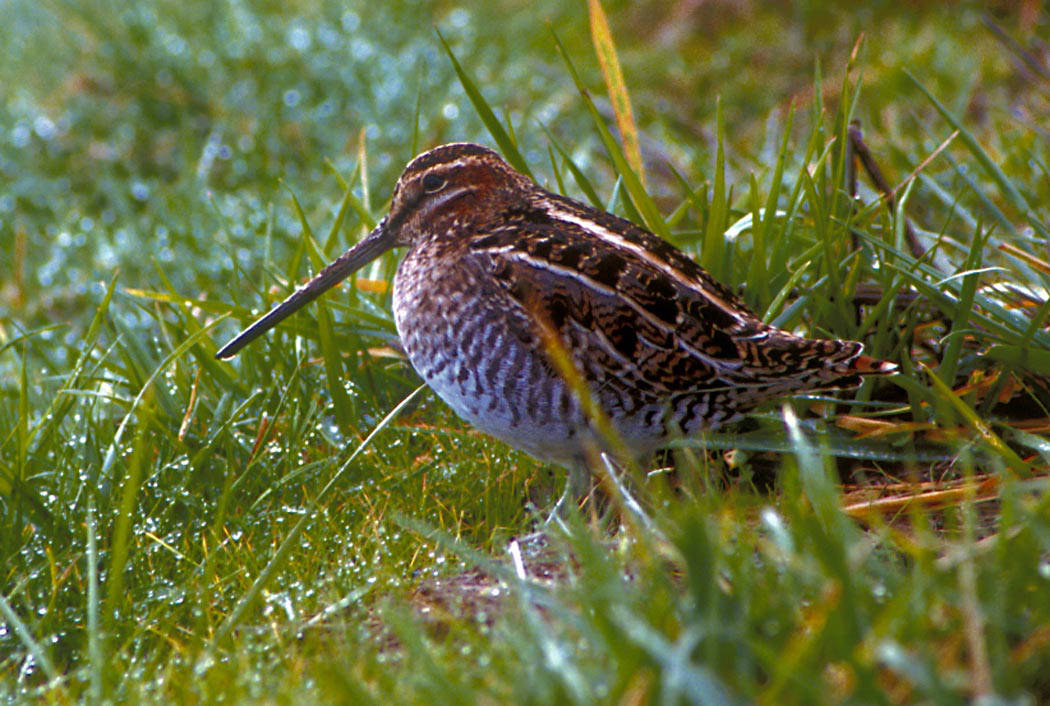
Photo by Patty Browne/USFWS • A Wilson’s snipe seeks out concealing cover in a wet field.
Lynda Carter of Jonesborough sent me an email asking for help making sense of a pre-dawn close encounter of the feathered variety.
“My sister and I were walking this morning before daylight and had a startling experience,” Lynda wrote. “We had started down a gravel drive when a bird flushed right at our feet. The bird flew away at about a 45 degree angle and made quite a bit of sound.”
Lynda wrote that she and her sister agreed the sound was wing noise rather than a call, which ruled out the screech owl they sometimes see on the drive. It would also be unusual for a screech owl to roost on the ground.
Lynda described the noise as louder than a dove taking off.
“I have never noticed doves on the ground at night,” she added before asking me for my best guess regarding the bird’s identity.
I cannot conclusively identify the bird, but I did offer some possibilities in a response to Lynda’s email.
If the location is near woods, I would go out on a limb and make three guesses: Wilson’s snipe, American woodcock or ruffed grouse.
The first two birds are each active both night and day, but the ruffed grouse is usually not active at night. Roosting on a gravel road is also not its style. I included it because a grouse’s wings make quite a lot of noise when they take off.
Wilson’s snipe and American woodcock are atypical shorebirds with long legs and bills. Both are also often active around dusk and dawn. Their plumage lets them blend remarkably well with their surroundings, whether those be wetlands, fields or woodland floors.
Wilson’s snipe looks stocky, thanks in part to the extra-large pectoral (breast) muscles that make up nearly a quarter of the bird’s weight, a feat unmatched by any other shorebird, according to the All About Birds website. Using these massive flight muscles, a snipe can reach speeds estimated at 60 miles an hour.
Photo by Bryan Stevens * A Wilson’s snipe ventures from cover to forage on a muddy bank.
According to All About Birds, the American woodcock nests in young, shrubby, deciduous forests, old fields and mixed forest-agricultural-urban areas across the eastern United States and southern Canada.
In late winter and early spring, these dumpy shorebirds are famous for their nuptial displays conducted in forest openings and old fields. They take flight, and their feathers produce an eerie sound as they make their descent back to the ground.
If the bird flushed from hiding by Lynda and her sister had been vocal, I would have guessed killdeer. But Lynda didn’t hear anything but the apparent noise from the wings, which in my mind rules out the killdeer and its loud vocalizations.
I cautioned Lynda that my guesses were not definitive. Alas, her encounter may remain a mystery, but the unexpected interaction with the unknown bird does sound like it made for a dramatic experience.
To ask a question, make a comment or share a sighting, email me at ahoodedwarbler@aol.com.
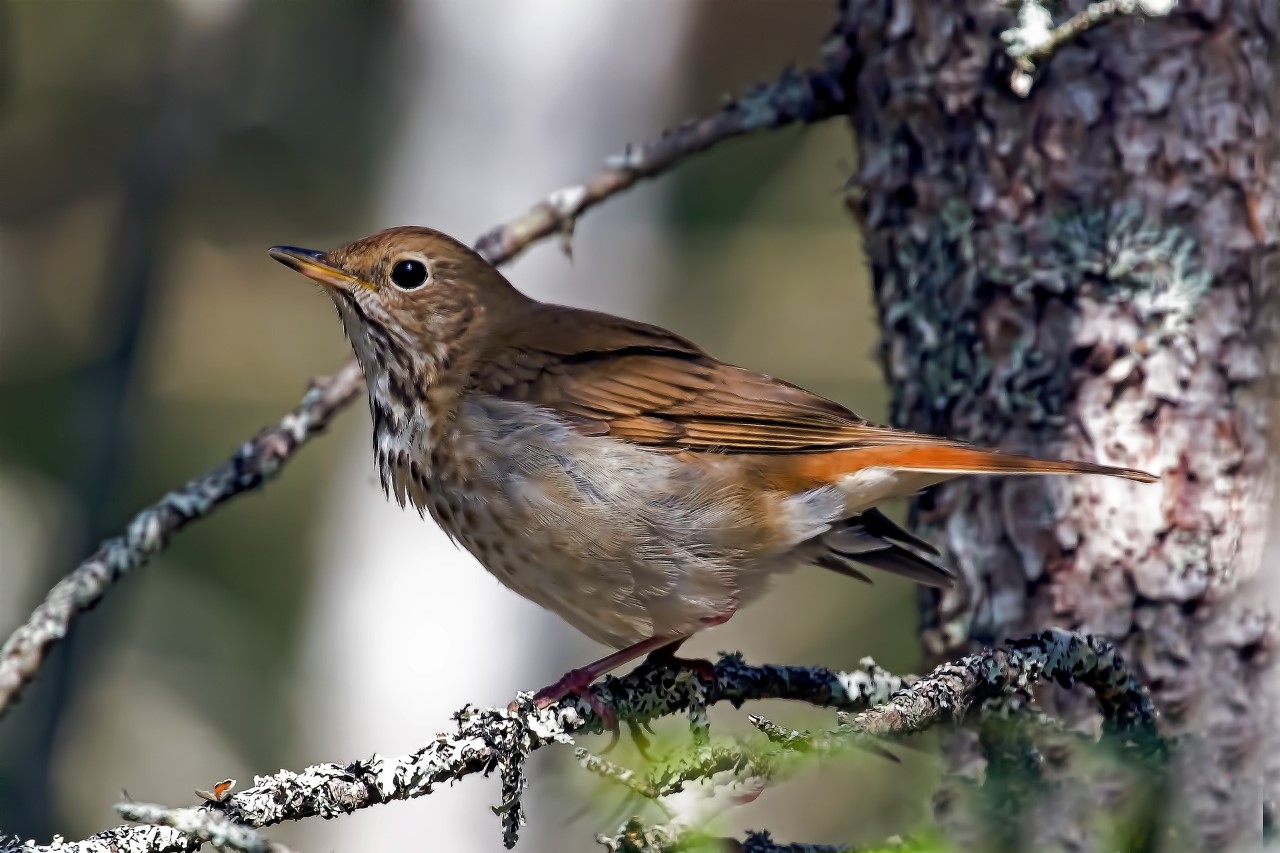
Photo by Hans Toom/Pixabay • Hermit thrushes, such as this individual, are winter visitors to the region. The hermit thrush is related to other members of the thrush family, including Eastern bluebird, American robin and wood thrush.
Carol Garland of Unicoi contacted me via Facebook Messenger about my recent column in the Johnson City Press about bluebirds.
“I have several bluebirds in my yard this year,” Carol wrote in her message. “I have had a couple maybe every year, but this fall I saw eight on a bush in my yard.”
She described the bush as having purplish berries.
“Bless them, they cleaned it, and I was so glad to have something they could eat,” she continued. “I don’t know what kind it is but wondered if you would have any idea.”
I suggested that the bush might likely be either a privet, if the berries are very dark purple to almost black, or a beautyberry if the berries are a brighter, almost orchid-like purple.
Most privet plants produce masses of purple-black berries which are fairly popular with birds that spread the seeds widely. Similarly, American beautyberry, also known as French mulberry, produces large clusters of bright purple berries, which birds and deer eat, thus distributing the seeds.
Carol also asked if I knew where she could buy live meal worms for her bluebirds.
“I am going to see if I can get a couple of houses for them, but they must have some places around because they have been here most of the winter,” she added.
For mealworms, I suggested that Carol contact the Wild Birds Unlimited store on W. Market Street in Johnson City. Gardening centers might also be a likely source for either live or freeze-dried mealworms. Searching online would likely provide plenty of possibilities for acquiring this favorite protein source for bluebirds.
Eastern bluebirds are a member of the thrush family of birds, which consists of several species fond of both insects and fruit.
I also heard from Susan Peters of Elizabethton on the subject of bluebirds and other thrushes.
“I really enjoyed your bluebird column, as I am sure so many others did,” Susan wrote in an email to me. “It prompted me to check that my bluebird houses were clean and free of other occupancies.”
She added that she has seen bluebirds in her birdbath with a bit of snow on the edges of the bath. She added that she has a heater in the bath to keep the water thawed during cold spells.
“They are a wonderful winter sight,” she wrote.
“I was wondering if you thought it was possible for a hermit thrush to be in my yard under the feeders,” she also queried. “My identification skills are purely amateur, but in checking my Peterson books, I think I saw one for several days.”
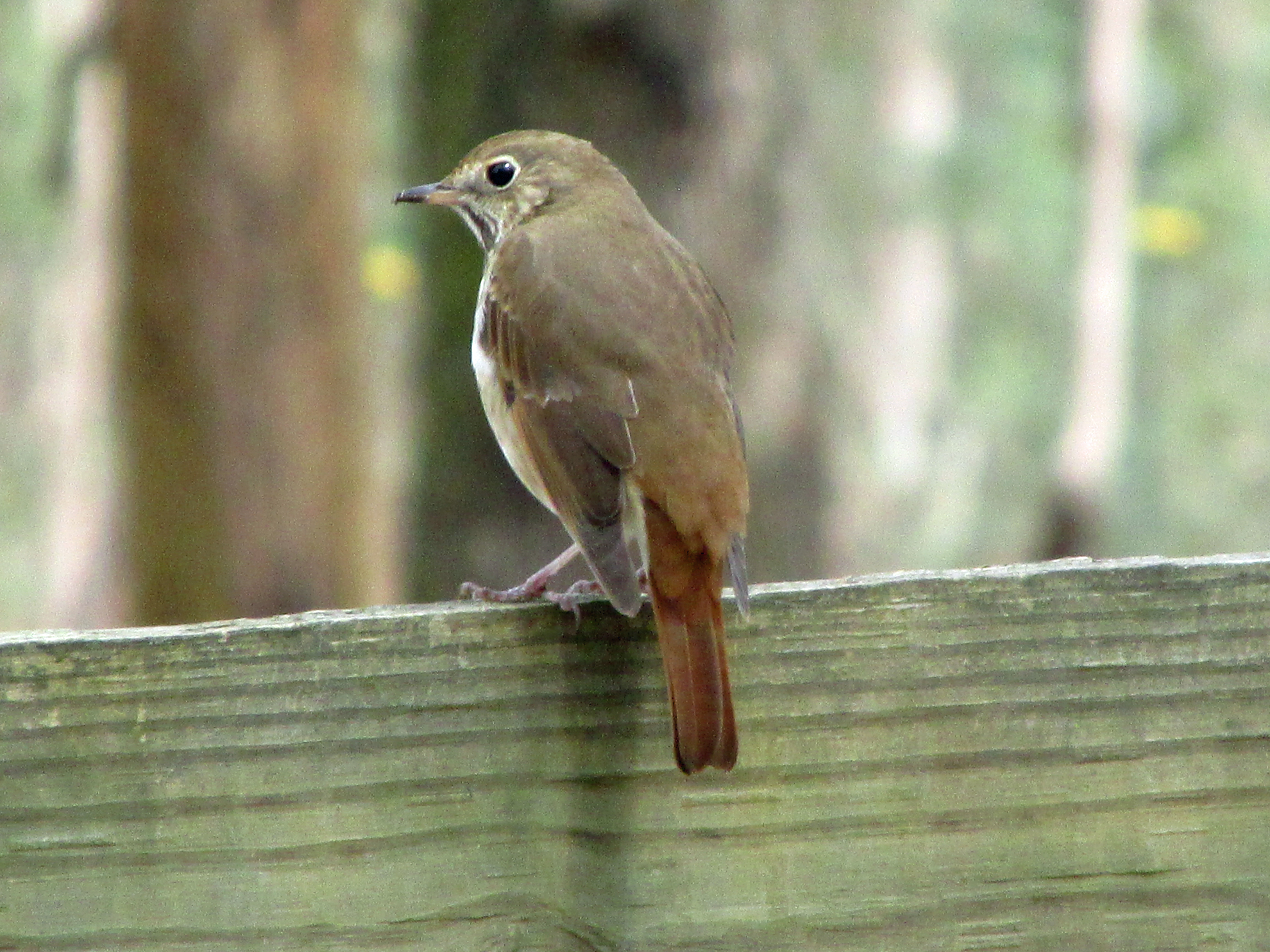
She described the bird as a bit smaller than a wood thrush with a bit more olive color, a white eyering and showing spots/stripes on its breast.
“I really thought the thrushes were migratory,” she wrote.
In a reply I explained that most thrushes are migratory. In a sense, even the hermit thrush, a winter resident in the region, is migratory. It simply migrates to the area from the more northern locations that provide breeding habitat for the species.
According to Tennessee Watchable Wildlife on the website of the Tennessee Wildlife Resources Agency, the hermit thrush is primarily a winter visitor to Tennessee arriving in early October and departing by late April. The same holds true for western North Carolina and southwest Virginia.
The entry at Tennessee Watchable Wildlife describes this thrush as a quiet, unobtrusive bird spending most of its time foraging in the leaf litter or in berry-filled tangles at the forest edge.
Susan described seeing the thrush as a real treat.
“The hermit thrush was my mother’s favorite bird,” she wrote.
Photo by Bryan Stevens • A hermit thrush perches on a fence in March in South Carolina. These thrushes are winter residents in much of the eastern United States.
Susan wrote that her mother always called the hermit and wood thrushes “deedle-deedle” birds because of their calls.
“My hermit thrush visits under the feeders almost every morning,” she wrote in a followup email. “What a treat. Thanks again for the confirmation.”
To share sightings, ask questions or make comments, email me at ahoodedwarbler@aol.com.
Photo by Bryan Stevens • People are invited to count birds during a four-day period as part of the 2023 Great Backyard Bird Count taking place from Friday, Feb. 17 through Monday, Feb. 20. Participants will have an opportunity to look for birds, such as this pileated woodpecker, and report their findings.
The 2023 Great Backyard Bird Count will be held Friday, Feb. 17, through Monday, Feb. 20. This year’s GBBC will mark the 26th anniversary of this annual survey that utilizes citizen science to obtain valuable information about the world’s bird populations.
It’s easy to take part. Simply watch the feeders in your own yard or visit a favored birding spot. For instance, participants could choose to count in Persimmon Ridge Park in Jonesborough, Osceola Island Recreation Area in Bristol, Fishery Park in Erwin, Winged Deer Park in Johnson City, Orchard Bog in Shady Valley, Lake Lure in McDowell County, North Carolina or any other personal favorite birding location.
For details on how to report results of your co
unt, please visit http://www.birdcount.org and click the “Participate” menu button.
It really is as simple as counting all the birds you see and submitting your personal checklist.
Since 2013, the GBBC has been a global effort, allowing birders around the world to take part. Participants in 2015 observed almost half of the world’s known bird species, and that effort was surpassed the next year. Momentum has built ever since.
Last year, GBBC participants identified 7,099 species of birds. When you consider that scientists estimate between 9,000 to 10,000 different species of birds throughout the world, that’s a lot of coverage that the GBBC provides each year.
The GBBC is a joint project of the Cornell Lab of Ornithology and the National Audubon Society with partner Bird Studies Canada. With its global perspective, a great many exotic bird species are now tallied on the annual GBBC, but the survey remains firmly established as a grassroots effort to compile data crucial for the conservation of the world’s beloved birds. The information gathered by tens of thousands of volunteers helps track the health of bird populations at a scale that would not otherwise be possible.
It’s incredibly easy to take part in the GBBC. Anyone anywhere in the world can count birds for at least 15 minutes on one or more days of the four-day count period and enter their sightings at http://www.BirdCount.org. There’s no charge or fee for taking part in the GBBC, which is a fun way to observe a variety of birds. Thanks to the flexible count criteria, it is also an easy way to make a contribution to science. The data delivered by the thousands of participants is now collected and compiled by the website ebird.org.
In 2022, the GBBC continued this impressive effort. Here are some interesting tidbits from last year’s survey:
• 7,099 species of birds identified.
• 192 participating countries.
• 359,479 eBird checklists.
• 298,208 Merlin Bird IDs.
• 141,990 photos added to Macaulay Library.
• 384,641 estimated global participants.
The United States had the highest number of checklists with more than 234,000 checklists submitted from all 50 U.S. states and the District of Columbia. California led all states with 20,191 checklists submitted. New York, Texas and Florida rounded out the top tier.
North Carolina birders helped their state rank 6th with 9,926 checklists submitted. Virginia birders can be proud that their commonwealth ranked 7th with 9,469 checklists submitted. Tennessee didn’t fare too poorly. The Volunteer State ranked 23rd with 4,074 checklists submitted.
Internationally, people living in the nations of India and Canada submitted a lot of checklists.
Over my years taking part in the GBBC, I have counted many interesting and unexpected birds, including green-winged teal, Ross’s goose, snow goose, red-shouldered hawk and Cooper’s hawk.
This year’s GBBC will be held over a four-day period, starting on Friday, Feb. 17, and continuing through Monday, Feb. 20.
Participants can count alone or join with groups of fellow birders. Those taking part in the GBBC are invited to count in as many locations as they like. The reported results will help create a real-time snapshot of where birds are distributed during the winter months. Visit http://www.birdcount.org for more details on how to take part in the 2023 GBBC.
Circle these dates on your calendar and get ready to go count birds.
•••••
To share a sighting, make a comment or ask a question, email me at ahoodedwarbler@aol.com.










 Our Fine Feathered Friends