Author Archives: Bryan Stevens

Unknown's avatar

About Bryan Stevens

Bryan Stevens lives in Northeast Tennessee. He is an editor, writer and columnist. He has written food columns for the Johnson City Press, Elizabethton Star and Carter County Compass since 2003.

Winter season offers a chance to get to know special little wren


Willfried Wende/Pixabay • Outside of the Americas, there is only one species of wren. In the Americas, this wren is known as the winter wren.

Note: I’m on vacation. Please enjoy this column originally published in December of 2017.

Of late, every time I step outside my front door I’ve incurred the ire of a winter wren that’s taken up residency in my yard. This wren is a tiny bird among a family of birds known for small size, but it makes its presence known in unmistakable terms.

For starters, the winter wren is a noisy bird. The one living at my home arrived in late November and immediately claimed a niche to call its own. Any intrusion is met with a scolding chatter as the wren scurries low to the ground to drop out of view. In fact, the winter wren’s a very terrestrial bird. Observers are just as likely to see one of these wrens run across the ground as they are to see it take flight. I’m hopeful he will remain as winter’s grip tightens for the next couple of months.

The website All About Birds, managed by The Cornell Lab of Ornithology, offers advice on making a wren-friendly yard. “Landscaping with native plants is a good way to provide habitat for winter wrens,” according to the website. Other steps to take could extend to creating brush piles and ensuring some sections of the yard offers dense vegetation. The website also notes that this wren is often found making its home near streams.

In the summer, the winter wren often nests atop some of the high-elevation mountains in the region, especially ones with abundant fir and spruce trees. Otherwise, it’s mostly a winter visitor in the region. Other wrens common to the region include the Carolina wren and the house wren. In suitable habitats, especially during fall and spring migration, two other wrens — marsh wren and sedge wren — are observed occasionally in the region. Other wrens native to the United States include the rock wren, canyon wren, cactus wren, Pacific wren and Bewick’s wren.

The world’s 88 species of wrens are, for the most part, the quintessential “little brown birds,” but that hasn’t kept them from acquiring some interesting and descriptive common names. Some examples include the tooth-billed wren, flutist wren, riverside wren, whiskered wren, happy wren, musician wren, timberline wren, speckle-breasted wren, white-breasted wood wren and giant wren. The last species on the list resides in Mexico and is indeed a “giant” among a family of tiny birds, reaching a length of almost nine inches and weighing all of 1.8 ounces.

For the most part, wrens are birds of the New World. In fact, only the Eurasian wren represents the family in Europe, Asia and Africa. Experts recently split the winter wren into several different species, including the Pacific wren of the west coast of North America and the Eurasian wren of Europe, Asia and Africa.

Just as the winter wren thinks nothing of acting like a mouse when scurrying through leaf litter and over fallen logs in search of insect prey, this bird doesn’t hesitate to imitate mice by poking into shadowy holes in the ground or exploring the dark crevices of fallen logs. When winter temperatures drop sharply, many of these birds may cram themselves into a roosting hole to benefit from the communal heat from so many tiny feathered bodies in such close proximity. Winter wrens eat mostly insects and spiders, but in winter these birds will also eat some seeds and berries. Winter wrens rarely visit feeders, but a suet cake often attracts birds with similar dietary preferences, including kinglets and chickadees. A larger relative, the Carolina wren, is a common visitor to feeders.

In English and German lore, the winter wren was known as the “king of the birds.” Different tales provide varying explanations for how such a small bird earned such an inflated title. Ritual hunts were enacted in some European locations. These hunts, known as “wren hunts,” were conducted by “wren boys” who would parade through town on their quests. Wren Day fell on Dec. 26, which coincided with the holiday St. Stephen’s Day. Some myths blame the noisy bird for betraying the hiding place of Stephen, who was delivered up as a Christian martyr to his enemies due to the bird’s treachery. In some European cultures, various superstitions sprang up about wrens. For instance, in Scotland it is considered extremely unlucky to kill a wren.

Personally, I feel lucky to have the tiny winter wren spending time around my home and can guarantee no “wren hunts” will be staged here. At a time of year when feathered friends can be scarce, a winter wren is a welcome visitor.

•••

Bryan Stevens has written about birds and birding since 1995. Email him at ahoodedwarbler@aol.com to ask a question, share a bird sighting or make a comment.
Kinglets are tiny birds with huge appeal

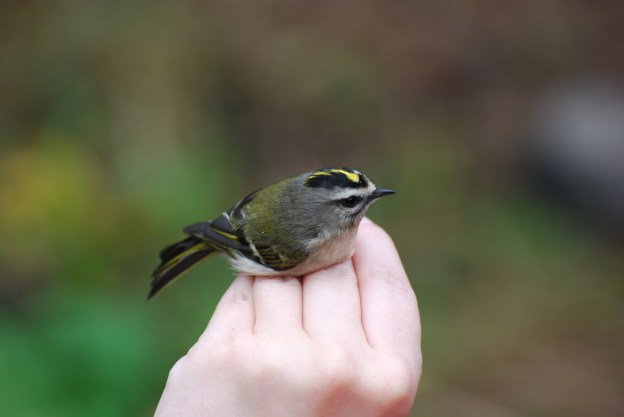
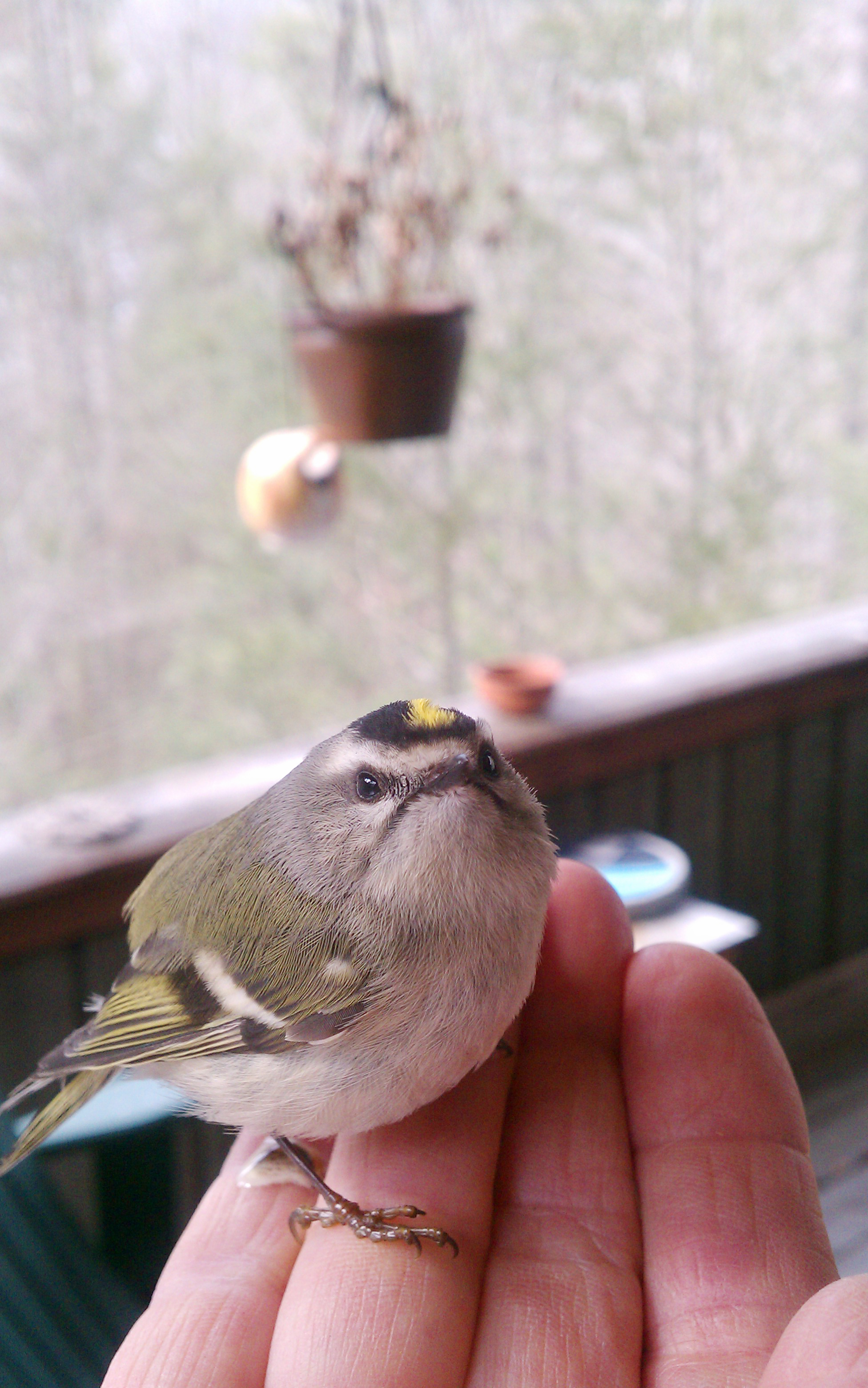
Photo by Beth McPherson • A golden-crowned kinglet recovers in the photographer’s hand after striking a window.

With the recent cold weather, I’ve been seeing a few golden-crowned kinglets, as well as the closely related ruby-crowned kinglet, at my home.

Golden-crowned kinglets are fairly common winter birds. Ruby-crowned kinglets, although not always as common as their relative, also are found in the region during the winter season.

Both the golden-crowned and ruby-crowned kinglets are members of a family of tiny birds known collectively as kinglets and firecrests. They’re such tiny, energetic birds that they absolutely excel with the “cuteness” factor.

All kinglets are very tiny birds, as well as extremely active ones. They are also the only members of this family of birds found in North America. Four other species, however, are native to Europe, Asia and North Africa. The remaining species include goldcrest, common firecrest, Madeira firecrest and flamecrest, which is also known as the Taiwan firecrest.

Kinglets, as their name suggests, are tiny birds. In fact, about the only North American birds smaller than kinglets are some of the hummingbirds. The kinglets belong to the family, Regulidae, and the genus, Regulus. The family and genus names are derived from a Latin word, regulus, which means “rex,” or “king.” The name was apparently inspired by the colorful crown patches, often red, orange or gold, that resemble the royal “crowns” of kings.

Although similar in size and overall coloration, the ruby-crowned and golden-crowned kinglets are easily distinguished from each other. Side by side, the two species of North American kinglets are easy to identify. The golden-crowned kinglet has a striped facial pattern formed by bold black and white stripes. The ruby-crowned kinglet, on the other hand, has a bold white eye ring but no striping.

The golden-crowned kinglet has an orange crown patch, while the ruby-crowned kinglet has a red crown patch that is, more often than not, kept concealed. Both sexes of the golden-crowned kinglet possess an orange crown patch, but only the male ruby-crowned kinglet boasts a scarlet patch of feather atop the head.

Kinglets are active birds, foraging vigorously for small insects and spiders. When foraging, both kinglet species have a habit of flicking their wings over the backs. Even if you can’t get a good look at the birds, this behavior alone helps contrast them from other small birds, including some warblers and wrens.

Golden-crowned kinglets are widespread in the region during the winter. During the summer months, head to the slopes of some of the region’s higher mountains to look for these tiny birds that nest at the higher elevations of the Southern Appalachians.

Ruby-crowned kinglets can also be found in the region during the winter, but extreme cold weather will often force these less cold-hardy birds to eke out the winter months farther south.

Kinglets don’t typically visit feeders, but they do tend to join mixed flocks with membership consisting of such species as tufted titmouse, Carolina chickadee and white-breasted nuthatch. When traveling with such flocks, kinglets may visit the space around feeders but rarely take seeds or other fare offered at feeders.

In recent decades, perhaps assisted by the surge in the popularity of feeding birds, kinglets have been observed sampling such fare as suet cakes, peanut chips and scraps of sunflower seeds that have been shelled and dropped by other birds.

Normally, kinglets have a rather fleeting lifespan. These tiny birds can be considered old if they live three or four years. There are always exceptions. The oldest golden-crowned kinglet on record was six years and four months old. That individual, a male, was documented by a bird bander in 1976, according to the website All About Birds.

Kinglets are surprisingly tame at time and often exhibit as much curiosity about us as we display toward them. They’re very active birds, however, constantly moving from perch to perch. These bursts of hyperactivity can make them difficult to observe with any satisfaction since they so rarely remain still for long.

•••

To learn more about birds and other topics from the natural world, friend me on Facebook at https://www.facebook.com/ahoodedwarbler. I like to post about local birds, wildlife, flowers, insects and other aspects of the natural world.

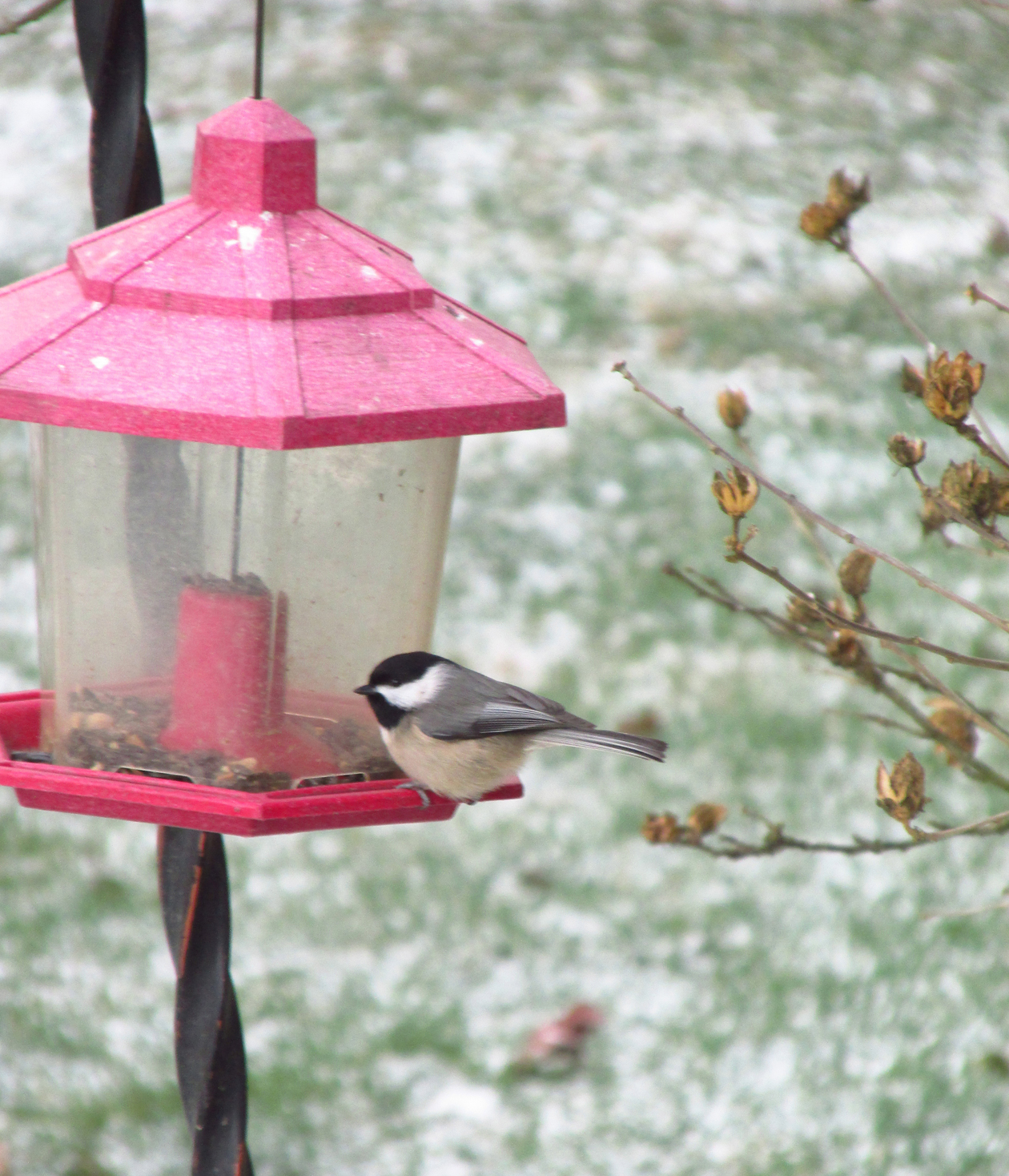
Carolina chickadees are cheerful backyard birds

Photo by Bryan Stevens • A Carolina chickadee visits a feeder for sunflower seeds.

I’ve learned not to leave my house without an offering for the local birds. Should I neglect to bring sunflower seed to fill the feeders in the yard as I leave for work in the morning, I must face a scolding from the resident Carolina chickadees.

I think I’ve become familiar enough with these tiny black, white and gray birds that I can tell the difference between a disappointed scolding, the result of leaving the house empty handed, and their jubilant and excited chattering as they invite other birds near and far to come and partake of the bounty when I remember to fill the feeders.

Chickadees have a namesake scolding vocalization — a strident chick-a-dee-dee-dee — that they use to communicate with each other as the move through dreary winter woodlands.

They and the tufted titmice, a closely related species, are among the birds most easily acclimated to human presence and activity.

Photo by Bryan Stevens • A Carolina chickadee endures a cold winter’s day.

On the mornings when I remember their sunflower seeds, the waiting chickadees are doing tiny hoppity dances in the branches of nearby trees and shrubs, barely able to contain their excitement. They barely give me time to move away from the feeders before they dart in, grab a seed and carry it off to quickly shell on a safe perch.

In the spring, the Carolina chickadee has a familiar “fee-bee-fee-bo” song that rings out in the woodlands around my home. Cavity-nesters, chickadees readily take to nest boxes provided by human landlords. We are about five months away from spring of 2025, but that’s all right. Early winter is a great time to make the acquaintance of the Carolina chickadee.

This diminutive songbird is at home in mixed or deciduous woods in the United States from New Jersey west to southern Kansas and south to Florida and Texas. The Carolina chickadee also ranges along the Appalachian Mountains, but on some of the higher peaks they are replaced by their cousin, the black-capped chickadee. In Tennessee, birders need to visit some of the higher peaks in the Great Smoky Mountains National Park in order to find black-capped chickadees.

Sunflower seeds are a favorite offering. They are also attracted by peanuts, suet and other varieties of bird seed. They comprise the nucleus of mixed flocks of various species, so they will also bring other birds into your yard and within easy viewing range. Some other members of the flock might include wrens, nuthatches, titmice and perhaps a couple of kinglets or a downy woodpecker.

It’s easy to attract chickadees to your yard. Shrubs and small trees, feeders stocked with sunflower seeds and perhaps a mesh cage offering a suet cake are sure to make these small birds feel welcome. If you want to witness the family life of chickadees, build or buy a box suitable for wrens and other smaller birds. That task can wait until February of March of next year. Chickadees will happily take up residence in the offered nesting boxes.

Once a pair of chickadees settles down into domestic bliss in the spring, they almost at once start work on the construction of a nest. These little songbirds, looking quite smart in their handsome black, white and gray feathers, build an exquisite nest. The primary nesting material is green moss, which they stuff into a natural cavity or bird box in great quantities. The female chickadee fashions a depression in the collection of moss. She lines this shallow basin with plant fibers as well as strands of fur or hair to provide soft cushioning for her eggs.

A female chickadee can lay a large number of eggs, with the clutch size ranging between three and ten eggs. Once the young hatch, both parents are kept busy delivering food to a large brood of hungry, noisy chicks. The young grow quickly, but they take advantage of the safety of their cavity nest and don’t depart for the wider world until 20 days after their hatching.

North America’s other chickadees include the aforementioned black-capped chickadee, as well as boreal chickadee, chestnut-backed chickadee, grey-headed chickadee, Mexican chickadee, and mountain chickadee. On a trip to Utah in 2003 and 2006, I saw both black-capped chickadees and mountain chickadees.

In other parts of the world, chickadees are known as “tits,” which is from an Old English word denoting small size. Worldwide, there are about 60 species of chickadees and tits, which are classified collectively under the scientific family name, Paridae. Other members of this family range into Europe, Asia and Africa, including species with colorful names like fire-capped tit, yellow-bellied tit, azure tit, green-backed tit and cinnamon-breasted tit.

Alas, in Northeast Tennessee, western North Carolina and southwest Virginia, we have only the Carolina chickadee, but these entertaining birds are sure to become the star attractions in yard and garden once they discover your feeders and begin providing their cheerful antics.

•••

If you have a question, wish to make a comment or share a sighting, email me at ahoodedwarbler@aol.com.

Photo by Bryan Stevens • A young Carolina chickadee, not long out of the nest, explores the world.

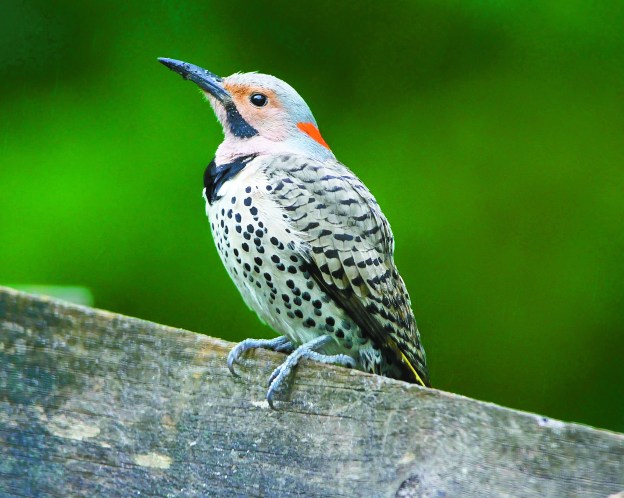
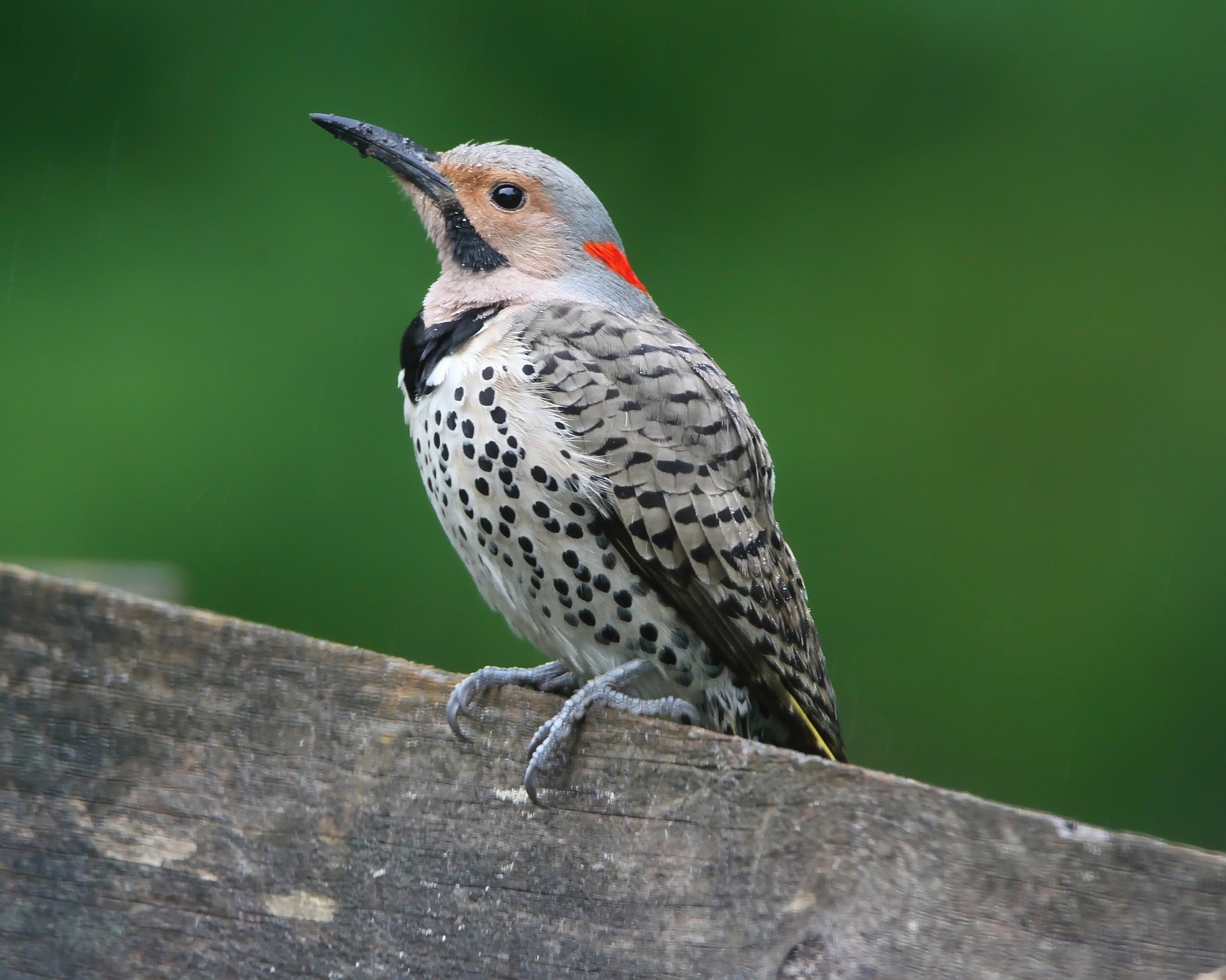
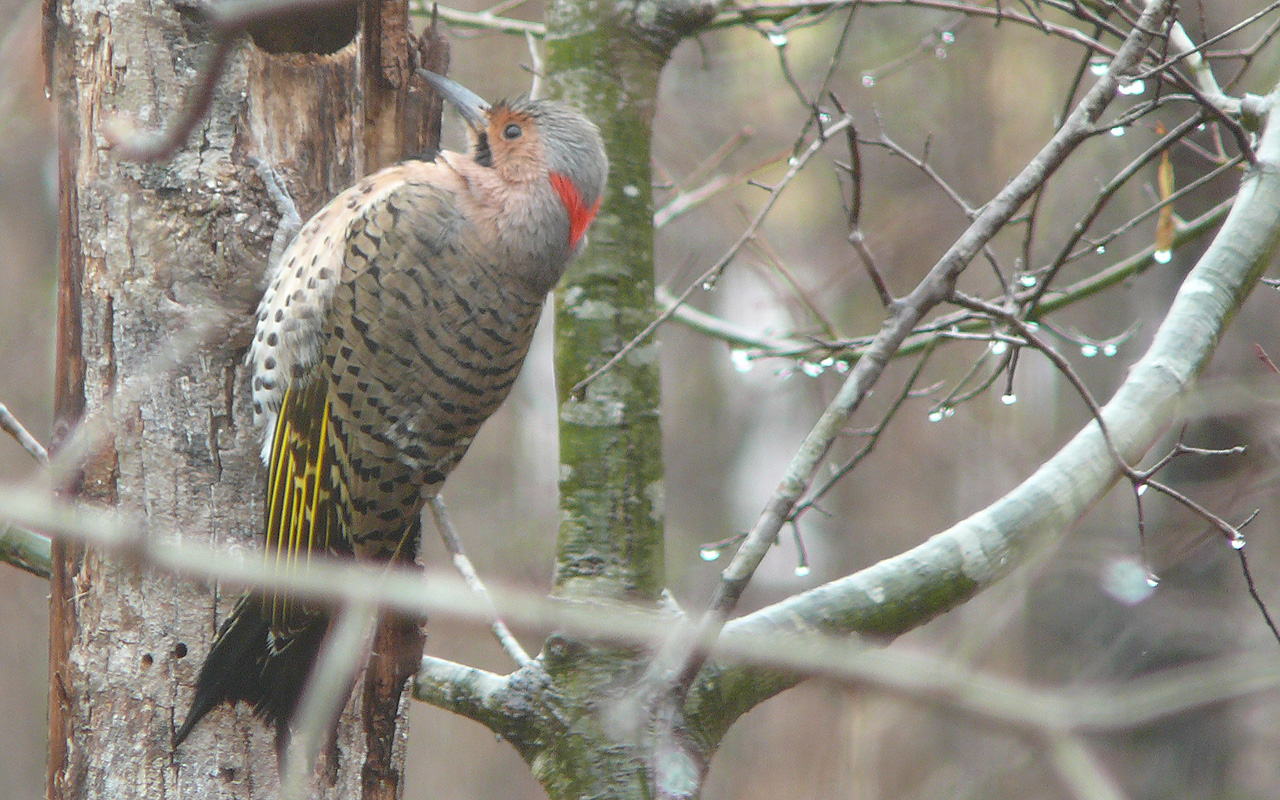
Seasonal transitions raise profiles of flickers, other birds

NatureLady/Pixabay • Northern flickers belong to the woodpecker family. Relatives living in the region include the pileated woodpecker, yellow-bellied sapsucker and downy woodpecker. Unlike most woodpeckers, flickers spend an extensive amount of time foraging on the ground for various insects.

Robin Free, a resident of Scott County, Virginia, emailed me after reading a recent column about owls. She told me she was interested in attracting more owls to her property, which she noted boasts an abundance of ground squirrels and mice.

I congratulated her on the fact that with all those ground squirrels and mice her home should make for happy hunting grounds for any owls in the vicinity.

I suggested she could play a recording of a screech-owl call at dusk to see if she can get a real owl to respond. These small owls are very curious and will readily respond.

Photo by Bryan Stevens
An Eastern Screech-Owl at rest in a roosting hole in a large sycamore tree.

The owl that Robin and most os us are likely to attract is the Eastern screech-owls. Since screech-owls are cavity-nesters, people can offer a roosting/nesting box. Obviously, these boxes have to be a little larger than for songbirds. Simply do a Google search to find screech-owl boxes for purchase.

Here’s some info I found online about screech-owl boxes. Placement is crucial. Mount the box at least 10 feet high in a tree, on a pole or on the edge of woods, fields or wetlands. Keep it away from trees where squirrels can jump to it. Add a couple of inches of wood chips or saw dust for nesting material.


•••

In this transition from fall to winter, some birds have adopted higher profiles around my home. I hear and see ruby-crowned kinglets and white-throated sparrows almost every morning as I leave for work. I am also seeing and hearing Northern flickers.

Flickers are woodpeckers, but there are some differences between them and other members of this clan. While flickers can be found during all seasons in the region, this woodpecker is one of the migratory ones. I see the most Northern flickers during fall migration. This woodpecker is one of the few of its kind that usually migrates to warmer climates during the colder months, although the species is not completely absent from the region in the winter season.

This species also has many other common names, including yellow-hammer — a popular name in the Deep South — and harry-wicket, heigh-ho and gawker bird. The Northern flicker is also the only woodpecker to serve a state — Alabama — as an official bird. The flicker earned this distinction back in 1927. Alabama soldiers who fought for the Confederacy were nicknamed “yellowhammers” because of their grey-and-yellow uniforms, which matched the colors of the bird. Incidentally, Alabama was one of the first states to ever name an official state bird.

There are two races of Northern flicker — yellow-shafted and red-shafted — found in the United States. Eastern flickers show yellow feather shafts beneath the wings while western counterparts show red beneath the wings. A trip to Utah several years ago gave me a chance to also see the red-shafted race of this bird.

The Northern flicker is also not the only flicker in the United States. The gilded flicker inhabits many of the deserts — Sonoran, Yuma and Colorado — in the United States. Of course, trees are scarce in deserts, but that hasn’t proven an obstacle for this woodpecker. The bird is closely associated with saguaro cactus. Other desert dwellers depend on this woodpecker. Once the flickers are no longer making use of their nest and roost holes in the multi-armed cacti, other wildlife moved into the chambers.

The Northern flicker is an enthusiastic drummer, pounding loudly on the sides of trees with its stout bill. The purpose of the drumming is to communicate with mates and signal potential rivals that they’re intruding. Toward that objective, flickers sometimes substitute metal utility poles or the sides of buildings for the trunks of trees. In addition to drumming, the flicker also employs a variety of loud vocalizations that are fairly distinctive. A loud, repeated vocalization, often translated as “wicka-wicka-wicka,” is similar to the cluck-like call of the larger pileated woodpecker. The flicker is also known for emitting a sharp, loud “kleeer” call that can be heard from a considerable distance. It’s that call that I’ve been hearing most mornings in the woodlands around my home.

The adult flicker is a brown bird with black bars on the back and wings. A distinctive black patch occupies the upper breast, while the lower breast and belly are beige with black spots. Males can be identified by a black or red mustache stripe at the base of the beak. They also have a red stripe on the back of their gray heads. The flicker’s dark tail is set apart by a white rump patch that is conspicuous when the bird takes flight..

Look for Northern flickers in fields, orchards, city parks and well-planted suburban yards. These woodpeckers are usually not too shy around human observers and will sometimes allow for extended observation. If you’re even more fortunate, you could find one visiting your yard or garden. Just remember to scan the ground. This is one woodpecker that’s not a consistent tree-hugger like many of its kin.

•••

Bryan Stevens has written weekly about birds and birding since 1995. Email him at ahoodedwarbler@aol.com to share sightings, ask questions or make comments.


Hawks and other birds can be affected by albinism, leucism

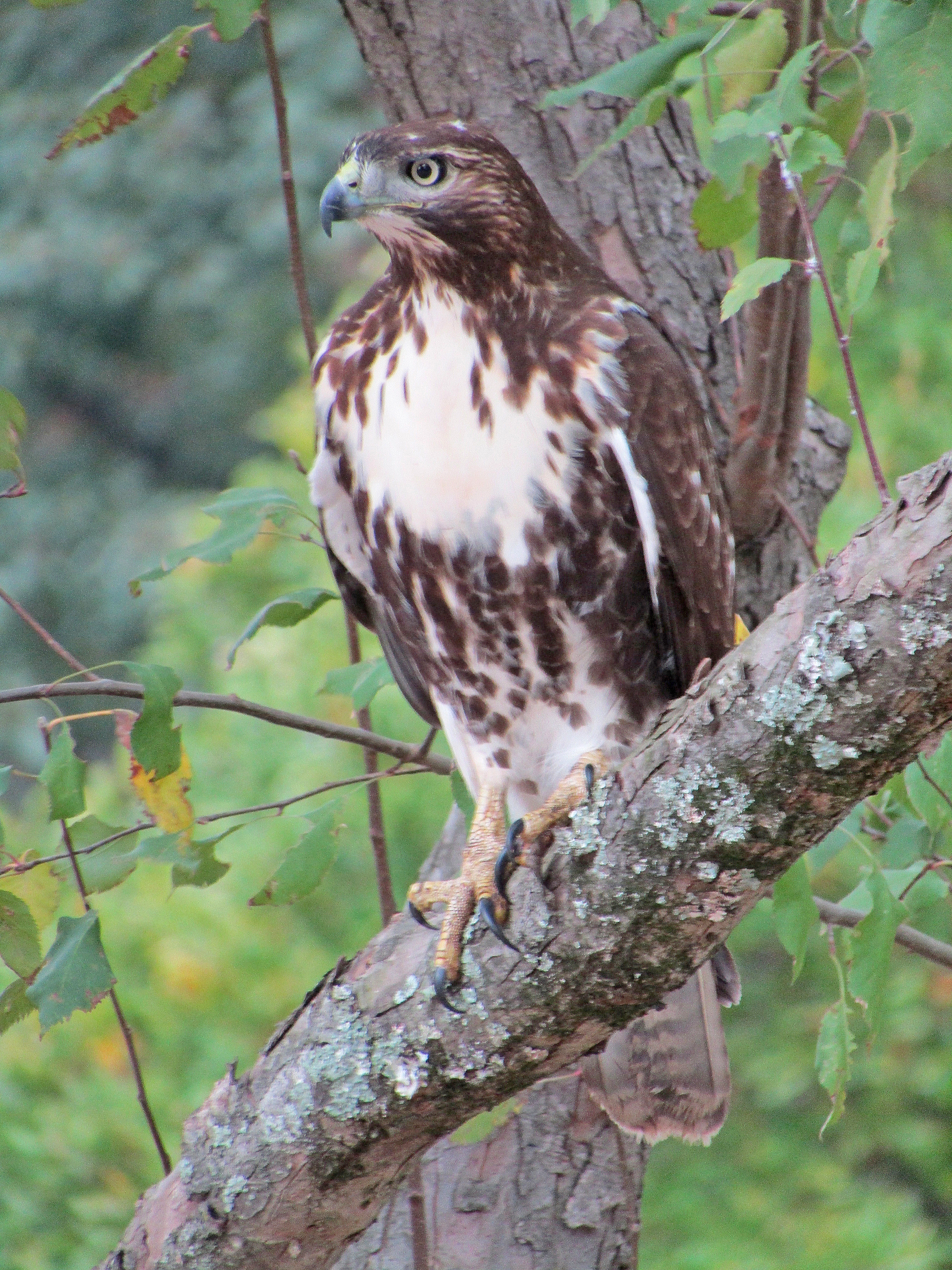
Photo by Bryan Stevens • Raptors, like this Red-tailed Hawk, proved plentiful on count day. Broad-winged Hawk, a relative of the Red-tailed Hawk, even set a new record for most individuals found.

Birds of a feather, as the old saying goes, tend to flock together, but what happens when a member of the flock stands out from the rest? Although conventional wisdom mandates that being conspicuous is not helpful for most wild creatures, some of them can’t help but get attention.

Bigger birds are more conspicuous than smaller songbirds, but an all-white (or nearly so) red-tailed hawk sticks out more than its kin with regular plumage.

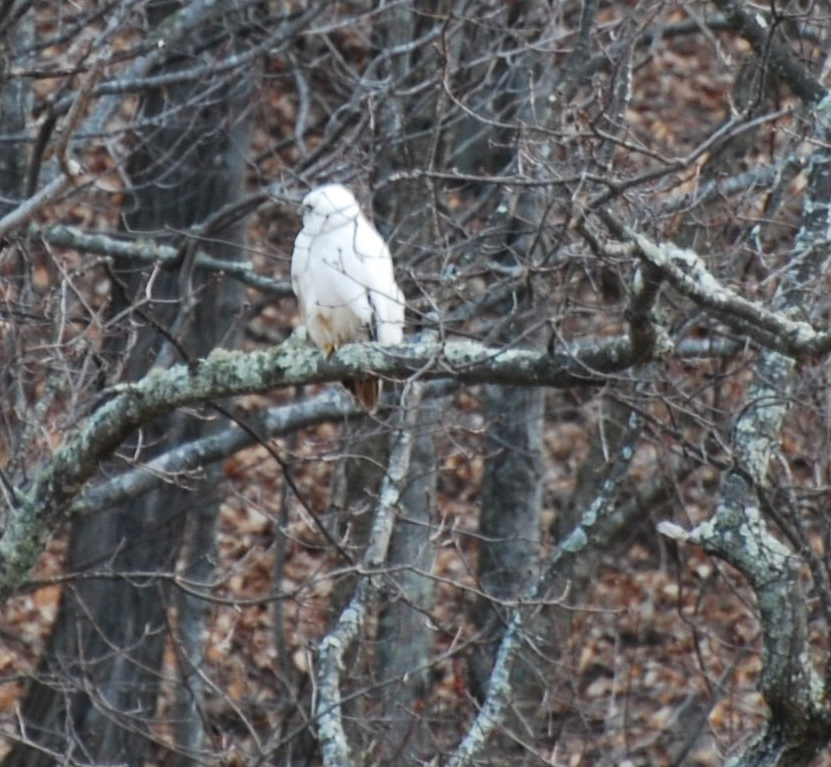
I stepped into the back parking lot behind The Erwin Record on Oct. 22 and immediately heard American crows feuding with something, causing quite the commotion. When I looked up I saw the crows tagging a large white hawk. I studied the hawk and noticed that, with the light shining from the other side, the tail feathers revealed an almost translucent hint of red. It was a red-tailed hawk but other than the faint color evident in the tail it was entirely white.
This is my first sighting of an albino (or close to it) red-tailed hawk in Unicoi County. Years ago I used to notice an albino red-tailed near the state line between Tennessee and North Carolina when traveling to Asheville on Interstate 26.

Albinism is a genetic, or inherited, condition resulting in a complete lack of production of pigmentation. Albino birds are, for the most part, extremely uncommon. I’ve heard of a variety of birds, ranging from hummingbirds and American robins to various ducks and swallows, that have a tendency to produce albino individuals.

Leucism is another genetic mutation that causes affected birds to grow feathers that are pale or whitish overall. A faint pattern may be visible. Leucism is also uncommon, but is more common that albinism. The fact that I could detect a faint hint of red in the bird’s tail feathers means that the hawk I saw in Erwin was, technically, affected by leucism and not albinism.

Photo by Jean Potter • This partial albino red-tailed hawk was spotted for several years near the state line dividing northeast Tennessee and western North Carolina.

Albinism and leucism are not the only conditions that can affect pigment in a bird’s feathers. Some birds have the opposite problem in that they produce too much pigment, resulting in a much darker bird than what would be typical. The plumage of such affected birds is described as melanistic, which is in stark contrast to an albino bird. With a melanistic bird, the feathers are much darker than usual because of an abundance of pigment. In rare albino birds, the opposite occurs and the lack of pigment in the feathers leave them looking white. Completely albino birds also tend to have red eyes. It’s probably better for a bird to be melanistic. Albino birds tend to stick out like sore thumbs, attracting the attention of predators.

I’ve only seen a few albino or partial albino birds in person, although I have observed videos and photographs of such birds. During a trip to Salt Lake City, Utah, in 2006, I observed an albino Brewer’s blackbird. An albino blackbird is almost an oxymoron. This particular blackbird had a white upper body and head and a black lower body. At first, I thought it might be a small tern, but closer observation — and identification of the birds with which it was associating — eventually confirmed that it was a Brewer’s blackbird, a common species in Salt Lake City.
These observations remain my best looks at albino birds in the wild. I’ve also seen partial albinos, including an American crow with white feathers in its wings that inhabited the woodlands and fields at my home for several years. I’ve also observed a couple of American goldfinches over the years that would probably qualify as leucistic birds.

A few years ago, I saw an albino red-tailed hawk while driving between Erwin, Tennessee, and Asheville, North Carolina, on Interstate 26. The hawk was often present near the North Carolina Visitors Center.

The red-tailed hawk is one of the most widespread and commonly observed hawks in Tennessee, according to a profile on the Tennessee Wildlife Resources Agency’s website. These large raptors frequently perch in trees along roadsides and is more likely to nest in wooded residential neighborhoods than other hawks.

During my teaching days at East Tennessee State University, I became familiar with a pair of hawks that chose some of the larger trees on campus as regular perching sites.
Small to medium sized mammals, birds, and snakes, with occasional insects and fresh carrion make up the bulk of a red-tailed hawk’s diet. I figured that the ETSU hawks helped keep the local squirrel population in check.

The breeding range of the red-tailed hawk extends across North America from Alaska to Florida and southward to Panama and the Caribbean. The raptor is found in Tennessee year round and migrants from the northern parts of the range join resident birds in winter.
As in most birds, the conditions of albinism and leucism are somewhat rare. I’ve also heard from readers over the years about birds such as American goldfinches and downy woodpeckers exhibiting albino tendencies.

These issues involving the absence or abundance of pigment can complicate bird identification. After all, all-white birds, from snowy owls and tundra swans to great egrets and snow geese, do exist in nature. Even in these birds, however, there’s usually some other color present to break up the uniformity of the bird’s plumage. Keep in mind that such rarities as albino individuals of such common species as house finches and American robins can show up at your feeders or in your yard. It’s just another way birds constantly surprise us.

•••••

To learn more about birds and other topics from the natural world, friend Bryan Stevens on Facebook at https://www.facebook.com/ahoodedwarbler. He is always posting about local birds, wildlife, flowers, insects and much more.


Spotlight on dark-eyed junco launched weekly column 29 years ago

Pixabay • A dark-eyed junco visits a deck for birdseed.

I wrote my first bird column on Sunday, Nov. 5, 1995, which means this weekly column is marking its 29th anniversary this week.

Looking back, it seems almost unbelievable that I’ve written anything on a regular weekly basis for almost 30 years. This column has appeared in a total of six different newspapers, which I regard as a personal achievement, as well as an accomplishment for our feathered friends. It’s on their behalf that I pen these weekly efforts to promote conservation and good will toward all birds. I have also posted the column as a weekly blog posting since February 2014 at http://www.ourfinefeatheredfriends.com.

I’ve played detective, helping people identify everything from “rain crows,” or cuckoos, to Muscovy ducks, rose-breasted grosbeaks and house finches. I’ve observed unusual birds, including white pelicans, brants and roseate spoonbills, in Northeast Tennessee, Southwest Virginia and Western North Carolina and spotlighted them in these columns.

Photo by Ken Thomas • A dark-eyed junco perches on some bare branches on a winter’s day.

While my vision challenges remain, I find that looking through binoculars works just fine, allowing me to spin the focus wheel and still take delight in the kaleidoscopic parade of colorful warblers that pass through the region each spring and fall as well as the fast-paced duels of ruby-throated hummingbirds. My main problem these days is the inability to spot movement, especially in treetops where many birds like to hang out.

At my home, I continue to provide sunflower seed and other supplemental food for the resident birds like Carolina chickadees, white-breasted nuthatches, song sparrows and downy woodpeckers.

Even as I tweak my anniversary column for “Feathered Friends,” I’m looking forward to the winter bird feeding season. The prognostication of approaching winter weather is a perfect time to dust off this week’s column, which is a revision of the first bird column I ever wrote. This column focused on a common visitor to yards and feeders during the winter months. In fact, dark-eyed juncos should be returning to the region any day. Here, with some revisions I have made through the years, is that first column.

•••

Of all the birds associated with winter weather, few are as symbolic as the dark-eyed junco, or “snow bird.” The junco occurs in several geographic variations.

John V. Dennis, author of “A Complete Guide to Bird Feeding,” captures the essence of the junco in the following description: “Driving winds and swirling snow do not daunt this plucky bird. The coldest winter days see the junco as lively as ever and with a joie de vivre that bolsters our sagging spirits.” The dark-eyed junco’s scientific name, hyemalis, is New Latin for “wintry,” an apt description of this bird.

Most people look forward to the spring return of some of our brilliant birds — warblers, tanagers and orioles — and I must admit that I also enjoy the arrival of these birds. The junco, in comparison to some of these species, is not in the same league. Nevertheless, the junco is handsome in its slate gray and white plumage, giving rise to the old saying “dark skies above, snow below.”

Just as neotropical migrants make long distance journeys twice a year, the junco is also a migrating species. But in Appalachia, the junco is a special type of migrant. Most people think of birds as “going south for the winter.” In a basic sense this is true. But some juncos do not undertake a long horizontal (the scientific term) migration from north to south. Instead, these birds merely move from high elevations, such as the spruce fir peaks, to the lower elevations. This type of migration is known as vertical migration. Other juncos, such as those that spend their breeding season in northern locales, do make a southern migration and, at times, even mix with the vertical migrants.

During the summer months, a visit to higher elevations mountaintops is almost guaranteed to produce sightings of dark-eyed juncos. Juncos may nest as many as three times in a season. A female junco usually lays three to six eggs for each nest, which she constructs without any assistance from her mate.

Juncos are usually in residence around my home by early November. Once they make themselves at home I can expect to play host to them until at least late April or early May of the following year. So, for at least six months, the snow bird is one of the most common and delightful feeder visitors a bird enthusiast could want.

Juncos flock to feeders where they are rather mild-mannered — except among themselves. There are definite pecking orders in a junco flock, and females are usually on the lower tiers of the hierarchy. Females can sometimes be distinguished from males because of their paler gray or even brown upper plumage.

Since juncos are primarily ground feeders they tend to shun hanging feeders. But one winter I observed a junco that had mastered perching on a hanging “pine cone” feeder to enjoy a suet and peanut butter mixture.

Dark-eyed juncos often are content to glean the scraps other birds knock to the ground. Juncos are widespread. They visit feeders across North America. The junco is the most common species of bird to visit feeding stations. They will sample a variety of fare, but prefer such seeds as millet, cracked corn or black oil sunflower.

The juncos are a small branch of the sparrow clan. Some of the other juncos include the endangered Guadalupe junco, yellow-eyed junco, Baird’s junco and volcano junco. The last one on the list is endemic to the Talamancan montane forests of Costa Rica and western Panama. Baird’s junco is named for Spencer Fullerton Baird, an American ornithologist and naturalist.

Baird served as secretary for the Smithsonian Institution from 1878 until his death in 1887. He greatly expanded the natural history collections of the Smithsonian from 6,000 specimens in 1850 to over two million by the time of his death.

I hope you’ve enjoyed this introduction to juncos. There’s something about winter that makes a junco’s dark and light garb an appropriate and even striking choice, particularly against a backdrop of newly fallen snow.

Of course, the real entertainment from juncos comes from their frequent visits to our backyard feeders. When these birds flock to a feeder and began a furious period of eating, I don’t even have to glance skyward or tune in the television weather forecast. I know what they know. Bad weather is on the way!

•••

I’ve already seen the first of the season’s white-throated sparrows, a reliable precursor to juncos. If you’d like to share your first sighting this season of dark-eyed juncos, email me at ahoodedwarbler@aol.com. As always, the column is open as a line of communication with fellow bird enthusiasts. I’ve enjoyed sharing stories about birds with countless readers over the past 29 years. I can also be reached on Facebook at https://www.facebook.com/ahoodedwarbler.


Vocal screech owls are pint-sized predators

Photo by Bryan Stevens • An Eastern screech owl perches on a hemlock branch. These owls are much smaller than such relatives as great horned owl and barred owl.

It’s been my pleasure to enjoy almost daily serenades by an Eastern screech owl residing in the woods around my home. The small owl’s shivery wailing calls usually start around dusk and can continue at intervals throughout the night.

Back in September while I watched almost daily for migrants from a lawn chair, I heard on a couple of occasions the “early bird” owls calling occasionally from shady wooded areas. The owls tended to call more often during the daytime when conditions were overcast.

I always pause and listen when I hear the wailing and haunting vocalizations of the screech-owls that make their home in the woodlands that surround my home. I’m glad to have this small owl as a neighbor, but I fully realize that owls have suffered from a dark reputation in certain corners. The fact is, unless you are a small rodent or some sort of insect-sized prey, the Eastern screech-owl makes an excellent addition to the neighborhood.

On the verge of Halloween, a closer look at this small owl is warranted. An adult Eastern screech owl is usually only between six and nine inches in length. Many people upon first seeing a screech-owl assume it’s a baby owl. During past trips to Brookgreen Gardens in South Carolina, I have enjoyed attending the daily educational programs conducted by the zoo staff at Brookgreen. These programs are designed to introduce visitors to various examples of native wildlife. The presenter usually introduced a couple of animals to the audience. On several occasions, the show featured birds of prey, including hawks and owls.

Photo by Irene K-s/Pixabay.com • An Eastern screech owl keeps an eye on its surroundings.

Two of the shows during my visit to Brookgreen back in 2019 featured Lucy, an Eastern screech-owl, and people in the audience invariably asked if she was a baby owl. To their astonishment, they learned that Lucy was an adult screech-owl and unlikely to grow any bigger.

There are larger owls in our region, including the great horned owl and barred owl. Lucy and her kin must avoid these much larger owls, which would not scruple at making a meal of the much smaller owl.

Because of their small size, screech-owls prey on some comparatively small creatures, including insects, small rodents, amphibians, songbirds and reptiles. The Eastern screech-owl is also a cavity-nesting bird and will accept bird boxes provided by humans so long as the box’s entrance hole is customized to their size.

The screech owl is the owl most likely to encounter human beings. It’s an adaptable little feathered predator, just as much at home in the backyard and garden as it is in parks and woodlands. In addition to nesting in cavities, this owl roosts in them during the daytime hours. Look for roosting screech-owls in knotholes of trees or in unoccupied wood duck boxes. Although they come in two color phases — red and gray — both variations are quite capable of camouflage. When perched or roosting, these small owls blend remarkably with their surroundings.

The Eastern screech owl also produces a variety of odd wails and other vocalizations including a distinctive, trembling “whinny” call that is often made when the owl feels curious or alarmed. It’s a wavering, haunting call that is made after dark, most often at the hours closer to dawn and dusk. Imitating the call of a screech-owl or playing a recording is also a trick for getting some shy songbirds to show themselves. Screech owls are not-so-welcome co-habitants among my yard’s songbirds, which will flock to this owl’s call and band together to “mob” the predator and try to convince it to depart the immediate area.

As small as the Eastern screech-owl is, the United States is home to several other pint-sized owls, including Western screech-owl, Northern pygmy-owl, Northern saw-whet owl, flammulated owl and elf owl, which at six inches tall and a weight of less than an ounce qualifies as the world’s smallest owl.

Photo by U.S. Fish and Wildlife Service • The tiny Northern Saw-whet Owl nests on several of the region’s higher mountains.

Any time I finish listening to a calling owl and go back indoors for the evening, I reflect on the fact that screech-owls make good neighbors. Their prey preferences remove many nuisance insects and rodents from the habitat they share with humans as well as other wildlife. If you’re hearing an odd, winnowing call from the edge of the woods at your own home, there’s a good chance that you have one of these small owls as a neighbor.

Keep alert for these small owls and their larger kin as we observe this year’s Halloween holiday, as well as other days and nights throughout the year.

•••

To learn more about birds and other topics from the natural world, friend Bryan Stevens on Facebook at https://www.facebook.com/ahoodedwarbler. He enjoys posting about local birds, wildlife, flowers, insects and much more. If you have a question, wish to make a comment or share a sighting, email him at ahoodedwarbler@aol.com.

Holly Keepers/USFWS • A red Eastern screech owl peeks from a perch among some evergreen branches.

Grosbeaks are migrating back south

Photo by Bryan Stevens
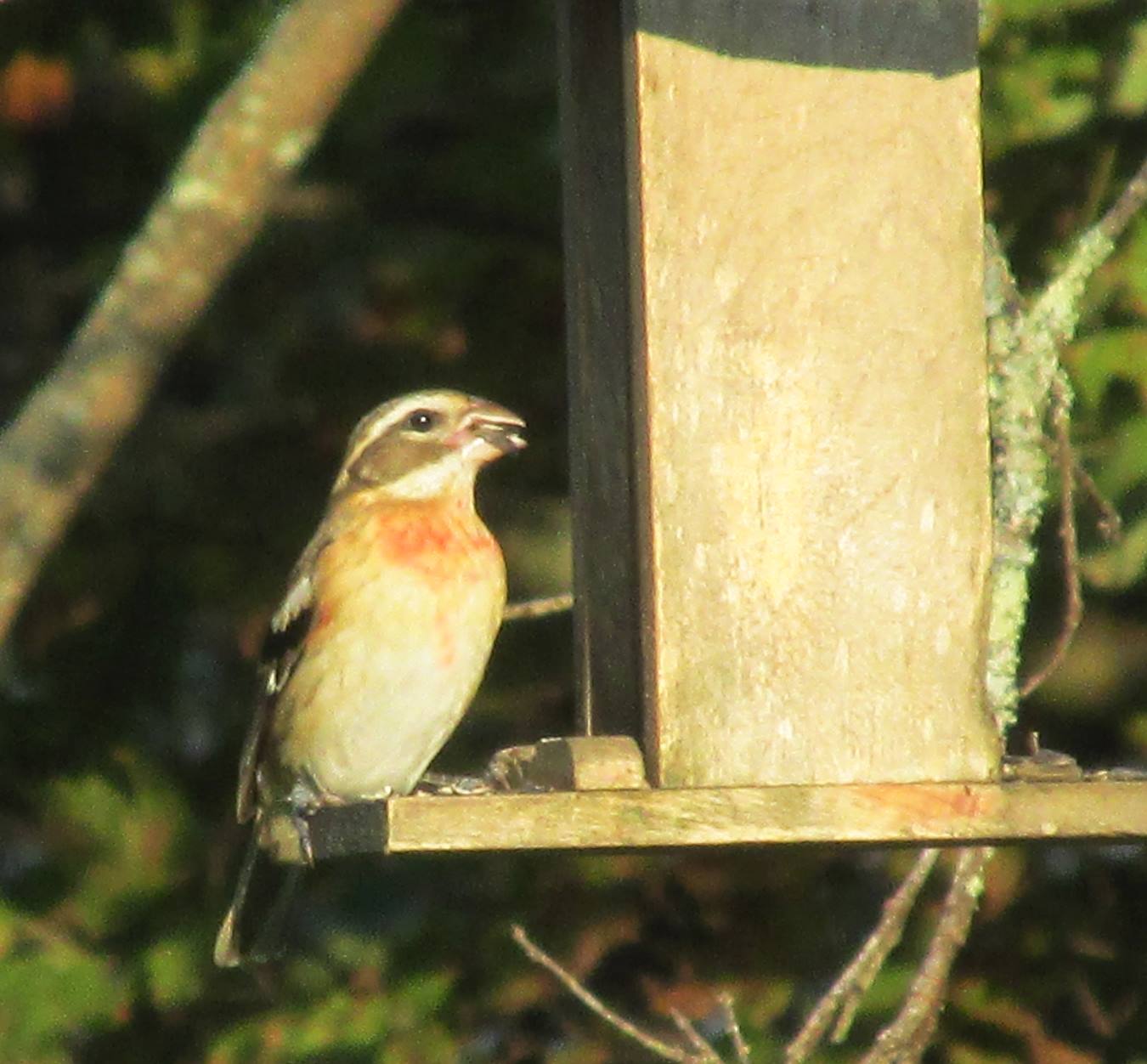
A young male Rose-breasted Grosbeak visits a feeder in September of 2013. Young males resemble females but show a splash of orange on the breast that will be replaced the following spring by the familiar rosy-red patch.

Kaylynn Sanford Wilster hosted some refugees from Hurricane Helene at her feeders on Sept. 27. She notified me of their arrival with a post to my Facebook page.

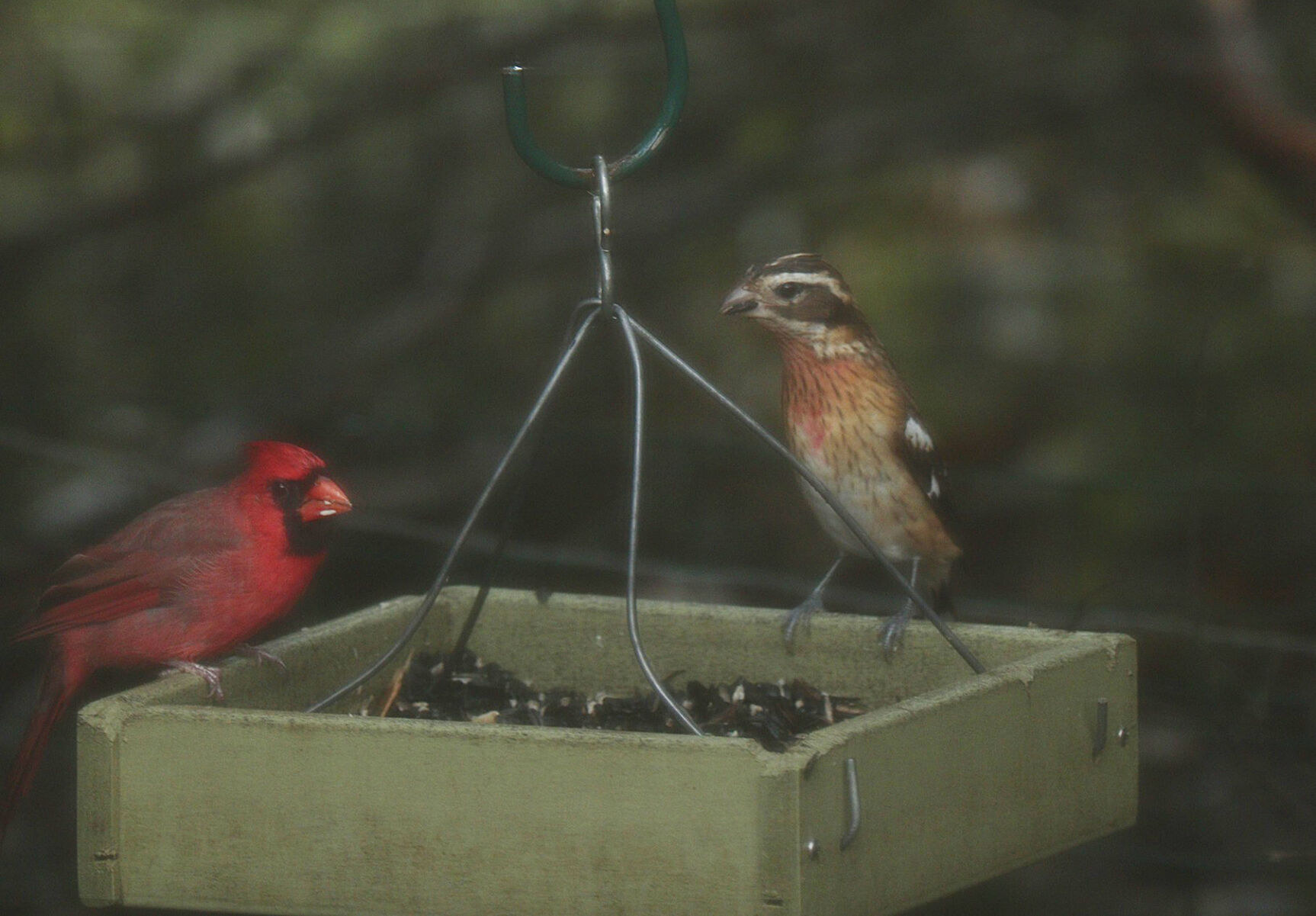
Kaylynn lives in Piney Flats near Boone Lake and sees plenty of birds and other wildlife at her home. She shared photos on my Facebook page of Northern cardinals sharing a feeder with rose-breasted grosbeaks. While the cardinals are found here throughout the year, rose-breasted grosbeaks are mostly spring and fall migrants in the region.

The photos captured the dark and rain of the early part of the day on Sept. 27 as remnants of Hurricane Helene barreled through the region. I suspect that the rose-breasted grosbeaks that landed on her feeders were hoping to ride out the storm with easy access to food.

Photo Courtesy of Kaylynn Sanford Wilster • A young male rose-breasted grosbeak, right, shares space on a feeder with an adult male Northern cardinal.

Plenty of rose-breasted grosbeaks pass through northeast Tennessee, southwest Virginia and western North Carolina every spring and fall. These songbirds also make their summer home on local mountains. Rose-breasted grosbeaks birds spread out widely across the eastern half of the North American continent, ranging from northeastern British Columbia to Quebec and Nova Scotia in Canada. They also range south from New Jersey to Georgia. The rose-breasted grosbeak also reaches Colorado, Oklahoma and Kansas.

For the most part, however, the rose-breasted grosbeak is replaced in the western United States by the closely related black-headed grosbeak.

As fall approaches, the rose-breasted grosbeak migrates south to a winter range that spans central Mexico, Central America and northern South America. As they depart, many of these migrating birds will make autumn visits to again partake of offerings of sunflower seeds at backyard feeders. So, if you didn’t get to see these showy birds in the spring, local bird enthusiasts get another chance to see them in September and October.

The male rose-breasted grosbeak gives this species it name. Males are the epitome of the birds that make their home for part of the year in the American tropics. The contrasting black and white plumage is emphasized by a triangular slash of rosy-red color on the breast. Put all those elements together and the male rose-breasted grosbeak is not a bird that would be mistaken for any other.

The female grosbeak, however, doesn’t stand out in the same way. She is much less colorful than the male. With her brown and white plumage, she is often mistaken for a large sparrow or finch.

Both sexes have a massive bill, which they use to hull sunflower seeds at feeders or glean insects from leaves and branches. It’s the heavy, blunt bill for which the term “grosbeak” is derived. “Gros” is a German term for large or big, so grosbeak simply means a large-beaked bird. People who band birds to further the study of them will tell you that rose-breasted grosbeaks can inflict a wicked nip. In Northeast Tennessee, bird banders frequently encounter rose-breasted grosbeaks in their mist nets — and bear the scars to prove it.

With some birds, males play only a minor role in the nesting process. That’s not the case with the rose-breasted grosbeak male. The males help with nest-building chores and share responsibility with the female for incubating the eggs.

The female lays three to five eggs in a cup-shaped nest. It’s not easy to locate the nests since the birds usually place them in trees at least 20 feet above the ground. Within two weeks, the eggs have hatched and the parents are kept extremely busy finding enough food to satisfy the voracious nestlings. Well fed by both parents, the young grow quickly and usually are ready to leave the nest within 12 days.

Often, when a first brood of young departs the nest, the male will care for the rowdy group of fledglings as the female starts a second nest to capitalize on the long days of summer.

Away from our feeders, rose-breasted grosbeaks feed on insects, seeds, fruit and even some leaf buds and flowers. I’ve seen these birds satisfying a sweet tooth — or should that be sweet beak? — by feeding on jewelweed flowers and apple blossoms. If sugar’s good for hummingbirds, I am sure it is a valuable energy source for rose-breasted grosbeaks, too.

Some of the grosbeaks in Kaylynn’s photos were young male grosbeaks that didn’t yet have the stunning plumage of an adult male. They were making their first migration, heading south to spend the winter on the same wintering grounds as their parents. An interruption of that migration by a hurricane must have been an unwelcome one, but the birds at her feathers didn’t appear to have even a feather out of place.

Like people, birds can be extremely resilient, even in the face of something like a hurricane. Whether you see rose-breasted grosbeaks in the spring or the fall, these songbirds are cherished visitors that can add some excitement to a gloomy day.

Photo by Bryan Stevens • A migrating rose-breasted grosbeak rests and recuperates after a collision with a. window.

Mockingbird has been Tennessee state bird since 1933

By George/Pixabay • The Northern mockingbird serves as the state bird for Tennessee, as well as four other states. These songbirds are renowned for having a spirited nature.

We know some birds by their colorful feathers and others by a distinctive song. The Northern mockingbird demands attention not so much from brilliant plumage or a unique song — this bird actually copies the songs of other birds — but from an indomitable spirit all out of proportion to its size.

The mockingbird is a relatively common bird in most of the region, but it has always been rather scarce bird at my home. This year has been no exception. I’ve observed gray catbirds and brown thrashers as summer transitioned into autumn, but there’s been no sign of any Northern mockingbirds.

Mockingbirds don’t usually visit my yard and gardens outside of late fall and early winter. Close relatives like the gray catbird and brown thrasher, however, are usually fairly common birds in spring, summer and fall. I’ve even had thrashers visit during the winter months, as well as an unexpected December sighting of a catbird in 2015.

These three species are lumped together in a family of birds known as the “mimic thrushes,” so named because of their talent for mimicry. The group provides a convenient umbrella for some related songbirds capable of imitating the songs of other birds.

Mimidae, the Latin root for “mimic,” provides the scientific name for the family, which includes mockingbirds and the New World catbirds, as well as thrashers. The Northern mockingbird is best known for the ability to mimic, but relatives like the gray catbird and brown thrasher are also talented mimics.

The varied repertoire of a mockingbird has always impressed human listeners. Laura C. Martin notes in her book, “The Folklore of Birds,” that the Choctaw Indians referred to the mockingbird as hushi balbaha, or “the bird that speaks a foreign language.”

Mockingbirds will break into song — their own and those of other birds — at almost any time of day or night. Both sexes sing. Biologists have speculated that there might not be a limit to the songs mockingbirds can learn to imitate, while other experts believe that the mockingbird’s mimicry might not be quite so extensive.

The Northern mockingbird is the only mockingbird found in North America, but Central America, South America and some of the Caribbean islands are also home to 16 other species of mockingbirds. Several endemic species of mockingbirds also inhabit some of the islands in the Galápagos archipelago.

Some of these other mockingbirds include brown-backed mockingbird, white-banded mockingbird, blue mockingbird, blue-and-white mockingbird, chalk-browed mockingbird, Bahama mockingbird and tropical mockingbird.

Anyone with much experience with mockingbirds would probably agree that these birds are bold, courageous and sometimes fiercely assertive.

The aggression of the mockingbird was on full display on an occasion when I observed a pair of these birds attempting to defend a berry-laden holly tree from a voracious flock of cedar waxwings. Badly outnumbered, the two mockingbirds would successfully chase off several waxwings only for another dozen or so waxwings to take the place of their vanquished flock mates. Although the flock of waxwings consisted of about 80 individual birds, the mockingbird pair put up a valiant struggle to defend the food represented by those holly berries.

Nesting mockingbirds are also very defensive of both their nest and young. They will attack anything that moves in the vicinity, including domestic cats and dogs, as well as humans.

I once observed a young red-tailed hawk perched in a tree while crows and blue jays were screaming in protest at the large raptor’s presence. The only bird to actually make contact with the hawk, however, was a single mockingbird that swiped the back of the hawk’s head in a persuasive effort to convince the raptor to move along.

Perhaps not surprisingly, these aggressive songbird can reach a ripe old age. According to the website All About Birds, the oldest Northern mockingbird on record was at least 14 years, 10 months old when it was found in Texas.

Early American naturalist and artist John James Audubon painted a famous depiction of mockingbirds attacking a rattlesnake. He painted the dramatic scene to demonstrate the fearless nature of the mockingbird in defending its young.

It’s that feisty attitude that impresses most people about mockingbirds. Even people who don’t like this bird — some consider it a bully — usually give grudging credit that the bird doesn’t lack in courage or spirit.

Perhaps that’s the reason five states — Tennessee, Texas, Florida, Arkansas and Mississippi — have made the mockingbird their official state bird. The southern makeup of these states reflects that the mockingbird has always been a bird of the southern United States even as it has expanded its range northward and westward.

The mockingbird was designated the state bird by the Tennessee General Assembly in 1933. The mockingbird’s designation had been decided earlier that same year in an election conducted by the Tennessee Ornithological Society. Florida and Texas both selected the mockingbird in 1927, Arkansas in 1929, and Mississippi in 1944. The mockingbird was once the official state bird of South Carolina but was replaced by the Carolina wren in 1948.

I find mockingbirds fascinating, partly because they remain a bit of a rarity at my home. I realize that the militant nature of this bird may distress those wanting peace and harmony among the feathered occupants of their yards and gardens.

If the mockingbird had a slogan, it might be something like “don’t mess with me.” The mockingbird in your yard or garden considers the territory its own little kingdom. Intruders beware.

•••

To share a sighting, make a comment or ask a question, email me at ahoodedwarbler@aol.com.


Rare birds are occasional silver linings after hurricanes

Kaleomanuiwa Wong/USFWS • A sooty tern clings to a rocky perch. Hurricane Frances blew a sooty tern to Holston Lake in Bristol on Sept. 8, 2004.

During a program I presented on birds and birding at the Elizabethton/Carter County Public Library many years ago, an attendee asked me if I knew what happens to birds in a hurricane?

The question, no doubt prompted by the 2017 hurricanes Harvey and Irma, is of particular concern now that many of our favorite birds are migrating south along paths that could take them into harm’s way.

Hurricanes are often a factor that fall migrants must face. In 2004, Hurricane Frances blew some unusual tropical birds to Holston Lake in Bristol. Severe storms also present devastating obstacles for other birds.

Well-known birder and author Kenn Kaufman shared his knowledge about birds and hurricanes when interviewed back in 2011 on the Audubon website. Among some fascinating insight he shared, Kaufman noted that the way intense storms affect birds depends on the species. He noted that a whimbrel, a large shorebird, would be more likely to fly through a major hurricane and live to tell the tale. On the other hand, such a storm would likely prove lethal for songbirds like warblers and thrushes.

To the questioner at my program, I also admitted that dedicated birders are, at times, rather atypical people. For a birder looking to find a totally unexpected bird, every hurricane comes with a proverbial silver lining. In the case of birders, that lining involves some of those stronger flyers — birds like whimbrels, noddies, terns, jaegers or tropicbirds — that get swept into the eye of the storm, carried far inland and dropped onto large lakes as the storm weakens.

My first direct observation of one of these hurricane-transported displaced birds took place back on Sept. 8, 2004. I had been drawn to Musick’s Campground on South Holston Lake by reports of an incredible fallout of such birds, which included species like whimbrel and red knot. More than a dozen fellow birders were present in the swirl of wind, mist and rain when a graceful bird with a dramatic two-toned black and white plumage flew overhead.

I had no idea of the bird’s identity, but I knew instantly it was a species I’d never observed. I heard someone yell “sooty tern” — the identity of the shouter turned out to be area birding legend Rick Knight — and then pandemonium broke out as birders in rain gear got their binoculars into position to track the bird before it flew out of sight.

We needn’t have worried. The bird lingered long enough for all those present to get a good look. I was accompanied that day by the late Howard P. Langridge, a well-known birder in both Florida and Tennessee. Howard had seen sooty terns, but he had found them when visiting the islands of the Dry Tortugas, west of the Florida Keys.

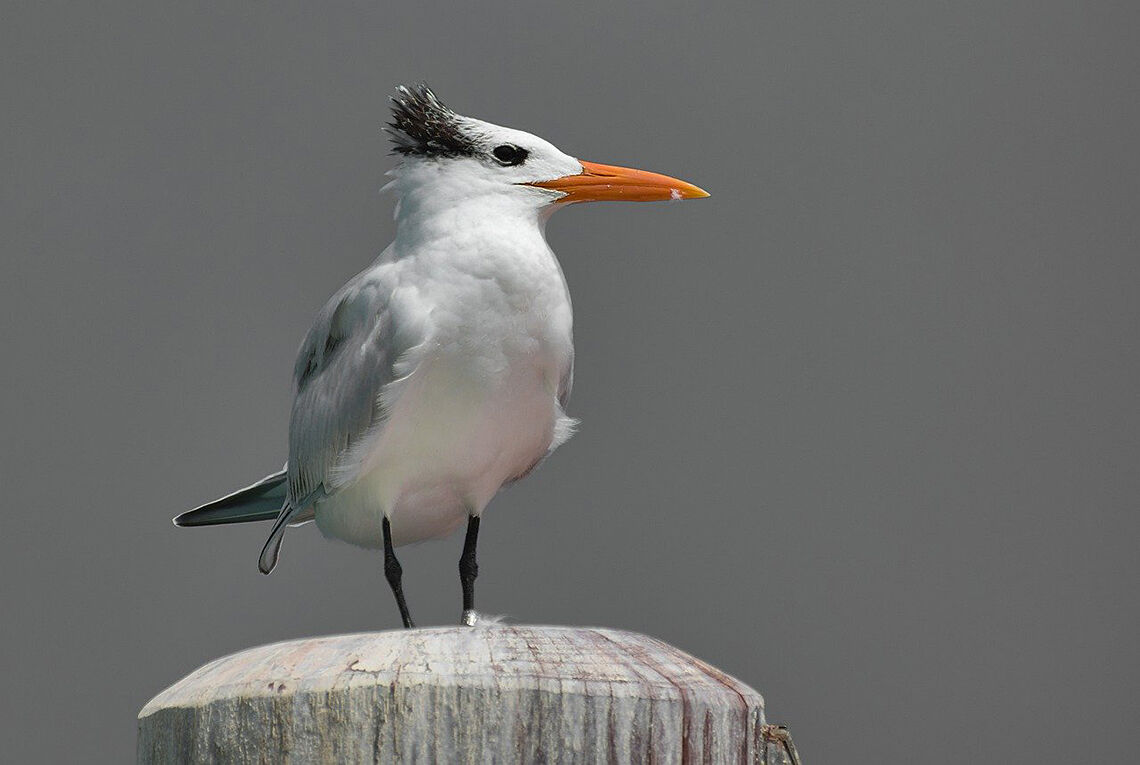
Ronald Plett/Pixabay • Royal terns, like the individual pictured, usually stay close to coastlines. In 1989, Hurricane Hugo blew a royal tern all the way to Watauga Lake, establishing the first record for the species in the state.

Two months after the exciting observation of that sooty tern, Howard passed away at age 81. So, even to this day, memories of that bird are tinged with some bittersweetness from the fact it was one of my last birding adventures with a man who served as a bit of a birding mentor for me.

On our drive back home after that exciting encounter with the storm-driven tern, Howard talked excitedly about sooty terns and some of the other rare birds he had seen in a birding career that spanned more than 50 years.

In addition, we learned a valuable lesson that day. It’s an accepted fact that no bird is worth risking life or limb. It’s also a good idea to be careful where you park when going out to a rain-drenched lakeshore to look for birds from a diminished hurricane. Howard and I lingered after the other birders departed. When we started to leave, he discovered his car’s back tires had gotten stuck in the clay mud. With Howard behind the wheel, I pushed his car as the tires spun madly for traction. I ruined a new pair of denim jeans, but I got the car out of the mud. It’s one more memory that will put a smile on my face to this day.

The sooty tern, blown to a Bristol lake in 2004 by Hurricane Frances, remains a highlight of my birding; however, it’s hardly the only unusual bird to be dumped on area lakes thanks to hurricanes that formed in tropic waters.

Hurricane Hugo back in 1989 remains one of the most legendary storms in the minds of most long-time birders in the area. I hadn’t yet taken up birding at that time, but birders like Howard made sure I knew all about the bird bounty stirred up by Hugo. Two species of jaegers — parasitic and pomarine — were among the birds blown inland to Watauga Lake in Carter County. Seeing these birds usually requires a seat on a boat capable of traveling far out to sea to look for birds that hardly ever venture near the shoreline except for nesting.

Hurricane Hugo also blew more than 50 Forster’s terns — a record number for the region — to Watauga Lake. In addition, a single royal tern — a first record for Tennessee — was also detected by birders looking for birds displaced by Hurricane Hugo.

Much farther back, a high count of Caspian terns was recorded Sept. 5, 1964, at Boone Lake in the wake of Hurricane Cleo. The late Wallace Coffey, a well-known birder in Bristol, was present to witness those 130 Caspian terns. Both Caspian and royal terns are birds usually found along the Atlantic Coast in places like Florida, Georgia and the Carolinas.

As I write this week’s post, I did some digging online to see if Hurricane Helene caused any problems for migrating birds.

It’s possible that the storm did drive some unusual species inland. Common gallinules have been spotted in Oak Ridge, as well as Roane County and Anderson County in the days after the storm. American avocets have also shown up in locations across the Volunteer State in the same time period.

Cornell Laboratory of Ornithology did report some displaced birds in the wake of Hurricane Helene, but the reports came mostly from coastal areas that saw some off-shore species like sooty shearwater, Audubon’s shearwater, magnificent frigatebird, brown noddy, bridled tern, sooty tern, Bermuda petrel and American flamingo driven closer to coastlines.

I haven’t heard of any regional migrant fallouts, but then Helene was a rather horrific storm. Even dedicated birders know when to hunker down and look for birds another day.

•••

Email me at ahoodedwarbler@aol.com to share a sighting, make a comment or ask a question.