Category Archives: Winter birds

Impossible to overlook the beauty of cardinals at Christmas

Photo by Nature Lady/Pixabay • A male Northern cardinal is always a welcome splash of brightness on wintry days.

Christmas Eve is upon us. I hope the hustle and bustle has died down and everyone can take delight in an enjoyable holiday. My own sincere wish to readers is that everyone gets to celebrate a great holiday that just might also include an interlude for watching some birds.

Often, when we think of winter birds, our thoughts focus on some of the less-than-colorful feeder visitors — the brown sparrows and wrens, the black and white chickadees, the drab American goldfinches that look so unlike their summer appearance.

There’s one bird, however, that makes an impression in any season. The Northern cardinal, especially the brilliant red male, stands out against a winter backdrop of snow white, deep green or drab gray.

Over the years, the Northern cardinal has also become associated with the Christmas season. How many Christmas cards have you received this holiday season with a cardinal featured in the artwork? I’d wager that at least a few cards in any assortment of holiday greetings will feature the likeness of a bright red cardinal.

Cardinals, also known by such common names as redbird and Virginia nightingale, are easily recognized backyard birds. I never tire of observing these colorful birds. Cardinals are easily lured to any backyard with plentiful cover to provide a sense of security and a generous buffet of sunflower seed.

Cardinals accept a wide variety of food at feeders. Sunflower seed is probably their favorite, but they will also sample cracked corn, peanuts, millet, bakery scraps and even suet. The cardinal is also one of only a few birds that I have noticed will consistently feed on safflower seed.

While we may get the idea that cardinals feed largely on seed, that is a misconception based on our observation of the birds at our feeders. When away from our feeders, cardinals feed on insects and fruit, including the berries of mulberry, holly, pokeberry, elderberry, Russian olive, dogwood and sumac.

Kevin Tipton/Pixabay • Female cardinals, more subdued than males, are still a sure means of providing some joy when glimpsed in wintry settings.

There’s no difficulty in identifying a cardinal. The male boasts crimson plumage, a crest, a black face and an orange bill. The female, although less colorful, is also crested. Female cardinals are soft brown in color, with varying degrees of a reddish tinge in their feathers, particularly in their wings. Immature cardinals resemble females except young cardinals have dark bills.

Cardinals are a widespread species, ranging westward to the Dakotas and south to the Gulf Coast and Texas. The southeastern United States was once the stronghold of the cardinal population. In the past century, however, cardinals have expanded their range into New England and Canada. These birds have even been introduced to Hawaii.

At feeders, cardinals mingle with a variety of other birds. Their preference for dense, tangled habitat is one they share with such birds as brown thrashers, Eastern towhees, Carolina wrens and song sparrows. In general, however, cardinals directly associate only with their own kind. Cardinals will form loose flocks during the winter, but these flocks are never as cohesive as those of such flocking birds as American goldfinches. Cardinals are more often observed in pairs. For such a bright bird, the male cardinal can be surprisingly difficult to detect as he hides in thick brush that conceals his presence. Cardinals are nervous birds, however, and usually betray their presence with easily recognized chip notes.
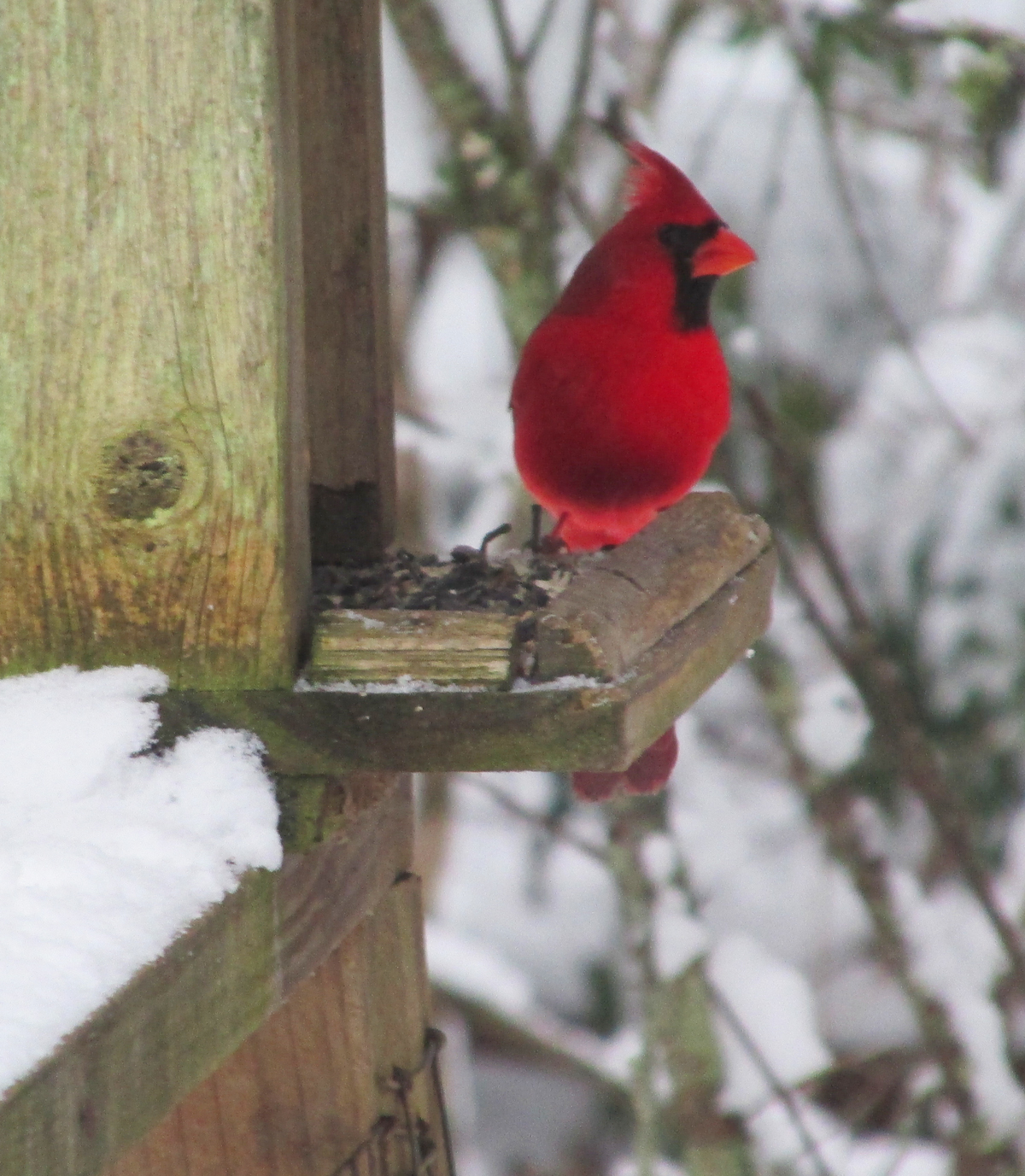
Photo by Bryan Stevens • A male Northern cardinal visits a feeder on a snowy afternoon.

It’s not surprising that such a popular bird has also become associated with many trappings of the Christmas season.

“You see cardinals on greeting cards, stationery, paper plates, paper napkins and tablecloths, doormats, light switch plates, candles, candle holders, coffee mugs, plates, glasses, Christmas tree ornaments and lights, bookmarks, mailboxes, Christmas jewelry,” writes June Osborne in her book “The Cardinal.”

Osborne asserts that cardinals have become an integral part of the way that many people celebrate the holiday season. I can be included among such people. My Christmas decorations include an assortment of cardinal figurines and ornaments. There are other birds — doves and penguins for example — associated with the holiday season, but for me the holidays magnify the importance of one of my favorite birds. The cardinal, in its festive red plumage, appears made to order for a symbol of the holiday season.

There’s additional evidence to put forward as testimony to the popularity of the Northern cardinal. It’s the official state bird of seven states: Virginia, North Carolina, West Virginia, Ohio, Illinois, Indiana and Kentucky. Only the Northern mockingbird, which represents five states as official state bird, even comes close to the Northern cardinal in this respect.

Even once the holidays are past, there’s nothing like a glimpse of a Northern cardinal to add some cheer to a bleak winter day.
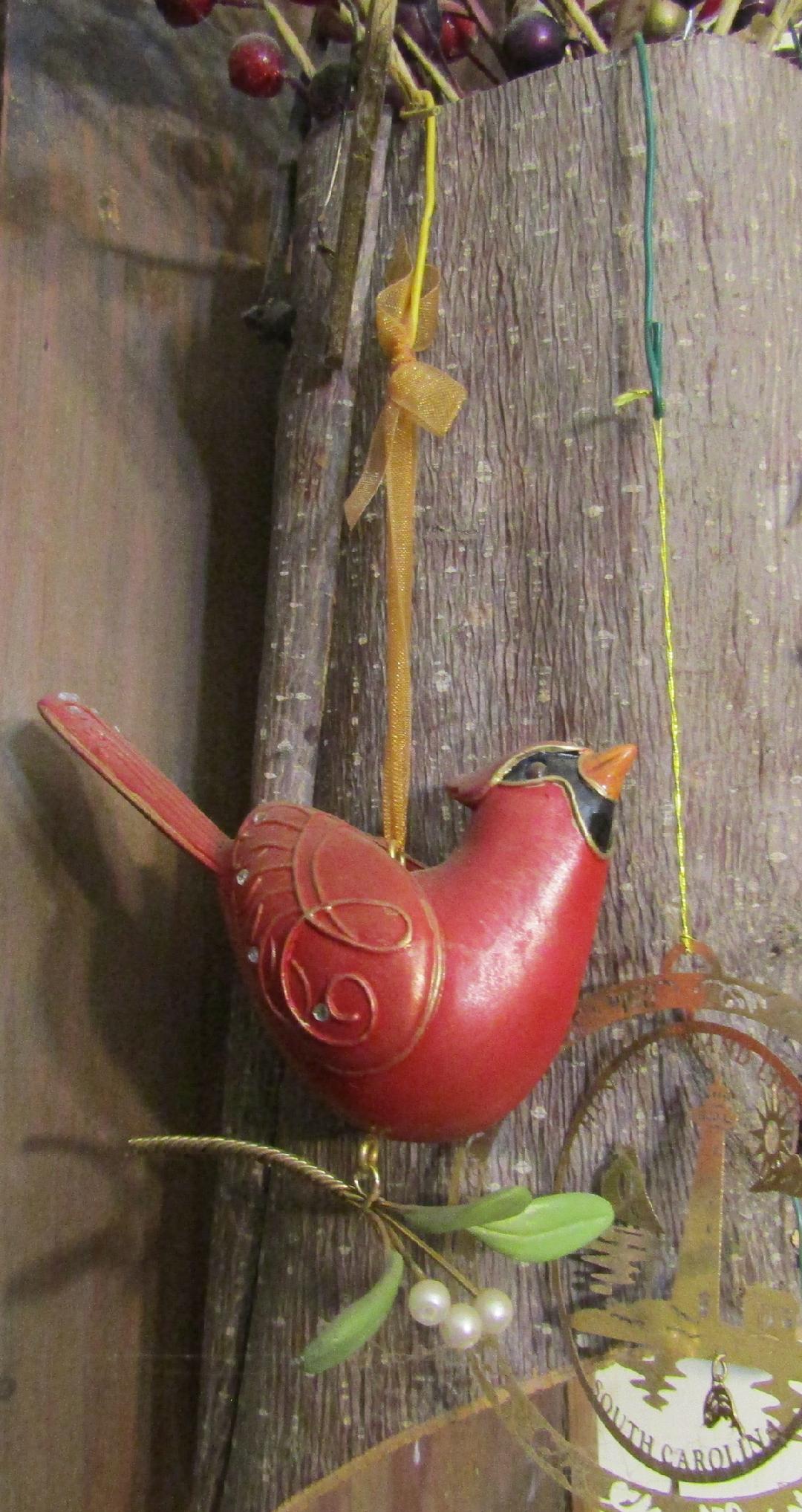
Photo by Bryan Stevens • Northern cardinals are a favorite for makers of Christmas ornaments.

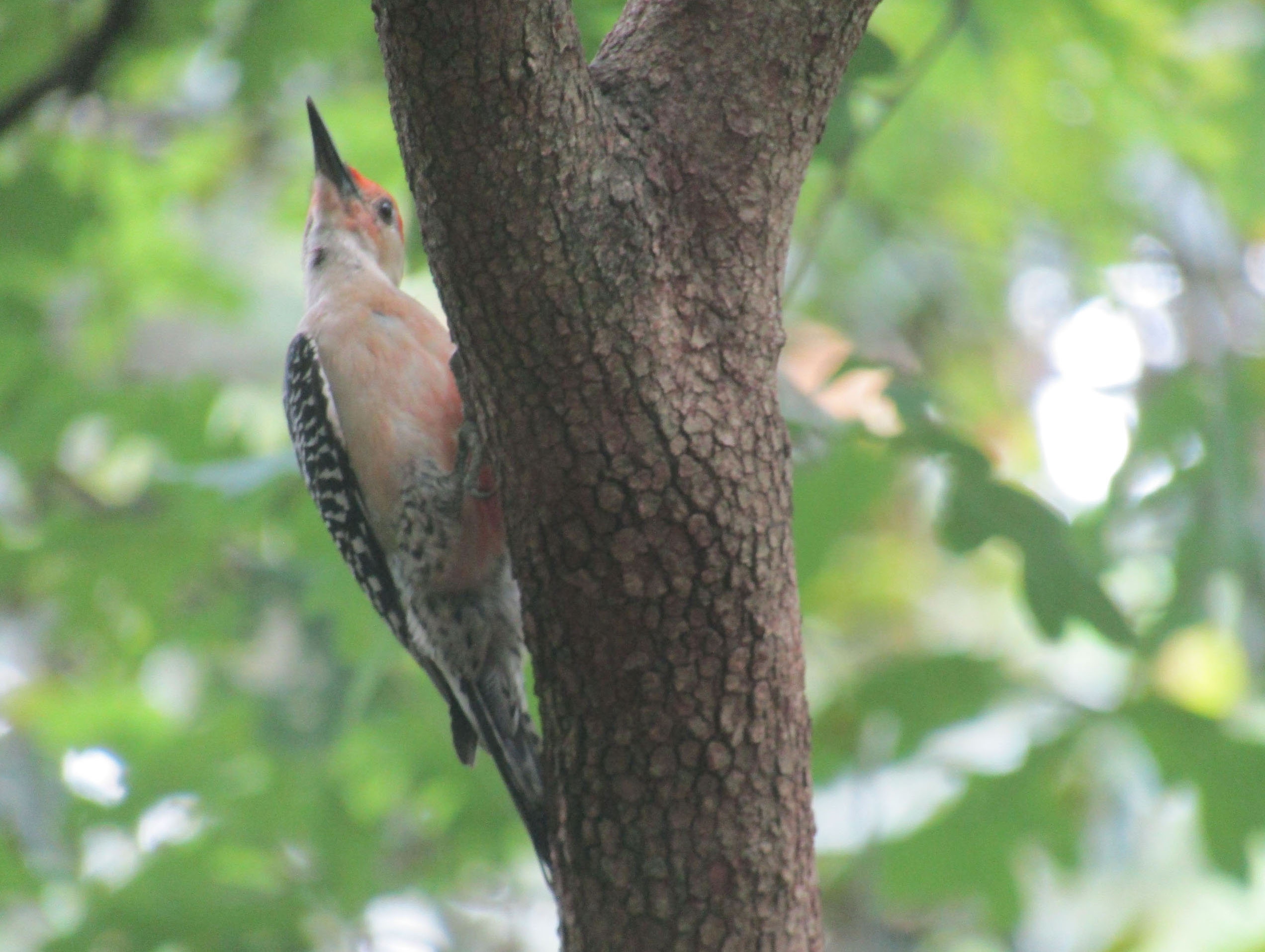
Red-bellied woodpeckers, other birds raise their profile during recent snowstorm

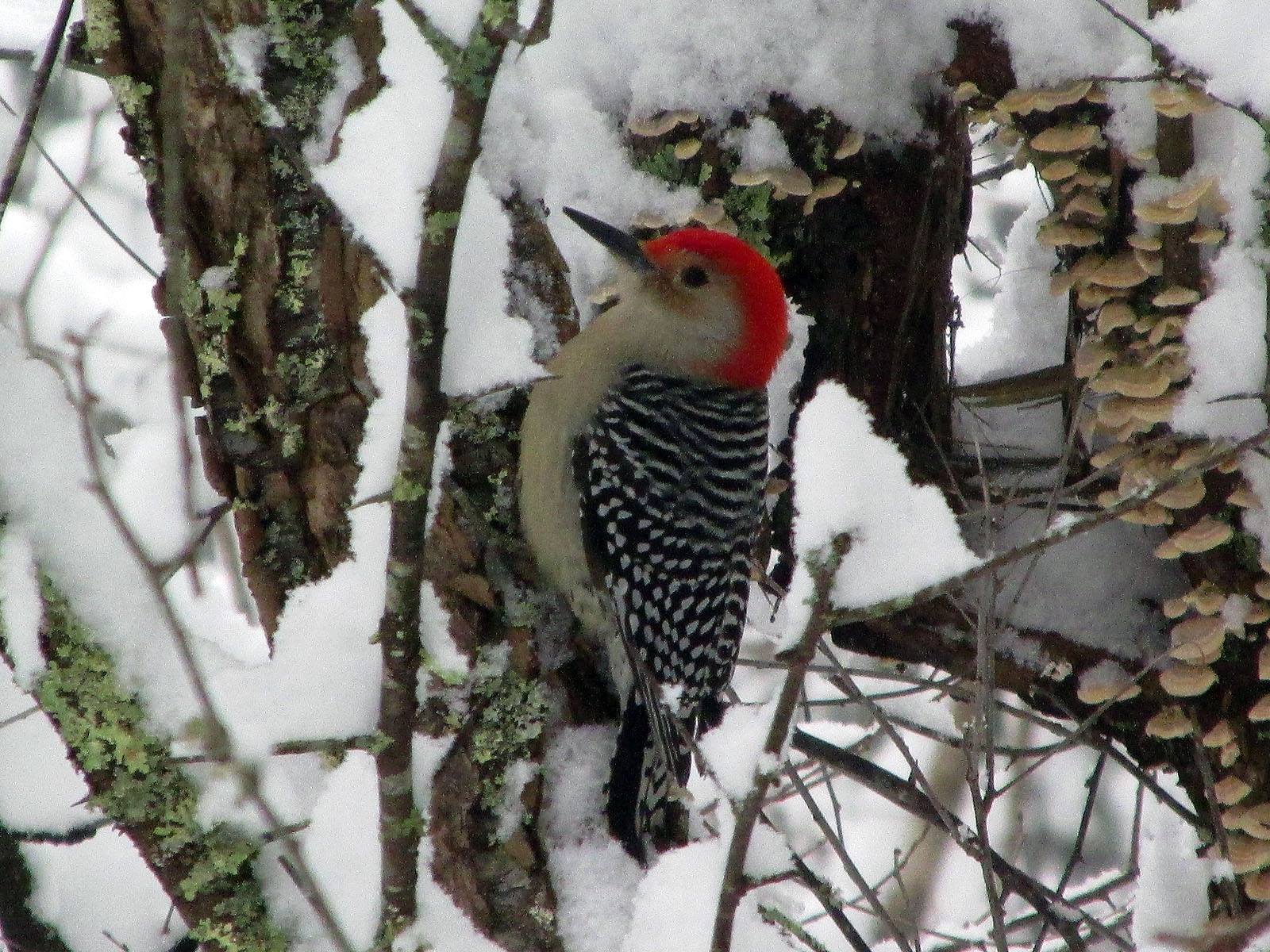
Photo by Bryan Stevens • A red-bellied woodpecker makes a tentative approach to a feeder stocked with sunflower seeds. Red-bellied woodpeckers are fairly common in the region.

I’m sure many share my sentiment that with February almost in the rear-view mirror it could be hoped that winter might be nearly at an end.

That misguided hope was dashed last week when another winter storm struck the region, accompanied by another blast of Arctic chill. At least the birds didn’t seem to mind terribly.

Dark-eyed juncos, Eastern towhees, song sparrows and American goldfinches flocked to my feeders. Another bird’s persistent “churr” call made the presence of a red-bellied woodpecker known even before I managed to sight one visiting one of my feeders.

Among the woodpecker family, the red-bellied and red-headed woodpeckers are close cousins, belonging to a genus of those tree-clinging birds known as Melanerpes. The term, translated from Latin, means “black creeper.” Indeed, many of the two dozen members of the Melanerpes genus have an extensive amount of black feathers in their plumage.

Other members of the genus include woodpeckers from the Caribbean, as well as from Central and South America. Some of them have quite colorful names, such as yellow-tufted woodpecker, golden-cheeked woodpecker and the accurately named beautiful woodpecker, a native of Colombia.

Photo by Bryan Stevens • Red-bellied woodpeckers are common throughout the southeastern United States.

The red-bellied woodpecker is one of the most widespread members of this genus with a range that extends from southern Canada to northeastern Mexico, as well as the eastern United States as far south as Florida and as far west as Texas. A century ago the red-bellied woodpecker was almost exclusively a southeastern bird, but it has expanded its range northward and westward considerably in the last 100 years. Its southern origins are hinted at in its scientific name of Melanerpes carolinus, which can be roughly translated as “black creeper of the Carolinas.”

It’s also named for a characteristic of its appearance that is not particularly prominent and difficult to observe. The faint tint of red that tinges the white belly feathers is extremely difficult to observe when this woodpecker is hitching up the trunk of a large tree. Because males, and females to a certain extent, have a red cap, the species has been erroneously referred to as a “red-headed woodpecker” by many casual observers. The true red-headed woodpecker, however, has an entirely red head and a plumage pattern that, considering its color trio of red, white and blue-black, is downright patriotic. The red-headed woodpecker (Melanerpes erythrocephalus) is about the same size as the red-bellied woodpecker.

All woodpeckers are noisy when the mood strikes them, but the red-headed and red-bellied have always struck me as rather more clamorous than some of their relatives. The most common call of the red-bellied woodpecker is a sort of rolling “churr” repeated frequently while the bird is on the move from tree to tree.

To enjoy close views of the red-bellied woodpecker, provide plenty of peanuts, sunflower seeds and suet cakes. During the recent snowstorm I would no doubt have enjoyed even more views of the visiting red-bellied woodpecker if I hadn’t been out of suet cakes. The offerings of sunflower seeds and peanuts, I’m happy to report, were gratefully accepted.

Photo by Bryan Stevens • A red-bellied woodpecker climbs snow-covered branches.

If there are any of these woodpeckers in the woods nearby, they will find these food offerings in short order. All my research indicates the same is true of red-headed woodpeckers, but I’ve never observed this woodpecker at my home. I’ve seen red-headed woodpeckers in Tennessee, Virginia and South Carolina, but their populations are somewhat localized. Woodlands dominated by oak trees are often inhabited by both these woodpeckers, which are fond of the acorns produced by these trees.

One reason the red-headed woodpecker may be less common than its cousin relates to its fondness for hawking for flying insects along roadsides. The woodpeckers are frequently struck by cars when swooping after their winged prey. Historically, the American chestnut and beech trees also provided much of the mast crops consumed by these birds. With the extermination of the chestnut and the scarcity of beech in some locations, the red-headed woodpecker now depends on oaks and acorns. In fact, this woodpecker is rarely encountered outside of woodlands with an abundance of oak trees.

At feeders, red-bellied woodpeckers are prickly customers that often refuse to play nice with other birds. I’ve seen them stare down other large feeder birds, including blue jays, mourning doves and evening grosbeaks. With its large bill, the red-bellied woodpecker commands some respect.

Anyone who has hosted these birds knows they are a welcome visitor to any yard. Who knows? Some day I may even get a visit from the elusive red-headed woodpecker, which is the only woodpecker that resides in the region to thus far avoid my yard.

•••

To ask a question, make a comment or share a bird sighting, email me at ahoodedwarbler@aol.com.

Club posts 82nd annual Elizabethton Christmas Bird Count results

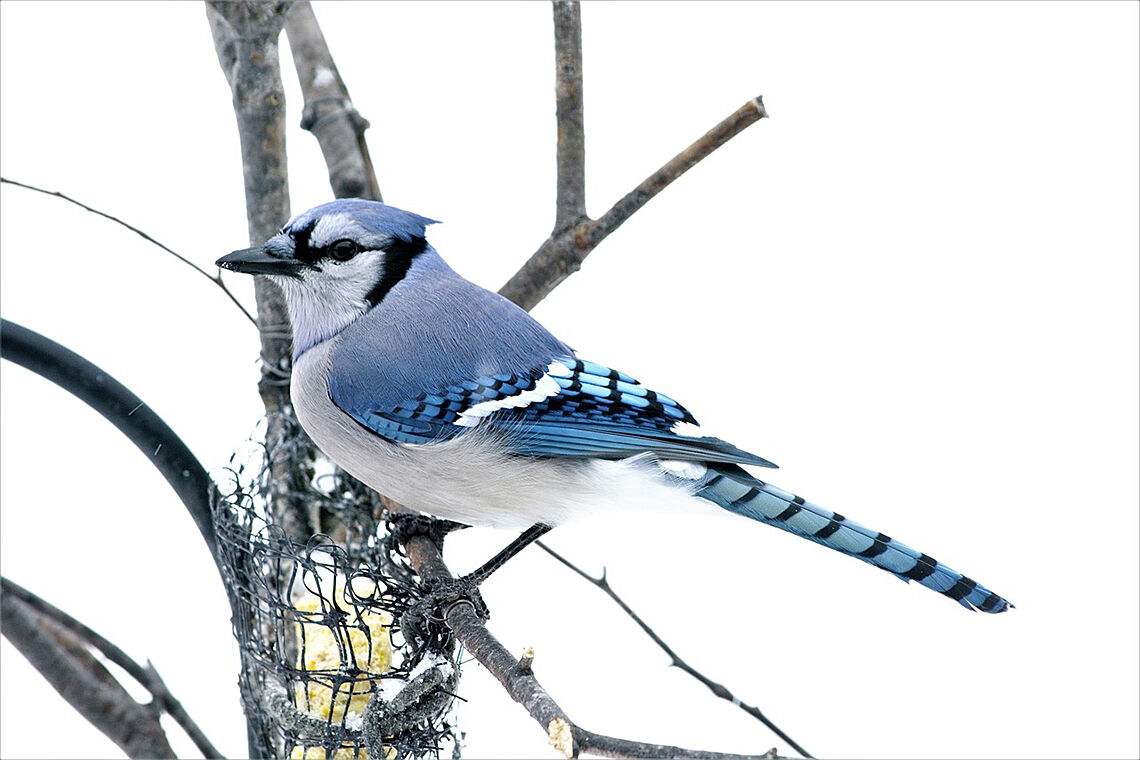
Photo by Scott/Pixabay • A blue jay perches at a suet feeder.

The 82nd Elizabethton Christmas Bird Count was held Saturday, Dec. 14, with 24 observers in six parties.

Unfortunately, I had to miss the count for the first time in almost a decade due to having contracted my first cold since 2019. I keep track of these things, especially when they interrupt the holiday season.

According to compiler Rick Knight, this year’s CBC tallied 71 species, with an additional three species seen during “count week,” which is defined as three days before or after count day. The three species found during count week were American wigeon, killdeer and pine warbler.
The total was just below the recent 40-year average of 72 species. The all-time high was 85 species recorded in 2017.

Here’s the list:
Canada goose, 302; wood duck, 2; American wigeon, 1; mallard, 65; green-winged teal, 2; ring-necked duck, 5; bufflehead, 143; hooded merganser, 3; red-breasted merganser, 1; and common merganser, 4.
Wild turkey, 26; pied-billed grebe, 10; rock pigeon 106; Eurasian collared-dove, 2; mourning dove, 108; killdeer, 1; Wilson’s snipe, 1; ring-billed gull, 9; double-crested cormorant, 1; great blue heron, 9; black vulture, 18; and turkey vulture, 21.Cooper’s hawk, 5; bald eagle, 6; red-shouldered hawk, 2; red-tailed hawk, 15; Easter screech-owl, 6; great horned owl, 1; and barred owl, 2.
Belted kingfisher, 12; red-bellied woodpecker, 30; yellow-bellied sapsucker, 8; downy woodpecker, 26; hairy woodpecker, 2; Northern flicker, 32; and pileated woodpecker, 19.
American kestrel, 16; Eastern phoebe, 13; blue jay, 107; American crow, 339; fish crow, 1; and common raven, 10.
Carolina chickadee, 102; tufted titmouse, 77; ruby-crowned kinglet, 11; golden-crowned kinglet, 17; cedar waxwing, 103; red-breasted nuthatch, 8; white-breasted nuthatch, 27; and brown creeper, 10.

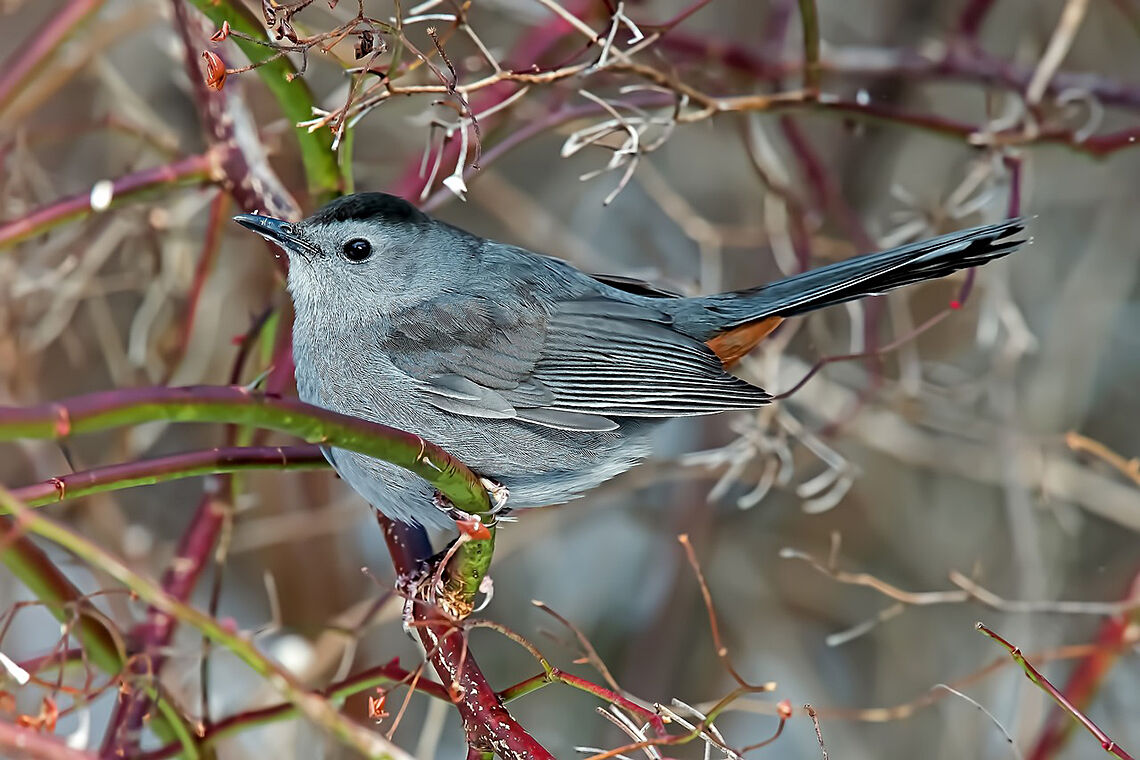
Hans Toom/Pixabay • A gray catbird found on this year’s Elizabethton Christmas Bird Count represents a somewhat unusual winter sighting for the species.

Carolina wren, 104; winter wren, 9; gray catbird, 1; Northern mockingbird, 55; European starling, 369; Eastern bluebird, 108; hermit thrush, 11; and American robin, 181.
House sparrow, 34; house finch, 73; purple finch, 2; American goldfinch, 34; chipping sparrow, 18; field sparrow, 9; dark-eyed junco, 151; white-throated sparrow, 56; song sparrow, 125; swamp sparrow, 7; Eastern towhee, 10.
Eastern meadowlark, 11; orange-crowned warbler, 1; pine warbler, yellow-rumped warbler, 98; and Northern cardinal, 118.

Knight noted that highlights from the count included fish crow, gray catbird and orange-crowned warbler.

Other notable species include red-breasted and common mergansers and Eurasian collared-dove.

There are always some notable misses. This year the count failed to find horned grebe, sharp-shinned hawk, fox sparrow and white-crowned sparrow.

The first Christmas Bird Counts were conducted on Christmas Day (Dec. 25) in 1900. The annual census arose from a proposal made by famed ornithologist Frank M. Chapman. According to Audubon.org, these yearly counts, conducted throughout the country, have provided a wealth of data over the past century.

Observations made due to CBCs have helped Audubon researchers, conservation biologists, wildlife agencies and other interested individuals to study the long-term health and status of bird populations across North America. When combined with other surveys such as the Breeding Bird Survey, the data provides a picture of how the continent’s bird populations have changed in time and space over the past hundred years.

The concept of the Christmas Bird Count, according to the website for the National Audubon Society, arose from a less than bird-friendly custom prevalent at the turn of the 20th century. So-called sportsmen would conduct a “Side Hunt,” a rather blood-thirsty Christmas custom that saw hunters competing to see who could score the largest amount of feathered and furred corpses.

The annual holiday bird survey may even have arisen from an earlier custom with roots in Europe that came to the United States of America with early colonists. The “Side Hunt” has some similarity to a peculiar celebration in Ireland and other European countries known as “Wren Day” or “Hunt the Wren Day.” The event was conducted the day after Christmas, the date of Dec. 26 being consigned as Saint Stephen’s Day. By the 20th century, the hunt consisted of tracking down a fake wren carried atop a decorated pole. Crowds would parade through towns in masks and colorful attire. These groups were referred to as “wren boys.”

Whether or not the “Side Hunt and “Wren Hunt” shared any connections, it was a huge step forward for conservation when Chapman, the preeminent ornithologist of his day, proposed a new holiday tradition. His radical idea was to count birds during the Christmas season rather than hunting and killing them.

I think other bird lovers will join me in celebrating Chapman’s wonderful idea, which has continued strong for the past 125 years.

•••

I’ve written about birds and birding since 1995. To share a sighting, ask a question or make a comment, email me at ahoodedwarbler@aol.com.

Three species of owls — great horned (pictured), Eastern screech and barred — were tallied on this year’s CBC.


Birds have developed ways of dealing with cold

David Ellis/USFWS • A common redpoll feasts on stiff goldenrod seed. These small finches can endure temperatures 100 degrees below freezing.

With the arrival of January, we can probably be assured of some cold weather. I’m not fond of the cold, but I can put on gloves and a thicker coat and I am good to go.

What about our feathered friends? How do birds cope when temperature plummet below freezing?

Birds actually employ a range of strategies and behaviors that keep them cozy even during the worst that winter can hurl at them.

Some birds avoid the necessity of coping with cold by migrating. All those tropical species that brighten the warmer seasons in the mountains of Southern Appalachia withdraw to warmer areas in Central and South America during the winter.

Those birds that elect not to put distance between themselves and cold temperatures must do something to stay warm. Feathers are one of a bird’s defining traits, and they can do a neat trick with their feathers to stay warm. You’ve probably seen them do this. They will fluff their feathers, trapping air between them to provide insulation. If you’ve ever noticed that some birds look “fatter” in extreme cold it’s likely because they have fluffed up to combat the cold.

Of course, feathers require good maintenance to help with the task of staying warm, and birds are diligent about such tasks. Preening feathers on a routine basis keeps them watertight and able to hold in heat. Some birds even grow extra feathers in autumn to prepare for cold temperatures. That’s similar to dogs or cats growing a denser coat of fur in anticipation of wintry temperatures.

Birds have different comfort levels when its comes to personal space, but many of the more sociable species will huddle together. You’ve probably seen nature documentaries of penguins in the Antarctic as they huddle together for weeks on end to endure the harsh conditions of the globe’s southernmost continent.

Larger species of birds, such as geese and grouse, eat more and gain weight, which is often achieved by the storage of body fat.

Other birds have also adopted the huddling strategy in a cozy cavity or nest box. My most vivid recollection of an observation of this strategy involved Eastern bluebirds. During a severe cold snap accompanied by snow and blustery winds, I watched multiple bluebirds enter one of my nesting boxes. I’m not sure how many entered the box, but it was likely about eight to 10 birds.

Necessity makes birds adaptable. The next day the aforementioned high winds took down the post that held the nest box. At dusk the bluebirds showed up again. They looked baffled to find the box had disappeared. Then I saw them fluttering into an old tire that I had used at the base of the pole to help anchor the box. Faced with oncoming darkness, they chose to huddle together inside the old tire.

Natural cavities in trees also provide cozy roosting spaces for birds. Chickadees and titmice, nuthatches and woodpeckers seek out such cavities ahead of time so they will always be ensured of a warm space during bouts of inclement weather.

The biological mechanism of torpor is one that’s probably familiar to fans of hummingbirds, but other small birds can also take steps to lower their body temperature. Chickadees and kinglets put this ability to good use. In these small birds, the adaptation being employed is known as controlled hypothermia. Chickadees can drop their body temperature by as much as 22 degrees below normal daytime body temperature.

Snakes and reptiles can enter a physical state called brumation, where they sleep more but still wake to eat, drink and enjoy the sun on warmer days, according to information on the Facebook page of the U.S. Fish and Wildlife Service. Since snakes are cold-blooded, they’re lethargic at these colder temperatures even when they’re on the move.

Hibernation, although a strategy widely used by mammals, is rare in birds. The common poorwill (a relative of whip-poor-will and chuck-will’s-widow – is the only bird known to go into torpor for extended periods that can range from weeks to months. On the southern edge of their range in the United States, poorwills spend much of the winter hibernating, usually concealed in rock piles.

There’s warmth in numbers. Crows, starlings, robins and other species will gather in communal roosts to use body warmth to stay warm overnight. Sometimes these roosts are quite large and can lead to conflict with nearby humans who may not want the noise and mess that comes with hosting a large flock of birds.

While warm socks and gloves protect human toes and fingers, birds don’t have to worry about frostbite. Quick circulation means that blood does not linger in their feet long enough to freeze. In addition, the legs and feet of birds are covered in scales. Like feathers, the scales provide excellent insulation.

Some birds will gather together in large stands of evergreens. I’ve observed house sparrows gathering in the holly trees outside the courthouse in downtown Erwin at dusk on cold evenings.

There are things we can do to help. Plant evergreen trees or construct a brush pile that will provide shelter from the elements, as well as a measure of safety from predators, for the birds that share our lawns and gardens.

Many people already feed birds. Try supplementing seeds with some food rich in fat. Birds, unlike us, will not be adversely affected by a high-fat diet. Their metabolism allows them to burn off the extra calories in an enviable amount of time. Some high-fat foods that birds will love include peanut butter and beef suet, as well as peanuts and other assorted nuts. While it’s relatively simple to render suet into a usable for for birds, most people cannot be blamed for turning to commercially made suet cakes. Many of these are also made even more appealing with a mix of peanuts or fruit into the suet cake. The extra calories derived from these foods will let birds better regulate their body temperature and tolerate the more frigid nights.

It’s also important to provide liquid water for birds. Outdoor heaters designed to fit into a birth bath can help prevent the water from freezing during cold snaps.

Birds will also appreciate a sunny spot. By basking in sunshine, they can also boost their internal temperature.

Some birds are just built for cold. For example, snowy owls have been observed in temperatures 80 degrees below zero. Species of redpolls, a type of finch, can endure temperatures 100 degrees below freezing.

Emperor penguins live and nest in some of the most inhospitable terrain on the planet. Those who have viewed the documentary film “March of the Penguins” will be familiar with the species. Their colonies on the ice in the Antarctic must endure temperatures than can plunge to -40 degrees Farenheit. They must also survive frigid winds that can reach 90 miles per hour.

Emperor penguins have several adaptation to help them survive such cold conditions, according to the World Wildlife Fund. These penguins have two layers of feathers, a reserve of fat and beaks and flippers that are proportionally smaller than those for other penguin species.

Lee Karney/USFWS • The common raven can live in a range of habitats, but these large and intelligent birds are especially adapted to cold.

The common raven is another bird that shrugs off cold and snow. They can survive and thrive in habitats as varied as Arctic tundra and scorching deserts. If temperatures drop below -4 degrees Farenheit, ravens can generate extra body heat.

All things considered, birds are simply better at coping with cold than we are.

•••

Bryan Stevens has written about birds since 1995. To ask a question, make a comment or share a bird sighting, email him at ahoodedwarbler@aol.com.

Cardinal a natural symbol for Christmas

Photo by Bryan Stevens • A male Northern cardinal visits a feeder on a snowy afternoon.

Merry Christmas. This week’s newspaper is coming out on Christmas Day and, as is my usual custom on this holiday, I want to share my enthusiasm for the Northern cardinal, one of my favorite birds.

I’ve also come to believe that the cardinal is also an excellent feathered symbol for the Christmas holiday. Anyone who provides sunflower seeds at a bird feeder has most likely received visits from this bird.

Individual cardinals around my home have become very accustomed to my presence. Some of them have even learned my routine and know when to anticipate my daily stocking of the feeders with sunflower seeds.

I have always enjoyed watching cardinals. The beauty of both male and female cardinals is undeniable. They’re usually nervous, twitchy birds, so it has been fun watching some of the resident cardinals grow accepting of my presence.

The Northern cardinal, especially the brilliant red male, stands out against a winter backdrop of snow white, deep green or drab gray. Over the years, the cardinal has also become associated with the Christmas season.

How many Christmas cards have you received this holiday season with a cardinal featured in the artwork? I’d wager that at least a few cards in any assortment of holiday greetings will feature the likeness of a Northern cardinal.

There is a possible reason that male cardinals try to outshine each other when it comes to their bright red plumage. According to the website Tennessee Watchable Wildlife, brighter red male cardinals are able to hold territories that have denser vegetation, feed young at higher rates and have greater reproductive success than males with feathers of a duller hue.

The Northern cardinal belongs to a genus of birds known as Cardinalis in the family Cardinalidae. There are only two other species in this genus, and they range across North America and into northern South America. The two relatives are the pyrrhuloxia, or Cardinalis sinuatus, of the southwestern United States, and the Vermilion cardinal, or phoeniceus, a bird found in Colombia and Venezuela.

The Northern cardinal is a native and abundant bird. Cardinals are a widespread species, ranging westward to the Dakotas and south to the Gulf Coast and Texas. The southeastern United States was once the stronghold of the cardinal population. In the 20th century, however, cardinals have expanded their range into New England and Canada.

The cardinal accepts a wide variety of food at feeders. Sunflower seed is probably their favorite, but they will also sample safflower seed, cracked corn, peanuts, millet, bakery scraps and even suet. While we may get the idea that cardinals feed largely on seed, that is a misconception based on our observation of the birds at our feeders. Cardinals away from our feeders eat insects and fruit, including the berries of mulberry, holly, pokeberry, elderberry, Russian olive, dogwood and sumac.

The cardinal uses its large beak to efficiently hull sunflower seeds or deal with other foods foraged in field and forest away from our feeders. The large, heavy beak hints at the cardinal’s kinship with birds such as tanagers and grosbeaks.

In fact, some of America’s early naturalists referred to the bird as “cardinal grosbeak.” Other common names include the apt “redbird” moniker and “Virginia nightingale.”

Even once the holidays are past, there’s nothing like a glimpse of a Northern cardinal to add some cheer to a bleak winter day. It’s not surprising that such a popular bird has also become associated with many trappings of the Christmas season.

“You see cardinals on greeting cards, stationery, paper plates, paper napkins and tablecloths, doormats, light switch plates, candles, candle holders, coffee mugs, plates, glasses, Christmas tree ornaments and lights, bookmarks, mailboxes, Christmas jewelry,” writes June Osborne in “The Cardinal,” a book about this popular bird.

“And the list goes on,” Osborne writes. “Cardinals have become an integral part of the way that many people celebrate the holiday season.”

I can be included among such people. My Christmas decorations include an assortment of cardinal figurines and ornaments. There are other birds — doves and penguins for example — associated with the holiday season, but for me the holidays magnify the importance of one of my favorite birds. The cardinal, in its festive red plumage, appears made to order for a symbol of the holiday season.

I’m hoping you enjoy your Christmas and that at least a few cardinals and other birds fly your way.

•••

Bryan Stevens has written about birds and birding since 1995. Email him at ahoodedwarbler@aol.com to share a sighting, ask a question or make a comment.

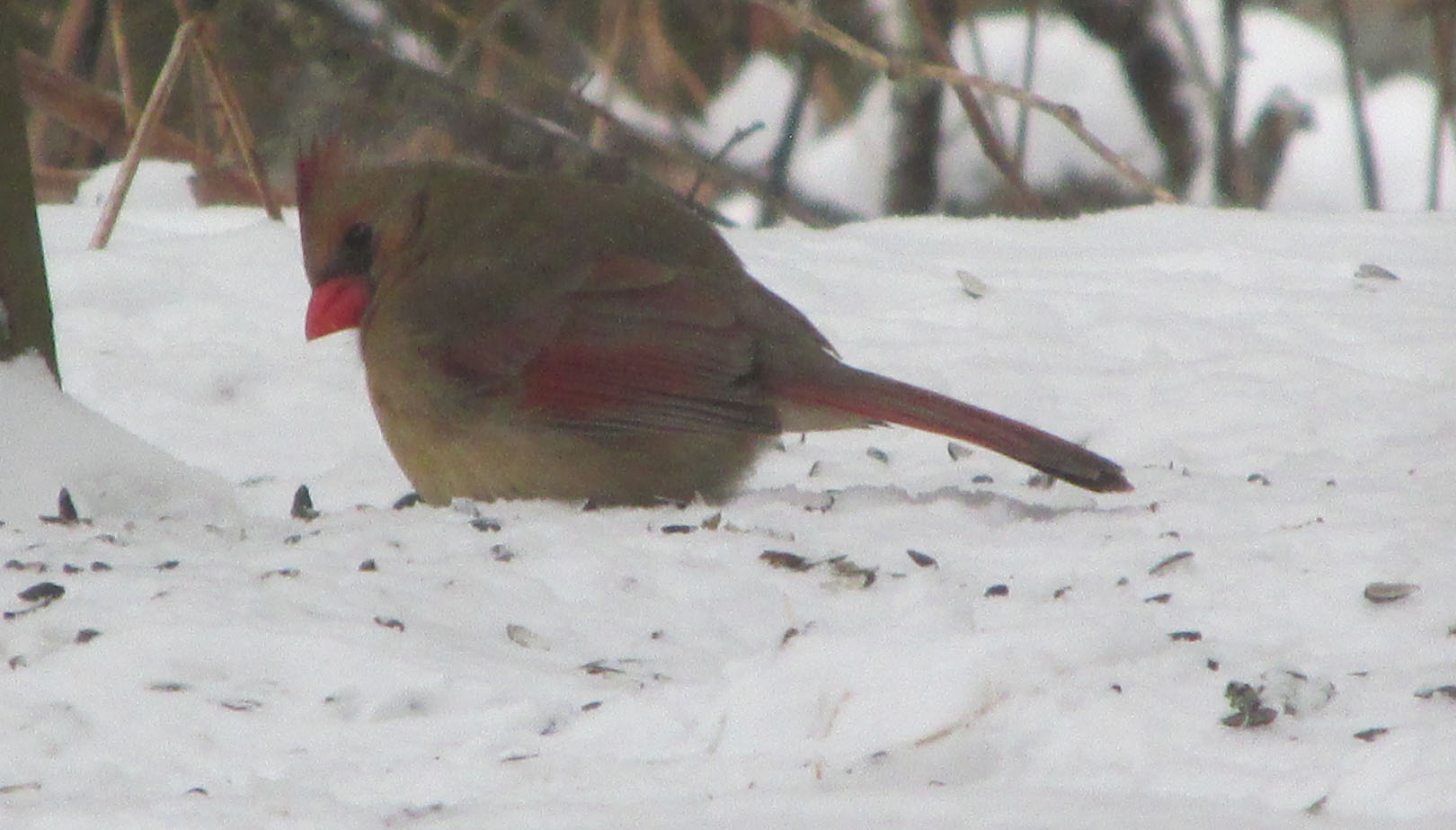
Photo by Bryan Stevens • A female Northern cardinal forages for seeds in the snow.


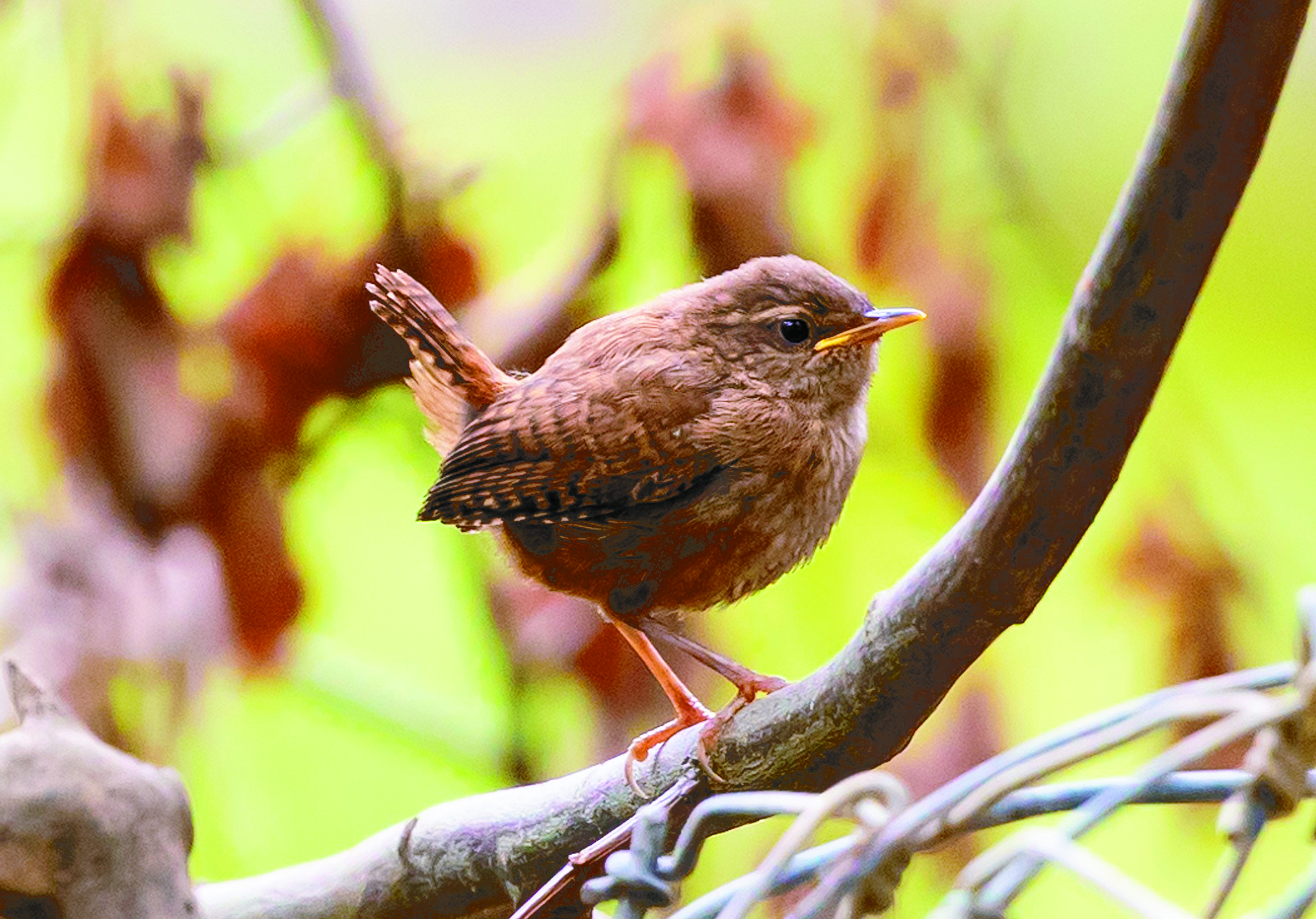
Winter wrens, true to their name, are only resident during the winter months in much of the region.

Photo by TheOtherKev/Pixabay • The winter wren is a tiny, secretive winter resident throughout Northeast Tennessee, southwest Virginia and western North Carolina.

On a recent morning, I noticed Grayson the cat acting agitated before I heard the reason for his state. A blur of brown feathers revealed itself among a tangle of vines and leaves draped across the exterior of the dining room window.

The blur of feathered frantic activity produced a steady stream of shrill notes as it methodically gleaned beneath seemingly every single leaf in the untidy cluster of frost-withered vines. Those notes, as well as the constant, darting movement, attracted Grayson’s notice and then mine. The little visitor, safely on the other side of the glass — much to Grayson’s disappointment — turned out to be the season’s first winter wren.

The winter wren is a noisy bird and quite different than the Carolina wren, a larger relative that is fairly common in the region. This wren usually arrives in my yard in late October or early November. Upon their arrival, they immediately claim niches to call their own. Any intrusion is met with a scolding chatter as the wren scurries low to the ground to drop out of view. In fact, the winter wren’s a very terrestrial bird. Observers are just as likely to see one of these wrens run across the ground as they are to see it take flight.

The website All About Birds, managed by The Cornell Lab of Ornithology, offers advice on making a wren-friendly yard. “Landscaping with native plants is a good way to provide habitat for Winter Wrens,” according to the website. Other steps to take could extend to creating brush piles and ensuring some sections of the yard offers dense vegetation. The website also notes that this wren is often found making its home near streams.

In the summer, the winter wren often nests atop some of the high-elevation mountains in the region, especially ones with abundant fir and spruce trees. Otherwise, it’s mostly a winter visitor in the region. Other wrens common to the region include the Carolina wren and the house wren. In suitable habitats, especially during fall and spring migration, two other wrens — marsh wren and sedge wren — are observed occasionally in the region. Other wrens native to the United States include the rock wren, canyon wren, cactus wren, Pacific wren and Bewick’s wren.

The world’s 88 species of wrens are, for the most part, the quintessential “little brown birds,” but that hasn’t kept them from acquiring some interesting and descriptive common names. Some examples include the moustached wren, sooty-headed wren, gray-barred wren, tooth-billed wren, bicolored wren, spotted wren, flutist wren, riverside wren, whiskered wren, happy wren, musician wren, timberline wren, speckle-breasted wren, sepia-brown wren, white-breasted wood wren and giant wren. The last species on the list resides in Mexico and is indeed a “giant” among a family of tiny birds, reaching a length of almost nine inches and weighing all of 1.8 ounces.

For the most part, wrens are birds of the New World, ranging through North, Central and South America. In fact, only the Eurasian wren represents the family in Europe, Asia and Africa. Experts recently split the winter wren into several different species, including the Pacific wren of the west coast of North America and the Eurasian wren of Europe, Asia and Africa. Birding friends in Great Britain, where the bird is resident throughout the year, tell me they simply refer to the species as “wren.”

Just as the winter wren thinks nothing of acting like a mouse when scurrying through leaf litter and over fallen logs in search of insect prey, this bird doesn’t hesitate to imitate mice by poking into shadowy holes in the ground or exploring the dark crevices of fallen logs. When winter temperatures drop sharply, many of these birds may cram themselves into a roosting hole to benefit from the communal heat from so many tiny feathered bodies in such close proximity. Winter wrens eat mostly insects and spiders, but in winter these birds will also eat some seeds and berries. Winter wrens rarely visit feeders, but a suet cake often attracts birds with similar dietary preferences, including kinglets and chickadees. A larger relative, the Carolina wren, is a common visitor to feeders.

In English and German lore, the winter wren was known as the “king of the birds.” Different tales provide varying explanations for how such a small bird earned such an inflated title. Ritual hunts were enacted in some European locations. These hunts, known as “wren hunts,” were conducted by “wren boys” who would parade through town on their quests. Wren Day fell on Dec. 26, which coincided with the holiday St. Stephen’s Day. Some myths blame the noisy bird for betraying the hiding place of Stephen, who was delivered up as a Christian martyr to his enemies due to the bird’s treachery. In some European cultures, various superstitions sprang up about wrens. For instance, in Scotland it is considered extremely unlucky to kill a wren.

Personally, I feel lucky to have the tiny winter wren spending time around my home and can guarantee no “wren hunts” will be staged here. At a time of year when feathered friends can be scarce, a winter wren is a welcome visitor.


Rufous hummingbirds appear after other hummers depart for the winter

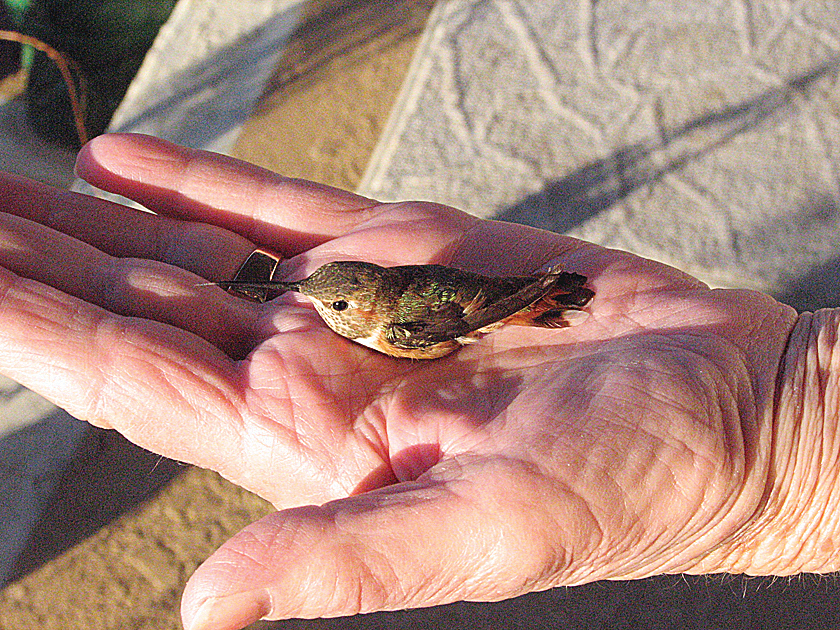
Photo by Bryan Stevens • A young rufous hummingbird approaches a feeder for a sip of sugar water. These hummingbirds, which are native to the western United States and Canada, have become regular visitors throughout the eastern United States in late fall and early winter.

Almost every year since beginning to write this column, I have penned articles about the phenomenon of wintering hummingbirds. With the official 2020-21 winter season approaching, I have already gotten word of hummingbirds making themselves at a couple of homes in the region, as well as from such far-flung locales as Ohio and New York.

Photo by U.S. Fish & Wildlife Service/Dave Menke • The rufous hummingbird is increasingly becoming a migrant/winter resident in the eastern United States.

Katherine Noblet, a former resident of Johnson City, Tennessee, is hosting a rufous hummingbird at her home in Mount Vernon, Ohio. The tiny bird was banded and identified on Nov. 16. The verdict? The tiny visitor is a first-year female rufous hummingbird.

Noblet, who also hosted rufous hummingbirds when she lived in Tennessee, has posted on Facebook about her most recent winter hummingbird. She noted that the hummingbird, which she has named Reba, first appeared on Nov. 14. Temperatures have dipped into the 20s during the bird’s stay.

“Why a few of these tiny creatures want to hang around this far north is a mystery, but she looks happy and healthy and cannot be existing on just sugar water,” Noblet noted in a Facebook post on Nov. 24. “I have to trust she knows what she is doing.”

Closer to home, some Roan Mountain residents have reported lingering hummingbirds.

Leslie and Kathie Storie, who reside on Heaton Creek in Roan Mountain, Tennessee, posted to Facebook on Oct. 29 about a visiting hummingbird.

Photo by Bryan Stevens • A rufous hummingbird grasps a briar as a perch for a moment’s rest from its frantic activities.

“We had a hummingbird on Heaton Creek about 6 o’clock today,” they noted in a post on my Facebook page.

Although they had already taken down their feeders, they reported still having pineapple sage and lantana in bloom in their yard. These flowers are favorites of hummingbirds and would no doubt help attract one of these tiny birds.


Judi Sawyer, also a resident of Roan Mountain, has hosted not one but two rufous hummingbirds this fall. She noticed the birds in early October. One of the two birds was banded and documented on Oct. 4. One of the birds evaded the bander’s traps, but the one that was banded was identified as an immature male rufous hummingbird.

I also received an email recently from Susan Jensen, a resident of Carmel, New York, about a lingering hummingbird at her feeders. She had found one of my online articles about wintering hummingbirds and contacted me for more information.

“We have had ruby-throated hummingbirds for many years and I have three feeders for them during the season,” Jensen said. “I always leave one up until I know for sure everyone has passed through to their winter location.”

In October, she reported a feeder visitor that looked like a strange ruby-throated hummingbird. She described the bird as bronze and rusty with a bit of green.

Photo by Bryan Stevens • Rufous hummingbirds have been extensively documented as wintering throughout the southeastern United States. This male rufous hummingbird was documented in Hampton, Tennessee, a couple of years ago.

“For about two weeks I thought it was a ruby-throated hummingbird until I realized it wasn’t,” Susan wrote in her email.

After a quick Google search, I emailed Susan and put her in touch with Robert Yunick of Schenectady, New York. On Friday, Nov. 20, he traveled to Susan’s home. He banded the bird, which he identified as juvenile female rufous hummingbird, confirming Susan’s thoughts on the bird’s identity. Susan shared a video of the banding process at this link:

https://share.icloud.com/photos/0wh7RBoUKoPsxXBvQi39coTCQ

“It has been here since Oct. 10,” she informed me in an email. She noted that the bird has endured at several freezing nights when the temperature dipped down to 20 degrees.

“I change the feeder every three days and, if it is frozen like it was this morning, I change it again,” she said. “We are now going to bring the feeder in at night and put it out early the next morning.”

A rufous hummingbird hosts in a host’s hand after being banded and documented in Hampton, Tennessee, several years ago.

Susan enjoyed observing the banding process. “The whole process was surprising,” she wrote to me. “I had never witnessed anything like it.”

Susan said the visiting hummingbird got caught in the trap fairly quickly.

“Bob worked very quickly to measure and band her,” Susan added. “It took about 20 minutes and he fed her three times.”

At the conclusion of the process, she got to hold the tiny visitor. “I have held a hummingbird before, but it was still very special,” Susan said.

She also shared what she termed an “extra story” about hummingbirds.

“About three to four years ago, I was sitting on my deck, watching the babies (immature) hummingbirds buzz around later in the evening,” she said. “They chase each other, and do all kinds of acrobatics.”

During that evening’s antics, one of the hummingbirds flew right into the post used to hold Susan’s feeder.

“It knocked itself out, falling on the railing,” Susan explained. “I was stunned. I picked her up and proceeded to do everything wrong until my son came home. He looked up what to do, and we righted all the wrongs.”

They realized that the bird needed to be fed, so they took down the feeder and fed her twice.

“After that, she took off,” Susan noted. “It was amazing.”

Susan shared that she has been feeding the birds at her home in New York’s Hudson Valley for over 30 years.

“My parents got me interested,” she explained. “They took up bird watching when I was in high school and I have been bird watching ever since.”

Watching birds, she noted, is her all-time favorite thing. “Even when my husband and I are hiking we are always looking for something new,” she said. “It never gets old.”

Photo by Daniel Roberts/Pixabay.com • An adult male rufous hummingbird is a dazzling bird. Many of the winter rufous hummingbirds look much less vibrant.

Through the years, I have seen several of these seemingly out-of-place hummingbirds. Some of them remain at their host’s feeders for a brief stay of a few days or a couple of weeks, but some of these hummingbirds have extended their stay for several months, lingering throughout the winter months before eventually departing in February or March.

The big question concerns whether these hummingbirds are truly lost and out of place. The answer, based on everything I have managed to learn, is that these hummingbirds are precisely where they want to be. For still unknown reasons, some of these western hummingbirds make a migration swing through the eastern United States.

Many of the visiting winter hummingbirds turn out to be rufous hummingbirds, which is a species native to the western United States. The birds visiting at the homes of Katherine, Judi, and Susan all turned out to be rufous hummingbirds. It’s likely the visitor reported by the Storeys was also a rufous hummingbird.

In the summer months, the ruby-throated is the expected species of hummingbird in the eastern United States. In the winter months — not so much. However, in regions all across the Eastern United States, as well as along the Gulf Coast, a few ruby-throated hummingbirds are attempting to overwinter.

The rufous hummingbird has basically become an expected winter visitor each year in Southwest Virginia, East Tennessee, and western North Carolina. A few reports are received each winter. I have observed rufous hummingbirds in many different locations throughout East Tennessee and Southwest Virginia.

Winter hummingbirds, while always a delightful surprise for their hosts, no longer shock long-time birders. We’ve grown to expect them. If any readers are still hosting lingering hummingbirds at their feeders, I’d love to hear their stories. Email me at ahoodedwarbler@aol.com.

Finches arrive ahead of winter in impressive numbers

I’d watched with some degree of envy after friends posted on social media about the arrival of purple finches and pine siskins earlier this fall. What was wrong with my yard?

Fortunately, I only needed to remain patient. People began reporting the arrival of these two species of winter finches at their feeders weeks ago all across Tennessee. The purple finches and pine siskins showed up, finally, at my home on Oct. 23.

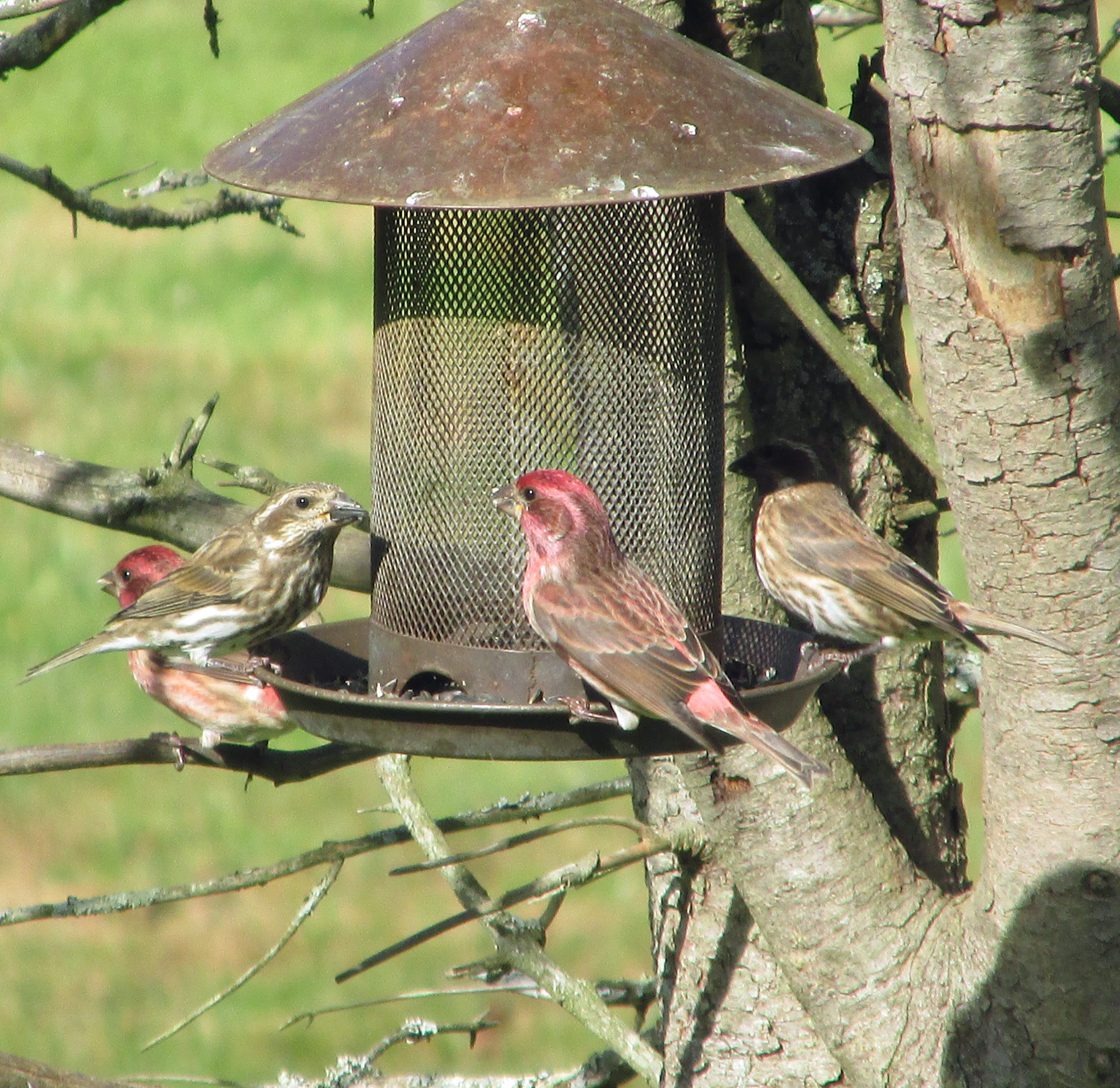
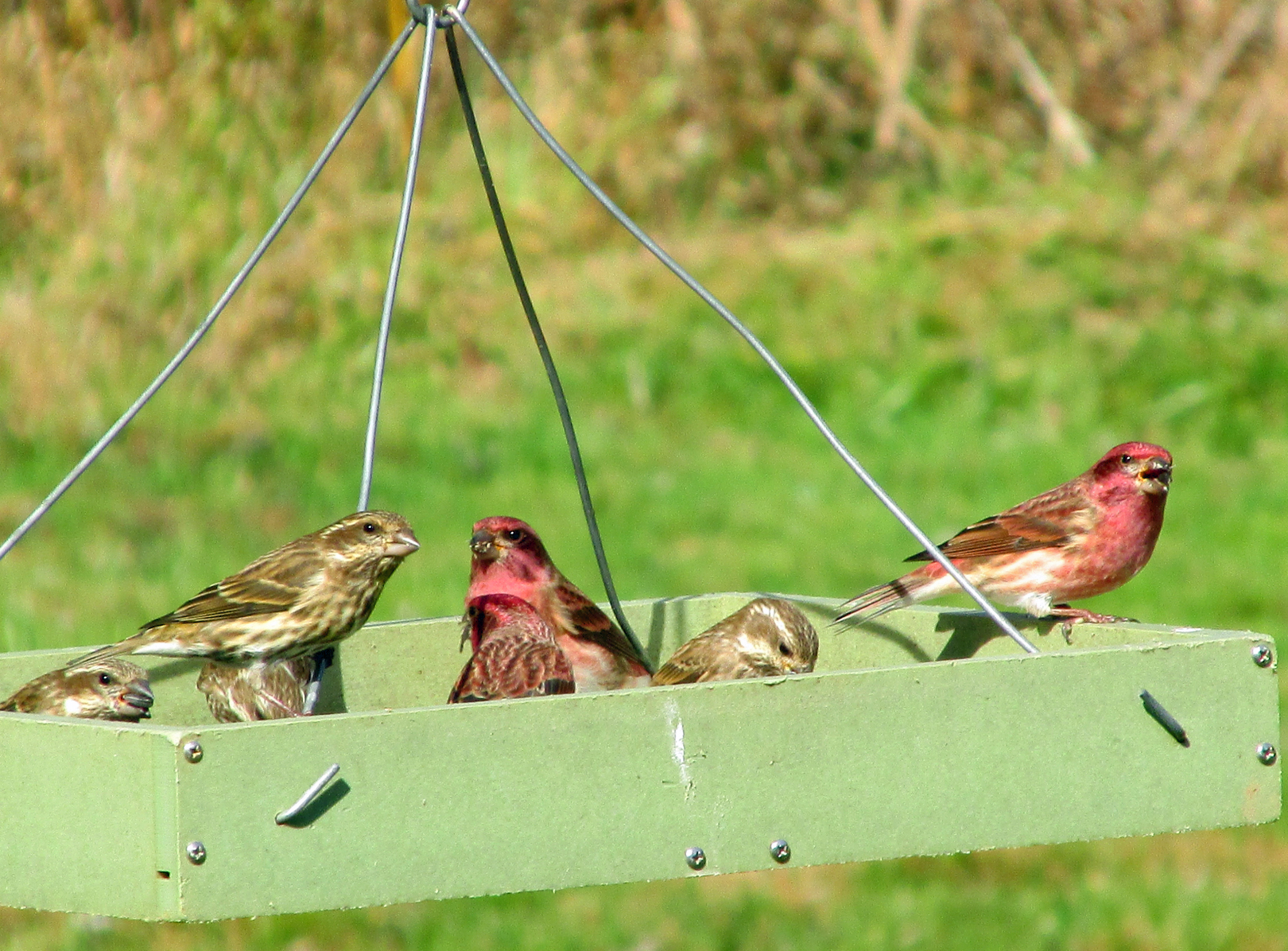
Photo by Bryan Stevens • Male and female purple finches share space at a feeder.

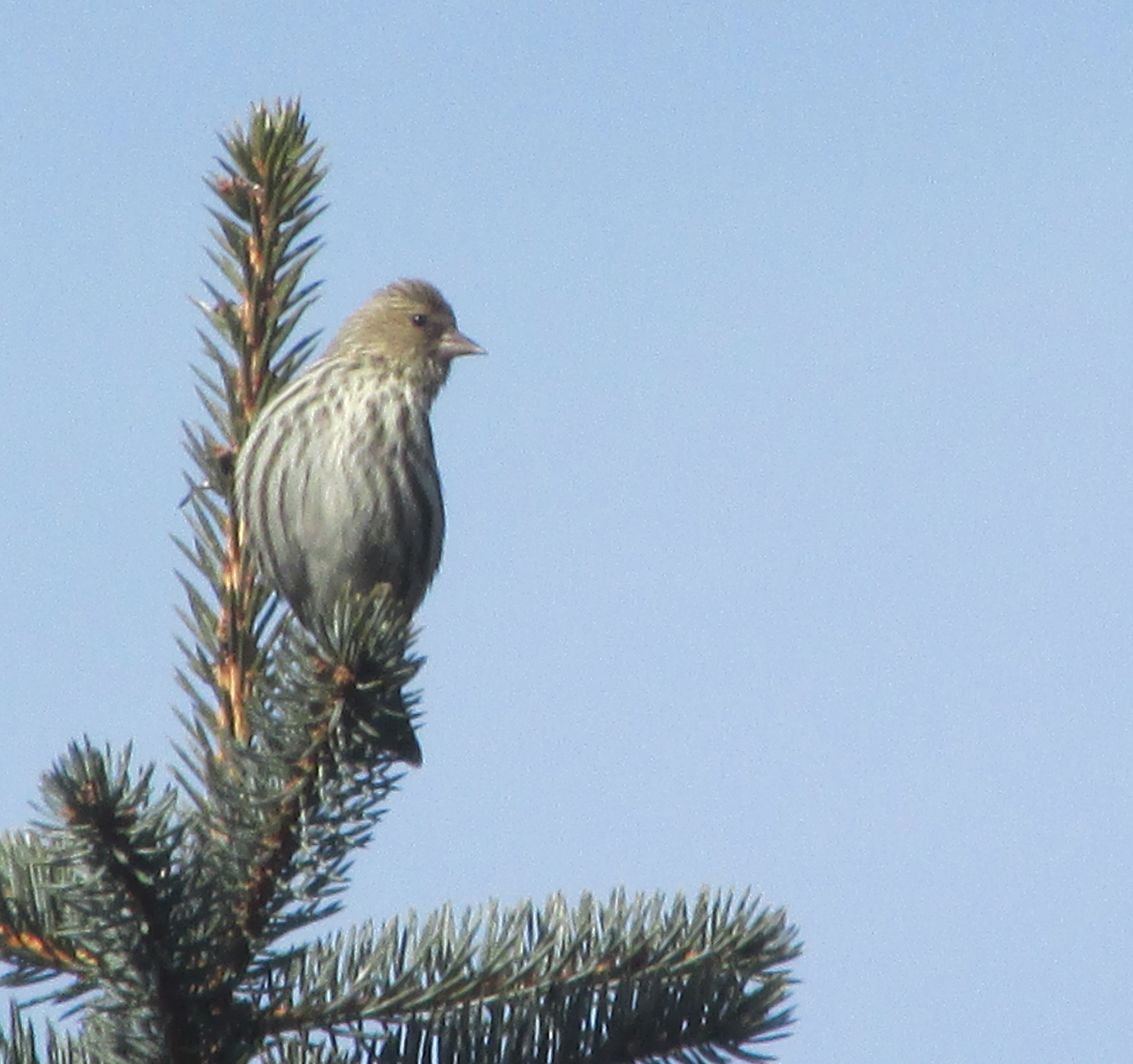
The pine siskin nests during the summer on the higher elevations of Roan Mountain. These small finches, which are related to the American goldfinch, are common winter feeder visitors some years and completely absent other years. This looks to be a year for siskin abundance. Andrew Del-Colle, Site Director and Editor for Audubon Magazine, posted a recent article about this autumn’s dramatic irruption of pine siskins.

Photo by Bryan Stevens • A pine siskin in a spruce at Carver’s Gap on Roan Mountain.

Project FeederWatch, which has monitored North American bird population trends for decades, defines the term irruption as a sudden change in the population density of an organism. In the case of birds, irruptions refer to the movement of northern-wintering species to the south in years of low food availability. Other species that often stage winter irruptions include evening grosbeaks, red-breasted nuthatches and common redpolls. There’s also some indication that some of these other birds may make their way south this winter.

“If you’ve never seen a pine siskin, this is your year,” Del-Colle wrote. “In the past month, the birds have invaded the United States in search of food, inundating backyard feeders across the country. Without question, it’s one of the biggest irruption years in recorded history for the finches.”

Photo by Bryan Stevens • Purple finches jostle for space in a feeder stocked with sunflower seeds.

The pine siskins at my home spend much of their time in weedy fields adjacent to my home and visit my feeders on a semi-regular basis. I suspect their feeder visitation will increase once some truly wintry weather arrives.

The purple finches that arrived on the same day do not rival the siskins in sheer numbers. Nevertheless, the purple finches have lingered, as well. The purple finch, which is a winter visitor to northeast Tennessee, southwest Virginia and western North Carolina, is apparently not as common as in the past. Experts have speculated that the decline in the numbers of purple finches each winter can be attributed, at least in part, to the closely related house finch. The house finch may simply be out-competing the purple finch for scarce natural resources.

Photo by Bryan Stevens • A male house finch perched on a cable. These finches are native to the western United States but became established in the eastern states thanks to the illicit pet trade.

The house finch is quite widespread across the United States. Originally, however, the house finch was a bird of the western part of the country, living in Mexico and the southwestern United States. About 1940, the house finch became established in the eastern United States. In violation of federal law, these small finches were being sold in New York City as pet birds described as “Hollywood Finches.” To avoid trouble with authorities, vendors and even some owners released their “Hollywood Finches” into the wild. Finding the area around New York City to their liking, house finches spread. Within a few decades, they were common birds throughout the eastern United States, including Tennessee, Virginia and North Carolina.

As the house finch claimed a new range, they inevitably encountered the related purple finch. During the winter, both finches are often present at feeders in the region. When both are available for observation, bird enthusiasts should take advantage of the opportunity to compare and contrast these birds. I have never had any difficulty distinguishing a purple finch from a house finch. The two species, at least in my eyes, are easily recognized. I can understand why some people might have trouble separating the two birds. The late Roger Tory Peterson once described the purple finch as a bird “dipped in raspberry juice.” Think about that imagery for a moment and you’ve got a good start to distinguishing a male purple finch from a male house finch. With some practice, observers will come to notice the subtle differences between a purple finch and a house finch.

These two finches belong to the genus Haemorhous, which can be roughly translated as “the color of blood.” The two species are also simply classified as American rosefinches. This grouping also includes a third species, Cassin’s finch, which occurs in the western United States. I have seen all three species, adding Cassin’s finch during a visit to Utah in 2006.

____________

Differentiating purple finches

from house finches can be a challenge

Let’s deal first with the males. Male purple finches are delicate pink-red (that raspberry coloration) on the head and breast, mixing with brown on the back and cloudy white on the belly. The red of a male purple finch is definitely a color I have not observed with many other birds. Even “red” birds such as male Northern cardinals and male scarlet tanagers do not show the same red color. Once you learn the way the red appears in the plumage of a male purple finch, you are on your way to telling this bird apart from its relative.

The red in the plumage of male house finches is surprisingly variable. In most cases, the heads, necks and shoulders of male birds are reddish and the red at times extends to the stomach and between the wings on the bird’s back. The intensity of the red changes with the seasons and is also derived from the berries and fruits in the bird’s diet. Pale yellow and bright orange are alternatives to the typical red plumage.

Look closely at the photograph of the purple finches accompanying this column. There’s a distinctive facial pattern evident on the birds. The strong facial markings include a whitish eye stripe and a dark line down the side of the throat. This pattern simply doesn’t exist with the male house finch. When I make a snap identification of these two birds, I always look for the facial pattern even before I study any other aspects of the appearance of the bird. In addition, purple finches have powerful, conical beaks and a tail that appears short and is clearly notched at the tip. Rounding out the description of a male house finch is the fact that they have a long, square-tipped brown tail and are brown or dull-brown across the back with some shading into gray on the wing feathers. The breast and stomach feathers may be streaked.

Females of both house finches and purple finches are dull brown birds that could easily be mistaken for sparrows. Again, the facial pattern is much more apparent on a female purple finch than on the related female house finch. In addition, I have always noticed that female purple finches are usually a darker shade of brown than the dull brown female house finches. Both male and female house finches are more slender than their more chunky-bodied counterparts.

______________

Although not closely related to our American birds, there is also a group known as rosefinches common to Europe and Asia. Some of these distant relatives include such descriptively named birds as scarlet finch, streaked rosefinch, red-mantled rosefinch, pink-browed rosefinch, long-tailed rosefinch, three-banded rosefinch and Himalayan beautiful rosefinch.

Purple finches occupy a variety of winter habitats, including fields, woodland edges, lawns and gardens. All it takes to lure these finches to feeders is a plentiful offering of sunflower seeds. If you are lucky enough to have both of these finches visiting your feeders, take time to study the differences. It takes some practice, but they can be distinguished quite confidently.


Twenty-five years ago this week, dark-eyed junco provided inspiration for first column

I wrote my first bird column on Sunday, Nov. 5, 1995, which means this weekly column is marking its 25th anniversary this week. This column has appeared over the last three decades in a total of six different newspapers, which I regard as a personal achievement, as well as an accomplishment for our feathered friends. It’s on their behalf that I pen these weekly efforts to promote conservation and good will toward all birds. I have also posted the column as a weekly blog posting since February of 2014 at ourfinefeatheredfriends.wordpress.com.

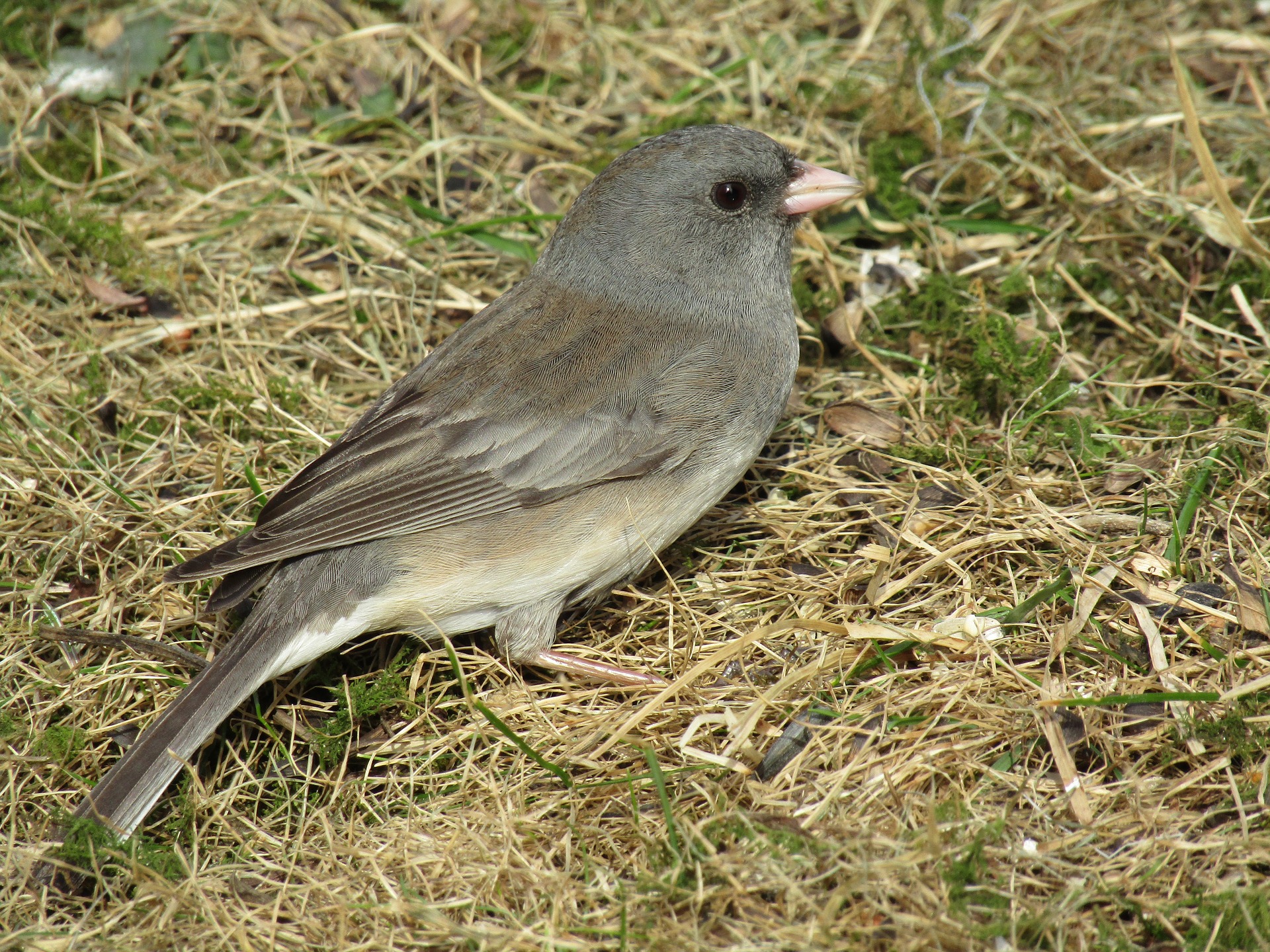
Photo by Steve McLeod/Pixabay.com • The dark-eyed junco is a fairly common winter resident in the region. Rather widespread, different races of the dark-eyed junco are found throughout the North American continent.

I’ve played detective, helping people identify everything from “rain crows,” or cuckoos, to Muscovy ducks and double-crested cormorants. I’ve observed unusual birds, including white pelican, brant and roseate spoonbill, in Northeast Tennessee and Southwest Virginia and spotlighted them in these columns. I still take delight in the kaleidoscopic parade of colorful warblers that pass through the region each spring and fall as well as the fast-paced duel of ruby-throated hummingbirds and the occasional rufous hummingbird straying through the region.At my home, I also provide sunflower seed and other supplemental food for the resident birds like Carolina chickadees, white-breasted nuthatches, song sparrows and downy woodpeckers.

Photo by Steve McLeod/Pixabay.com • The dark-eyed junco is a fairly common winter resident in the region. They are faithful feeder visitors during bouts of wintry weather.

Even as I write my silver anniversary column for “Feathered Friends,” local weather forecasters are predicting the winter’s first hard freeze. This prognostication of approaching winter weather is a perfect time to dust off this week’s column, which is a revision of the first bird column I ever wrote. This column focused on a common visitor to yards and feeders during the winter months. In fact, dark-eyed juncos should be returning to the region any day. Here, with some revisions I have made through the years, is that first column.

•••••

Of all the birds associated with winter weather, few are as symbolic as the dark-eyed junco, or “snow bird.” The junco occurs in several geographic variations.

John V. Dennis, author of “A Complete Guide to Bird Feeding,” captures the essence of the junco in the following description: “Driving winds and swirling snow do not daunt this plucky bird. The coldest winter days see the junco as lively as ever and with a joie de vivre that bolsters our sagging spirits.” The dark-eyed junco’s scientific name, hyemalis, is New Latin for “wintry,” an apt description of this bird.

Most people look forward to the spring return of some of our brilliant birds — warblers, tanagers and orioles — and I must admit that I also enjoy the arrival of these birds. The junco, in comparison to some of these species, is not in the same league. Nevertheless, the junco is handsome in its slate gray and white plumage, giving rise to the old saying “dark skies above, snow below.”

Photo by Bryan Stevens / A Dark-eyed Junco visits a hanging feeder.

Just as neotropical migrants make long distance journeys twice a year, the junco is also a migrating species. But in Appalachia, the junco is a special type of migrant. Most people think of birds as “going south for the winter.” In a basic sense this is true. But some juncos do not undertake a long horizontal (the scientific term) migration from north to south. Instead, these birds merely move from high elevations, such as the spruce fir peaks, to the lower elevations. This type of migration is known as vertical migration. Other juncos, such as those that spend their breeding season in northern locales, do make a southern migration and, at times, even mix with the vertical migrants.

During the summer months, a visit to higher elevations mountaintops is almost guaranteed to produce sightings of dark-eyed juncos. Juncos may nest as many three times in a season. A female junco usually lays three to six eggs for each nest, which she constructs without any assistance from her mate.

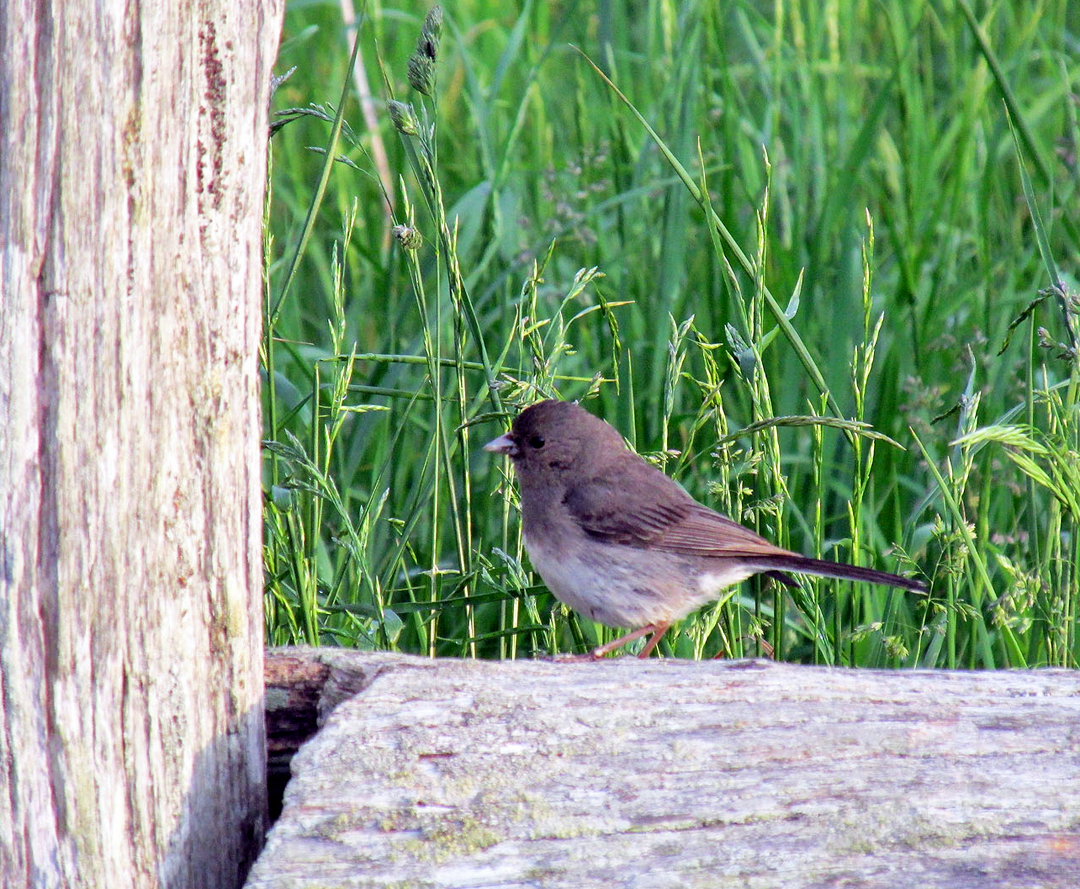
Photo by Bryan Stevens • Dark-eyed junco nests on high mountain slopes during the summer month. This dark-eyed junco was photographed at Carver’s Gap on Roan Mountain during the summer nesting season.

Juncos are usually in residence around my home by early November. Once they make themselves at home I can expect to play host to them until at least late April or early May of the following year. So, for at least six months, the snow bird is one of the most common and delightful feeder visitors a bird enthusiast could want.

 Juncos flock to feeders where they are rather mild-mannered — except among themselves. There are definite pecking orders in a junco flock, and females are usually on the lower tiers of the hierarchy. Females can sometimes be distinguished from males because of their paler gray or even brown upper plumage.

Since juncos are primarily ground feeders they tend to shun hanging feeders. But one winter I observed a junco that had mastered perching on a hanging “pine cone” feeder to enjoy a suet and peanut butter mixture.

Photo by Ken Thomas • A dark-eyed junco perches on some bare branches on a winter’s day.

Dark-eyed juncos often are content to glean the scraps other birds knock to the ground. Juncos are widespread. They visit feeders across North America. The junco is the most common species of bird to visit feeding stations. They will sample a variety of fare, but prefer such seeds as millet, cracked corn or black oil sunflower.

There’s something about winter that makes a junco’s dark and light garb an appropriate and even striking choice, particularly against a backdrop of newly fallen snow.

Of course, the real entertainment from juncos come from their frequent visits to our backyard feeders. When these birds flock to a feeder and began a furious period of eating, I don’t even have to glance skyward or tune in the television weather forecast. I know what they know. Bad weather is on the way!

•••••

If you’d like to share your first sighting this season of dark-eyed juncos as the temperatures get colder, email me at ahoodedwarbler@aol.com. As always, the column is also a line of communication with fellow bird enthusiasts. I’ve enjoyed sharing stories about birds with countless readers over the past 25 years. I can also be reached on Facebook at https://www.facebook.com/ahoodedwarbler. 


Several different species of hawks make their home in region

Photo by Bryan Stevens • This captive red-shouldered hawk was rehabilitated after suffering an injury and now works in an educational program at Brookgreen Gardens in South Carolina to teach the public about raptors, other birds, and various types of wildlife.

In recent weeks, I’ve enjoyed some observations of the region’s larger raptors, including red-tailed hawks and red-shouldered hawks.

Anyone who travels along the region’s Interstate Highway System has probably noticed hawks perched in trees or on utility lines adjacent to the roadway. The section of Interstate 26 that runs between Unicoi and Johnson City is often a productive area for keeping alert for raptors. The raptor I have most often observed along this stretch of road is the Red-tailed Hawk, although I have also observed Cooper’s Hawk, Sharp-shinned Hawk, and American Kestrel. In the time of spring and fall migration, it’s also possible to observe Broad-winged Hawks.

The Red-tailed Hawk is named for its prominent red tail. However, only adults show the characteristic red tail. The affinity for Red-tailed Hawks for roadsides is a double-edged sword. Viewing a large hawk from your car is an easy way to watch birds. For inexperienced or careless raptors, however, roadside living is often rife with the chance for a collision with a car or truck. The Red-tailed Hawk, which prefers open countryside, is attracted to the margins of roads and highways because these locations also attract their favorite prey, which includes rodents like rats, squirrels and mice and other small mammals such as rabbits.

Human behavior contributes to some of the problems that hawks encounter in the zone that brings them too close for comfort to motorized vehicles. When people toss trash from a car, the scent of the litter will lure curious and hungry rodents. In turn, hunting hawks are brought to the edges of roads in search of their preferred prey, increasing the likelihood of colliding with automobiles.

Photo by Bryan Stevens • A calling red-shouldered hawk perched in a dead tree on Pawleys Island in South Carolina.

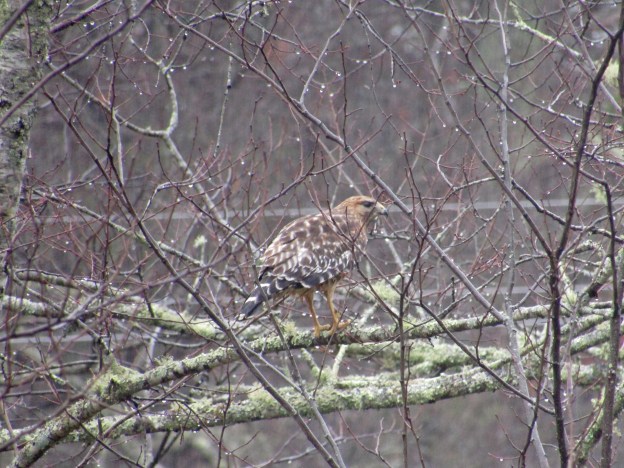
In recent days, I have also noticed a Red-shouldered Hawk lurking among the branches of the large weeping willow next to the fish pond. The Red-shoulder Hawk typically prefers wetland habitats and is less likely to haunt roadsides. According to a factsheet published by the New York State Department of Environmental Conservation, this raptor breeds in moist woodlands, riverine forests, the borders of swamps, open pine woods and similar habitats. Nesting almost always occurs near water, such as a swamp, river or pond.

The Red-shouldered Hawk produces a distinctive, piercing whistle that reminds me of the shrill call of a Killdeer. The visiting Red-shouldered Hawk has been silent so far, perhaps not wishing to draw attention. The few times the local crows have noticed the presence of any sort of raptor, they’ve flocked together to mob the unfortunate hawk. It’s also not the right time of year; during courtship and the subsequent nesting period, these hawks are vocal, but at other times of the year, they are rarely heard. It’s also possible to mistakenly think you have heard one of these large hawks. Blue Jays have apparently learned to imitate the “kee-yar” call of this hawk, often working a flawless rendition of the whistled notes of this large raptor.

In contrast to the related Red-tailed Hawk, the Red-shouldered Hawk soars less and prefers to perch hidden in the cover of trees. This hawk’s name comes from the reddish-brown shoulder patches in the bird’s wings. Adults show a tail marked with vivid bands of black and white that is quite distinctive. The Red-shouldered Hawk belongs to the same genus of raptors as its larger relative, the Red-tailed Hawk. The genus, buteo, includes about two dozen large raptors that are often the dominant avian predators in their respective habitats.

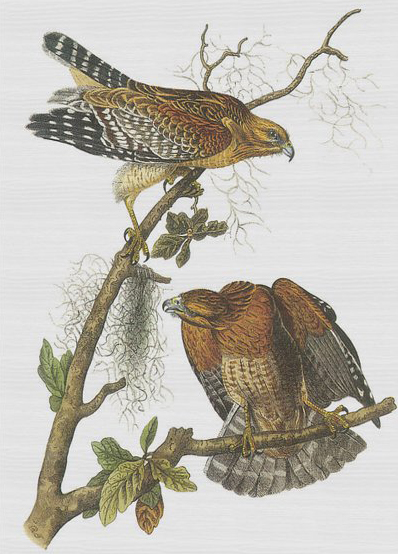
Early naturalist and artist John James Audubon painted this pair of red-shouldered hawk.

Some of the buteo species have adapted to life on islands, including the Galapagos Hawk and the Hawaiian Hawk. Some of these hawks have quite descriptive names, including the White-throated Hawk, Gray-lined Hawk, Zone-tailed Hawk and Short-tailed Hawk. Outside the United States, raptors in the buteo genus are often known as “buzzards.” When the first European colonists came to the New World, they applied the term buzzard to both types of native vultures as well as the large raptors like Swainson’s Hawk and Broad-winged Hawk that reminded them of the ones back in Europe.

All too often, our large hawks don’t receive the love they deserve from the public. They may even run afoul of misinformed individuals who may regard all predatory birds as “bad.” The reality is that all hawks are valuable components of a healthy, working ecosystem, with each species filling a certain niche.