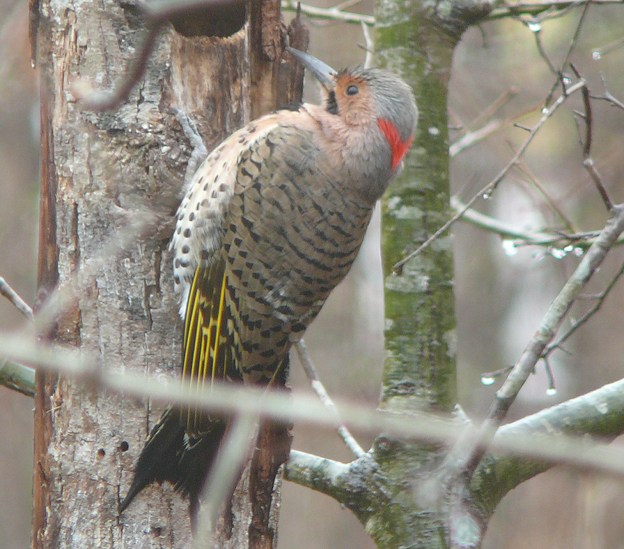
Category Archives: Woodpeckers

Flicker, towhee among recent winter bird arrivals

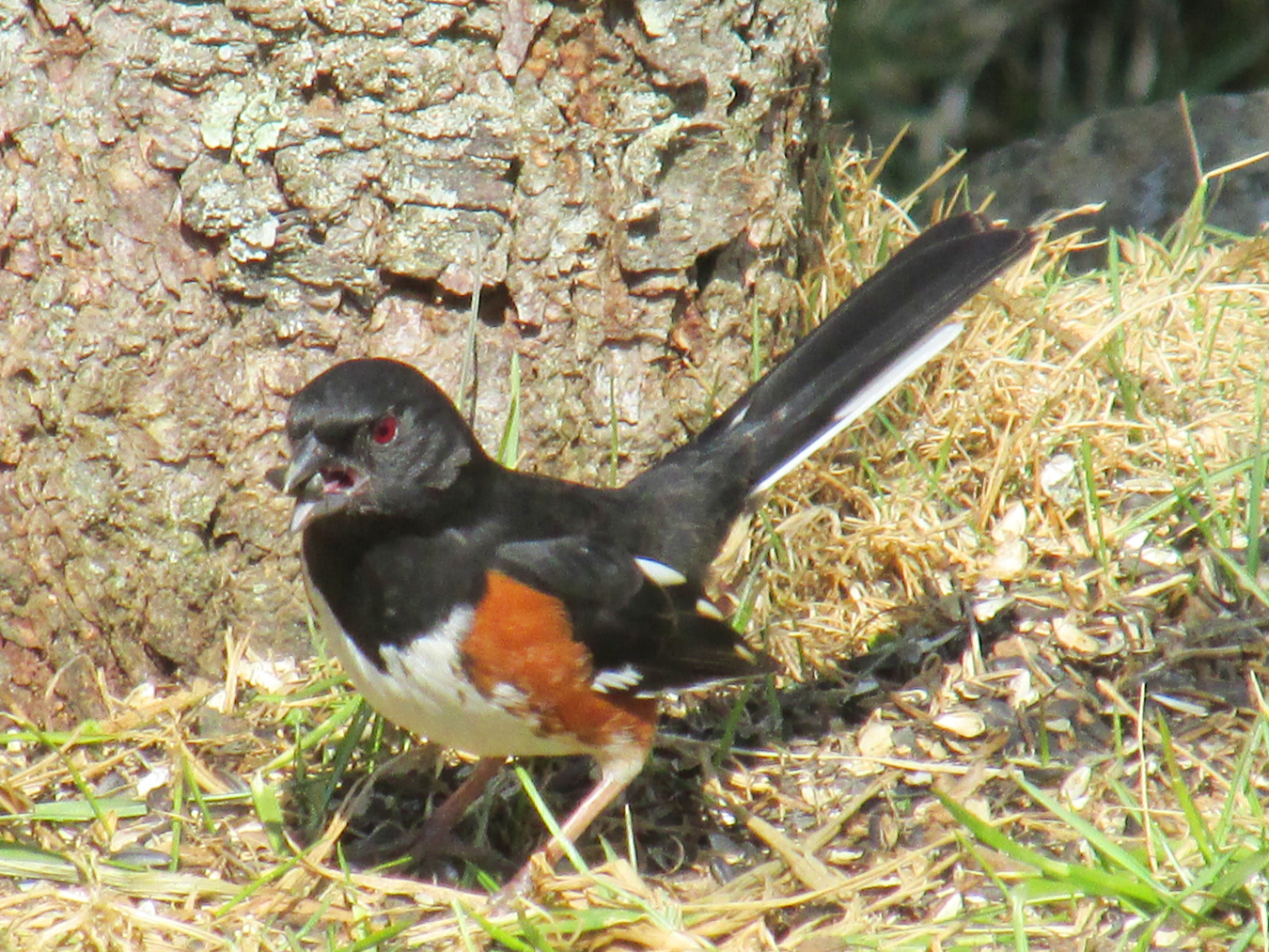
Towhee1

Photo by Bryan Stevens • An Eastern towhee feeds on the ground beneath a feeder.

I’d almost given up on any new birds arriving to break the daily monotony of birds in my yard when two birds put in their first appearances of the year. An Eastern towhee and a Northern flicker both showed up simultaneously for the first time in 2017 on Jan. 13.

The towhee, a male, was feeding in the usual manner of its kind, scratching vigorously on the ground beneath my feeders. Towhees are quite ingenious at uncovering any seeds dropped by other birds.
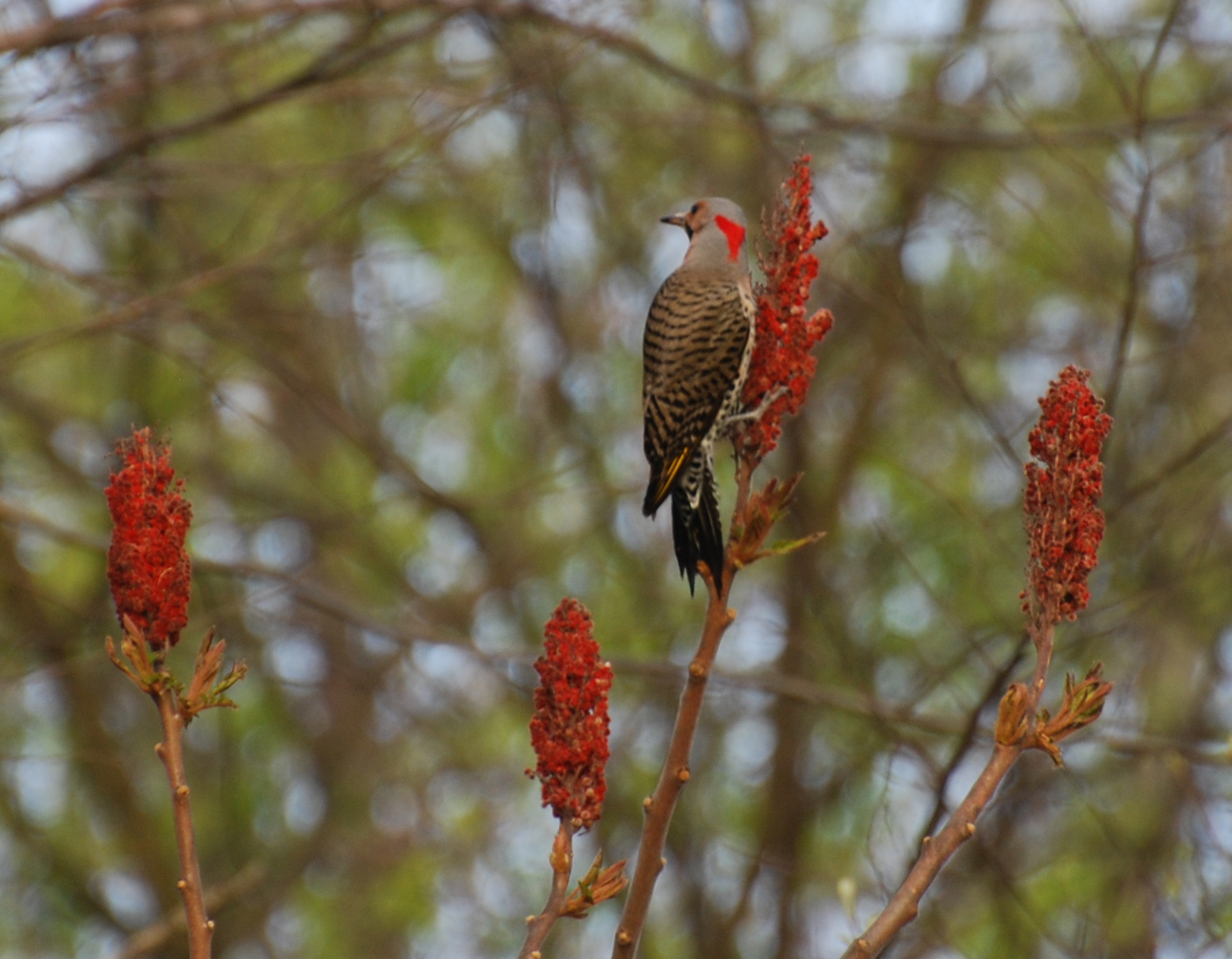
flicker

Photo by Jean Potter • A Northern flicker perches on a staghorn sumac.

The flicker was calling from the upper branches of a very tall tree at the edge of a wood lot near my home. The ringing calls of the flicker carried quite clearly even from a distance. Most woodpeckers, including the Northern flicker, are enthusiastic performers. We often think of woodpeckers in association with loud, repetitive drumming with their beaks against the trunk of a tree. Flickers are also known for using other surfaces for drumming. I’ve observed flickers drumming agains metal utility poles and metal siding on homes. That’s really not so strange when you consider that the purpose of the drumming is to communicate with mates or to signal potential rivals that they’re getting a little too close.

Woodpeckers are also known for a variety of vocalizations, and the Northern flicker is no exception. In addition to drumming, the flicker also employs a variety of loud vocalizations that are fairly distinctive. A loud, repeated flicker, often translated as “wicka-wicka-wicka,” is similar to the cluck-like call of the larger pileated woodpecker. The flicker is also known for emitting a sharp, loud “kleeer” call can be heard from a considerable distance. It was this “kleer” call that first drew my attention to the presence of the flicker at my home on Jan. 13.

Flickers are probably most vocal during the spring months. They go quiet for a period during the summer nesting season but start to make themselves heard again during the fall months. A warm, sunny day during the winter is often motivational enough to convince flickers to vocalize.

northern_flicker-1-2

Photo by U.S. Fish & Wildlife Service • A Northern flicker peers from a nesting cavity.

A lot of wildlife is probably getting mixed signals thanks to the extremely mild January temperatures. For instance, I’ve already had a few crocuses blooming in my gardens. Bees and other pollinators have also awoken from winter slumber to take advantage of the unseasonal blooms. If frigid weather does eventually arrive, I hope that these “early birds” suffer no ill effects.

The Northern flicker is the second-largest woodpecker in the region. The only bigger member of the family is the large and unmistakable pileated woodpecker. The flicker ranges across the United States and Canada. The flicker is also present in Central America, Cuba and the Cayman Islands. Known scientifically as Colaptes auratus, which can be roughly translated as the “golden woodpecker,” there are about a dozen species of flickers in North, Central and South America, as well as the Caribbean.

birds-of-ga-northern-flicker

The Nothern flicker is the official state bird of Alabama, where the bird is known as “Yellowhammer.”

In the United States and Canada, flickers in the eastern half of the continent are known as “yellow-shafted” flickers. The phrase “yellow-shafted” describes the Eastern race of this woodpecker, which is replaced in the western United States by the “red-shafted” flicker. In reality, both the yellow and red-shafted birds are considered by experts to be the same species. The yellow feathers in Eastern birds are found under the wings and on the tail. The yellow, or red, sections of the wings are most visible when the bird is in flight. I’ve seen both forms of this woodpecker, observing the red-shafted form during trips to Utah in 2003 and 2006.

Although most people think of woodpeckers as spending most of their time clinging to the trunks of trees, the flicker actually has something in common with the Eastern towhee. Like the towhee, the flicker spends a lot of time on the ground hunting for its favorite food — ants. The flicker even has a special adaptation — a barbed tongue — that it uses to capture ants.
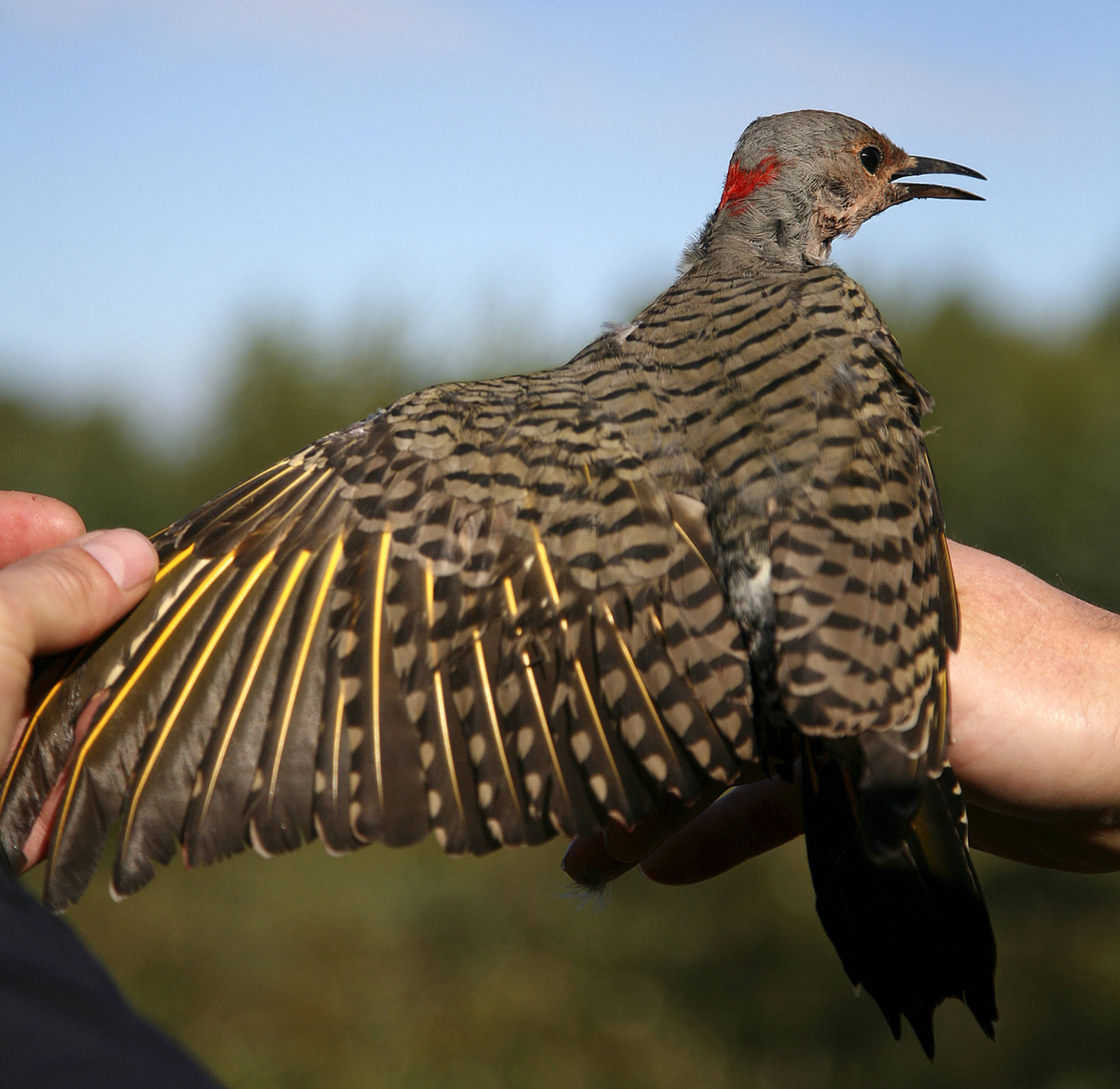
flicker-yellowwing-2

Photo by U.S. Fish and Wildlife Service • A Northern flicker, captured for a banding operation, has its wing extended to show the yellow feathers indicative of the eastern race of this species.

Flickers will come to feeders, but I’ve never had much luck attracting them. Perhaps I’ve not offered the right fare. The late John V. Dennis recommends “meat scraps, cracked walnuts and pecans, halved oranges and apples, and white bread” in his book, “A Complete Guide to Bird Feeding.” Even Dennis acknowledged that flickers are, at best, wary visitors to feeders. Not much has changed since Dennis wrote his book back in 1977. If any readers have had success luring flickers to their feeders, I’d love to hear their advice for attracting them.

The flicker has even been recognized as an official state bird by Alabama. Of course, Alabama officially bestowed the recognition on the “yellowhammer,” a nod to a nickname for both the flicker as well as Confederate soldiers during the Civil War. Even today, Alabama is still known as the Yellowhammer State. Somewhat surprisingly, the flicker is the only woodpecker that has received designation as a state bird.

••••••

To learn more about birds and other topics from the natural world, friend Stevens on Facebook at https://www.facebook.com/ahoodedwarbler. He is always posting about local birds, wildlife, flowers, insects and much more. If you have a question, wish to make a comment or share a sighting, email ahoodedwarbler@aol.com.
Annual Fall Bird Count finds 125 species

rthawk-one

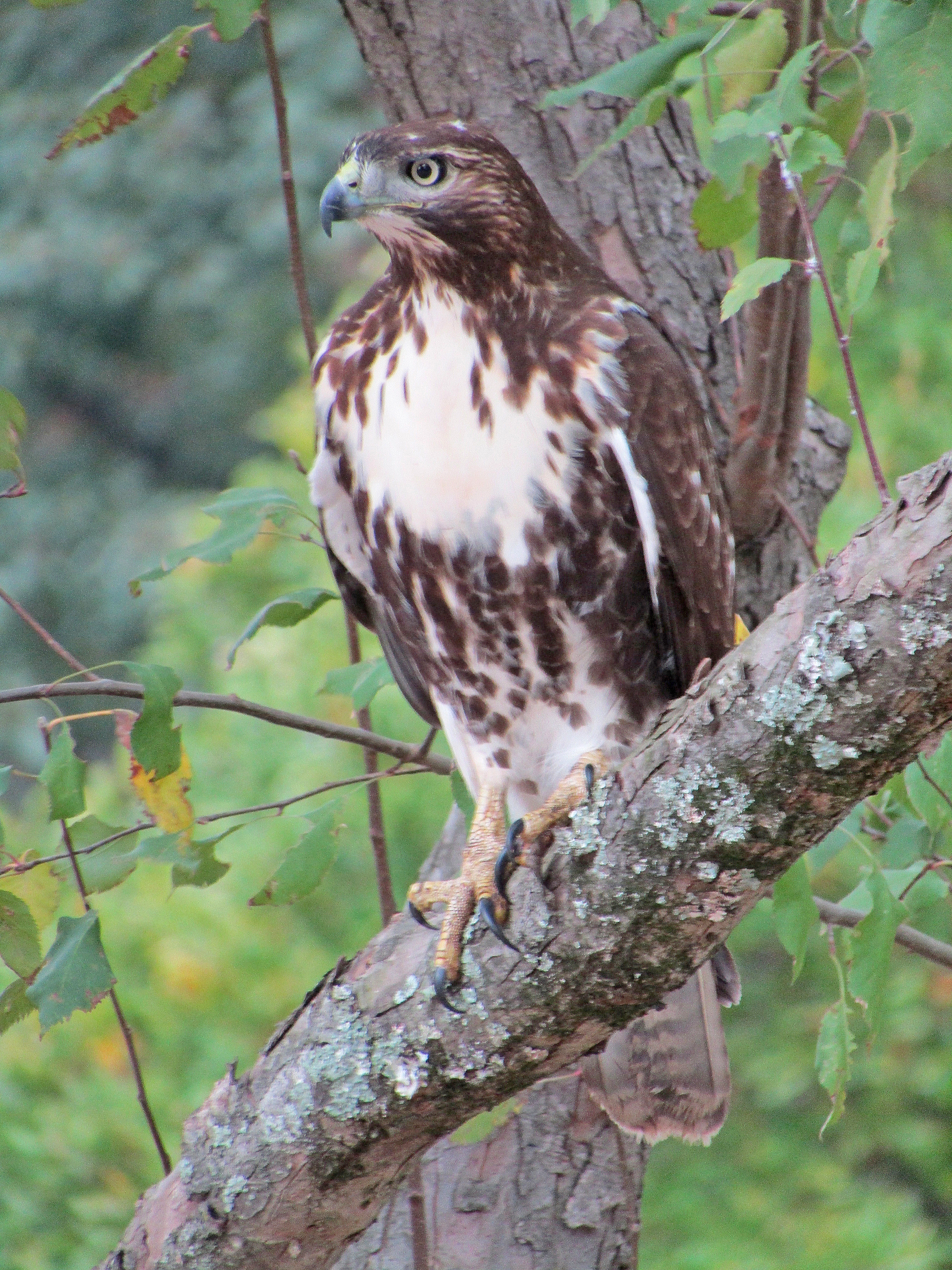
Photo by Bryan Stevens                  Red-tailed Hawks were found in good numbers on the recent fall count, but the species was outnumbered by migrating Broad-winged Hawks.

The Lee and Lois Herndon Chapter of Tennessee Ornithological Society held its annual Fall Bird Count back in September. The chapter’s five-county Fall Bird Count, the 47th consecutive survey conducted by the chapter, was held Sept. 24. A total of 39 observers (and two yard watchers) found a total of 125 species. Oppressive heat on the day of the count probably negatively affected bird numbers.
The Fall Bird Count, as well as the chapter’s annual Spring Bird Count, surveys bird populations in the upper Northeast Tennessee counties of Carter, Johnson, Sullivan, Unicoi and Washington.
The annual count is compiled by long-time chapter statistician Rick Knight.
The recent count was most notable for low numbers of many species. “A curious statistic: we had more Cedar Waxwings than European Starlings,” Knight remarked.
The all-time high on for a Fall Bird Count was 137 species in 1993.
•••••

bluewingteal-splash

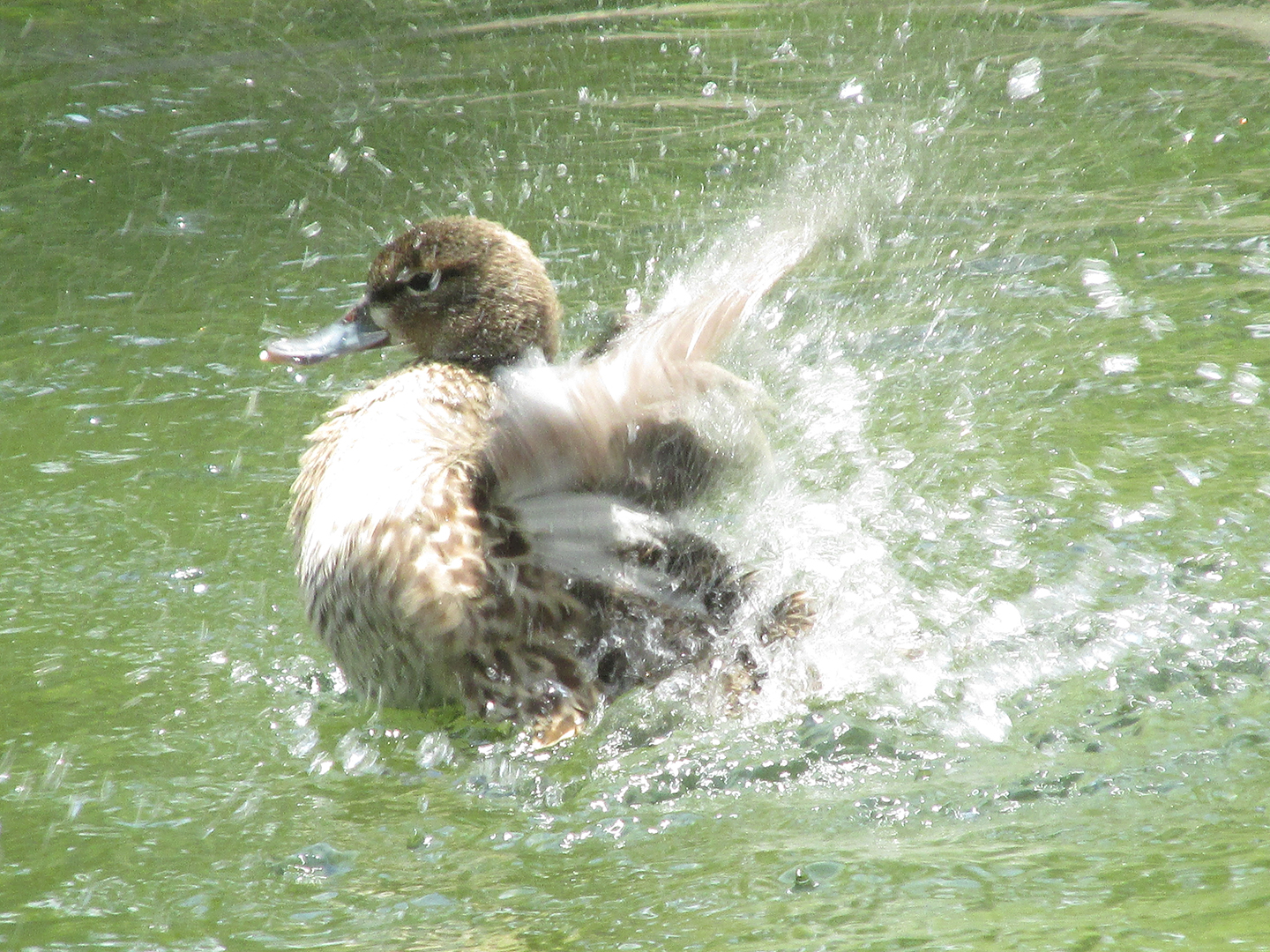
Photo by Bryan Stevens                                     Blue-winged Teal were among the migratory waterfowl found during the recent Fall Bird Count conducted by the Elizabethton Bird Club.

The total for this year’s Fall Bird Count follows:
Canada Goose, 1,118; Wood Duck, 40; Mallard, 224; Blue-winged Teal, 4; Green-winged Teal, 1; Ruffed Grouse, 2; Wild Turkey, 23; Pied-billed Grebe, 3; Double-crested Cormorant, 16; Great Blue Heron, 30; Great Egret, 10; Green Heron, 2; Black-crowned Night-Heron, 2; and Yellow-crowned Night-Heron, 1.
Black Vulture, 159; Turkey Vulture, 222; Osprey, 7; Bald Eagle, 4; Sharp-shinned Hawk, 2; Cooper’s Hawk, 10; Red-shouldered Hawk, 5; Broad-winged Hawk, 25; and Red-tailed Hawk, 22.
Killdeer, 66; Spotted Sandpiper, 3; Least Sandpiper, 4; Pectoral Sandpiper, 6; American Woodcock, 4.
Rock Pigeon, 365; Eurasian Collared Dove, 2; Mourning Dove, 174; Yellow-billed Cuckoo, 1; Eastern Screech-Owl, 14; Great Horned Owl, 8; Barred Owl, 8, and Northern Saw-whet Owl, 1.


Downy-Male-Feb23

Photo by Bryan Stevens Downy Woodpecker was the most numerous woodpecker tallied on the fall count.

Common Nighthawk, 3; Chimney Swift, 379; Ruby-throated Hummingbird, 30; Belted Kingfisher, 33; Red-headed Woodpecker, 1; Red-bellied Woodpecker, 61; Yellow-bellied Sapsucker, 5; Downy Woodpecker, 42; Hairy Woodpecker, 10; Northern Flicker, 28; and Pileated Woodpecker, 32.
American Kestrel, 14; Peregrine Falcon, 2; Eastern Wood-pewee, 12; Acadian Flycatcher, 1; Empid species, 3; Eastern Phoebe, 68; and Eastern Kingbird, 1.
White-eyed Vireo, 2; Yellow-throated Vireo, 2; Blue-headed Vireo, 20; Red-eyed Vireo, 15; Blue Jay; 329; American Crow, 376; and Common Raven; 26.
Purple Martin, 1; Tree Swallow, 163; Barn Swallow, 1; Carolina Chickadee, 152; Tufted Titmouse, 124; Red-breasted Nuthatch, 12; and White-breasted Nuthatch, 36.

mockingbird-nov11

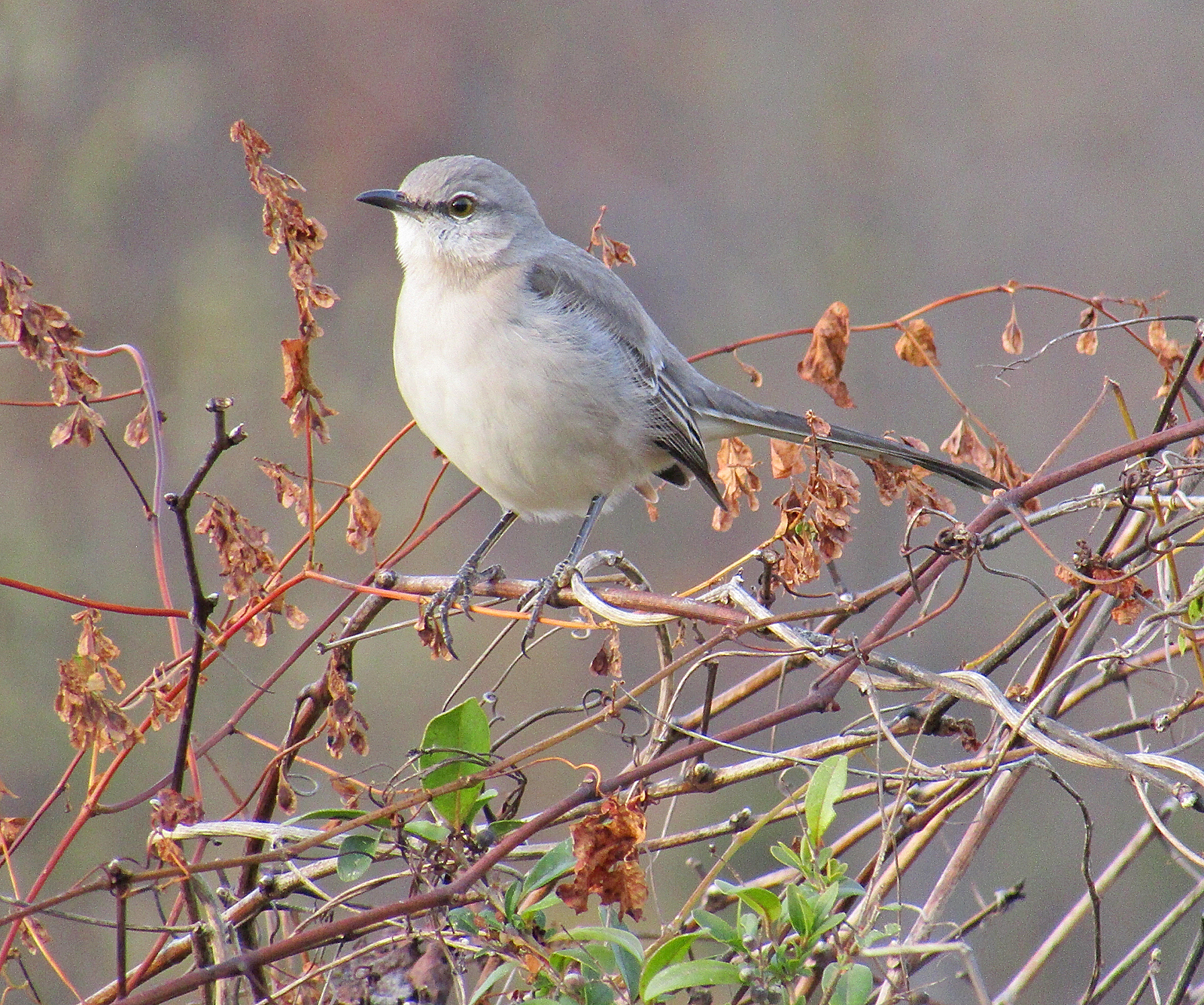
Photo by Bryan Stevens                                                 A total of 54 Northern Mockingbirds, Tennessee’s official state bird, was found on the count.

Brown Creeper, 5; House Wren, 3; Carolina Wren, 139; Blue-gray Gnatcatcher, 2; Golden-crowned Kinglet, 23; and Ruby-crowned Kinglet, 5.
Eastern Bluebird, 91; Veery, 4; Gray-cheeked Thrush, 6; Swainson’s Thrush, 89; Hermit Thrush, 1; Wood Thrush, 16; American Robin, 343, Gray Catbird, 48; Brown Thrasher, 14; and Northern Mockingbird, 54.

crossbills

Photo by Bryan Stevens                                    Red Crossbills were among the finches tallied on this year’s Fall Bird Count.

European Starling, 426; Cedar Waxwing, 506; Ovenbird, 4; Worm-eating Warbler, 1; Northern Waterthrush, 1; Black-and-white Warbler, 4; Tennessee Warbler, 12; Orange-crowned Warbler, 1; Common Yellowthroat, 10; Hooded Warbler, 4; American Redstart, 13; Cape May Warbler, 7; Northern Parula, 3; Magnolia Warbler, 11; Bay-breasted Warbler, 6; Blackburnian Warbler, 3; Chestnut-sided Warbler, 2; Black-throated Blue Warbler, 3; Palm Warbler, 16; Pine Warbler, 11; Yellow-rumped Warbler, 2; Yellow-throated Warbler, 2; Prairie Warbler, 1; and Black-throated Green Warbler, 8.
Eastern Towhee, 65; Chipping Sparrow, 24; Field Sparrow, 11; Song Sparrow, 83; Dark-eyed Junco, 95; Summer Tanager, 2; Scarlet Tanager, 15; Northern Cardinal, 138, Rose-breasted Grosbeak, 43; and Indigo Bunting, 13.
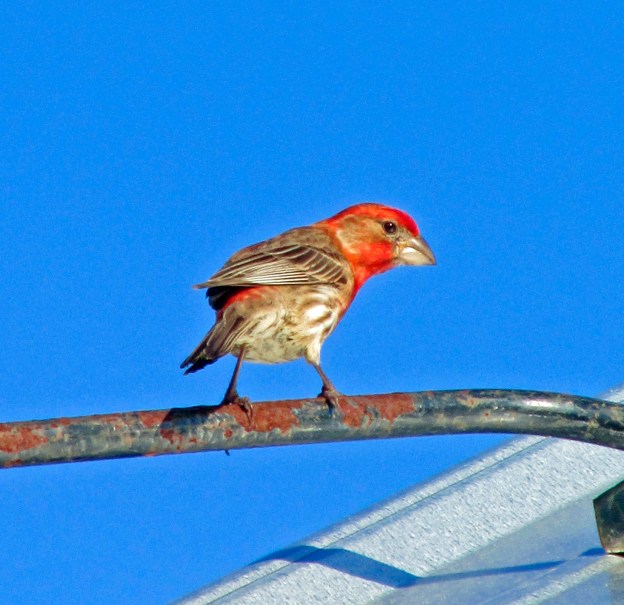
Red-winged Blackbird, 61; Eastern Meadowlark, 10; Common Grackle, 156; House Finch, 51; Red Crossbill, 2; Pine Siskin, 10; American Goldfinch, 231; and House Sparrow, 38.

••••••
The season’s first White-throated Sparrow showed up at my home on Oct. 30. I’m hopeful that the sparrow is but the first of many new arrivals ahead of the winter season. To share a sighting, ask a question or make a comment, send an email to ahoodedwarbler@aol.com.

Woodpecker’s ‘red belly’ often obscured from view, but ‘redhead’ name often goes to wrong bird


In recent posts I have discussed the smallest and largest of the woodpeckers in the region, as well as focused a spotlight on the oddball yellow-bellied sapsucker and the medium-sized Northern flicker. This week’s post will focus on one of the most common, although ridiculously misnamed, woodpeckers, as well as one of its rather uncommon relatives.

OLYMPUS DIGITAL CAMERA

Photo by Ken Thomas                                            Just as acrobatic as its relatives, the red-bellied woodpecker ranks as a popular visitor to feeders. This photograph shows off the splash of red on the belly that gives this particular woodpecker its name.

Among the woodpecker family, the red-bellied and red-headed woodpeckers are close cousins, belonging to a genus of those tree-clinging birds known as Melanerpes. The term, translated from Latin, means “black creeper.” Indeed, many of the two dozen members of the Melanerpes genus have an extensive amount of black feathers in their plumage. Other members of the genus include woodpeckers from the Caribbean, as well as from Central and South American. Some of them have quite colorful names, such as yellow-tufted woodpecker, golden-cheeked woodpecker and the accurately named beautiful woodpecker, a native of Colombia.

1966266_10205839301334114_1762688218168201429_o

Photo by Bryan Stevens                                  When climbing the trunks of trees, red-bellied woodpeckers don’t often reveal the faint reddish wash on the feathers covering their stomachs. This photo, however, is an exception and shows the trait that gives this medium-sized woodpecker its common name.

The red-bellied woodpecker is one of the most widespread members of this genus with a range that extends from southern Canada to northeastern Mexico, as well as the eastern United States as far south as Florida and as far west as Texas. A century ago the red-bellied woodpecker was almost exclusively a southeastern bird, but it has expanded its range northward and westward considerably in the last 100 years. Its southern origins are hinted at in its scientific name of Melanerpes carolinus, which can be roughly translated as “black creeper of the Carolinas.”

It’s also named for a characteristic of its appearance that is not particularly prominent and not easy to observe. The faint tint of red that tinges the white belly feathers is extremely difficult to observe when this woodpecker is hitching up the trunk of a large tree. Because males, and females to a certain extent, have a red cap, the species has been erroneously referred to as a “red-headed woodpecker” by many casual observers. The true red-headed woodpecker, however, has an entirely red head and a plumage pattern that, considering its color trio of red, white and blue-black, is downright patriotic. The red-headed woodpecker (Melanerpes erythrocephalus) is about the same size as the red-bellied woodpecker.

Redheaded_woodpecker

Photo by Dave Menke/U.S. Fish and Wildlife Service                  The uncommon red-headed woodpecker deserves its common name because it, and not the related red-bellied woodpecker, has an entirely red head.

All woodpeckers are noisy when the mood strikes them, but the red-headed and red-bellied have always struck me as rather more clamorous than some of their relatives. The most common call of the red-bellied woodpecker is a sort of rolling “churr” repeated frequently while the bird is on the move from tree to tree.

To enjoy close views of the red-bellied woodpecker, provide plenty of peanuts, sunflower seeds and suet cakes. If there are any of them in the woods nearby, they will find these food offerings in short order. All my research indicates the same is true of red-headed woodpeckers, but I’ve never observed this woodpecker at my home. I’ve seen red-headed woodpeckers in Tennessee, Virginia and South Carolina, but their populations are somewhat localized. Woodlands dominated by oak trees are often inhabited by both these woodpeckers, which are fond of the acorns produced by these trees.

Female-Redbellied

Photo by Bryan Stevens           A female red-bellied woodpecker peers around a tree trunk.

One reason the red-headed woodpecker may be less common than its cousin relates to its fondness for hawking for flying insects along roadsides. The woodpeckers are frequently struck by cars when swooping after their winged prey. Historically, the American chestnut and beech trees also provided much of the mast crops consumed by these birds. With the extermination of the chestnut and the scarcity of beech in some locations, the red-headed woodpecker now depends on oaks and acorns. In fact, this woodpecker is rarely encountered outside of woodlands with an abundance of oak trees.

At feeders, red-bellied woodpeckers are prickly customers that often refuse to play nice with other birds. I’ve seen them stare down other large feeder birds, including blue jays, mourning doves and evening grosbeaks. With its large bill, the red-bellied woodpecker commands some respect.

10974570_10204879280134184_5728419233300989270_o

Photo by Bryan Stevens                                Although once considered a bird of the southeastern United States, the red-bellied woodpecker has expanded its range north and west during the past century.

Anyone who has hosted these birds knows they are a welcome visitor to any yard. Who knows? Some day I may even get a visit from the elusive red-headed woodpecker, which is the only woodpecker resident in the region to thus far avoid my yard.

••••••

1655770_10205115222432594_4327567867962744958_o

Photo by Mark Stevens     A promotional sign for Brookgreen Gardens in South Carolina bears the image of a red-bellied woodpecker.

To learn more about birds and other topics from the natural world, friend Stevens on Facebook at https://www.facebook.com/ahoodedwarbler. He is always posting about local birds, wildlife, flowers, insects and much more. If you have a question, wish to make a comment or share a sighting, email him at ahoodedwarbler@aol.com.

Northern flicker one of America’s most widespread woodpeckers

 
Facebook friend Melissa Hale posted on my page about her discovery of an unusual feather.
 

“I think I have found a feather from a yellow-shafted flicker,” she wrote. “Do we even have these around here?” She noted that she has heard several species of woodpecker around her home and added that daughter Heather has seen quite a few different woodpeckers around their home.

Flicker-YellowWing

Photo by Donna Dewhurst/U.S. Fish & Wildlife Service              The extended wing of this Northern flicker shows how the eastern race of this woodpecker is known as the “yellow-shafted” form.

 
I posted back that she probably had found a flicker’s feather. The name “yellow-shafted flicker” is one of a great many common names for this medium-sized woodpecker, which is known by birders as the Northern flicker. The phrase “yellow-shafted” describes the Eastern race of this woodpecker, which is replaced in the western United States by the “red-shafted” flicker. In reality, both the yellow and red-shafted birds are considered by experts to be the same species. The yellow feathers in Eastern birds are found under the wings and on the tail. The yellow, or red, sections of the wings are most visible when the bird is in flight. I’ve seen both forms of this woodpecker, observing the red-shafted form of the Northern flicker during trips to Utah in 2003 and 2006.
 
Melissa described the feather as “one of the most beautiful feathers I have ever seen,” which is not too surprising. Most of the region’s woodpeckers are black and white birds. The Northern Flicker, on the other hand, shows considerable color— for a woodpecker. 
 

While flickers can be found during all seasons in the region, this woodpecker is one of the migratory ones. I see the most Northern flickers during fall migration. This woodpecker is one of the few of its kind that migrates to warmer climates during the colder months, although the species is usually not absent from the region in the winter season.

Northern_flicker (2)

Photo by U.S. Fish & Wildlife Service          The Northern Flicker resides in open habitats near trees, including woodlands edges, suburban yards, city parks and orchards.

 
As mentioned earlier, this is a woodpecker with many other common names, including yellow-hammer — a popular name in the Deep South — and harry-wicket, heigh-ho and gawker bird. The Northern flicker is also the only woodpecker to serve a state — Alabama — as an official bird. The flicker earned this distinction back in 1927. Soldiers from Alabama who fought for the Confederacy were nicknamed “yellowhammers” because of their grey-and-yellow uniforms, which matched the colors of the bird. Incidentally, Alabama was one of the first states to ever name an official state bird.
 
The Northern flicker — both the yellow- and red-shafted races — is not the only flicker in the United States. The gilded flicker inhabits many of the deserts — Sonoran, Yuma and Colorado — in the United States. Of course, trees are scarce in deserts, but that hasn’t proven an obstacle for this woodpecker. The bird is closely associated with saguaro cactus. Other desert dwellers depend on this woodpecker. Once the flickers are no longer making use of their nest and roost holes in the multi-armed cacti, other wildlife moved into the chambers. 
 
The Northern flicker is an enthusiastic drummer, pounding loudly on the sides of trees with its stout bill. The purpose of the drumming is to communicate with mates and signal potential rivals that they’re intruding. Toward that objective, flickers sometimes substitute metal utility poles or the sides of buildings for the trunks of trees. In addition to drumming, the flicker also employs a variety of loud vocalizations that are fairly distinctive. A loud, repeated flicker, often translated as “wicka-wicka-wicka,” is similar to the cluck-like call of the larger pileated woodpecker. The flicker is also known for emitting a sharp, loud “kleeer” call can be heard from a considerable distance. Flickers are probably most vocal during the spring months. 10683622_10204092032613488_952638671796664703_o 2
 
If you search for flickers, however, don’t concentrate all your scanning on tree trunks. These woodpeckers spend a lot of time in field or on lawns in search of insect prey, which mostly consists of ants and beetles. Flickers also eat seeds and fruit, and these woodpeckers will also visit feeders for peanuts, sunflower seed and suet. 
 

The adult flicker is a brown bird with black bars on the back and wings. A distinctive black patch occupies the upper breast, while the lower breast and belly are beige with black spots. Males can be identified by a black or red mustache stripe at the base of the beak. They also have a red stripe on the back of their gray heads. The flicker’s dark tail is set apart from a white rump patch that is conspicuous when the bird takes flight.

Northern_flicker (1)

Photo by U.S. Fish & Wildlife Service                  A Northern Flickers looks out from its nesting cavity.

 
The Northern flicker, as either the red- or yellow-shafted reach, ranges across the United States and Canada. The flicker also ranges to Central America, Cuba and the Cayman Islands. Known scientifically as Colaptes auratus, which can be roughly translated as the “golden woodpecker,” there are about a dozen species of flickers in North, Central and South America, as well as the Caribbean. 
 

A couple members of the flicker clan are now extinct. The human introduction of cats and goats to Guadalupe Island, offshore from the western coast of Baja California, Mexico, led to the extinction of this woodpecker in 1906. The Bermuda flicker apparently died out centuries ago, although a few may have lingered into the 17th century. John Smith, the early explorer associated with the Jamestown colony of Virginia, may have written of the Bermuda flicker in a journal recording his voyages. 

Birds-of-GA-northern-flicker

English-born John Abbot explored southeastern Georgia, collecting specimens and painting birds such as this Northern Flicker during the Revolutionary era in Colonial America.

 
Look for Northern flickers in fields, orchards, city parks and well-planted suburban yards. These woodpeckers are usually not too shy around human observers and will sometimes allow for extended observation. If you’re even more fortunate, you could find one visiting your feeders. 
 
••••••
 
To learn more about birds and other topics from the natural world, friend Bryan Stevens on Facebook at https://www.facebook.com/ahoodedwarbler. He is always posting about local birds, wildlife, flowers, insects and much more. If you have a question, wish to make a comment or share a sighting, email ahoodedwarbler@aol.com.
Region’s largest woodpecker always makes big impression

Downy-Male 3

Photo by Bryan Stevens                         The downy woodpecker is the smallest of its kind in the region. Its largest relative is the crow-sized pileated woodpecker.

In recent posts, I’ve discussed the yellow-bellied sapsucker, a definite oddball among the region’s woodpeckers, as well as the downy woodpecker, which is the smallest member of this clan of tree-hugging birds. This week I’d like to discuss the pileated woodpecker. On the other end of the size scale from the downy, the pileated woodpecker ranks as the largest member of this family of birds to make its home in the United States.

Pileated_Woodpecker-27527

Photo by Ken Thomas                                                     The pileated woodpecker, despite its size and noisy personality, is a rather shy bird.

The large pileated woodpecker — it’s the size of a crow — never fails to impress. This bird has a loud, raucous cackling call, which is often heard before the bird is observed. This woodpecker spends a good amount of its time low to the ground, so when one takes flight unexpectedly, often calling loudly as its powerful wing beats carry it away from an observer, the moment can be somewhat startling. These experiences of sudden and unexpected sightings of one of these woodpeckers is often accompanied by exclamations of surprise. Hence common names such as “wood-hen” and “Lord God Bird” have been adopted for these woodpeckers. Other names for the pileated have included carpenter bird, cock-of-the-woods and wood-hen.

PileatedWP-BRISTOL

Photo by U.S. Fish & Wildlife Service                                              The pileated woodpecker, if the ivory-billed woodpecker is truly extinct, reigns as the largest woodpecker in the United States.

At one point, the pileated woodpecker was relegated to second place when it came to the size of native woodpeckers. The often inaccessible swampy woodlands and river bottoms of the American south were home to the former title holder, the ivory-billed woodpecker. With the unsettled status of the ivory-billed woodpecker — is it extinct or is it still lingering in an Arkansas swamp? — the pileated woodpecker is considered the largest woodpecker in the United States. If incontrovertible evidence of the existence of ivory-billed woodpeckers should emerge in the future, the pileated woodpecker would once again find itself overshadowed by this dramatically larger relative.

Although the pileated woodpecker can reach a length of 19 inches, the bird weighs only about 11 ounces. Male and female look similar with a black and white body and a bright red crest. Males show a red stripe — or mustache — on the cheek that is not present in females.

John_James_Audubon_-_Pileated_Woodpecker

Early naturalist and painter John James Audubon painted these pileated woodpeckers in the process of foraging for food.

As mentioned earlier, the pileated woodpecker often can be found low to the ground, foraging on tree stumps and fallen logs, as well as in taller, living trees. The reason for this behavior rests with one of its favorite foods — the humble carpenter ant. The pileated is not the only woodpecker that supplements its diet with ants. For instance, the Northern flicker is also fond of dining on these insects. Studies conducted on the dietary preferences of pileated woodpeckers have revealed that as much as 40 percent of the diet is made up of ants. Some pileated woodpeckers appear to have developed quite an addiction for ants with some individuals dining almost exclusively on ants. These woodpeckers also eat wild fruits and nuts, as well as other insects and their larvae. The pileated woodpecker will occasionally visit a feeder for suet or seeds, but I’ve not had much luck overcoming their instinctive wariness.

Pileated woodpeckers — usually a mated pair — have been among my wild neighbors for years, but they are shy, retiring birds. Despite their bold appearance and capacity for making quite a racket, the pileated woodpecker usually goes out of its way not to attract attention to itself. Because of this, close-up observations of the largest of our woodpeckers are experiences to savor.

10847689_10205532193376607_2833698272038797483_o

Photo by Bryan Stevens                                This pileated woodpecker was photographed at Brookgreen Gardens in South Carolina in 2015.

The bird’s enthusiastic ability to excavate cavities in rotten trees is a boon to other species of birds. Certain species of ducks as well as owls, bats, squirrels and other species of wildlife will often make use of cavities created by pileated woodpeckers for roosting locations or to raise their own young.

Worldwide, there are about 180 different woodpeckers, but the family is conspicuous in its absence from Australia, Madagascar and New Zealand. The pileated woodpecker ranges across the continent, with birds present in the forests across Canada and the eastern United States as well as certain areas along the Pacific coast.

••••••

To learn more about birds and other topics from the natural world, friend Stevens on Facebook at https://www.facebook.com/ahoodedwarbler. He is always posting about local birds, wildlife, flowers, insects and much more. If you have a question, wish to make a comment or share a sighting, email ahoodedwarbler@aol.com.

Sapsuckers are odd birds out among the woodpeckers


Sapsucker-Two

Photo courtesy of Jean Potter                            A male yellow-bellied sapsucker clings to the trunk of a tree.

Worldwide, there are almost 10,000 species of birds. After awhile, you begin to wonder if thinking of unique names for each of these species began to deplete creative reserves.

Then again, some of the names given to birds suggest someone really wanted just to have fun at the expense of birders and nature enthusiasts. After all, you have to be careful about shouting out bird names like blue-footed booby, great bustard and hoary redpoll in mixed company.

There are also bird names that just don’t make a lot of sense — names like dickcissel and phainopepla — even to birders. Then there are names that are oxymoronic, including greater pewee and giant hummingbird.

There are some bird names that sound like fighting words that bring into question concepts like courage and honor. Indeed, I sometimes think people are waiting for a punchline when I inform them there truly is a species of bird known as the yellow-bellied sapsucker.

Sapsucker-One

Photo courtesy of Jean Potter                                                                    A male yellow-bellied sapsucker visits a suet basket for a quick meal during a recent cold spell.

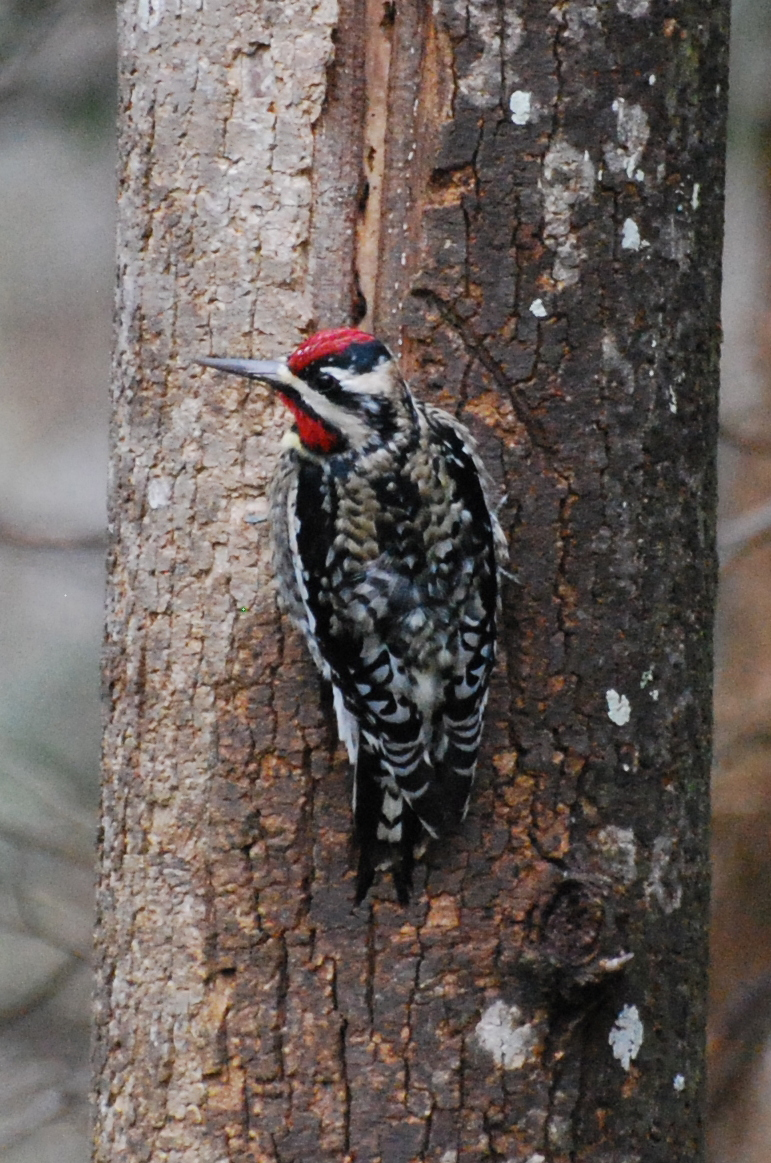
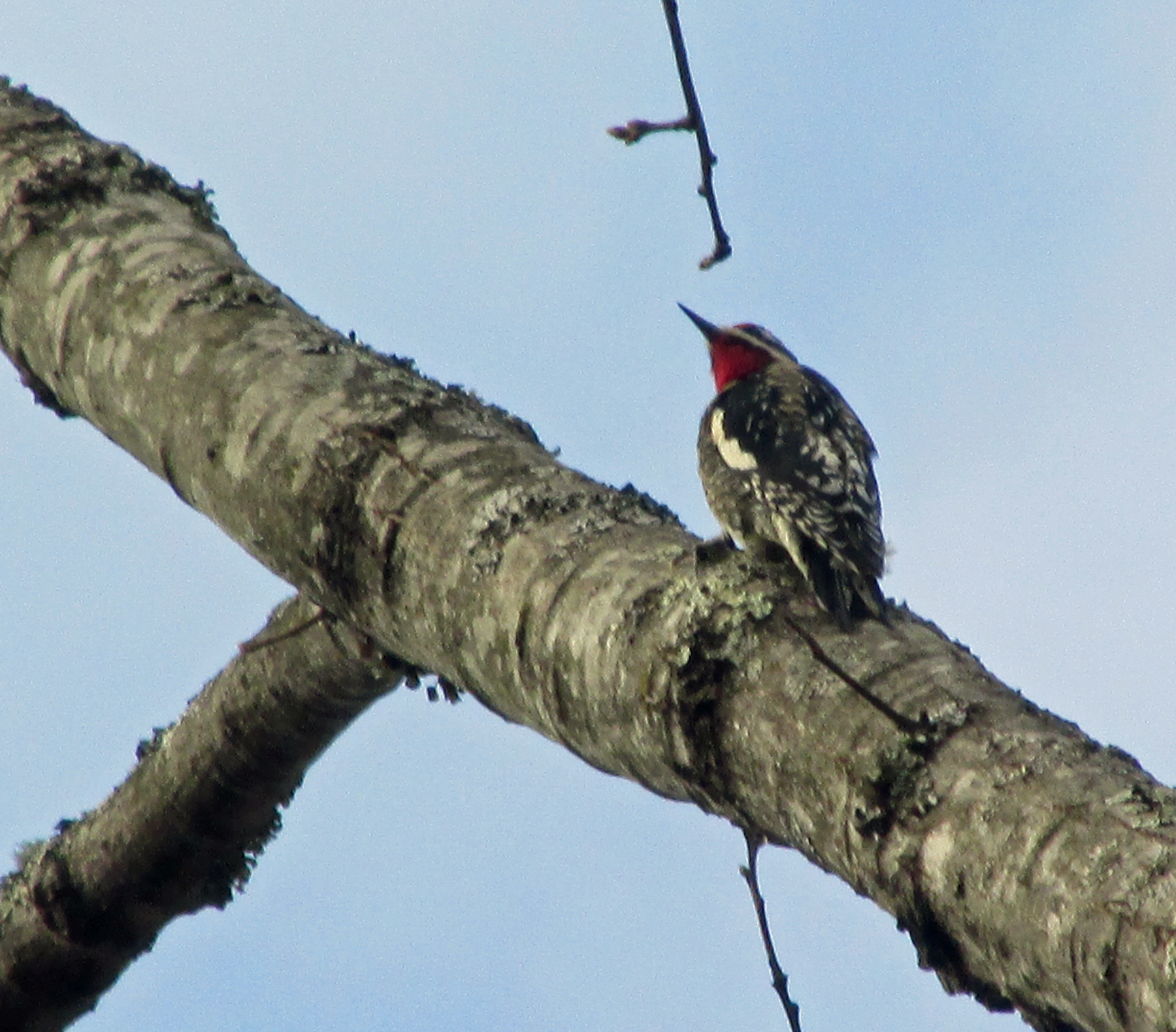
I focused on the downy woodpecker, the smallest member of the woodpecker clan in a post from a couple of weeks ago. This week I am exploring one of the family’s oddball members, the aforementioned (and much maligned) yellow-bellied sapsucker.

In profile clinging to the trunk of a tree, the yellow-bellied sapsucker is a rather pudgy, especially for a woodpecker. The sapsucker has black and white plumage enhanced by red foreheads in both sexes. Male sapsuckers also have a bright red throat patch. Both sexes also show a large white stripe on their black wings. And yes, there is enough of a pale yellow wash on the stomach of this odd woodpecker to justify the descriptive “yellow-bellied” as part of its common name.


COUNT-Sapsucker

Photo by Bryan Stevens                                    This yellow-bellied sapsucker was photographed during a Christmas Bird Count.

Sapsuckers harvest sap by using their bills to drill various sorts of holes into the bark of a tree. Some of the more shallow holes, which are usually made in a rectangular fashion, must be maintained on a frequent basis for the bird to continue to derive sap from the tree. These holes — known as sap wells — not only provide nourishment to the sapsucker but to other birds, including hummingbirds, that appreciate a quick sugar fix. Insects also come to these wells, which function as sticky traps to capture the bugs so they can be eaten later when sapsuckers or other birds return to inspect the wells.

audubon-viii-gleaners-of-forest-and-meadow-yellow-bellied-sapsucker-aka-yellow-bellied-woodpecker

Early naturalist and artist John James Audubon painted the yellow-bellied sapsucker, known during his time as the yellow-bellied woodpecker.

Although they tend to prefer trees like maple and birch, sapsuckers are known to feed on more than 250 different varieties of trees. Indeed, they actually do feed on the trees. Not only do these birds subsist largely on sap, they also feed on the cambium layer in the bark of a tree. The sapsucker also supplements its diet with insects, fruits and seeds. Unlike other members of the woodpecker clan, sapsuckers do not visit feeders all that frequently. When a sapsucker does visit a feeder, it is often lured there by the promise of suet.

While most woodpeckers attempt to tough out the winter season in the same region where they spent the summer, the yellow-bellied sapsucker is migratory. Ahead of the coldest months of the year, sapsuckers migrate to the southeastern United States, as well as the West Indies and Central America. During the summer months, most sapsuckers nest in forests across Canada, Alaska and the northeastern U.S. states. There is also a small population of breeding sapsuckers in the Appalachian Mountains of Virginia, Tennessee and North Carolina.

The yellow-bellied sapsucker has a call that sounds amazingly like the meow of a cat. I know about this call from personal experience. While birding in South Carolina a few years ago, I searched diligently for the source of such a call. It sounded somewhat like a gray catbird — another mimic of the common household feline — but not quite. Now I know that when I hear this unusual call I can train my binoculars on the branches and trunks of nearby trees to scan for a sapsucker.

Redbreasted_Sapsucker

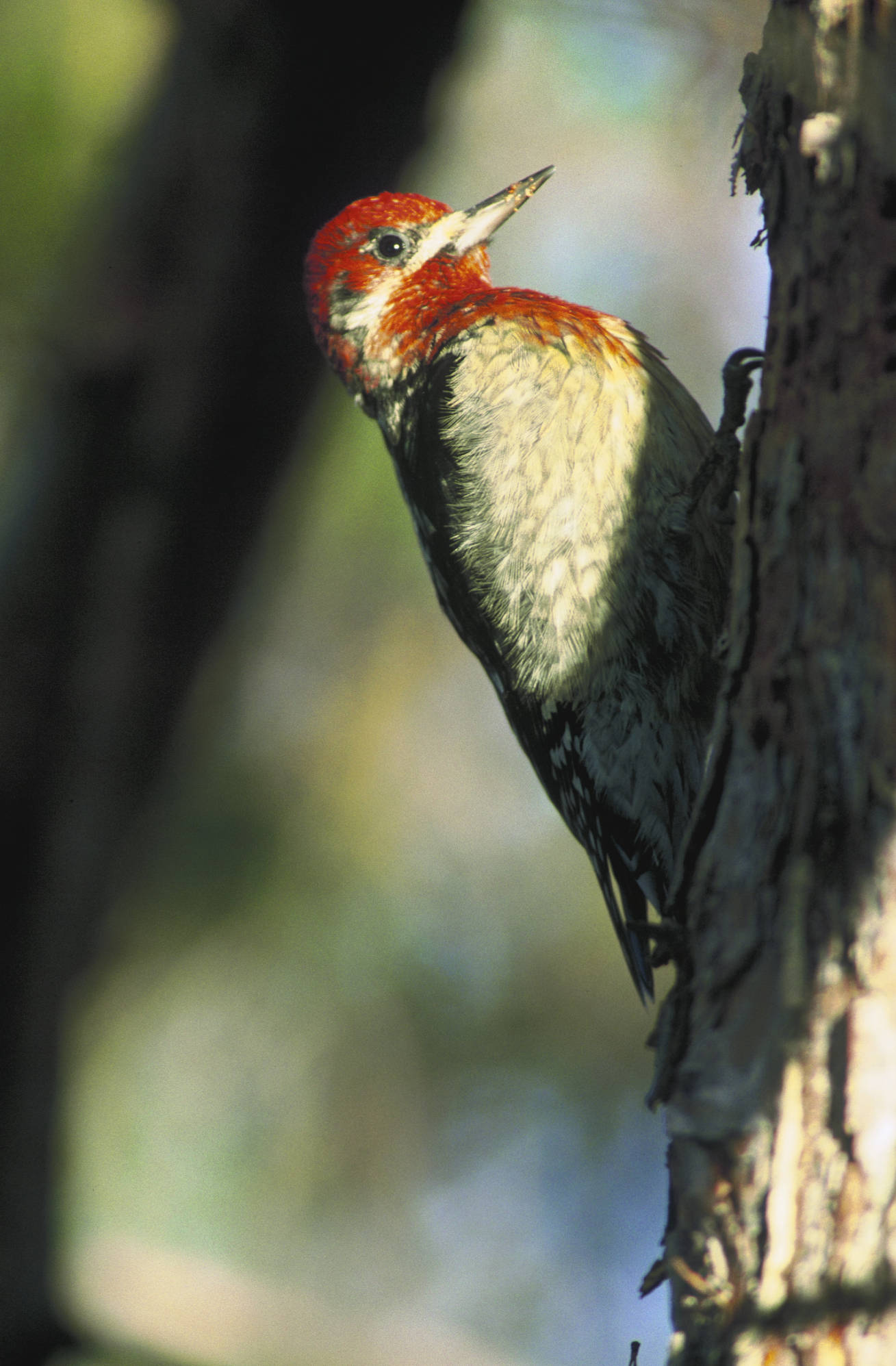
Photo by Dave Menke/U.S. Fish & Wildlife Service The red-breasted sapsucker, shown here, is a relative of the yellow-bellied sapsucker found in the western United States.

There are actually another three sapsucker species — Williamson’s, red-breasted and red-naped — in North America, but they are all birds of the western half of the continent.

It is true of many species of birds that males and females look different. In the case of the Williamson’s sapsucker, males and females look so different that early naturalists mistakenly believed the male and female were entirely different species! Only two decades after the initial discovery of this bird did scientists finally realize that both male and female Williamson’s sapsuckers were the same species. This particular sapsucker was named in honor of Lt. Robert Stockton Williamson, who led a surveying expedition that collected the first male. The intent of the expedition wasn’t focused on collecting birds. Williamson and his men had actually been assigned the job of identifying the best route west for a railway to the Pacific Ocean.

I’ve actually seen very few yellow-bellied sapsuckers at my home, but it isn’t too difficult to find this bird during fall migration and in the winter months at city and state parks in the region. If you observe a yellow-bellied sapsucker in your own yard, consider yourself lucky to get a glimpse of this oddball woodpecker.

••••••

To learn more about birds and other topics from the natural world, friend Stevens on Facebook at https://www.facebook.com/ahoodedwarbler. He is always posting about local birds, wildlife, flowers, insects and much more. If you have a question, wish to make a comment or share a sighting, email ahoodedwarbler@aol.com.
Winter storms can’t ruffle feathers of the downy woodpecker


Winter Storm Jonas was one for the history books, but the birds at my home weathered the wintry conditions without ruffling their feathers all that much.WinterStormJonas_Top-620x380

The storm reminded me of a major blizzard back in 1993 that set me on the path to becoming the enthusiast about birds that I am today. The Blizzard of ’93 — which was dubbed “a storm of the century” — killed more than 300 people and dumped more than 20 inches of snow across a vast swath of the Appalachians and the Northeastern United States. Fierce winds blew snow around into massive drifts. That storm developed on March 12, 1993, and dissipated by March 15, 1993.

Downy-Topsy

Photo by Bryan Stevens                                  Snow doesn’t deter a determined downy woodpecker.

Winter Storm Jonas dumped almost 11 inches of snow at my home, which was considerably less than back in 1993 when about three feet of snow accumulated. I remember the winds being more fierce with the ’93 storm, as well. Fortunately, my electric power never faltered through either of the storm, but my family was quite stranded for several days in 1993. With very little else to do, I watched my feeders. I remember observing birds like cardinals and juncos endured buffeting winds as they flocked to feeders that I had just placed in the yard earlier that winter. It was the beginning of my desire to learn more about birds, including training myself to identify the various species I encounter at home and afield.

More than 20 years later, the recent Winter Storm Jonas sent a variety of birds flocking to my feeders after what has been a lackluster start to the winter bird-feeding season. Some unexpected visitors — a male red-winged blackbird, two European starlings and a few purple finches — made their first appearance for the winter.

Downy-2

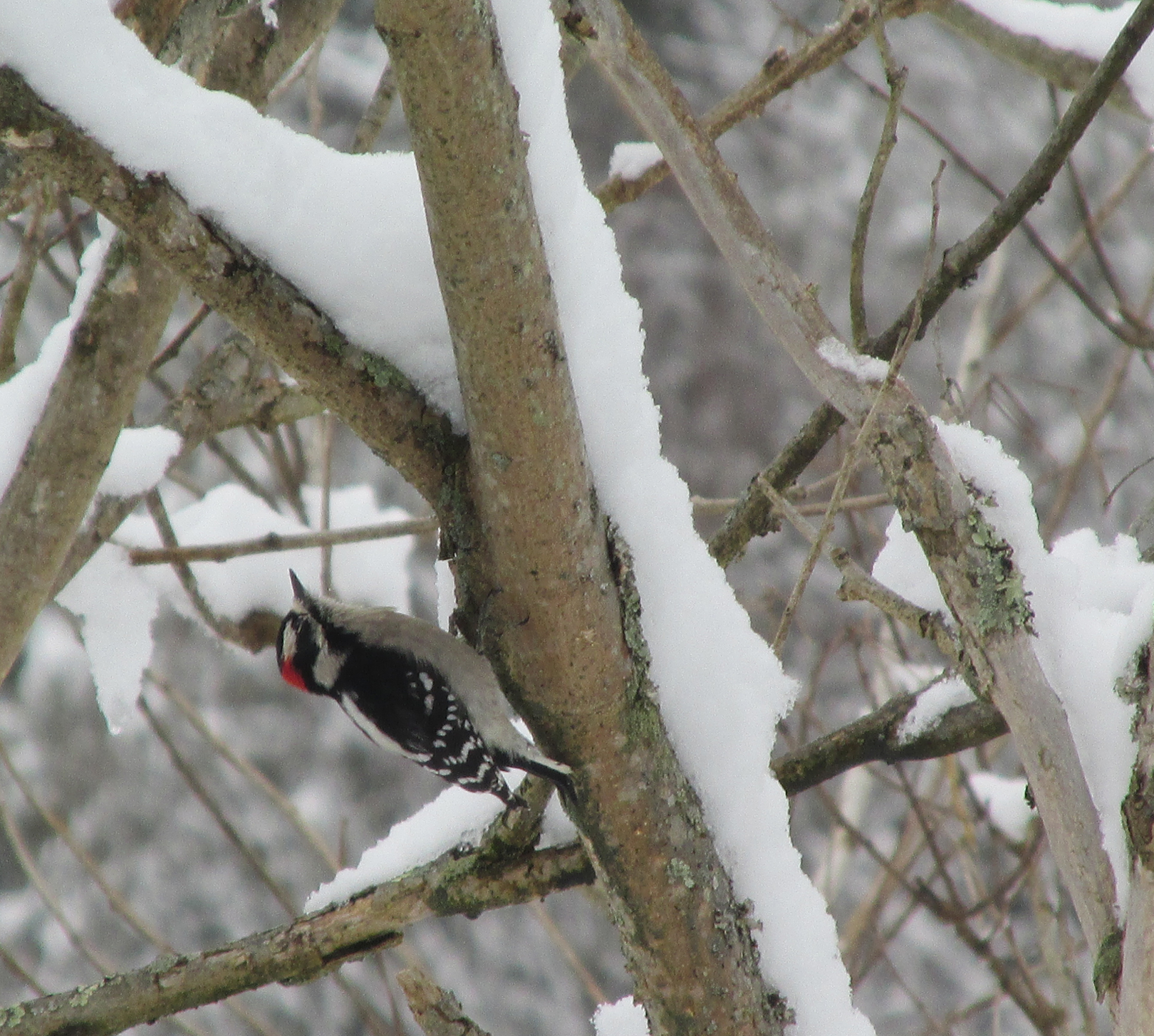
Photo by Bryan Stevens                                    Only the male downy woodpecker sports the red patch of feathers on the back of its head.

The most common visitors at the feeders were the dark-eyed juncos. I estimated that about two dozen of these “snow birds” spent most of the storm perched on my feeders or foraging on the ground beneath them. I also observed numerous Northern cardinals, Eastern towhees, American goldfinches, white-breasted nuthatches, Carolina chickadees, white-throated sparrows, song sparrows and more.

DUo-Downy-Titmouse

Photo by Bryan Stevens                                        A tufted titmouse and downy woodpecker share space at a suet feeder.

One bird that visited frequently also did so with amazing discretion. The downy woodpecker is a small black-and-white bird that often infiltrates a mixed flock of birds to nab a sunflower seed or grab a bit of suet before the other members of the flock are even aware of its presence. Perhaps because of its status as the smallest of the North American woodpeckers, the downy woodpecker is quite good at not drawing attention to itself.

Not only is the downy woodpecker the smallest of the woodpeckers in the United States, it’s also the most common. It’s the woodpecker that most bird lovers encounter in the yards and at their feeders. However, the downy is not the smallest woodpecker in the world. That distinction goes to species known as “piculets” that reside in Asia and South America. Worldwide, more than 180 species of woodpeckers thrive almost worldwide, only absent from the continents of Australia and Antarctica.

Hairy_woodpecker

Photo by U.S. Fish & Wildlife Service The hairy woodpecker is a larger look-alike relative of the downy woodpecker.

The dainty downy woodpecker has a larger lookalike relative. The hairy woodpecker not only bears a strong resemblance to the downy, but shares similar habitat, as well. Despite almost identical plumages, the two species are quite different in size. The downy, at six inches in length, is the size of a sparrow. The larger hairy woodpecker almost 10 inches in length, making it closer in size to a robin.

As most birders know, size is often difficult to determine, especially if you don’t have a downy and hairy woodpecker in close proximity. The deciding factor is usually a good look at the beak of these two birds. A downy woodpecker has a short, stubby, almost un-woodpecker-like bill. The hairy woodpecker, on the other hand, has a large bill like those of such relatives as red-bellied woodpecker and Northern flicker.

Downy-Male-Feb23

Photo by Bryan Stevens                                                    A downy woodpecker visits a feeder for a shelled peanut.

The downy woodpecker is a cavity-nesting bird, but the species does not usually accept man-made nesting boxes although they often utilize them for roosting purposes. Downy woodpeckers endure frigid nights not only by finding a cozy roosting spot but by also lowering their body temperature. This action is a form of controlled hypothermia that is also practiced by such small birds as chickadees, kinglets and hummingbirds.

Downy woodpeckers have a way of hitching themselves along trunks and branches in a jerky fashion. Although not silent by any means, the downy woodpecker limits its utterances to a range of “peents,” as well as a high-pitched jumble of descending notes often described as a “whinny.” Of course, they also make themselves heard by pounding against tree trunks and branches like their larger relatives.

Female-Downy1

Photo by Bryan Stevens                                Downy woodpeckers are quite comfortable climbing along tree trunks and branches.

A pair of downy woodpeckers makes a great addition to the diversity of birds in any yard. Don’t fret too much about them when the weather turns nasty. Despite their small sizes, they have a huge arsenal of adaptations to deal with the cold. Whether its a modest flurry or the “storm of a century,” the downy woodpecker’s not likely to ruffle many feathers in coping.

••••••

To learn more about birds and other topics from the natural world, friend Stevens on Facebook at https://www.facebook.com/ahoodedwarbler. He is always posting about local birds, wildlife, flowers, insects and much more. If you have a question, wish to make a comment or share a sighting, email ahoodedwarbler@aol.com.