Tag Archives: Fall migration

House finch origin story in region has unusual twist

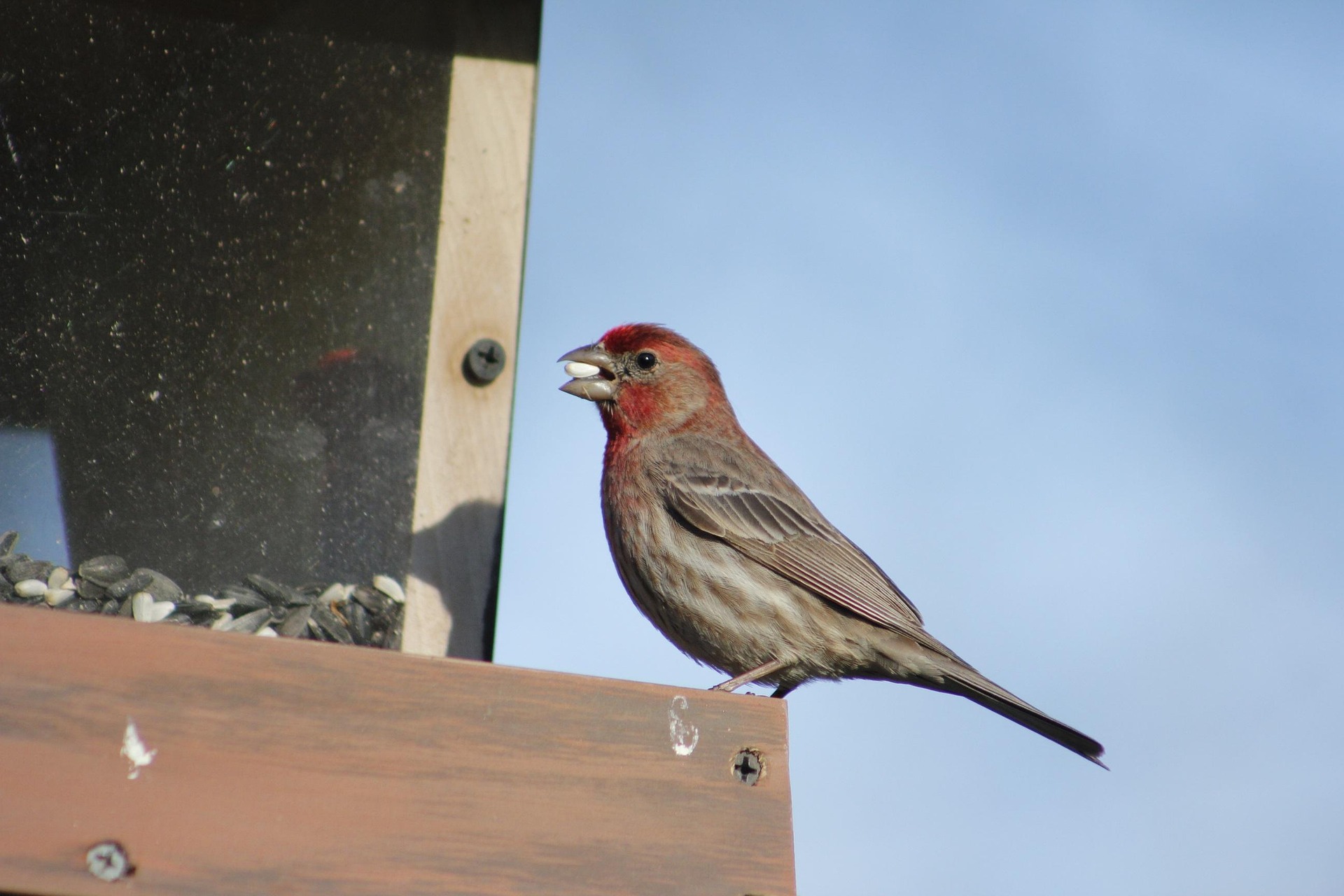
Photo by GeorgiaLens/Pizabay • A male house finch visits a feeder. Flocks of these small finches can become regular feeder visitors. Credit: GEORGIALENS/PIXABAY

I received an email from Unicoi residents Judy and Bill Beckman asking for a reason to explain a sudden absence in house finches at their feeders.

“For a number of weeks now, our house finches have disappeared from our feeders,” they wrote in the email. “They are usually the dominant number of birds. We do not recall this happening before. Any thoughts?”

I answered, explaining that the birds will probably return. Exactly when the finches decide to return to the couple’s yard is more problematic.

In fall and spring, even birds that don’t normally migrate get a bit restless. I suggested that the house finches could just be exploring somewhere else nearby.

My best guess is the finches they will return. As I explained in my answer, the Beckmans have probably provided a generous buffet for the birds. They will remember where the best free lunch is served.

Photo by Bryan Stevens • A male house finch perched on a cable. These finches are native to the western United States but became established in the eastern states thanks to the illicit pet trade.

The house finch is an interesting species. Until the 1980s, this species was not present in Northeast Tennessee. Although this finch is a native North American bird, it is not truly native to the Eastern half of the continent. All the house finches in the Eastern United States are descended from captive birds released into the wild by dealers in the exotic bird trade.

About 1940, the house finch became established in the eastern United States. In violation of federal law, these small finches were being sold in New York City as pet birds described as “Hollywood Finches.” To avoid trouble with authorities, vendors and even some owners released their “Hollywood Finches” into the wild. Finding the area around New York City to their liking, house finches thrived spread. Within a few decades, they were common birds throughout the eastern United States, including Tennessee, Virginia and North Carolina. The house finch had also been introduced into Hawaii about 1870, and is still present today, along with many other species of birds not native to the islands.

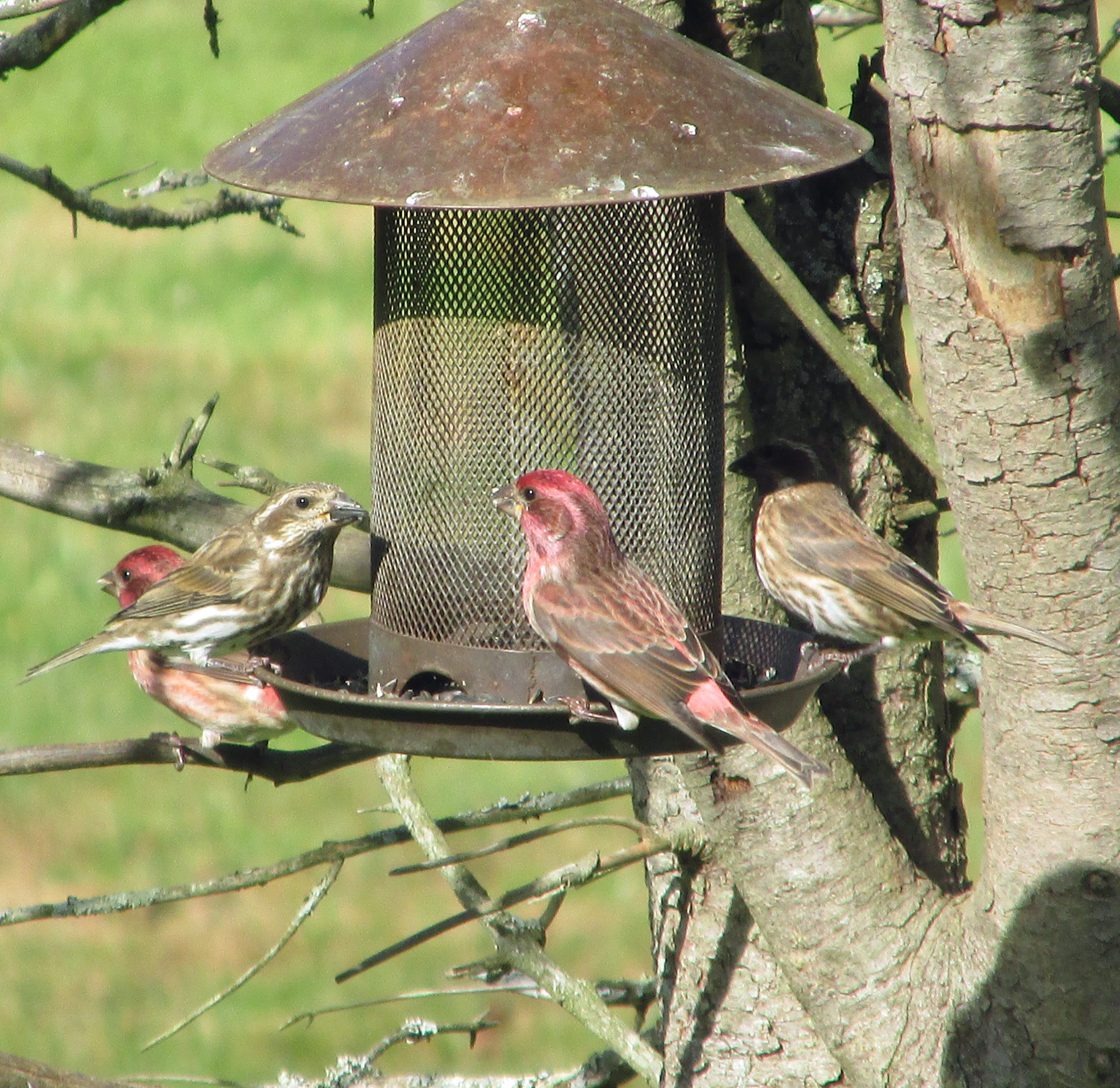
As the house finch claimed a new range, the species inevitably encountered the related purple finch. During the winter, both finches are often present at feeders in the region. When both are available for observation, bird enthusiasts should take advantage of the opportunity to compare and contrast these birds.

Personally, I have never had any difficulty distinguishing a purple finch from a house finch. The two species, at least in my eyes, are easily recognized. I can understand why some people might have trouble separating the two birds. The late Roger Tory Peterson once described the purple finch as a bird “dipped in raspberry juice.” Think about that imagery for a moment and you’ve got a good start to distinguishing a male purple finch from a male house finch.
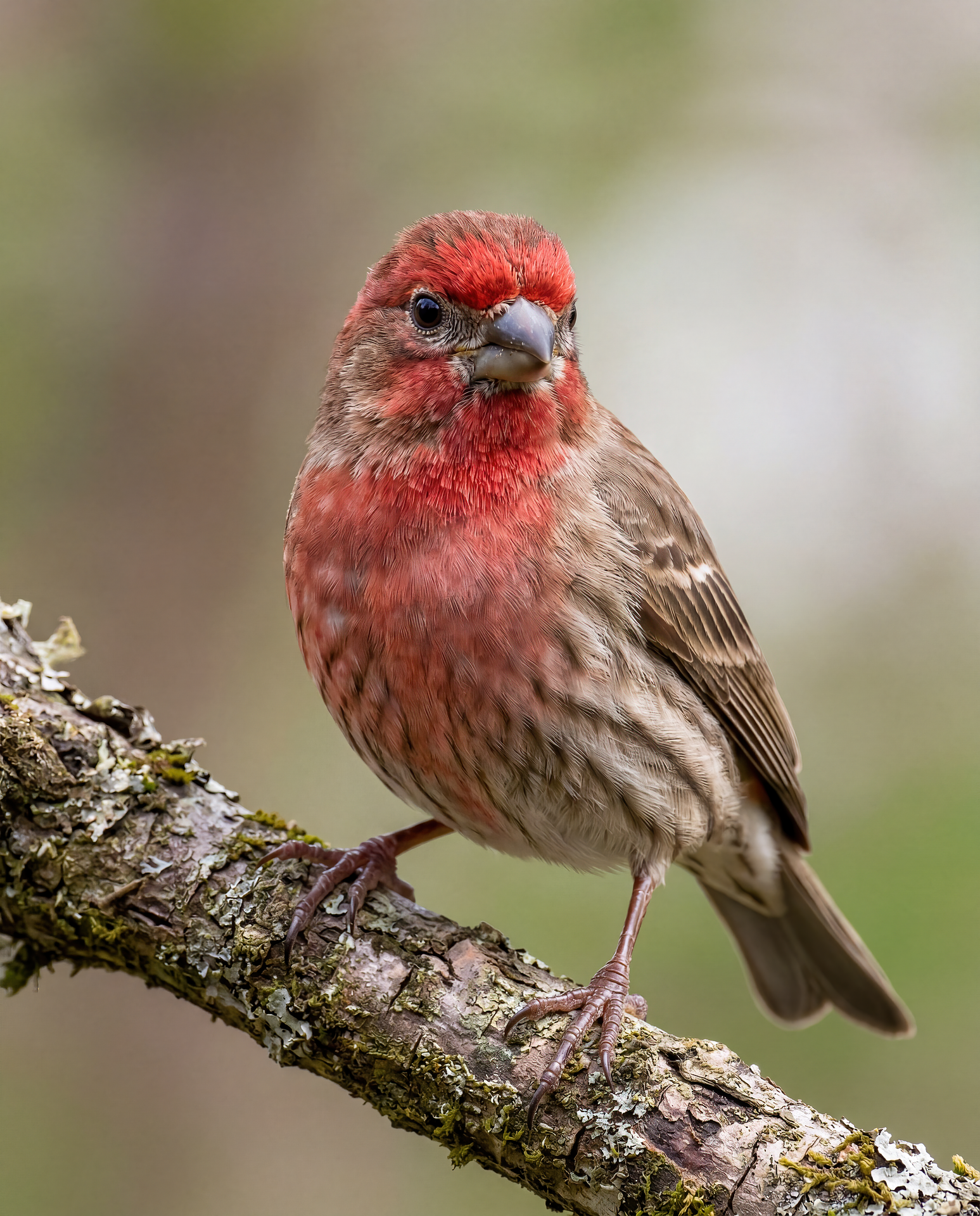
Photo by Ray Shrewsberry • A male house finch perches on a branch. This bird species has been introduced into locations nature never meant for the bird to live.

The females of both species are a different matter. However, purple finch females have a more distinctive facial pattern and a heavier bill than do female house finches. With a little practice, it’s not difficult to identity these two species in the field. In Northeast Tennessee, house finches and purple finches are usually only present together during the winter months when purple finches occasionally flock to our feeders.

In their native range in the western United States, house finches have adapted to a range of habitats, including deserts, grassland, chaparral and open woods. Another related species in the Western United States is Cassin’s finch, which is a species found mostly in high-elevation regions dominated by tall evergreen or coniferous forests.

The house finch is an abundant bird. According to the Partners in Flight, there are an estimated 40 million house finches ranging across North America.

They have also proven resilient. House finches are susceptible to some contagious diseases, including Mycoplasma gallisepticum, a bacterium that causes chronic respiratory disease in chickens and infectious sinusitis in turkeys, chickens, game birds, pigeons and passerine birds. House finch populations in the Eastern United States crashed in the 1990s due to the epidemic prevalence of the bacteria. Their numbers have since stabilized, although the species remains vulnerable to infection from the bacteria. Infection with the bacteria often leads to conjunctivitis characterized by swollen, encrusted, nasal discharges, impaired vision and weight loss. Infected birds usually succumb to slow starvation or predation. House finch conjunctivitis is most frequent during colder months when birds congregate and flock to bird feeders. Anyone who fed birds during the 1990s likely witnessed the disease at their feeders.

They also proved to be a songbird susceptible to West Nile virus, but most house finches and other songbirds recover from this mosquito-borne disease. Crows, ravens and jays, however, are vulnerable to the disease.

Overall, although a strange twist of fate brought the house finch into Tennessee and other parts of the Eastern half of the nation, this bird has become a welcome visitor. Males have a cheery song and bright plumage. By all accounts, it’s also here to stay.

I’m going to have to keep a closer watch over my own feeders. I had a pair that visited regularly at the start of the summer season. It’s time to see if they’re back with a new generation of house finches.

•••

Bryan Stevens has written about birds, birding and birders since 1995. Email him at ahoodedwarbler@aol.com.
These migratory birds are true champions

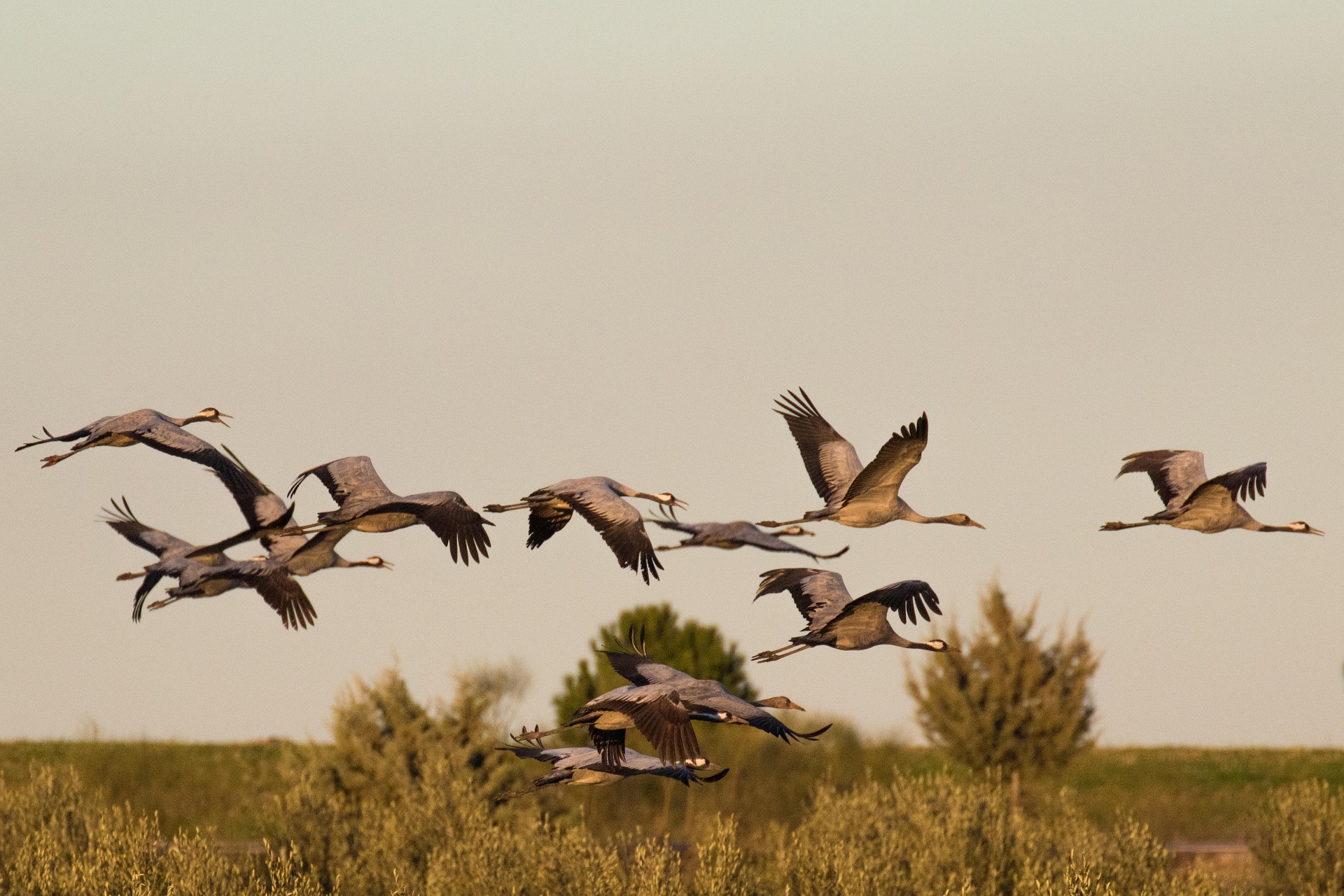
ANNE AND SATURNINO MIRANDA/PIXABAY • The common crane holds a record achieved by the feat of flying over the Himalayans at a height of 37,000 feet. However, this is not a typical flight. They usually fly below 3,280 feet.

As it does every year, September’s arrival puts fall migration into sharp focus. The birds that returned this past spring — the warblers, vireos, tanagers, grosbeaks, flycatchers, hawks, hummingbirds and many more — have begun or are beginning to make their way back to the locations where they will spend the winter months far from the cold, bleak conditions over most of North America.

On recent mornings as I leave for work I have heard the buzz of hummingbird wings, as well as the scolding calls of red-eyed vireos from the woodlands around my home.

Some of these birds migrate out of the tropics every spring to avoid competition. Others find North America a land of abundant, albeit temporary, resources. This land of plenty offers a wealth of insects, seeds, fruit and other nourishing, nutritious food to help parent birds keep their strength while they work to ensure their young thrive. Of course, once the bountiful period concludes, they return to the tropics of Central and South America to winter. Those that do so successfully will make the journey back to the United States and Canada in the spring. It’s an ongoing cycle, repeating year after year, season after season.

The phenomenon of migration isn’t exclusive to the neotropical migrants of the New World. Birds in other parts of the world migrate, too. Waterfowl, shorebirds and raptors are among some of the families of birds that stage impressive migrations.

Here are some migration achievements of some of our feathered friends:

Elevation Champ
The Himalayas represent a mountainous challenge for many migratory birds. Some birds, however, shrug off the astonishing heights of the world’s tallest mountains. The common crane holds a record achieved by the feat of flying over the Himalayans at a height of 37,000 feet. However, this is not a typical flight for these cranes. In fact, they usually avoid flying over mountains. They usually fly below 3,280 feet. The regular migrant that does fly at loft heights is the bar-headed goose, recording reaching 29,000 feet. These geese regularly fly over the peaks of the Himalayas when migrating.

Long-distance Champ
The Arctic tern truly takes migration to extremes. This small seabird travels each year from its Arctic nesting grounds to the Antarctic region, where it spends the winter months. Put into terms of mileage, the Arctic tern can travel about 50,000 miles in a single year. For a bird with a body length of about 15 inches and a wingspan of about 28 inches, this incredible migration is an astonishing feat. These statistics permit the Arctic tern to easily lay claim to the title of champion migrant among our feathered friends.

Tiny Champ
The ruby-throated hummingbird, a favorite of many bird enthusiasts living in the eastern United States, makes an impressive migration each year. Just to reach the United States, these tiny birds undertake a strenuous journey. They leave their wintering grounds in Central America to return to the United States and Canada for the nesting season. Most of these tiny birds, which are barely four inches long, make a non-stop flight of more than 500 miles across the Gulf of Mexico. The journey can take almost an entire day. With the end of summer, the entire population of ruby-throated hummingbirds, increased by a new generation of young birds, makes the Gulf crossing for a second time in a year to return to the American tropics for the winter months.

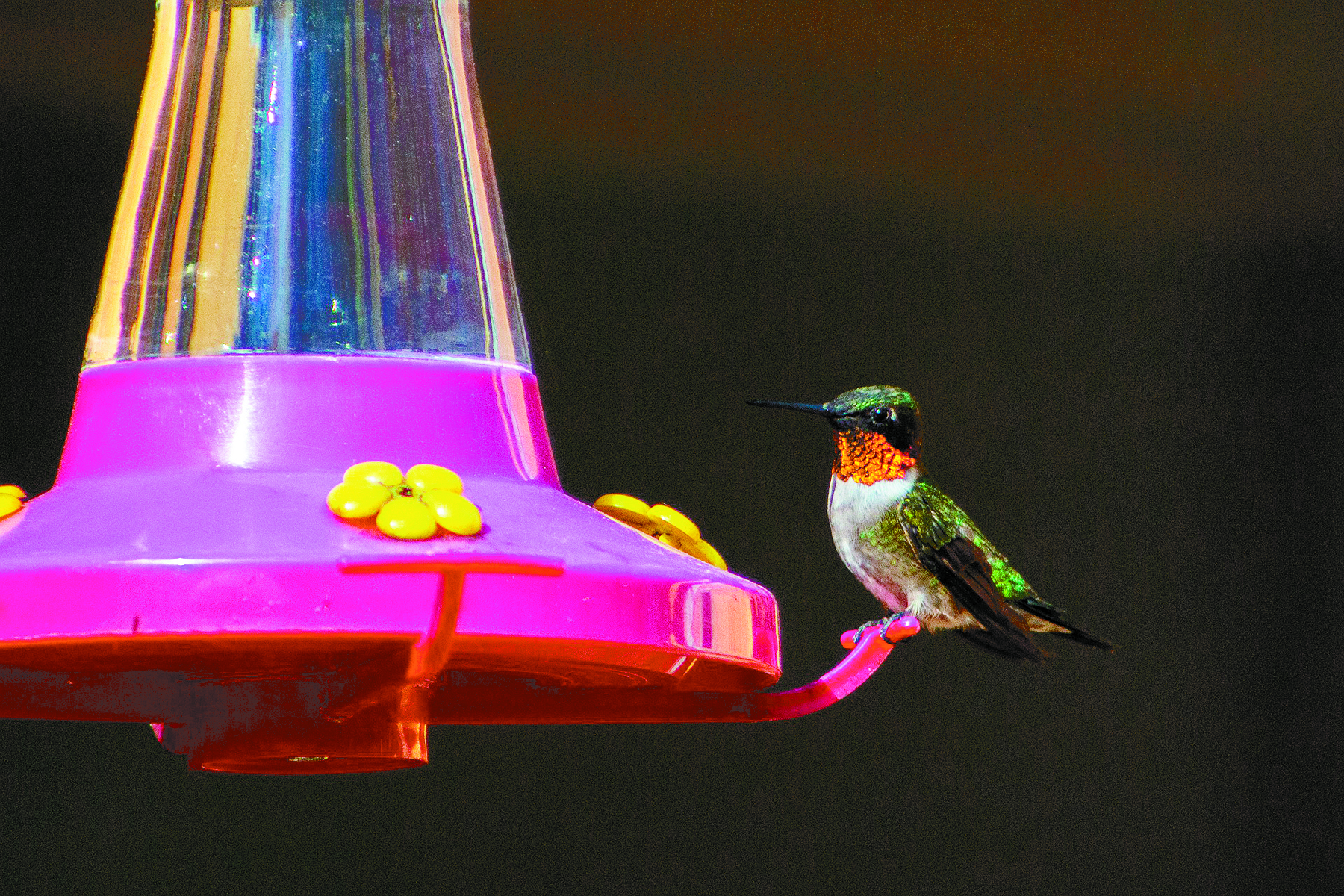
Photo by Bryan Stevens • A ruby-throated hummingbird perches at a feeder for a sip of sugar water.

Dedicated Champ
Among North America’s buteo hawks, which includes raptors such as red-shouldered hawk and red-tailed hawk, the broad-winged hawk stands out as a dedicated migrant. These hawks form flocks that at times number in the hundreds or thousands as they sail and glide on thermals rising over various mountain ranges. These hawks and other raptors are well-known in the region for migrating past the Mendota Fire Tower in Southwest Virginia every September and early October. The broad-winged hawk’s counterpart in the western United States is Swainson’s hawk, which shares the broad-winged hawk’s inclination for migrating in large flocks. Swainson’s hawk is named for William Swainson, the famous 19th century English naturalist for which Swainson’s thrush is also named.

Warbler Champs
My favorite family of birds, the warblers, are seasonal migrants. The Northern parula, a warbler species that regular spends the spring and summer months in the woods around my home, winters in Mexico, Central America, the Caribbean and southern Florida. The Northern parula breeds across the eastern half of the United States and southeastern Canada. It’s not a migration of an incredible distance, but it’s still quite an accomplishment for a bird less than five inches long and weighing less than half an ounce.

Photo by Bryan Stevens • The Northern parula, like most warblers, is a medium- to long-distance migrant.

Another warbler is a true migratory champion. Few warblers make as great a journey as the blackpoll warbler. Instead of migrating over land, this five-inch-long warbler undertakes a two-stage migration. The first half of the migration is a non-stop flight of about 1,500 miles. Every fall, these tiny birds fly over the Atlantic Ocean during this part of their migration, departing from Canada or the northern United States and not stopping until they reach various locations in the Caribbean. There they will spend some time recovering from the exhausting first half of their journey before they continue their way to such South American countries as Colombia and Venezuela. Once again, during the time they spend flying over open ocean, these tiny warblers do not feed.

Fall’s a great time to witness the variety of avian life. Look for some of these migrants passing through your yards, gardens or favorite birding spots.

For those wanting suggestions for seeking out migrating birds, the linear trail in Erwin, Rocky Fork State Park in Flag Pond and Limestone Cove Recreation Area are some good bets.

Too short a season: Hummingbirds’ stay coming to a close

Photo by Katy Jefferson/Pixabay • A male ruby-throated hummingbird perches on a sugar water feeder.

September’s right around the corner. Then comes fall, then winter, and the cycle of the seasons continues to advance.

Always there as signals to herald the imminent approach of a new season are the birds. Our feathered friends are quite remarkable in that regard.

I heard from Elizabethton resident Susan Peters recently via email about my recent columns on catbirds.

She reported that she has noticed that catbirds return almost exactly at the same time as the hummingbirds every year. She described the catbirds as very chatty for awhile when they first come back.

“I just assumed they were letting everyone else know they were back,” she wrote.

I agree with her. I think the constant vocalizing of the catbirds is an announcement to human neighbors as well as their fellow feathered kin that they are back in the vicinity.

Catbirds appear to stage different high profile periods during their yearly stay. My own catbirds are always at their most chatty when they first return in the spring, in later summer after the nesting season when they “reappear,” and again in fall just before they depart for their wintering grounds.

Photo by Bryan Stevens A curious Gray Catbird peeks from dense cover. Attendees at the fall rally can look for catbirds and other species at any of the offered bird hikes.

It was the other “feathered friend” mentioned in Susan’s message that I thought I’d riff on this week.

The ruby-throated hummingbird activity is rising at my home. Of course, that’s true for a lot of the wildlife. I’ve seen plenty of white-tailed deer, along with this summer’s fawns, as well as rabbits, groundhogs and raccoons during recent lazy late summer days. I think many of these visitors are trying to dry out from the frequent rainstorms.

If anything, the abundant rain has propelled an explosion of blooms, including jewelweed, a definite hummingbird favorite. Before the jewelweed burst into bloom a healthy crop of tiny red crocosmia blooms kept the hummingbirds coming back for more. I’ve also got some trumpet vines clinging to the wall of the family garage that also serve as a hummingbird attractant.

We’ve got six or seven more weeks to enjoy their company, and then come the inevitable winter months forcing us to await their return next spring as everything goes green once again.

It’s bittersweet when I flip the calendar page from August to September, but there are some good things to anticipate. Every season brings some of its own birds. Fall and winter mean migrating waterfowl, hermit thrushes and crowded bird feeders.

I don’t have anything against fall – it’s my favorite season. But I know that our ruby-throated hummingbirds, which returned only five months ago in early April, will soon be departing.

It won’t be only the hummingbirds. Warblers, orioles, tanagers and other migrants will also fly south to spend the winter season somewhere more hospitable.

Photo by Bryan Stevens • Late summer usually brings a spike in visiting hummingbirds.

Most of the hummingbirds that visited our gardens over the summer are getting ready to migrate back to their winter homes in Central America. The one that returned this spring and successfully nested are being joined at our sugar water feeders by the season’s offspring. That’s the reason there’s a spike in numbers in late summer and early fall.

The New World is home to about 360 species of hummingbirds. In addition to the ruby-throated hummingbird, I’ve seen eight other hummingbird species.

We’ve expended many adjectives in finding names of them all. Sometimes, words fail. Mere adjectives are somewhat inadequate in providing common names for many of the world’s hummingbirds, but that doesn’t keep us from trying to give descriptive names to each hummingbird species. For instance, we have the beautiful hummingbird of Mexico; the charming hummingbird of Costa Rica and Panama; the festive coquette of northwestern South America; and the magnificent hummingbird of the southwestern United States.

Other names are even more elaborate and occasionally outlandish, such as the white-tufted sunbeam of Peru; the violet-throated metaltail of Ecuador; the violet-throated starfrontlet of Peru and Bolivia; the hyacinth visorbearer of Brazil; and the rainbow-bearded thornbill of Colombia and Ecuador.

And in East Tennessee and across the entire eastern half of the North American continent, we have the ruby-throated hummingbird. It’s the single representative of this huge family of birds in this part of the world.

For the young birds, this will be their first epic crossing of the Gulf of Mexico, something the species must do twice a year to get to and from their summer home in eastern North America. We use the word “epic” far too often to describe achievements, but it applies to the feat of this tiny bird.

Photo by Bryan Stevens • A ruby-throated hummingbird visits a feeder for a sip of sugar water.

These tiny birds are about 3.5 inches in length and weigh two to six grams. That’s the weight of a penny.

Think about it. Something so small is able to fly 500 miles across open water between the U.S. Gulf Coast and the Yucatán Peninsula or Mexico.

This journey takes these tiny birds 18 to 24 hours of non-stop flying, with success depending greatly on the wind and weather conditions.

They can’t feed while flying over the ocean, so they tank up and double their body weight by eating heavy amounts of nectar and insects before the flight.

Some members of the species have chosen a safer coastal route around the edge of the Gulf through Texas instead of direct flight across. This turns a 500-mile journey into one that stretches to 1,000 to 2,000 miles. Regardless, that’s still a truly epic undertaking.

Keep your feeders filled with sugar water and add some extra flowers to your garden this fall seasons. You’ll earn the gratitude of visiting hummers. And, when they return next spring, consider yourself repaid in full.

•••

Bryan Stevens has written about birds, birding and birders since 1995. Email him at ahoodedwarbler@aol.com to share a sighting, make a comment or ask a question.

Make an effort to win over gray catbirds

Veronika Andrews from Pixabay • If all else fails, bribery works well on gray catbirds. Provide these birds with a treat and their confidence is more quickly given.

The gray catbird is a baffling bird with a personality that runs the gamut from introverted to extroverted, sometimes depending on the season and at other times seemingly just on a whim. With some gentle persuasion, however, people can gain a catbird’s trust and develop a fun friendship with these clever songbirds.

Bribery also works. One summer, I only needed to offer some less-than-perfect strawberries and blueberries. A few blemishes on the fruit didn’t bother the resident catbirds at all, and they soon became accustomed to receiving such treats.

Your first introduction to the catbird is likely going to occur when you hear what sounds like an irritable feline hiding in a hedge, thicket or dense shrub. Upon closer examination, you may get a glimpse of a charcoal gray bird roughly the shape of a Northern mockingbird but smaller. A black cap and a patch of rusty-red feathers under the tail are the only exceptions to this bird’s overall gray plumage.

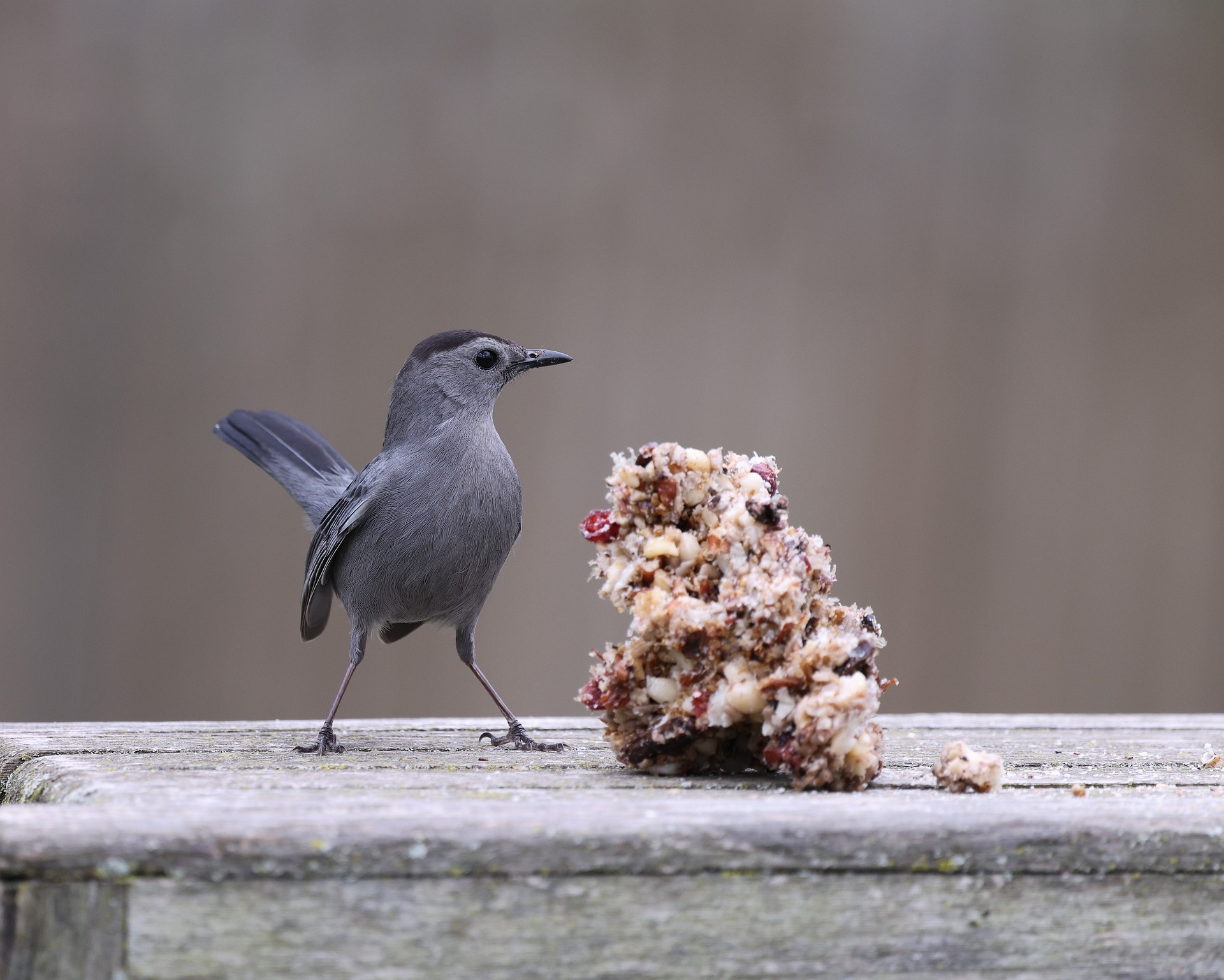
Photo by Bryan Stevens A curious Gray Catbird peeks from dense cover. Attendees at the fall rally can look for catbirds and other species at any of the offered bird hikes.

I’m pleased to note that catbirds are doing well. A profile on the website All About Birds confirms that the species is common and has benefitted from stable populations from 1966 to 2019, according to the North American Breeding Bird Survey. An estimate from Partners in Flight gives the species a breeding population of 29 million individuals spread out across North America. In a time when many bird species are declining, this is welcome news.

Catbirds are experts at concealing themselves from prying eyes. The gray plumage blends into the shadowy sections of the tangles and thickets where the bird likes to hide itself. However, even when gray catbirds are reluctant to be seen, they’re almost eager to be heard. The catbird is extremely vocal, with several calls and songs in its repertoire, including the rather faithful rendering of a fussy cat’s meow that provides this bird its common name.

They’re part of a family related to thrushes that are known as “mimic thrushes.” Besides its surprisingly accurate rendition of a feline, the catbird has several other common vocalizations. Despite their shy nature, they’re extremely curious. Imitating their calls or simply producing a squeaky sound will usually persuade the bird to move out of cover and search for the source of the noise.

Catbirds are part of the parade of returning birds each spring that includes species like rose-breasted grosbeaks, scarlet tanagers, Baltimore orioles and indigo buntings, but because they lack the brilliant plumages of these other birds their arrival would probably go unnoticed if not for the fact they are extremely noisy for the first few weeks they are back. Then they go silent again and remain quieter as they take up the serious business of raising young.

Photo by Bryan Stevens • A gray catbird hides within the branches of a dense shrub.

However, in a mood that appears to swing with the seasons, gray catbirds emerge again in late summer and early fall when they feast on such fruit as elderberries and wild cherries while making their whiny cacophony of calls from any tangle or thicket where they happen to be.

The catbird belongs to the genus Dumetella. The name is based upon the Latin term dūmus, which roughly translated means “thorny thicket.” Dumetella, in turn, means “dweller in the thornbushes” or “small bird of the thornbushes.” It’s a rather apt description for a bird fond of habitats often dominated by thorny vegetation. Older common names for the gray catbird included cat thrush and slate-colored mockingbird.

They are related to thrashers and mockingbirds, but scientists find them just different enough to warrant placing the gray catbird in its own genus. A relative known as the black catbird, which ranges throughout the Yucatan Peninsula of Mexico, as well as northern Guatemala and northern Belize, also belongs to a genus of its own. Both catbirds are classified as “mimic thrushes,” or Mimidae, of which there are about 30 species in the New World. There is a totally unrelated family of catbirds that ranges through Australia, Asia and parts of Africa.

Photo by Bryan Stevens • Gray catbird have a rusty-red patch beneath their tail, occasionally seen as they dive for cover.

The gray catbird is not as an accomplished mimic as some of its relatives, such as the Northern mockingbird. Males have motivation to constantly expand their repertoire, however, as doing so increases the likelihood of attracting a mate. They imitate other birds, but some have been recorded imitating frogs and other non-avian singers.

While not generally considered a bird to visit feeders, people have succeeded in attracting catbirds to feeders designed to offer grape jelly or orange slices. Planting fruit-bearing shrubs and trees is the best means of attracting these fascinating birds to your yard and garden. Leave a few untidy edges to your yard. Gray catbirds will thank you.

•••

Email me at ahoodedwarbler@aol.com to ask a question, make a comment or share a sighting.

Celebrating 30 years of birds, birding and birders

Photo by Bryan Stevens A burrowing owl perches on a sign at Antelope Island State Park in Utah in May 2006.

For the past 29 years, I’ve published my first bird column as close to the anniversary date of its initial publication as possible.

I’m not doing that this year. Instead, in a celebration of writing “Feathered Friends” on a weekly basis for the past 30 years, I am devoting this week’s column to personal reflection.

Has it truly been 30 years? It’s the question I’ve asked myself as the date on the calendar approached, marking 30 years since I began writing my weekly “Feathered Friends” column. The column made its debut in the Elizabethton Star’s Sunday lifestyles section, but since that debut on Nov. 5, 1995, the column has appeared in most of the newspapers in the region, plus a couple in North Carolina.

The column ran from 1999 to 2003 in the Herald & Tribune in Jonesborough and began running in The Erwin Record in 2003. It has mostly run each week in Unicoi County’s weekly newspaper since that time. The column began another run in the Elizabethton Star from 2008 to 2014, followed by a run in the Bristol Herald Courier, as well as in Six Rivers Media publications such as The Tomahawk in Mountain City, as well as Johnson City Press and Kingsport Times.

The column went online via WordPress in 2014 and is still posted weekly on Sundays at ourfinefeatheredfriends.com. I’m still staggered by the fact I’ve been writing this column on a weekly basis for 30 years. Readers have followed my accomplishments in birding, including detailed columns every time I’ve added a new species to my life list.

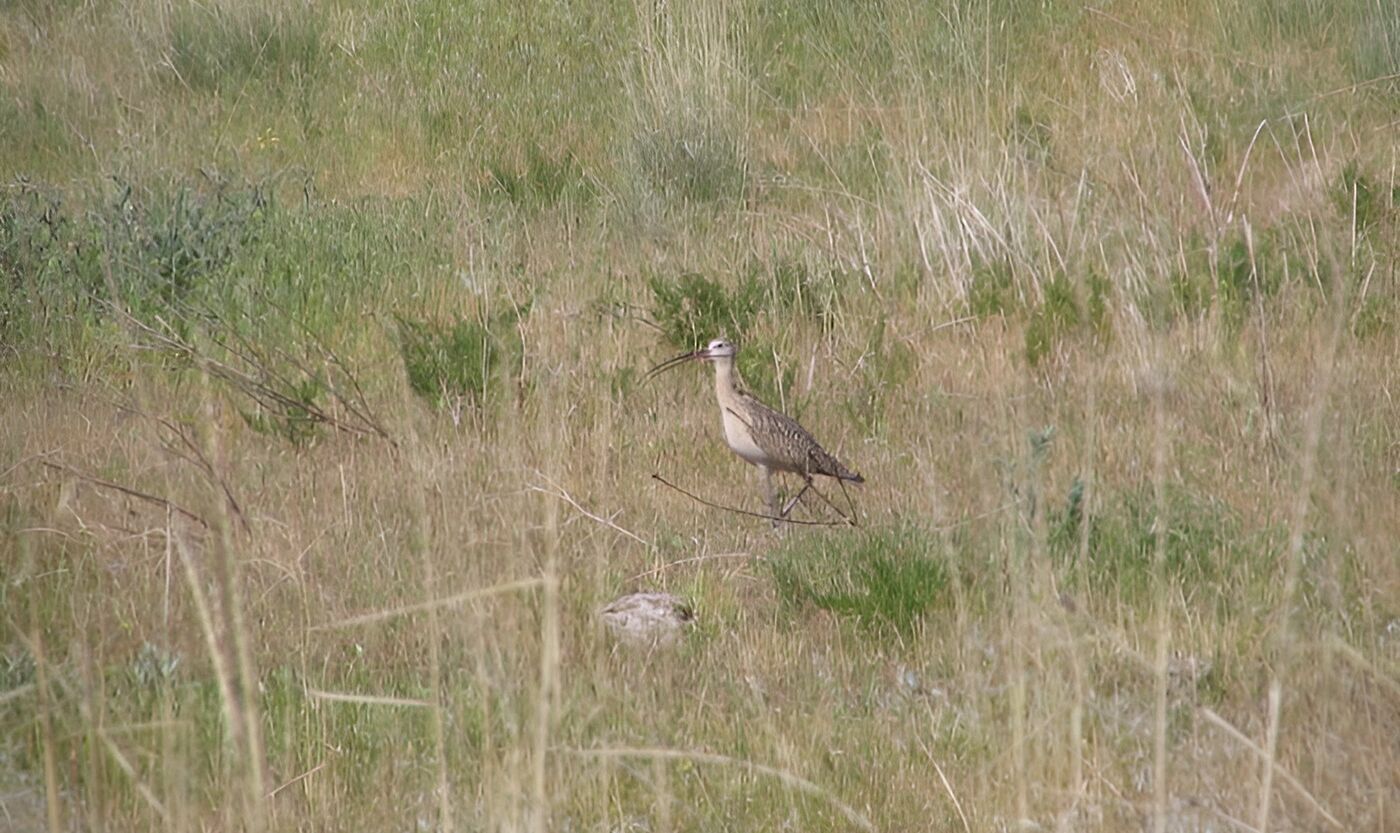
Photo by Bryan Stevens A long-billed curlew calls in a grassland at Utah’s Antelope Island State Park in May 2006.

Those special columns have included birds such as burrowing owl, long-billed curlew, roseate spoonbill, black-necked stilt, Nelson’s sparrow, black rail, swallow-tailed kite, Mississippi kite, grey-cheeked thrush, limpkin, least bittern, American bittern, painted bunting, lazuli bunting, golden eagle, American dipper, Townsend’s solitaire, mourning warbler, clay-colored sparrow, black-headed grosbeak, Western tanager, Northern saw-whet owl, bananaquit and many other memorable species. Just this past summer I added scissor-tailed flycatcher when I observed a female of this species nesting in Jonesborough.

I’ve added several hummingbirds to my list over the years, including Cuban emerald and Bahama woodstar from a trip to the Bahamas in 2000, and black-chinned hummingbird and broad-winged hummingbird from a trip to Utah. I saw a far out-of-range green-breasted mango in Charlotte, North Carolina, and traveled to Nashville to see a Calliope hummingbird, which is also the smallest of North American birds. In Northeast Tennessee, I’ve seen numerous rufous hummingbirds and a couple of Allen’s hummingbirds, both of which are western species with a perplexing habit of migration through the region and showing up in unlikely locations.

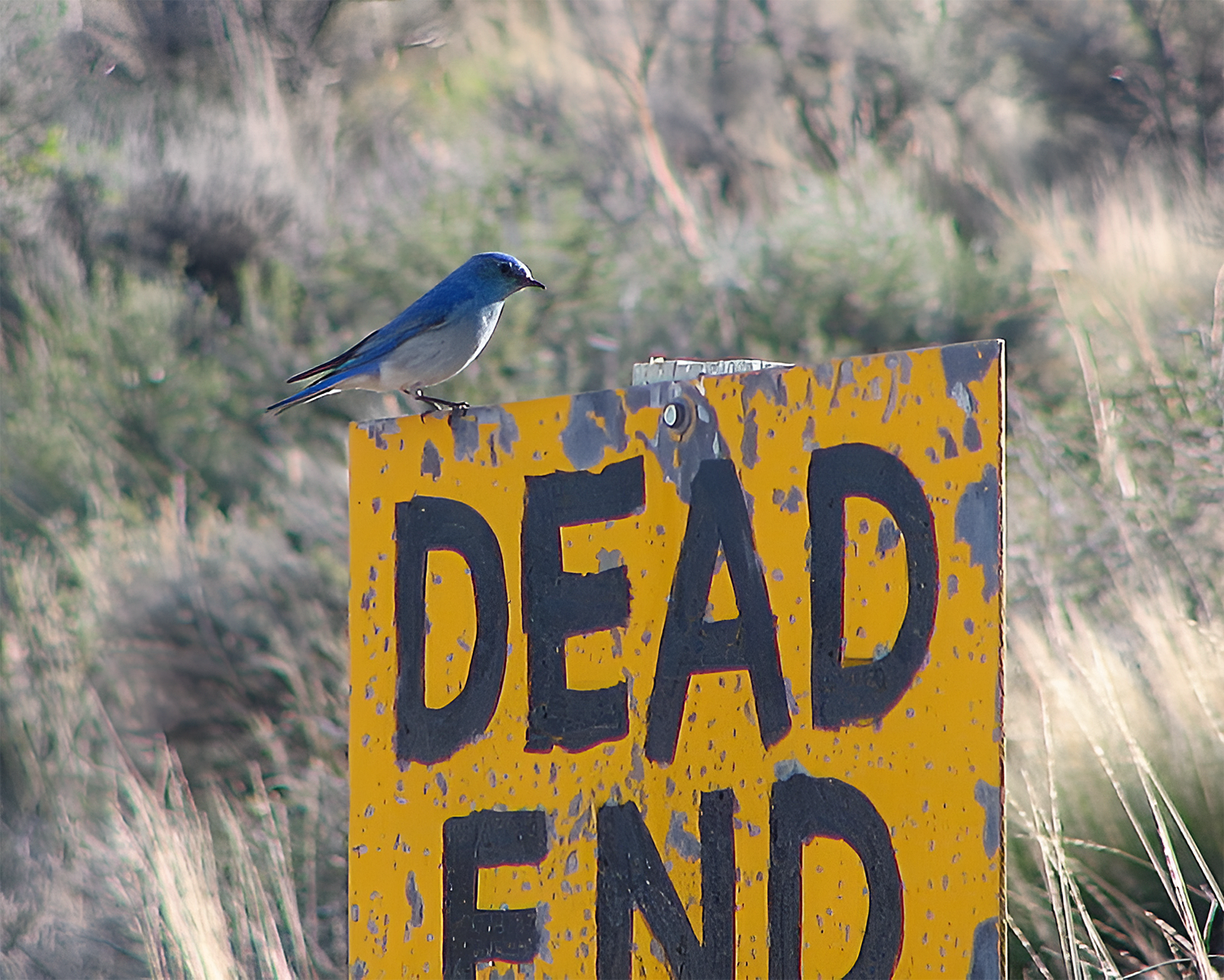
Photo by Bryan Stevens A mountain bluebird at Sweetwater Trailer Park and Campground at Garden City, Utah, on the shores of Bear Lake. Despite the sign, this location was certainly no “dead end” when it came to birding.

Even more than the birds, however, are the people I’ve met through this weekly column. I’ve been able to share stories about birding with people like Howard Langridge, Reece Jamerson, Gilbert Derouen and Wallace Coffey. They’re all gone now, but I have my memories of our time together looking for and finding some memorable birds.

I’ve met people like Brookie and Jean Potter, Tess Cumbie, Gary Wallace, Barbara Lake, Rick Knight, Joe McGuinness, Charles Moore, Fred Alsop, Allan Trently, Brenda Richards, Chris Soto, Rob Biller and Brayden Paulk. I’ve left out names because in all honesty there are too many to list. I’ve shared stories about Tom and Cathy McNeil, a couple who have chased rare birds such as buff-breasted sandpiper, snowy owl and hurricane-displaced American flamingos.

I’ve had adventures. I got stuck in mud at Musick’s Campground with Howard Langridge at Holston Lake as Hurricane Frances passed through the region in 2004, but we got a sooty tern!

Photo by Bryan Stevens A least bittern slips through marsh vegetation at Huntington Beach State Park in South Carolina.

While birding with Reece Jamerson at Austin Springs on Boone Lake, an American bittern walked up to us from a flooded ditch, absolutely fearless, and got so close we didn’t even need binoculars. Of course, we also hadn’t brought cameras.

I stood in freezing conditions for hours with dozens of birders in 2009 Springfield, Tennessee, scanning a field littered with plastic and other debris hoping for a glimpse of a reported snowy owl. Just as everyone was ready to give up hope, the owl, present all along, transformed from a white plastic bag into a fully feathered owl. It even made a short flight as if to reward everyone for their patience.

Visiting Antelope Island State Park in the middle of the Great Salt Lake in May 2006 with David Thometz and his parents, we saw many birds, the highlight being a long-billed curlew. We were driving on a road bordering a huge expanse of grassland facing the Great Salt Lake. I remarked that this looked like great habitat — I had done my homework in advance – for long-billed curlews. The words had barely left my mouth when we heard some whistled notes and saw my first-ever (and, to date, only) long-billed curlew. Even better, I managed to get a photo of the bird. We also saw thousands of horned grebes, as well as a photogenic burrowing owl, Western meadowlarks, chukars, lark sparrows and many other interesting species. Later during that same trip while traveling through Logan Canyon near Salt Lake City, I was mesmerized by an American dipper and then some Townsend’s solitaires that crowded into the scene.

Photo by Bryan Stevens A painted bunting visits feeders at Huntington Beach State Park.

On a November visit to Boone Dam with Wallace Coffey, we scanned a flock of gulls on a sandbar. When these white birds suddenly dispersed, one larger white bird that stayed behind became my first-ever sighting of a snow goose. I think Wallace’s excitement that I had gotten a life bird was even greater than my own.

Of course, my birding memories go farther back than these 30 years I’ve been writing this column. I remember the yellow birds (American goldfinches), the red birds (Northern cardinals) and blue birds (Indigo buntings) that visited each summer of my childhood. I can still hear the nocturnal serenades of whip-poor-wills that called from the woodlands while I saw on the front porch with my paternal grandparents at their home. The headlights of passing vehicles would silence them momentarily, but then one would begin calling again, and soon others rejoined the chorus. When lighting bugs added their visuals to the audio, we had all the makings of a perfect evening in the pre-Internet era.

To offer perspective, my column got its start with a feature on dark-eyed juncos, also known as “snowbirds.” With the recent dip in temperatures, I have a feeling it won’t be long before we start seeing these winter visitors.

I’ve got some plans for digging up some vintage columns as I celebrate 30 years of writing this column during 2026. There may be some other special surprises. Stay tuned and thanks to all who have read these columns over the years.

Photo by Bryan Stevens
Two Black-necked Stilts forage along the causeway wetland at Huntington Beach State Park.


Why do owls give a hoot? For many reasons

Dave Menke/USFWS Great horned owls, such as this individual, are effective predators after dark.

As September slid into October, the evening serenades began. At first, they consisted of a pair of Eastern screech-owls calling from the surrounding woodlands. On Oct. 2, the low hoots of a great horned owl joined the wailing calls of the two screech-owls.

I’ve gotten into the habit of 10-minute walks in the evening after dinner, and I posted about the owls on my Facebook account.

Several friends responded, including Tom McNeil, a fellow birders and an fellow alumna of Hampton High School.

“We’ve been hearing a pair (of great horned owls) hooting up on the ridge between you and us,” Tom wrote. “We also had a barred owl calling a few weeks ago, which was only the second time ever.”

Tom and his wife, Cathy, reside in the Piney Grove community of Hampton. As he indicated, only a steep mountain ridge separates his property from mine.

That ridge is a magnet for birds, ranging from pileated woodpeckers and wild turkeys to warblers, vireos, tanagers, flycatchers and many other songbirds. The bird population changes with the seasons, but there’s always a diversity of birds making their home on those wooded slopes.

Linda Cauley also responded to my Facebook post, sharing that she also had recently heard a great horned owl.

Larry A. Woodward/USFWS Eastern screech-owl chicks peer from the tree cavity that served as their first home.

Kaylynn Sanford Wilster has also been hearing a great horned owl. “First great horned owl I’ve had here in forever it seems like,” she wrote. “I think there’s just one but I’m not sure.”

Joanne Campbell commented on my post.

“We had a big hoot owl right outside our door last week,” Joanne wrote. “Closest I’ve ever been to one.”

I’d been surprised to hear screech-owls, which are considerably smaller than a great horned owl, calling at the same time as their larger kin. Great horned owls are not finicky and will dine on any smaller creature they can seize in their strong talons. I’d heard that smaller owls usually go silent in the presence of this large nocturnal predator.

Of course, the screech-owls were relatively close to my home while the great horned owl’s calls were notably distant. Perhaps they felt that enough space existed between them to ease any worries.

I also got to wondering why owls are so vocal. A little research came up with some answers.

First, it’s important to note that Eastern screech-owls produce different vocalizations for various purposes. One of my favorites is the “whinny,” a descending call that is, apparently, a territorial display to inform other owls that they have claimed a territory as their own.

At this time of the year, juvenile screech-owls are also striking out on their own away from parental care. These young owls deploy the whinny to establish their own territories. They will need a well-defined territory to ensure they can find enough prey during the lean, cold winter months.

The whinny itself is of short duration, lasting only a couple of seconds. Screech-owls also produce other sounds, which have been described as hoots, barks and squeal.

Another common screech-owl vocalization is an even-pitched trill, often called a “bounce song” or tremolo. I can do a decent job imitating this sound, and I’ve often stirred up songbirds by doing so. A flock will sometimes materialize as if from thin air, as the members of the flock scold and search for the owl. It’s a good way to draw some curious birds closer for observation.

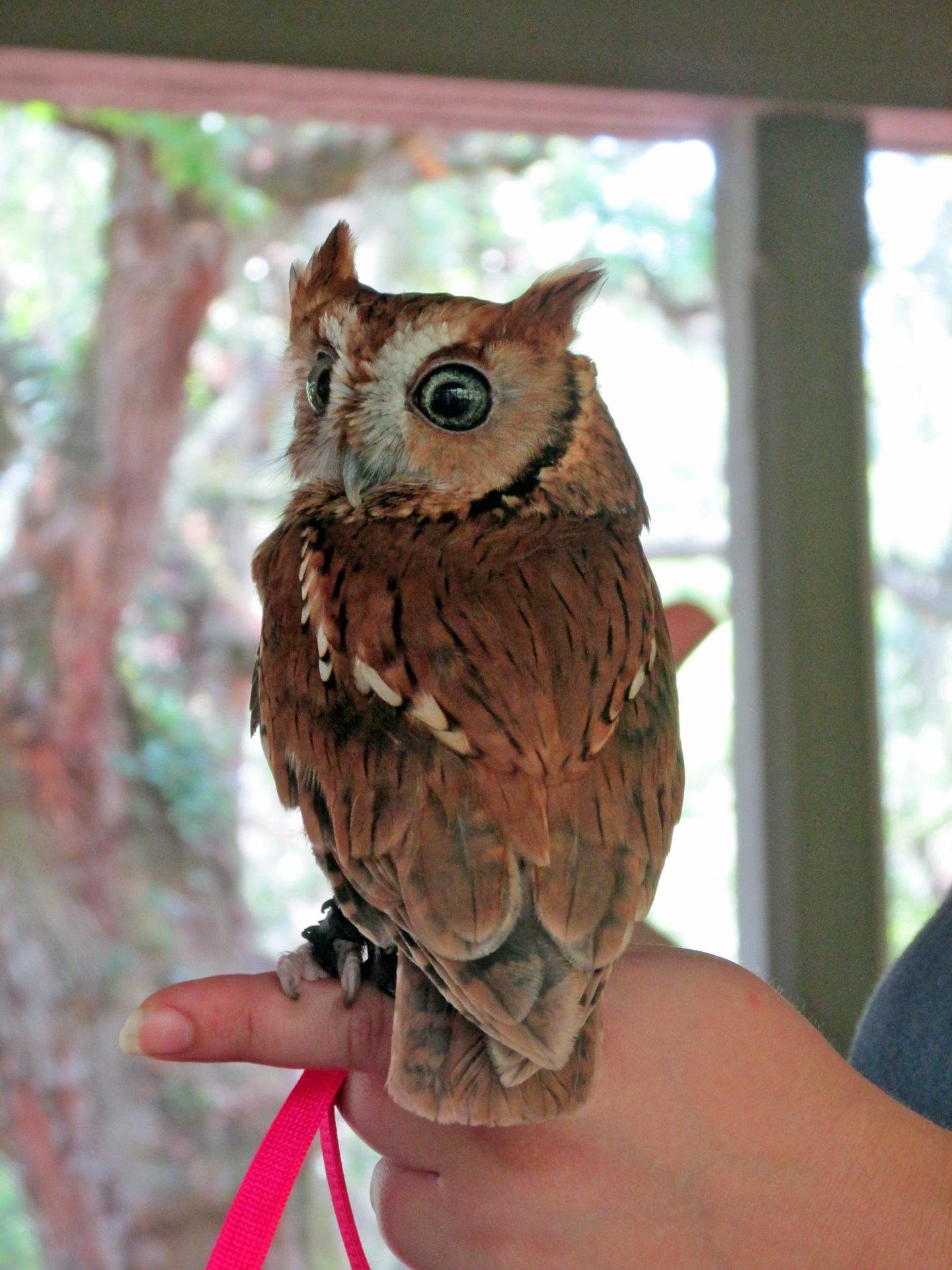
Bryan Stevens Lucy, a rehabilitated owl, helps programmers at Brookgreen Gardens provide educational programs about owls to the public.

Great horned owls, or “hoot owls” as they are widely known, also produce their low, nocturnal calls for many of the same reasons as screech-owls do. These large owls hoot to communicate, with the most common reasons being to define and defend territory, locate and attract a mate during breeding season and stay in contact with their young. Hooting also helps them establish boundaries with other owls and signals their presence, making their calls particularly energetic and frequent in the autumn and winter months when territories are being set up.

Pairs of great horned owls will hoot together as part of their courtship to strengthen their bond. A female owl’s voice is notably higher in pitch than the male’s, according to the website All About Birds. I’m hoping I will soon hear the duet that Tom and Cathy are enjoying on the other side of the ridge. So far, I’ve only detected the one great horned owl. I have heard these mesmerizing duets in the past, however. Listening can produce shivers down the spine. Of course, that is also helped by the fact they most often hoot on evenings once the weather had become more chilly.

The days are shorter, nights are longer, so now is a great time to get familiar with the owls. It can be as easy as stepping onto the front porch and listening.

•••

Bryan Stevens has been writing about birds, birding and birders since 1995. To share a sighting, ask a question or make a comment, email him at ahoodedwarbler@aol.com.
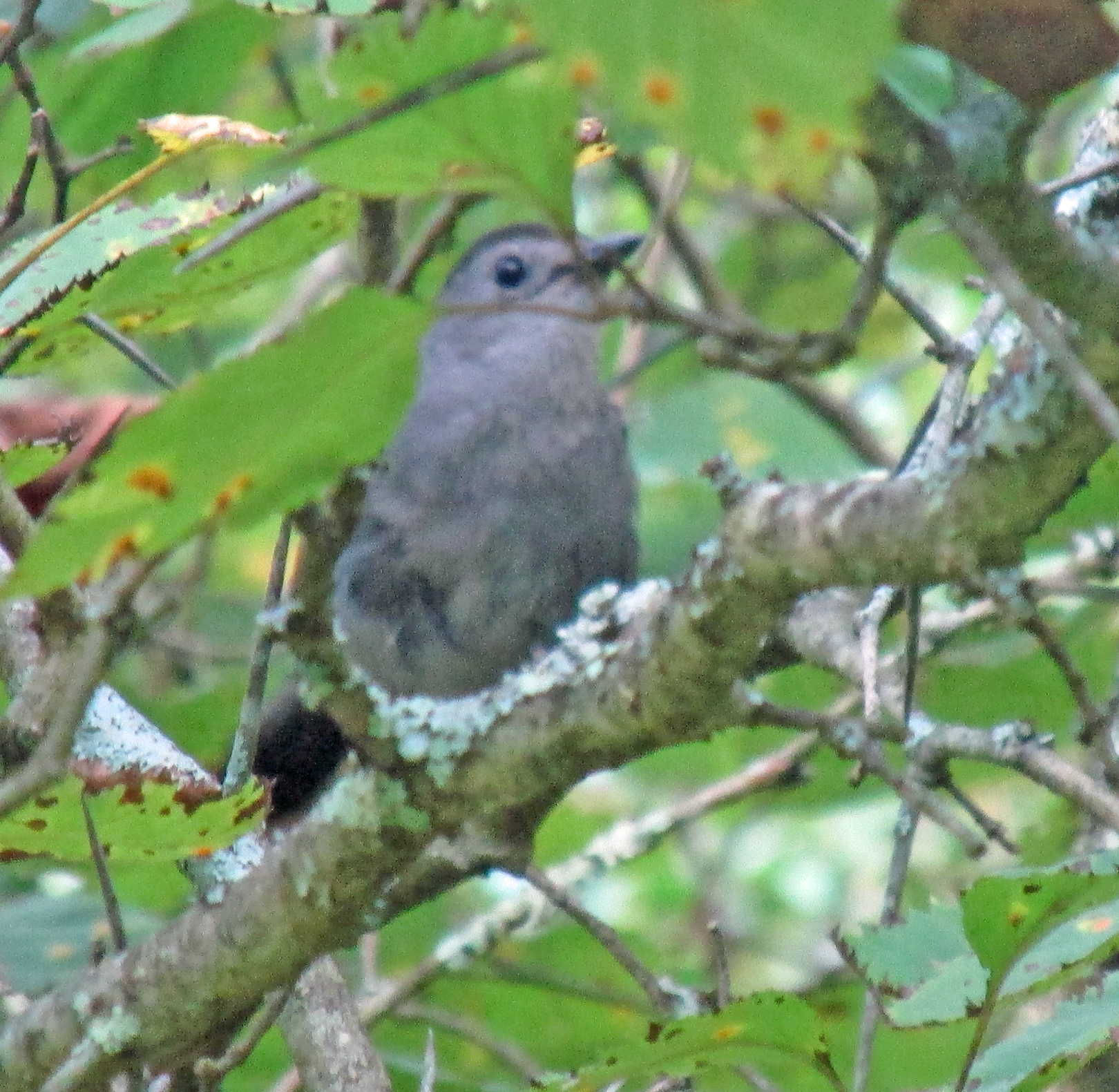
Photo by Irene K-s/Pixabay.com
An Eastern screech owl keeps an eye on its surroundings.

Local couple comes to aid of injured hummingbird

Rex and Linda Mathes • Linda and Rex Mathes came to the aid of this injured hummingbird. Most ruby-throated hummingbirds, like other migratory birds, face many perils and obstacles during their migrations.

Erwin resident Linda Mathes emailed me recently to inquire about wildlife rehabilitators who might be able to help an injured ruby-throated hummingbird.

“We found a hummingbird in the backyard yesterday, alive, so brought into house and put in box,” Linda wrote. “We think its wing is damaged.”

Linda noted that she and her husband, Rex, also brought the hummingbird feeder inside.

“My husband picks it up and holds it up to feeder and it drinks,” Linda explained. “He does this several times a day.”

She added that the hummingbird regained enough strength to also sit on Rex’s finger.

“We were worried the bird would not have any nectar during the night,” she added.

The next morning, the bird still seemed fine other than for the injured wing.

“He is very perky,” Linda note. “He/she is a real fighter.”

I provided Linda with some suggestions on wildlife rehabilitaters, but she found one on her own with the help of a friend. Rex and Linda made a trip on Monday, Sept. 29, to deliver the hummingbird into the care of a licensed wildlife rehabilitation professional.

Bryan Stevens • Ruby-throated hummingbirds have usually departed from the region by early October.

“They gave me a patient number so I could call about the bird.”

When she called on the morning of Tuesday, Sept 30, she got a detailed report.

The vet had prescribed muscle relaxers for the hummingbird,” Linda said. “Her condition was listed as guarded but at least she might have a chance.”

As they were leaving the facility, someone brought in an injured chipmunk.

Linda added that there was no charge for caring for the bird but she planned to send a small donation.

I’m hopeful for the hummingbird’s recovery. Over the years, I’ve encountered several injured birds. Several of the birds stunned themselves after impacts with windows, an all-too-common hazard. Rose-breasted grosbeak and Swainson’s thrush have been among some of these. Most of the birds have recovered after a brief rest period in a shoe box covered with a towel. It’s always a relief when they can fly off under their own power.

Migration can be hazardous and arduous for our feathered friends. Birds face various hazards, including collisions with human-made structures like buildings and power lines, habitat loss and degradation, storms, disorienting light pollution and predation from other animals.

They also need to refuel to keep up their strength, and the lack of food along a migration route can deal the chances of their success a serious blow.

Even birds that cannot fly undertake migrations. For instance, flightless penguins swim hundreds or thousands of miles to reach preferred ranges for feeding or nesting. The Australian emu, a smaller relative of the ostrich, makes seasonal migrations on foot to ensure access to abundant food supplies at all seasons.

Ruby-throated hummingbirds make an awe-inspiring and non-stop crossing of the Gulf of Mexico every fall to reach their wintering grounds. Their flight across the waters of the Gulf can take these tiny birds 18 to 22 hours. Even more incredible, they make the trip in reverse in the spring when they return to their nesting grounds across the Eastern United States.

Photo by Bryan Stevens • A ruby-throated hummingbird visits a feeder for a sip of sugar water.

Ruby-throated hummingbirds lead relatively brief lives, which is understandable considering the perils they face and the incredible migrations they stage twice each year. The oldest known ruby-throated hummingbird was a female, according to the website All About Birds. She was at least 9 years, 2 months old when she was recaptured and rereleased in 2014 during banding operations in West Virginia.

The New World is home to about 360 species of hummingbirds. We’ve expended a lot of energy finding adjectives to provide names for all these hummingbirds. Sometimes, words fail. Mere adjectives are somewhat inadequate in providing common names for many of the world’s more hummingbirds, but that doesn’t keep us from trying to give descriptive names to each hummingbird species. For instance, we have the beautiful hummingbird of Mexico; the charming hummingbird of Costa Rica and Panama; the festive coquette of northwestern South America; and the magnificent hummingbird of the southwestern United States.

•••

To share a sighting, make a comment or ask a question, email me at ahoodedwarbler@aol.com.

Broad-winged hawk is region’s migratory raptor

COURTNEY CELLEY/USFWS • A broad-winged hawk perches with a snake in its talons.

I’ve been seeing a few birds that qualify as fall migrants, but there have been some other birds in the mix, such as red-shouldered hawk.

In the last five years or so, red-shouldered hawk has become a year-round resident. But I hadn’t seen or heard one of these hawk since early summer, so I’m not sure if this individual was a resident or simply one passing through during this time of flux for our feathered friends.

Migration by its nature stirs up birds, which may pop into some unexpected places for a pit-stop on their travel route.

Other birds I’ve seen or heard recently include broad-winged hawk, Eastern wood-pewee, Northern waterthrush, hooded warbler, gray catbird, blue jay, American goldfinch, American crow, common raven, great blue heron and Eastern phoebe, as well as ruby-throated hummingbird and three woodpecker species: Downy, pileated and red-bellied.

The hawks, however, got my attention. The broad-winged hawk, known scientifically as Buteo platypterus, thrills onlookers every September by staging phenomenal migratory flights that can include hundreds or thousands of individual birds. The term “platypterus” translates from Greek as “wide winged.”

Outside of birding circles, however, the broad-winged hawk is not nearly as widely known for its migratory feats as, for example, the monarch butterfly or Eastern North America’s ruby-throated hummingbird. When time to migrate, these hawks form large flocks, which also include other raptor species. “Hawk watches” are held at some famous peaks. A Mendota Hawk Watch is conducted ever fall on Clinch Mountain near an abandoned fire tower close to Mendota, Virginia.

Larry McDaniel with the Bristol Bird Club reported that the watch this season has been productive.

“The Mendota Hawk Watch is going strong with good coverage and lots of raptors,” he wrote in a Facebook post on Sept. 19. “There have already been over 3.600 broad-wings reported and we are just now getting into the statistical peak. The show will be over by late September, so get up there while the birds are still flying.”

Other famous “hawk watch” locations in the eastern United States include Whitefish Point in Michigan and Hawk Ridge, Minnesota. Closer to home, I’ve seen sizeable flocks, or kettles, of broad-winged hawks, on occasion in the company of other raptors, on Holston Mountain and Roan Mountain.

The genus Buteo includes the broad-winged hawk’s larger kin, including red-tailed hawk, rough-legged hawk, red-shouldered hawk and ferruginous hawk. Outside the United States, raptors in the buteo genus are often known as “buzzards.” When the first European colonists came to the New World, they applied the term buzzard to both types of native vultures as well as the large raptors like Swainson’s hawk that reminded them of the ones back in Europe such as the common buzzard.

Some of the buteo species have adapted to life on islands, including the Galapagos hawk and the Hawaiian hawk. There’s an endangered sub-species of broad-winged hawk known as the Puerto Rican broad-winged hawk that resides in forests on the island of Puerto Rico.

Some of these hawks have quite descriptive names, including the white-throated hawk, gray-lined hawk, zone-tailed hawk and short-tailed hawk, as well as long-legged buzzard, jackal buzzard and red-necked buzzard.

The broad-winged hawk, like all of its kin, is a predatory bird. These medium-sized hawks prey primarily on rodents, amphibians and insects, but they will also capture and eat snakes. They take some time to prepare prey after making a capture. In the case of snakes and frogs, these hawks “skin” their victims.

Many of our hawks are resident throughout the year, but the broad-winged hawk only spends the spring and summer. Look for them now. They won’t return until late April and early May in 2026.

•••

Bryan Stevens has written about birds, birders and birding since 1995. Share a sighting, ask a question or make a comment by emailing him at ahoodedwarbler@aol.com.

Use autumn to get ready for bird-feeding season

Bryan Stevens • A female Northern cardinal visits a hanging platform feeder for a winter meal of sunflower seeds.

I’ve enjoyed a decent amount of activity in my yard this fall, enjoying visits from ruby-throated hummingbirds and American goldfinches as well as brown thrashers and gray catbirds. I’ve also glimpsed a few warblers. As much as I enjoy fall, crowding into my awareness is the fact that cold weather will soon be with us again.

Even that fact, however, is not totally unwelcome. Winter’s a fine season for peering through the windows at the birds that flock to feeders. So, with the winter season looming just around the corner, now might be a good time to take some steps to make your yard and feeders more attractive and welcoming to our feathered friends.

Photo Courtesy of Byron Tucker
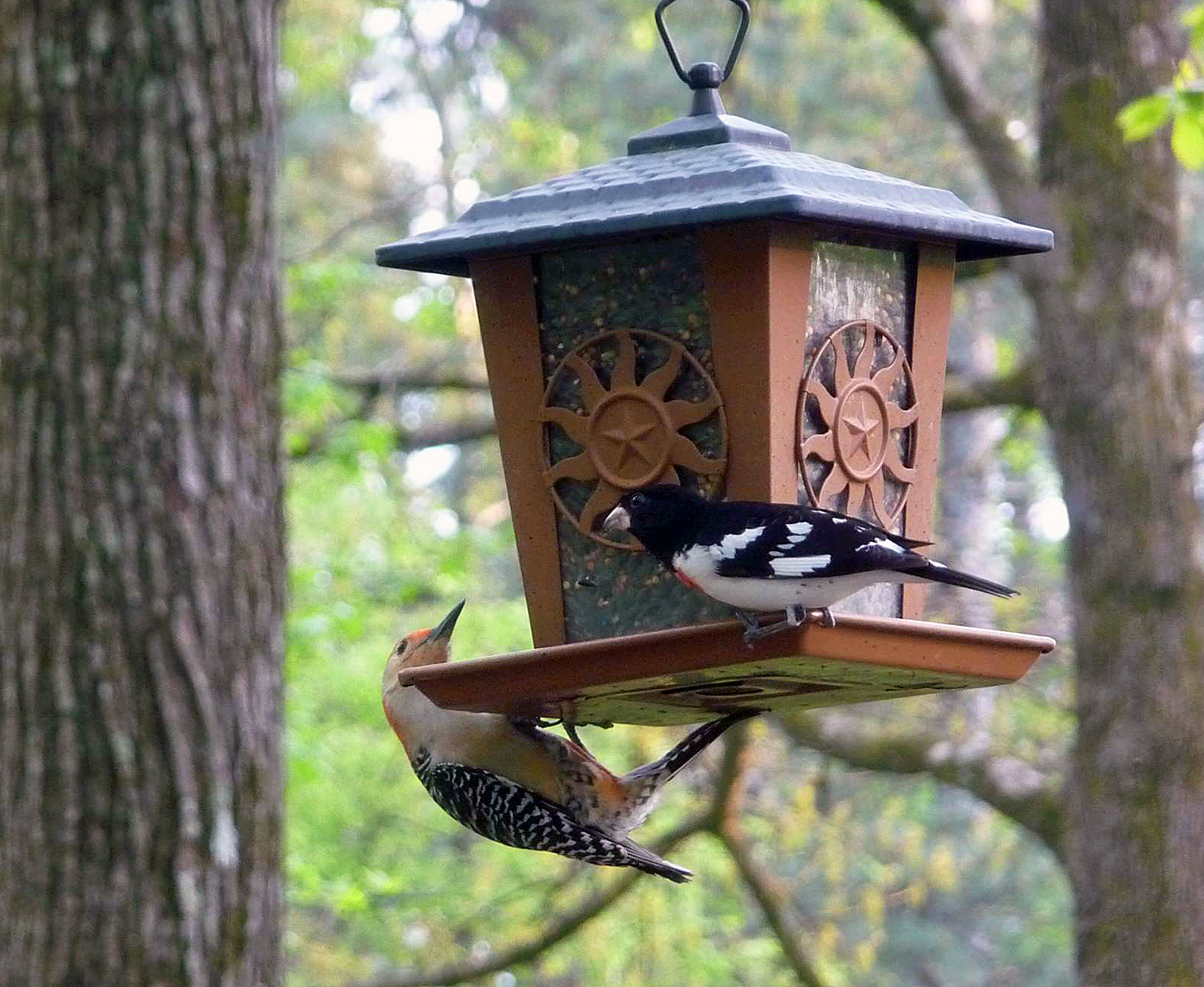
A Rose-breasted Grosbeak joins a Red-bellied Woodpecker at a feeder in Atlanta.

Seeing all the activity in my yard during fall migration made me want to ensure that it remains attractive for those birds that choose to eke out a living during the colder months of the year in our region.

Here are a few suggestions of things to do this fall to make your winter bird feeding more productive. It’s better to do these outdoor chores now before winter truly put a nip in the air.

• Plant native trees that bear fruit. Autumn’s a recommended planting time for many trees, so consider checking with a local nursery about the selection of such native trees as American holly, serviceberry and red mulberry. It’s always good to select trees that provide fruit at different seasons to maximize the appeal of your plantings to birds. A flock of American robins or cedar waxwings, or even a pair of Northern mockingbirds, can quickly strip berries from a holly tree when conditions turn snowy and icy.

• Build or refurbish a brush pile. Fall’s a season for pruning, so take those discarded limbs and twigs to construct a protective shelter for songbirds. Shy birds that naturally avoid open spaces can be coaxed closer to feeders by having access to a tangle of sticks and brush. A brush pile offers a degree of protection should songbirds at your feeder need to find a quick hiding place when a hawk or other predator makes an unexpected appearance.

• Evaluate feeders. The winter season brings snow, ice and a flurry of renewed interest in bird feeders, so now is the time to clean and replace feeders. The elements are not always kind on feeders, so when it becomes apparent that a feeder is in poor condition, consider replacing it with a new one. It’s also important to give feeders a thorough cleaning. Using a mild bleach solution will help disinfect them and make feeding from them safe for our feathered friends. Just be sure to rinse throughly and then dry the feeder before hanging it back out.

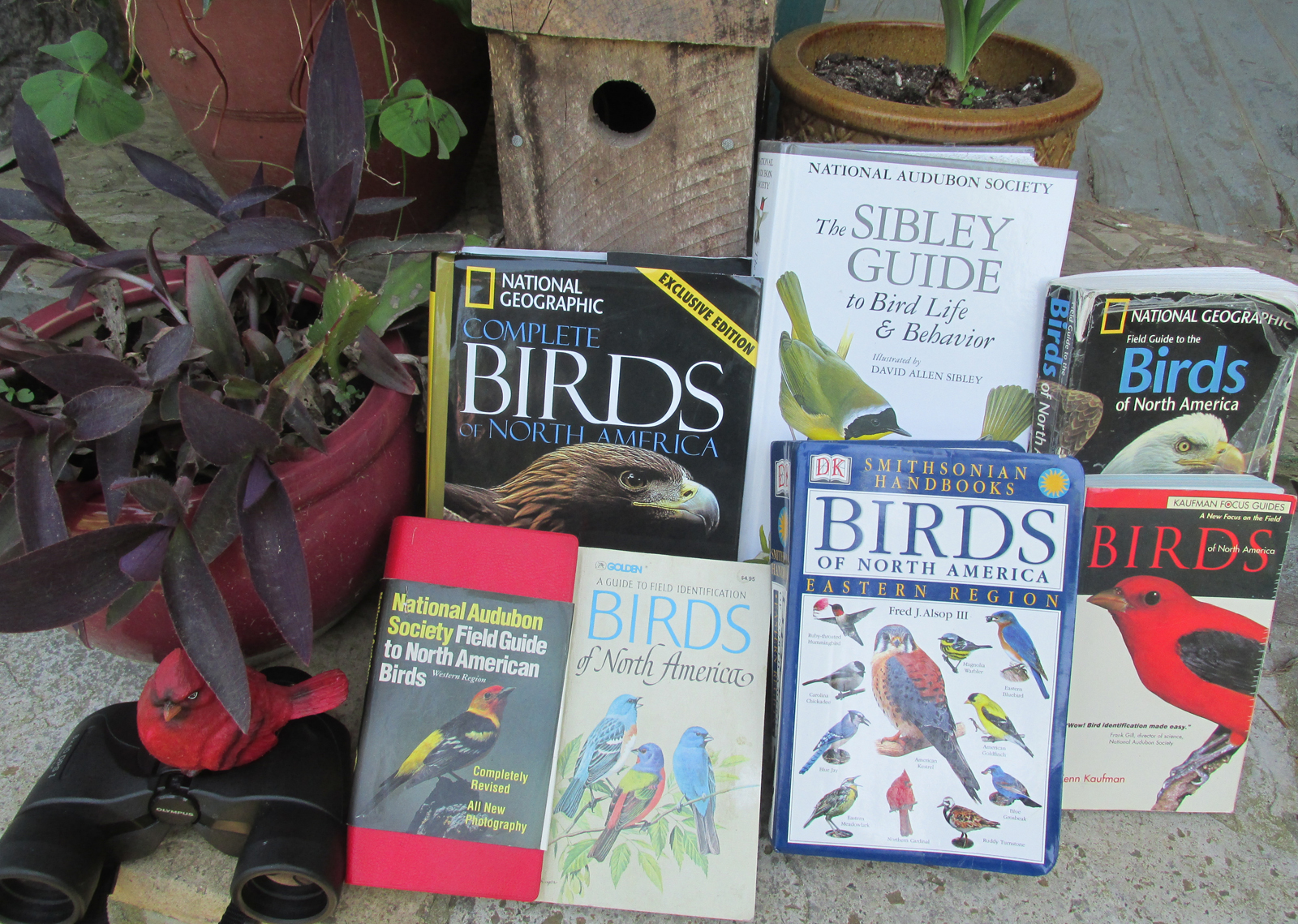
Photo by Bryan Stevens • Field guides are an essential tool for bird identification.

• Take some steps to increase your enjoyment of the birds coming to your feeders. Invest in a good bird identification guide or app. I am a fan of a good field guide that I can hold in my hands while thumbing through the pages, but I know that many people prefer the convenience of an app that’s accessible through their smartphone. Some popular apps would include the Audubon Bird Guide, eBird and Merlin Bird ID. Some of my recommended field guides include Peterson Field Guide to Birds of North America and The Sibley Field Guide to Birds of Eastern North America. Identifying birds congregated in the winter at a feeder is often easier than trying to track them through the green canopy during the other seasons. Of course, you’ll want to be aware that some birds wear different plumages during the winter months. The guides and apps can help with these identification challenges.

• Upgrade your optics. Place a pair of binoculars on your Christmas list. Bring the birds closer to you with a reliable pair of binoculars. It will make all the difference.

• Don’t take down the sugar water feeders just yet. Although ruby-throated hummingbirds almost all depart in early October, other species of hummingbirds normally found in the western United States have reliably made appearances in the region in October, November and other winter months. Through the years, I have seen several of these seemingly out-of-place hummingbirds. Some of them remain at their host’s feeders for a brief stay of a few days or a couple of weeks, but some of these hummingbirds have extended their stay for several months, lingering throughout the winter months before eventually departing in February or March. The big question concerns whether these hummingbirds are truly lost and out of place. The answer, based on everything I have managed to learn, is that these hummingbirds are precisely where they want to be. For still unknown reasons, some of these western hummingbirds make a migration swing through the eastern United States. One thing is certain: You won’t see one of these “strays” unless you keep out a feeder with fresh sugar water. It’s not that difficult. After all, the ants and wasps that made a nuisance of themselves during warmer temperatures are no longer active. If it gets too cold, you can always move your feeders inside at night and put back outdoors at daylight. If you do happen to attract a winter hummingbird, please let me know. I love helping to document these rare visitors.

•••

Bryan Stevens has written about birds, birders and birding since 1995. Share sightings, ask questions or make a comment by emailing him at ahoodedwarbler@aol.com.

Photo by Bryan Stevens • Male and female purple finches share space at a feeder.

Birds with different spring and fall looks challenge birders

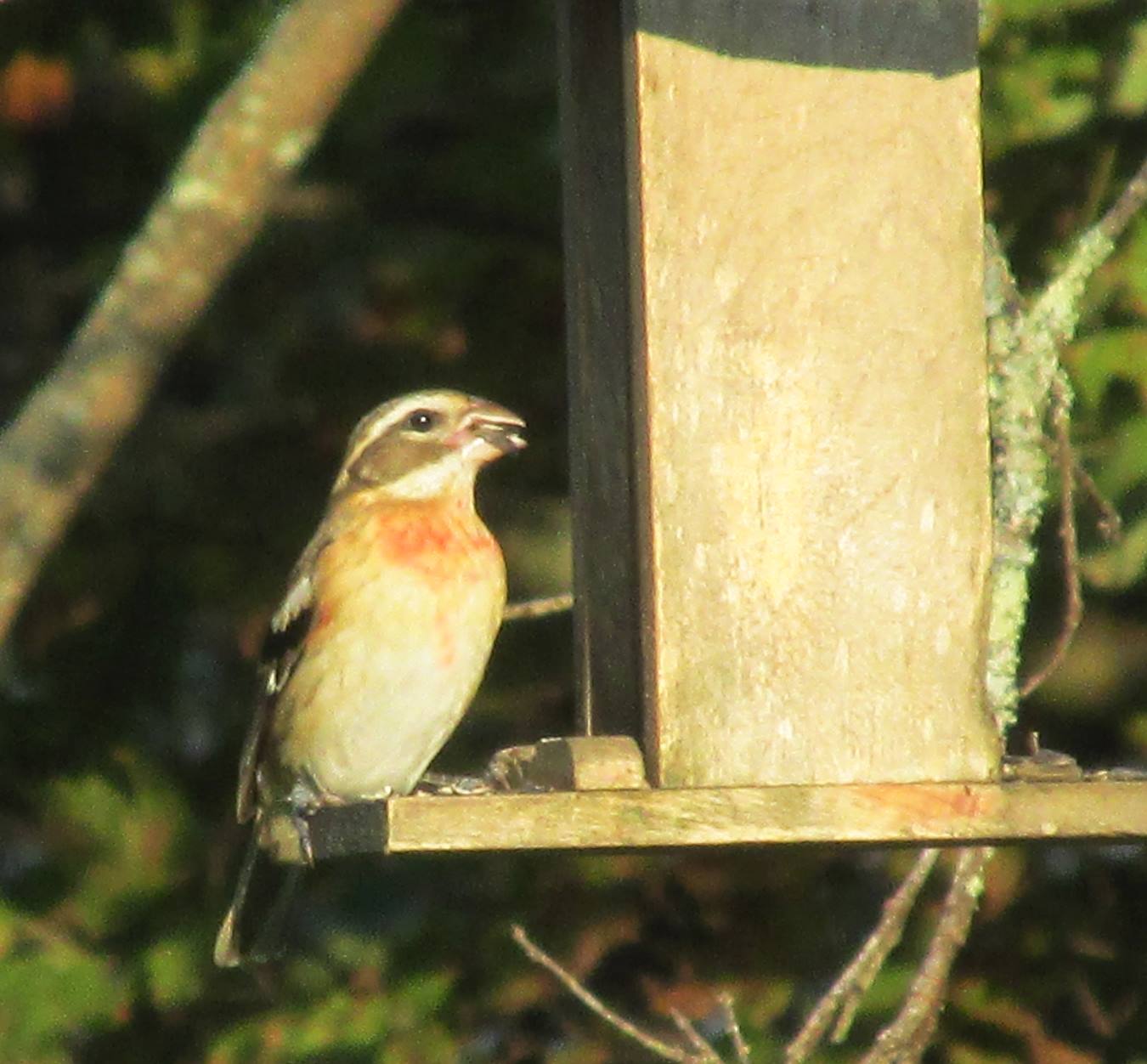
Photo by Bryan Stevens • A young male Rose-breasted Grosbeak visits a feeder in September of 2013. Young males resemble females but show a splash of orange on the breast that will be replaced the following spring by the familiar rosy-red patch.

My favorite season is fall. I’m always excited when birds return in the spring, but I have better luck observing fall migrants.

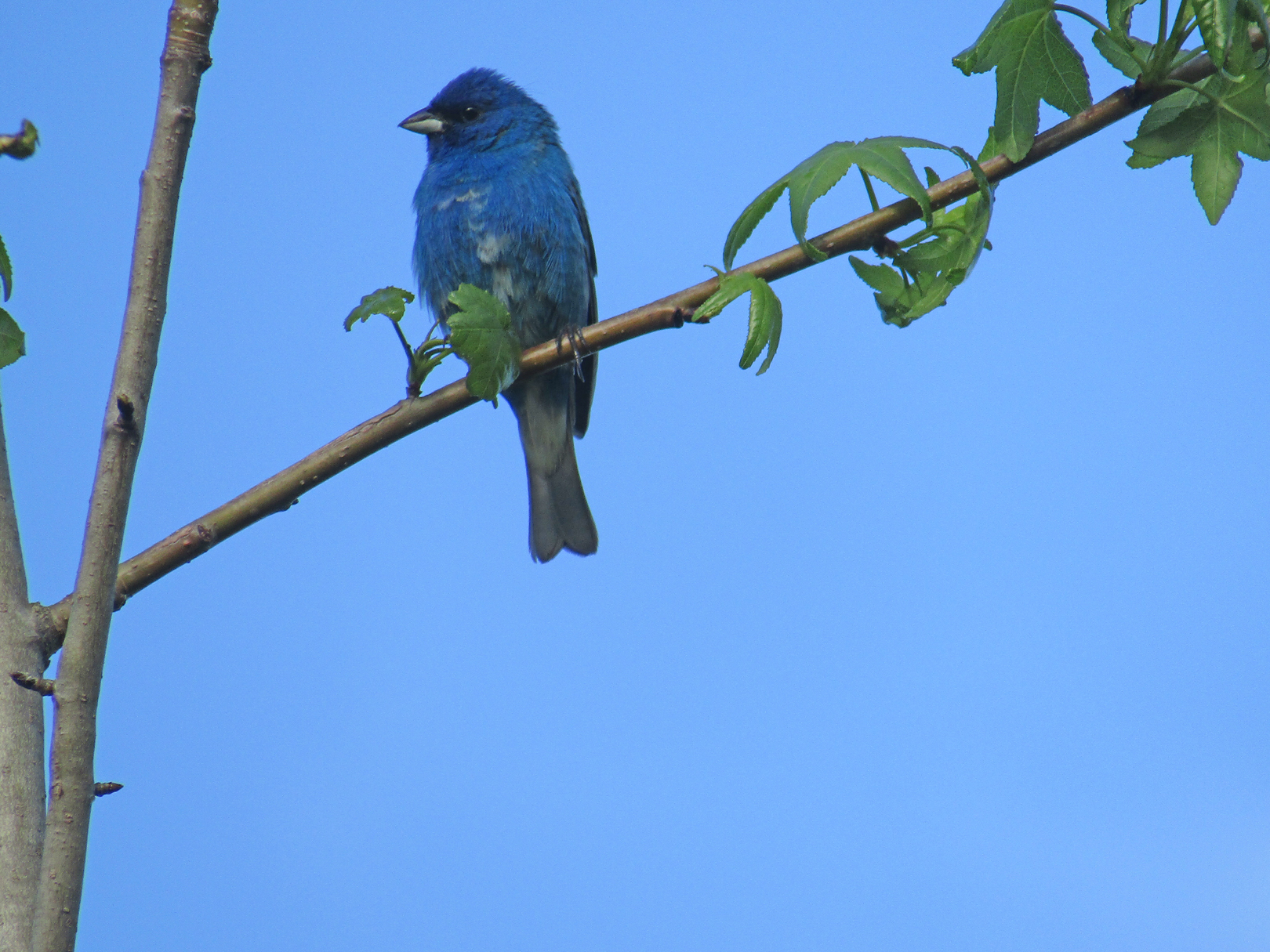
There’s a trade-off, however. Many birds don’t look their best by the time autumn migration rolls around. Take the male indigo bunting, for instance. This species is the only solid blue bird in the eastern United States, but it’s all an illusion — literally a trick of the light.

The indigo bunting’s feathers are not really blue; the male’s brilliant azure plumage is caused by the process of diffraction of light around the structure of the bird’s feathers. This process scatters all but the blue light, and the resulting color shifts from black to blue to turquoise as the angle of reflected light changes. In bright light, it can even look unnaturally vivid blue. In poor light, however, an indigo bunting male can appear black. Fortunately, indigo buntings have both a characteristic body shape and song, so even if the birds are not seen in their best light, they can still be recognized.

Photo by Bryan Stevens • Male indigo buntings look their best when they arrive each spring. They most over the summer, giving fall males a blotchy plumage of brown with some hints of blue remaining..

For such a bright blue bird, indigo buntings are not easy to detect. When that plumage gets mottled with brown patches in fall, these birds blend even better with their backgrounds.

The indigo bunting belongs to a genus of birds known as Passerina, which is included the family Cardinalidae, which includes birds like Northern cardinal and rose-breasted grosbeak. They are often lumped into a group known as North American buntings, although they are not closely related to such birds as snow bunting and lark bunting. The latter is even recognized as the official state bird for Colorado, a unique honor for this group of birds. The other members of the Passerina genus include lazuli bunting, varied bunting, painted bunting, rose-bellied bunting, orange-breasted bunting and blue grosbeak.

Indigo buntings linger into early October, but they also molt feathers and take on a less showy look in late summer and fall. Even the males can end up looking rather shabby compared to a spring counterpart in electric blue plumage.

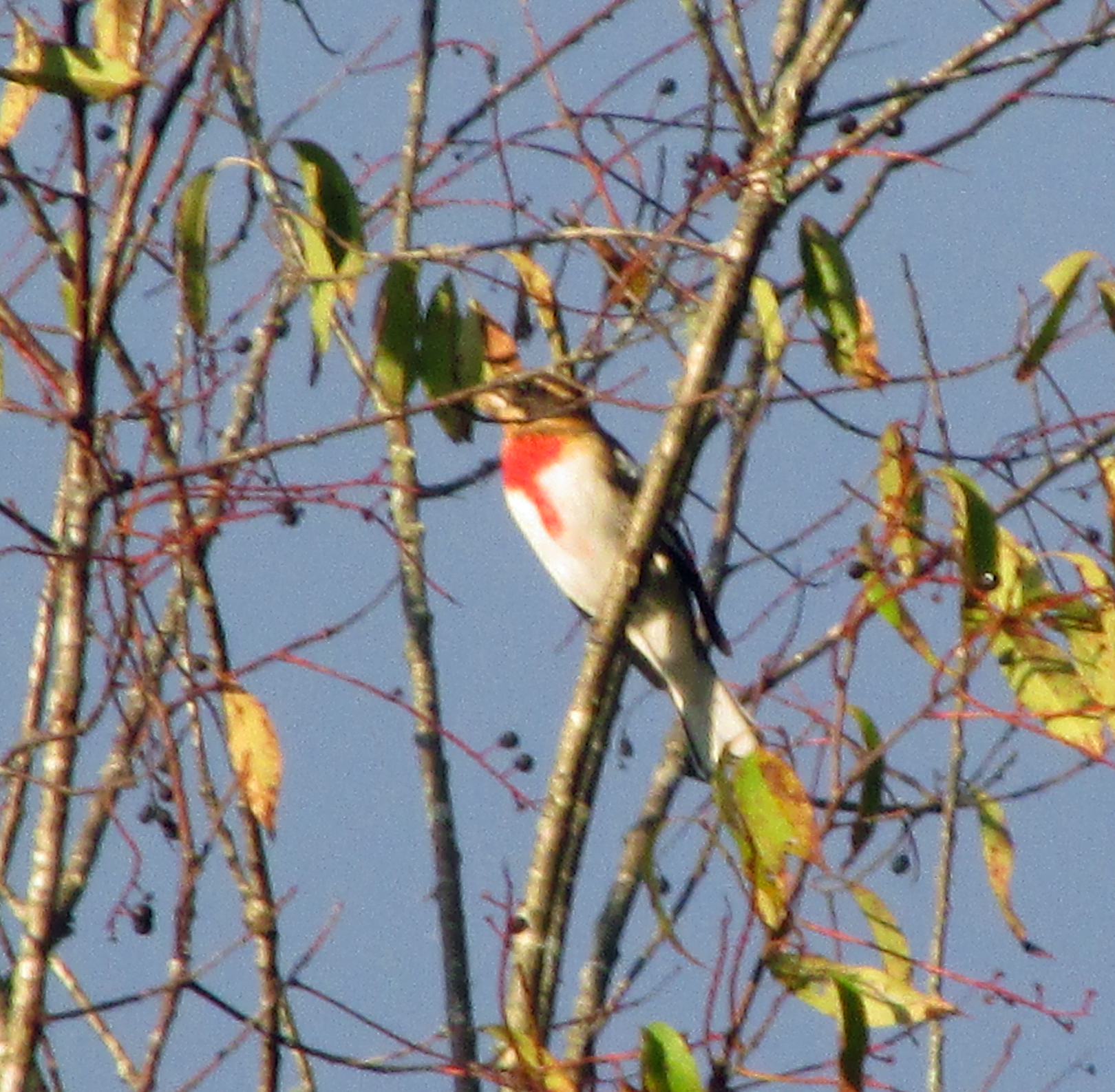
The rose-breasted grosbeak, or at least adult males of the species, are birds that can take one’s breath away when observed in spring when the birds first return from their tropical wintering grounds. By fall, however, even adult males have lost some of the crisp black-and-white plumage and the rosy coloration on the breast often fades to dull orange.

In fall, the rose-breasted grosbeak migrates south to a winter range that spans central Mexico, Central America and northern South America. As they depart, many will make stops in yards with feeders to partake of offerings of sunflower seeds. So, if you didn’t get to see these showy birds in the spring, local bird enthusiasts get another chance to see them in this month and into October.

Photo by Bryan Stevens • Some of the Rose-breasted Grosbeaks migrating through this fall still retain some of their rosy color.

The male rose-breasted grosbeak gives this species it name. Males are the epitome of the birds that make their home for part of the year in the American tropics. The contrasting black and white plumage is emphasized by a triangular slash of rosy-red color on the breast. Put all those elements together and the male rose-breasted grosbeak is not a bird that would be mistaken for any other.

The female grosbeak, however, doesn’t stand out in the same way. She is much less colorful than the male. With her brown and white plumage, she is often mistaken for a large sparrow or finch. At this time of year, however, all rose-breasted grosbeaks: Adult males, adult females and young birds born this past summer can look dull. The best way to identify them is by focusing on the beak. That large, sturdy beak gives this species the other part of its name. “Gros” is a German word for big, so the name basically means “big beak.”

A fall appearance at odds with how a bird looks in the spring is also true of the scarlet tanager. The vibrant red and black spring males may look yellow or greenish-yellow once the acquire their fall and winter plumage. It’s not all that surprising. The males no longer have to impress females with their splendid coloration once the nesting season’s concluded.

The warblers, my absolute favorite family of birds, are famous for looking different in the fall. Long ago, someone coined the phrase “confusing fall warblers” since many young birds and even adult birds in fall plumage can look different than spring birds.

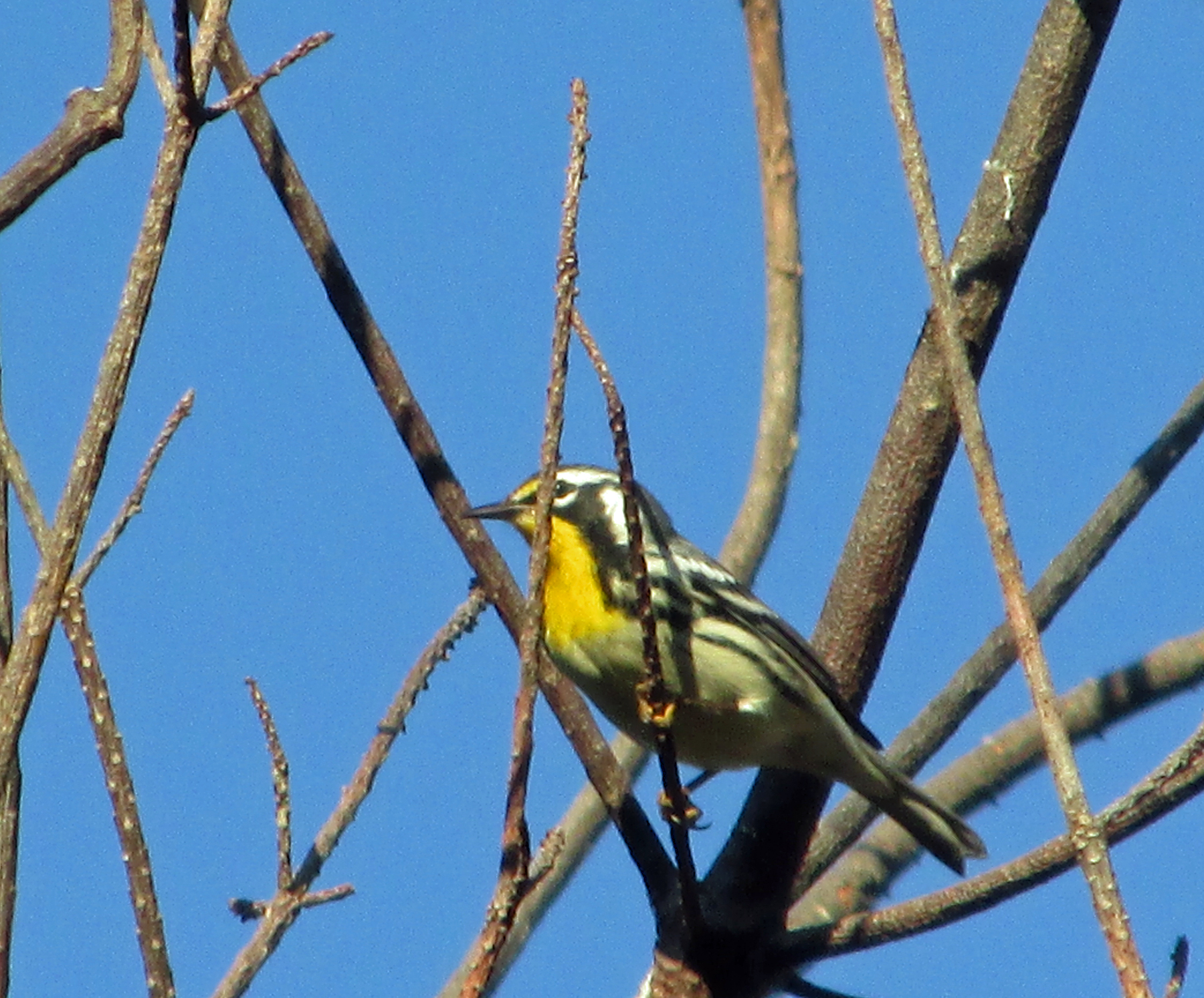
Photo by Bryan Stevens • The appearance of yellow-throated warblers does not change much from spring to autumn.

To identify confusing fall warblers, focus on features that remain consistent in their drabber autumn plumage, such as bill shape, leg color, tail patterns, wing bars and subtle facial markings. Learning the foraging behaviors of the various species can also be helpful.

Some of the warblers that look much different in fall includes species like magnolia warbler, Tennessee warbler, chestnut-sided warbler and Cape May warbler. Other species, such as hooded warbler, ovenbird and Northern waterthrush don’t change all that much with the seasons.

•••

Bryan Stevens is the managing editor of The Erwin Record. He has written about birds, birders and birding since 1995. To ask a question, make a comment or share a sighting, email him at ahoodedwarbler@aol.com.