Category Archives: Birdwatching

House finch origin story in region has unusual twist

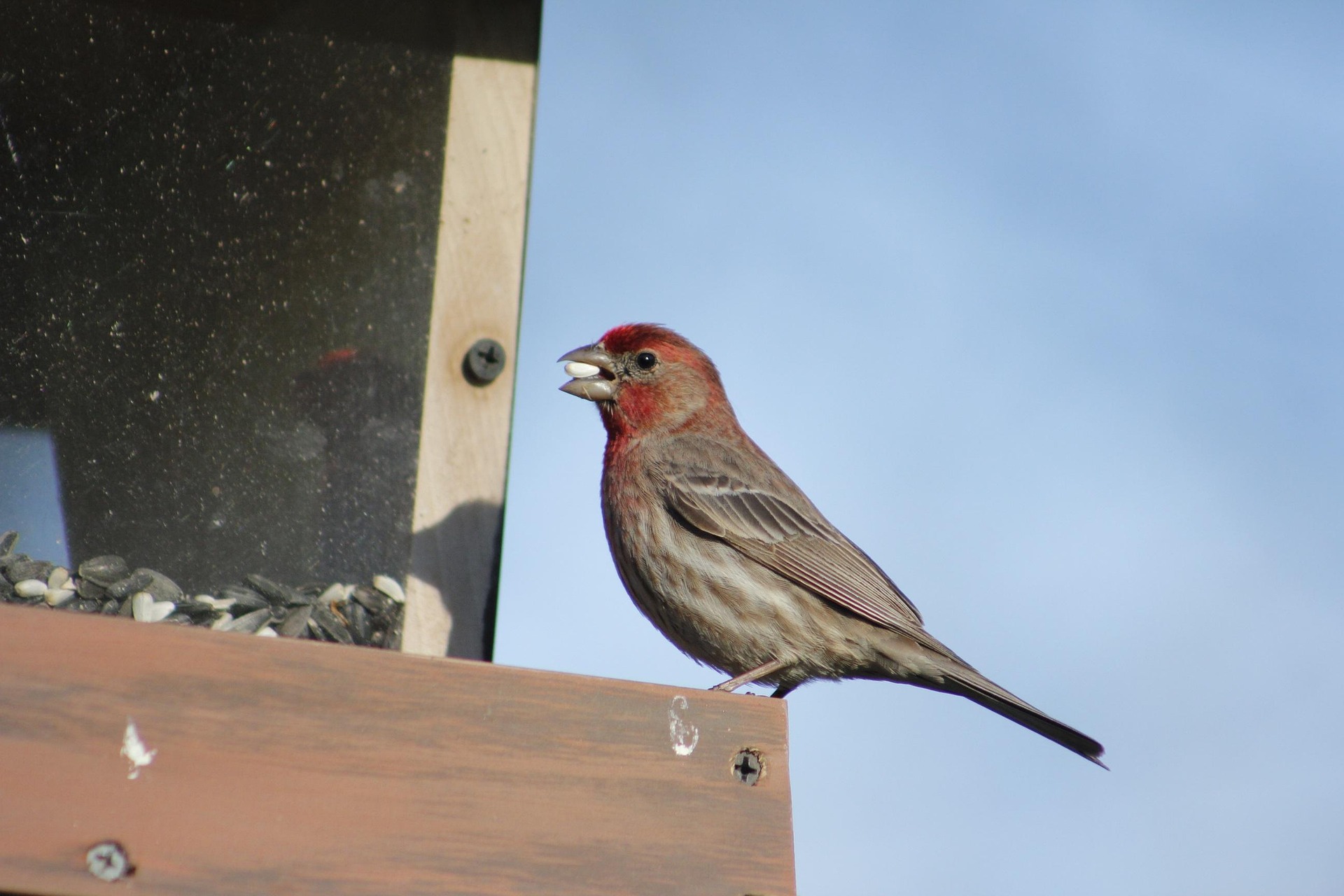
Photo by GeorgiaLens/Pizabay • A male house finch visits a feeder. Flocks of these small finches can become regular feeder visitors. Credit: GEORGIALENS/PIXABAY

I received an email from Unicoi residents Judy and Bill Beckman asking for a reason to explain a sudden absence in house finches at their feeders.

“For a number of weeks now, our house finches have disappeared from our feeders,” they wrote in the email. “They are usually the dominant number of birds. We do not recall this happening before. Any thoughts?”

I answered, explaining that the birds will probably return. Exactly when the finches decide to return to the couple’s yard is more problematic.

In fall and spring, even birds that don’t normally migrate get a bit restless. I suggested that the house finches could just be exploring somewhere else nearby.

My best guess is the finches they will return. As I explained in my answer, the Beckmans have probably provided a generous buffet for the birds. They will remember where the best free lunch is served.

Photo by Bryan Stevens • A male house finch perched on a cable. These finches are native to the western United States but became established in the eastern states thanks to the illicit pet trade.

The house finch is an interesting species. Until the 1980s, this species was not present in Northeast Tennessee. Although this finch is a native North American bird, it is not truly native to the Eastern half of the continent. All the house finches in the Eastern United States are descended from captive birds released into the wild by dealers in the exotic bird trade.

About 1940, the house finch became established in the eastern United States. In violation of federal law, these small finches were being sold in New York City as pet birds described as “Hollywood Finches.” To avoid trouble with authorities, vendors and even some owners released their “Hollywood Finches” into the wild. Finding the area around New York City to their liking, house finches thrived spread. Within a few decades, they were common birds throughout the eastern United States, including Tennessee, Virginia and North Carolina. The house finch had also been introduced into Hawaii about 1870, and is still present today, along with many other species of birds not native to the islands.

As the house finch claimed a new range, the species inevitably encountered the related purple finch. During the winter, both finches are often present at feeders in the region. When both are available for observation, bird enthusiasts should take advantage of the opportunity to compare and contrast these birds.

Personally, I have never had any difficulty distinguishing a purple finch from a house finch. The two species, at least in my eyes, are easily recognized. I can understand why some people might have trouble separating the two birds. The late Roger Tory Peterson once described the purple finch as a bird “dipped in raspberry juice.” Think about that imagery for a moment and you’ve got a good start to distinguishing a male purple finch from a male house finch.
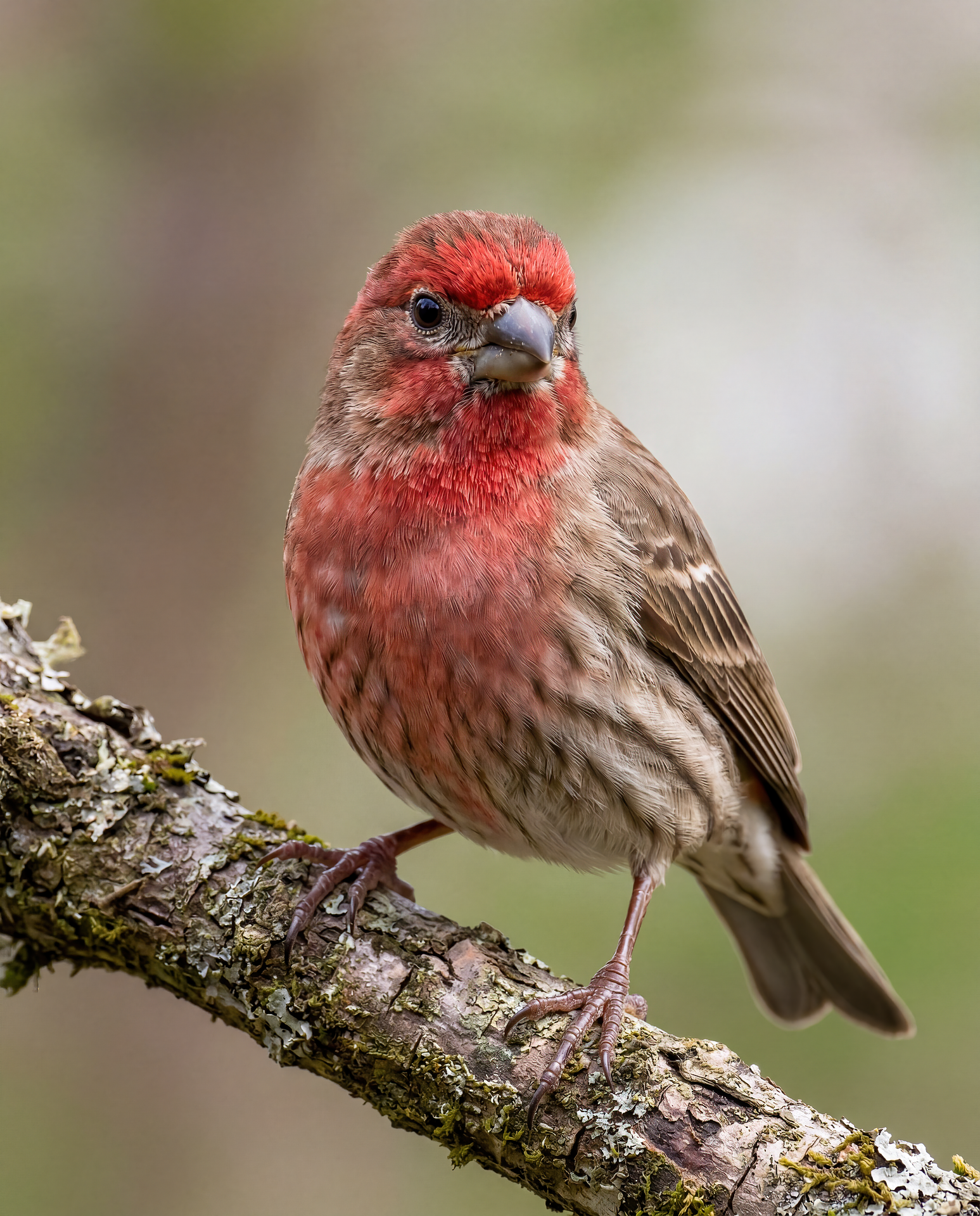
Photo by Ray Shrewsberry • A male house finch perches on a branch. This bird species has been introduced into locations nature never meant for the bird to live.

The females of both species are a different matter. However, purple finch females have a more distinctive facial pattern and a heavier bill than do female house finches. With a little practice, it’s not difficult to identity these two species in the field. In Northeast Tennessee, house finches and purple finches are usually only present together during the winter months when purple finches occasionally flock to our feeders.

In their native range in the western United States, house finches have adapted to a range of habitats, including deserts, grassland, chaparral and open woods. Another related species in the Western United States is Cassin’s finch, which is a species found mostly in high-elevation regions dominated by tall evergreen or coniferous forests.

The house finch is an abundant bird. According to the Partners in Flight, there are an estimated 40 million house finches ranging across North America.

They have also proven resilient. House finches are susceptible to some contagious diseases, including Mycoplasma gallisepticum, a bacterium that causes chronic respiratory disease in chickens and infectious sinusitis in turkeys, chickens, game birds, pigeons and passerine birds. House finch populations in the Eastern United States crashed in the 1990s due to the epidemic prevalence of the bacteria. Their numbers have since stabilized, although the species remains vulnerable to infection from the bacteria. Infection with the bacteria often leads to conjunctivitis characterized by swollen, encrusted, nasal discharges, impaired vision and weight loss. Infected birds usually succumb to slow starvation or predation. House finch conjunctivitis is most frequent during colder months when birds congregate and flock to bird feeders. Anyone who fed birds during the 1990s likely witnessed the disease at their feeders.

They also proved to be a songbird susceptible to West Nile virus, but most house finches and other songbirds recover from this mosquito-borne disease. Crows, ravens and jays, however, are vulnerable to the disease.

Overall, although a strange twist of fate brought the house finch into Tennessee and other parts of the Eastern half of the nation, this bird has become a welcome visitor. Males have a cheery song and bright plumage. By all accounts, it’s also here to stay.

I’m going to have to keep a closer watch over my own feeders. I had a pair that visited regularly at the start of the summer season. It’s time to see if they’re back with a new generation of house finches.

•••

Bryan Stevens has written about birds, birding and birders since 1995. Email him at ahoodedwarbler@aol.com.
Despite fearsome look and Herculean size, native beetle is harmless and fascinating

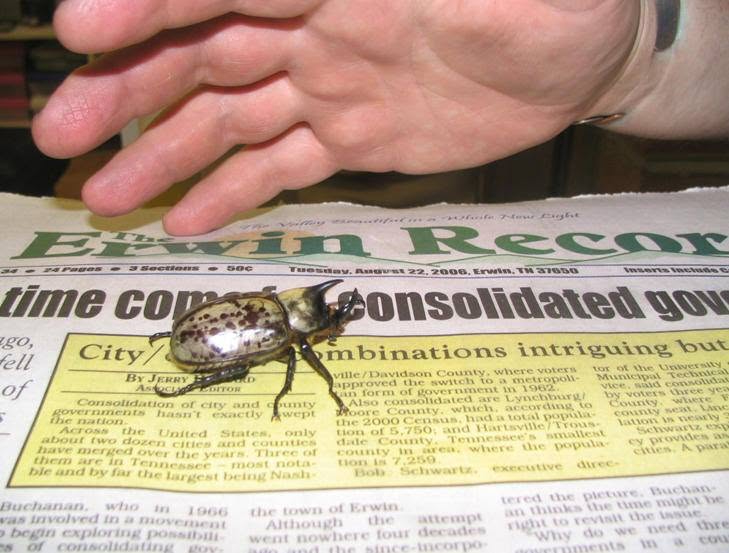
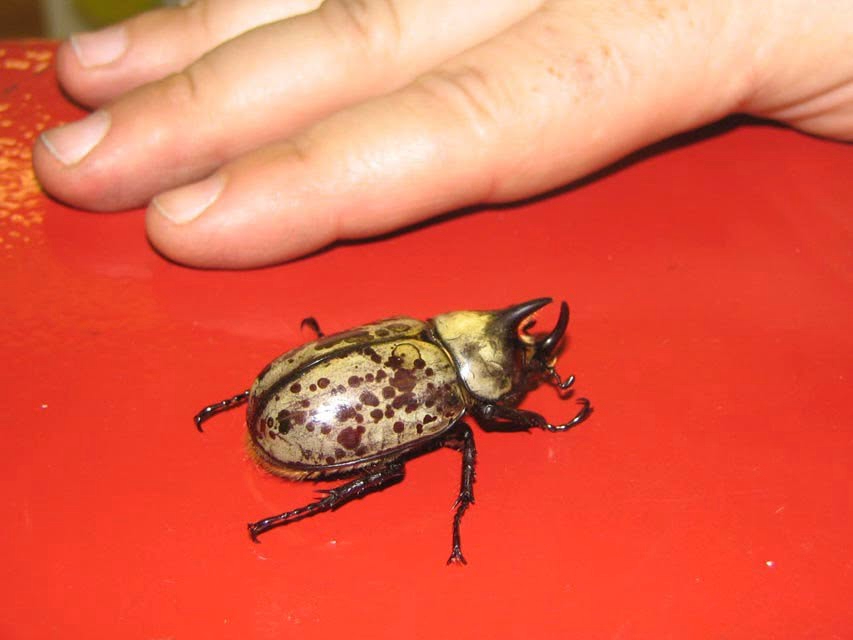
Bryan Stevens • This Eastern Hercules Beetle, observed and photographed 20 years ago, was photographed with a hand and a newspaper for a size comparison.

I’m continuing to celebrate my 30th year of bringing readers stories about things with wings. Usually the subjects of these columns have feathers, but that’s not always the case.

I’ve written about everything from minks and otters to butterflies and beetles.

As way of introduction of a rerun of a column from 2006, I saw my first Eastern Hercules Beetle in Erwin 20 years ago this month. Now, after a rather long gap, I’ve observed another, once again in Erwin and not far from the location where I saw the first one.

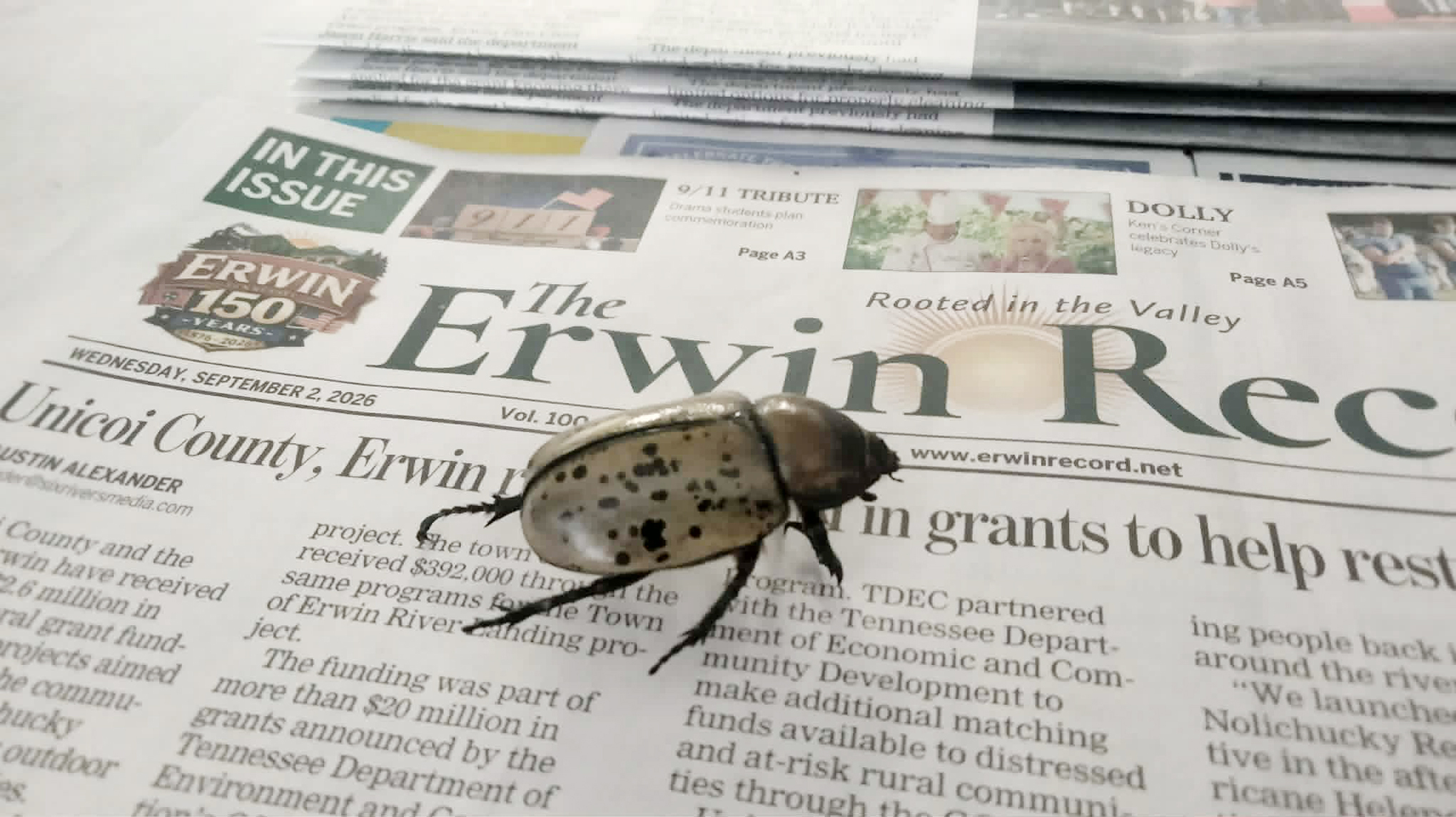
In fact, I found this one just outside The Erwin Record office on Gay Street. Unfortunately, this specimen was dead. The one in 2006 had been very much alive.

There are some other coincidences readers may notice as they read the column I wrote after my first sighting. The column ran in The Erwin Record on Sept. 12, 2006.

•••

Although my friend’s tone of voice sounded somewhat horrified, I felt only fascinated as I turned to look at the focus of his trepidation.

I had failed to notice the large beetle clinging to the brick wall at Erwin’s Flick Video. The creature, undeniably bizarre in appearance and rather sizable for a bug, kept me spellbound for a moment.

Fortunate to have my digital camera with me, I snapped numerous photographs of this large insect, fascinated by its size and appearance.

I made a quick identification of the insect as a “Rhinoceros beetle,” which turned out to be only partially correct. In fact, the insect belonged to an extensive family of beetle that does include various species of rhinoceros beetle, as well as the scarab beetles, which derive their fame from depictions in the art of ancient Egypt.

An Eastern Hercules Beetle can reach a length of 2.4 inches. This male was found in September of 2006 on an Erwin Record coin box at Flick Video.

After extensive online research, I revised my identification to Eastern Hercules Beetle – a true giant among our native bugs.

The Eastern Hercules Beetle is the largest beetle in the Southeastern United State. This big bug boasts an extensive family of closely related insects known by such names as rhinoceros beetle, unicorn beetle, horn beetle and horned beetle.

This insect’s scientific name is Dynastes tityus, placing it in a genus that contains only six other species.

For a bug, the Eastern Hercules Beetle is not without its appeal. The hard shell is olive-green with a pattern of brownish spots. When I showed photographs of the beetle to people, a few individuals likened it to a “spotted Easter egg with horns.”

The Eastern Hercules Beetle can reach a length of 2.4 inches. Only the male beetle sports the impressive horns. Female beetles are slightly smaller and lack horns. The male’s main horns extend from the front of the head, but they also sport two smaller horns on the thorax.

The horns are not merely for show. Male beetles are intolerant of each other and use their horns in combat to settle their differences. The horns are not mobile, however, and the beetle cannot bring the horns together to pinch a person.

The “horns” on this beetle are also not mouthparts. This bug does not bite. They may look fearsome, but they are completely harmless.

The size of the beetle’s horns is directly related to the amount of food the creature obtained during its larval form. The larval grubs of this beetle feed on nutrients available in rotting wood. For instance, they can often be located in fallen logs on the forest floor.

Bryan Stevens • This female Eastern Hercules Beetle was found dead on the sidewalk on Gay Street in Erwin, Tennessee, in September of 2026.

The huge beetle grubs are often tasty morsels for a variety of wildlife. Pileated woodpeckers will use their stout bills to chisel the grubs from fallen stumps and logs. Raccoons, opossums, skunks and snakes also hunt these grubs.

Some birds, including owls and crows, will eat the adult beetles. The adult beetles are not without some defensive measures. When threatened, they can release a foul-smelling to discourage predators. I might have hesitated to pick up the beetle I encountered if I’d known this fact at the time.

Like all insects, this beetle has six legs which are capable of gripping any surface with surprising tenacity. I encouraged considerable resistance when I attended to remove the beetle from a brick to which it had attached itself.

My research also indicated that the only way this beetle can injure a person would be by accidentally scratching someone with its spiky limbs.

These beetles are not often seen by people. This large beetle spends the daylight hours in hiding, becoming more active after dark. They can fly and are attracted to bright lights.

I count myself very fortunate to have been able to observe this usual creature for a few minutes and document my sighting with some photographs.

I readily admit most people would not consider an Eastern Hercules Beetle as “cute,” but surely only a person with a complete lack of imagination could stare into this bug’s beady little eyes and not find the bug to possess true character and personality.

I’m joking – sort of – and promise to return to the usual topic of our feathered friends in next week’s column.

•••

Bryan Stevens has written about birds, birding, birders and on occasion, bugs, since 1995. Email him at ahoodedwarbler@aol.com.
 

33rd Carter County Summer Bird Count tallies 119 species

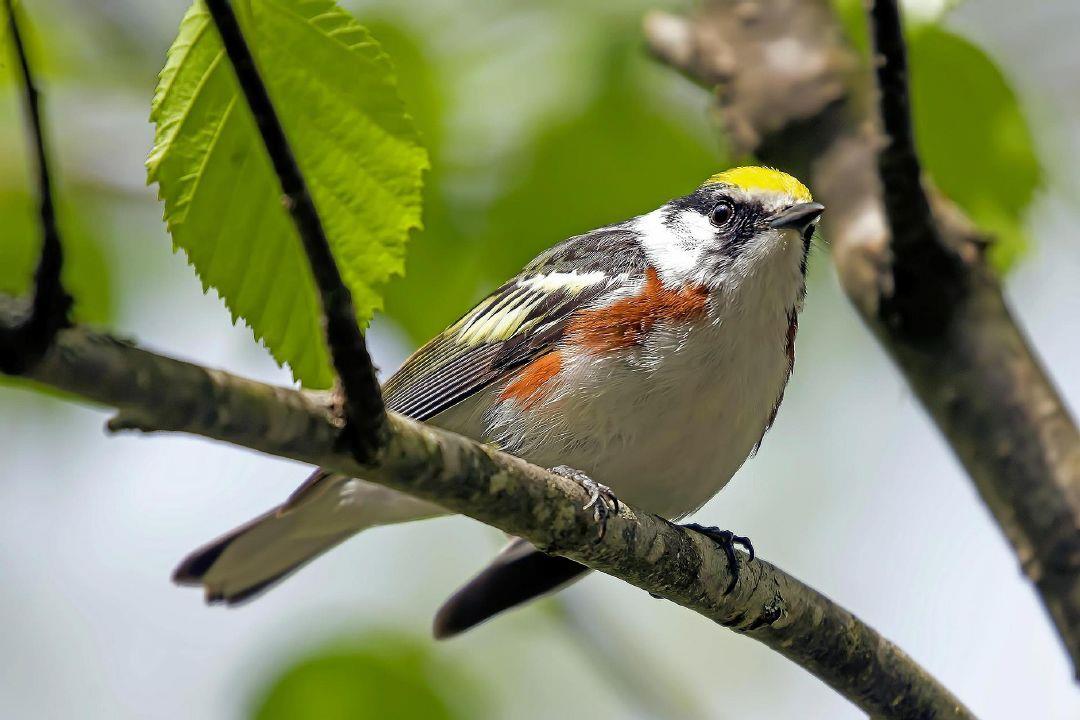
Hans Toom/Pixabay • A male chestnut-sided warbler peeks from the foliage of a tree., A total of 31 chestnut-sided warblers were found by counters during the 2026 Carter County Summer Bird Count.

Members and friends of the Elizabethton Bird Club conducted the 33rd Carter County Summer Count on Saturday, June 6, with 21 observers. Participants tallied 119 species, which is slightly above the average of 114.

According to count compiler Rick Knight, the all-time high of 123 species was achieved in 2017. Some of the more abundant birds on this year’s count included European starling with 900 individuals counted, and American robin with 343 individuals found. A total of 21 different species of warblers were found.

I counted in Elizabethton along the Watauga River along with Chris Soto and Rex Whitfield and Rob Armistead. Our group also consisted of Jean and Brookie Potter, who covered Wilbur Lake; and Connie and Dave Irick, who made their survey on Holston Mountain. We also had a single feeder watcher, Dianna Lynne of Stoney Creek.

The list:
Canada goose, 181; wood duck, 21; mallard, 60; and common merganser, 18

Wild turkey, 20; ruffed grouse, 3; mourning dove, 107; rock pigeon, 22; yellow-billed cuckoo, 1; common nighthawk, 15; chuck-will’s-widow, 2; Eastern whip-poor-will, 12; chimney swift, 76; and ruby-throated hummingbird, 16

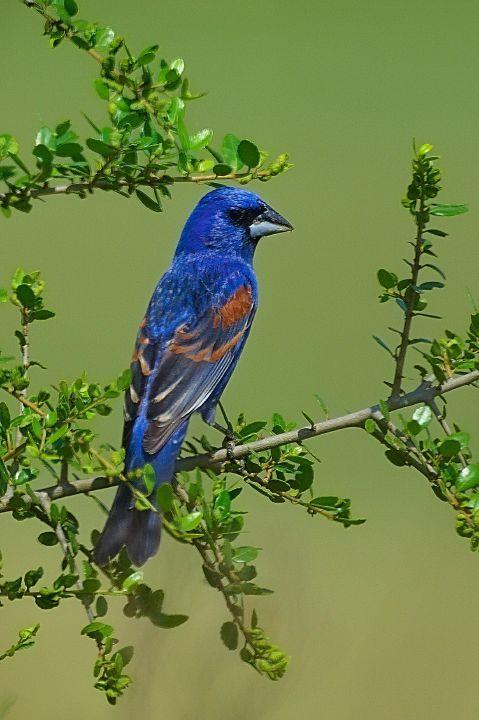
Lynn Wilson/Pixabay • A male blue grosbeak perches in the branches of a shrub. Five of these birds were found on the Carter County Summer Bird Count.

Killdeer, 3; double-crested cormorant, 29; green heron, 3; great blue heron, 29; black vulture, 11; turkey vulture, 70; osprey, 2; sharp-shinned hawk, 1; Cooper’s hawk, 1; red-shouldered hawk, 4; broad-winged hawk, 8; and red-tailed hawk, 8

Eastern screech owl, 2; barred owl, 1; belted kingfisher, 4; red-bellied woodpecker, 22; yellow-bellied sapsucker, 1; downy woodpecker, 29; hairy woodpecker, 7; Northern flicker, 17; and pileated woodpecker, 16

American kestrel, 1; great crested flycatcher, 5; Eastern kingbird, 21; Eastern wood-pewee, 50; Acadian flycatcher, 45; alder flycatcher, 1; least flycatcher, 12; and Eastern phoebe, 70

White-eyed vireo, 6; blue-headed vireo, 53; warbling vireo, 6; red-eyed vireo, 183; blue jay, 117; American crow, 255; fish crow, 5; and common raven, 10

Carolina chickadee, 83; tufted titmouse, 74; tree swallow, 67; Northern rough-winged swallow, 44; purple martin, 18; barn swallow, 75; and cliff swallow, 288

Golden-crowned kinglet, 3; cedar waxwing, 20; red-breasted nuthatch, 5; white-breasted nuthatch, 24; brown creeper, 5; blue-gray gnatcatcher, 30; Carolina wren, 125; house wren, 31; and winter wren, 5

Gray catbird, 37; brown thrasher, 32; Northern mockingbird, 87; European starling, 900; Eastern bluebird, 84; veery, 14; hermit thrush, 1; wood thrush, 84; and American robin, 343

House sparrow, 36; house finch, 152; red crossbill, 1; American goldfinch, 141; grasshopper sparrow, 1; chipping sparrow, 80; field sparrow, 40; dark-eyed junco, 61; song sparrow, 210; Eastern towhee, 108; and yellow-breasted chat, 1

Eastern meadowlark, 17; orchard oriole, 7; Baltimore oriole, 3; red-winged blackbird, 107; brown-headed cowbird, 51; and common grackle, 75

Ovenbird, 86; worm-eating warbler 17; Louisiana waterthrush, 10; golden-winged warbler 5; black and white warbler, 40; Swainson’s warbler, 12; common yellowthroat, 26; hooded warbler, 140; American redstart, 26; Northern parula, 58; magnolia warbler, 1; Blackburnian warbler, 5; yellow warbler, 13; chestnut-sided warbler, 31; black-throated blue warbler, 65; pine warbler, 6; yellow-rumped warbler, 5; yellow-throated warbler, 30; prairie warbler, 1; black-throated green warbler, 49; and Canada warbler, 6

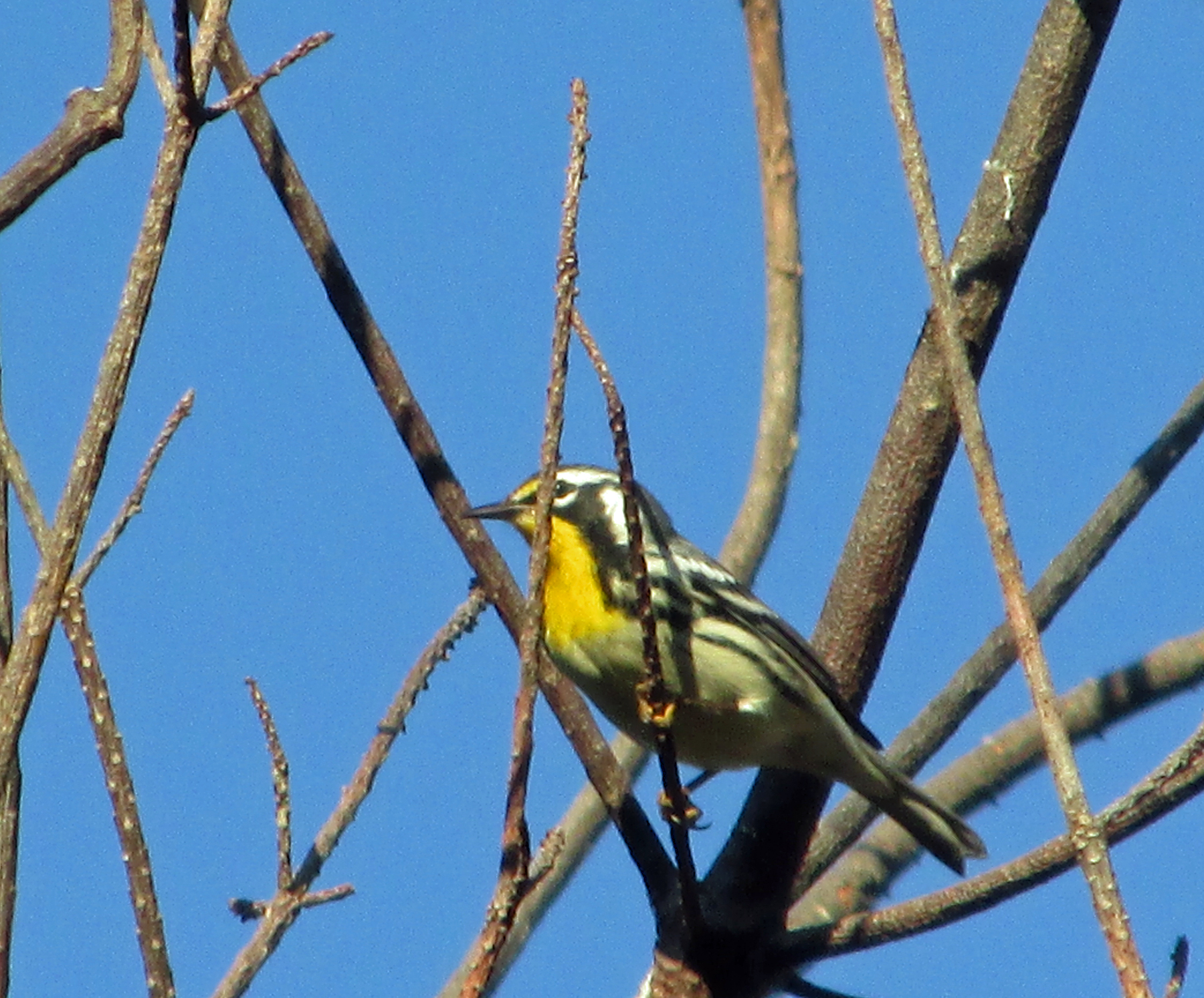
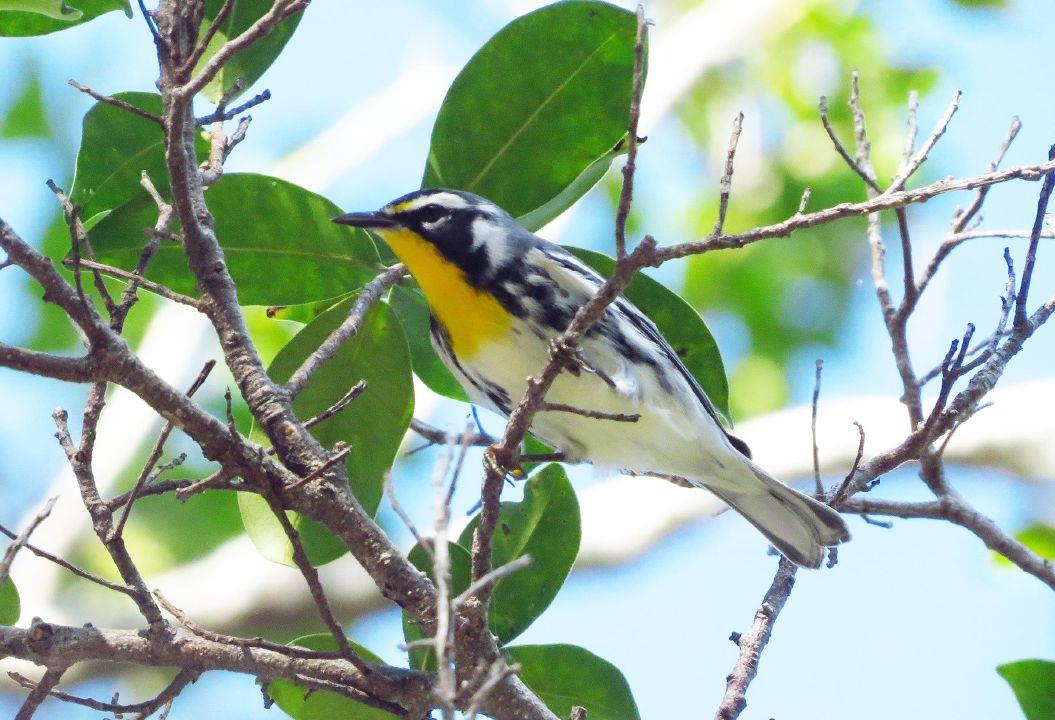
Photo by Bryan Stevens A Yellow-throated warbler perches in a cluster of dead branches.

Scarlet tanager, 45; Northern cardinal, 154; rose-breasted grosbeak, 12; blue grosbeak, 5; and indigo bunting, 144.

I’ll discuss the results of the Unicoi County Summer Bird Count, which was held June 13, in an upcoming column.

•••

To ask a question, make a comment or share a sighting, email me at ahoodedwarbler@aol.com.

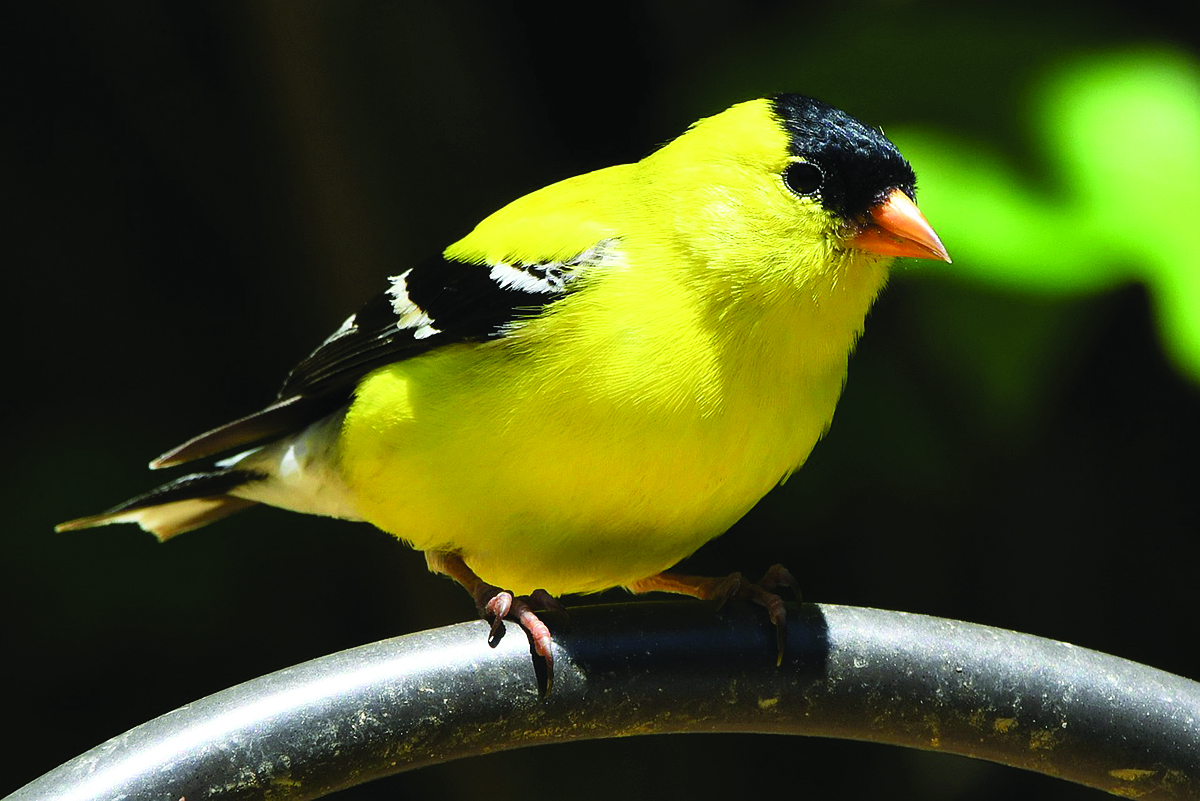
Miles Moody/Pixabay • A male American goldfinch looks his best during the spring and summer seasons.

Yellow-throated warbler sighting on April 2 is first of season

Susan Young/USFWS • The yellow-throated warbler can be a challenge to observe due to its habit of remaining aloft in the tops of tall trees.

You have to admire our feathered friends for always keeping a surprise or two tucked under their wings.

My first warblers of the spring season arrived on April 2, and neither was one of the species I fully expected to be this year’s “early bird” at my home.

A yellow-throated warbler and a pine warbler, both singing from a stand of pine trees, took this year’s early arrival status. This is the first time either of these two warblers has gained that distinction.

The Northern parula has in recent years claimed this honor, which in years past went to species such as hooded warbler or black-throated green warbler.

In 2025, an ovenbird beat all of other warblers to arrive on Friday, April 7, in the woodlands around my home. followed a few days later by a black-throated green warbler.

Technically, I noticed the yellow-throated warbler first, so it gets the honor of being the spring’s first returning warbler. Only a few minutes passed, however, before I also took note of the singing pine warbler. At press time, no other warblers have arrived.

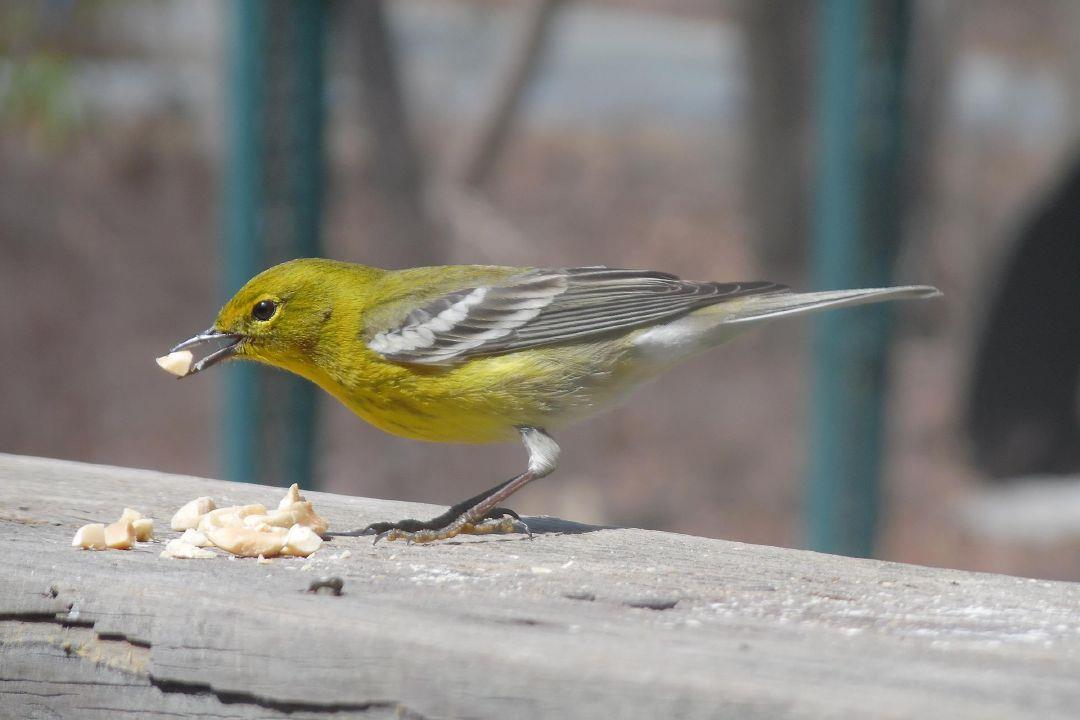
Nikolaus Schultz/Pixabay • Pine warblers can become regular feeder visitors if fare to their liking is available.

I’m still waiting for my first ruby-throated warbler of spring. I’ve not yet heard from any readers, but I fully anticipate hearing about these tiny flying gems arriving any day.

Last year I welcomed back the season’s first ruby-throated hummingbird at 4:14 p.m. on Sunday, April 6. I’m hopeful I can shave a few days off that arrival time this year, but that’s entirely up to the hummingbirds.

As I have for many years, I am asking readers to share their first sightings of hummingbirds. I have tracked arrivals for several years now. To share your first spring sighting of a ruby-throated hummingbird, email me at ahoodedwarbler@aol.com or contact me on Facebook at http://www.facebook.com/ahoodedwarbler. Please include the date and time of your sighting. I also welcome the sharing of other details about your sightings.

Photo by Bryan Stevens • Blue-headed vireos, such as this bird, are high-elevation summer residents in the region. In the spring and fall, they are also common migrants.

Regardless, spring has sprung. Dogwoods are blooming, and their blossoms are beautiful, but it’s also a reminder that our traditional “dogwood winter” with its accompanying dip back into cooler temperatures, is around the corner. Other birds have also been arriving.

A blue-headed vireo put in an appearance on March 29. A chipping sparrow did the same on March 30. When the dam finally breaks, dozens of birds will return or, in some cases, migrate through the region on their way farther north. April and May are exciting times for birders.

As for the two warblers that arrived on April 2, they represent species that have made only occasional appearances at my home. Perhaps the affinity for pine trees that both of these warblers share could have drawn them to visit. There are several stands of large pines thriving on the property.

As its name would indicate, pine warblers are almost always found near pines. These birds have white bellies, two white wing bars, dark legs and thin, relatively long pointed bills. Yellowish “spectacles” around their eyes help contrast them from other warblers. Adult males have olive upperparts and bright yellow throats and breasts; females and immatures display upperparts which are olive-brown.

Bryan Stevens • A pine warbler visits a feeder for a helping of suet.

Pine warblers feed mostly on insects, as well as some seeds and fruit. They tend to forage by probing in crevices on tree trunks and branches, or by poking their beaks into pine cones. Pine warblers spends a great deal of time on the ground, often in the litter of pine needles beneath large trees. They turn over leaves and clusters of pine needles to search for insects concealed beneath them.

The pine warbler doesn’t make the longer migrations of some members of the warbler family. In fact, some pine warblers are resident in the southeastern United States year-round. Visits to wooded suburbs in Atlanta in almost any season is sure to feature sightings. Many pine warblers have also included visits to backyard feeders into their daily routines. They’re fond of offerings such as mealworms, suet cakes and sunflower chips.

The only real requirement needed to attract pine warblers is the presence of pines. These birds utilize various pines, including loblolly, shortleaf, longleaf and white pines.

The yellow-throated warbler is also fond of pine trees. Not quite as common at feeders at pine warblers, the yellow-throated warbler has shifted its behavior to take advantage of the extra resource that a well-maintained feeding station kept supplied with diverse offerings represents.

Photo by Bryan Stevens A Yellow-throated Warbler makes a migratory stop in my yard on the first day of September.

The yellow-throated warbler is also commonly associated with mature trees that extend above the canopy. They also prefer that favored trees are located near a water source. Some of the favored trees for the species include sycamore, shortleaf pine, Virginia pine and bald cypress.

I’ll be interested to see if these two species linger or if they’re passing through and simply using my home as a stopping point to forage and rest before continuing on their way.

It’s a great time of year to stay alert to new arrivals. Keep a pair of binoculars at the ready, and don’t forget to share those sightings, especially as the return of ruby-throated hummingbirds is imminent.

•••

Bryan Stevens has written about birds, birding and birders since 1995. Email him at ahoodedwarbler@aol.com to make a comment, ask a question or share a sighting.