Monthly Archives: May 2026

Eastern phoebes make good neighbors

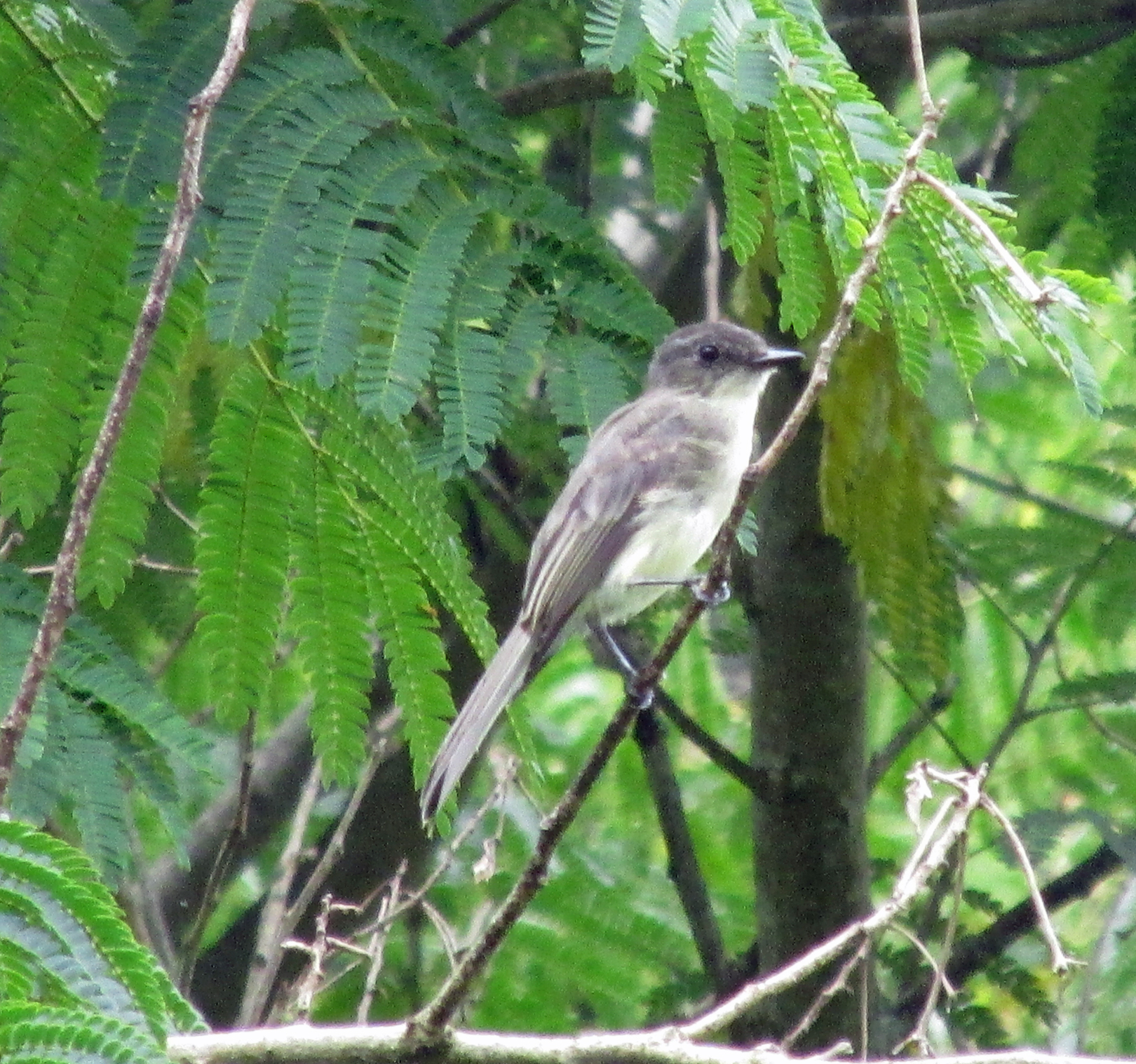
Photo by Bryan Stevens • An Eastern phoebe perches in a mimosa tree.

We’ve reached June, and I can hardly believe it. After a May that veered from cold to unseasonably hot, I’m hoping June can find a happy balance.

The birds haven’t ruffled their feathers about temperature variances, as best as I can tell. Migration is, for the most part, concluded. Some birds have already completed a first nesting, including some Eurasian starlings in downtown Erwin. During a stroll on the Union Street sidewalk, I flustered a fledgling and its parents. I gave them some space as I passed, and it looked like things got back to normal.

Nesting is the main focus of most birds during the spring and summer months, and the process can stretch out until August and early September for species like cedar waxwing and American goldfinches.
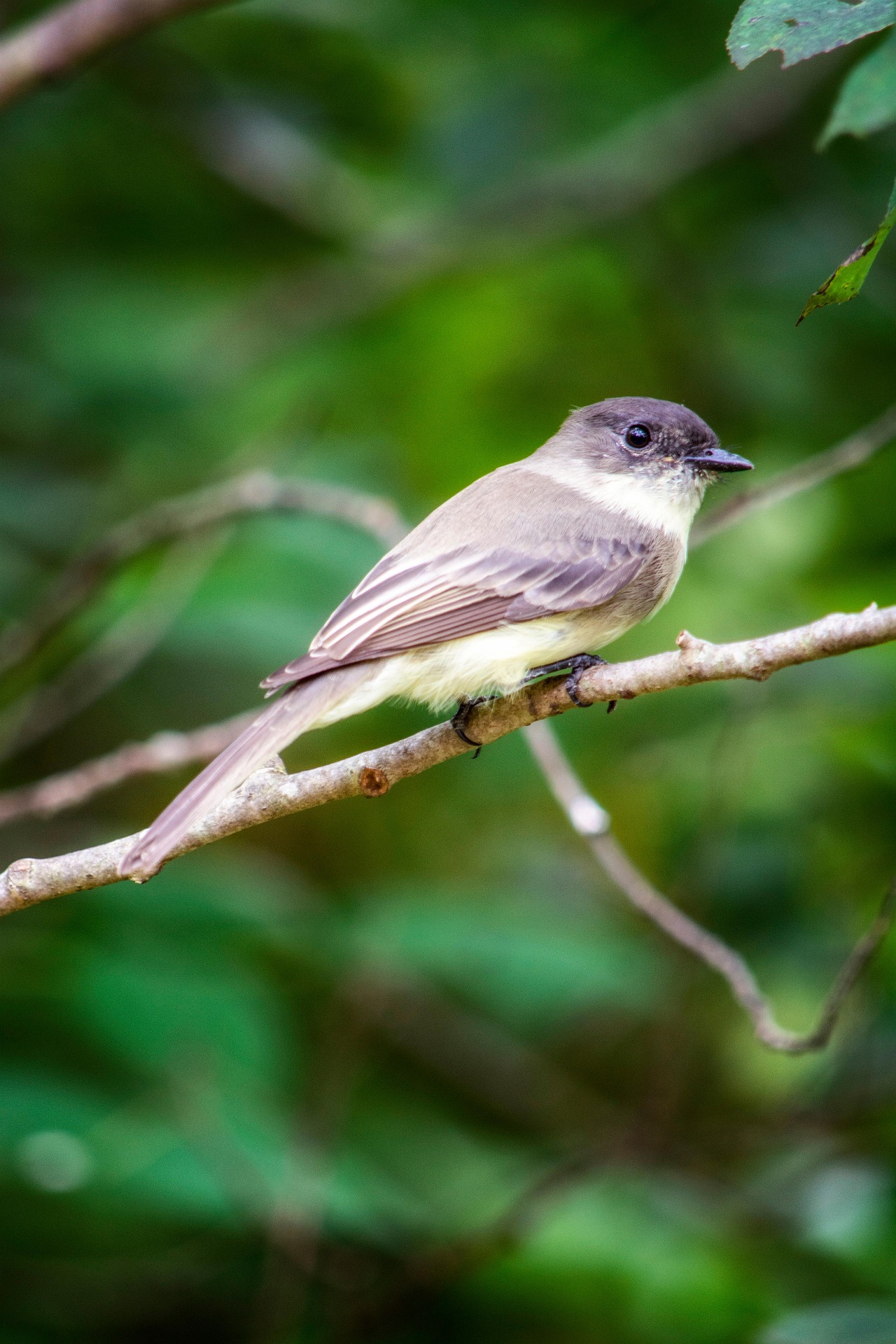
Photo by Megan Zopf/Pixabay • An Eastern phoebe perches on a branch.

Other birds, such as various sparrows, American robin and Eastern bluebird, may attempt to nest multiple times in zealous bids to propagate their species.

I’ve noticed that the old nest on the blades of the porch fan at my house has gotten a bit greener as the Eastern phoebes have done some refurbishment to what has been a popular nest location for this species at my home in recent years.

Actually, it’s probably only the resident female phoebe involved in bringing new moss to the structure and working the material into the foundation of the previous nest. According to the website All About Birds, the female phoebe works solo on all nest-building tasks, although the male may accompany her, perhaps offering the avian equivalent of moral support.

She uses various materials, including mud, moss and leaves, along with grass stems and animal hair, during her construction process. Once she is done with her refurbishment and the nest meets her standards, she will lay two to six eggs. She’ll incubate them for 15 to 16 days. Once hatched, the nestlings will reside in the nest for up to 20 days. Even after the young fledge from the nest, the parents remain attentive as they introduce their brood to the wider world.

John James Audubon, an early naturalist and famed painter of North America’s birds, conducted an experiment with some young phoebes that represents the first-ever bird banding in the United States of America. His novel experiment, which he carried out in 1803, involved tying some silver thread to the legs of the phoebes he captured near his home in Pennsylvania. He wanted to answer a question he had about whether birds are faithful to home locations from year to year.

Photo by Bryan Stevens • A young Eastern phoebe awaits a food delivery from a parent.

The following year, Audubon again captured two phoebes and found the silver thread had remained attached to their legs. Today, ornithologists still conduct bird banding to gather information on birds and the mystery of their migrations. So, that pair of phoebes that returned to your backyard this spring — they just might be the same ones that have spent past summer seasons providing you with an enlightening glimpse into their lives. I’ve wondered myself if the phoebes that nest on my porch ceiling fan are the same two birds that have done so in previous years. I’ve suspected they are or, perhaps, they are related to the original nesting pair.

The Eastern phoebe, known by the scientific name of Sayornis phoebe, has two relatives in the genus Sayornis. The genus is named after Thomas Say, an American naturalist. The Eastern phoebe’s close relatives include the black phoebe and Say’s phoebe. The black phoebe ranges throughout Oregon, Washington and California and as far south as Central and South America. As its name suggests, this bird has mostly black feathers instead of the gray plumage of its relatives. The Say’s phoebe, also named for the man who gave the genus its name, is the western counterpart to the Eastern phoebe.

The phoebes belong to the world’s largest family of birds, which is known collectively as the “tyrant flycatchers.” With more than 400 species, this family of birds consists of species known as tyrannulets, elaenias, pygmy tyrants, tody-flycatchers, spadebills, flatbills, attilas, kingbirds and kiskadees.

Since they belong to the vast family of New World flycatchers, it’s probably no surprise that these phoebes feed largely on insects. The birds will often perch patiently until an insect’s flight brings it within easy range. A quick flight from its perch usually allows the skillful bird to return with a morsel snatched on the wing. In the winter months, the Eastern phoebe also eats berries and other small fruit. Phoebes can even feed on poison ivy berries without risk of ill effects.

The Eastern phoebe is not a colorful bird, but it makes a good neighbor. I’d encourage everyone to welcome this bird whenever they get the chance.

To make a comment, ask a question or share a sighting, email me at ahoodedwarbler@aol.com. I’ve written about birds, birding and birded for 30 years and love hearing from fellow enthusiasts.
Region’s 83rd Spring Bird Count tallies 155 species

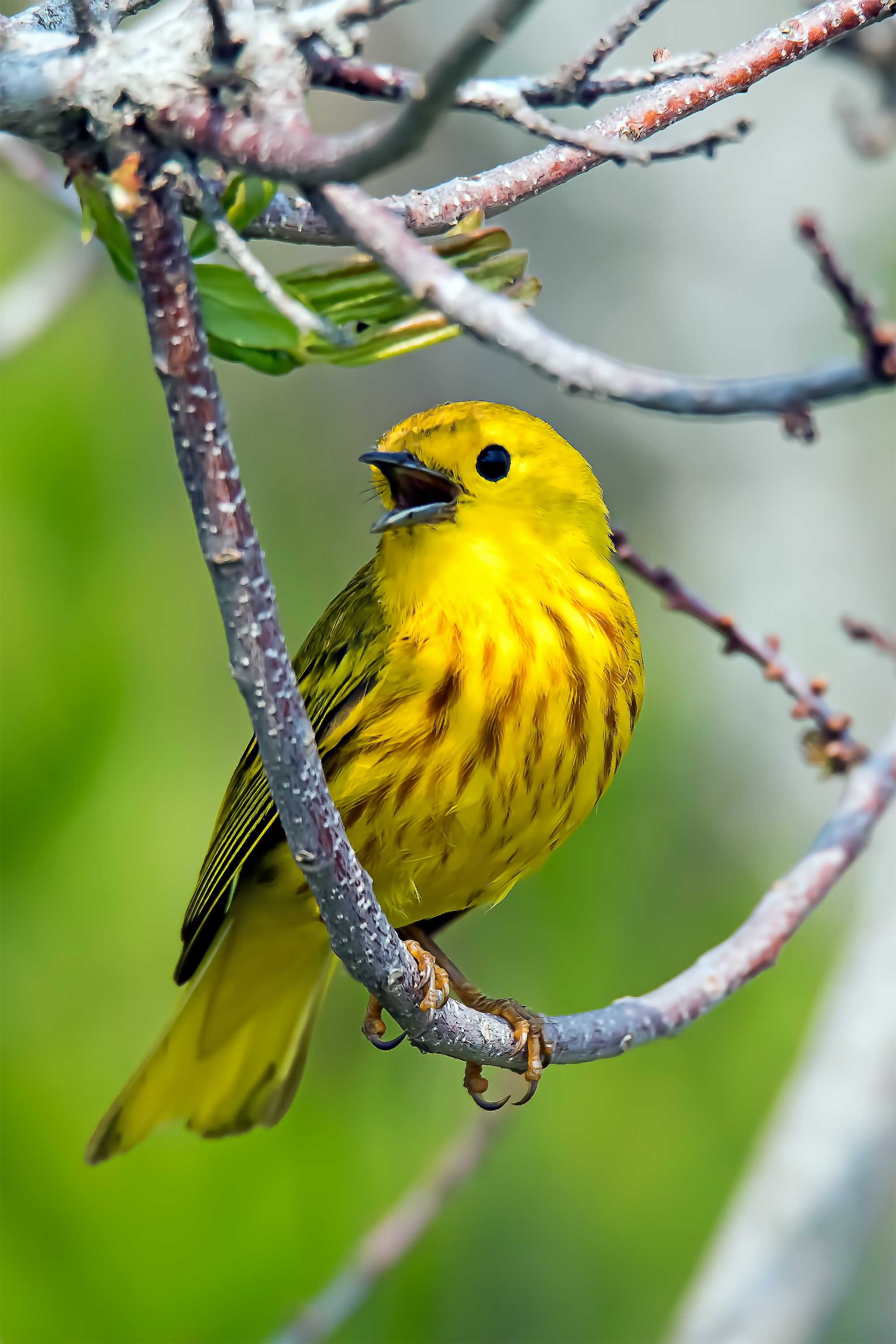
Hans Toom • A yellow warbler perches on a tree branch.

The 83rd consecutive Elizabethton Spring Bird Count was held Saturday, May 9, with 44 observers in 16 parties. The counters tallied 155 species, which is slightly above the average of 152 species in the most recent 20 years of this annual survey. The all-time high on this count took place in 2016 with 166 species tallied.

Although the day began on a slightly chilly note, temperatures soon warmed and skies remained clear and sunny most of the day. I counted near Sycamore Shoals State Historic Park and along the Watauga River in Elizabethton with Mary Anna Wheat and Chris Soto. We counted ourselves lucky to get some good birds on our list, including Northern waterthrush, blackpoll warbler and Kentucky warbler.

A total of 28 species of warblers made the list, as well as good sightings such as Northern saw-whet owl, sora, blue grosbeak, summer tanager and dickcissel.

Compiler Rick Knight noted that, as always, a few species got missed on count day, notably ruffed grouse, great horned owl, Virginia rail and prairie warbler.

The count group’s total list follows:

Canada goose, 391; wood duck, 71; American wigeon, 13; mallard, 69; common merganser, 11; red-breasted merganser, 1; and wild turkey, 25.

Mourning dove, 181; Eurasian collared-dove, 2; rock pigeon, 78; yellow-billed cuckoo, 2; common nighthawk, 2; chuck-will’s-widow, 8; Eastern whip-poor-will, 19; chimney swift, 101; and ruby-throated hummingbird, 15.

Sora, 1; killdeer, 32; semipalmated plover, 24; least sandpiper, 37; semipalmated sandpiper, 5; spotted sandpiper, 71; solitary sandpiper, 22; lesser yellowlegs, 8; greater yellowlegs, 5; common tern, 2; and Forster’s tern, 3.

Photo by Bryan Stevens • A tree swallow checks out a nesting box soon after making its spring return. 

Double-crested cormorant, 136; yellow-crowned night-heron, 6; green heron, 8; great egret, 1; great blue heron, 61; black vulture, 86; and turkey vulture, 94.

Osprey, 16; sharp-shinned hawk, 1; Cooper’s hawk, 3; bald eagle, 8; red-shouldered hawk, 8; broad-winged hawk, 4; red-tailed hawk, 20; American barn owl, 1; Eastern screech owl, 7; barred owl, 3; and Northern saw-whet owl, 1.

Belted kingfisher, 17; Red-headed woodpecker, 6; Red-bellied woodpecker, 66; yellow-bellied sapsucker, 2; downy woodpecker, 39; hairy woodpecker, 8; Northern flicker, 35; and pileated woodpecker, 31.

American kestrel, 9; great crested flycatcher, 27; Eastern kingbird, 112; Eastern wood-pewee, 30; Acadian flycatcher, 47; willow flycatcher, 2; least flycatcher, 15; and Eastern phoebe, 59.

White-eyed vireo, 15; yellow-throated vireo, 6; blue-headed vireo, 72; Eastern warbling vireo, 19; red-eyed vireo, 310; and loggerhead shrike, 1.

Blue jay, 167; American crow, 291; fish crow, 15; common raven, 15; Carolina chickadee, 136; and tufted titmouse, 154.

Bank swallow, 4; tree swallow, 124; Northern rough-winged swallow, 90; purple martin, 42; barn swallow, 165; and cliff swallow, 785.

Ruby-crowned kinglet, 1; Golden-crowned kinglet, 1; cedar waxwing, 225; red-breasted nuthatch, 10; white-breasted nuthatch, 25; brown creeper, 3; and blue-gray gnatcatcher, 63.

Carolina Wren, 187; Northern House Wren, 35; Winter Wren, 5; Gray Catbird, 78; Brown Thrasher, 46, Northern Mockingbird, 131; Eurasian Starling, 630; and Eastern Bluebird 140

Veery, 18; Swainson’s thrush, 8; hermit thrush, 2; wood thrush, 70; and American robin, 717.

House sparrow, 55; house finch, 129; pine siskin, 2; and American goldfinch, 226.

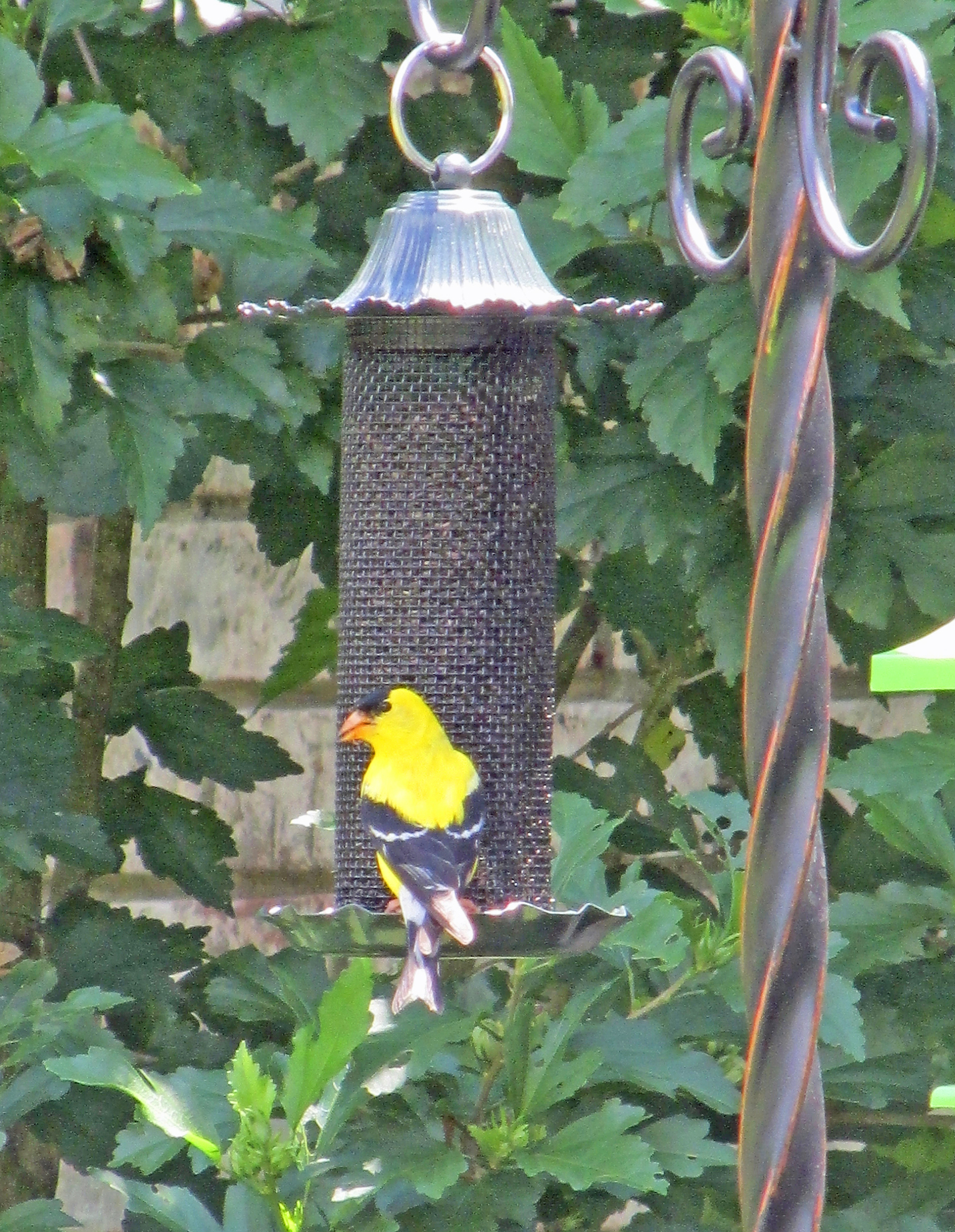
Bryan Stevens • A male American goldfinch visits a thistle seed feeder.

Grasshopper sparrow, 4; chipping sparrow, 101; field sparrow, 41; dark-eyed junco, 45; white-crowned sparrow 1; white-throated sparrow, 5; Savannah sparrow, 1; song sparrow, 268; swamp sparrow, 1; and Eastern towhee, 142.

Yellow-breasted chat, 5; Eastern meadowlark, 48; orchard oriole, 43; Baltimore oriole, 28; red-winged blackbird, 272; brown-headed cowbird, 64; and common grackle, 280.

Ovenbird, 132; worm-eating warbler, 27; Louisiana waterthrush, 29; Northern waterthrush, 6; golden-winged warbler, 5; blue-winged warbler, 1; black-and-white warbler, 58; Swainson’s warbler, 23; Tennessee warbler, 10; Kentucky warbler, 11; common yellowthroat, 45; hooded warbler, 198; American redstart, 26; Cape May warbler, 12; Northern parula, 73; magnolia warbler, 4; bay-breasted warbler, 11; Blackburnian warbler, 12; yellow warbler, 19; chestnut-sided warbler, 40; blackpoll warbler, 12; black-throated blue warbler, 76; palm warbler, 2; pine warbler, 14; yellow-rumped warbler, 26; yellow-throated warbler, 42; black-throated green warbler, 104; and Canada warbler, 32.

Summer tanager, 1; scarlet tanager, 81; Northern cardinal, 239; rose-breasted grosbeak, 35; blue grosbeak, 9; indigo bunting, 152; and dickcissel, 2.


American dipper highlight of 2003 Utah trip


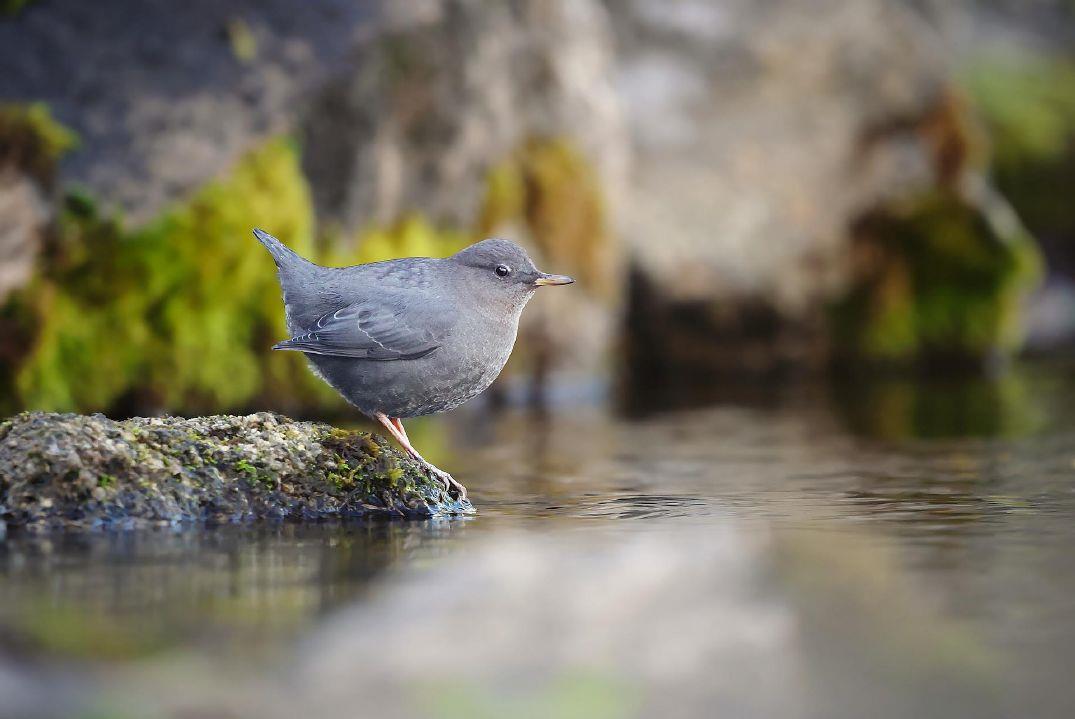
Daniel Roberts/Pixabay • The American dipper is North America’s only aquatic songbird.

I am observing 30 years of writing my weekly “Feathered Friends” column in 2026. To help celebrate this personal milestones, I’ve been visiting my archives to republish some memorable columns.

This week, I’m sharing an account of a visit in October 2003 to Utah and Idaho. The story involves homemade raspberry ice cream, a songbird that thinks it’s a fish and a bonus sighting of a species named for American naturalist and ornithologist John Kirk Townsend.

I did some homework in advance of my two-week trip to Salt Lake City, Utah, to come up with a list of target birds. The American dipper made the list as a species that I had high hopes of seeing. I learned from a friend that American dippers inhabit many of the streams in canyons, some in the immediate vicinity of Salt Lake City. Another friend, David Thometz, and I searched City Creek Canyon and Little Cottonwood Canyon in the Salt Lake metropolitan area without success.

We saw other birds, including lazuli bunting, Western kingbird, black-billed magpie, so this early disappointment didn’t sting too much, and we got a second chance near the end of my visit.

The American dipper, also known by the common named “water ouzel,” is a songbird with incredible adaptations allowing the bird to take advantage of a special niche in its environment, namely rushing waters of clear mountain streams. Dippers are eight-inch songbirds with stubby gray bodies. They range from Alaska through the mountains of the American western states and into Mexico. These birds are named for particular “dipping” motions that they display walking along stream edges.

These birds forage for food, primarily aquatic insect larvae, both above and beneath the surface of rushing streams.

I finally found my American dipper while traveling Logan Canyon on a trip back to Salt Lake City after visiting Bear Lake National Wildlife Refuge in Idaho. David and I stopped at Card Picnic Area in the Uinta-Wasatch-Cache National Forest to enjoy a local treat we picked up in Garden City, Utah.

We saw some good birds, including cinnamon teal and trumpeter swan, at Bear Lake, which is famous for its raspberries. The locals often stage an annual Raspberry Festival. We were too late for the festival in 2003, but we purchased two small plastic containers of homemade raspberry ice cream at a shop.

The ice cream was frozen solid, so we made plans to let the ice cream thaw and then made a stop at some point along Logan Canyon to enjoy the frozen treat. We took a scenic drive along Highway 89, enjoying the mile-high limestone cliffs easily viewed from the roadway. The route takes in forest terrain, the Logan River and plenty of opportunities to view native wildlife. Prior to stopping to eat our ice cream, we made stops and saw two different races – Oregon and slate-colored – of the dark-eyed junco, as well as black-capped and mountain chickadees and least chipmunks. We also saw sleek trout in Logan River, which is dotted by various beaver dams. We could not positively identify the trout, but the local streams are inhabited by brook, cutthroat and rainbow trout.

The Card Picnic Area is a beautiful streamside site featuring picnic tables beneath huge trees. There was a beautiful wide pool in Logan River adjacent to the tables. The only bird we saw upon arrival was a junco that disappeared into the brush too quickly for me to identify.

After enjoying our ice cream, a delicious treat that anyone visiting Bear Lake should not miss, we walked to the side of the stream to snap some photographs. As we approached the stream, a small bird flushed and flew somewhat awkwardly to the opposite stream bank.

I felt my pulse quicken as I realized that one of target birds had materialized. “David, I think we’ve found a dipper!” I whispered excitedly as I lifted my binoculars. As the bird came into focus, I immediately recognized the small grayish bird as it walked nervously over some damp gravel on the other side of the stream. As we watched, the dipper produced a loud, bubbling song, easily heard even over the noise of the rushing water.

The dipper also blinked conspicuously, showing white eyelids. Those eyelids are a special adaptation for life spent below rushing water. The eyelids protect the bird’s eyes while it is beneath the water. Some of my guide books mention that the dipper will blink and show the eyelids most often when alarmed. Dippers have a thin white line of feathers on each eyelid, according to All About Birds. That thin line of feathers creates a white flash as the bird blinks.

The birds appear to fearlessly take to the frigid water of mountain streams, but there’s a good reason for that. Dippers also have a thick coat of down and more feathers than most songbirds. Some estimates place the number at between 4,200 to 6,000 feathers. By comparison, an American robin has 3,000 feathers. This dense coat of feathers helps insulate the birds from the cold water. A dipper’s blood also carries a higher oxygen capacity, helping these small birds stay under water for up to 30 seconds.

We remained calm and as still as possible so we could put the bird at ease. Our actions must have worked because the bird returned to its routine, turning over fallen leaves in the shallows to look for scurrying insect larvae. Then, the dipper hopped onto a large rock in the rushing water, and I held my breath. I wanted so badly to see this small bird dive and swim beneath the water. I wasn’t disappointed. The bird soon plunged into the stream, swimming against the current, using its wings as paddles. Watching this tiny songbird provided an exciting observation, but not as much as when the dipper fearlessly plunged completely beneath the water, spent a few seconds submerged and then popped back to the surface. This show was repeated several times for our benefit.

A family picnicking at the site even got to enjoy the show when we pointed out the dipper. The family lived in the local area, but the father expressed surprise to learn dippers lived in Utah, although he had seen them in Washington. It’s surprising what we sometimes fail to notice in our own backyards.

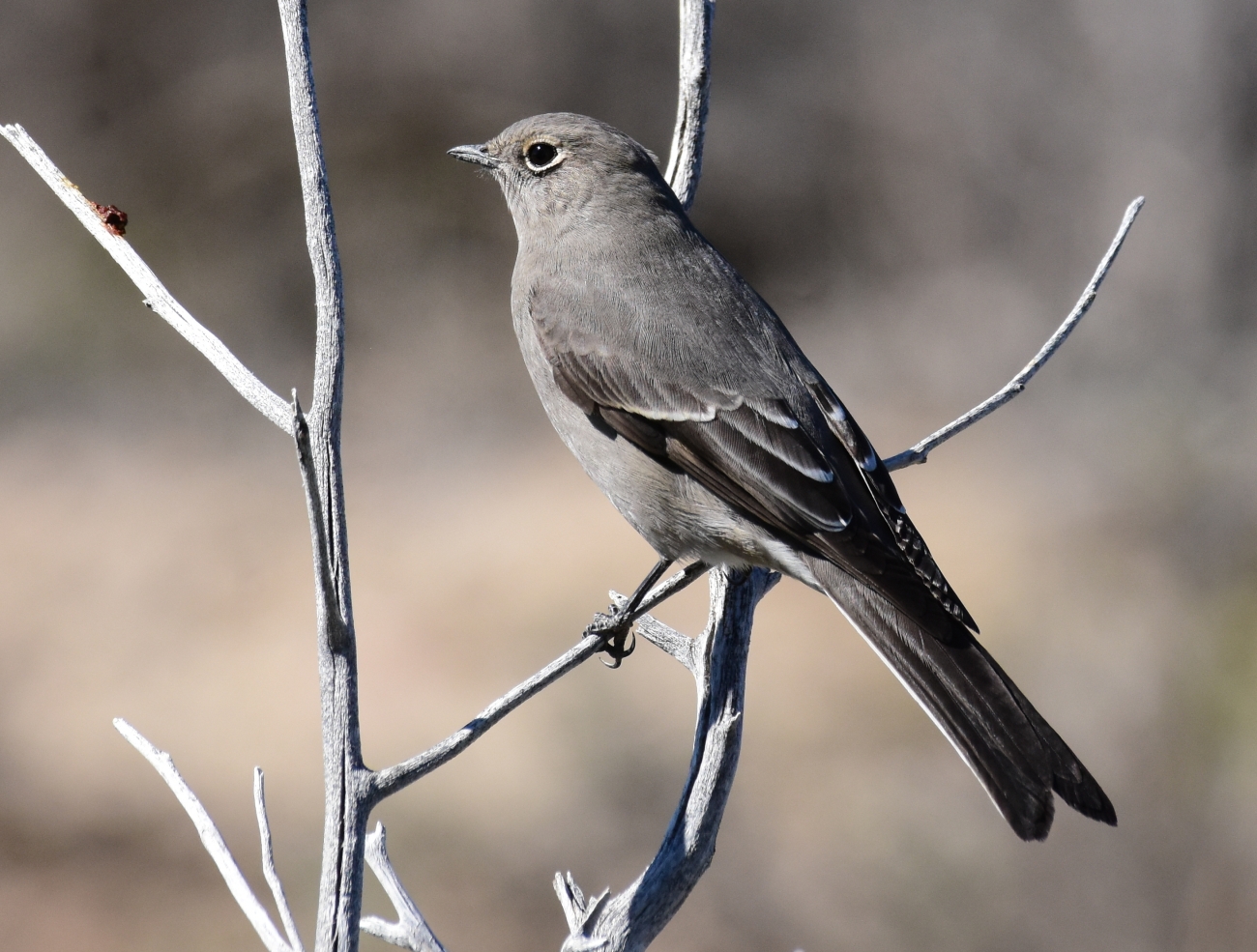
Tom Koerner/USFWS • The Townsend’s solitaire is related to thrushes.

Sighting the American dipper would have been more than enough, but when birding, surprises are always welcome. So, imagine my astonishment when, while watching the dipper, three additional birds dropped down from some overhanging trees and drank at the stream side.

Although unprepared for these new birds, my prior research helped me recognize them as Townsend’s solitaires, a member of the thrush family. The Townsend’s solitaire is a grayish bird with a superficial resemblance to the Northern mockingbird. The Townsend’s solitaire is the only member of its family of mountain-forest thrushes, or solitaires, to range into the United States.

This species is named for John Kirk Townsend, a 19th-century naturalist who traveled across the Rocky Mountains to the Pacific coast in 1833 to collect bird and mammal specimens with veteran botanist Thomas Nuttall. Only 24 at the time, Townsend accompanied Nuttall, 48 years old at the time, from Philadelphia to the Pacific Northwest. They focused their search along the Columbia River.

As for dippers, there are five different species found around the world. In addition to the American dipper, there is a white-throated dipper, or European dipper, as well as the brown dipper of Asia, the white-capped dipper of South America and the rufous-throated dipper, also of South America.

I think it’s a shame that the American dipper’s range doesn’t extend into the eastern half of the nation. Based on my observation, I think the bird would be right at home along Indian Creek in Unicoi County.

•••

Bryan Stevens has written about birds, birding and birders since 1995. Contact him at ahoodedwarbler@aol.com. 


Nature’s showstoppers: Rose-breasted grosbeaks bring the wow factor

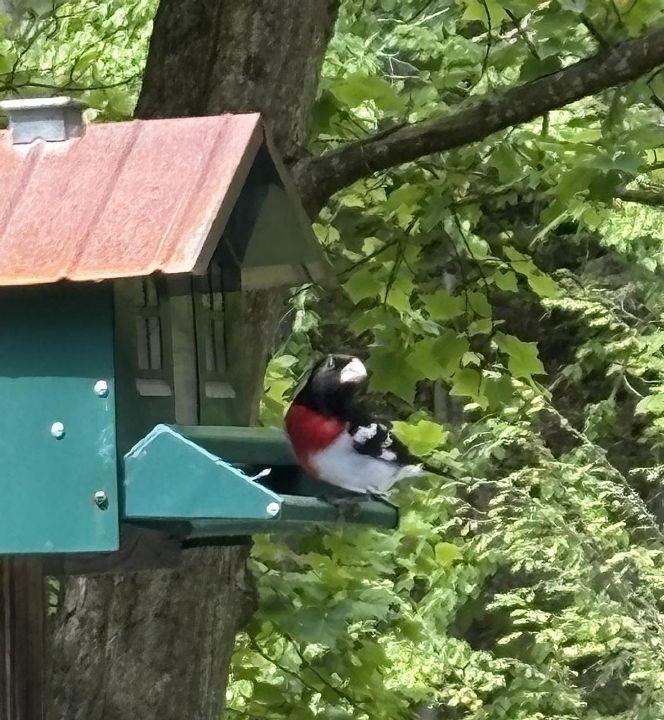
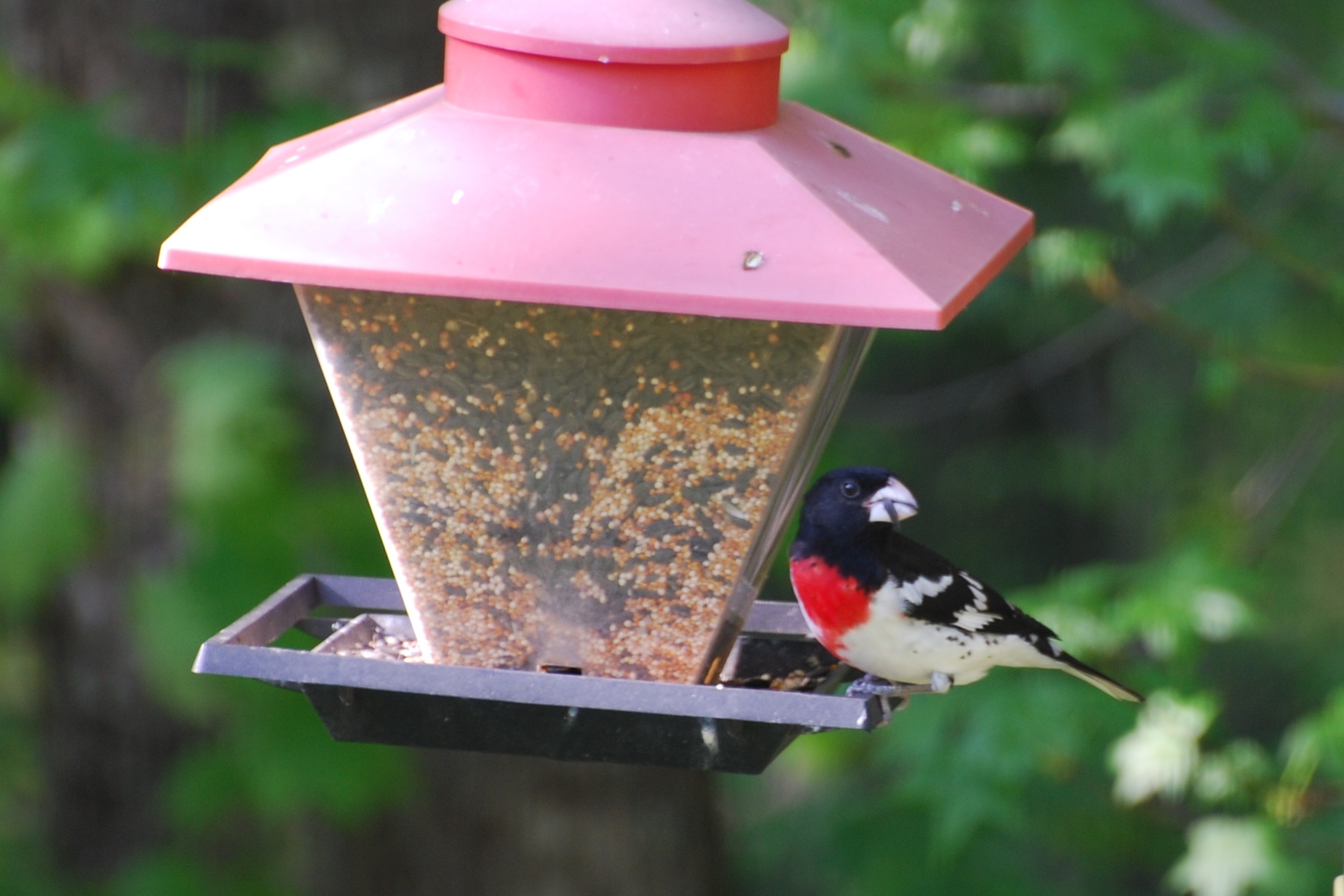
Photo by Cheri Miller • A male rose-breasted grosbeak visits a feeder at the photographer’s home.

Cheri Miller posted on my Facebook page to share a sighting and a photo of a male rose-breasted grosbeak visiting a feeder at her home in Hampton. The bird arrived on May 1.

The bird’s arrival is right on schedule. Plenty of rose-breasted grosbeaks pass through northeast Tennessee, southwest Virginia and western North Carolina in late April and early May every spring. A sighting of a male in his best spring plumage is always a breathtaking sight.

Kaylynn Sanford Wilster, who lives in Piney Flats near Boone Lake, sought me out May 7 on Facebook for my help identifying a bird that turned out to be a male rose-breasted grosbeak.

She had taken some video and photos of the bird through her bedroom window with her phone and said the bird was eating sunflower seeds at her feeder. Grosbeaks love sunflower seeds, so keep those feeders stocked!

A few of these migrating grosbeaks will even decide to make their summer home on local mountains. However, these birds spread out widely across the eastern half of the North American continent, ranging from northeastern British Columbia to Quebec and Nova Scotia in Canada. They also range south from New Jersey to Georgia. The rose-breasted grosbeak also reaches Colorado, Oklahoma and Kansas.

For the most part, however, the rose-breasted grosbeak is replaced in the western United States by the closely related black-headed grosbeak.

As fall approaches, the rose-breasted grosbeak migrates south to a winter range that spans central Mexico, Central America and northern South America. As they depart, many of these migrating birds will make autumn visits to again partake of offerings of sunflower seeds at backyard feeders. So, if you don’t get to see these showy birds in the spring, you do get another chance to see them in September and October.

Photo by Bryan Stevens • A male rose-breasted grosbeaks stays in the treetops on Roan Mountain in Tennessee.

The male rose-breasted grosbeak gives this species its common name. Males are the epitome of the birds that make their home for part of the year in the American tropics. The contrasting black and white plumage is emphasized by a triangular slash of rosy-red color on the breast. Put all those elements together and the male rose-breasted grosbeak is not a bird that would be mistaken for any other.

The female grosbeak, however, doesn’t stand out in the same way. She is much less colorful than the male. With her brown and white plumage, she is often mistaken for a large sparrow or finch.

Both sexes have a massive bill, which they use to hull sunflower seeds at feeders or glean insects from leaves and branches. It’s the heavy, blunt bill for which the term “grosbeak” is derived. “Gros” is a German term for large or big, so grosbeak simply means a large-beaked bird. People who band birds to further scientific study will tell you that rose-breasted grosbeaks can inflict a wicked nip. In Northeast Tennessee, bird banders frequently encounter rose-breasted grosbeaks in their mist nets — and some bear the scars to prove it.

With some birds, males play only a minor role in the nesting process. That’s not the case with the rose-breasted grosbeak male. The males help with nest-building chores and share responsibility with the female for incubating the eggs.

The female lays three to five eggs in a cup-shaped nest. It’s not easy to locate the nests since the birds usually place them in trees at least 20 feet above the ground. Within two weeks, the eggs have hatched and the parents are kept extremely busy finding enough food to satisfy the voracious nestlings. Well fed by both parents, the young grow quickly and usually are ready to leave the nest within 12 days. Often, when a first brood of young departs the nest, the male will care for the rowdy group of fledglings as the female starts a second nest to capitalize on the long days of summer.

Photo by Jean Potter • Male rose-breasted grosbeaks always look stunning.

Away from our feeders, rose-breasted grosbeaks feed on insects, seeds, fruit and even some leaf buds and flowers. I’ve seen these birds satisfying a sweet tooth — or should that be sweet beak? — by feeding on jewelweed flowers and apple blossoms. If sugar’s good for hummingbirds, I am sure it is a valuable energy source for rose-breasted grosbeaks, too.

Other grosbeaks that range the United States and Canada include the blue grosbeak, pine grosbeak, evening grosbeak and black-headed grosbeak.

The rose-breasted grosbeak is a cherished spring visitor that never disappoints observers. The handsome male brings a hint of the tropics to the mountains of Northeast Tennessee and beyond,

•••

Bryan Stevens has written about birds, birding and birders since 1995. Share a sighting, make a comment or ask a question by emailing him at ahoodedwarbler@aol.com.

Photo Courtesy of Byron Tucker
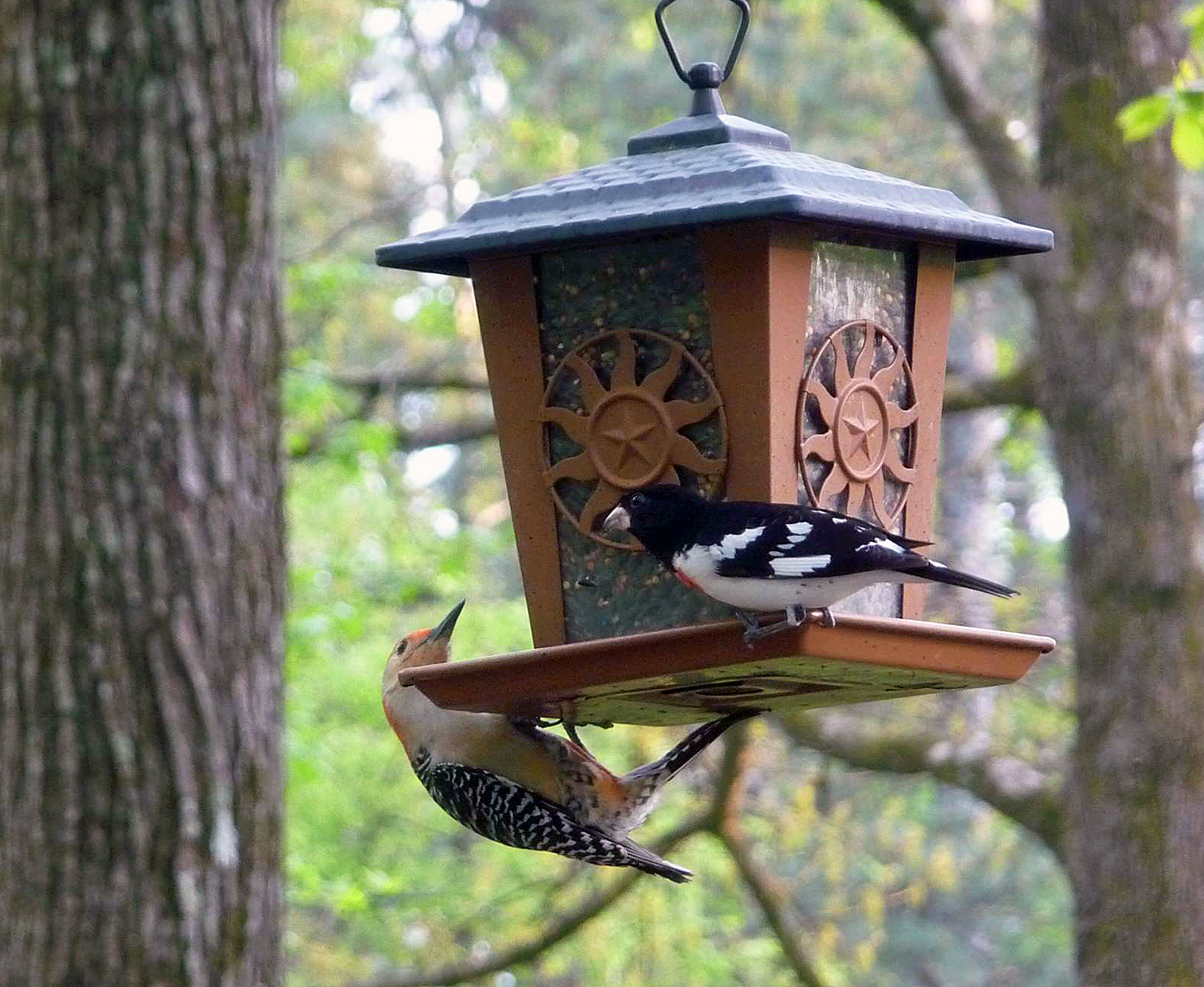
A Rose-breasted Grosbeak joins a Red-bellied Woodpecker at a feeder in Atlanta.

Some birds make us shift focus from the showy to the subtle

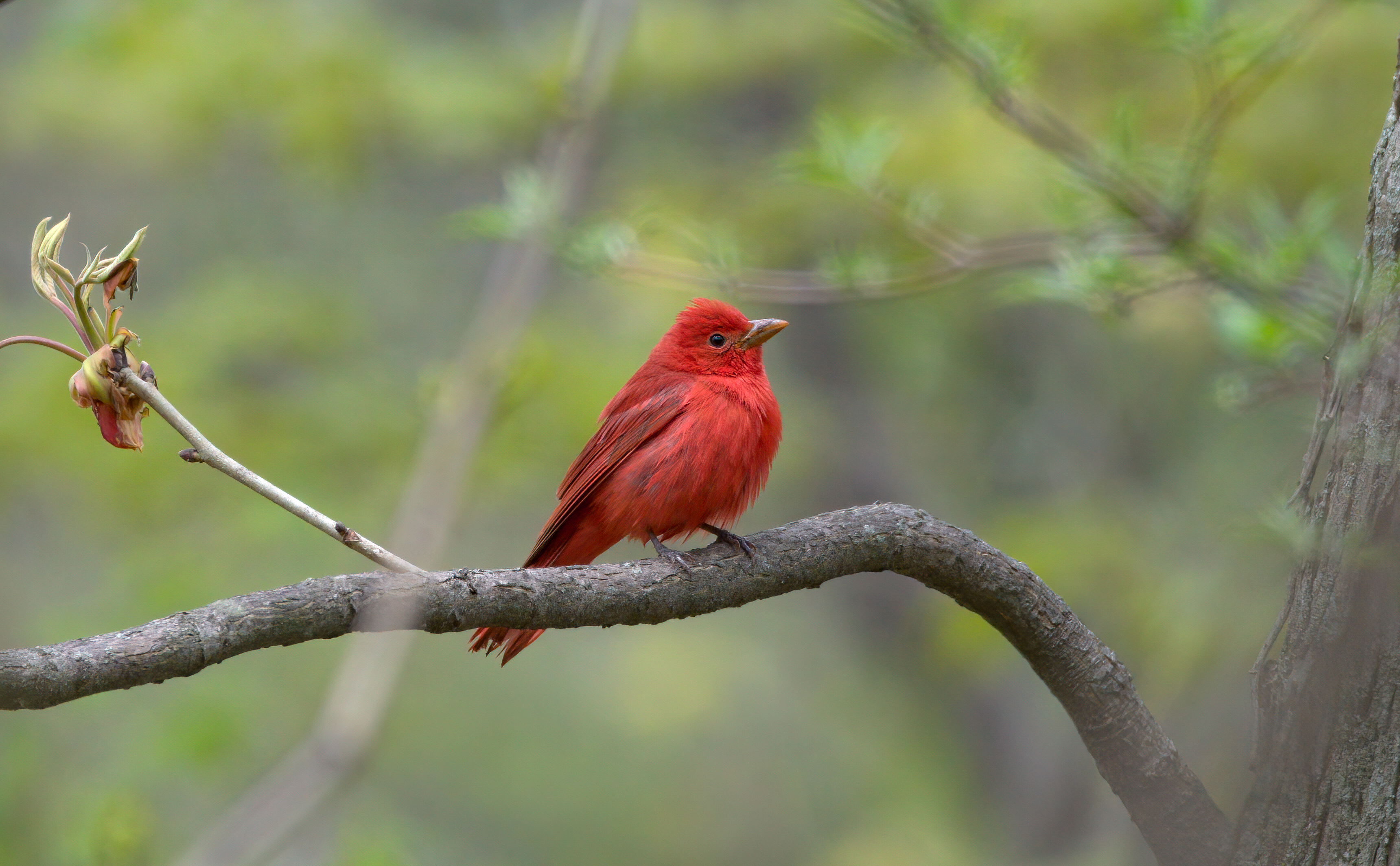
USFWS • Male summer tanagers are a rosy-red bird that pale somewhat in comparison to male scarlet tanagers.

Many of our summer birds have already returned for another nesting season. In the past week or so I have welcomed back chimney swift, common yellowthroat and red-eyed vireo.

I’m still receiving hummingbird arrival reports. April Kerns Fain had her first hummingbird of the year on April 13 at her home in Unicoi.
•••
Tom Brake in Abingdon, Virginia, reported his first hummingbird on April 16.
•••
Phyllis Moore in Bristol, Virginia, noted that her first spring hummingbird sighting involved two of these birds returning to her home.
•••
Anita Clemmer in Boone, North Carolina, saw her first spring hummingbird on April 17.
•••
Pam Seely saw her first hummingbirds of spring on April 18 at her home near The Laurels.
•••

Sue Schreiner saw her first hummingbird of spring on April 19 at her Bluff City home.

•••
Amy Tipton in Erwin reported her first spring hummingbird on at 7:30 p.m. on April 21.

•••

Spring is a great time to enjoy some truly vibrant birds that catch the eye, including scarlet tanager, Baltimore oriole, chipping sparrow, rose-breasted grosbeak, indigo bunting and more. Of course, some of our summer birds keep a low profile. Without showy feathers, they are more than able to fade into the background. They’re worth seeking out, but they do lack the “wow” factor of some of their more spectacular kin.

Here’s are some profiles on a handful of birds that live in the shadows of some much better-known relatives.

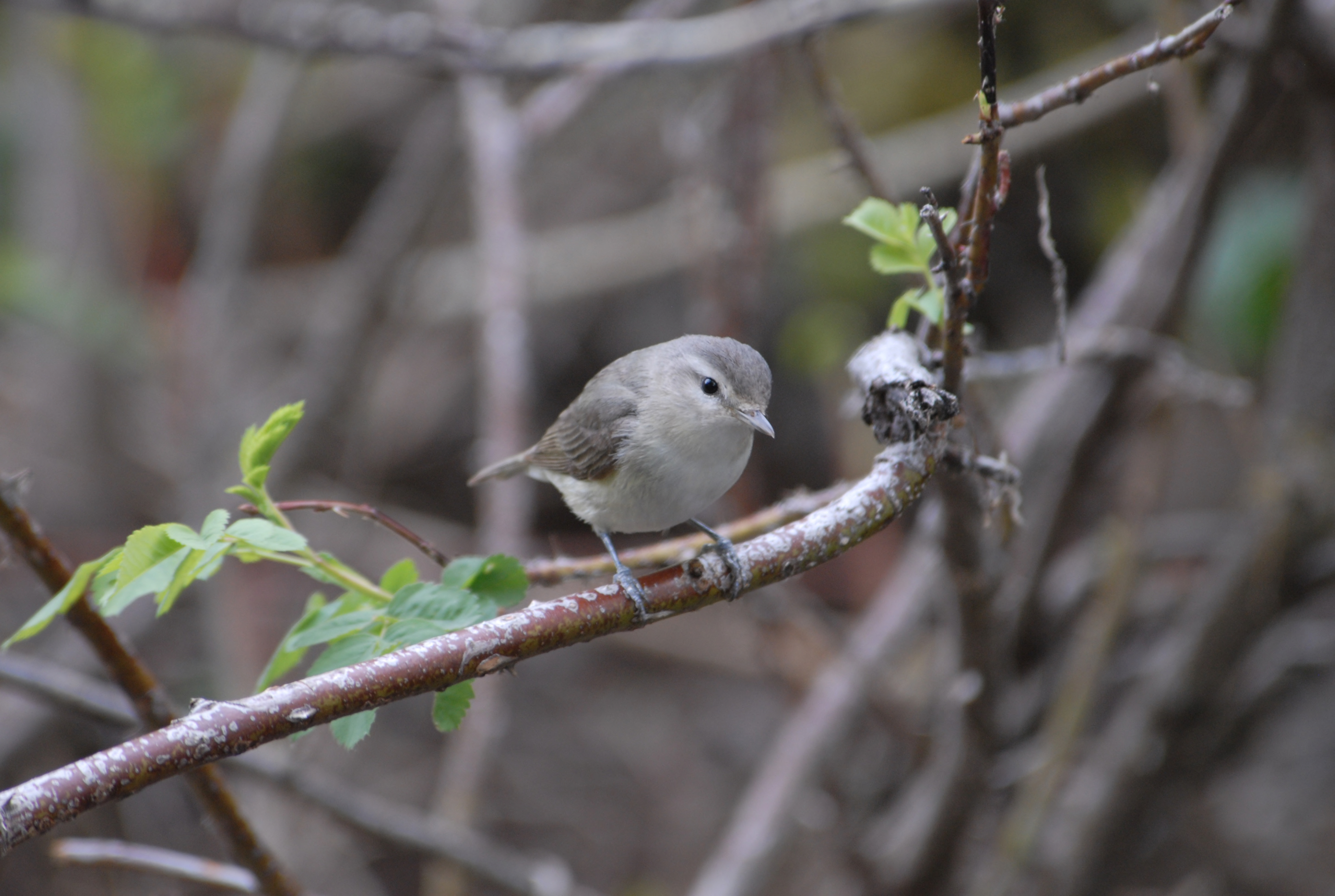
USFWS • The warbling vireo is a “plain Jane” among the region’s birds.

Warbling Vireo
The warbling vireo is one of the true “Plain Janes” of the world of birds. In the vireo family, which is known mostly for species that are largely “little green birds,” the warbling vireo lacks even that color. These are small, plain birds with gray-olive upperparts and white underparts occasionally tinged with faint yellow. They have a mild face pattern with a whitish stripe over the eye. It would never be described as colorful. They remain high in the treetops foraging for caterpillars and other prey. This habit makes observation of this bird difficult. Compared to the red-eyed vireo, blue-headed vireo and white-eyed vireo, it’s easy to see why the warbling vireo is named for its song, not its appearance.

Summer tanager
If not for the fact that the related scarlet tanager boasts an appearance that screams tropical beauty, this is a bird that cannot fairly be described as subdued in appearance. But male summer tanagers have a rosy-red plumage and lack the brilliant crimson feathers of the male scarlet tanager. Females of both species are dull birds with yellow-green plumage. These birds are more common in the southeastern United States. They’re not rare, but it isn’t easy to see them due to their tendency to remain in the upper branches of tall trees, especially oaks.

USFWS • The orchard oriole is the smallest member of the oriole family. This species is also notably less showy than some relatives.

Orchard oriole
The Baltimore oriole is an unmistakable bird. The bright orange and black plumage of the male reminded early North American settlers of the livery colors of Cecil Calvert, or Lord Baltimore, an important founder of Maryland and the namesake of the Baltimore oriole. The smaller orchard oriole is a charming bird, but its burnt orange and black plumage lacks the intensity of its better-known relative. The smallest of the orioles, it is outclassed in that regard by its more showy relatives, which include Bullock’s oriole, hooded oriole and Altimara oriole. The orchard oriole can be tempted to feeders that offer sugar water, orange slices or grape jelly, as can many other oriole species.

Ryan Dziedzic USFWS • Great crested flycatcher perches on a branch. Despite a grandiose name, this bird is not particularly showy, but it’s definitely an interesting species.

Great crested flycatcher
The largest family of birds, the tyrant flycatchers, consists of about 400 species. Most are drab birds in appearance, but some stand out. The great kiskadee, scissor-tailed flycatcher and vermilion flycatcher offer some “oomph” to a family of birds with plumages dominated by gray, black and white. In appearance, the great crested flycatcher has a shaggy brown crest and yellow and warm brown coloration in its plumage. It’s mostly the expectations of a name like great crested flycatcher that tends to fall flat when people see this attractive but not showy bird. This bird is different than other flycatchers in one respect – a cavity-nester, pairs of great crested flycatchers claim tree cavities or nesting boxes when it comes time build a nest and raise young.

•••

To share a sighting, make a comment or ask a question, email ahoodedwarbler@aol.com.