Tag Archives: Warbling Vireo

Some birds make us shift focus from the showy to the subtle

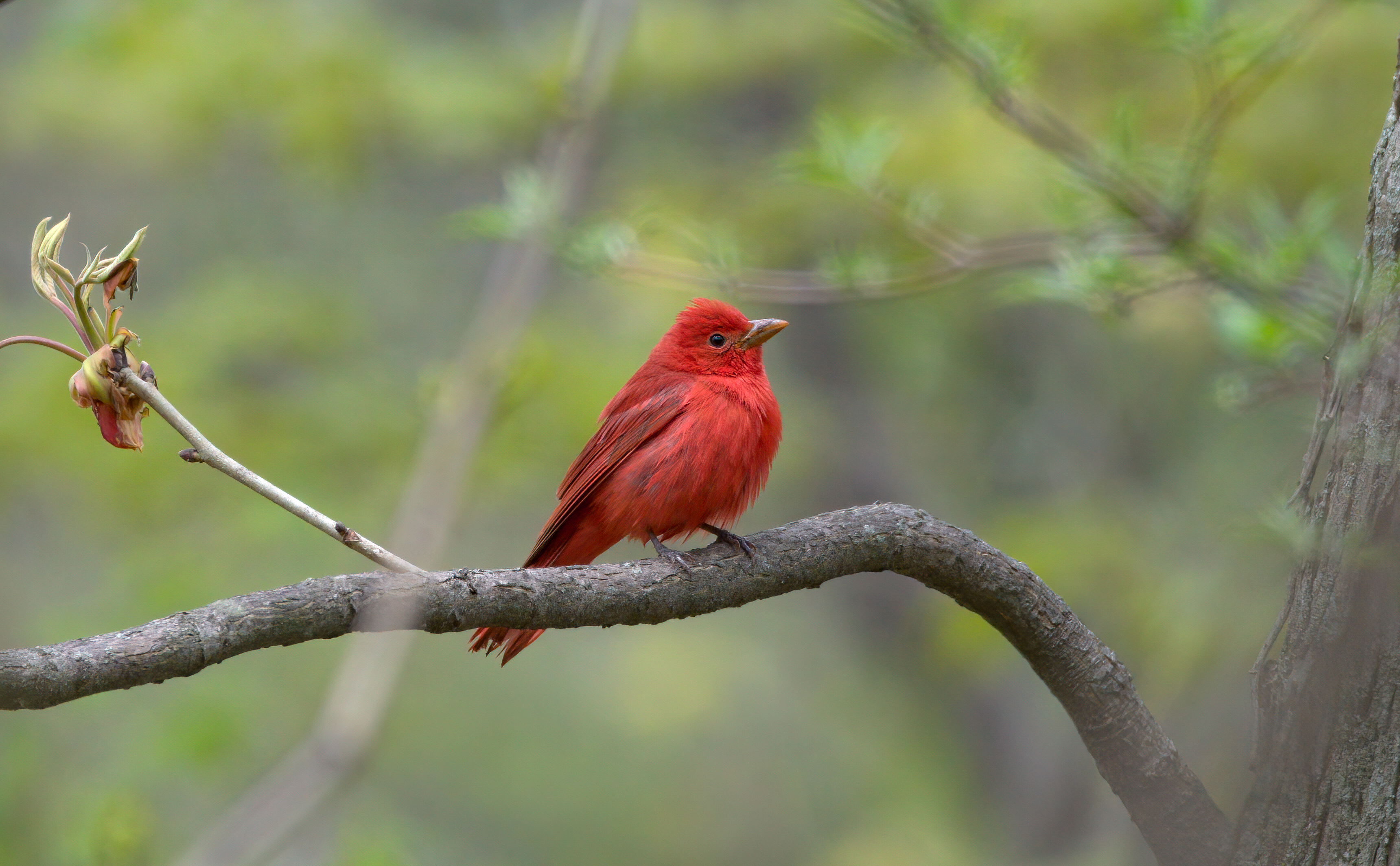
USFWS • Male summer tanagers are a rosy-red bird that pale somewhat in comparison to male scarlet tanagers.

Many of our summer birds have already returned for another nesting season. In the past week or so I have welcomed back chimney swift, common yellowthroat and red-eyed vireo.

I’m still receiving hummingbird arrival reports. April Kerns Fain had her first hummingbird of the year on April 13 at her home in Unicoi.
•••
Tom Brake in Abingdon, Virginia, reported his first hummingbird on April 16.
•••
Phyllis Moore in Bristol, Virginia, noted that her first spring hummingbird sighting involved two of these birds returning to her home.
•••
Anita Clemmer in Boone, North Carolina, saw her first spring hummingbird on April 17.
•••
Pam Seely saw her first hummingbirds of spring on April 18 at her home near The Laurels.
•••

Sue Schreiner saw her first hummingbird of spring on April 19 at her Bluff City home.

•••
Amy Tipton in Erwin reported her first spring hummingbird on at 7:30 p.m. on April 21.

•••

Spring is a great time to enjoy some truly vibrant birds that catch the eye, including scarlet tanager, Baltimore oriole, chipping sparrow, rose-breasted grosbeak, indigo bunting and more. Of course, some of our summer birds keep a low profile. Without showy feathers, they are more than able to fade into the background. They’re worth seeking out, but they do lack the “wow” factor of some of their more spectacular kin.

Here’s are some profiles on a handful of birds that live in the shadows of some much better-known relatives.
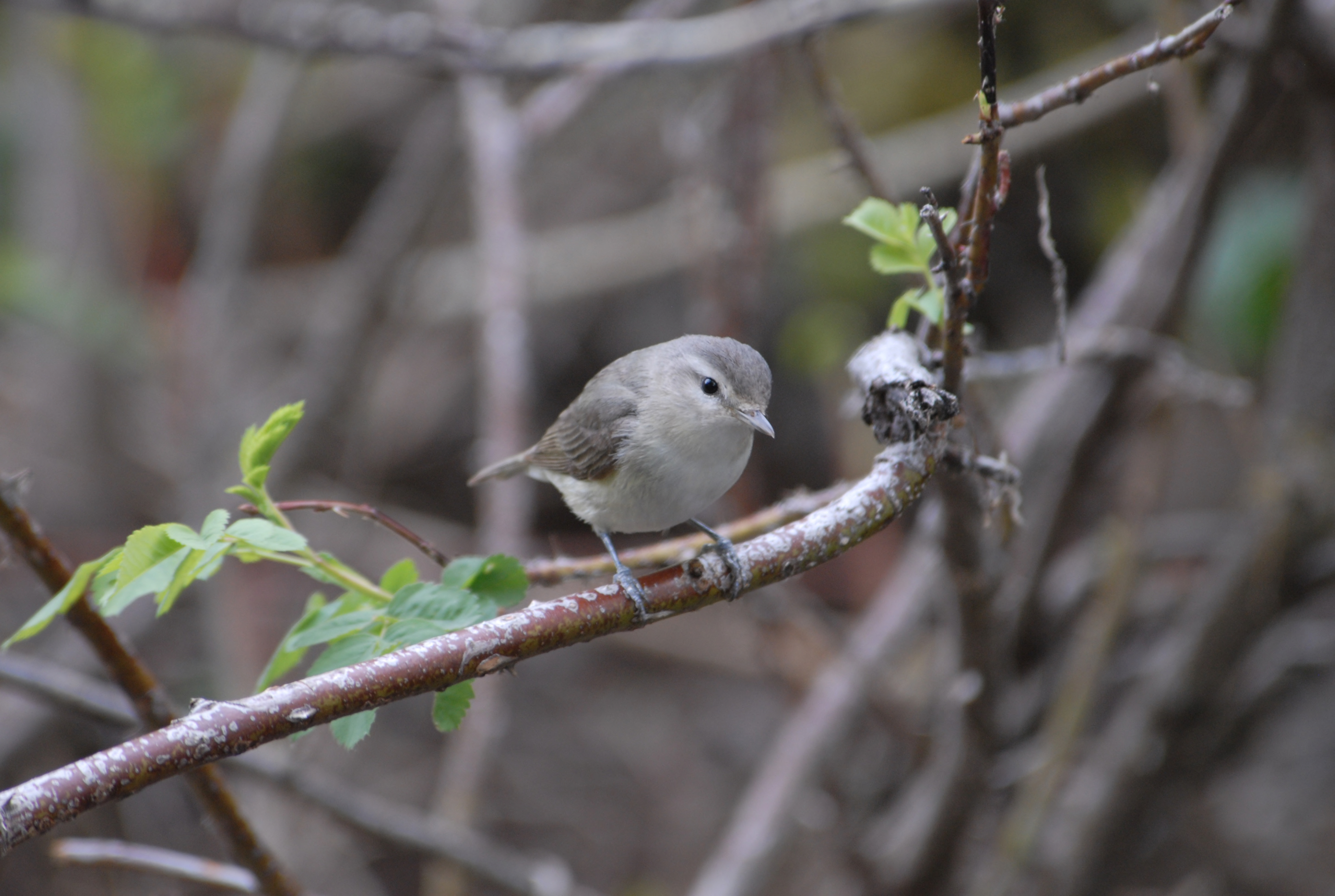
USFWS • The warbling vireo is a “plain Jane” among the region’s birds.

Warbling Vireo
The warbling vireo is one of the true “Plain Janes” of the world of birds. In the vireo family, which is known mostly for species that are largely “little green birds,” the warbling vireo lacks even that color. These are small, plain birds with gray-olive upperparts and white underparts occasionally tinged with faint yellow. They have a mild face pattern with a whitish stripe over the eye. It would never be described as colorful. They remain high in the treetops foraging for caterpillars and other prey. This habit makes observation of this bird difficult. Compared to the red-eyed vireo, blue-headed vireo and white-eyed vireo, it’s easy to see why the warbling vireo is named for its song, not its appearance.

Summer tanager
If not for the fact that the related scarlet tanager boasts an appearance that screams tropical beauty, this is a bird that cannot fairly be described as subdued in appearance. But male summer tanagers have a rosy-red plumage and lack the brilliant crimson feathers of the male scarlet tanager. Females of both species are dull birds with yellow-green plumage. These birds are more common in the southeastern United States. They’re not rare, but it isn’t easy to see them due to their tendency to remain in the upper branches of tall trees, especially oaks.
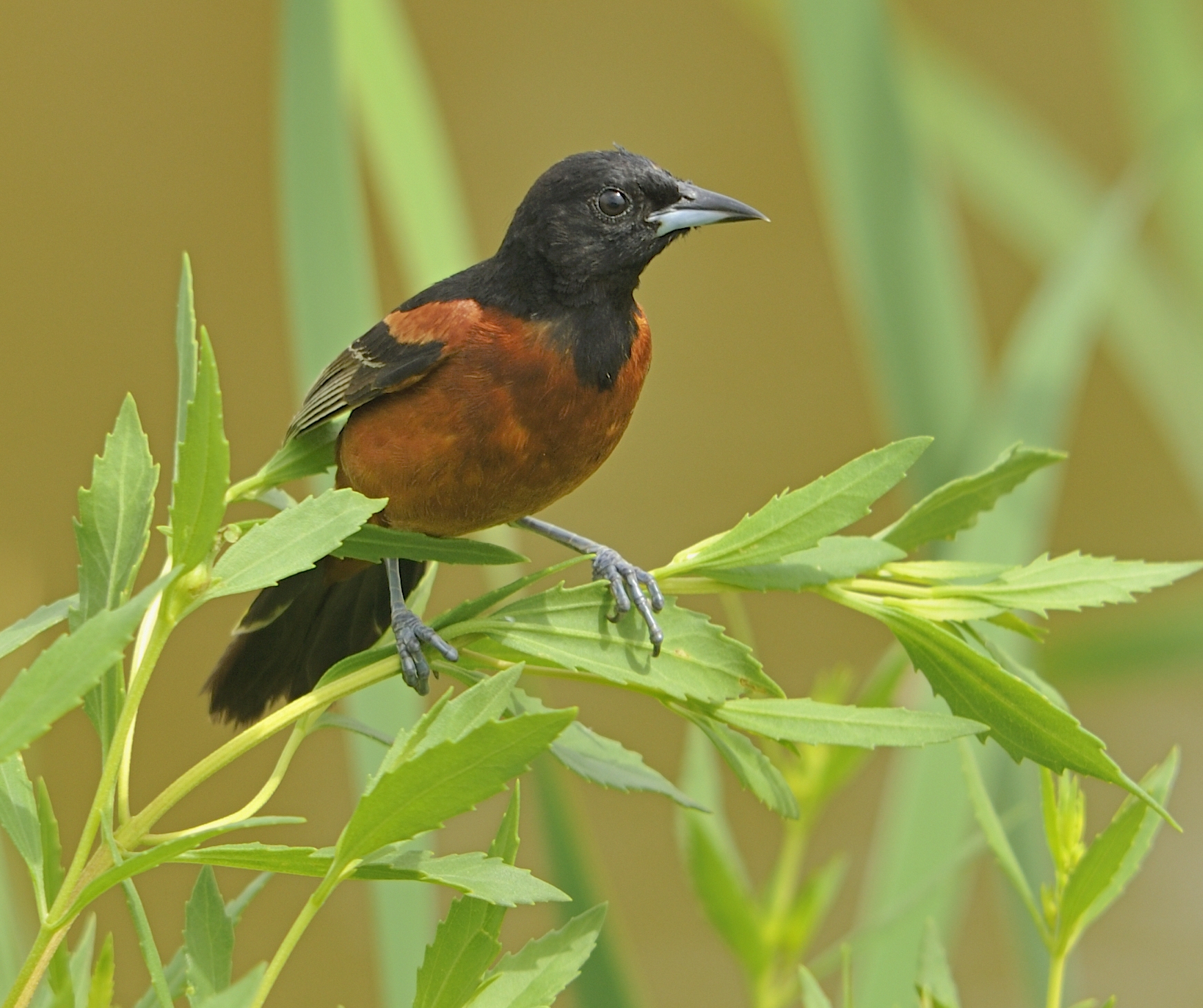
USFWS • The orchard oriole is the smallest member of the oriole family. This species is also notably less showy than some relatives.

Orchard oriole
The Baltimore oriole is an unmistakable bird. The bright orange and black plumage of the male reminded early North American settlers of the livery colors of Cecil Calvert, or Lord Baltimore, an important founder of Maryland and the namesake of the Baltimore oriole. The smaller orchard oriole is a charming bird, but its burnt orange and black plumage lacks the intensity of its better-known relative. The smallest of the orioles, it is outclassed in that regard by its more showy relatives, which include Bullock’s oriole, hooded oriole and Altimara oriole. The orchard oriole can be tempted to feeders that offer sugar water, orange slices or grape jelly, as can many other oriole species.
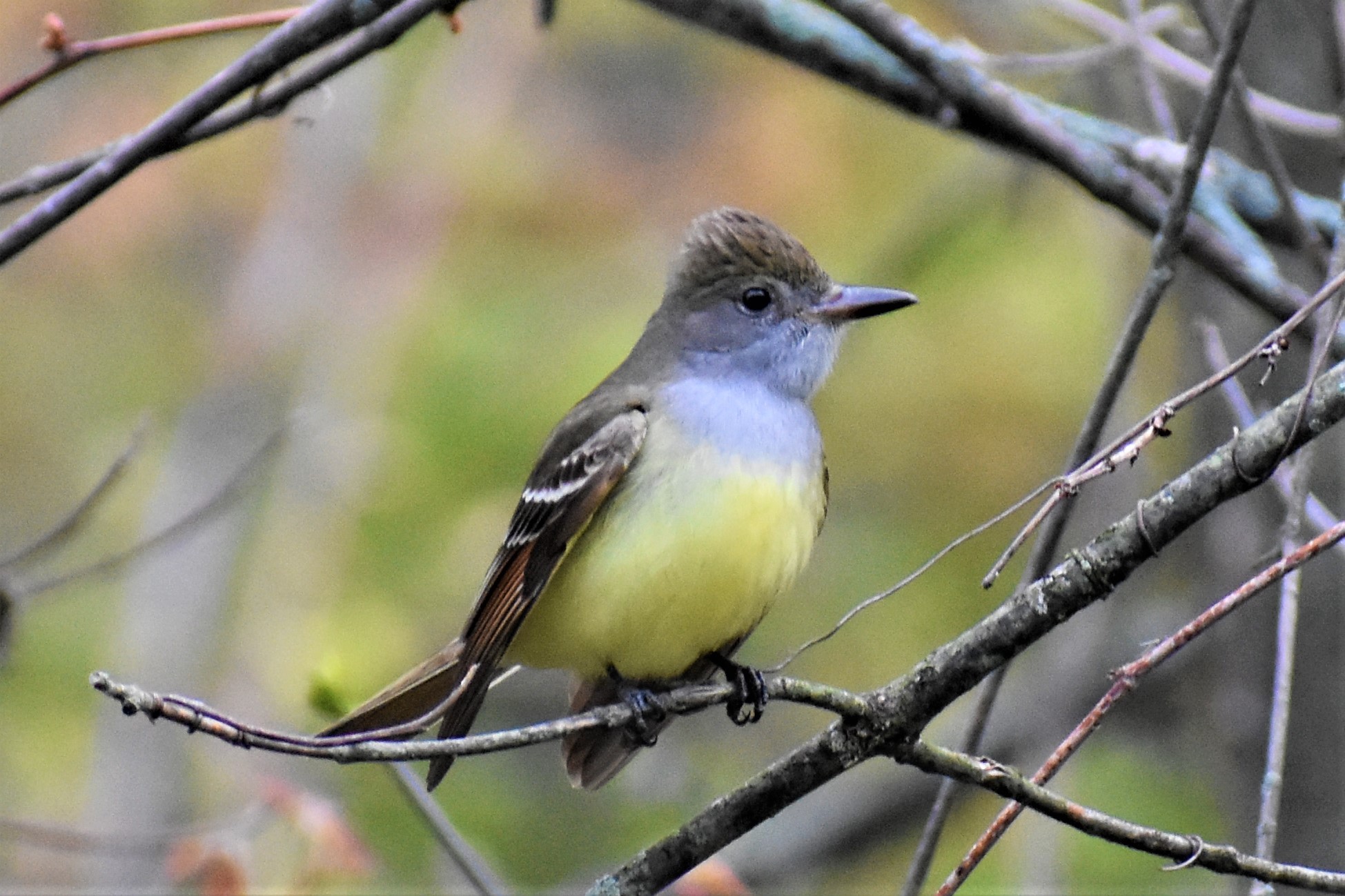
Ryan Dziedzic USFWS • Great crested flycatcher perches on a branch. Despite a grandiose name, this bird is not particularly showy, but it’s definitely an interesting species.

Great crested flycatcher
The largest family of birds, the tyrant flycatchers, consists of about 400 species. Most are drab birds in appearance, but some stand out. The great kiskadee, scissor-tailed flycatcher and vermilion flycatcher offer some “oomph” to a family of birds with plumages dominated by gray, black and white. In appearance, the great crested flycatcher has a shaggy brown crest and yellow and warm brown coloration in its plumage. It’s mostly the expectations of a name like great crested flycatcher that tends to fall flat when people see this attractive but not showy bird. This bird is different than other flycatchers in one respect – a cavity-nester, pairs of great crested flycatchers claim tree cavities or nesting boxes when it comes time build a nest and raise young.

•••

To share a sighting, make a comment or ask a question, email ahoodedwarbler@aol.com.
Region’s drab vireos more famous for persistent singing than their appearance

In some recent columns, I’ve focused on some of the summer songbirds — scarlet tanager, rose-breasted grosbeak – with flashy, bright plumages.  Not all our summer nesting birds boast such vivid coloration. In fact, one family of songbirds — the vireos — is known for its dull plumage.

Photo by Bryan Stevens      A blue-headed vireo sings from a woodland perch.

Photo by Bryan Stevens A blue-headed vireo sings from a woodland perch.

I’ve had some interesting encounters with vireos in the past few weeks. From early May through mid-June, a male red-eyed vireo sang daily from the woodland near my home. He would commence signing early in the morning and continue through late afternoon. I never saw him, which is not too surprising. Red-eyed vireos lead almost their entire lives in the forest canopy. If you do manage to observe one, you’ll see an olive green bird with white underpart. The red-eyed vireo, known scientifically as Vireo olivaceus, shows a narrow white eyebrow bordered above with black. It also has a grayish crown and the namesake red eye.
At a glance, the vireos would appear related to the wood warblers. Research into vireo DNA, however, has led many experts to contend that vireos are more closely related to crows and shrikes. Like the flycatcher, warbler and hummingbird families, the vireo family is exclusive to the New World. There are about 50 species of vireos. The majority reside in the tropics, but about a dozen species spend their nesting season within the United States.

JP-RedEyedVireo-Fledgling

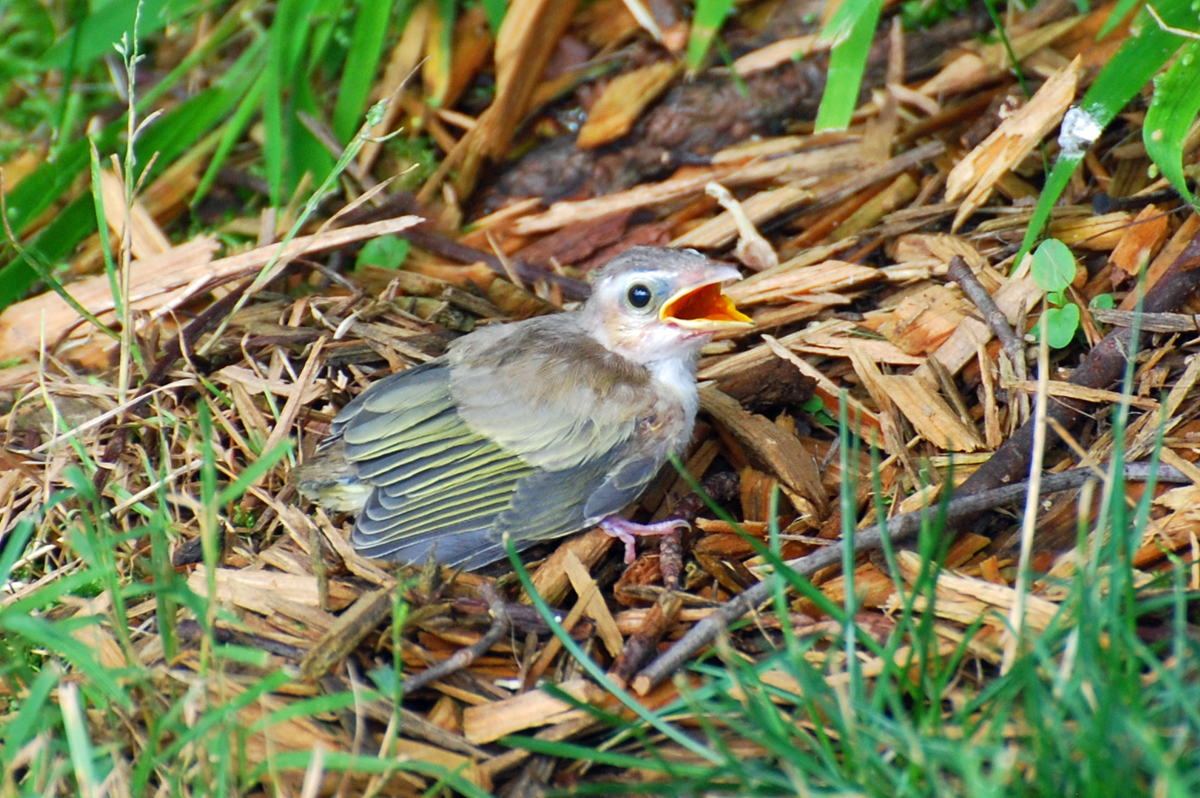
Photo Courtesy of Jean Potter A young red-eyed vireo begs for food, which will bring a prompt response from a nearby parent.

In Southwest Virginia and Northeast Tennessee, vireos resident during the summer months include red-eyed, white-eyed, blue-headed, yellow-throated and warbling.  Most people are likely unaware of vireos. Although not uncommon, these birds are much more frequently heard than seen. They spend much of their time in the forest canopy or in dense brush. When singing, they can remain at a perch, unmoving, for long periods of time. 
On recent woodland walks I have heard the loud scolding calls of red-eyed vireos. This call, given apparently when the vireo is alarmed or irritated, is quite unlike the usual vocalizations produced by this bird. First and foremost, the call is louder than one would think could be produced by a bird that is only about six inches long.
During the summer season, the red-eyed vireo is also one of the most persistent of singing songbirds. Another of its common names is “Preacher Bird,” so called because of its tendency to unceasingly deliver it song. To give you an idea of just how persistently this bird sings, the red-eyed vireo holds the record for singing its song the most times in a single day. Some individuals have been recorded singing the series of emphatic syllables more than 20,000 times in a day. The song is not particularly musical, consisting of whistled phrases, each slightly different and punctuated with brief pauses. 

Photo Courtesy of Jean Potter A red-eyed vireo sits on its basket-shaped nest.

Photo Courtesy of Jean Potter
A red-eyed vireo sits on its basket-shaped nest.

The red-eyed vireo is still considered one of eastern North America’s most common summer breeding birds. At one time, this bird was probably the most common breeding bird in Eastern woodlands. It is still one of the most widespread, ranging from the Eastern United States into the Northwestern United States and across Canada. In fall, they withdraw to spend the winter in South America.
The term “vireo,” originating in Latin, can be translated into English as “green bird.” It’s an apt description, as many of these small birds are primarily dull green in coloration.
There is an endangered vireo, the black-capped vireo, a bird with a limited breeding range in Texas. Black-capped vireos numbers have dwindled to perilous levels due to the loss of low growing woody cover these birds need for breeding purposes. The cause of the loss of habitat varies, but includes the clearance of land for livestock as well as overgrazing by livestock and deer. In the past, fires regularly opened up such habitats. Due to modern fire control practices, such fires are no longer a natural occurrence. Since this species is already endangered, brown-headed cowbirds have also contributed to the problem since the cowbirds slip their own eggs into the nests of black-capped vireos.

Vireo_blackcapped_B07T

Photo by USFWS The black-capped vireo is the only member of the vireo family in the United States classified as endangered.

Two others, Bell’s vireo and gray vireo, are identified as species of concern on the Audubon Watchlist. This listing spotlights species that may bear intense scrutiny to make certain they don’t become endangered.
Other vireos that can be found in the United States, for at least part of the year, include Philadelphia vireo, plumbeous vireo and Cassin’s vireo. A specialty of Florida is the black-whiskered vireo. 
Many species of vireo are also found in the islands of the Caribbean, including Jamaican vireo, Cuban vireo and Puerto Rican vireo. Some of the more colorful common names for vireos include the yellow-green vireo, golden vireo and yellow-winged vireo. 
In Central and South America, the vireo family expands to include many birds with common names such as “Shrike-Vireo,” “Greenlet” and “Peppershrike.” Some of the varied species include the lemon-chested greenlet, green shrike-vireo and the black-bellied peppershrike.

Warbling_Vireo

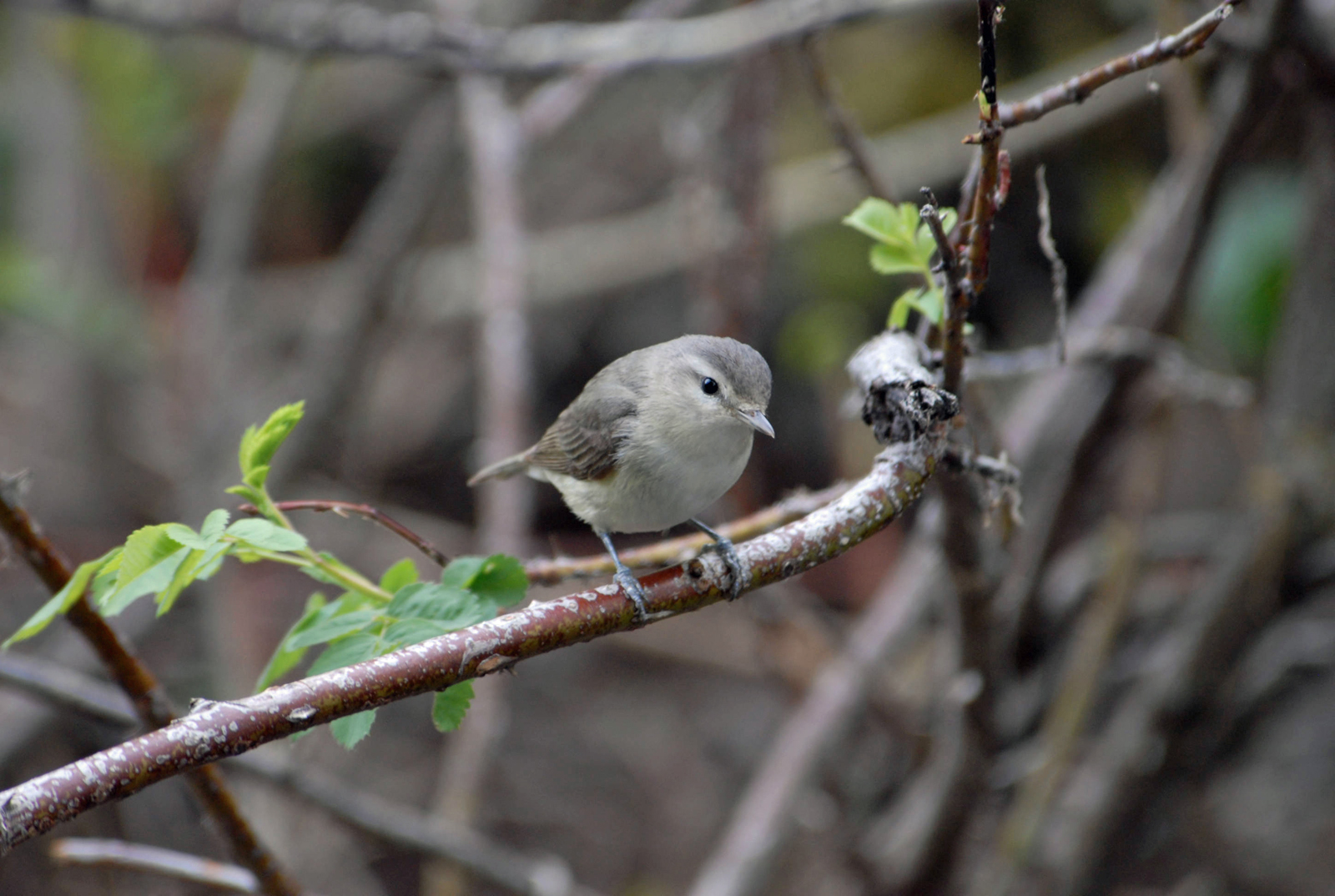
Photo by Dave Menke/USFWS A warbling vireo is the most drab member of a family known for its drabness. The warbling vireo’s impressive song, however, reminds many listeners of the song of the gaudy painted bunting.

Known by the scientific name, Vireo gilvus, the warbling vireo is another member of this family of songbirds that can be found in the region. It is named for its distinctive, warbling song. Some experts have likened its song to that of the painted bunting. That must be about all the two birds have in common. In contrast with the gaudy painted bunting, the warbling vireo can quite honestly stake a claim as one of our most drab songbirds. Overall, this is a grayish little bird with a white eyeline that is paler than the rest of its plumage. Its legs are blue-gray in color and this species has a bill that is stout like other vireos and unlike the beaks of most warblers. It’s their plainness that is the most distinctive aspect of their appearance.
Many vireos construct deep cup- or basket-shaped nests, often in the higher branches of tall trees. Male and female share incubation duties and work together to feed their young. 
Most vireos feed on in­sects during their summer stay north of the border. However, during migration they often feed on berries and continue to do so on their wintering grounds. Experts have noted that the white-throated vireo is particularly fond of gumbo-limbo seeds. This tropical tree can be found from southern Florida and Mexico, as well as throughout the Caribbean and in South America in Brazil and Venezuela.

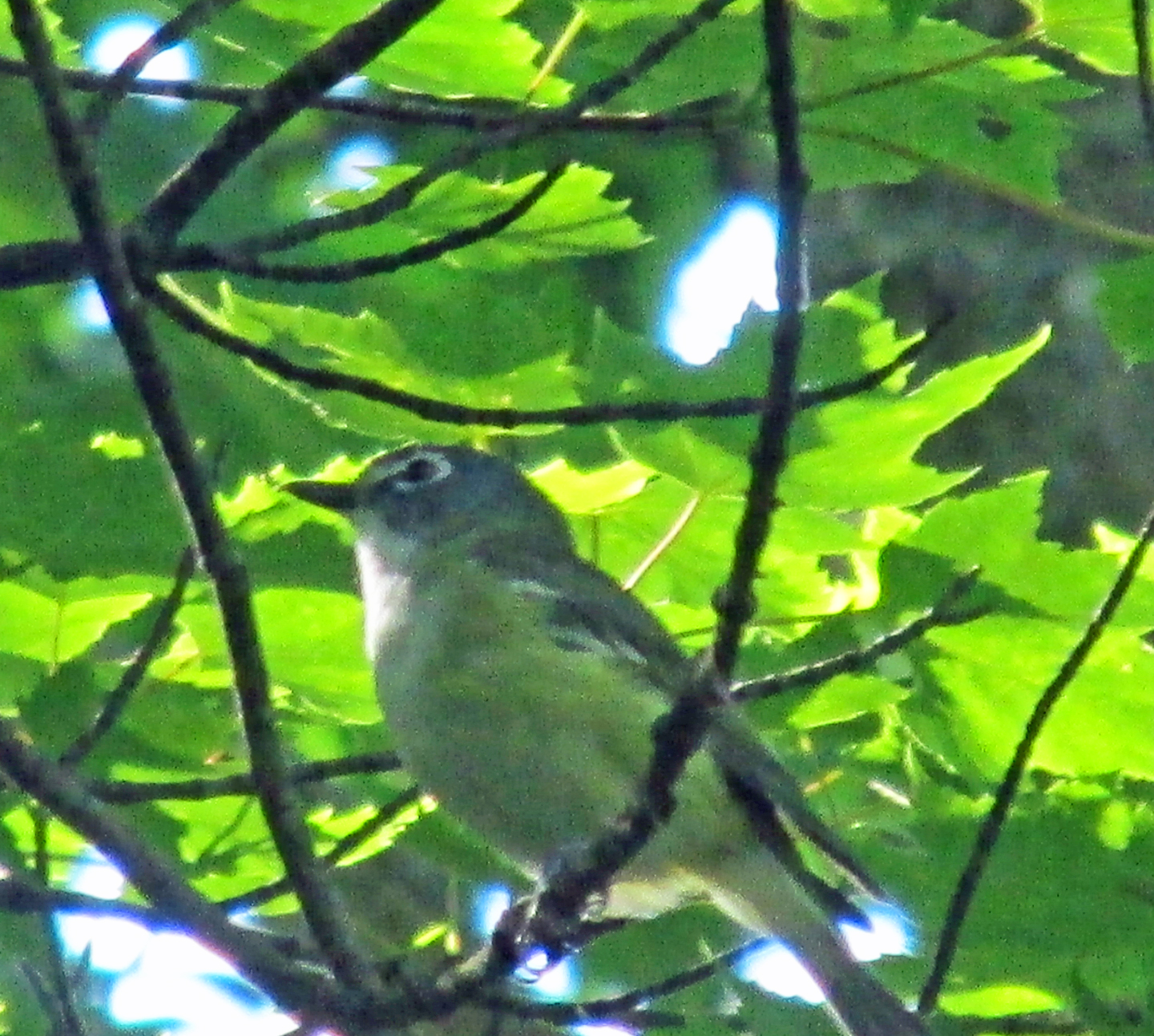
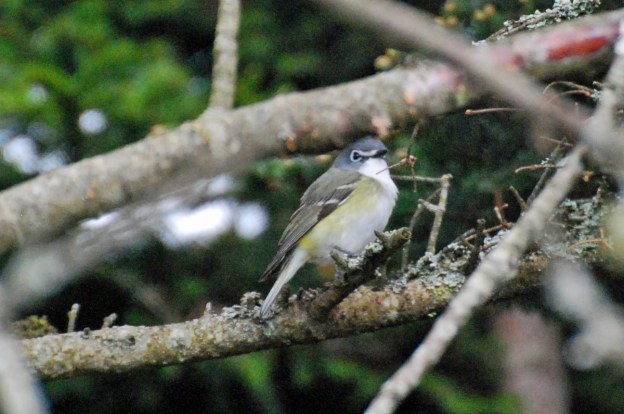
Photo by Jean Potter The Blue-headed Vireo prefers wooded habitats at higher elevations.

Photo by Jean Potter
The Blue-headed Vireo prefers wooded habitats at higher elevations.

At times, it’s important to use our ears, as well as our eyes, when trying to find birds. That’s particularly true of the vireos. The widespread family can be found in rural areas, as well as suburban settings. Tall stands of trees are one of the essential requirements. So, when you next hear some whistled phrases coming from the treetops, be sure to look up. You may get lucky.
To hear a singing red-eyed vireo, visit the link below to view a video of the bird on YouTube: