
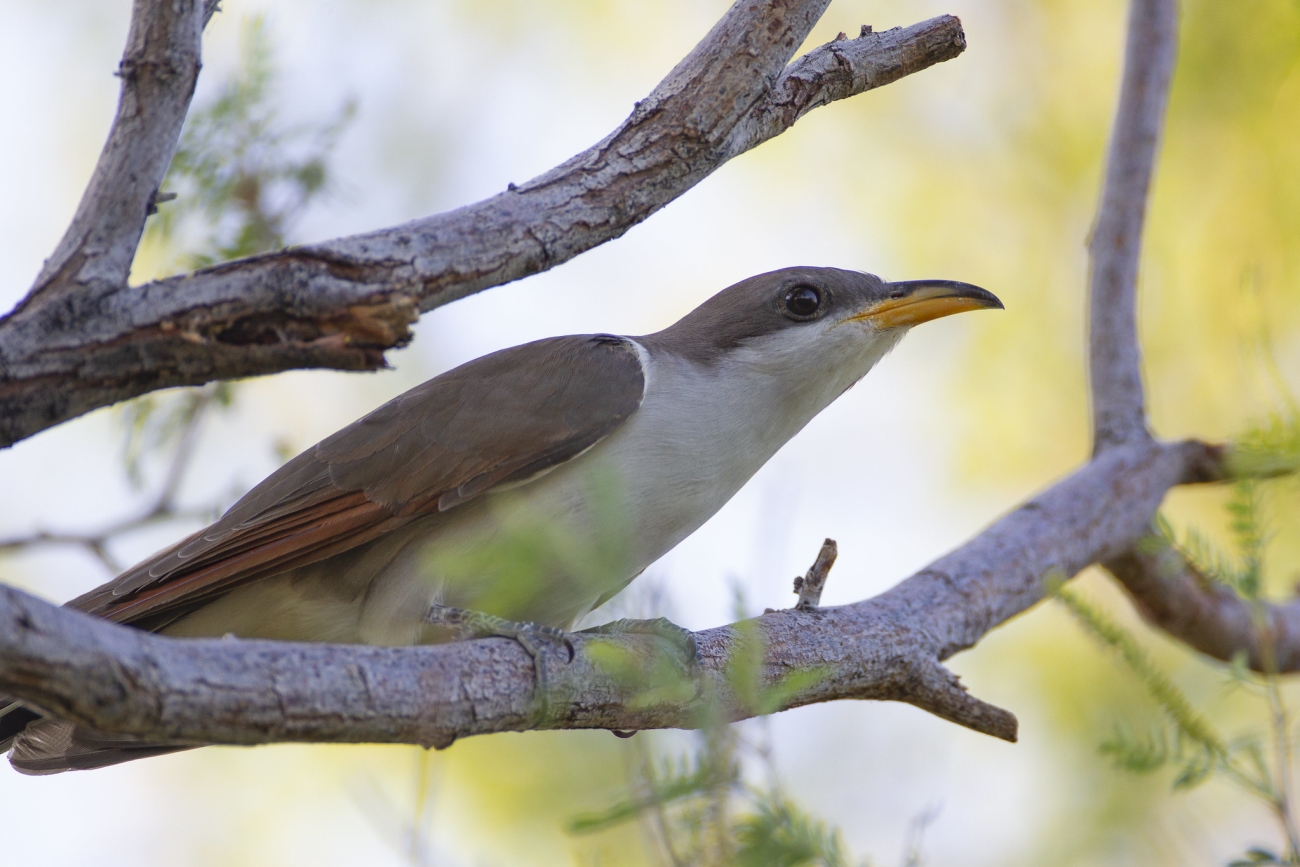
Photo by Peter Pearsall/USFWS • A yellow-billed cuckoo perches horizontally along a bare tree branch. The species feeds prodigiously on a variety of caterpillars.
I heard the low, gulping call of a yellow-billed cuckoo concealed by a dense curtain of green on the ridge behind my home on Sunday, July 26.
The hidden caller reminded me that this bird has acquired the nickname “rain crow” for consistently calling prior to summer downpours.
The yellow-billed cuckoo migrates a great distance to spend the summer months hidden in the dense green canopy of our local woodlands. Cuckoos spend the summer months in southern Canada and across most of the United States, but the bird’s winter range extends as far south as Venezuela and Argentina. They make a roundtrip journey of about 5,000 miles every spring and fall.
In pursuit of their favorite food – caterpillars – the yellow-billed cuckoo provides a public service, removing hairy tent caterpillars and their unsightly silk tents from the branches of various trees. I certainly applaud these efforts. Only a handful of birds feed on these caterpillars, with the yellow-billed cuckoo being the first and foremost consumer of these pests. The cuckoo has a voracious appetite for these caterpillars.
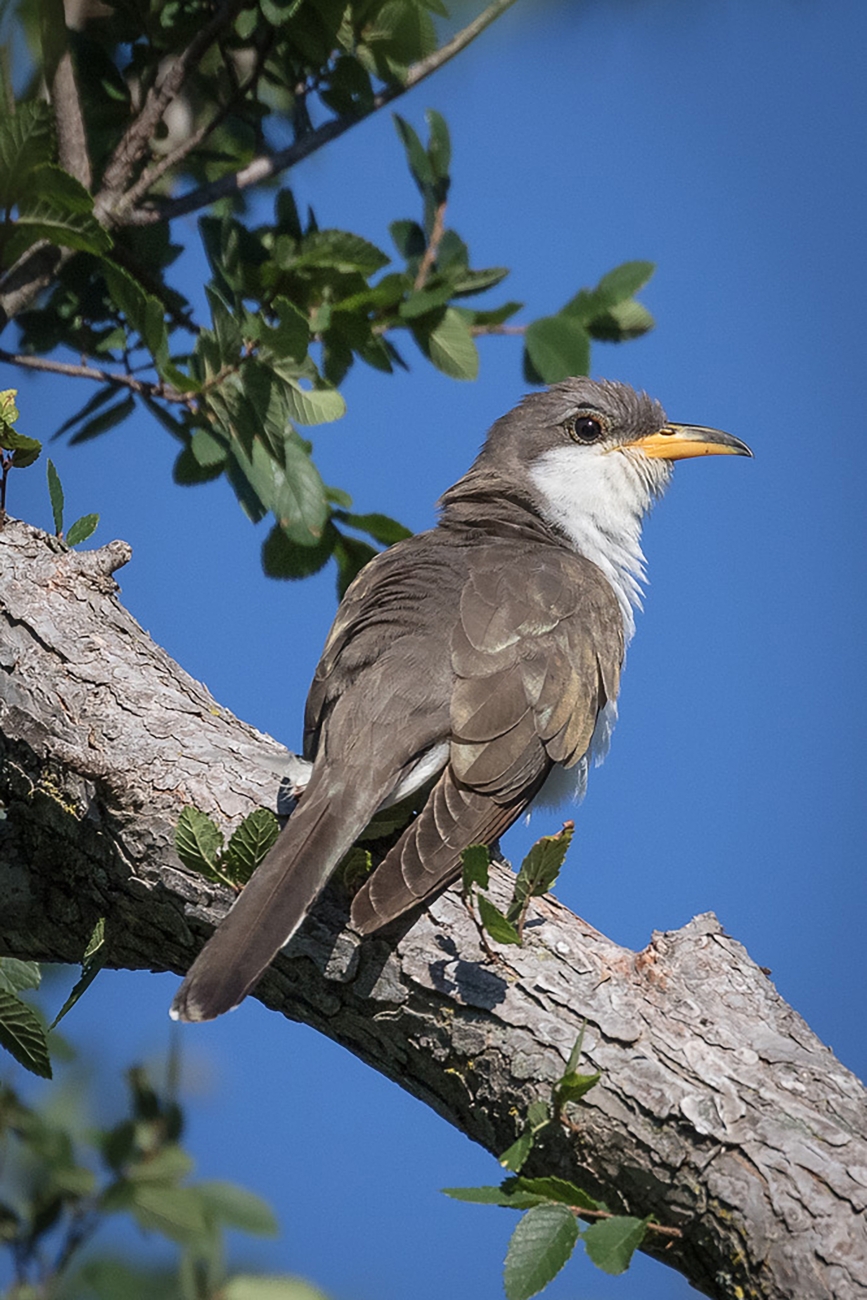
Photo by USFWS • A yellow-billed cuckoo selects a surprising open perch for a bird known for its reclusive nature.
Staking out tent caterpillar nests would seem a good way to increase the chances of seeing these elusive birds. Personally, it’s never quite worked out that way. My best – and first – sighting of a yellow-billed cuckoo is now buried 30 years back among my birding memories. I saw the bird perched in a gnarled peach tree that once stood only a few yards from my home.
Another memorable sighting took place on Fripp Island, South Carolina. That bird, observed from a golf cart, shared a tree with a scolding blue-gray gnatcatcher. The discrepancy in the sizes of the tiny gnatcatcher and the large cuckoo was striking. I genuinely feared that the cuckoo might attempt to snack on the smaller bird.
Other sightings have taken place at Roan Mountain State Park, Winged Deer Park in Johnson City, Sycamore Shoals State Historic Park in Elizabethton and Douglas Lake in Cocke County.
In addition to sightings of live birds, some readers have reported window strikes to me, usually because they’re unable to identify the bird that suffered a sad demise after impacting a window.
The yellow-billed cuckoo is a large bird, which an observation in close quarters emphasizes. This bird can reach a length of nearly 12 inches, but much of that length is composed of its long tail. It easily matches the size of such familiar birds as blue jay and American robins.
The yellow-billed cuckoo has a long, streamlined body and a brown and white plumage. The underside of the tail features large white dots and the wings show some rusty-red feathers. The bird also has a large, curved beak that gives the species its common name.
I hear these birds every summer, but my sightings amount to perhaps a couple every decade. I’m sure I could see more cuckoos with extra effort, but this bird would still present a challenge.
Europe’s common cuckoo is famous in folklore and fairy tales for slipping its eggs into the nests of other birds. While the yellow-billed cuckoo does this on occasion, it is not in the same league as nest parasites such as brown-headed cowbirds.
Two other cuckoos spend time in the United States. The black-billed cuckoo is also found in Northeast Tennessee, but this species is even more difficult to locate than its yellow-billed cousin.
I’ve only seen black-billed cuckoos on a few occasions. My best and first sighting involved a bird that briefly perched on a snag along a hiking trail at Johnson City’s Winged Deer Park. I managed to get my binoculars on the bird long enough for a memorable look. I’ve also seen this species at Sycamore Shoals State Historic Park and at Hampton Creek Cove in Roan Mountain.
Another species is the mangrove cuckoo, a bird that in the United States resides only in southern Florida while also ranging the Caribbean, both coasts of Mexico and Central America, and the Atlantic coast of South America as far south as the mouth of the Amazon River. It’s no surprise that this specialist species is found primarily in mangrove swamps.
The yellow-billed cuckoo is known by the scientific name, Coccyzus americanus. Other cuckoos in the genus Coccyzus, which includes about a dozen species, are pearly breasted cuckoo, dark-billed cuckoo, chestnut-bellied cuckoo, grey-capped cuckoo, bay-breasted cuckoo and the great lizard cuckoo.
Although I haven’t seen one for a few years, I’m still glad to know that the yellow-billed cuckoo remains a lurker in the woodlands around my home. If you manage to lay eyes on this elusive bird, consider yourself fortunate.
•••
Bryan Stevens has written about birds, birding and birders since 1995. To share a sighing, ask a question or make a comment, email him at ahoodedwarbler@aol.com.
 Our Fine Feathered Friends