
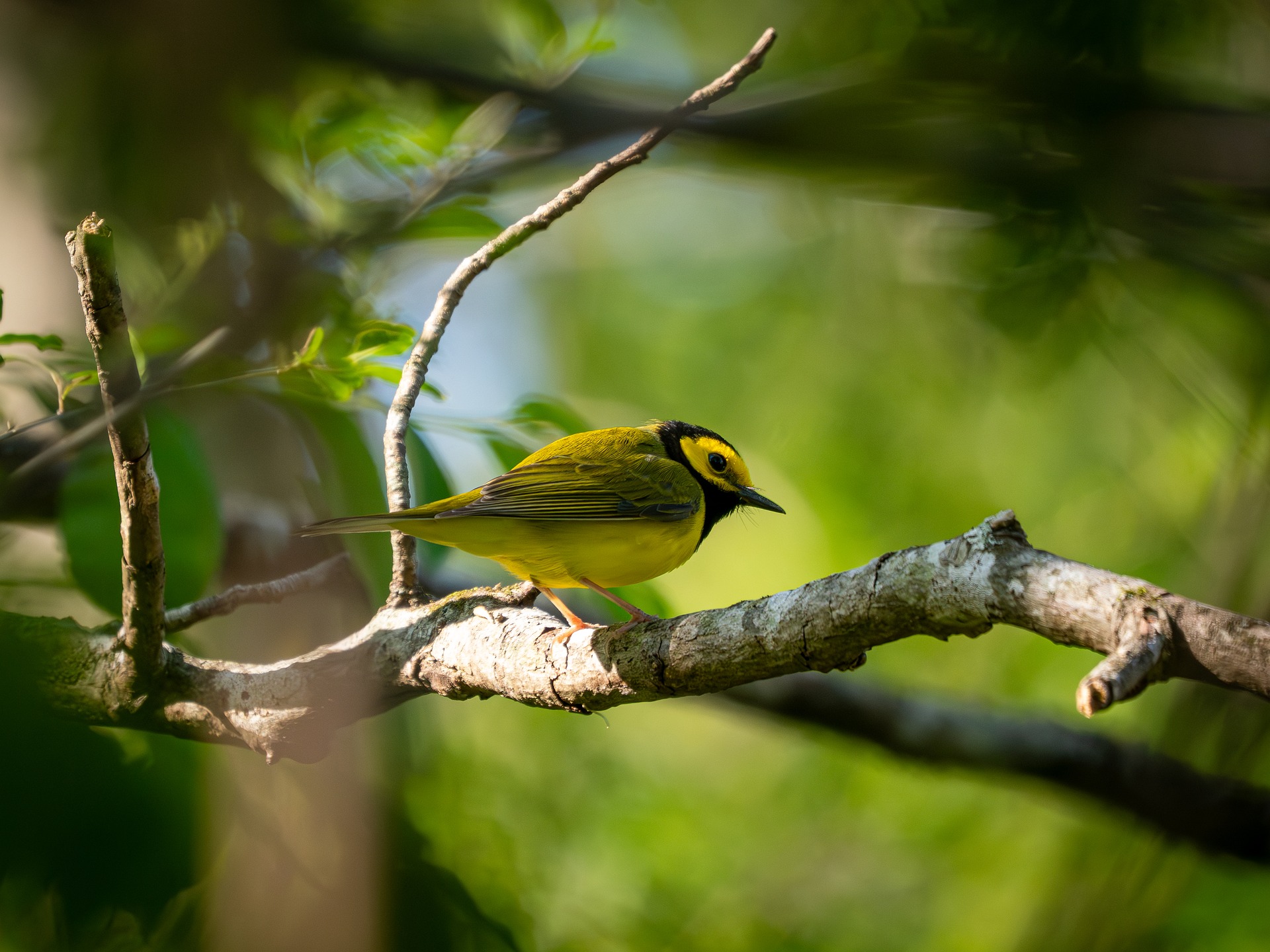
Photo by Ariel Hernandez/Pixabay • A male hooded warbler prefers shaded habitats.
I have a love-hate relationship with fall. It’s my favorite season, but in the back of my mind I know it’s also the signal that winter’s icy grip is imminent. Autumn also signals the departure of some of my favorite birds, including ruby-throated hummingbirds, scarlet tanagers, red-eyed vireos and many species of warblers.
Many people would be astonished that warblers live among us for about six months of every year. Anyone in East Tennessee with property containing woodlands, thickets, meadows, as well as creeks and ponds, are likely neighbors for many species of breathtakingly beautiful warblers. Unless one makes some effort to specifically look for these birds, however, warblers can easily go unnoticed. They don’t come to feeders, so it’s up to their human neighbors to seek them out.
Many birders will hem and haw if asked to name their favorite bird. Not me. I’ll quickly let you know that the bird with that distinction is a small songbird known as the hooded warbler. I have plenty of other runners-up, but the hooded warbler has been my favorite since I first got into birding in the early 1990s.

Photo by Jean Potter • A male hooded warbler flits through the foliage of a rhododendron thicket.
Every time I behold a hooded warbler, I marvel at the bird’s exquisite appearance. The gold and green feathers seem to glow brightly in the dim light of the shadowy thickets of rhododendron where they prefer to lurk. The black hood and bib surrounding the male’s yellow face stands out by virtue of its stark contrast from the brighter feathers. Large coal-black eyes complete the effect. The appearance of the male bird provides this species with its common name. The female has an identical yellow-green coloration as the male, although she is slightly more drab. She lacks the black hood and bib, although older females may acquire some dark plumage on the head and around the face. Both sexes also show white tail feathers that they constantly fan and flick as they move about in thick vegetation and shrubbery.
Hooded warblers nest in the woodlands around my home. So, from the time my favorite warbler returns in April until the last individual departs in October, I enjoy regular glimpses of this colorful and interesting bird. Like all warblers, the hooded warbler is quite energetic, dashing after tiny insects in the branches of shrubs and trees. Hooded warblers often forage close to the ground, which makes observing them easier than for some of their treetop-dwelling kin.
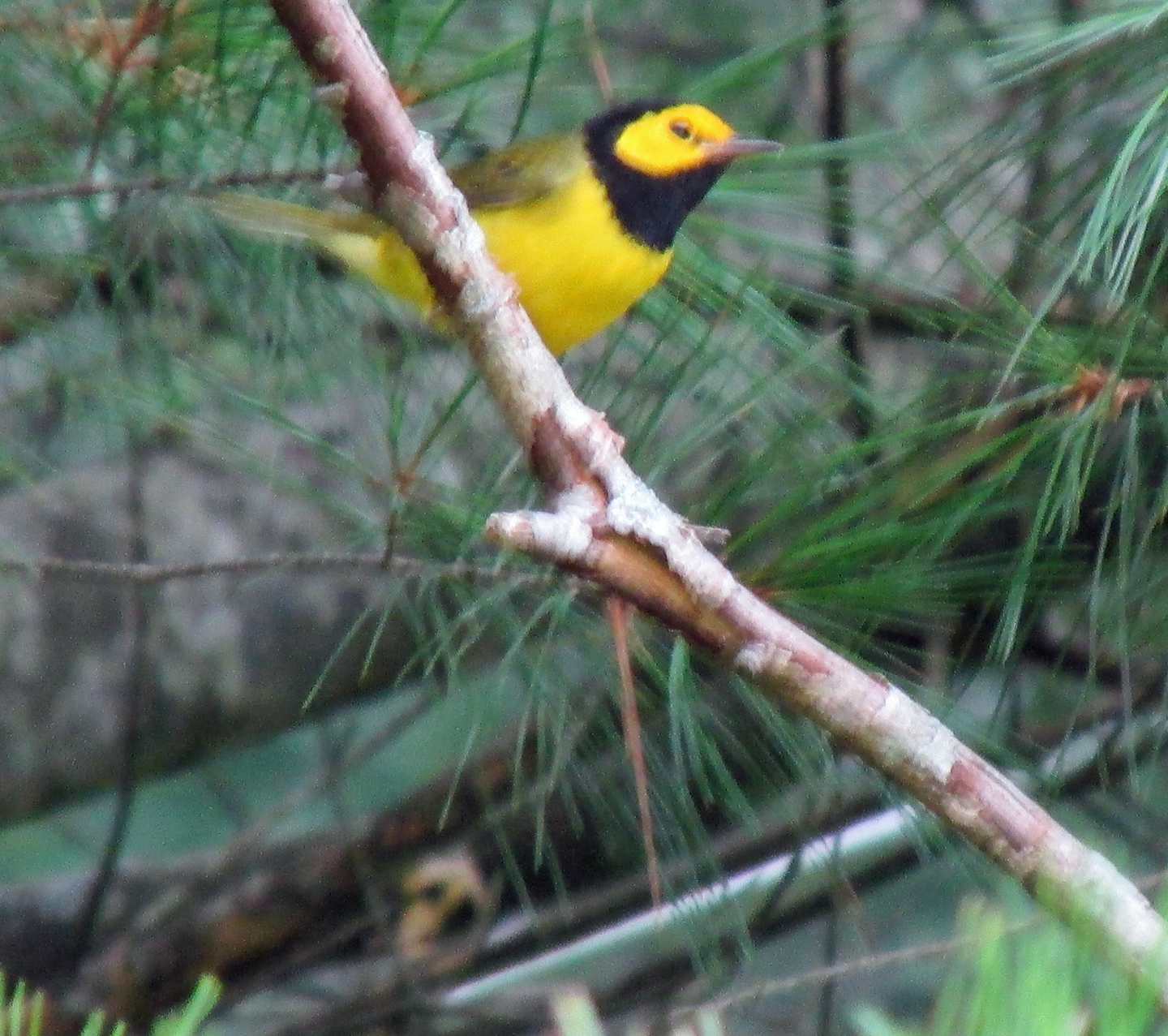
Photo by Bryan Stevens • A male hooded warbler grasps a perch during a fall migration stop.
According to the website All About Birds, male hooded warblers often return to the same breeding spot year after year. The website cites a seven-year study in Pennsylvania that determined that about 50% of banded males returned to the area to breed again. The study makes me think that some of the hooded warblers returning to my rhododendron thickets each spring are previous nesting birds or perhaps their descendants.
Bird-banding also has helped determine how long this species can live. According to All About Birds, the oldest recorded hooded warbler was a male, and at least 8 years, 1 month old when he was recaptured and rereleased during banding operations in Louisiana in 2004. Most songbirds have short lifespans, so it’s wonderful that some of these tiny birds can reach such a ripe old age.
I know that every migrant passing through my yard at this time of year is making its way southward, and it will likely be another five to six months before I again see any of my favorite songbirds. The hooded warbler will make itself at home in the forests of Mexico, as well as in Belize, Costa Rica and other Central American nations, throughout the winter season. Most hooded warblers begin returning to their winter haunts as early as mid-September, but lingering individuals continue to entertain birders in the United States throughout October before they too head south.
To reach its wintering grounds, many hooded warblers take the same path preferred by ruby-throated hummingbirds and make a nonstop flight across the Gulf of Mexico. This incredible crossing brings these birds to the Yucatan. From there, they disperse to various points in Central America. That birds as small as hummingbirds and warblers make this incredible migration twice yearly is one of nature’s most phenomenal feats of endurance.
The warblers, also known as wood-warblers, are an exclusively New World family of birds, numbering approximately 116 species. About 50 of these species of warblers make their home in the eastern United States and Canada for the spring and summer, departing in the fall and returning to tropical wintering grounds. Some of them are extremely bright and colorful birds. The hooded warbler is rightfully ranked among the more brightly colored warblers.

Photo by Bryan Stevens • A female hooded warbler is banded in an operation at Carver’s Gap in Roan Mountain, Tennessee.
The warblers are an incredible family of birds. I’ve seen all but a handful of the species that reside for part of the year in the eastern United States. I still want to see a Connecticut warbler and cerulean warbler, as well as the endangered Kirtland’s warbler of Michigan and the golden-cheeked warbler of Texas.
I’ll miss the warblers once fall migration has run its course. For those months they are here, the warblers belong to us. They seem like “our” birds. They’re only on loan, though.
Our other winter birds will offer some compensation in the absence of hooded warblers and most of their kin, but I’ll be eagerly awaiting that flash of gold from the recesses of a rhododendron thicket next April and the loud notes of “weeta-weeta-wee-Tee-o” that comprise the male hooded warbler’s easily recognized song.
•••
Bryan Stevens has written about birds, birders and birding since 1995. Email him at ahoodedwarbler@aol.com.

