

Photo by dbadry/Pixabay.com • Blue Jays often create food caches for acorns and other items. This jay is leaving a feeder with several peanuts thanks to an expandable esophagus.
The Elizabethton Bird Club’s 57th Fall Bird Count was held Saturday, Sept. 26. This long-running count includes the five-county area of Northeast Tennessee and is conducted by the Elizabethton Bird Club.
Parties fan out into the counties of Carter, Johnson, Sullivan, Unicoi and Washington to look for birds.
According to longtime compiler Rick Knight, there may have been some fall counts conducted before 1970, but he has found no record of them. Other counts date back to the 1940s.
This year 29 observers participated in 10 parties. The weather was pleasant. Counters tallied 121 species, which is slightly below the 30-year average of 124. The all-time high count was 137 species in 1993.
Counters found 21 species of warblers. Common birds included Canada goose (600), European starling (517), chimney swift, (457), blue jay (373), and American crow (365).

Photo by Bryan Stevens / A trio of American crows forages on a grassy lawn.
My party focused on Elizabethton along the Watauga River, as well as Holston Mountain and Wilbur Lake. To cover so much territory, we broke into smaller counting groups. My group focused on Elizabethton. Assisting me were Rob Armistead, Peyton Williams and Chris Soto. In addition, Chris’s sister, Dianna Lynne, counted birds at her feeders at home on Stoney Creek in Elizabethton.
Focused on Wilbur Lake and Lynn Valley in Elizabethton were Brookie and Jean Potter. David and Connie Irick focused on Holston Mountain.
I enjoyed the beautiful fall weather and the good birding company with my group.
The list:
Canada goose, 670; wood duck, 24; blue-winged teal, 6; mallard, 100; common merganser, 17; wild turkey, 20; and pied-billed grebe, 1.
Rock pigeon, 55; Eurasian collared-dove, 1; mourning dove, 229; yellow-billed cuckoo, 3; black-billed cuckoo, 2; chimney swift, 457; ruby-throated hummingbird, 32.
Sandhill crane, 1; killdeer 32; spotted sandpiper, 2; solitary sandpiper, 1; double-crested cormorant, 12; green heron, 5; great egret, 3; great blue heron, 32.

Photo by Bryan Stevens • An Eastern screech-owl perched in a hemlock tree.
Black vulture, 9; turkey vulture, 112; osprey, 13; sharp-shinned hawk, 4; Cooper’s hawk, 5; bald eagle, 4; red-shouldered hawk, 11; broad-winged hawk, 5; red-tailed hawk, 33; Eastern screech-owl, 22; great horned owl, 2; barred owl, 2.
Belted kingfisher, 24; red-headed woodpecker, 9; red-bellied woodpecker, 79; yellow-bellied sapsucker, 2; downy woodpecker, 44; hairy woodpecker, 9; Northern flicker, 61; pileated woodpecker, 34.
American kestrel, 19; merlin, 1; Eastern wood-pewee, 17; Eastern phoebe, 65; white-eyed vireo, 4; yellow-throated vireo, 3; blue-headed vireo, 14; Philadelphia vireo, 3; red-eyed vireo, 16.
Blue jay, 373; American crow, 365; fish crow, 2; common raven, 25; Carolina chickadee, 151; tufted titmouse, 135; tree swallow, 174; barn swallow, 33; cliff swallow, 5; ruby-crowned kinglet, 6; golden-crowned kinglet, 5; cedar waxwing 102.
Red-breasted nuthatch, 2; white-breasted nuthatch, 81; brown creeper, 1; blue-gray gnatcatcher, 5; Carolina wren, 140; house wren, 2; winter wren, 2.
Gray catbird, 61; brown thrasher, 22; Northern mockingbird, 77; European starling, 517; Eastern bluebird, 117; gray-cheeked thrush, 7; Swainson’s thrush, 33; hermit thrush, 2; wood thrush, 13; American robin, 101.
House sparrow, 21; house finch, 92; pine siskin, 2; American goldfinch, 154; chipping sparrow, 38; field sparrow, 4; dark-eyed junco, 34; Savannah sparrow, 1; song sparrow, 84; Eastern towhee, 43.

Photo by Bryan Stevens
A total of 84 Song Sparrows, such as the one pictured here, was found during the recent Fall Bird Count.
Yellow-breasted chat, 1; Eastern meadowlark 21; red-winged blackbird 52; brown-headed cowbird 1; common grackle 5.
Ovenbird, 3; Northern waterthrush, 2; black-and-white warbler, 5; Tennessee warbler, 83; Nashville warbler, 1; common yellowthroat, 16; hooded warbler, 14; American redstart, 21; Cape May warbler, 33; Northern parula, 18; magnolia warbler, 32; bay-breasted warbler, 30; Blackburnian warbler, 7; yellow warbler, 3; chestnut-sided warbler, 8; black-throated blue warbler, 4; palm warbler, 32; pine warbler, 6; yellow-throated warbler, 5; black-throated green warbler, 15; Canada warbler, 2.
Scarlet tanager, 14; Northern cardinal, 139; rose-breasted grosbeak, 59; blue grosbeak, 2; and indigo bunting, 14.
•••
According to longtime count compiler Rick Knight, some count highlights included a fly-over sandhill crane in Limestone in Washington County, as well as two black-billed cuckoos, a merlin, three Philadelphia vireos, two fish crows and a yellow-breasted chat.
As always, some species got missed. Notable misses included ruffed grouse, common nighthawk and loggerhead shrike. “Shorebirds, blackbirds and sparrows were in short supply,” Knight noted.
•••
Bryan Stevens has written about birds, birding and birders since 1995. Email him at ahoodedwarbler@aol.com.
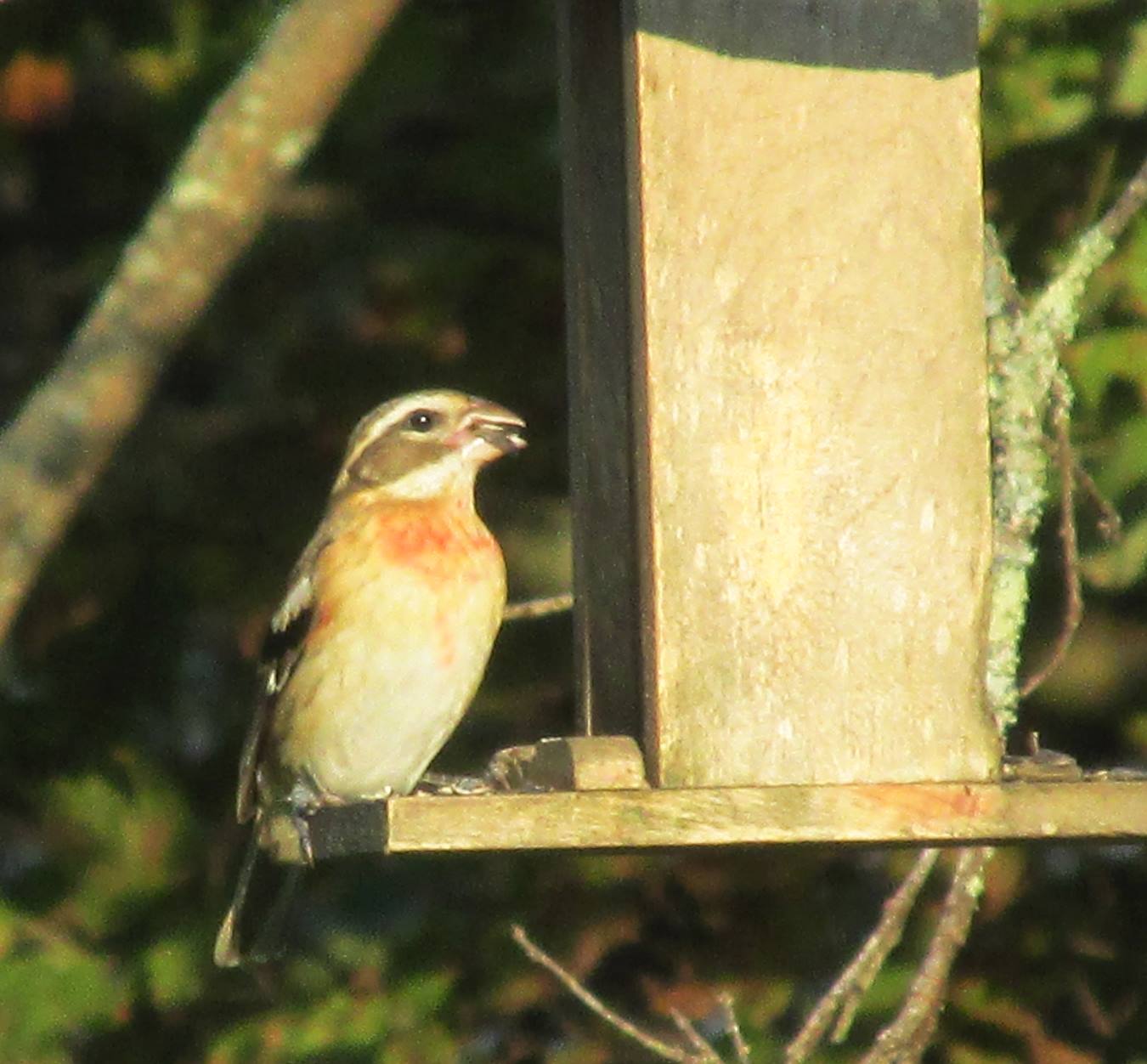
Photo by Bryan Stevens
A young male Rose-breasted Grosbeak visits a feeder in September of 2013. Young males resemble females but show a splash of orange on the breast that will be replaced the following spring by the familiar rosy-red patch.

