Monthly Archives: July 2026

Future looks brighter for some endangered birds

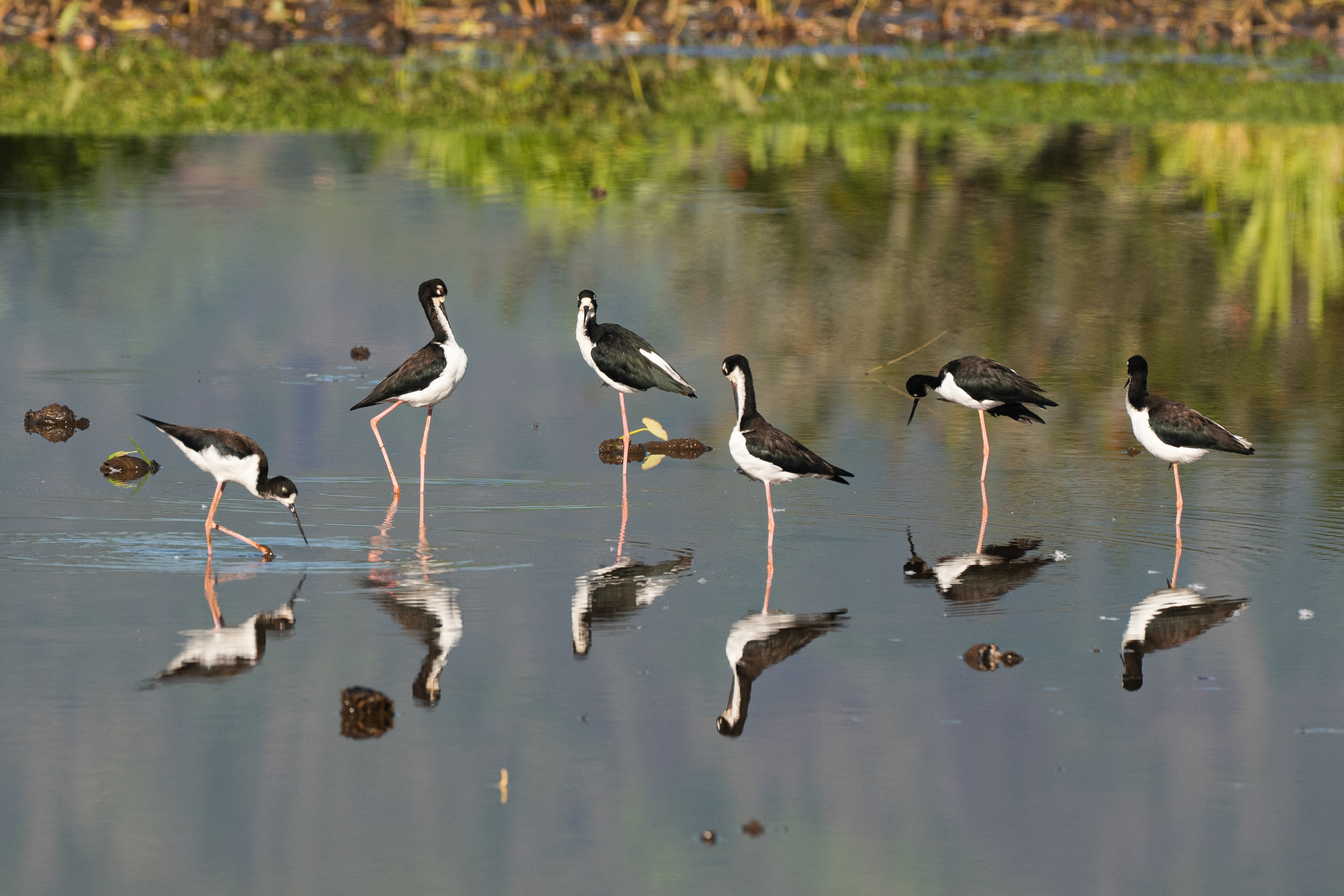
 Laurel Smith/USFWS • A group of Hawaiian stilts or ae’o cast their reflections in a wetland at Kilauea Pond National Wildlife Refuge, one of the few freshwater wetlands found on the Hawaiian Islands.

Everyone, including birders, enjoys reading some good news. There have been some recent success stories involving some of the world’s most endangered birds, including hopeful stories about the Hawaiian stilt and Guam kingfisher.

The kingfisher, extinct in the wild, survives in secure facilities around the world and has gradually increased to a population of about 150 birds. That’s a big increase from the 29 birds collected in the wild between 1984 and 1986 as a desperate attempt to preserve the species in captivity. A native name for the kingfisher is “sihek.”
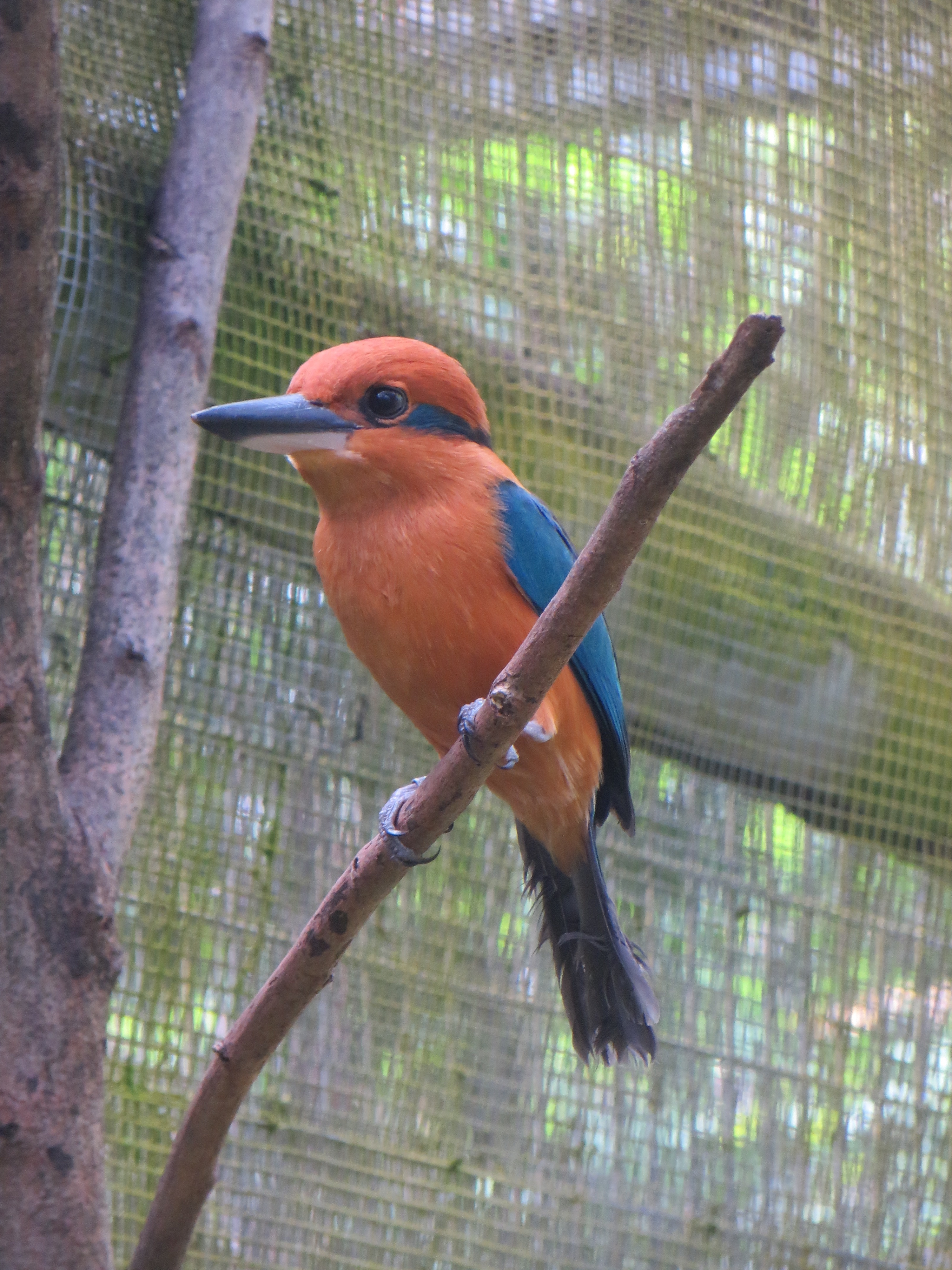
M. Kastner/USFWS • An adult Guam kingfisher in captivity. The entire wild population was taken into captivity as a desperate move to save the population. The move seems to be working.

The kingfisher has made headlines in the past few months. Four chicks hatched at the Smithsonian Conservation Biology Institute in Front Royal, Virginia, in April and May. The hatching of additional chicks took place, also in April and May, at The National Aviary in Pittsburgh, Pennsylvania.

Some of the captive-bred population has been returned successfully to the wild on a predator-free atoll near Hawaii. The Guam kingfisher was eradicated in the wild due to the accidental introduction of the brown tree snake to Guam shortly after World War II.

The stilt has been even more successful, recently being reclassified as threatened instead of endangered. The population now stands at about 1,500 birds, up significantly from the mere 200 alive in 1940.
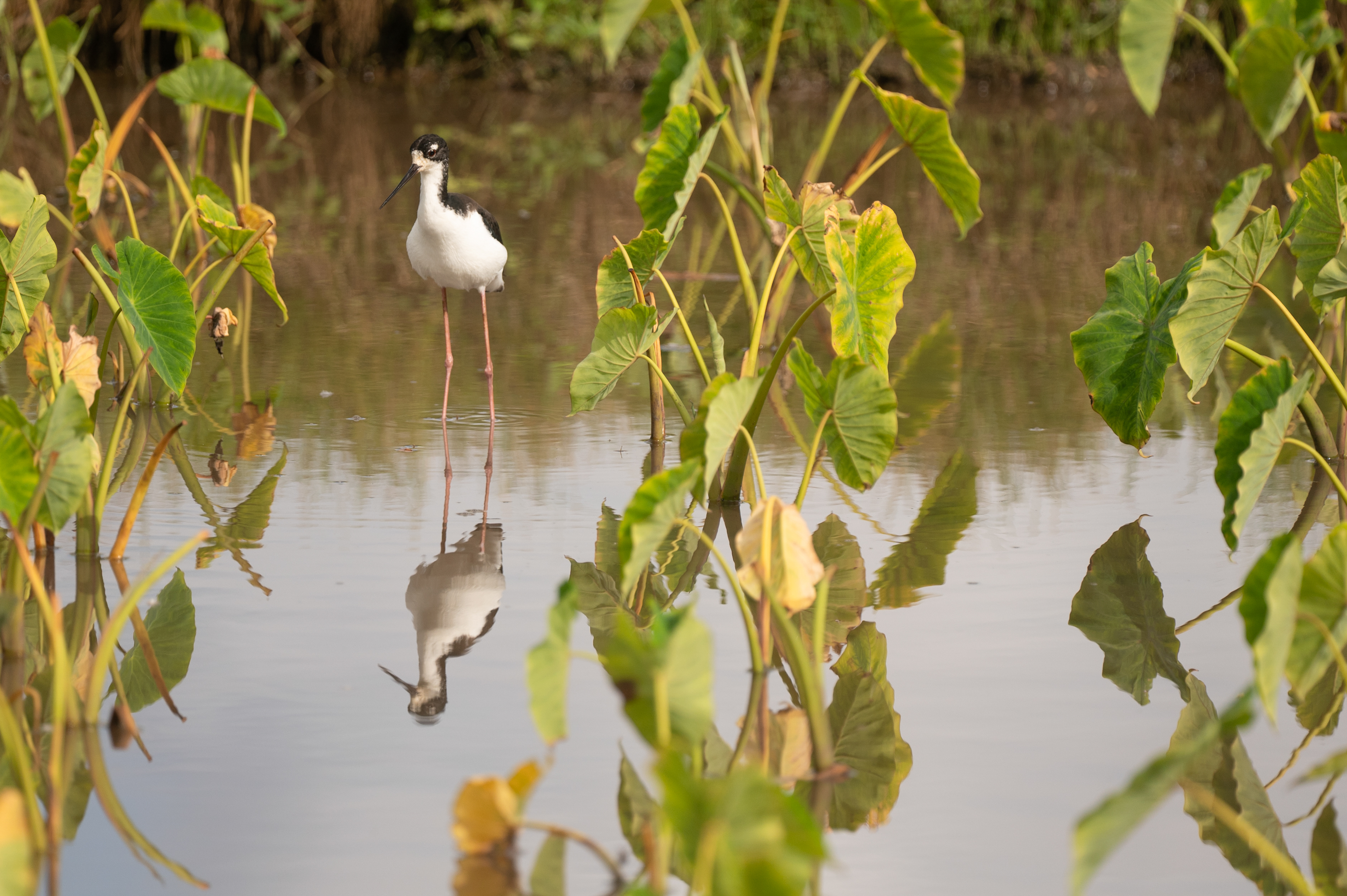
Laurel Smith/USFWS • Ae‘o (Hawaiian stilt) are opportunistic feeders. They prey on chaete worms, crustaceans, insects, tadpoles and small fish in shallow waters or mudflats.

The U.S. Fish and Wildlife Service posted on July 16 a release announcing the downlisting the aeʻo (Hawaiian stilt) from endangered to threatened under the Endangered Species Act.

“The downlisting of aeʻo is a huge achievement,” said Bridget Fahey, the Service’s acting regional director for the Pacific Region. “While there is still more work to be done to sustain the aeʻo’s recovery, today we want to celebrate the efforts of our conservation partners, including the State of Hawaii, the U.S. military, private landowners and local organizations.”

The aeʻo is a wading bird native to all the main Hawaiian Islands except Kahoʻolawe. The aeʻo was originally listed as endangered in 1970 due to destruction and alteration of habitat, hunting, introduced predatory animals and nonnative birds and diseases.

The aeʻo is closely related to the black-necked stilt, as well as the American avocet, another long-legged shorebird. The species are classified together in the family, recurvirostridae. The Hawaiian stilt is considered a sub-species of the black-necked stilt.

It’s time to start looking for shorebirds, a family of birds also known with a little more creative flair as “wind birds” along the region’s rivers, lakes and ponds. They are so named because so many species are capable of incredible long-distance migrations. A range of shorebirds migrate through the region in late summer and into fall.

My last sighting of black-necked stilts took place more than a decade ago in May 2014 during a South Carolina vacation. I observed three black-necked stilts at Huntington Beach State Park while walking on a marsh boardwalk near the park’s Nature Center. They flew toward the causeway, so I got into my car and drove there to try to re-locate them. I did find two of the stilts feeding along the causeway, but I never managed to re-locate the third bird.

Photo by Bryan Stevens
Two Black-necked Stilts forage along the causeway wetland at Huntington Beach State Park in South Carolina.

I watched the two stilts foraging for food in shallow water shared by egrets and alligators. The two birds, despite a somewhat gangly appearance, moved with elegantly efficient strides on their long pink legs.

I have seen this unusual shorebird in Tennessee only once on Oct. 13, 2004, at Austin Springs on Boone Lake in Washington County. The bird, first found by Rick Knight, drew many excited birders to the location for looks at this shorebird before it departed to continue its migration flight south.

As you might imagine, land-locked Tennessee is not an ideal location for finding shorebirds, but spring and fall migration brings a surprising variety of these birds through Northeast Tennessee. Black-necked stilts, however, are a rarity. I have also seen this species of shorebird on Fripp Island, South Carolina, as well as just outside of Wendover, Nevada, on a visit to the Bonneville Salt Flats.

The world of shorebirds has produced many lookalike species, including many of the small sandpipers often collectively labeled as “peeps” by birders. The black-necked stilt, however, is not at all likely to be confused with any other shorebird. It is a slender bird atop a pair of extremely long pink legs. It has a two-tone appearance with black upper parts and white underparts. The black and white dichotomy continues along the bird’s long neck and head. This bird also has a thin, needle-shaped bill that it uses to delicately pluck aquatic insects and other prey from water or mud.

The black-necked stilt’s long pink legs are exceptional. In fact, this species has the second-longest legs in proportion to their bodies of any bird, exceeded only by flamingos, according to the website All About Birds.

•••

To share a sighting, make a comment or ask a question, email me at ahoodedwarbler@aol.com.

Birds of summer offer exciting observations

Bryan Stevens • A great egret catches a small fish.

Summer birding is not always productive. Recent sweltering days have reminded me of that fact. There are a few birds, however, that seem to increase their profiles in summer instead of wilting and retreating to the shade until the season begins to cool off.

Here’s a look at some of my summer favorites and the reasons behind their inclusion on this list.

Belted kingfisher
Although this member of the widespread kingfisher clan can be found in the region all year, the belted kingfisher definitely keeps a high profile in late summer when a visit to any pond, creek, river or lake is likely to result in hearing this kingfisher’s rattling vocalization, often made when the bird feels alarmed or disturbed.

In her book “The Folklore of Birds,” Laura C. Martin writes that in some accounts the kingfisher, not the dove, was the second bird Noah released from the ark after the Biblical flood. Instead of looking for land, the kingfisher flew too high and the sun scorched the bird’s feathers. After his setback with the raven and now the kingfisher, Noah made the kingfisher remain on the ark’s deck to catch its food from the water.

Halcyon days, a term meaning a period of peaceful quiet, is derived from Greek legend. According to the legend, the god Zeus restrained the storms during the period when the kingfishers nest. The scientific name for the belted kingfisher is Megaceryle alcyon, a variation on the term “halcyon.”

Photo by Bryan Stevens • The scientific name for the belted kingfisher is Megaceryle alcyon, a variation on the term “halcyon.”

Martin writes in her book about a Cherokee legend about how the kingfisher acquired its angling lifestyle. The poor bird wanted to be a waterbird, but lacked the equipment to make a living at fishing. The other animals convened a council and, in pity for the kingfisher’s plight, endowed the bird with its spear-like bill. Since that time, the bird has been known as “king of the fishers.”

The “king of the fishers” is indeed to be envied by human anglers. Although not successful in every attempt, the belted kingfisher is certainly exceptional in its pursuit of fish. According to John Eastman in his book, “Birds of Lake, Pond and Marsh,” the belted kingfisher typically captures about 10 fish per day. Some human anglers would envy a success rate like that.

Great egret
Many long-legged wading birds, as a general rule, like to wander in late summer after the nesting season’s finished. Many of these birds are common in coastal areas, but in late summer they often show up far inland.

Some of the waders to look for in the region include wood stork, roseate spoonbill, tricolored heron and snowy egret. The wading bird most likely to actually put in an appearance at local ponds or rivers is the great egret.

The great egret became a motivational symbol for conservation with the foundation of the National Audubon Society in 1905. The National Audubon Society spearheaded efforts to end the mass slaughter of various bird species. Some birds were killed for food, but millions were also killed for their showy feathers that were destined to decorate stylish attire worn as a symbol of high fashion. As early as 1910, some states began passing legislation to abolish trade in bird plumes. The federal government also passed the Migratory Bird Treaty Act, which was a law first enacted in 1916 to implement measures to protect and conserve migratory birds.

In 1953, a great egret in flight was chosen as the symbol for the official logo of the National Audubon Society, which was formed in part to prevent the killing of birds for their feathers. Birds like great egrets, snowy egrets, roseate spoonbills and other long-legged waders had been decimated before people responded to the wanton destruction being visited upon these beautiful and awe-inspiring creatures.

The great egret belongs to the genus Ardea, which includes various egrets and herons. Other members of this genus include Goliath heron, black-headed heron, purple heron and pied heron.

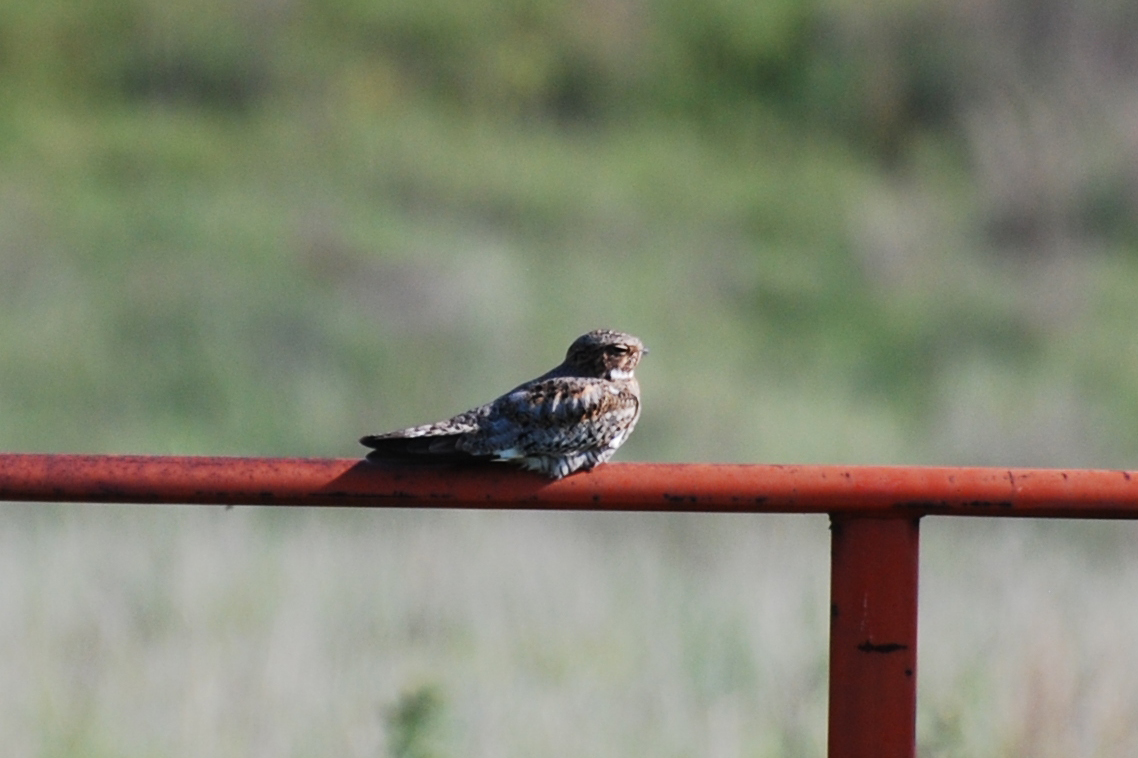
Photo by Jean Potter • A common nighthawk rests on a metal railing.

Common nighthawk
This insect-eating bird is a member of the nightjar family, which includes such familiar nocturnal serenaders as chuck-will’s widow and whip-poor-will.

The name common nighthawk is a misnomer. The species is not strictly nocturnal and it is certainly not a hawk. The nighthawk doesn’t offer a serenade like whip-poor-wills, but it does produce a “pent” call that sounds much like an electric buzzer. It’s often the first indication of one of these birds swooping overhead.

Nighthawks form impressive flocks, often numbering in the dozens or even hundreds. They are often active in evening hours, but I’ve seen large flocks of these migrating birds in mid-afternoon. August and September are the best time to look skyward to enjoy the spectacle of a large flock of swooping nighthawks as they pass overhead.

Swallow-tailed Kite
This is not exactly a common summer bird, but like the wandering wading birds, late summer is a likely time to catch a glimpse of this aerodynamic, unmistakable raptor. Several years ago I got the thrill of adding a swallow-tailed kite to my life list in some agricultural fields in southwestern Washington County. I’ve also seen swallow-tailed kites in Florida. I also observed my first-ever Mississippi kite in Elizabethon in 2020 during a Spring Bird Count.

The swallow-tailed kite is a large, streamlined raptor with long, narrow, pointed wings, slender bodies and a long, deeply forked tail that gives the bird its common name. The small, sharply hooked beak is used to catch insect prey, as well as amphibians, snakes and bats.

Bryan Stevens • A male American goldfinch looks its best in spring and summer. By fall, the bright colors are replaced with the drab winter plumage.

American goldfinch
Goldfinch males still look sharp in late summer, but they do start losing that bold pattern of black and white against a backdrop of golden-yellow feathers. These birds also form fussy but sociable flocks that congregate at bird feeders or bird baths in many a backyard.

A sighting of a goldfinch can be memorable. I still retain vivid imagery of these birds from childhood, long before I could identify them by name. They would always appear in late summer, perching atop the three blue spruces in our yard. The trees are no longer standing, but the memories of those colorful yellow and black birds endure.

Summer is the season of plenty for American goldfinches. Roadside ditches are choked with chicory, evening primrose and other seed-producing plants often dismissed as “weeds.” Simply driving local roads can, and often does, produce sightings of flocks of American goldfinches as they forage for seeds. These small songbirds will readily visit feeders for sunflower and thistle seeds.

•••

Bryan Stevens has written about birds, birders and birding since 1995. Email him with questions, comments or sightings at ahoodedwarbler@aol.com.

Photo by Bryan Stevens • A great egret resting on a spit of land in a lake at Murphy Candler Park in Brookhaven, Ga.

Scarlet tanagers bring brilliance of tropics to local Mountains

Photo Courtesy of Jean Potter
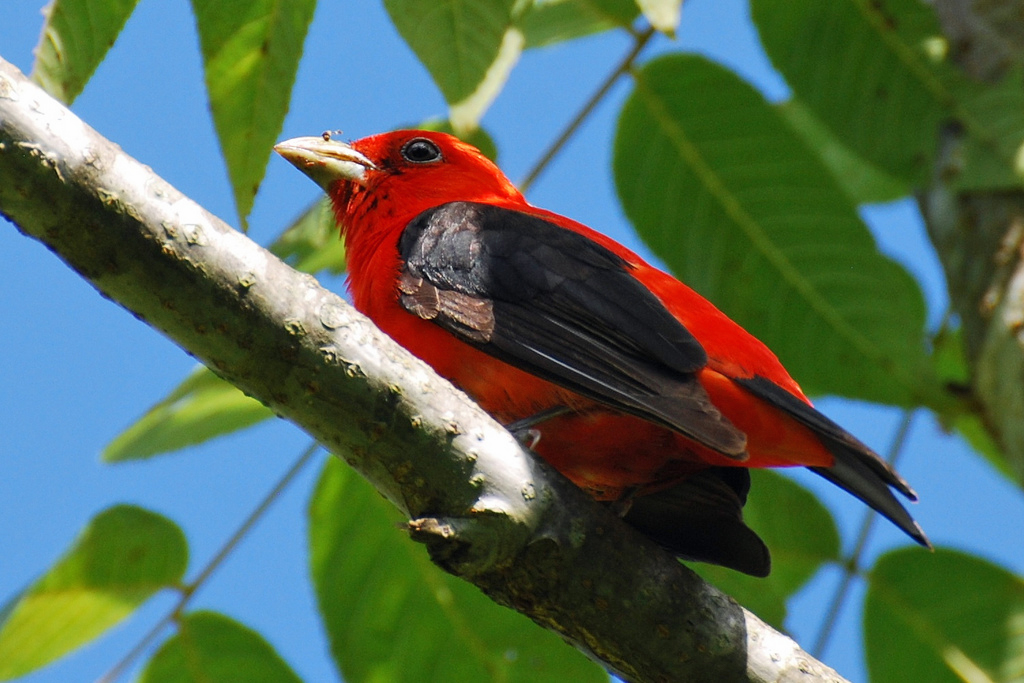
A male scarlet tanager brightens shadowy woodlands with a flash of tropical colors yet remains mostly inconspicuous in the forest canopy.

The berries on the mulberry trees at home ripened slightly ahead of the recent Fourth of July holiday. As the berries ripened, various birds descended on the trees. Among the visitors were American robins, cedar waxwings, gray catbird, wood thrushes and, almost without a doubt, scarlet tanagers.

The male scarlet tanager is a breathtaking bird that makes the mountains of northeast Tennessee, western North Carolina and southwest Virginia their summer home. The extraordinary appearance of the male scarlet tanager is certainly one that sets it apart from most other songbirds.

This tanager is not typically a feeder visitor, but bird enthusiasts have had varying degrees of success trying to lure these birds with fruit, such as orange slices placed in special feeders or simply spiked onto the branches of backyard trees. As an added bonus, orange slices can also attract birds such as brown thrashers, Baltimore orioles and gray catbirds.

The scarlet tanager indulges its fondness for fruit by incorporating various berries into its diet, Blueberry, mulberry, elderberry, serviceberry and wild cherry are all sure to attract scarlet tanagers and other fruit-eating birds. Plant some of these trees and shrubs to make your yard or garden more inviting to a range of our fine feathered friends.

Bryan Stevens • A male scarlet tanager stands out from other summer birds.

I usually have a few scarlet tanagers in residence around my home during the summer months, but I haven’t seen one in 2026. As usual, I have heard them. But listening to the male sing is not quite the same as observing this beautiful bird with its brilliant plumage of crimson red paired with black wings and tail.

Of course, like many other birds, the female scarlet tanager makes no real claim to the common name with her comparatively drab greenish plumage. However, the scientific name, Piranga olivacea, gives a nod to the olive-green plumage of females, young males and even adult males when they’re molting their feathers.

I began hearing a male scarlet tanager singing deep in the woods at about the time the mulberries ripped. I’m speculating that he got lured close enough to overhear by the mulberries.

So, why is it so difficult to lay eyes on such a brightly colored bird? The answer rests with this bird’s daily routine, which is usually conducted among the upper woodland canopy in such tall trees as oaks and poplars.

The male tanager does produce a distinctive song. Upon first hearing it, listeners might mistake the hidden singer for an American robin. Listen a little closer, however, and the song sounds as if it is being delivered by a hoarse robin with a sore throat. The male tanager also makes a vocalization described as “chip-burr” that is also easily heard.

Photo by Bryan Stevens
A scarlet tanager feeds on wild cherries. By late summer and early fall, even male tanagers have lost most of their vibrant plumage. 

If we were to see a scarlet tanager in a rain forest in South America, we might not be so surprised by vibrant plumage that has come to be associated with many tropical birds. The scarlet tanager is certainly better attired than most birds to provide observers a glimpse of a creature that would indeed look more at home in the jungle.

Worldwide, there have traditionally been about 390 species of tanagers. Experts have changed some of the ways they classify tanagers, so that figure has fluctuated in recent years.

Tanagers are a New World family of birds, concentrated mainly in the tropics of Central and South America. Some of the world’s other tanagers are known by extremely descriptive names, including bay-headed tanager, blue-and-black tanager, seven-coloured tanager, gilt-edged tanager, green-naped tanager, beryl-spangled tanager, opal-rumped tanager flame-faced tanager and blue-gray tanager.

The scarlet tanager ranges in North America with a couple of other relatives: Western tanager and summer tanager.

I am hoping I might still see a male scarlet tanager this summer, but it needs to be soon. The males molt their feathers in late summer and lose their vibrant red appearance. They usually remain in the region’s mountains through late September and early October. Tanagers are common migrants offering a chance to see them as they pass through to return to the tropics. They’re just not going to look as good in the fall as they do in spring and early summer.

•••
Bryan Stevens is celebrating 30 years of writing about birds, birders and birding. Email him at ahoodedwarbler@aol.com to share a sighting, ask a question or make a comment.

Eastern kingbirds deserve their billing as tyrant flycatchers

Photo by Bryan Stevens • An Eastern kingbird perches on a chain-link fence on the campus of East Tennessee State University in Johnson City, Tennessee.

On Saturday, June 27, I spotted two Eastern kingbirds perched on utility lines that extend over the fish pond at my home.

Eastern kingbirds are fairly common summer residents in the region, but they’ve not been at all common birds at my home. In fact, this recent sighting is only the second I’ve ever made of the species at my home in 30 years of birding. As best I can recall, the first time I saw this species at home was in the late 1990s. I’ve seen Eastern kingbirds in many other areas in the region, as well as on trips to Florida, Georgia, South Carolina and Virginia.

It didn’t take long to discover what had attracted the kingbirds to the fish pond. Using the utility lines as convenient perches, the birds continually swooped down over the waterlily-choked pond and returned to the lines with their catches. They were hunting dragonflies, an abundant insect at my fish pond. Based on my observations, they were quite skilled at capturing the dragonflies.

Kingbirds belong to an extensive family of birds known as tyrant flycatchers, or Tyrannidae. The family’s members are exclusively found in the New World. It is the world’s largest family of birds, with more than 400 species.

Tanagers, with 384 species, and hummingbirds, with 363 species, are close rival families when it comes to number of species. So are the pigeons and doves with 353 species, and Old World flycatchers with 345 species.

The Eastern kingbird is easy to recognize and identify. The bird’s plumage is a study in contrast, being black above and white below. In addition, there’s a noticeable white edge to the tip of the bird’s otherwise all-black tail. There is a red patch of feathers on top of the bird’s head, which gives this pint-sized tyrant a “crown,” but most birders, myself included, will tell you that this colorful patch is rarely seen and is instead kept concealed at most times.

Photo by Bryan Stevens • An Eastern kingbird perches on a fence post in the Limestone Cove community of Unicoi, Tennessee.

The scientific name of the Eastern kingbird is Tyrannus tyrannus, a good clue to the bird’s militant nature. Kingbirds, which are about the size of an American robin, are famous for displaying aggressive behavior against much larger birds such as crows and hawks, as well as vultures and herons.

While some birds are all bluff, the Eastern kingbird often follows through with its attacks. According to the website All About Birds, kingbirds have been known to knock blue jays right out of a tree.

I’ve observed kingbirds tormenting such large birds as red-tailed hawks and turkey vultures. I once watched a kingbird get so close to a red-tailed hawk that it almost looked like the smaller bird was hitching a ride on the hawk’s back. I suspect the hawk lost a feather or two in the encounter, not to mention suffering a blow to its dignity.

Other North American kingbirds include Western kingbird, tropical kingbird, Couch’s kingbird, Cassin’s kingbird and the thick-billed kingbird. On a trip to Salt Lake City in Utah many years back, I got the chance to see a Western kingbird, the counterpart to the Eastern kingbird in that part of the country.

Look for the Eastern kingbird in open terrain that offers plenty of perches. These birds spend most of their time chasing and catching flying insects, which provide the bulk of the bird’s food during the summer months.

While the kingbird is probably to be lauded for helping control populations of insect pests, they are not discriminating in their choice of prey. As a result, kingbirds feed on beneficial insects, such as dragonflies and bees, as well as pests like flies.

Photo by Bryan Stevens
A glimpse through the vegetation reveals one of the pond’s most voracious predators. Dragonflies consume many other species of insects, including some that are considered pests. Pictured is a female Blue Dasher. In turn, many birds, including Eastern kingbirds, feed on dragonflies. Kingbirds are skilled at snatching winged insects right out of the air.

Other flycatchers that are relatively common in the region include Eastern phoebe and Eastern wood-pewee. The region is also home to some pint-sized flycatchers during the warmer months, including least flycatcher, Acadian flycatcher, willow flycatcher and alder flycatcher.

Don’t judge the tyrannical kingbird too harshly. These birds are motivated to show aggression to other species due to an inordinate need to protect mates, young and territory. It’s not their fault that they are quite masterful at fulfilling this task.

Kingbirds are not the only birds to exhibit bold, brash behavior. Mockingbirds, brown thrashers and red-winged blackbirds are also quite pugnacious. At home, the male red-winged blackbirds have made numerous attacks on the resident red-shouldered hawks whenever these larger raptors venture too close to the cattail domain of the blackbirds.

Although the species faces potential habitat loss in both its summer range and tropical wintering grounds, the Eastern kingbird remains a prevalent bird across much of North America. It’s just not a common bird at my house, but perhaps my recent sighing of two kingbirds is a signal that’s about to change. Or it could mean that it will be another couple of decades before I see this species again at my home.

To share a sighting, ask a question or make a comment, send me an email at ahoodedwarbler@aol.com.