

Bryan Stevens • A great egret catches a small fish.
Summer birding is not always productive. Recent sweltering days have reminded me of that fact. There are a few birds, however, that seem to increase their profiles in summer instead of wilting and retreating to the shade until the season begins to cool off.
Here’s a look at some of my summer favorites and the reasons behind their inclusion on this list.
Belted kingfisher
Although this member of the widespread kingfisher clan can be found in the region all year, the belted kingfisher definitely keeps a high profile in late summer when a visit to any pond, creek, river or lake is likely to result in hearing this kingfisher’s rattling vocalization, often made when the bird feels alarmed or disturbed.
In her book “The Folklore of Birds,” Laura C. Martin writes that in some accounts the kingfisher, not the dove, was the second bird Noah released from the ark after the Biblical flood. Instead of looking for land, the kingfisher flew too high and the sun scorched the bird’s feathers. After his setback with the raven and now the kingfisher, Noah made the kingfisher remain on the ark’s deck to catch its food from the water.
Halcyon days, a term meaning a period of peaceful quiet, is derived from Greek legend. According to the legend, the god Zeus restrained the storms during the period when the kingfishers nest. The scientific name for the belted kingfisher is Megaceryle alcyon, a variation on the term “halcyon.”

Photo by Bryan Stevens • The scientific name for the belted kingfisher is Megaceryle alcyon, a variation on the term “halcyon.”
Martin writes in her book about a Cherokee legend about how the kingfisher acquired its angling lifestyle. The poor bird wanted to be a waterbird, but lacked the equipment to make a living at fishing. The other animals convened a council and, in pity for the kingfisher’s plight, endowed the bird with its spear-like bill. Since that time, the bird has been known as “king of the fishers.”
The “king of the fishers” is indeed to be envied by human anglers. Although not successful in every attempt, the belted kingfisher is certainly exceptional in its pursuit of fish. According to John Eastman in his book, “Birds of Lake, Pond and Marsh,” the belted kingfisher typically captures about 10 fish per day. Some human anglers would envy a success rate like that.
Great egret
Many long-legged wading birds, as a general rule, like to wander in late summer after the nesting season’s finished. Many of these birds are common in coastal areas, but in late summer they often show up far inland.
Some of the waders to look for in the region include wood stork, roseate spoonbill, tricolored heron and snowy egret. The wading bird most likely to actually put in an appearance at local ponds or rivers is the great egret.
The great egret became a motivational symbol for conservation with the foundation of the National Audubon Society in 1905. The National Audubon Society spearheaded efforts to end the mass slaughter of various bird species. Some birds were killed for food, but millions were also killed for their showy feathers that were destined to decorate stylish attire worn as a symbol of high fashion. As early as 1910, some states began passing legislation to abolish trade in bird plumes. The federal government also passed the Migratory Bird Treaty Act, which was a law first enacted in 1916 to implement measures to protect and conserve migratory birds.
In 1953, a great egret in flight was chosen as the symbol for the official logo of the National Audubon Society, which was formed in part to prevent the killing of birds for their feathers. Birds like great egrets, snowy egrets, roseate spoonbills and other long-legged waders had been decimated before people responded to the wanton destruction being visited upon these beautiful and awe-inspiring creatures.
The great egret belongs to the genus Ardea, which includes various egrets and herons. Other members of this genus include Goliath heron, black-headed heron, purple heron and pied heron.
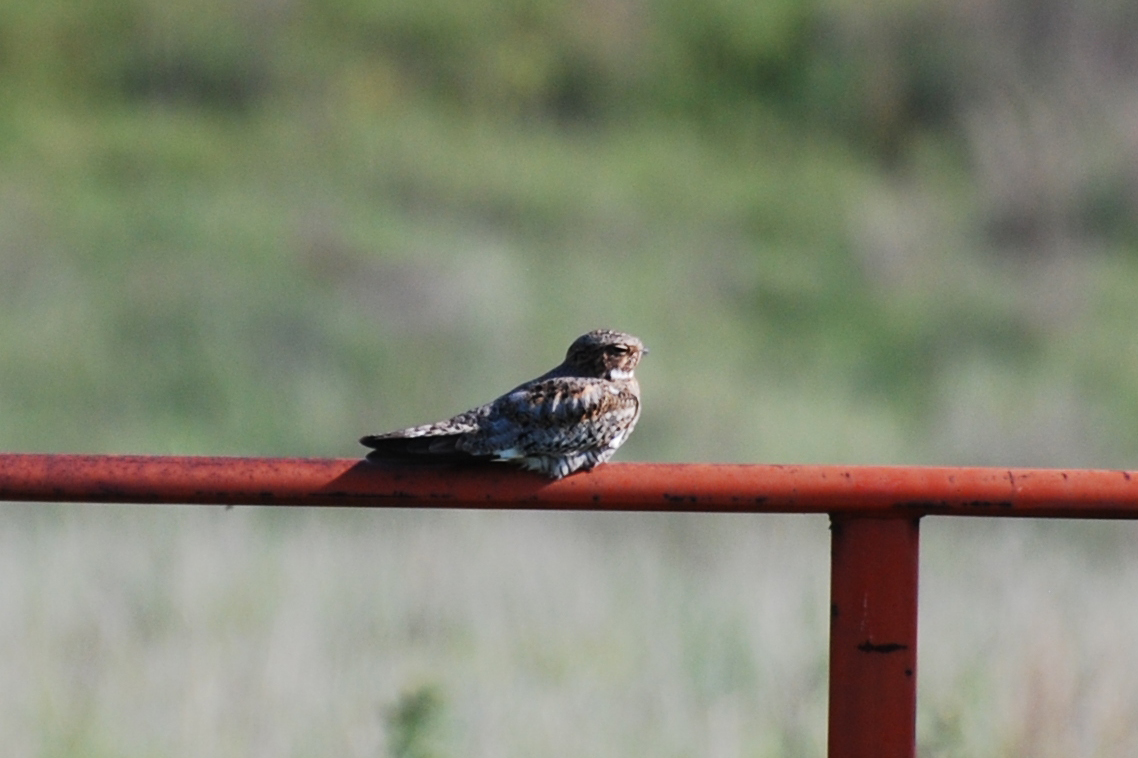
Photo by Jean Potter • A common nighthawk rests on a metal railing.
Common nighthawk
This insect-eating bird is a member of the nightjar family, which includes such familiar nocturnal serenaders as chuck-will’s widow and whip-poor-will.
The name common nighthawk is a misnomer. The species is not strictly nocturnal and it is certainly not a hawk. The nighthawk doesn’t offer a serenade like whip-poor-wills, but it does produce a “pent” call that sounds much like an electric buzzer. It’s often the first indication of one of these birds swooping overhead.
Nighthawks form impressive flocks, often numbering in the dozens or even hundreds. They are often active in evening hours, but I’ve seen large flocks of these migrating birds in mid-afternoon. August and September are the best time to look skyward to enjoy the spectacle of a large flock of swooping nighthawks as they pass overhead.
Swallow-tailed Kite
This is not exactly a common summer bird, but like the wandering wading birds, late summer is a likely time to catch a glimpse of this aerodynamic, unmistakable raptor. Several years ago I got the thrill of adding a swallow-tailed kite to my life list in some agricultural fields in southwestern Washington County. I’ve also seen swallow-tailed kites in Florida. I also observed my first-ever Mississippi kite in Elizabethon in 2020 during a Spring Bird Count.
The swallow-tailed kite is a large, streamlined raptor with long, narrow, pointed wings, slender bodies and a long, deeply forked tail that gives the bird its common name. The small, sharply hooked beak is used to catch insect prey, as well as amphibians, snakes and bats.

Bryan Stevens • A male American goldfinch looks its best in spring and summer. By fall, the bright colors are replaced with the drab winter plumage.
American goldfinch
Goldfinch males still look sharp in late summer, but they do start losing that bold pattern of black and white against a backdrop of golden-yellow feathers. These birds also form fussy but sociable flocks that congregate at bird feeders or bird baths in many a backyard.
A sighting of a goldfinch can be memorable. I still retain vivid imagery of these birds from childhood, long before I could identify them by name. They would always appear in late summer, perching atop the three blue spruces in our yard. The trees are no longer standing, but the memories of those colorful yellow and black birds endure.
Summer is the season of plenty for American goldfinches. Roadside ditches are choked with chicory, evening primrose and other seed-producing plants often dismissed as “weeds.” Simply driving local roads can, and often does, produce sightings of flocks of American goldfinches as they forage for seeds. These small songbirds will readily visit feeders for sunflower and thistle seeds.
•••
Bryan Stevens has written about birds, birders and birding since 1995. Email him with questions, comments or sightings at ahoodedwarbler@aol.com.

Photo by Bryan Stevens • A great egret resting on a spit of land in a lake at Murphy Candler Park in Brookhaven, Ga.

