
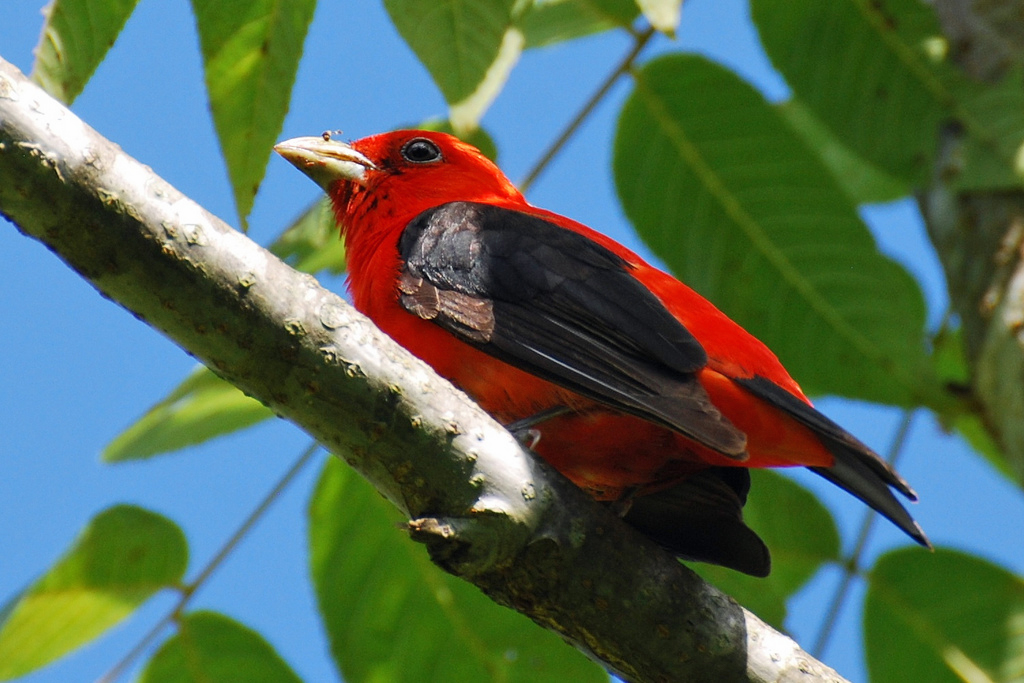
Photo Courtesy of Jean Potter
A male scarlet tanager brightens shadowy woodlands with a flash of tropical colors yet remains mostly inconspicuous in the forest canopy.
The berries on the mulberry trees at home ripened slightly ahead of the recent Fourth of July holiday. As the berries ripened, various birds descended on the trees. Among the visitors were American robins, cedar waxwings, gray catbird, wood thrushes and, almost without a doubt, scarlet tanagers.
The male scarlet tanager is a breathtaking bird that makes the mountains of northeast Tennessee, western North Carolina and southwest Virginia their summer home. The extraordinary appearance of the male scarlet tanager is certainly one that sets it apart from most other songbirds.
This tanager is not typically a feeder visitor, but bird enthusiasts have had varying degrees of success trying to lure these birds with fruit, such as orange slices placed in special feeders or simply spiked onto the branches of backyard trees. As an added bonus, orange slices can also attract birds such as brown thrashers, Baltimore orioles and gray catbirds.
The scarlet tanager indulges its fondness for fruit by incorporating various berries into its diet, Blueberry, mulberry, elderberry, serviceberry and wild cherry are all sure to attract scarlet tanagers and other fruit-eating birds. Plant some of these trees and shrubs to make your yard or garden more inviting to a range of our fine feathered friends.

Bryan Stevens • A male scarlet tanager stands out from other summer birds.
I usually have a few scarlet tanagers in residence around my home during the summer months, but I haven’t seen one in 2026. As usual, I have heard them. But listening to the male sing is not quite the same as observing this beautiful bird with its brilliant plumage of crimson red paired with black wings and tail.
Of course, like many other birds, the female scarlet tanager makes no real claim to the common name with her comparatively drab greenish plumage. However, the scientific name, Piranga olivacea, gives a nod to the olive-green plumage of females, young males and even adult males when they’re molting their feathers.
I began hearing a male scarlet tanager singing deep in the woods at about the time the mulberries ripped. I’m speculating that he got lured close enough to overhear by the mulberries.
So, why is it so difficult to lay eyes on such a brightly colored bird? The answer rests with this bird’s daily routine, which is usually conducted among the upper woodland canopy in such tall trees as oaks and poplars.
The male tanager does produce a distinctive song. Upon first hearing it, listeners might mistake the hidden singer for an American robin. Listen a little closer, however, and the song sounds as if it is being delivered by a hoarse robin with a sore throat. The male tanager also makes a vocalization described as “chip-burr” that is also easily heard.
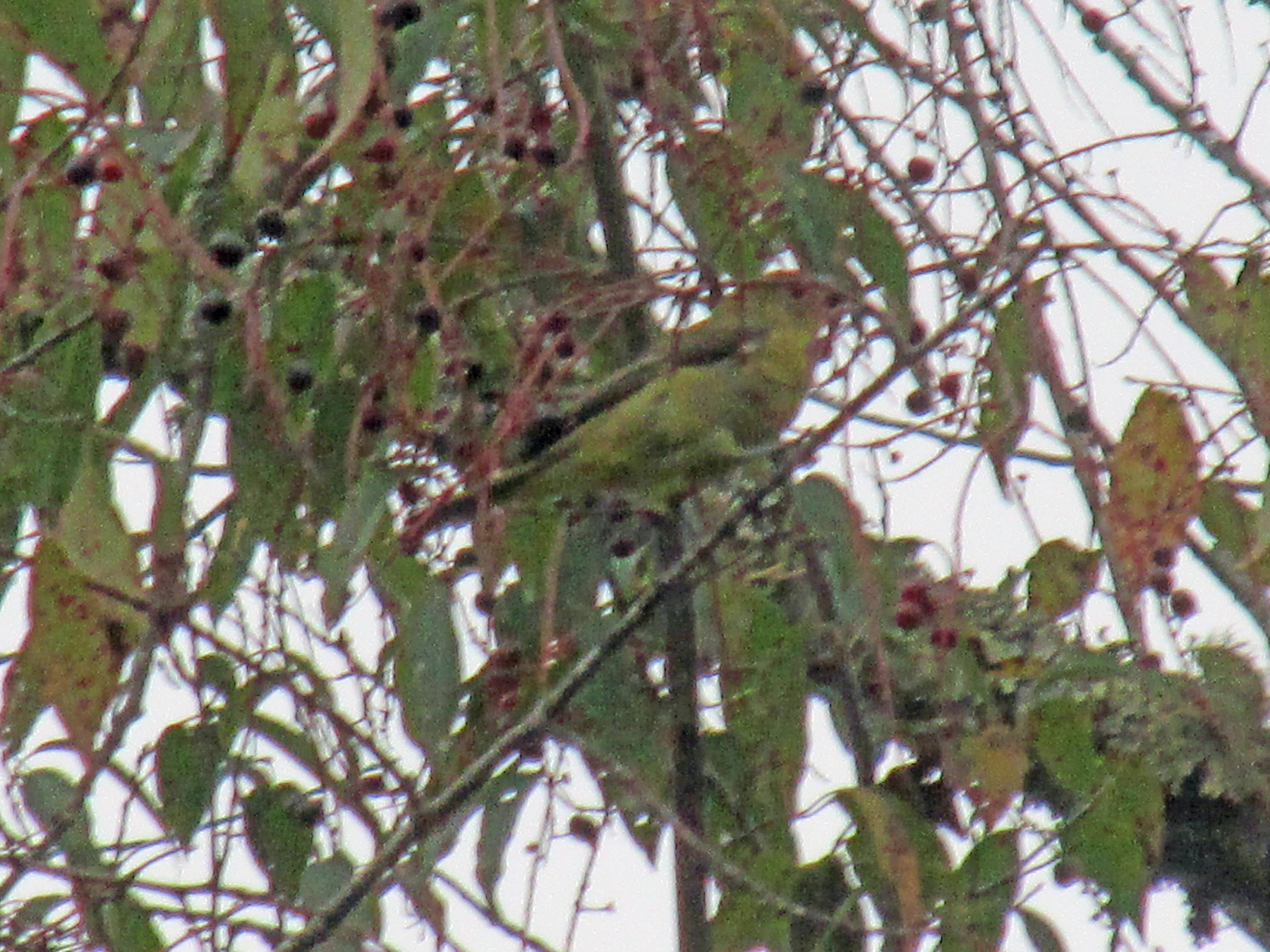
Photo by Bryan Stevens
A scarlet tanager feeds on wild cherries. By late summer and early fall, even male tanagers have lost most of their vibrant plumage.
If we were to see a scarlet tanager in a rain forest in South America, we might not be so surprised by vibrant plumage that has come to be associated with many tropical birds. The scarlet tanager is certainly better attired than most birds to provide observers a glimpse of a creature that would indeed look more at home in the jungle.
Worldwide, there have traditionally been about 390 species of tanagers. Experts have changed some of the ways they classify tanagers, so that figure has fluctuated in recent years.
Tanagers are a New World family of birds, concentrated mainly in the tropics of Central and South America. Some of the world’s other tanagers are known by extremely descriptive names, including bay-headed tanager, blue-and-black tanager, seven-coloured tanager, gilt-edged tanager, green-naped tanager, beryl-spangled tanager, opal-rumped tanager flame-faced tanager and blue-gray tanager.
The scarlet tanager ranges in North America with a couple of other relatives: Western tanager and summer tanager.
I am hoping I might still see a male scarlet tanager this summer, but it needs to be soon. The males molt their feathers in late summer and lose their vibrant red appearance. They usually remain in the region’s mountains through late September and early October. Tanagers are common migrants offering a chance to see them as they pass through to return to the tropics. They’re just not going to look as good in the fall as they do in spring and early summer.
•••
Bryan Stevens is celebrating 30 years of writing about birds, birders and birding. Email him at ahoodedwarbler@aol.com to share a sighting, ask a question or make a comment.

