Tag Archives: Kingfishers

Future looks brighter for some endangered birds

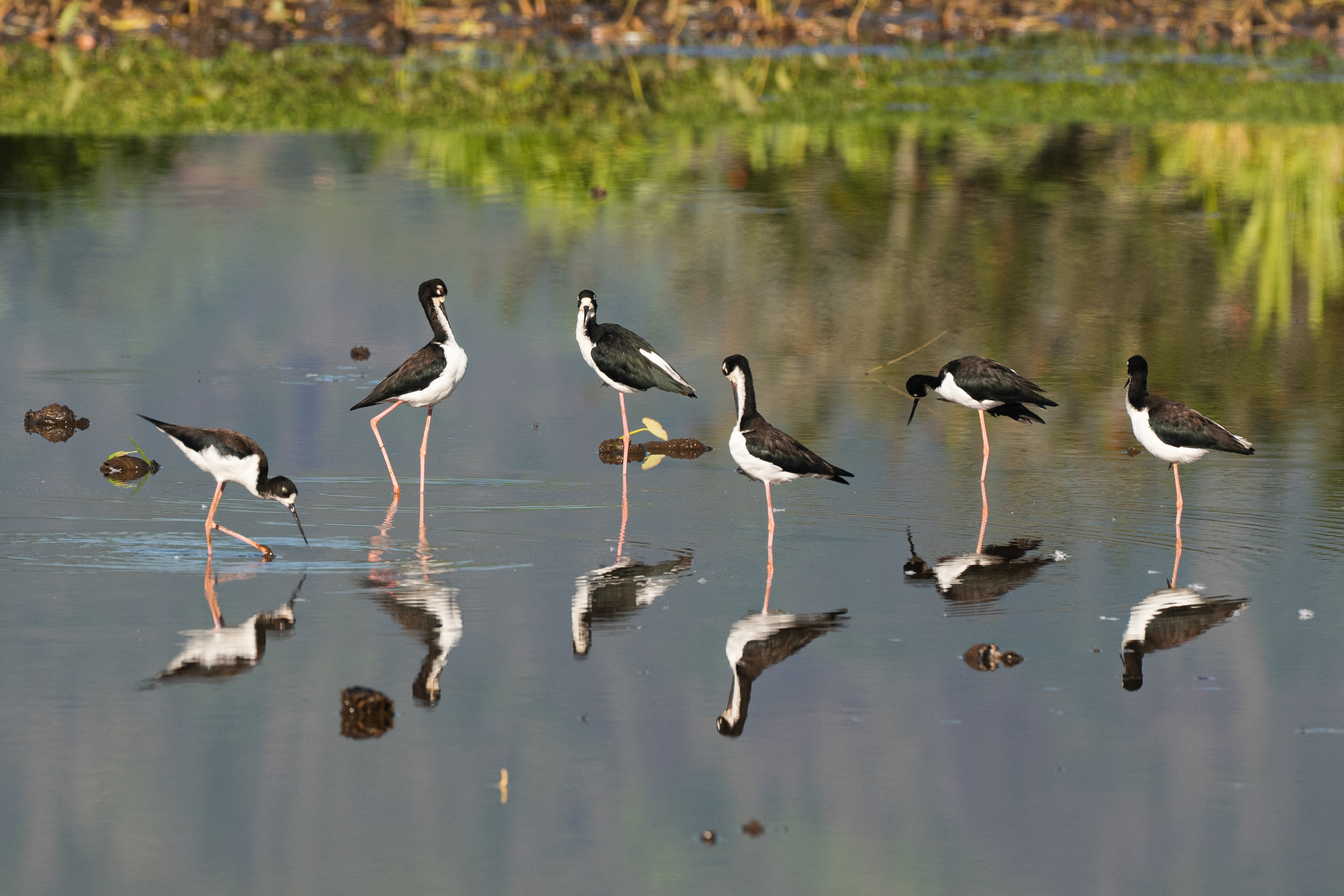
 Laurel Smith/USFWS • A group of Hawaiian stilts or ae’o cast their reflections in a wetland at Kilauea Pond National Wildlife Refuge, one of the few freshwater wetlands found on the Hawaiian Islands.

Everyone, including birders, enjoys reading some good news. There have been some recent success stories involving some of the world’s most endangered birds, including hopeful stories about the Hawaiian stilt and Guam kingfisher.

The kingfisher, extinct in the wild, survives in secure facilities around the world and has gradually increased to a population of about 150 birds. That’s a big increase from the 29 birds collected in the wild between 1984 and 1986 as a desperate attempt to preserve the species in captivity. A native name for the kingfisher is “sihek.”
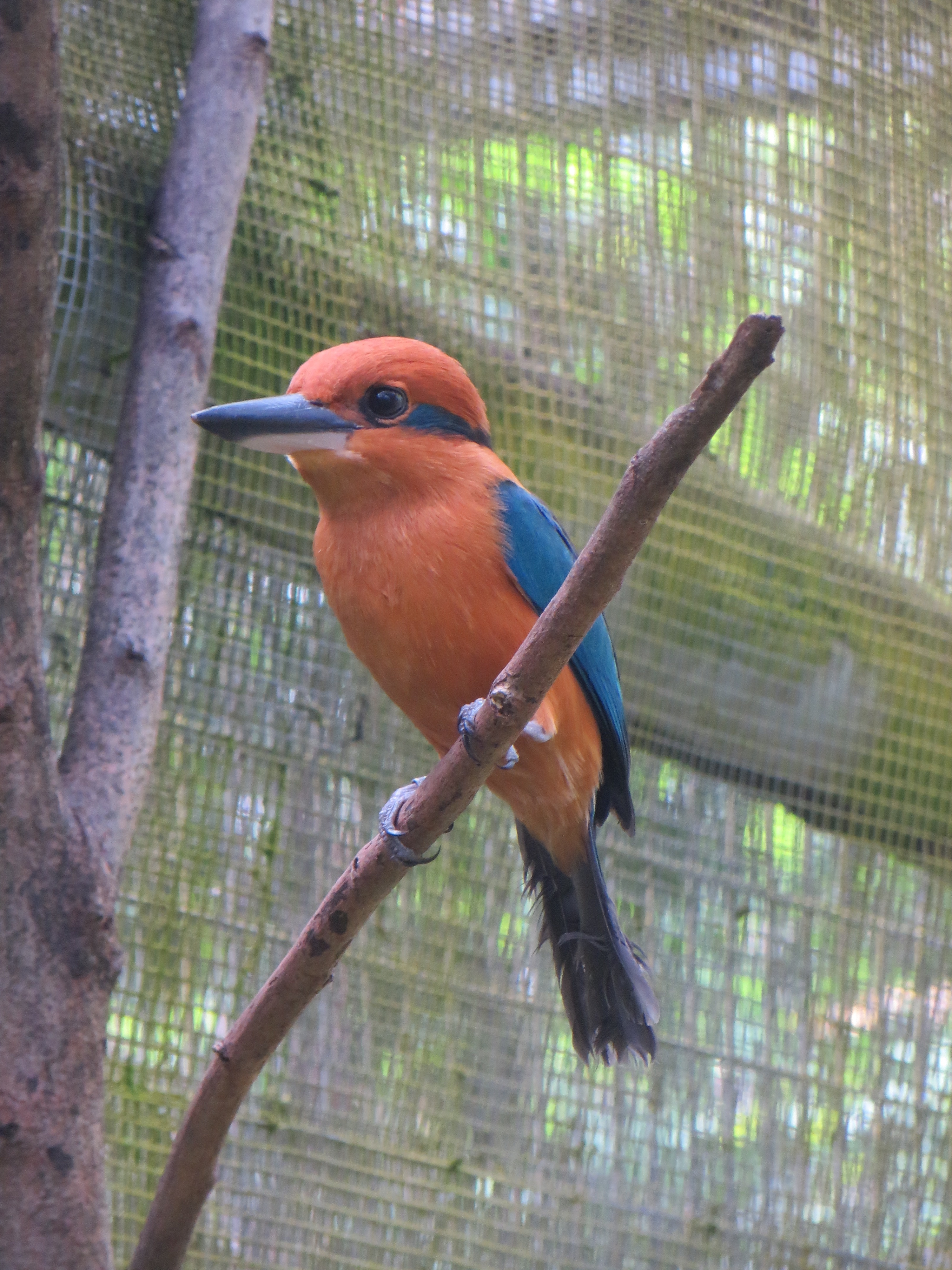
M. Kastner/USFWS • An adult Guam kingfisher in captivity. The entire wild population was taken into captivity as a desperate move to save the population. The move seems to be working.

The kingfisher has made headlines in the past few months. Four chicks hatched at the Smithsonian Conservation Biology Institute in Front Royal, Virginia, in April and May. The hatching of additional chicks took place, also in April and May, at The National Aviary in Pittsburgh, Pennsylvania.

Some of the captive-bred population has been returned successfully to the wild on a predator-free atoll near Hawaii. The Guam kingfisher was eradicated in the wild due to the accidental introduction of the brown tree snake to Guam shortly after World War II.

The stilt has been even more successful, recently being reclassified as threatened instead of endangered. The population now stands at about 1,500 birds, up significantly from the mere 200 alive in 1940.
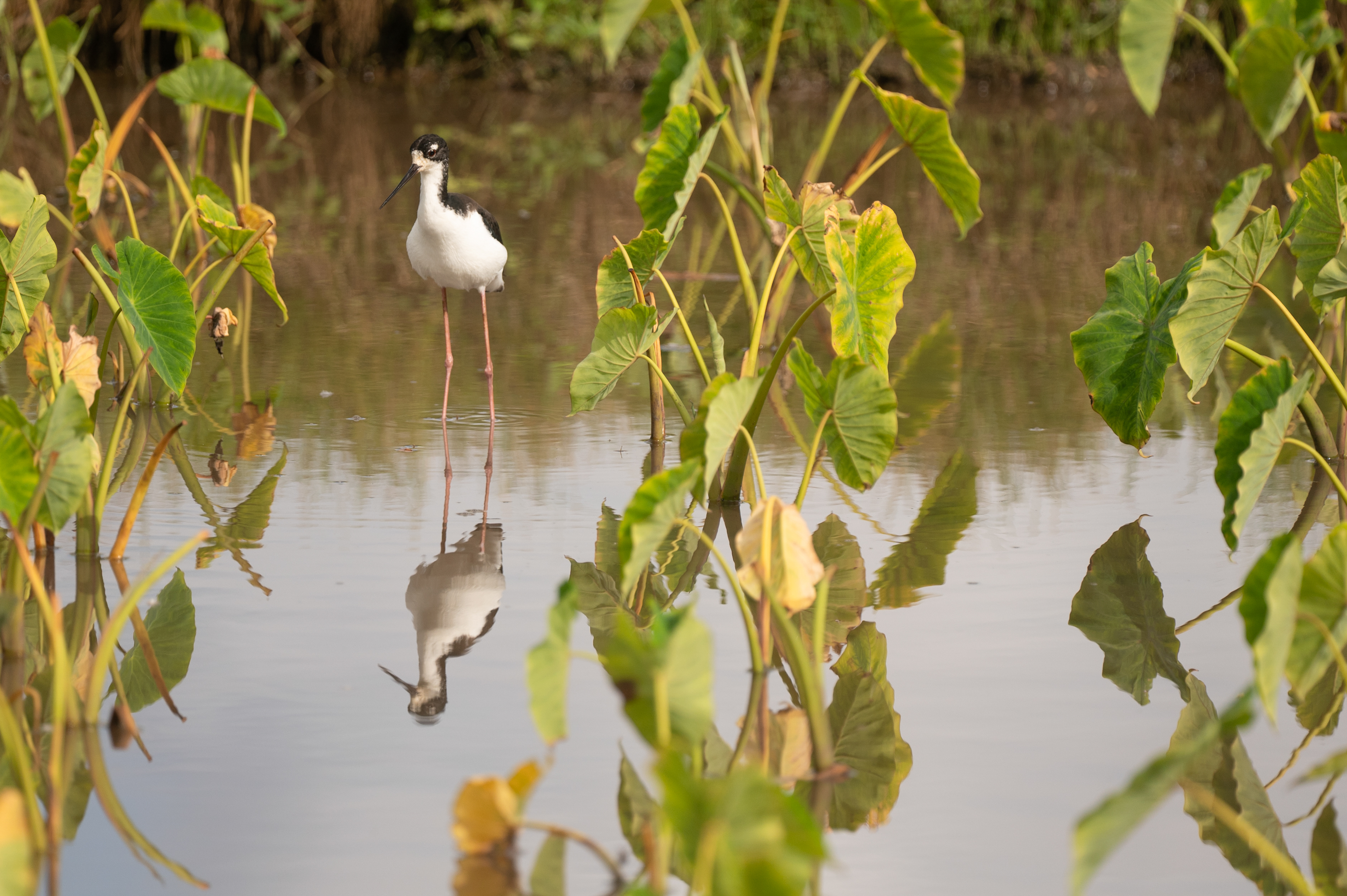
Laurel Smith/USFWS • Ae‘o (Hawaiian stilt) are opportunistic feeders. They prey on chaete worms, crustaceans, insects, tadpoles and small fish in shallow waters or mudflats.

The U.S. Fish and Wildlife Service posted on July 16 a release announcing the downlisting the aeʻo (Hawaiian stilt) from endangered to threatened under the Endangered Species Act.

“The downlisting of aeʻo is a huge achievement,” said Bridget Fahey, the Service’s acting regional director for the Pacific Region. “While there is still more work to be done to sustain the aeʻo’s recovery, today we want to celebrate the efforts of our conservation partners, including the State of Hawaii, the U.S. military, private landowners and local organizations.”

The aeʻo is a wading bird native to all the main Hawaiian Islands except Kahoʻolawe. The aeʻo was originally listed as endangered in 1970 due to destruction and alteration of habitat, hunting, introduced predatory animals and nonnative birds and diseases.

The aeʻo is closely related to the black-necked stilt, as well as the American avocet, another long-legged shorebird. The species are classified together in the family, recurvirostridae. The Hawaiian stilt is considered a sub-species of the black-necked stilt.

It’s time to start looking for shorebirds, a family of birds also known with a little more creative flair as “wind birds” along the region’s rivers, lakes and ponds. They are so named because so many species are capable of incredible long-distance migrations. A range of shorebirds migrate through the region in late summer and into fall.

My last sighting of black-necked stilts took place more than a decade ago in May 2014 during a South Carolina vacation. I observed three black-necked stilts at Huntington Beach State Park while walking on a marsh boardwalk near the park’s Nature Center. They flew toward the causeway, so I got into my car and drove there to try to re-locate them. I did find two of the stilts feeding along the causeway, but I never managed to re-locate the third bird.

Photo by Bryan Stevens
Two Black-necked Stilts forage along the causeway wetland at Huntington Beach State Park in South Carolina.

I watched the two stilts foraging for food in shallow water shared by egrets and alligators. The two birds, despite a somewhat gangly appearance, moved with elegantly efficient strides on their long pink legs.

I have seen this unusual shorebird in Tennessee only once on Oct. 13, 2004, at Austin Springs on Boone Lake in Washington County. The bird, first found by Rick Knight, drew many excited birders to the location for looks at this shorebird before it departed to continue its migration flight south.

As you might imagine, land-locked Tennessee is not an ideal location for finding shorebirds, but spring and fall migration brings a surprising variety of these birds through Northeast Tennessee. Black-necked stilts, however, are a rarity. I have also seen this species of shorebird on Fripp Island, South Carolina, as well as just outside of Wendover, Nevada, on a visit to the Bonneville Salt Flats.

The world of shorebirds has produced many lookalike species, including many of the small sandpipers often collectively labeled as “peeps” by birders. The black-necked stilt, however, is not at all likely to be confused with any other shorebird. It is a slender bird atop a pair of extremely long pink legs. It has a two-tone appearance with black upper parts and white underparts. The black and white dichotomy continues along the bird’s long neck and head. This bird also has a thin, needle-shaped bill that it uses to delicately pluck aquatic insects and other prey from water or mud.

The black-necked stilt’s long pink legs are exceptional. In fact, this species has the second-longest legs in proportion to their bodies of any bird, exceeded only by flamingos, according to the website All About Birds.

•••

To share a sighting, make a comment or ask a question, email me at ahoodedwarbler@aol.com.

Birds of summer offer exciting observations

Bryan Stevens • A great egret catches a small fish.

Summer birding is not always productive. Recent sweltering days have reminded me of that fact. There are a few birds, however, that seem to increase their profiles in summer instead of wilting and retreating to the shade until the season begins to cool off.

Here’s a look at some of my summer favorites and the reasons behind their inclusion on this list.

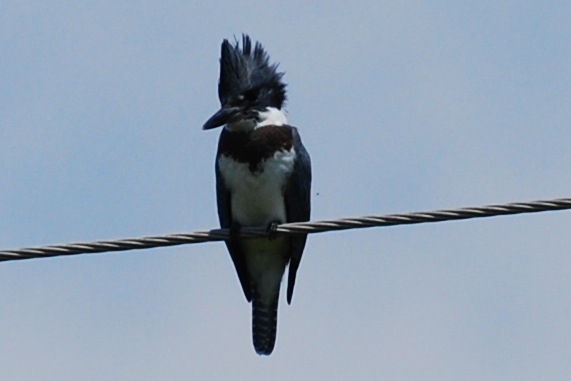
Belted kingfisher
Although this member of the widespread kingfisher clan can be found in the region all year, the belted kingfisher definitely keeps a high profile in late summer when a visit to any pond, creek, river or lake is likely to result in hearing this kingfisher’s rattling vocalization, often made when the bird feels alarmed or disturbed.

In her book “The Folklore of Birds,” Laura C. Martin writes that in some accounts the kingfisher, not the dove, was the second bird Noah released from the ark after the Biblical flood. Instead of looking for land, the kingfisher flew too high and the sun scorched the bird’s feathers. After his setback with the raven and now the kingfisher, Noah made the kingfisher remain on the ark’s deck to catch its food from the water.

Halcyon days, a term meaning a period of peaceful quiet, is derived from Greek legend. According to the legend, the god Zeus restrained the storms during the period when the kingfishers nest. The scientific name for the belted kingfisher is Megaceryle alcyon, a variation on the term “halcyon.”

Photo by Bryan Stevens • The scientific name for the belted kingfisher is Megaceryle alcyon, a variation on the term “halcyon.”

Martin writes in her book about a Cherokee legend about how the kingfisher acquired its angling lifestyle. The poor bird wanted to be a waterbird, but lacked the equipment to make a living at fishing. The other animals convened a council and, in pity for the kingfisher’s plight, endowed the bird with its spear-like bill. Since that time, the bird has been known as “king of the fishers.”

The “king of the fishers” is indeed to be envied by human anglers. Although not successful in every attempt, the belted kingfisher is certainly exceptional in its pursuit of fish. According to John Eastman in his book, “Birds of Lake, Pond and Marsh,” the belted kingfisher typically captures about 10 fish per day. Some human anglers would envy a success rate like that.

Great egret
Many long-legged wading birds, as a general rule, like to wander in late summer after the nesting season’s finished. Many of these birds are common in coastal areas, but in late summer they often show up far inland.

Some of the waders to look for in the region include wood stork, roseate spoonbill, tricolored heron and snowy egret. The wading bird most likely to actually put in an appearance at local ponds or rivers is the great egret.

The great egret became a motivational symbol for conservation with the foundation of the National Audubon Society in 1905. The National Audubon Society spearheaded efforts to end the mass slaughter of various bird species. Some birds were killed for food, but millions were also killed for their showy feathers that were destined to decorate stylish attire worn as a symbol of high fashion. As early as 1910, some states began passing legislation to abolish trade in bird plumes. The federal government also passed the Migratory Bird Treaty Act, which was a law first enacted in 1916 to implement measures to protect and conserve migratory birds.

In 1953, a great egret in flight was chosen as the symbol for the official logo of the National Audubon Society, which was formed in part to prevent the killing of birds for their feathers. Birds like great egrets, snowy egrets, roseate spoonbills and other long-legged waders had been decimated before people responded to the wanton destruction being visited upon these beautiful and awe-inspiring creatures.

The great egret belongs to the genus Ardea, which includes various egrets and herons. Other members of this genus include Goliath heron, black-headed heron, purple heron and pied heron.

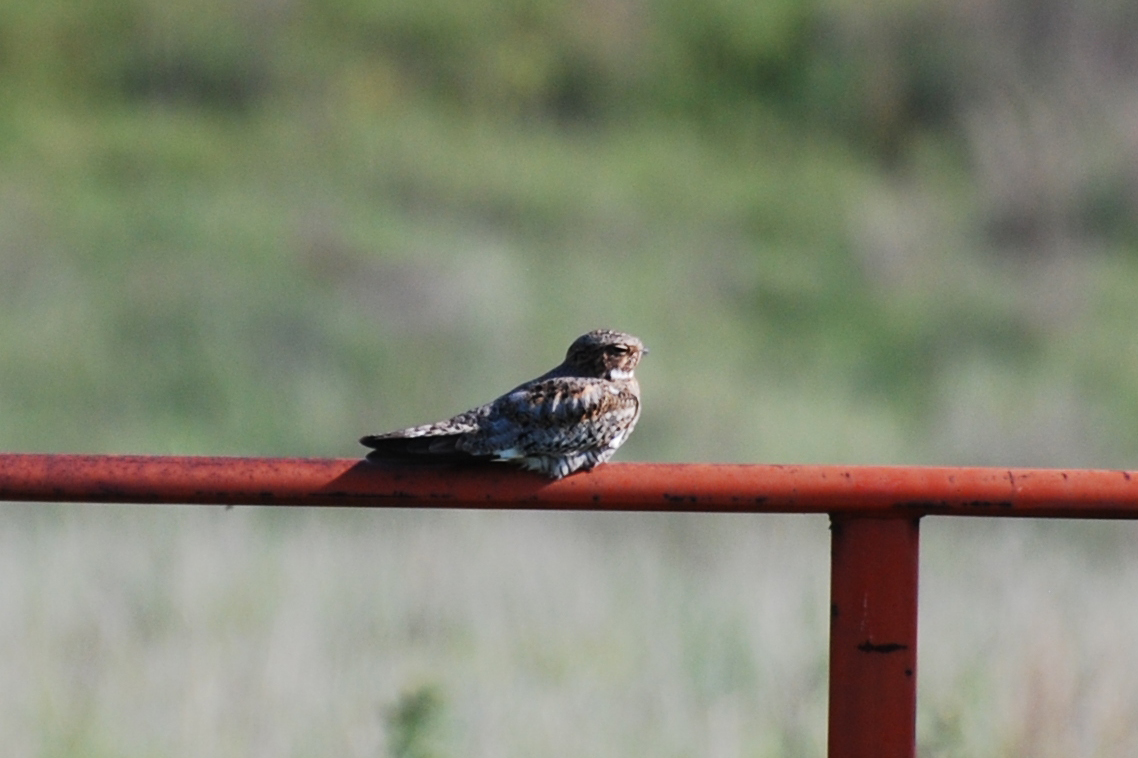
Photo by Jean Potter • A common nighthawk rests on a metal railing.

Common nighthawk
This insect-eating bird is a member of the nightjar family, which includes such familiar nocturnal serenaders as chuck-will’s widow and whip-poor-will.

The name common nighthawk is a misnomer. The species is not strictly nocturnal and it is certainly not a hawk. The nighthawk doesn’t offer a serenade like whip-poor-wills, but it does produce a “pent” call that sounds much like an electric buzzer. It’s often the first indication of one of these birds swooping overhead.

Nighthawks form impressive flocks, often numbering in the dozens or even hundreds. They are often active in evening hours, but I’ve seen large flocks of these migrating birds in mid-afternoon. August and September are the best time to look skyward to enjoy the spectacle of a large flock of swooping nighthawks as they pass overhead.

Swallow-tailed Kite
This is not exactly a common summer bird, but like the wandering wading birds, late summer is a likely time to catch a glimpse of this aerodynamic, unmistakable raptor. Several years ago I got the thrill of adding a swallow-tailed kite to my life list in some agricultural fields in southwestern Washington County. I’ve also seen swallow-tailed kites in Florida. I also observed my first-ever Mississippi kite in Elizabethon in 2020 during a Spring Bird Count.

The swallow-tailed kite is a large, streamlined raptor with long, narrow, pointed wings, slender bodies and a long, deeply forked tail that gives the bird its common name. The small, sharply hooked beak is used to catch insect prey, as well as amphibians, snakes and bats.

Bryan Stevens • A male American goldfinch looks its best in spring and summer. By fall, the bright colors are replaced with the drab winter plumage.

American goldfinch
Goldfinch males still look sharp in late summer, but they do start losing that bold pattern of black and white against a backdrop of golden-yellow feathers. These birds also form fussy but sociable flocks that congregate at bird feeders or bird baths in many a backyard.

A sighting of a goldfinch can be memorable. I still retain vivid imagery of these birds from childhood, long before I could identify them by name. They would always appear in late summer, perching atop the three blue spruces in our yard. The trees are no longer standing, but the memories of those colorful yellow and black birds endure.

Summer is the season of plenty for American goldfinches. Roadside ditches are choked with chicory, evening primrose and other seed-producing plants often dismissed as “weeds.” Simply driving local roads can, and often does, produce sightings of flocks of American goldfinches as they forage for seeds. These small songbirds will readily visit feeders for sunflower and thistle seeds.

•••

Bryan Stevens has written about birds, birders and birding since 1995. Email him with questions, comments or sightings at ahoodedwarbler@aol.com.
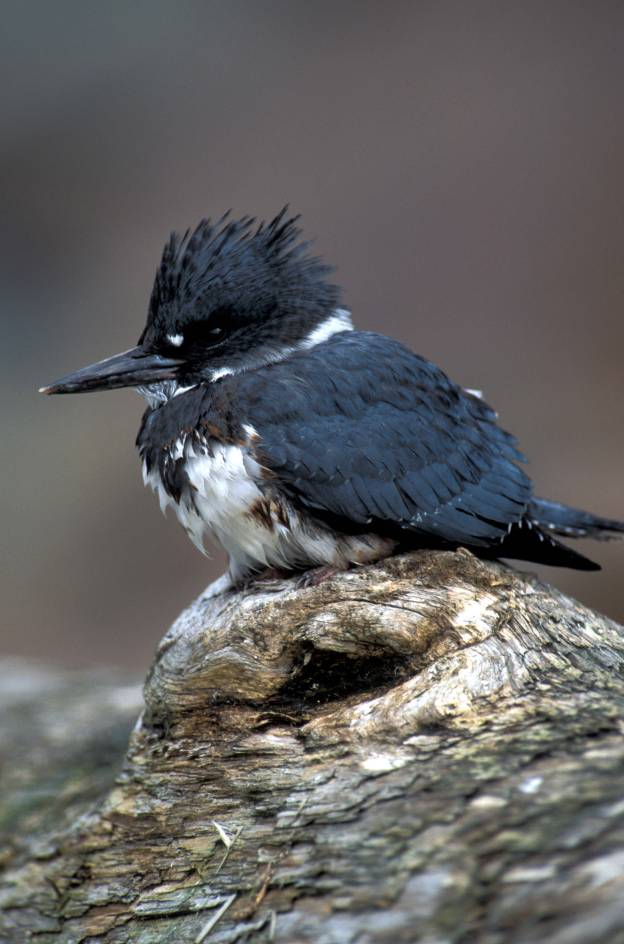
Photo by Bryan Stevens • A great egret resting on a spit of land in a lake at Murphy Candler Park in Brookhaven, Ga.

Belted kingfisher is a member of an interesting family of birds

Photo by Pexels/Pixabay A common kingfisher, also known as river kingfisher, perches near a water source. The common kingfisher ranges widely across Europe, Asia and North Africa.

Fishing is a favorite pastime for many people, who like nothing better than to spend a lazy summer afternoon trying their luck at their favorite fishing spot. Some of our feathered friends are skilled anglers.

The belted kingfisher’s nature as an angler rules out this bird ever visiting feeders in the backyard, but that doesn’t mean you’re unlikely to see this bird. For most of June and now July a belted kingfisher has been lurking around the creek and pond at my home.  With a little strategic effort, an observation of a belted kingfisher is fairly easy to obtain, especially during the summer months. If you live near a stream, pond, river or other body of water, you have probably been fortunate enough to observe a belted kingfisher as it goes about its daily routine.

If you are a fishing enthusiast yourself, you’ve likely shared some favorite fishing holes with this bird. The belted kingfisher is patient in its pursuit of fish. The birds prefer to perch on an exposed branch or a wire that overlooks a body of water that offers ample fishing opportunities. The belted kingfisher, however, is capable of hovering in place in order to spot and then capture its prey in an impressive plunge and lunge into the water.

Most of my observations of hunting kingfishers have involved the birds in their ambush approach to fishing — perching and diving on the unsuspecting fish. I have on a few occasions, however, also observed kingfishers as they hover over the water in a quest for a meal.

The belted kingfisher, like most of its kin, looks to have a head and bill that are slightly too large for the rest of the body. It’s the long, heavy bill that the kingfishers uses to snatch fish from their watery homes.

Photo by Bryan Stevens • A belted kingfisher perches on a branch along the Erwin Linear Trail.

Speaking of kin, the belted kingfisher is only one of 114 species found worldwide. Worldwide, these amazing birds range in size from the 16-inch-long laughing kookaburra of Australia to the tiny African dwarf kingfisher, which at four inches in length is smaller than most sparrows. This family of birds is divided into three groupings, the river kingfishers, the tree kingfishers and the water kingfishers. Kingfishers are a cosmopolitan family of birds with species present on every continent except Antarctica.

Despite the name “kingfisher,” not all kingfishers exist on a diet of fish. Some members of the kingfisher family instead prey on other quarry, such as snakes, lizards and insects.

Some interesting common names have been used to identify the world’s kingfishers, including half-collared kingfisher, shining blue kingfisher, blue-eared kingfisher, azure kingfisher, indigo-banded kingfisher, silvery kingfisher, malachite kingfisher, white-bellied kingfisher, cerulean kingfisher, rufous-backed kingfisher, spangled kookaburra, rufous-bellied kookaburra, shovel-billed kookaburra, lilac kingfisher, brown-winged kingfisher, stork-billed kingfisher, great-billed kingfisher, striped kingfisher, lazuli kingfisher, ultramarine kingfisher, cinnamon-banded kingfisher, sacred kingfisher, mewing kingfisher, chattering kingfisher, glittering kingfisher, red-breasted paradise kingfisher, pied kingfisher and green-and-rufous kingfisher.

The three North American kingfishers, however, are exclusively fish-eaters. The belted kingfisher, with a range that spans most of the United States, is the only kingfisher encountered by most Americans. Two others, the ringed kingfisher and the green kingfisher, are found in Texas and occasionally in other locations near the Mexican border.

In her book “The Folklore of Birds,” Laura C. Martin writes that in some accounts the kingfisher, not the dove, was the second bird Noah released from the ark after the Biblical flood. Instead of looking for land, the kingfisher flew too high and the sun scorched the bird’s feathers. After his setback with the raven and now the kingfisher, Noah made the kingfisher remain on the ark’s deck to catch its food from the water.

Halcyon days, a term meaning a period of peaceful quiet, is derived from Greek legend. According to the legend, the god Zeus restrained the storms during the period when the kingfishers nest. The scientific name for the belted kingfisher is Megaceryle alcyon, a variation on the term “halcyon.”

Again in Martin’s book, there is an account of a Cherokee legend about how the kingfisher acquired its angling lifestyle. The poor bird wanted to be a waterbird, but lacked the equipment to make a living at fishing. The other animals convened a council and, in pity for the kingfisher’s plight, endowed the bird with its spear-like bill. Since that time, the bird has been known as “king of the fishers.”

The “king of the fishers” is indeed to be envied by human anglers. Although not successful in every attempt, the belted kingfisher is certainly exceptional in its pursuit of fish. According to John Eastman in his book, “Birds of Lake, Pond and Marsh,” the belted kingfisher typically captures about 10 fish per day. Some human anglers would envy a success rate like that.

To observe this bird for yourself, stake out a pond or section of river -— the linear trail in Erwin and the pond at Fishery Park are good locations. In my experience, however, the belted kingfisher is somewhat wary of humans, so observe from a respectful distance or you’re likely to scare off the bird, which will depart giving its rattling call that sounds so much like a sound of pure annoyance.

Belted kingfisher and its kin successful at fishing, much more

Photo by Public Domain Photos/Pixabay.com • A female belted kingfisher returns to a perch after a successful catch.

A belted kingfisher has visited the fish pond quite frequently throughout this summer. The bird’s arrival is usually heralded by its hoarse, rattling call. The bird is rather shy, so any observation usually has to be done with some degree of stealth.

Belted kingfisher

I know fishing is a favorite pastime for many people. In these times of social distancing, there’s probably nothing better for some people to do than to spend a lazy summer afternoon baiting a hook and trying their luck at their favorite fishing spot. While doing so, they have probably encountered the angling counterpart among our feathered friends. The belted kingfisher’s nature as an angler rules out this bird visiting feeders in the backyard, but that doesn’t mean one is unlikely to see this bird. With a little strategic effort, a glimpse of a belted kingfisher is fairly easy to obtain, especially during the summer months. Any stream, pond, river or other body of water increases the chances of observing this fascinating bird.

The belted kingfisher prefers to perch on an exposed branch or a wire that overlooks a body of water that offers ample fishing opportunities. The belted kingfisher, however, is capable of hovering in place in order to spot and then capture its prey in an impressive plunge and lunge into the water.

Most of my observations of hunting kingfishers have involved the birds in their ambush approach to fishing — perching and diving on the unsuspecting fish. I have on a few occasions also observed kingfishers as they hover over the water in a quest for a meal.

The belted kingfisher, like most of its kin, looks to have a head and bill that are slightly too large for the rest of the body. It’s the long, heavy bill that the belted kingfisher uses to snatch fish from their watery homes.

The term “belted” refers to bands of feathers across the bird’s belly. Female belted kingfishers sport bands of rusty-red and blue feathers, while males are limited to a blue belt across the upper breast. Female belted kingfishers are an exception to the rule that most male birds are more vividly colored than their female companions.

A walnut tree with some dead branches overlooking my family’s fish pond is a favorite perching site for visiting belted kingfishers. A few become become regular visitors almost every spring and summer. In past years, I’ve been delighted by pairs of kingfishers that have brought as many as six of their offspring to hunt around the edges of the pond and creek near my home.

When a belted kingfisher does manage to capture a fish — not always a certainty, despite their great skill — the bird will usually fly to a perch where they will beat the fish unconscious before swallowing it. I remember one particular kingfisher that liked to catch fish in the creek and then fly to the corner of the metal garage roof where the bird proceeded to beat senseless the unlucky fish.

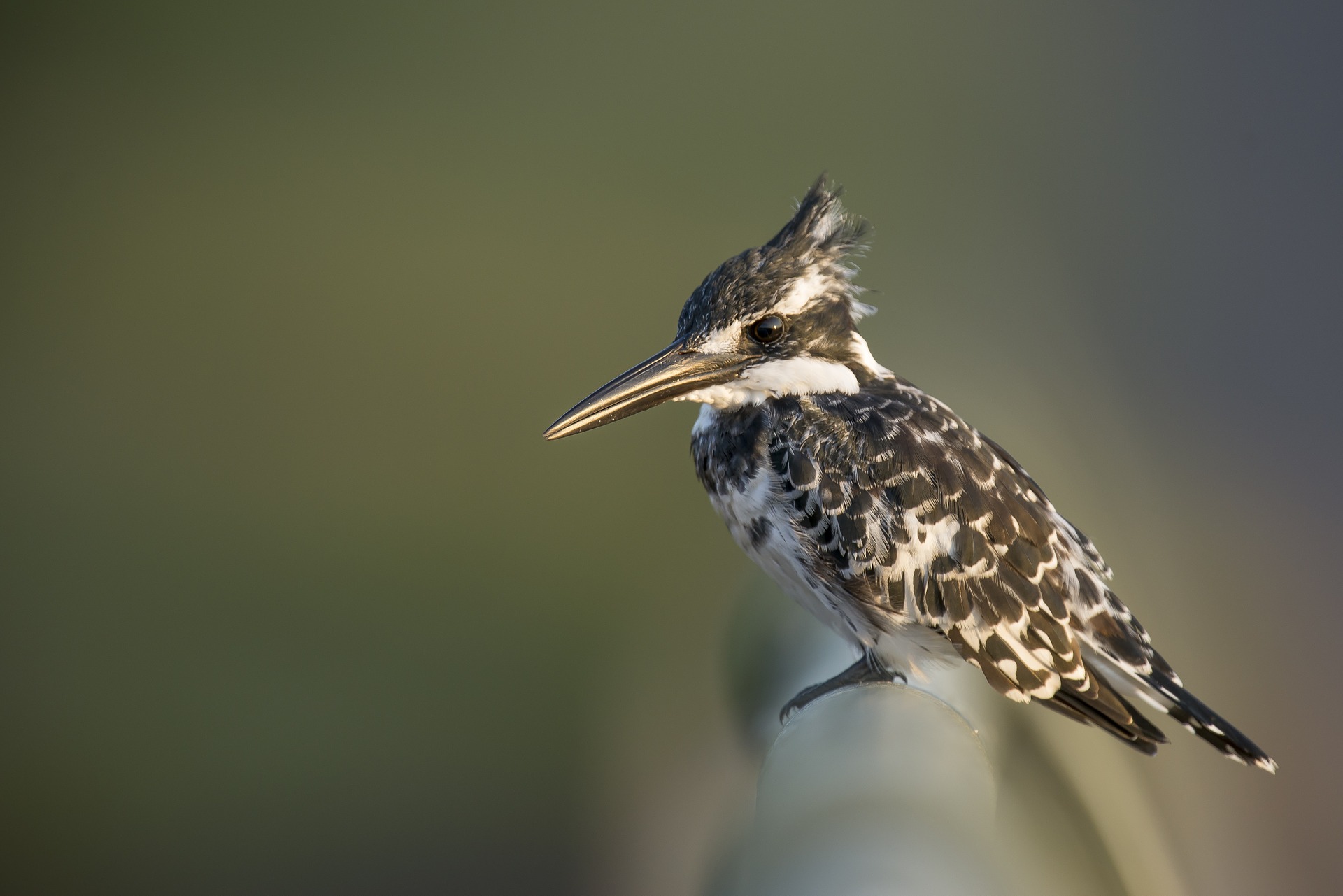
Photo by Pixabay.com • The pied kingfisher is a common member of the kingfisher family that ranges throughout Europe.

While the belted kingfisher is the only one of its kind in the eastern United States, the kingfishers are a large family of birds found around the globe. Worldwide, there are about 90 species of kingfishers that range in size from the 16-inch-long laughing kookaburra of Australia to the tiny African dwarf kingfisher, which at four inches in length is smaller than most sparrows. This family of birds is divided into three groupings: the river kingfishers, the tree kingfishers and the water kingfishers.

Despite the name “kingfisher,” not all kingfishers exist on a diet of fish. Some members of the kingfisher family instead prey on other quarry, such as snakes, lizards and insects.

Some of the varied names for members of this far-flung family of birds include moustached kingfisher, malachite kingfisher, shining-blue kingfisher, azure kingfisher, hook-billed kingfisher, little kingfisher, banded kingfisher, red-breasted paradise kingfisher, lilac kingfisher, glittering kingfisher, great-billed kingfisher, chocolate-backed kingfisher, ultramarine kingfisher, chattering kingfisher and yellow-billed kingfisher.

Photo by WelshPixie/Pixabay.com • The malachite kingfisher is a river kingfisher widely distributed in Africa south of the Sahara.

The family also consists of a group of related birds from Australia and New Guinea known as kookaburras, which includes blue-winged kookaburra, spangled kookaburra, rufous-bellied kookaburra, and the well-known laughing kookaburra. Hollywood often dubs the raucous calls of kookaburras into the background soundscapes of movies and shows with tropical themes.

Photo by Magee/Pixabay.com • The raucous calls of the kookaburra, an Australian kingfisher, are often incorporated into the background of jungle scenes in Hollywood movies.

There’s nothing quite so disappointing as coming home empty-handed after a day of fishing. Belted kingfishers rarely suffer that disappointment. Although not successful in every attempt, the belted kingfisher is certainly exceptional in its pursuit of fish. According to John Eastman in his book, “Birds of Lake, Pond and Marsh,” the belted kingfisher typically captures about 10 fish per day. That’s a feat that many human anglers might envy.


Kingfishers are world-class anglers

1622507_10202822806683633_5738404313137626778_o

Photo by Bryan Stevens                                                                                                       A perched Belted Kingfisher rests between attempts to catch fish along the waterfront at Winged Deer Park in Johnson City.

Fishing is a favorite pastime for many people, who like nothing better than to spend a lazy summer afternoon trying their luck at their favorite fishing spot.

There’s also an angling counterpart among our feathered friends. The Belted Kingfisher’s nature as an angler rules out this bird visiting feeders in the backyard, but that doesn’t mean you’re unlikely to see this bird. With a little strategic effort, an observation of a Belted Kingfisher is fairly easy to obtain, especially during the summer months. If you live near a stream, pond, river or other body of water, you have probably been fortunate enough to observe a Belted Kingfisher as it completes its daily routine.

If you are a fishing enthusiast yourself, you’ve likely shared some favorite fishing holes with this bird. The Belted Kingfisher is patient in its pursuit of fish. The birds prefer to perch on an exposed branch or a wire that overlooks a body of water that offers ample fishing opportunities. The Belted Kingfisher, however, is capable of hovering in place in order to spot and then capture its prey in an impressive plunge and lunge into the water.

Most of my observations of hunting kingfishers have involved the birds in their ambush approach to fishing — perching and diving on the unsuspecting fish. I have on a few occasions, however, also observed kingfishers as they hover over the water in a quest for a meal.

The Belted Kingfisher, like most of its kin, looks to have a head and bill that are slightly too large for the rest of the body. It’s the long, heavy bill that the Belted Kingfisher uses to snatch fish from their watery homes.

A walnut tree with some dead branches overlooking my family’s fish pond is a favorite perching site for visiting Belted Kingfishers. A few Belted Kingfishers become regular visitors almost every spring and summer. In past years, I’ve been delighted by pairs of kingfishers that have brought as many as six of their offspring to hunt around the edges of the pond and creek near my home.

When a Belted Kingfisher does manage to capture a fish — not always a certainty, despite their great skill — the bird will usually fly to a perch where they will beat the fish unconscious before swallowing it. I remember one particular kingfisher that liked to catch fish in the creek and then fly to the corner of the metal garage roof where the bird proceeded to beat senseless the unlucky fish.

Worldwide, there are about 90 species of kingfishers that range in size from the 16-inch-long Laughing Kookaburra of Australia to the tiny African Dwarf Kingfisher, which at four inches in length is smaller than most sparrows. This family of birds is divided into three groupings, the river kingfishers, the tree kingfishers and the water kingfishers.

Despite the name “kingfisher,” not all kingfishers exist on a diet of fish. Some members of the kingfisher family instead prey on other quarry, such as snakes, lizards and insects.

Some interesting common names have been used to identify the world’s kingfishers, including Half-collared Kingfisher, Shining Blue Kingfisher, Blue-eared Kingfisher, Azure Kingfisher, Indigo-banded Kingfisher, Silvery Kingfisher, Malachite Kingfisher, White-bellied Kingfisher, Cerulean Kingfisher, Rufous-backed Kingfisher, Spangled Kookaburra, Rufous-bellied Kookaburra, Shovel-billed Kookaburra, Lilac Kingfisher, Brown-winged Kingfisher, Stork-billed Kingfisher, Great-billed Kingfisher, Striped Kingfisher, Lazuli Kingfisher, Ultramarine Kingfisher, Cinnamon-banded Kingfisher, Sacred Kingfisher, Mewing Kingfisher, Chattering Kingfisher, Glittering Kingfisher, Red-breasted Paradise Kingfisher, Pied Kingfisher and Green-and-rufous Kingfisher.

Kingfishers comprise a cosmopolitan family of birds with species present on every continent except Antarctica.

kingfisher

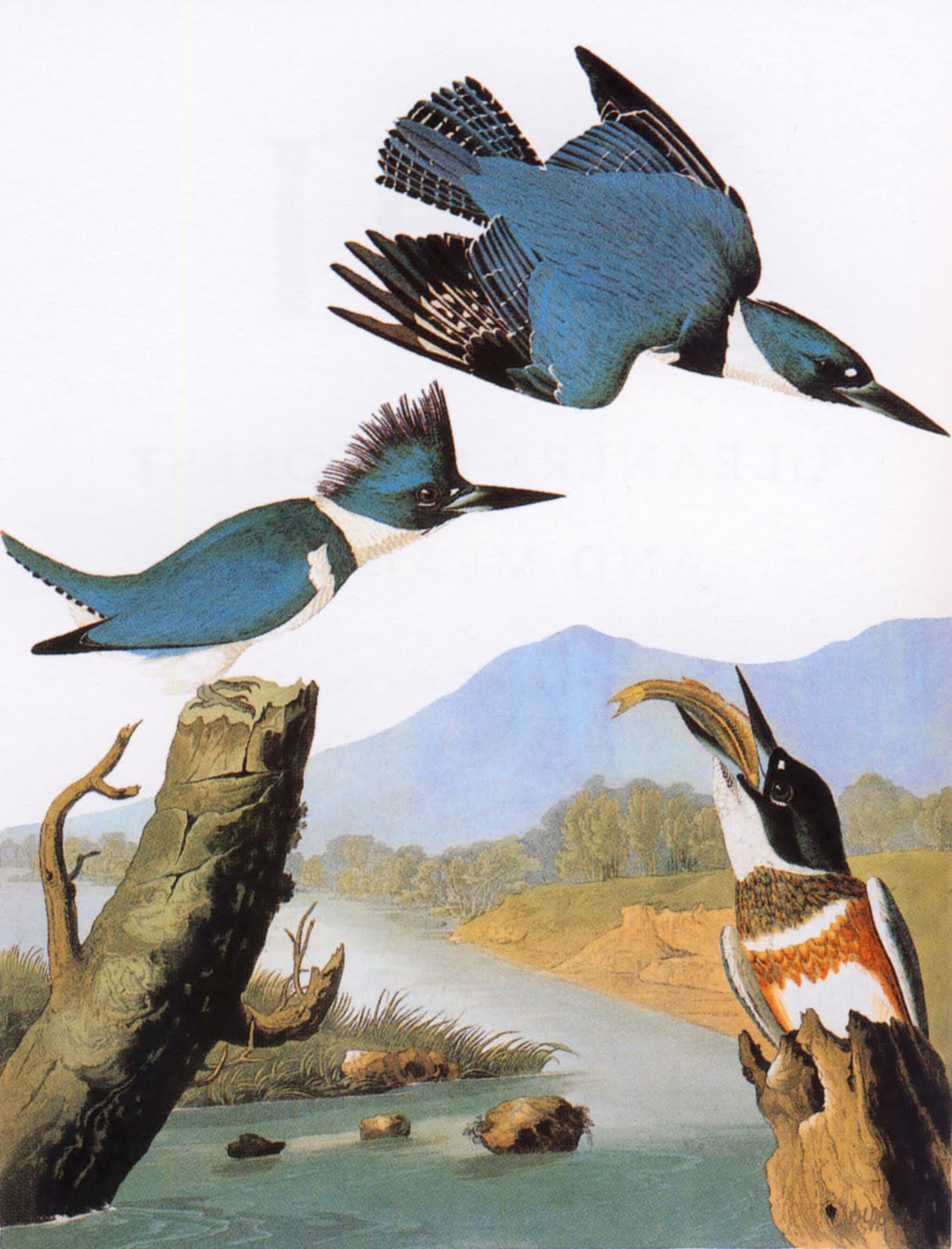
A depiction of Belted KingfisherS painted by John James Audubon.

The three North American kingfishers, however, are exclusively fish-eaters. The Belted Kingfisher, with a range that spans most of the United States, is the only kingfisher encountered by most Americans.

Two others, the Ringed Kingfisher and the Green Kingfisher, are found in Texas and occasionally in other locations near the Mexican border. The Ringed Kingfisher is similar in appearance to the Belted Kingfisher, but is somewhat larger with a rufous-colored belly. The little Green Kingfisher, not quite nine inches long, has the typical kingfisher appearance, but is green rather than blue on its upperparts.

With the Belted Kingfisher, only the female sports a ring of rufous coloration across her breast. She is an exception to the rule that most male birds are more vividly colored than their female companions.

In her book The Folklore of Birds, Laura C. Martin writes that in some accounts the kingfisher, not the dove, was the second bird Noah released from the ark after the Biblical flood. Instead of looking for land, the kingfisher flew too high and the sun scorched the bird’s feathers. After his setback with the raven and now the kingfisher, Noah made the kingfisher remain on the ark’s deck to catch its food from the water.

Halcyon days, a term meaning a period of peaceful quiet, is derived from Greek legend. According to the legend, the god Zeus restrained the storms during the period when the kingfishers nest. The scientific name for the Belted Kingfisher is Megaceryle alcyon, a variation on the term “halcyon.”

2782284667_afa8c0651e_o

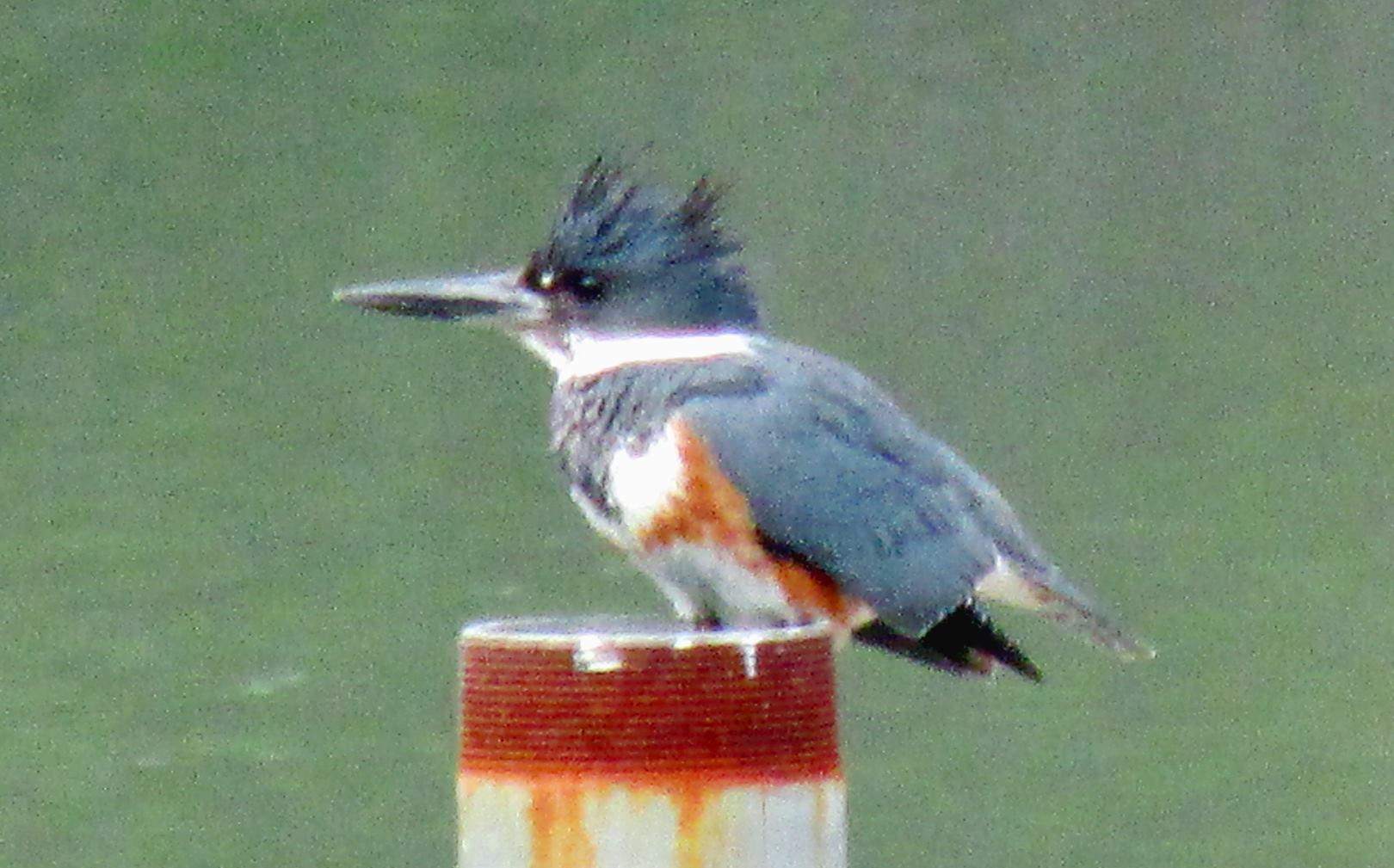
Photo Courtesy of Jean Potter                                                                                                          Belted Kingfisher sits on a wire to scan for fish.

Belted Kingfishers nest by excavating a cavity in a dirt bank, usually near water. The tunnel slopes upward from the entrance, and may extend as far as eight feet into the bank.

Again in Martin’s book, there is an account of a Cherokee legend about how the kingfisher acquired its angling lifestyle. The poor bird wanted to be a waterbird, but lacked the equipment to make a living at fishing. The other animals convened a council and, in pity for the kingfisher’s plight, endowed the bird with its spear-like bill. Since that time, the bird has been known as “king of the fishers.”

The “king of the fishers” is indeed to be envied by human anglers. Although not successful in every attempt, the Belted Kingfisher is certainly exceptional in its pursuit of fish. According to John Eastman in his book, Birds of Lake, Pond and Marsh, the Belted Kingfisher typically captures about 10 fish per day.

If you want to observe this bird for yourself, stake out a pond or section of river. You’re not likely to have to wait for long before you are rewarded with an observation. In my experience, however, the Belted Kingfisher is somewhat shy and wary of humans, so observe from a respectful distance or you’re likely to scare off the bird, which will depart giving its rattling call that sounds so much like the sound of annoyance on its part.