Tag Archives: Summer 2026

33rd Carter County Summer Bird Count tallies 119 species

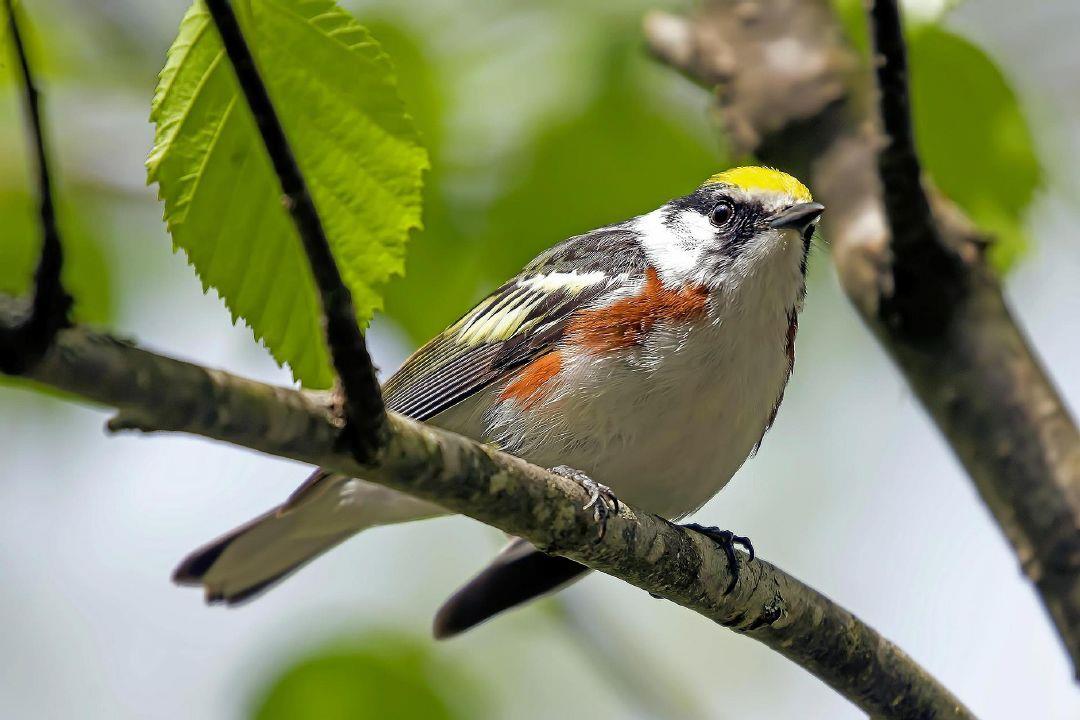
Hans Toom/Pixabay • A male chestnut-sided warbler peeks from the foliage of a tree., A total of 31 chestnut-sided warblers were found by counters during the 2026 Carter County Summer Bird Count.

Members and friends of the Elizabethton Bird Club conducted the 33rd Carter County Summer Count on Saturday, June 6, with 21 observers. Participants tallied 119 species, which is slightly above the average of 114.

According to count compiler Rick Knight, the all-time high of 123 species was achieved in 2017. Some of the more abundant birds on this year’s count included European starling with 900 individuals counted, and American robin with 343 individuals found. A total of 21 different species of warblers were found.

I counted in Elizabethton along the Watauga River along with Chris Soto and Rex Whitfield and Rob Armistead. Our group also consisted of Jean and Brookie Potter, who covered Wilbur Lake; and Connie and Dave Irick, who made their survey on Holston Mountain. We also had a single feeder watcher, Dianna Lynne of Stoney Creek.

The list:
Canada goose, 181; wood duck, 21; mallard, 60; and common merganser, 18

Wild turkey, 20; ruffed grouse, 3; mourning dove, 107; rock pigeon, 22; yellow-billed cuckoo, 1; common nighthawk, 15; chuck-will’s-widow, 2; Eastern whip-poor-will, 12; chimney swift, 76; and ruby-throated hummingbird, 16
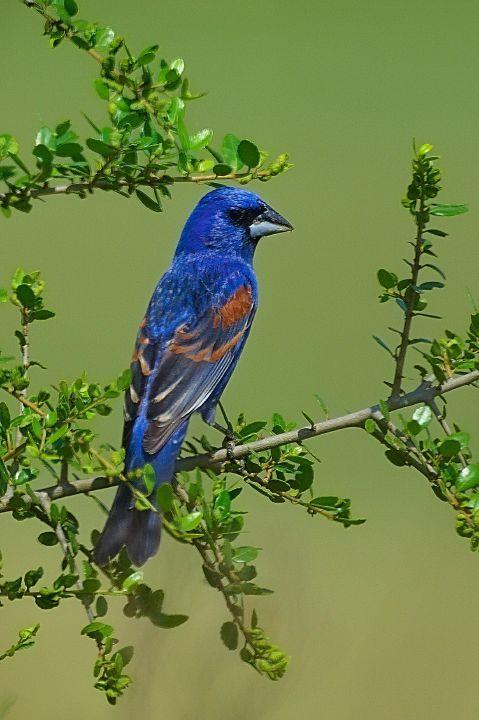
Lynn Wilson/Pixabay • A male blue grosbeak perches in the branches of a shrub. Five of these birds were found on the Carter County Summer Bird Count.

Killdeer, 3; double-crested cormorant, 29; green heron, 3; great blue heron, 29; black vulture, 11; turkey vulture, 70; osprey, 2; sharp-shinned hawk, 1; Cooper’s hawk, 1; red-shouldered hawk, 4; broad-winged hawk, 8; and red-tailed hawk, 8

Eastern screech owl, 2; barred owl, 1; belted kingfisher, 4; red-bellied woodpecker, 22; yellow-bellied sapsucker, 1; downy woodpecker, 29; hairy woodpecker, 7; Northern flicker, 17; and pileated woodpecker, 16

American kestrel, 1; great crested flycatcher, 5; Eastern kingbird, 21; Eastern wood-pewee, 50; Acadian flycatcher, 45; alder flycatcher, 1; least flycatcher, 12; and Eastern phoebe, 70

White-eyed vireo, 6; blue-headed vireo, 53; warbling vireo, 6; red-eyed vireo, 183; blue jay, 117; American crow, 255; fish crow, 5; and common raven, 10

Carolina chickadee, 83; tufted titmouse, 74; tree swallow, 67; Northern rough-winged swallow, 44; purple martin, 18; barn swallow, 75; and cliff swallow, 288

Golden-crowned kinglet, 3; cedar waxwing, 20; red-breasted nuthatch, 5; white-breasted nuthatch, 24; brown creeper, 5; blue-gray gnatcatcher, 30; Carolina wren, 125; house wren, 31; and winter wren, 5

Gray catbird, 37; brown thrasher, 32; Northern mockingbird, 87; European starling, 900; Eastern bluebird, 84; veery, 14; hermit thrush, 1; wood thrush, 84; and American robin, 343

House sparrow, 36; house finch, 152; red crossbill, 1; American goldfinch, 141; grasshopper sparrow, 1; chipping sparrow, 80; field sparrow, 40; dark-eyed junco, 61; song sparrow, 210; Eastern towhee, 108; and yellow-breasted chat, 1

Eastern meadowlark, 17; orchard oriole, 7; Baltimore oriole, 3; red-winged blackbird, 107; brown-headed cowbird, 51; and common grackle, 75

Ovenbird, 86; worm-eating warbler 17; Louisiana waterthrush, 10; golden-winged warbler 5; black and white warbler, 40; Swainson’s warbler, 12; common yellowthroat, 26; hooded warbler, 140; American redstart, 26; Northern parula, 58; magnolia warbler, 1; Blackburnian warbler, 5; yellow warbler, 13; chestnut-sided warbler, 31; black-throated blue warbler, 65; pine warbler, 6; yellow-rumped warbler, 5; yellow-throated warbler, 30; prairie warbler, 1; black-throated green warbler, 49; and Canada warbler, 6
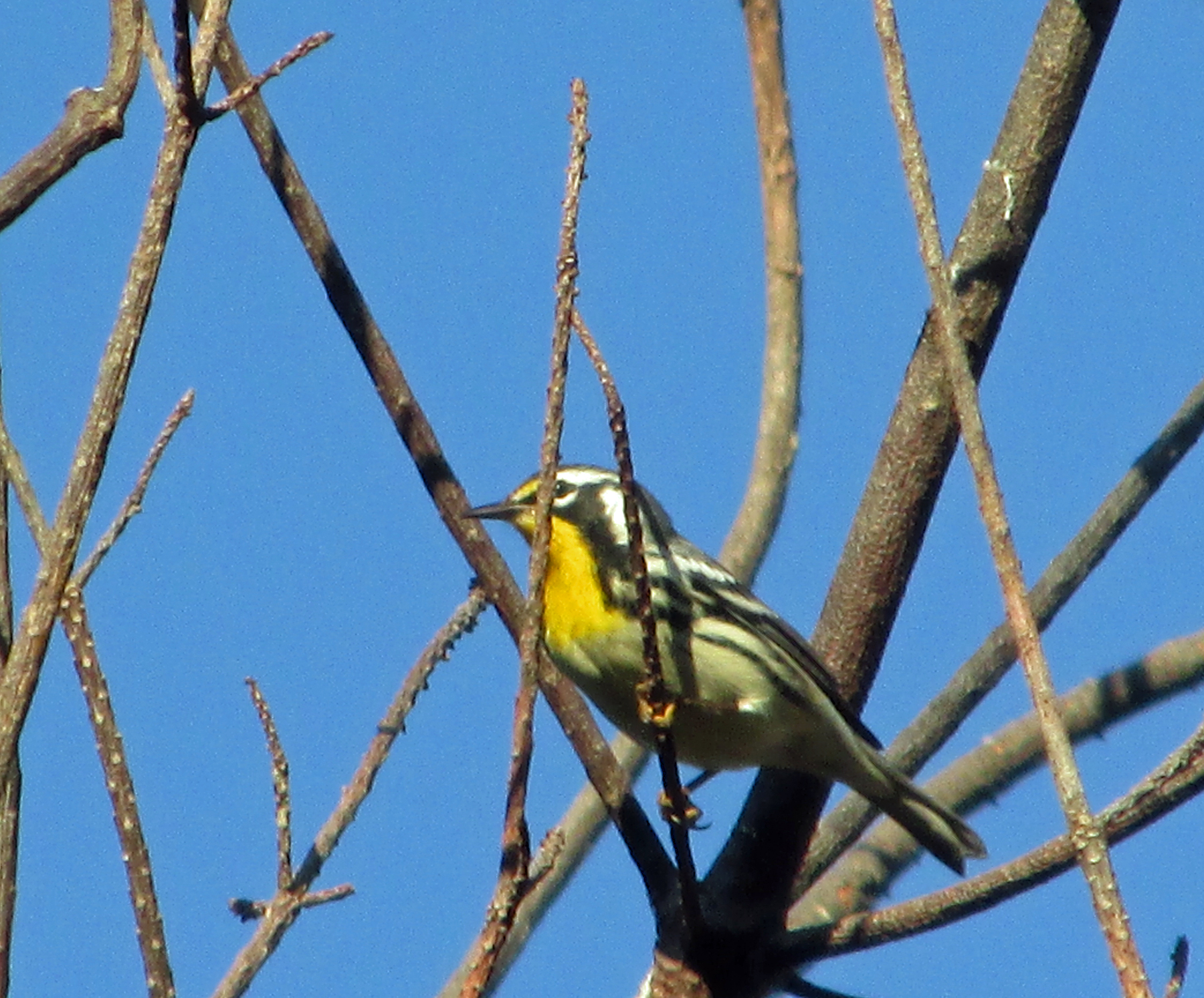
Photo by Bryan Stevens A Yellow-throated warbler perches in a cluster of dead branches.

Scarlet tanager, 45; Northern cardinal, 154; rose-breasted grosbeak, 12; blue grosbeak, 5; and indigo bunting, 144.

I’ll discuss the results of the Unicoi County Summer Bird Count, which was held June 13, in an upcoming column.

•••

To ask a question, make a comment or share a sighting, email me at ahoodedwarbler@aol.com.
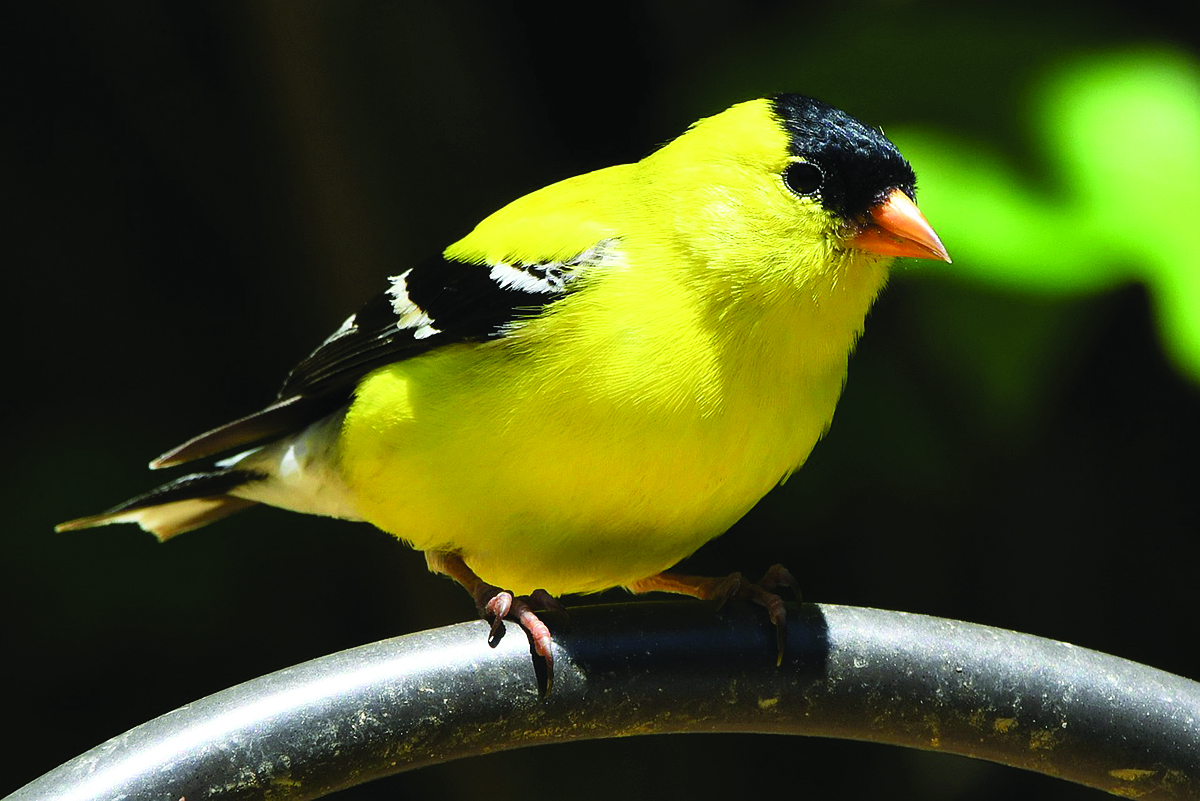
Miles Moody/Pixabay • A male American goldfinch looks his best during the spring and summer seasons.
Male indigo buntings dazzle in bright summer sunshine


Jim Hudgins/USFWSThe male indigo bunting in a quintessential bird of summer throughout the Eastern United States.

We’ve barely made it to mid-June and we’ve had some scorching days with intense sunshine and spiking temperatures.

It’s the kind of weather that wilts people, as well as many of our feathered friends, which would prefer to find shade when the mercury rises to the upper limits of the thermometer.

Not so for a few of our birds. Red-eyed vireos, Eastern wood-pewees and a handful of other birds sing even during the hottest hours of the day, albeit they’re often singing from deep shade.

An exception is the male indigo bunting, which can often be spotted singing from the top of a tall tree or shrub even under the brightest of summer sunshine.

Indigo Buntings thrive in the heat. While other birds go silent beneath the relentless summer sun, male Indigo Buntings perch on high, open branches or telephone wires. They belt out their lively songs to declare their presence to rival and establish territory.

The notes sound hopelessly jumbled upon first listen, but they eventually take shape into a recognizable pattern. These songbirds usually repeat their notes in pairs in a song that can be transcribed as “sweet-sweet, chew-chew, sweet-sweet.”

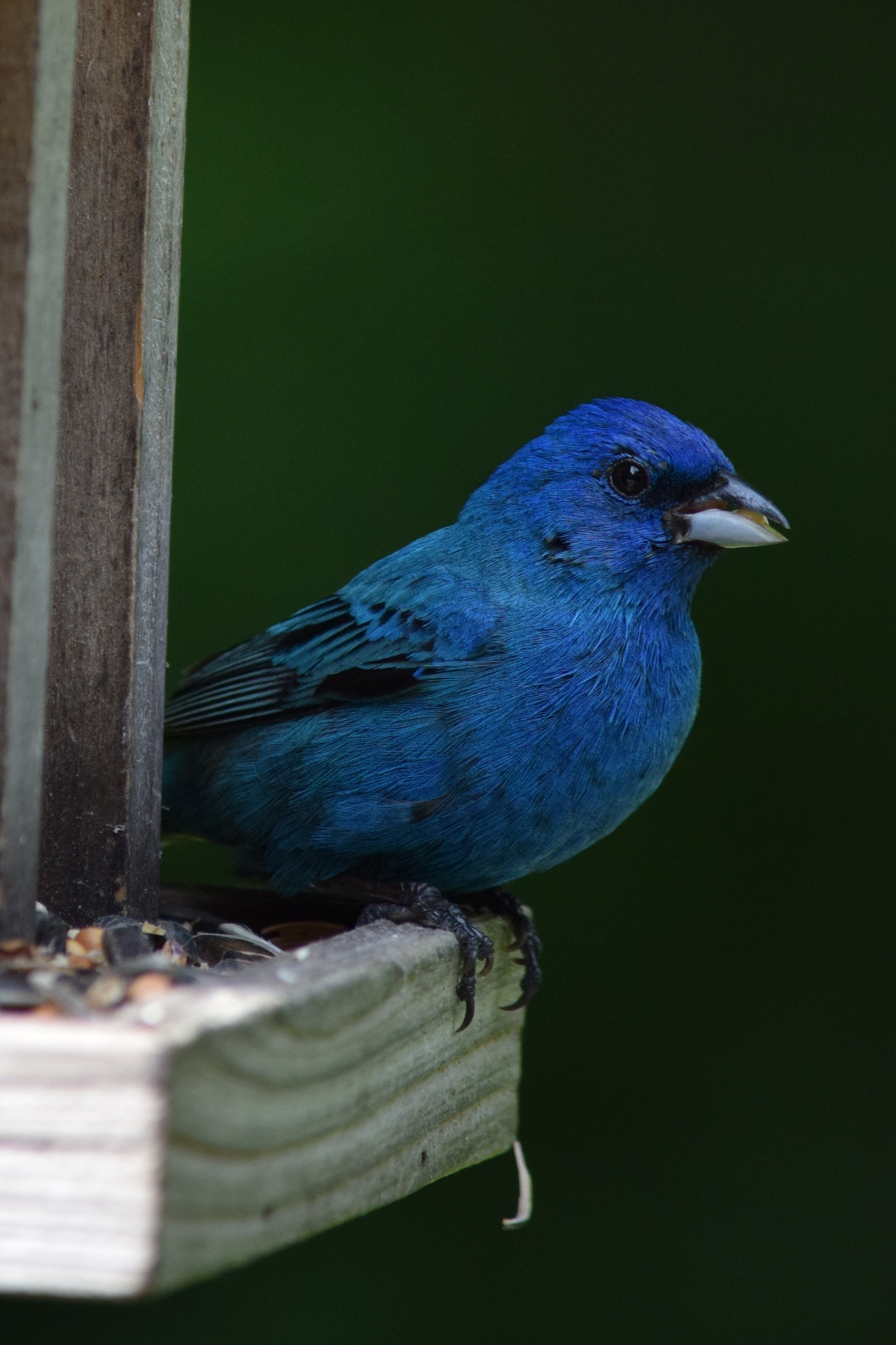
Heronworks/Pixabay • A male indigo bunting visits a feeder for a meal of bird seed.

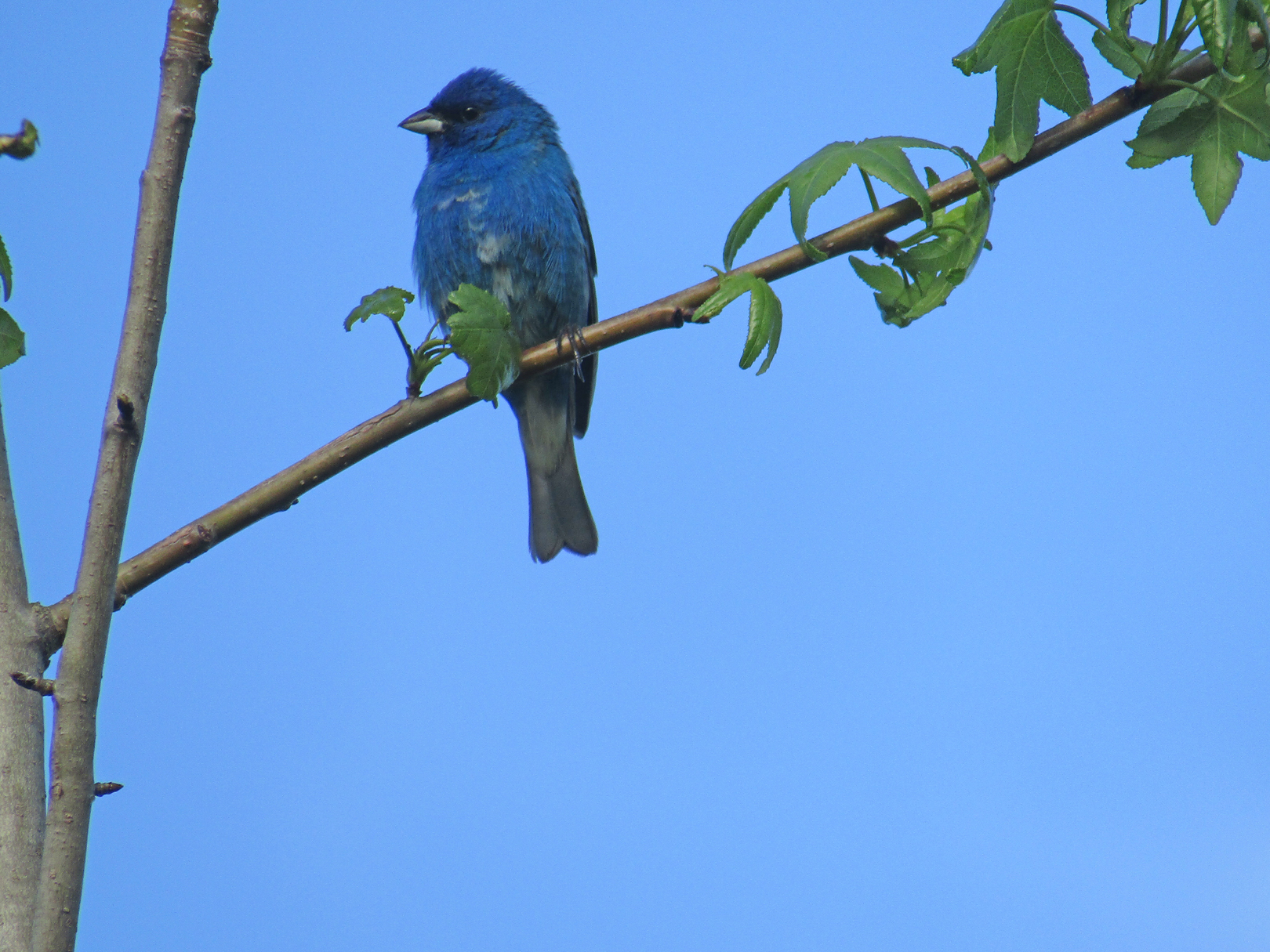
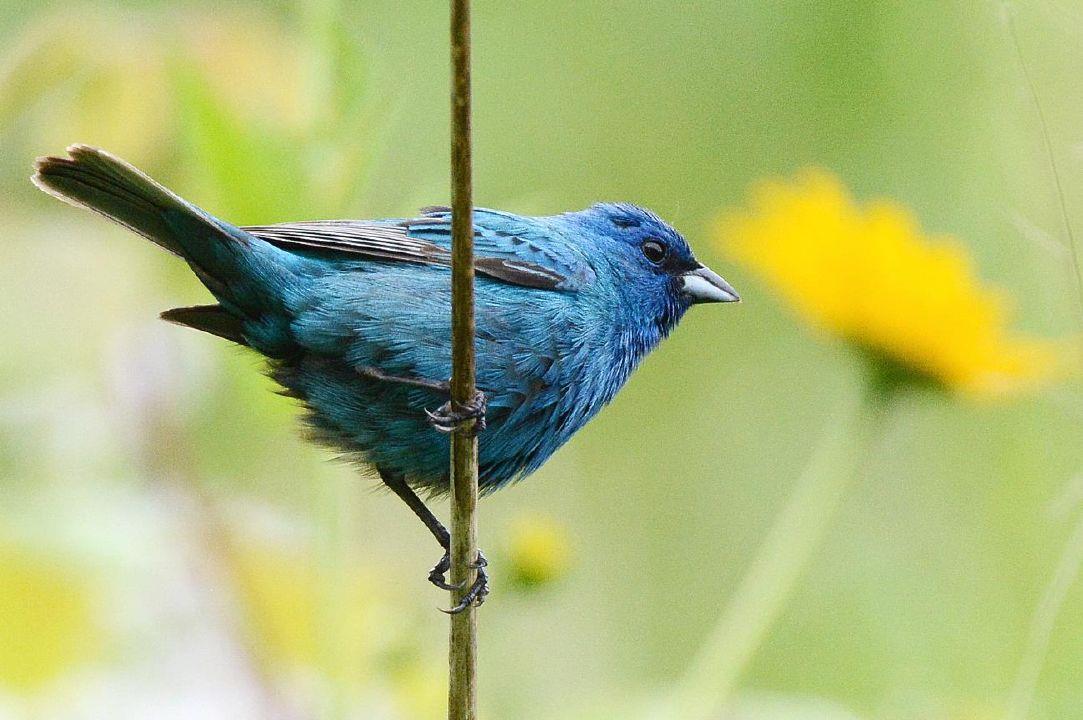
Males, which do the singing, have an appearance to match their loud songs. They are simply stunning in brilliant blue plumage. The male indigo bunting is the only solid blue bird in the eastern United States.

Alas, it’s all an illusion — literally a trick of the light. The indigo bunting’s feathers are not really blue; the male’s brilliant azure plumage is caused by the process of diffraction of light around the structure of the bird’s feathers. This process scatters all but the blue light, and the resulting color shifts from black to blue to turquoise as the angle of reflected light changes.

In bright light, this bird can even look unnaturally vivid blue. In poor light, however, an indigo bunting male can appear black. Fortunately, indigo buntings have both a characteristic body shape and song, so even if the birds are not seen in their best light, they can still be recognized.

For such a bright blue bird, indigo buntings are not always easy to detect. Males like elevated perches, often among a cluster of leaves. Learn the song — that burst of jumbled, high-pitched notes, and use that knowledge to help pinpoint singing males. Once you zero in on the singing bird’s location, it’s fairly easy to focus binoculars and enjoy peeking at such a pretty bird.

Like many species of songbirds, the male is by far the most colorful. In this instance, the male is also responsible for the species’ name. Indigo is a blue dye that was once an important crop in the South. The drab female may boast some blue highlights in her plumage. Juvenile birds just out of the nest also resemble the female. Pay close attention to any indigo buntings you observe as summer progresses. Juvenile birds will look mostly brown with just a hint of blue in the wings and the tail. These will be the young buntings that were hatched in spring and early summer. They will often accompany their parents to feeders.

Photo by Bryan Stevens • The male indigo bunting is a resplendent bird.

The indigo bunting’s scientific name is Passerina cyanea, referring the color cyan. Cyan is a bright, deep, sky blue, leaning very slightly to the greenish side of blue on the color wheel. Cyan is the blue ink in 4-color process printing. Along with magenta, yellow and black, these four colors of ink can produce a wide gamut of colors that we see every day in full-color printing. The indigo bunting is a reasonably close match to this intense blue ink color. The species belongs to a genus of birds known as Passerina, which is included the family Cardinalidae.

Although they are often lumped into a group known as North American buntings, they are not closely related to such birds as snow bunting and lark bunting. The other members of the Passerina genus include lazuli bunting, varied bunting, painted bunting, rose-bellied bunting, orange-breasted bunting and blue grosbeak.

Photo by Bryan Stevens • Male indigo buntings look their best in spring and summer. By fall, they are molting feathers and look less splendid.

Worldwide, other birds known as buntings include such descriptively named species as slaty bunting, corn bunting, white-capped bunting, gray-necked bunting, cinereous bunting, lark-like bunting, cinnamon-breasted bunting, chestnut-eared bunting, little bunting, yellow-throated bunting, golden-breasted bunting, black-headed bunting, red-headed bunting and yellow bunting.

For me, the indigo bunting has always been a bird of the summer season. One of my earliest memories of being aware of birds relates to seeing this astonishing all-blue bird perched atop a blue spruce in my family’s front yard.

Indigo buntings linger into early October in the region, but later in the season these birds begin to molt feathers and take on a more shabby look. Enjoy them while they’re here and at their best under a bright summer sun.

•••

To ask a question, make a comment or share a sighting, email me at ahoodedwarbler@aol.com.