
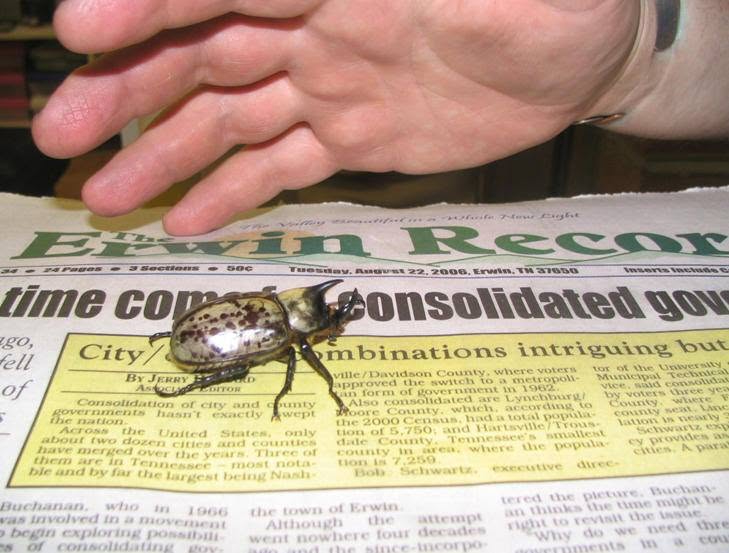
Bryan Stevens • This Eastern Hercules Beetle, observed and photographed 20 years ago, was photographed with a hand and a newspaper for a size comparison.
I’m continuing to celebrate my 30th year of bringing readers stories about things with wings. Usually the subjects of these columns have feathers, but that’s not always the case.
I’ve written about everything from minks and otters to butterflies and beetles.
As way of introduction of a rerun of a column from 2006, I saw my first Eastern Hercules Beetle in Erwin 20 years ago this month. Now, after a rather long gap, I’ve observed another, once again in Erwin and not far from the location where I saw the first one.
In fact, I found this one just outside The Erwin Record office on Gay Street. Unfortunately, this specimen was dead. The one in 2006 had been very much alive.
There are some other coincidences readers may notice as they read the column I wrote after my first sighting. The column ran in The Erwin Record on Sept. 12, 2006.
•••
Although my friend’s tone of voice sounded somewhat horrified, I felt only fascinated as I turned to look at the focus of his trepidation.
I had failed to notice the large beetle clinging to the brick wall at Erwin’s Flick Video. The creature, undeniably bizarre in appearance and rather sizable for a bug, kept me spellbound for a moment.
Fortunate to have my digital camera with me, I snapped numerous photographs of this large insect, fascinated by its size and appearance.
I made a quick identification of the insect as a “Rhinoceros beetle,” which turned out to be only partially correct. In fact, the insect belonged to an extensive family of beetle that does include various species of rhinoceros beetle, as well as the scarab beetles, which derive their fame from depictions in the art of ancient Egypt.
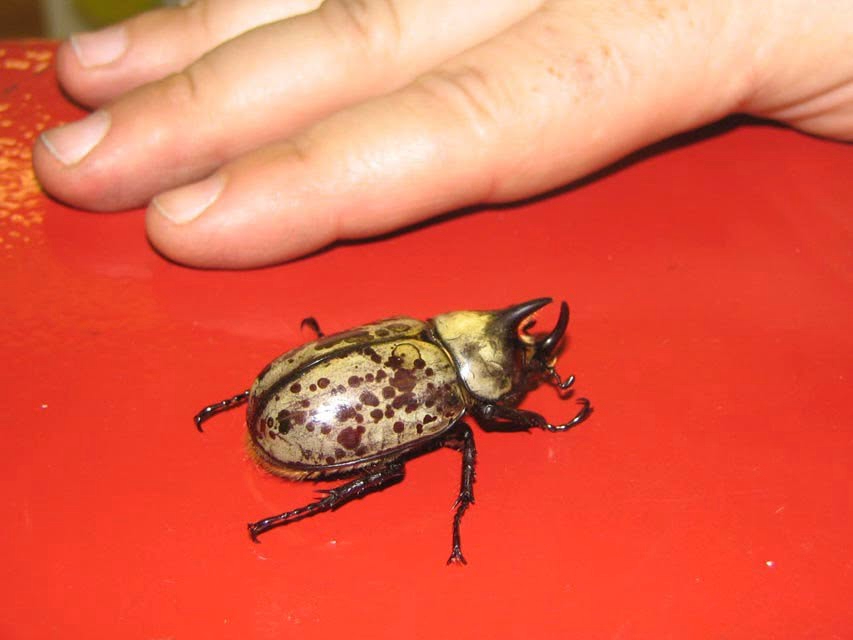
An Eastern Hercules Beetle can reach a length of 2.4 inches. This male was found in September of 2006 on an Erwin Record coin box at Flick Video.
After extensive online research, I revised my identification to Eastern Hercules Beetle – a true giant among our native bugs.
The Eastern Hercules Beetle is the largest beetle in the Southeastern United State. This big bug boasts an extensive family of closely related insects known by such names as rhinoceros beetle, unicorn beetle, horn beetle and horned beetle.
This insect’s scientific name is Dynastes tityus, placing it in a genus that contains only six other species.
For a bug, the Eastern Hercules Beetle is not without its appeal. The hard shell is olive-green with a pattern of brownish spots. When I showed photographs of the beetle to people, a few individuals likened it to a “spotted Easter egg with horns.”
The Eastern Hercules Beetle can reach a length of 2.4 inches. Only the male beetle sports the impressive horns. Female beetles are slightly smaller and lack horns. The male’s main horns extend from the front of the head, but they also sport two smaller horns on the thorax.
The horns are not merely for show. Male beetles are intolerant of each other and use their horns in combat to settle their differences. The horns are not mobile, however, and the beetle cannot bring the horns together to pinch a person.
The “horns” on this beetle are also not mouthparts. This bug does not bite. They may look fearsome, but they are completely harmless.
The size of the beetle’s horns is directly related to the amount of food the creature obtained during its larval form. The larval grubs of this beetle feed on nutrients available in rotting wood. For instance, they can often be located in fallen logs on the forest floor.
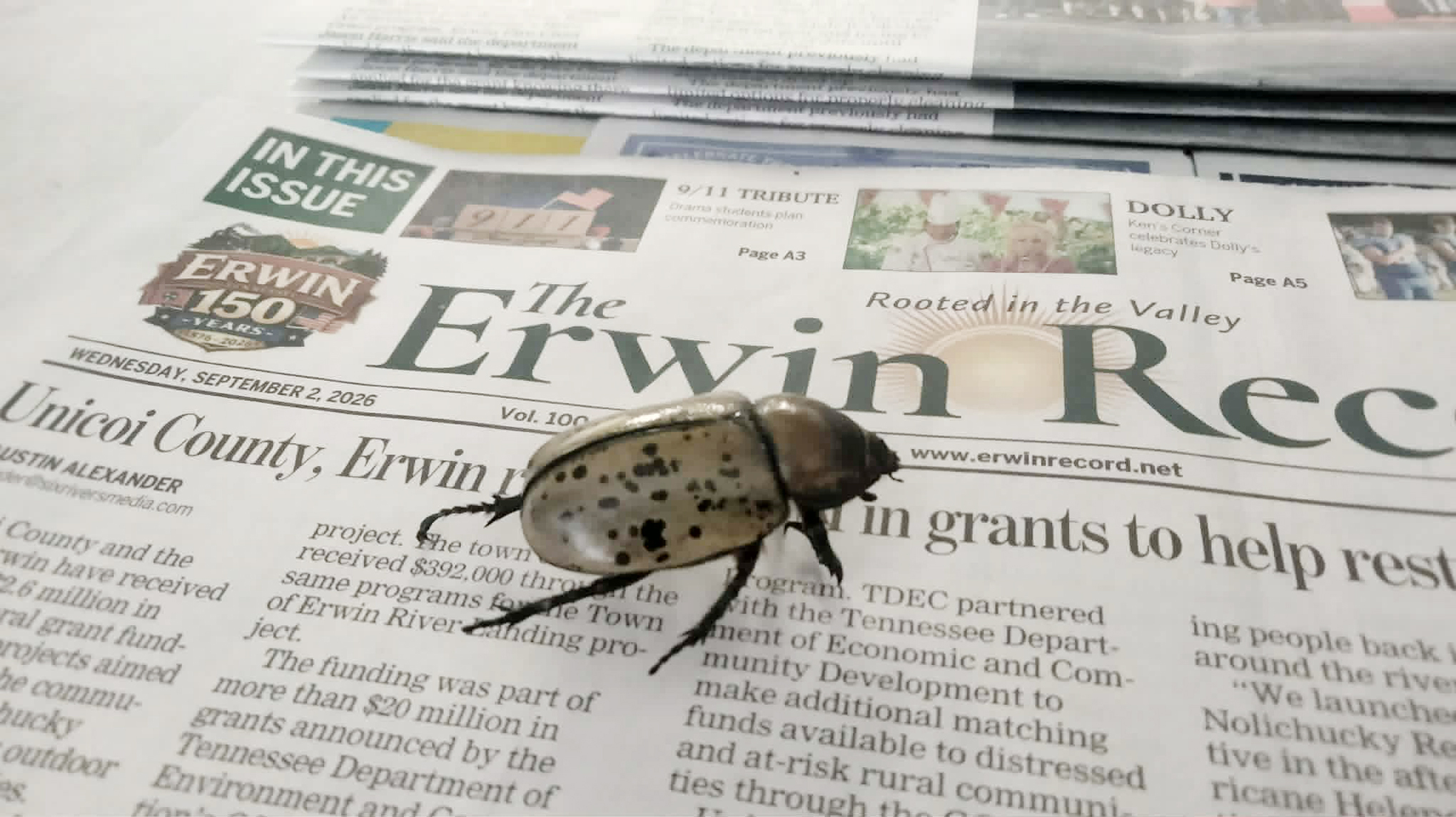
Bryan Stevens • This female Eastern Hercules Beetle was found dead on the sidewalk on Gay Street in Erwin, Tennessee, in September of 2026.
The huge beetle grubs are often tasty morsels for a variety of wildlife. Pileated woodpeckers will use their stout bills to chisel the grubs from fallen stumps and logs. Raccoons, opossums, skunks and snakes also hunt these grubs.
Some birds, including owls and crows, will eat the adult beetles. The adult beetles are not without some defensive measures. When threatened, they can release a foul-smelling to discourage predators. I might have hesitated to pick up the beetle I encountered if I’d known this fact at the time.
Like all insects, this beetle has six legs which are capable of gripping any surface with surprising tenacity. I encouraged considerable resistance when I attended to remove the beetle from a brick to which it had attached itself.
My research also indicated that the only way this beetle can injure a person would be by accidentally scratching someone with its spiky limbs.
These beetles are not often seen by people. This large beetle spends the daylight hours in hiding, becoming more active after dark. They can fly and are attracted to bright lights.
I count myself very fortunate to have been able to observe this usual creature for a few minutes and document my sighting with some photographs.
I readily admit most people would not consider an Eastern Hercules Beetle as “cute,” but surely only a person with a complete lack of imagination could stare into this bug’s beady little eyes and not find the bug to possess true character and personality.
I’m joking – sort of – and promise to return to the usual topic of our feathered friends in next week’s column.
•••
Bryan Stevens has written about birds, birding, birders and on occasion, bugs, since 1995. Email him at ahoodedwarbler@aol.com.

