
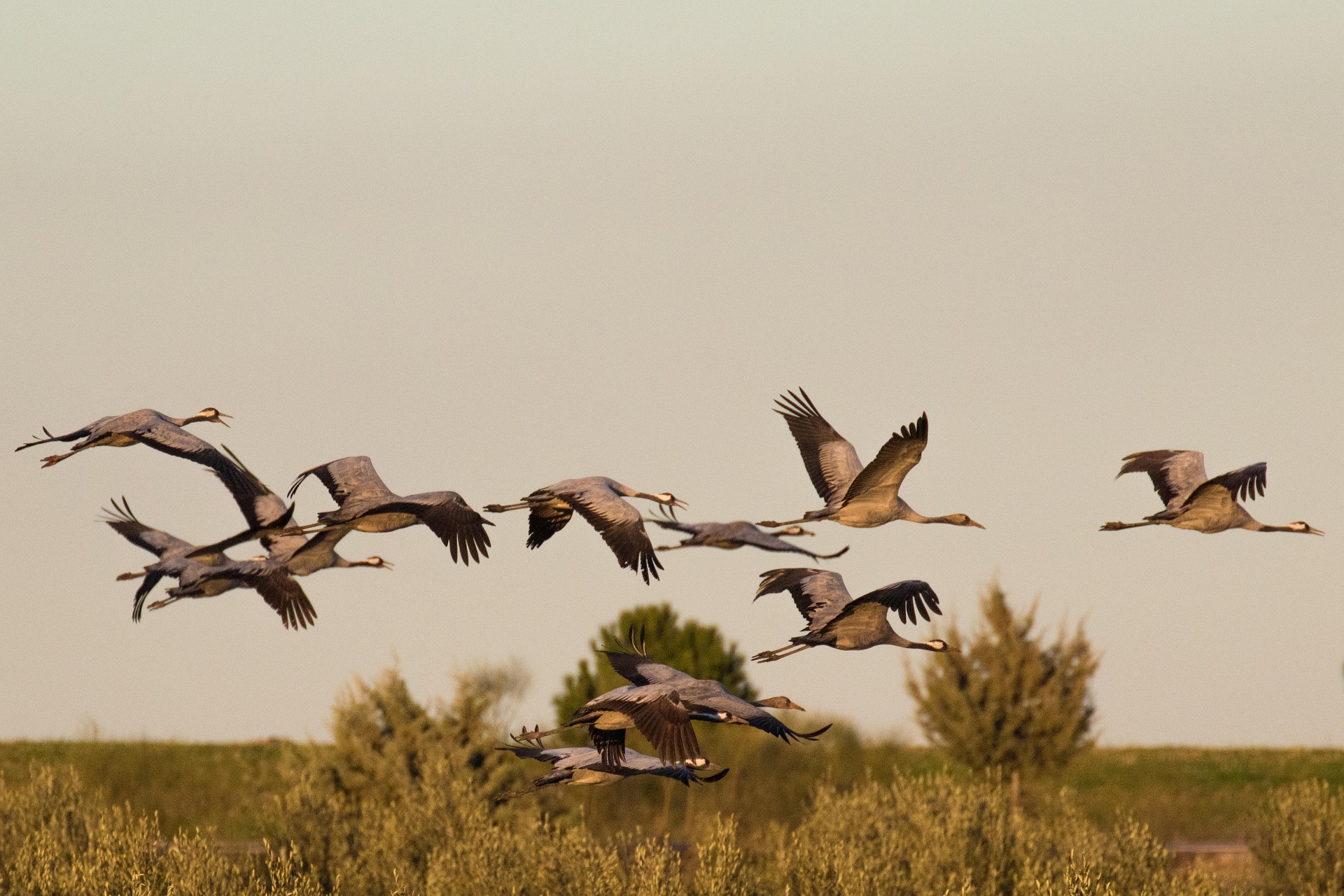
ANNE AND SATURNINO MIRANDA/PIXABAY • The common crane holds a record achieved by the feat of flying over the Himalayans at a height of 37,000 feet. However, this is not a typical flight. They usually fly below 3,280 feet.
As it does every year, September’s arrival puts fall migration into sharp focus. The birds that returned this past spring — the warblers, vireos, tanagers, grosbeaks, flycatchers, hawks, hummingbirds and many more — have begun or are beginning to make their way back to the locations where they will spend the winter months far from the cold, bleak conditions over most of North America.
On recent mornings as I leave for work I have heard the buzz of hummingbird wings, as well as the scolding calls of red-eyed vireos from the woodlands around my home.
Some of these birds migrate out of the tropics every spring to avoid competition. Others find North America a land of abundant, albeit temporary, resources. This land of plenty offers a wealth of insects, seeds, fruit and other nourishing, nutritious food to help parent birds keep their strength while they work to ensure their young thrive. Of course, once the bountiful period concludes, they return to the tropics of Central and South America to winter. Those that do so successfully will make the journey back to the United States and Canada in the spring. It’s an ongoing cycle, repeating year after year, season after season.
The phenomenon of migration isn’t exclusive to the neotropical migrants of the New World. Birds in other parts of the world migrate, too. Waterfowl, shorebirds and raptors are among some of the families of birds that stage impressive migrations.
Here are some migration achievements of some of our feathered friends:
Elevation Champ
The Himalayas represent a mountainous challenge for many migratory birds. Some birds, however, shrug off the astonishing heights of the world’s tallest mountains. The common crane holds a record achieved by the feat of flying over the Himalayans at a height of 37,000 feet. However, this is not a typical flight for these cranes. In fact, they usually avoid flying over mountains. They usually fly below 3,280 feet. The regular migrant that does fly at loft heights is the bar-headed goose, recording reaching 29,000 feet. These geese regularly fly over the peaks of the Himalayas when migrating.
Long-distance Champ
The Arctic tern truly takes migration to extremes. This small seabird travels each year from its Arctic nesting grounds to the Antarctic region, where it spends the winter months. Put into terms of mileage, the Arctic tern can travel about 50,000 miles in a single year. For a bird with a body length of about 15 inches and a wingspan of about 28 inches, this incredible migration is an astonishing feat. These statistics permit the Arctic tern to easily lay claim to the title of champion migrant among our feathered friends.
Tiny Champ
The ruby-throated hummingbird, a favorite of many bird enthusiasts living in the eastern United States, makes an impressive migration each year. Just to reach the United States, these tiny birds undertake a strenuous journey. They leave their wintering grounds in Central America to return to the United States and Canada for the nesting season. Most of these tiny birds, which are barely four inches long, make a non-stop flight of more than 500 miles across the Gulf of Mexico. The journey can take almost an entire day. With the end of summer, the entire population of ruby-throated hummingbirds, increased by a new generation of young birds, makes the Gulf crossing for a second time in a year to return to the American tropics for the winter months.

Photo by Bryan Stevens • A ruby-throated hummingbird perches at a feeder for a sip of sugar water.
Dedicated Champ
Among North America’s buteo hawks, which includes raptors such as red-shouldered hawk and red-tailed hawk, the broad-winged hawk stands out as a dedicated migrant. These hawks form flocks that at times number in the hundreds or thousands as they sail and glide on thermals rising over various mountain ranges. These hawks and other raptors are well-known in the region for migrating past the Mendota Fire Tower in Southwest Virginia every September and early October. The broad-winged hawk’s counterpart in the western United States is Swainson’s hawk, which shares the broad-winged hawk’s inclination for migrating in large flocks. Swainson’s hawk is named for William Swainson, the famous 19th century English naturalist for which Swainson’s thrush is also named.
Warbler Champs
My favorite family of birds, the warblers, are seasonal migrants. The Northern parula, a warbler species that regular spends the spring and summer months in the woods around my home, winters in Mexico, Central America, the Caribbean and southern Florida. The Northern parula breeds across the eastern half of the United States and southeastern Canada. It’s not a migration of an incredible distance, but it’s still quite an accomplishment for a bird less than five inches long and weighing less than half an ounce.

Photo by Bryan Stevens • The Northern parula, like most warblers, is a medium- to long-distance migrant.
Another warbler is a true migratory champion. Few warblers make as great a journey as the blackpoll warbler. Instead of migrating over land, this five-inch-long warbler undertakes a two-stage migration. The first half of the migration is a non-stop flight of about 1,500 miles. Every fall, these tiny birds fly over the Atlantic Ocean during this part of their migration, departing from Canada or the northern United States and not stopping until they reach various locations in the Caribbean. There they will spend some time recovering from the exhausting first half of their journey before they continue their way to such South American countries as Colombia and Venezuela. Once again, during the time they spend flying over open ocean, these tiny warblers do not feed.
Fall’s a great time to witness the variety of avian life. Look for some of these migrants passing through your yards, gardens or favorite birding spots.
For those wanting suggestions for seeking out migrating birds, the linear trail in Erwin, Rocky Fork State Park in Flag Pond and Limestone Cove Recreation Area are some good bets.

