Tag Archives: Grosbeaks

No shortage of contenders to vie for most beautiful bird status

Karen Burke/Pixabay • A Baltimore oriole feeds from a dish of grape jelly. Male orioles show off vibrant feathers during the spring season.

Last week’s column focused on rose-breasted grosbeaks. Males of this species are a stunning sight every spring. People seeing them for the first time are always blown away.

After a link to last week’s column was posted to Facebook, Daisy Scism in Damascus, Virginia, commented that she had a visit from a rose-breasted grosbeak at her feeder recently.

The arrival of rose-breasted grosbeaks got me to thinking of other colorful birds that spend the summer months in Northeast Tennessee, Western North Carolina and Southwest Virginia.

Here’s my list of must-see birds sure to knock your socks off with their dramatic appearance.

Scarlet Tanager

In late April and early May, once the oaks, the maples, the poplars and other tall deciduous trees begin spreading out new green leaves to create a concealing woodland canopy, a familiar song can be heard coming from the treetops. Upon first hearing it, listeners might mistake the hidden singer for an American robin. Listen a little closer, however, and the song sounds as if it is being delivered by a hoarse robin with a sore throat.
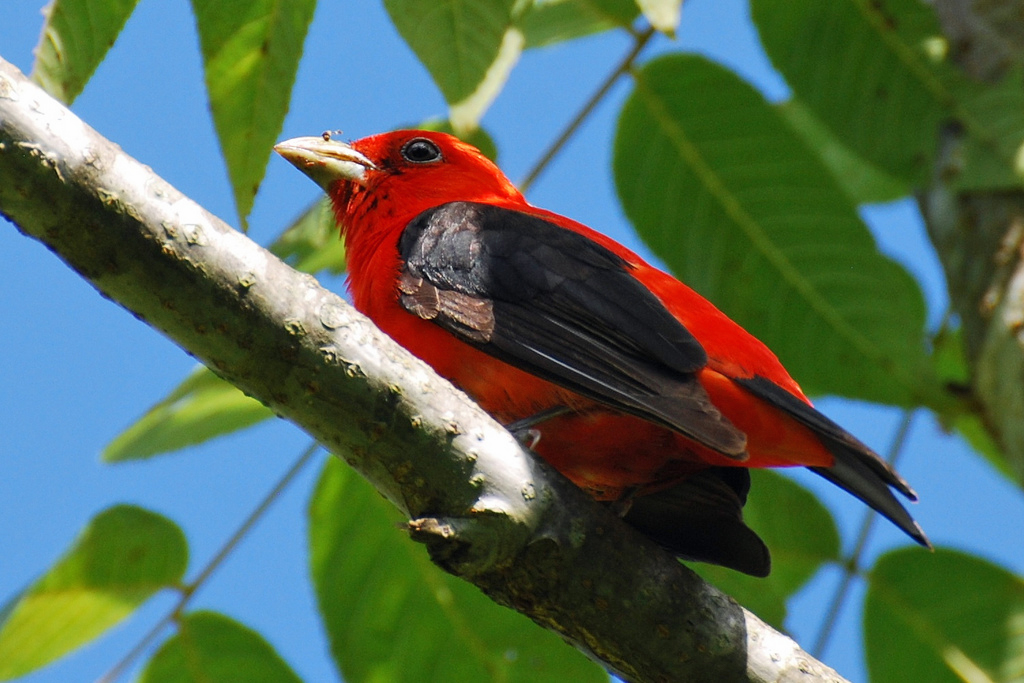
Photo Courtesy of Jean Potter
A male scarlet tanager brightens shadowy woodlands with a flash of tropical colors yet remains mostly inconspicuous in the forest canopy.

The producer of the hoarse but melodic song is a scarlet tanager, one of the most showy birds of Eastern woodlands from April to early October. The scarlet tanager also has an easily recognized call note, best described as a distinctive “chip-burr” or “chip-churr.”

Photo by Bryan Stevens • Despite the brilliant scarlet and black feathers, tanagers are more often heard than seen,

The male scarlet tanager boasts a brilliant plumage of crimson red paired with black wings and tail. Of course, this describes only the male. The female tanager makes no real claim to the common name with her comparatively drab greenish plumage. However, the scientific name, Piranga olivacea, gives a nod to the olive-green plumage of females, young males and even adult males when molting their feathers.

Baltimore Oriole

The Baltimore oriole would stand out among North American birds even without its colorful plumage and its long association with the city of Baltimore and its affiliated Major League Baseball team.

For instance, few other birds can match the Baltimore oriole for the sheer elaborate nature of the woven nest these birds construct for the purpose of sheltering eggs and young. The nests resemble hanging baskets that the female oriole weaves from a variety of collected strips of grass. The lining inside is even more elaborate and features soft materials such as plant down, feathers or even wool that can insulate and cushion the eggs. The nest itself is anchored securely in the fork of a tree branch.

Again, credit for being on a list of stunning regional birds goes to the males. The adult male Baltimore oriole is orange on the underparts, shoulder patch and rump, with some individual birds appearing a very deep flaming orange and others appearing yellowish orange. All of the rest of the male’s plumage is black. Adult female are yellow brown on the upper parts with darker wings and dull orange yellow on the breast and belly. The juvenile oriole is similar looking to the female, with males taking until the fall of their second year to reach adult plumage.

Photo by Bryan Stevens • The male indigo bunting is a resplendent bird.

Indigo Bunting

The indigo bunting is one of the reasons I love to pay attention to the clientele visiting my feeders. This small songbird likes to reside in the boundary region where forests and woodlands meet fields and pastures. Personally, the indigo bunting has always been a bird that is suggestive of the long, hot days of summer.

One of my earliest and still quite vivid birding memories is a recollection of a shockingly blue bird atop a blue spruce tree in my yard. Several decades later, the tree is no longer standing, but these beautiful birds — I now know those long-ago summer visitors were indigo buntings — still return each year to my yard and gardens.

The male indigo bunting is the only solid blue bird in the eastern United States, but it’s all an illusion — literally a trick of the light. The indigo bunting’s feathers are not really blue; the male’s brilliant azure plumage is caused by the process of ;right diffraction around the structure of the bird’s feathers. This process scatters all but the blue light, and the resulting color shifts from black to blue to turquoise as the angle of reflected light changes. In bright light, it can even look unnaturally vivid blue. In poor light, however, an indigo bunting male can appear black.

Indigo buntings usually arrive in the region in late April, and I’ve seen them linger until late October, although most indigo buntings have left the region by late September.

•••

Do you have your own candidates for most beautiful birds. Feel free to email me your choice at ahoodedwarbler@aol.com. Share sightings, ask questions or make comments as well.

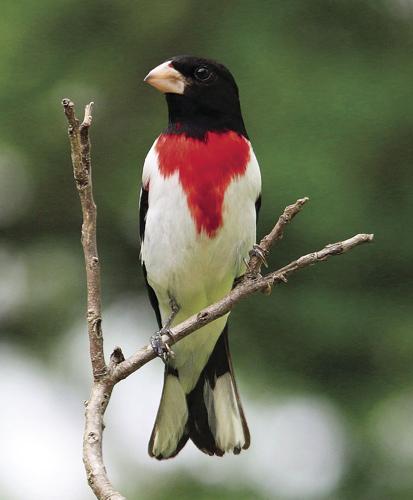
Male rose-breasted grosbeaks are always a stunning sight

Photo by Edbo23/Pixabay • A male rose-breasted grosbeak is arguably one of the most impressive of the migrating birds making spring stops at lucky households offering feeders stocked with an ample supply of sunflower and other seeds.

Susan Westall emailed me on Sunday, April 21, for help identifying a new bird at her feeders.

Susan wrote, “We spotted this bird today (April 21) around 2:45 p.m. This bird has never been to visit that we’re aware of. We didn’t find the identity.”

Susan, who noted that she resides in Marion, North Carolina, asked if I could help identify the bird. She helpfully enclosed three photographs.

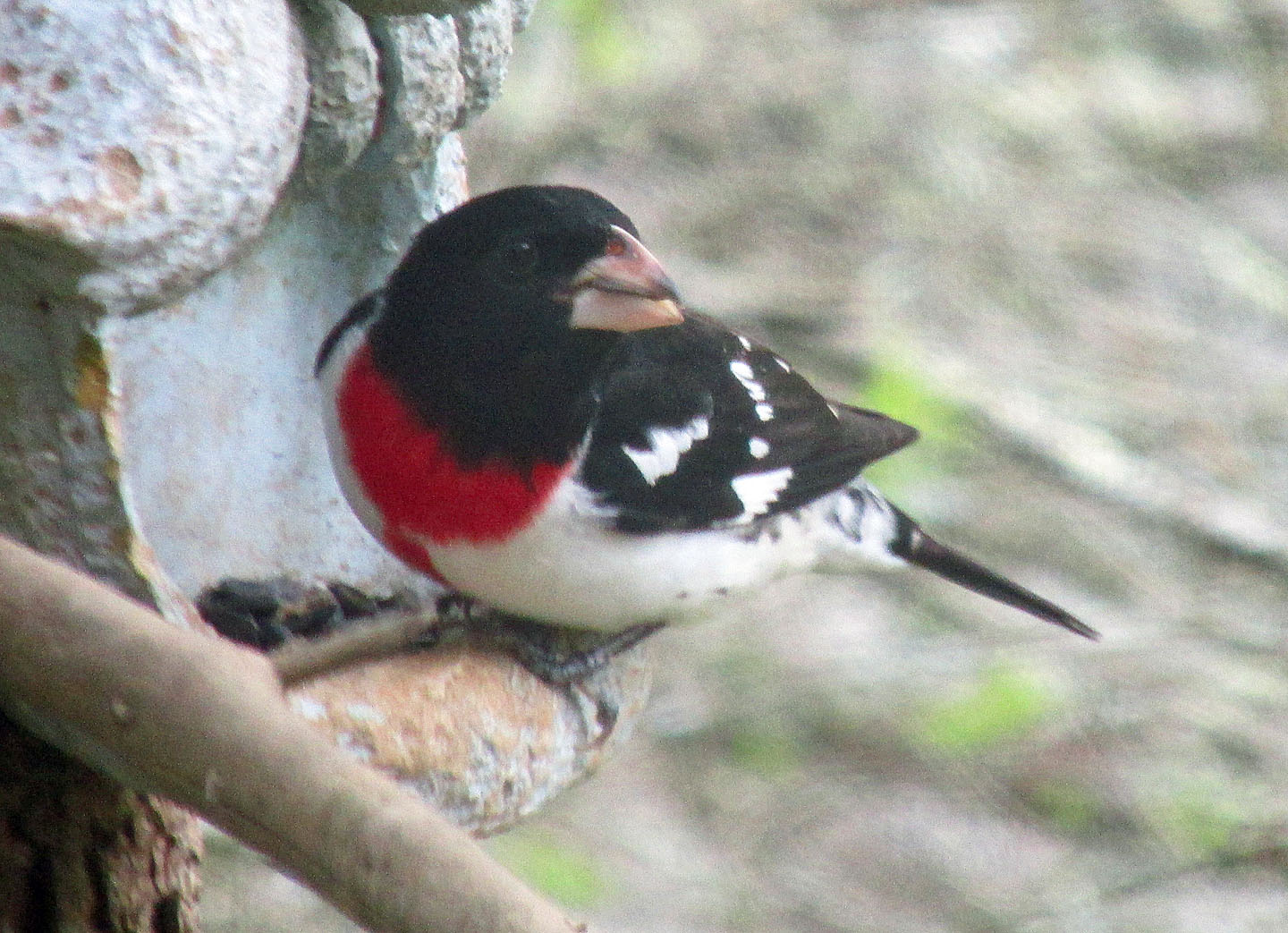
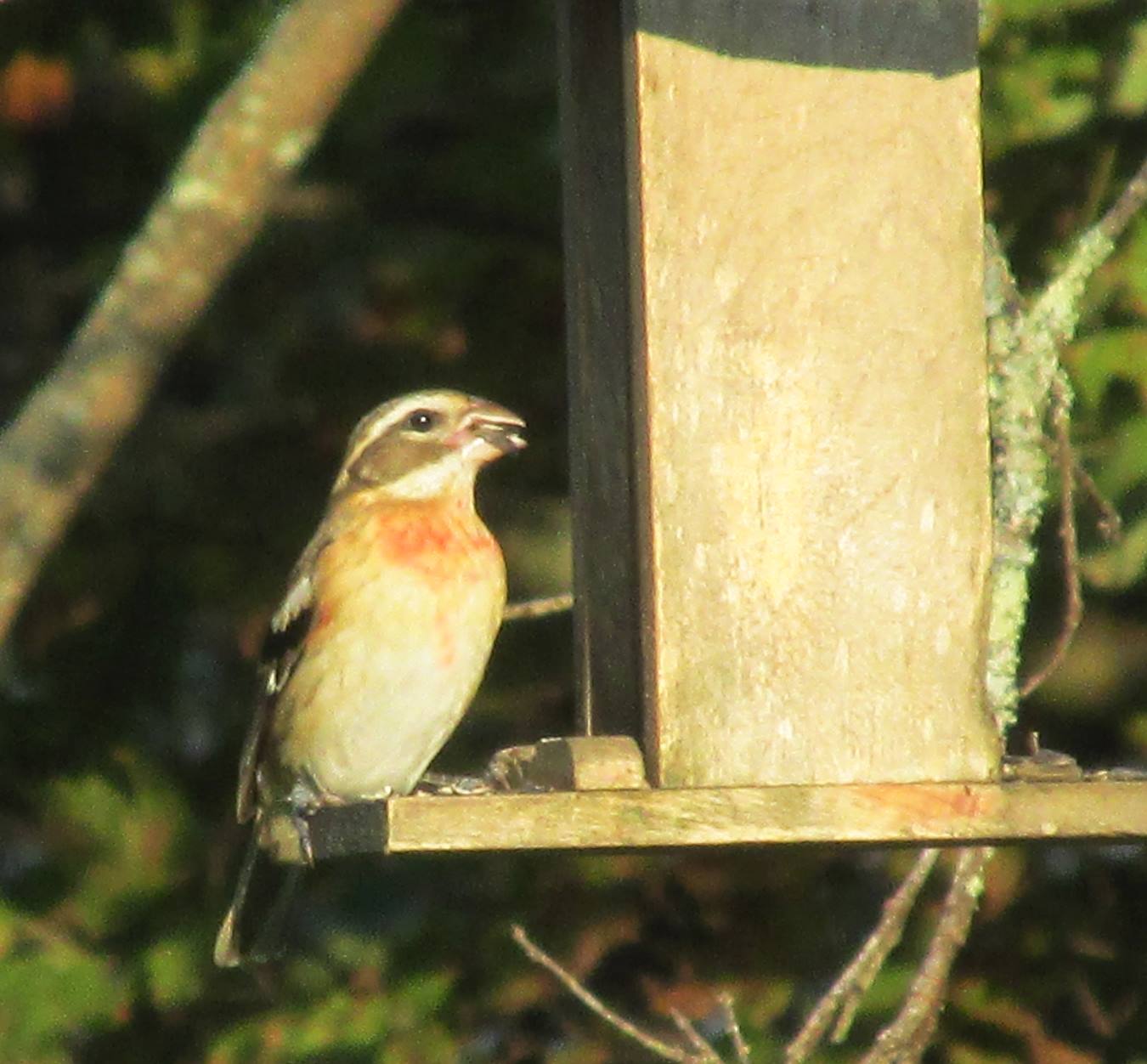
Photo provided by Susan Westall • A male rose-breasted grosbeak at a feeder at the Westall home.

One glimpse at her snapshots of the feathered visitor showed me that her mystery bird was none other than a rose-breasted grosbeak, one of the many splashy and impressive migrants that travel through Northeast Tennessee, Southwestern Virginia and Western North Carolina every spring.

Other than ruby-throated hummingbirds, the one bird whose return in the spring is guaranteed to generate excitement is the rose-breasted grosbeak. Every spring, I get phone calls and emails from people wanting to share the thrill of seeing these vibrant birds in their back yards.

A few people, like Susan, are completely stumped that such a flamboyant feathered visitor has landed in their own yard like an out-of-place inhabitant of a tropical jungle.

For most of us, these spring visits by rose-breasted grosbeaks is a fleeting and temporary stay. After finding the local arrangements, which can consist of well-stocked feeders and perhaps a convenient water source, to their liking, these migrants may linger for several days.

However, rose-treated grosbeaks nest at higher elevations and are usually impatient to continue the journey to where they will spend the summer months tending to their young.

Single birds are occasionally the first to arrive, but rose-breasted grosbeaks do form flocks when migrating. Even if a scout shows up alone at your feeders, he will often soon be joined by other grosbeaks.

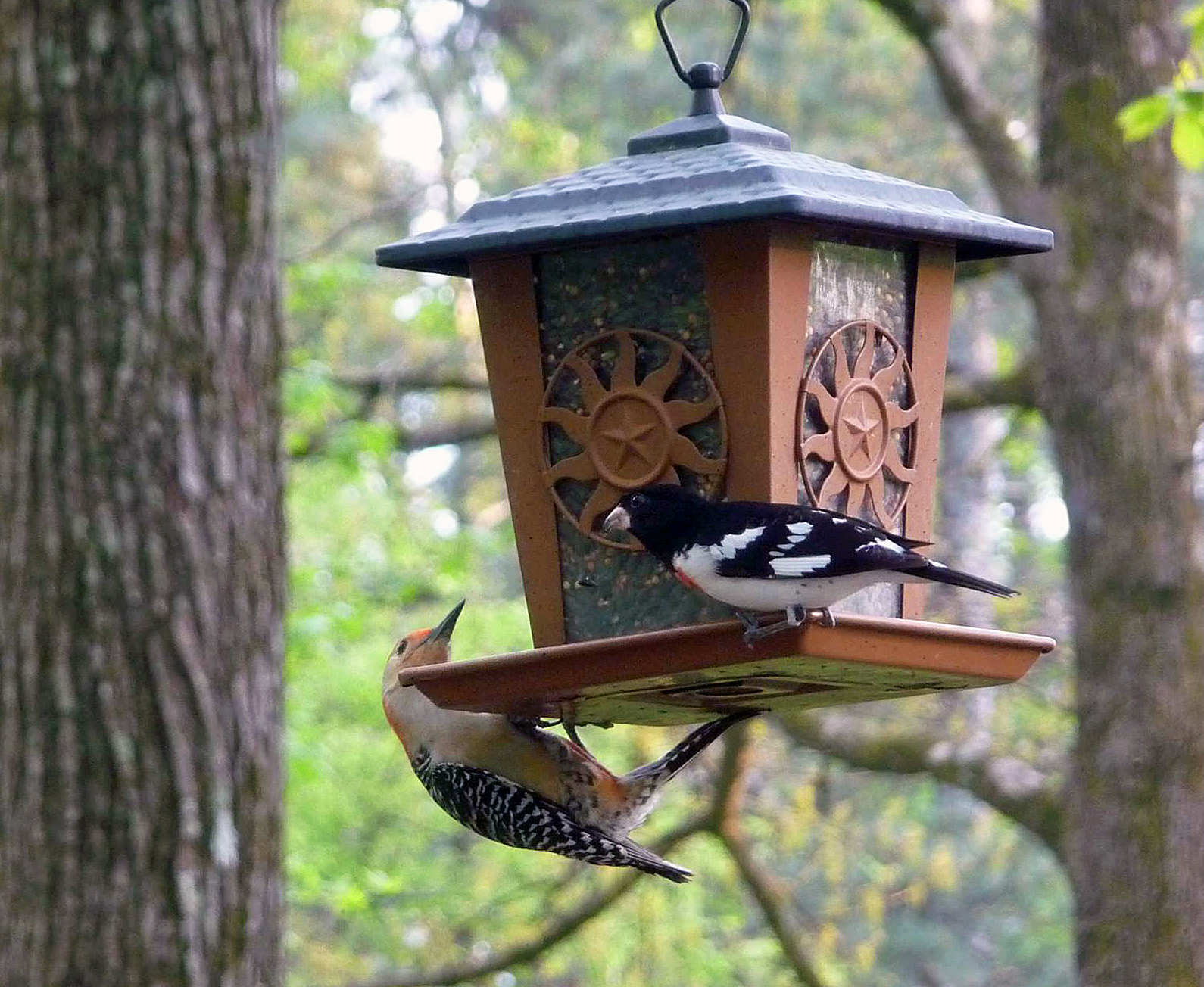
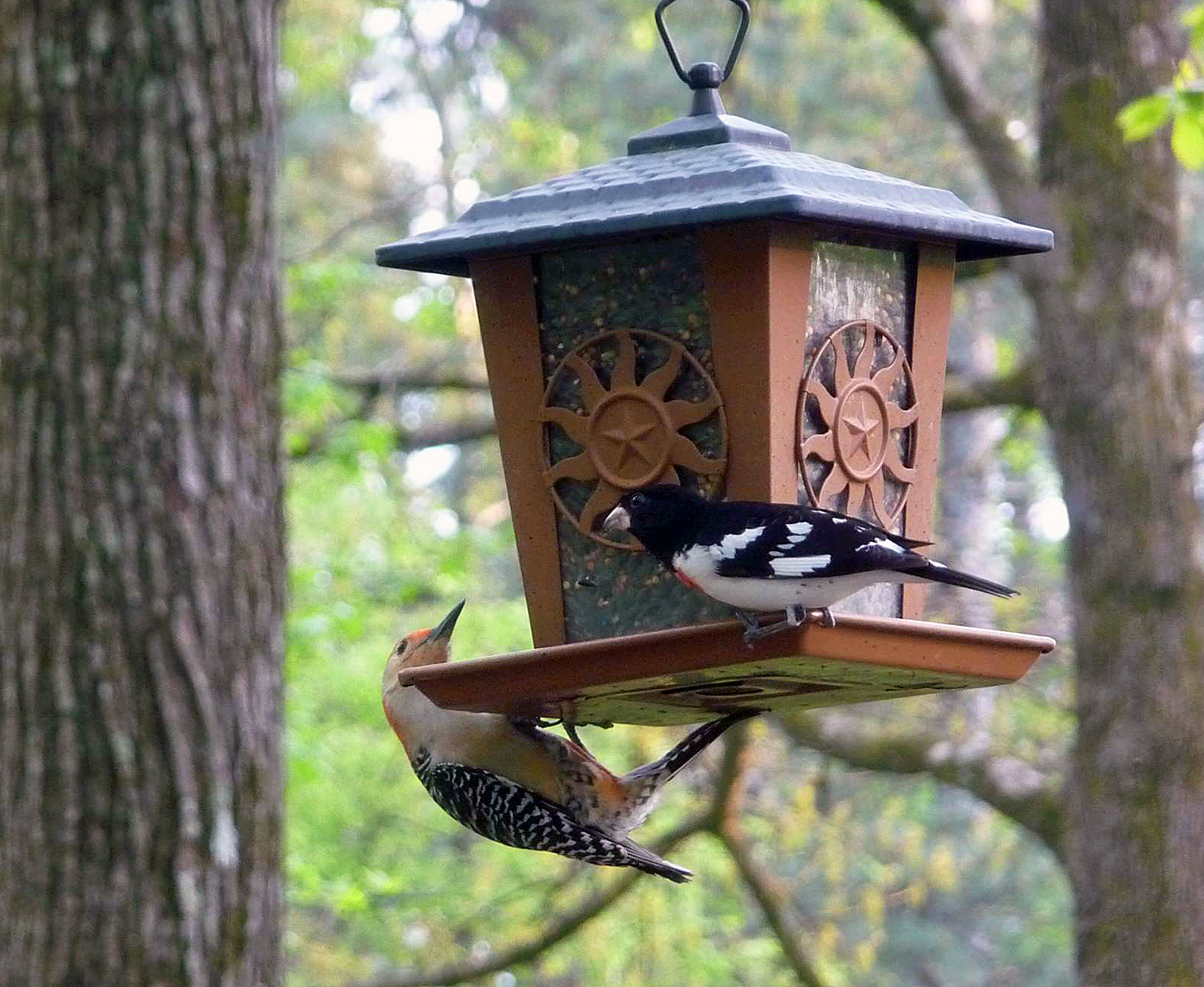
Photo provided by Byron Tucker • A male rose-breasted grosbeak has a showdown with a red-bellied woodpecker for access to a feeder.

Plenty of rose-breasted grosbeaks pass through the area, and a few even decide to make the region’s mountains their summer home. Rose-breasted grosbeaks spread out widely across the eastern half of the North American continent, ranging from northeastern British Columbia to Quebec and Nova Scotia in Canada. They also range south from New Jersey to Georgia. The rose-breasted grosbeak also reaches Colorado, Oklahoma and Kansas.

Farther west, the rose-breasted grosbeak is replaced by the closely related black-headed grosbeak. I saw black-headed grosbeaks on a trip to Salt Lake City, Utah, in 2006.

In many bird species males and females differ considerably. This is certainly true of male and female rose-breasted grosbeaks. The genders in this species are considered dimorphic, which is a scientific term which means that certain male and female birds of the same species may vary widely in size, plumage coloration, song or other secondary sexual traits.

They also have some things in common. Both sexes have a massive bill, which they use to hull sunflower seeds at feeders or glean insects from leaves and branches. It’s the heavy, blunt bill for which the term “grosbeak” is derived. “Gros” is a German term for large or big, so grosbeak simply means a large-beaked bird.

People who band birds to further the study of them will tell you that rose-breasted grosbeaks have a wicked bite and are capable of delivering quite a nip. Bird banders frequently encounter rose-breasted grosbeaks in their mist nets — and bear the scars to prove it.

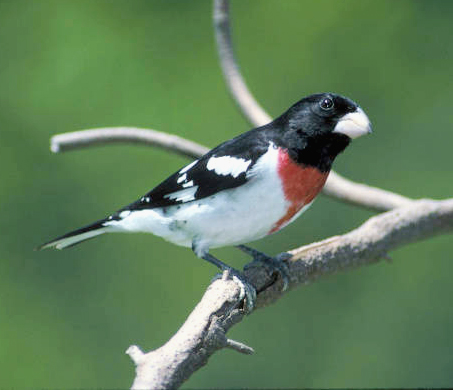
Only the male rose-breasted grosbeak displays the namesake splash of rosy-red feathers across a white breast. The rest of the male’s plumage consists of a dramatic contrast of black and white feathers. The female grosbeak, however, doesn’t stand out in the same way. She is much less colorful than the male. With her brown and white plumage, she is often mistaken for a large sparrow or finch.

At our feeders, this bird’s extremely fond of sunflower seeds. Away from our feeders, grosbeaks feed on insects, seeds, fruit and even some leaf buds and flowers. I’ve seen these birds satisfying a sweet tooth — or should that be sweet beak? — by feeding on jewelweed flowers and apple blossoms. If sugar’s good for hummingbirds, I am sure it is a valuable energy source for rose-breasted grosbeaks, too.

The rose-breasted grosbeak is a cherished spring visitor that never fails to impress by bringing a hint of the tropics to the mountains of Northeast Tennessee. If you are disappointed in hopes of seeing the species this spring, take heart. The rose-breasted grosbeak migrates through the region again in the fall, often from mid-September to late October. The males sometimes look less vibrant by autumn, but it’s always a treat to see this bird.

I’m hoping many readers are also enjoying their own opportunities for hosting this delightful songbird.

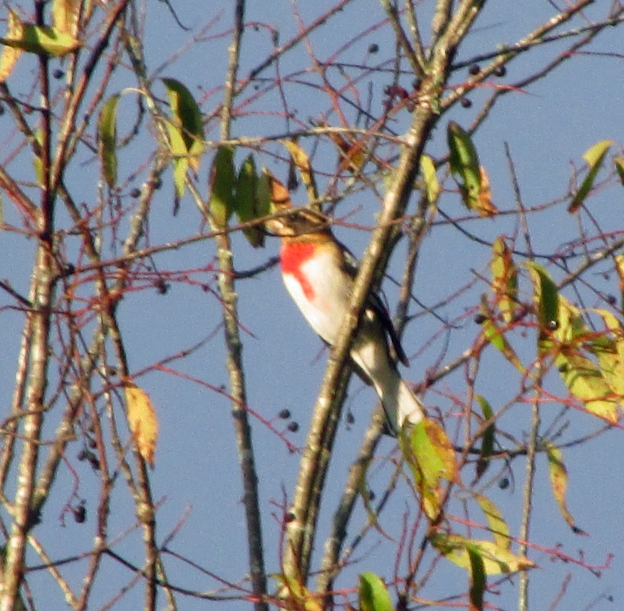
Photo by Bryan Stevens • A male rose-breasted grosbeak perched in a tree on Holston Mountain in Tennessee.

Other songbirds are also on the move. Warblers, vireos, tanager, flycatchers, orioles and more are migrating through the region. Some will stay and make a home in the region for the summer. Others will push on beyond the Southern Appalachians. Keep your eyes open for what may show up next.

•••

Mark this on your schedule: Bristol Bird Club will host a presentation by Kera and George Brewster of Wild Birds Unlimited in Johnson City on Tuesday, May 21.

They couple had been scheduled to give a program at the club’s January meeting, but a snowstorm prevented it.

The club meeting will take place at 7 p.m. at The Summit at 1227 Volunteer Parkway in Bristol, Tennessee. Attendees can also join the meeting and view the program on Zoom. For a Zoom invite, email Larry McDaniel at bristolbirdclub2022@gmail.com.

•••

Share a sighting, ask a question or make a comment by emailing me at ahoodedwarbler@aol.com.

Photo by Pixabay.com • A well-stocked feeder is a first step toward attracting more birds to your yard.

Rose-breasted grosbeaks make spring appearances in region

Photo by Bryan Stevens
A Rose-breasted Grosbeak finds a meal of sunflower seeds at a feeder.

There are so many birds arriving in the past week that one almost needs to take a breath from all the excitement and simply enjoy the beauty, both showy and subtle, that many of our returning feathered friends can provide.

The rose-breasted grosbeak is definitely one of the birds in the showy category. I haven’t seen one yet, but many readers have contacted me to let me know of their sightings.
•••
April Kerns Fain in Unicoi shared a photo and post on April 19 on my Facebook page about the arrival of her first rose-breasted grosbeak.
“Our grosbeak is back,” she wrote. Her photo showed the beautiful bird perched on a feeder stocked with plenty of sunflower seeds and suet.
•••
“We had two pairs show up a couple of days ago,” Karen Fouts, a resident of Marion, Virginia, commented on my Facebook page. “Aren’t they lovely?”
•••
Nancy Barrigar of Elizabethton posted that she and her husband, Gary, saw them on Roan Mountain the weekend of April 29-30. “Still waiting to see them at our feeders,” she added.
•••
Barbara Lake of Hampton also shared her rose-breasted grosbeak sighting. “We had them on the weekend,” she said. “Seem to be down to just two now.”
•••
Carolyn Dover Norman in Glen Rose, Texas, shared her story of a brief sighting.
“I had one passing through here in Texas last week — just for a day,” she wrote on my Facebook page.
•••
Gloria Walton Blevins in Damascus, Virginia, happily shared that she “saw one yesterday” on my Facebook page on April 29.
•••
Carolyn Baker Martin in Carter County reported that her grosbeak sighting involved a female rather than the more eyecatching male. “Had a female at our feeders two mornings,” she wrote.
•••
Felicia Mitchell in Washington County, Virginia, has enjoyed grosbeak sightings this spring.
“Female grosbeak showed up just this minute at front platform feeder,” Felicia wrote on April 29. “Likely a pair soon. And maybe a family one day.”
She later updated her comment to announce that a male grosbeak had arrived, along with the female.
•••
Philip Laws notified me that he saw a male and some female rose-breasted grosbeaks May 4 at his home in Limestone Cove.
•••
A few readers, like myself, are still awaiting that first spring rose-breasted grosbeak.
“I’m still looking for my first one,” wrote James Noel Smith in Unicoi.
•••
Priscilla Gutierrez in Roan Mountain noted that she’s still waiting for the grosbeaks to show up. “So beautiful,” she added.
•••
Kaylynn Sanford Wilster, who resides in Piney Flats near Boone Lake, posted a comment.
“A dear friend told me about the Merlin app and it says it heard a rose-breasted grosbeak the other day,” Kaylynn wrote. “I haven’t seen one yet though. I dearly love these birds.”
•••
“We haven’t seen our little visitor this spring,” wrote Laura Evans Barden. “Usually, he has made his appearance in our backyard by now. I love the rose-breasted grosbeaks.
She has the grosbeak’s favorite treat waiting when he does arrive.
“He loves the blue jays’ peanuts,” Laura noted.
Watch this video:
•••
Plenty of rose-breasted grosbeaks pass through northeast Tennessee, southwest Virginia and western North Carolina and a few even decide to make their summer home on local mountains. However, these birds spread out widely across the eastern half of the North American continent, ranging from northeastern British Columbia to Quebec and Nova Scotia in Canada. They also range south from New Jersey to Georgia. The rose-breasted grosbeak also reaches Colorado, Oklahoma and Kansas.
For the most part, however, the rose-breasted grosbeak is replaced in the western United States by the closely related black-headed grosbeak.
As fall approaches, the rose-breasted grosbeak migrates south to a winter range that spans central Mexico, Central America and northern South America. As they depart, many of these migrating birds will make autumn visits to again partake of offerings of sunflower seeds at backyard feeders. So, if you don’t get to see these showy birds in the spring, you get another chance in September and October.
The male rose-breasted grosbeak gives this species it name. Males are the epitome of the birds that make their home for part of the year in the American tropics. The contrasting black and white plumage is emphasized by a triangular slash of rosy-red color on the breast. Put all those elements together and the male rose-breasted grosbeak is not a bird that would be mistaken for any other.
The female grosbeak, however, doesn’t stand out in the same way. She is much less colorful than the male. With her brown and white plumage, she is often mistaken for a large sparrow or finch.
Both sexes have a massive bill, which they use to hull sunflower seeds at feeders or glean insects from leaves and branches. It’s the heavy, blunt bill for which the term “grosbeak” is derived. “Gros” is a German term for large or big, so grosbeak simply means a large-beaked bird. People who band birds to further the study of them will tell you that rose-breasted grosbeaks can inflict a wicked nip. In Northeast Tennessee, bird banders frequently encounter rose-breasted grosbeaks in their mist nets — and bear the scars to prove it.
With some birds, males play only a minor role in the nesting process. That’s not the case with the rose-breasted grosbeak male. The males help with nest-building chores and share responsibility with the female for incubating the eggs.
The female lays three to five eggs in a cup-shaped nest. It’s not easy to locate the nests since the birds usually place them in trees at least 20 feet above the ground. Within two weeks, the eggs have hatched and the parents are kept extremely busy finding enough food to satisfy the voracious nestlings. Well fed by both parents, the young grow quickly and usually are ready to leave the nest within 12 days. Often, when a first brood of young departs the nest, the male will care for the rowdy group of fledglings as the female starts a second nest to capitalize on the long days of summer.
Away from our feeders, rose-breasted grosbeaks feed on insects, seeds, fruit and even some leaf buds and flowers. I’ve seen these birds satisfying a sweet tooth — or should that be sweet beak? — by feeding on jewelweed flowers and apple blossoms. If sugar’s good for hummingbirds, I am sure it is a valuable energy source for rose-breasted grosbeaks, too.
The rose-breasted grosbeak is a cherished spring visitor that never fails to disappoint by bringing a hint of the tropics to the mountains.
Watch this video:

Grosbeaks in region include blue, rose-breasted representatives of family


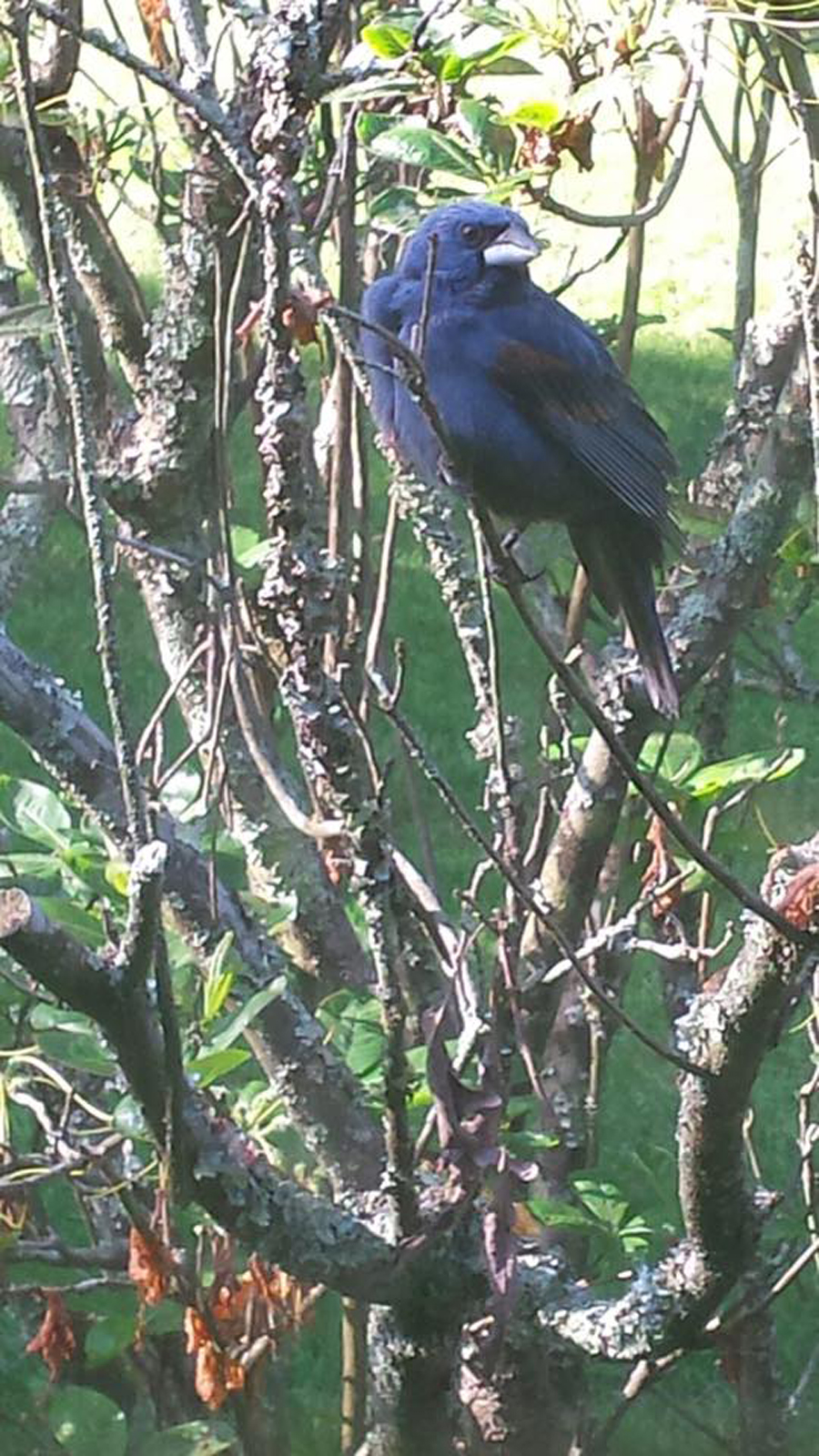
Daryl Herron, a real-life friend as well as a Facebook one, posted a photo of a bird on my page recently, seeking help with identifying the bird. His sister, Monica Cody, took the photo at her Kingsport home. The stunning bird depicted in the photo, as I happily reported back to Daryl, was a blue grosbeak. The grosbeak is an impressive bird, with males showing off an overall blue plumage save for some brown and black feathers in the wings.

Photo by U.S. Fish & Wildlife Service/ David Brezinski Rose-breasted Grosbeaks will likely be among the colorful birds present for this year's rally.

Photo by U.S. Fish & Wildlife Service/ David Brezinski
Rose-breasted Grosbeaks will likely be among the colorful birds present for this year’s rally.

Blue grosbeaks are mostly southern birds with Tennessee, Kentucky and Virginia representing the northern tier of this bird’s range in the southeastern part of the country. Look for these chunky, blue birds in brushy fields or along hedgerows in fairly open country. They favor the same habitats as such birds as yellow-breasted chat, brown thrasher and loggerhead shrike.

BlueGrosbeak-CODY

Photo by Monica Cody                    This male blue grosbeak showed up near Monica Cody’s home in Kingsport, Tennessee. The blue grosbeak is an uncommon visitor in the region.

It’s a shame this bird isn’t more common in the region. Blue grosbeaks will visit feeders, but in more than 20 years of maintaining well-stocked feeders, I’ve managed to attract only one of these birds. If more common, it would surely be a favorite bird among the people offering free seed for their feathered friends.

The blue grosbeak is related to the better-known rose-breasted grosbeak. Male rose-breasted grosbeaks are absolutely stunning, especially for people getting their first-ever glimpse of this bird. It’s the adult male with his vibrant black and white feathers and the large rosy-red splash of color across the breast that gives this bird its common name. Females are brown, streaked birds that are larger than but easily confused with some of our sparrows.

Among grosbeaks, both sexes have a massive bill, which they use to hull sunflower seeds at feeders or glean insects from leaves and branches. It’s the heavy, blunt bill for which the term “grosbeak” is derived. “Gros” is a German term for large or big, so grosbeak simply means a large-beaked bird. People who band birds to further the study of them will tell you that rose-breasted grosbeaks have a wicked bite and are capable of delivering quite a nip. Bird banders in the region frequently encounter rose-breasted grosbeaks in their mist nets — and some bear the scars to prove it.

Tammie-RBGrosbeak

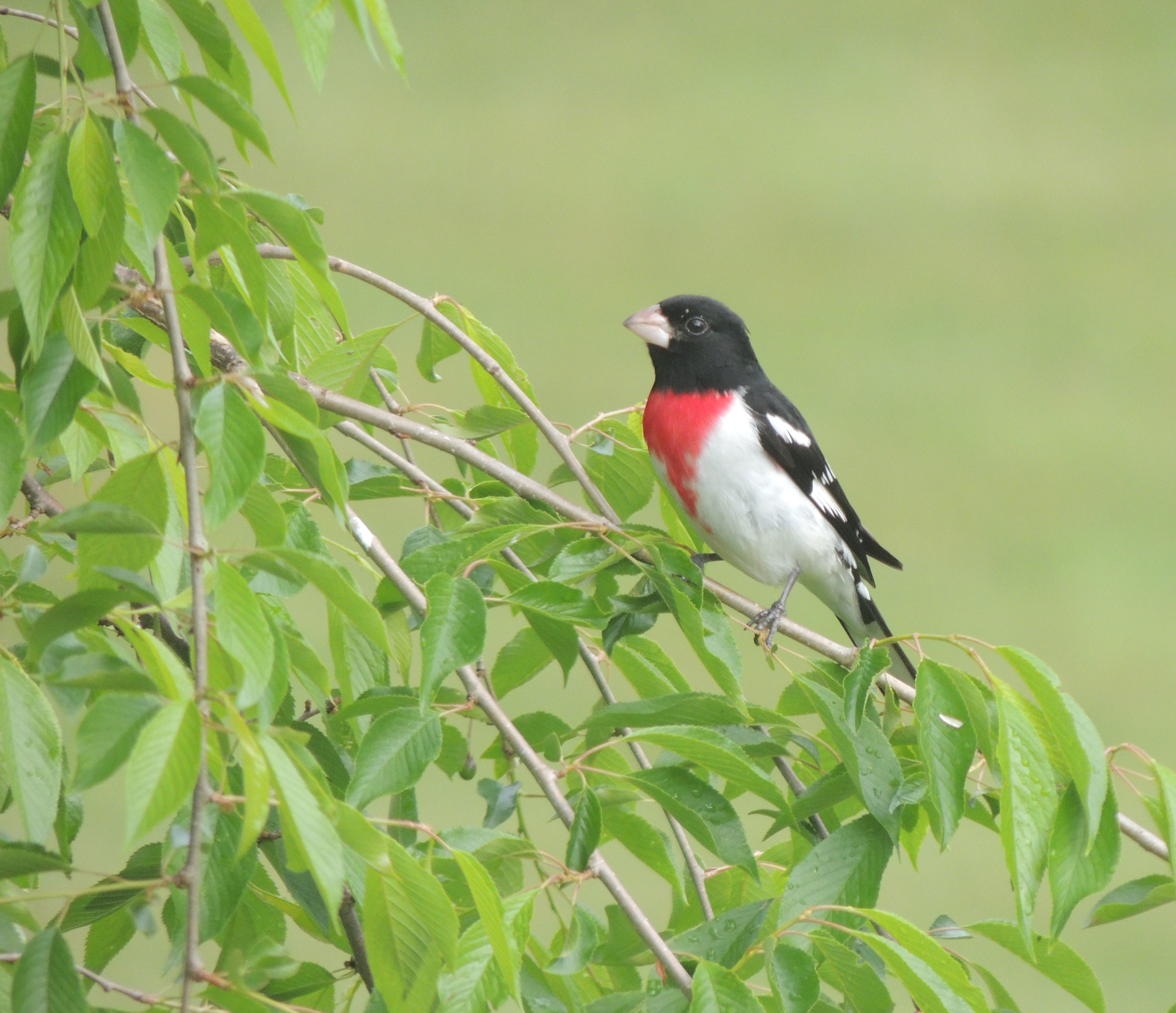
Photo by Tammie Kroll                                      The male rose-breasted grosbeak is probably one of the least difficult songbirds to identify with his unmistakable plumage pattern.

The spring arrival of rose-breasted grosbeaks is usually a fleeting visit. Finding suitable arrangements, which can consist of well-stocked feeders and perhaps a convenient water source, the migrating birds may linger for several days. These birds nest at higher elevations, however, and are usually impatient to continue the journey to where they will spend the summer months tending to their young.

This spring, Tammie Kroll was one of the lucky people to receive visits from rose-breasted grosbeaks. Tammie emailed me to share a beautiful photo she took of the male grosbeak that visited her home in Washington County, Virginia, near Exit 13 off Interstate 81.

There’s good news for those who didn’t receive springtime visits from these pretty birds. The rose-breasted grosbeak is also a common fall migrant and can again be attracted to yards offering sources of food and water. While males usually don’t look quite as dramatic by August and September, they’re still sure to cause a stir when visiting a feeder.

RM-RBGrosbeak

Photo by Bryan Stevens                                         A rose-breasted grosbeak sings from a tree on Roan Mountain, Tennessee.


Plenty of rose-breasted grosbeaks pass through northeast Tennessee, southwestern Virginia and western North Carolina, and a few even decide to make their summer homes in the mountains in these regions. However, these birds spread out widely across the eastern half of the North American continent, ranging from northeastern British Columbia to Quebec and Nova Scotia in Canada. They also range south from New Jersey to Georgia. The rose-breasted grosbeak also reaches Colorado, Oklahoma and Kansas.

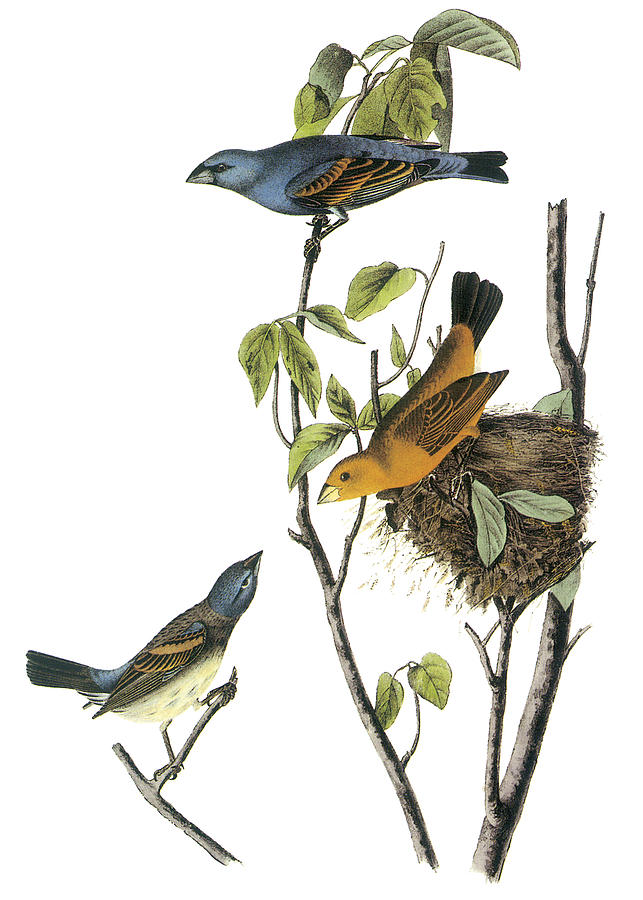
blue-grosbeak-john-james-audubon

John James Audubon painted this family of  blue grosbeaks.

For the most part, however, the rose-breasted grosbeak is replaced in the western United States by the closely related black-headed grosbeak. I saw several of these birds during a trip to Salt Lake City, Utah, back in 2006. Other grosbeaks in the United States include the evening grosbeak and pine grosbeak. In the American tropics other grosbeaks are found, including the descriptively named yellow-green grosbeak, crimson-collared grosbeak, ultramarine grosbeak and yellow-shouldered grosbeak.

•••••

Bryan Stevens lives near Roan Mountain, Tennessee. To learn more about birds and other topics from the natural world, friend Stevens on Facebook at https://www.facebook.com/ahoodedwarbler. He is always posting about local birds, wildlife, flowers, insects and much more. If you have a question, wish to make a comment or share a sighting, email ahoodedwarbler@aol.com.

Rose-breasted Grosbeaks provide splash of springtime excitement


Other than Ruby-throated Hummingbirds, the one bird whose return in the spring is guaranteed to generate excitement is the Rose-breasted Grosbeak. Every spring, I get phone calls and emails from people wanting to share the thrill of seeing these vibrant birds in their back yards.

Photo by Bryan Stevens A Rose-breasted Grosbeak finds a meal of sunflower seeds at a feeder.

Photo by Bryan Stevens
A Rose-breasted Grosbeak finds a meal of sunflower seeds at a feeder.

The spring arrival of Rose-breasted Grosbeaks is a temporary visit. Finding the arrangements, which can consist of well-stocked feeders and perhaps a convenient water source, the migrating birds may linger for several days. These birds nest at higher elevations, however, and are usually impatient to continue the journey to where they will spend the summer months tending to their young.

This year, my first Rose-breasted Grosbeak arrived at my home on Simerly Creek Road in Hampton around 3:30 p.m. on Friday, April 25. I saw a glimpse of black and white with a hint of red that lifted my spirits instantly. I had been hoping for about a week that migrating grosbeaks would visit as they often do in the spring. The lone male settled onto a small hanging feeder and began enjoying an offering of black-oil sunflower seeds. He made repeated trips throughout the afternoon and evening, allowing me to take several photos through a window.

Some of my posted photos drew enthusiastic comments from my Facebook friends. Dani Sue Thompson shared that the beautiful Rose-breasted Grosbeak is one of her favorite birds. Her mother, the late Donna Adams, was a huge fan of the related Blue Grosbeak, which is a less common visitor to Northeast Tennessee than the related Rose-breasted Grosbeak. Donna and I share many a grosbeak story over the years.

Byron Tucker, a friend from Atlanta, notified me on Facebook the day before the Rose-breasted Grosbeak arrived at my home that he was hosting them in Georgia. From a single bird to a flock of three males and three females, these visitors were a first for Byron. He was excited to host these colorful birds for several days at his feeders.

Photo Courtesy of Byron Tucker A Rose-breasted Grosbeak joins a Red-bellied Woodpecker at a feeder in Atlanta.

Photo Courtesy of Byron Tucker
A Rose-breasted Grosbeak joins a Red-bellied Woodpecker at a feeder in Atlanta.

Single birds are occasionally the first to arrive, but Rose-breasted Grosbeaks do form flocks when migrating. Even if a scout shows up alone at your feeders, he will often soon be joined by other grosbeaks. My recent visit by a single male led to two and then three males visiting the feeders. Eventually a female Rose-breasted Grosbeak also made an appearance.

Plenty of Rose-breasted Grosbeaks pass through Northeast Tennessee, and a few even decide to make mountains like Unaka, Holston and Roan their home for the summer. However, these birds spread out widely across the eastern half of the North American continent, ranging from northeastern British Columbia to Quebec and Nova Scotia in Canada. They also range south from New Jersey to Georgia. The Rose-breasted Grosbeak also reaches Colorado, Oklahoma and Kansas.

For the most part, however, the Rose-breasted Grosbeak is replaced in the western United States by the closely related Black-headed Grosbeak.

As fall approaches, the Rose-breasted Grosbeak migrates south to a winter range that spans central Mexico, Central America and northern South America. As they depart, many of these migrating birds will make autumn visits to again partake of offerings of sunflower seeds at backyard feeders. So, if you don’t get to see these showy birds in the spring, you get another chance in September and October.

The male Rose-breasted Grosbeak gives this species it name. Males are the epitome of the birds that make their home for part of the year in the American tropics. The contrasting black and white plumage is emphasized by a triangular slash of rosy-red color on the breast. Put all those elements together and the male Rose-breasted Grosbeak is not a bird that would be mistaken for any other.

The female grosbeak, however, doesn’t quite stand out in the same way. She is much less colorful than the male. With her brown and white plumage, she is often mistaken for a large sparrow or finch.

Photo by Bryan Stevens A young male Rose-breasted Grosbeak visits a feeder in September of 2013. Young males resemble females but show a splash of orange on the breast that will be replaced the following spring by the familiar rosy-red patch.

Photo by Bryan Stevens
A young male Rose-breasted Grosbeak visits a feeder in September of 2013. Young males resemble females but show a splash of orange on the breast that will be replaced the following spring by the familiar rosy-red patch.

Both sexes have a massive bill, which they use to hull sunflower seeds at feeders or glean insects from leaves and branches. It’s the heavy, blunt bill for which the term “grosbeak” is derived. “Gros” is a German term for large or big, so grosbeak simply means a large-beaked bird. People who band birds to further the study of them will tell you that Rose-breasted Grosbeaks have a wicked bite and are capable of delivering quite a nip. In Northeast Tennessee, bird banders frequently encounter Rose-breasted Grosbeaks in their mist nets — and bear the scars to prove it.

With some birds, males play only a minor role in the nesting process. That’s not the case with the Rose-breasted Grosbeak male. The males help with nest-building chores and share responsibility with the female for incubating the eggs.

The female lays three to five eggs in a cup-shaped nest. It’s not easy to locate the nests since the birds usually place them in trees at least 20 feet above the ground. Within two weeks, the eggs have hatched and the parents are kept extremely busy finding enough food to satisfy the voracious nestlings. Well fed by both parents, the young grow quickly and usually are ready to leave the nest within 12 days. Often, when a first brood of young departs the nest, the male will care for the rowdy group of fledglings as the female starts a second nest to capitalize on the long days of summer.

Away from our feeders, Rose-breasted Grosbeaks feed on insects, seeds, fruit and even some leaf buds and flowers. I’ve seen these birds satisfying a sweet tooth — or should that be sweet beak? — by feeding on jewelweed flowers and apple blossoms. If sugar’s good for hummingbirds, I am sure it is a valuable energy source for Rose-breasted Grosbeaks, too.

The Rose-breasted Grosbeak is a cherished spring visitor that never fails to disappoint by bringing a hint of the tropics to the mountains of Northeast Tennessee. I’m hoping many readers are also enjoying their own opportunities for hosting this delightful songbird.

•••••

The bird walk at Tipton-Haynes Historic Site on Saturday, April 26, yielded a good range of birds, including American Robin, House Wren, Cardinal, Song Sparrow, Carolina Chickadee, American Goldfinch, Tufted Titmouse, Crow, Canada Goose, Chimney Swift, Brown Thrasher, Barn Swallow, Eastern Towhee, European Starling, Yellow-rumped Warbler, Chipping Sparrow, Mallard, Red-winged Blackbird, Red-bellied Woodpecker, Turkey Vulture, Black Vulture, Northern Flicker, Grackle, Gray Catbird, Blue Jay, Mourning Dove and Eastern Bluebird.

Photo by Bryan Stevens A pair of Brown Thrashers provided quite a show for attendees at a recent bird walk at Tipton-Haynes Historic Site.

Photo by Bryan Stevens
A pair of Brown Thrashers provided quite a show for attendees at a recent bird walk at Tipton-Haynes Historic Site.

Attending the walk were Heather Jones, Charles Moore, David Thometz and myself. We enjoyed perfect spring weather and also admired the many wildflowers in the gardens and woodlands at the Johnson City historic site.

Members of the Lee and Lois Herndon Chapter of the Tennessee Ornithological Society will also hold a bird walk at 8 a.m. on Saturday, May 10, at Sycamore Shoals State Historic Park in Elizabethton. This walk is held in honor of International Migratory Bird Day and should provide participants with an excellent opportunity for seeing some fine birds.

•••••

I enjoy hearing from readers. Share a sighting, ask a question or make a comment by emailing me at ahoodedwarbler@aol.com or posting to my Facebook page.

Photo by Bryan Stevens The Rose-breasted Grosbeak never fails to impress.

Photo by Bryan Stevens
The Rose-breasted Grosbeak never fails to impress.