Tag Archives: Mallard

Winter’s ducks begin arriving in region

Photo by USFWS • A pair of green-winged teal swim together through a wetland.

Some interesting waterfowl have spent at least part of the winter at the pond at Erwin Fishery Park and a nearby fenced lagoon at the back of the park.

Some of the visitors since the start of the new year have included green-winged teal, American black duck, lesser scaup and Northern pintail. The scaup is a species of diving duck while the others are what are referred to as “dabbling” ducks. Diver and dabbler refers basically to the manner in which these ducks forage for their food.

The familiar mallard is probably the best known dabbling duck, but other dabblers include American wigeon, gadwall and Northern shoveler. Dabbling ducks generally feed in shallow water.

The green-winged teal is the smallest of North America’s dabbling ducks. There are two other close relatives of the green-winged teal in North America – the blue-winged teal and cinnamon teal. I’ve seen the green-winged and blue-winged at many locations in the region. I saw my only cinnamon teal during a trip to Utah and Idaho in 2003.

The Northern pintail that spent some time at Erwin Fishery Park was a hen with a more subtle appearance than adult male pintails.

This can be a species difficult to find in Northeast Tennessee. The website All About Birds notes that Northern Pintails are common, but their populations declined by about 2.6% per year resulting in a cumulative decline of about 75% between 1966 and 2019, according to the North American Breeding Bird Survey. The Partners in Flight organization estimates the global breeding population at 5.1 million.

Photo by Bryan Stevens • The Northern pintail is a dabbling duck, so classified due to its way of foraging for food in shallow water.


Elegant is a useful word for describing pintails. Both sexes have blue-grey bills and grey legs and feet. The drake is more striking, having a thin white stripe running from the back of its chocolate-brown head down its neck to its mostly white undercarriage. The drake also has attractive gray, brown and black patterning on its back and sides. The hen’s plumage is more subtle and subdued, with drab brown feathers similar to those of other female dabbling ducks. She has the same slender shaper as the male. Her tail feathers are long but don’t match the male’s namesake tapered tail feathers.

The Northern pintail is a cosmopolitan duck that also ranges into Europe, the Middle East, India and Asia. Other pintails include white-cheeked pintail, yellow-billed pintail and Eaton’s pintail. The latter species is restricted to the island groups of Kerguelen and Crozet in the southern Indian Ocean. The species was named after the English explorer, naturalist and entomologist Alfred Edwin Eaton. He served as the vicar of Shepton Montague in Somerset in England. Born in 1944, he died in 1929 at age 84.

Our region offers some dependable locations for looking for winter ducks, as well as other wintering waterfowl such as geese, grebes and loons. Accessible locations for looking for ducks during the winter season include Wilbur Lake near Elizabethton and Osceola Island Recreation Area below the tailwaters of Holston Dam in Bristol. Of course, any farm pond not frozen over is a potential location attractive to wandering waterfowl.


A duck known as the common merganser has expanded its summer nesting range to include the Nolichucky River and Watauga River. Twenty years ago this species, despite its name, was far from common in the region. It’s too early to tell whether changes wrought by last fall’s flooding from Hurricane Helene will affect this duck’s nesting attempts along these two rivers.

One difficulty in finding ducks in recent weeks has been the deep freeze gripping the region and turning almost all open water into ice. The widespread cold could help convince waterfowl from farther north to head south in the hope of less frigid conditions. My hope is that at least a few of those ducks will stop off at places like the pond at Erwin Fishery Park.

Ducks that aren’t too difficult to locate during winter in the region include bufflehead, ring-necked duck and hooded merganser. Other possible visitors include redhead and canvasback. If the Northern pintail is the most elegant of the dabbling ducks, the canvasback ranks as the most majestic of the diving ducks.

Ducks are interesting to observe. Binoculars and spotting scopes can make the process easier. Most ducks are social birds. Flocks, or rafts, of ducks display interesting interactions. In addition to the familiar “quack” of the mallard, different ducks produce a variety of hoots, whistles, hisses and other vocalizations.

•••

I’ve written about birds and birding since 1995. To ask a question, make a comment or share a sighting, email me at ahoodedwarbler@aol.com.

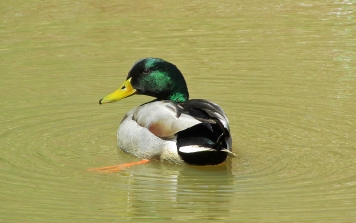
Photo by Bryan Stevens • The male mallard is probably the most recognized duck in the United States.

Good intentions can have ill effects for ducks, geese, other waterfowl


Pattie Rowland contacted me on Facebook recently with a valid concern, especially now that the temperatures are turning a little cooler. People with good intentions often visit parks to feed the ducks and geese that reside at ponds and creeks.


“I see people with bags of bread thinking they are helping the ducks and geese,” she explained.

Despite the good intentions, Pattie, a resident of Erwin, Tennessee, has some concerns about the practice and requested that I help raise awareness about the possible unintended consequences.

While I’m not an expert, I applaud her attempt to raise the issue about what foods are nutritional and which are not when it comes to feeding wild or domesticated waterfowl. So, I did some research into the topic.

Dave McRuer, the director of Wildlife Medicine at the Wildlife Center of Virginia, wrote about the risks associated with feeding waterfowl in a 2015 article on the center’s website.

McRuer noted that wild ducks and geese feed on a variety of natural foods, such as wild grains and grasses, aquatic plants, and invertebrates. This varied diet provides the essentials waterfowl need to thrive.

Mallard-Drakes

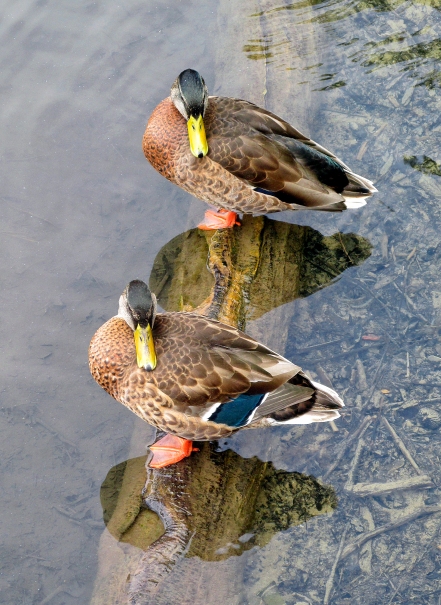
Photo by Bryan Stevens • Mallard drakes share a log during a period of relaxation. Mallards, Canada Geese, and some other waterfowl have voluntarily semi-domesticated themselves in exchange for an easy, but not always healthy, life based on human handouts.

On the other hand, McRuer warned about some of the foods commonly fed to waterfowl in public parks, such as bread, popcorn and corn, are typically low in protein and essential nutrients and minerals. Waterfowl feeding heavily on such fare are at risk for developing nutritional disorders.


His ultimate conclusion was that any benefits are far outweighed by risks when it comes to the feeding of waterfowl at public parks. His recommendation was to stop all forms of supplemental feeding.


He based his recommendation on more than nutritional concerns. Supplemental feeding can also lead to overcrowding, disease concerns, habitat degradation, and an unhealthy habituation to humans or animals associated with humans.


There are some alternatives to the quitting “cold turkey” option when it comes to feeding ducks and geese. Melissa Mayntz, a birder with more than 30 years of experience, penned an article for the website, The Spruce, recommending some foods that will not expose waterfowl to potential harm.


In an article titled “What to Feed Ducks,” Mayntz wrote that it is important to realize that waterfowl are capable of fending for themselves and do not require human handouts to survive, no matter what the season nor how much they seem to beg for treats. She did offer some tips on choosing nutritious treats to supplement the wild diet of park waterfowl.


Various grains, such as cracked corn, wheat, barley, oats, and rice can safely be offered as an occasional treat. In addition, she recommended grapes (sliced in half), chopped lettuce or other greens and vegetable trimmings or peels chopped into small, easily eaten pieces.

Mallard-March28

Photo by Bryan Stevens • A Mallard drake still shows some caution toward humans, arguing that this individual has not become dependent on human handouts.

Mayntz’s article basically echoes many of the warnings from the one by McRuer. Some of the foods commonly offered, such as bread, crackers, cereal and popcorn, offer very little nutritional value. In addition, bread and other similar foods are dangerous if they are moldy. Increasing the disk is the fact that any excess bread that isn’t eaten can quickly mold. Molded food can kill waterfowl, which is the last thing people would want to happen to these birds.


I agree with Mayntz in her conclusion, which admits that feeding waterfowl at local ponds and parks can be a fun experience in wildlife viewing for people of all ages. By avoiding potentially dangerous foods and restricting treats to items that actually provide nutritional value, birders can continue to enjoy this pastime without risking the lives of the birds they love so much.


As a general rule, I don’t feed the waterfowl at local parks. Many years ago I fed a flock of semi-domesticated mallards that took up residence at my fish pond. From a half dozen birds, the flock eventually grew to about two dozen ducks. The only food I fed them was cracked corn during the winter season. They foraged quite successfully for the rest of their food from the pond, the nearby creek and the fields. I’m convinced they helped control the numbers of pest insects during their stay. To this day, an occasional pair of mallards will visit on cold winter days. At times, they look at me like they’re expecting a handout and I wonder if they could be descendants of some of those mallards from the original flock.

Canada_Geese

Photo by Bryan Stevens • In some areas, Canada Geese have become so prevalent that they are considered pests. Human handouts to waterfowl are not always compatible with good health for the birds that receive them.


So, don’t let good intentions cause problems for any of our feathered friends. If you want to feed ducks at the local park, consider the healthy alternatives instead of providing bread. After all, people cannot live on bread alone, and neither can ducks.


•••••

Calendars make fun Christmas presents

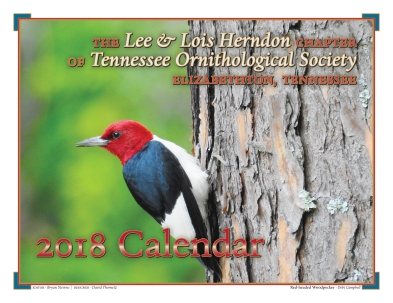
The Lee and Lois Herndon Chapter of Tennessee Ornithological Society produces an annual calendar featuring some exceptional bird photography from its members. This year’s calendar features full-color photographs of some colorful and engaging birds. The club sells the calendars for $15 each. All proceeds are used to support birding opportunities and bird-related causes. For instance, the club pays for bird seed to stock the feeders at Sycamore Shoals State Historic Park in Elizabethton, Tennessee. The club also regularly supports causes that benefit birds.HerndonCalendar2018(Cover)

The calendar also features an informative calendar grid with highlights for major holidays, as well as important bird-related dates. The calendar’s pages feature more than 80 full-color photographs of area birds, including common favorites, as well as a few more exotic birds. The front cover features a dazzling photograph of a red-headed woodpecker. The photo was taken by Debi Campbell, a resident of Bluff City, Tennessee, and current president of the Herndon chapter. If you’re interested in obtaining a calendar, contact ahoodedwarbler@aol.com by email. Calendars will also be available for purchase by cash or check only at the offices of the Bristol Herald Courier located at 320 Bob Morrison Blvd. in Bristol, Virginia.

If you’re interested in obtaining a calendar, contact ahoodedwarbler@aol.com by email. Calendars will also be available for purchase by cash or check only at the offices of the Bristol Herald Courier located at 320 Bob Morrison Blvd. in Bristol, Virginia.