Tag Archives: penguins

Great auk’s story ended 180 years ago this week

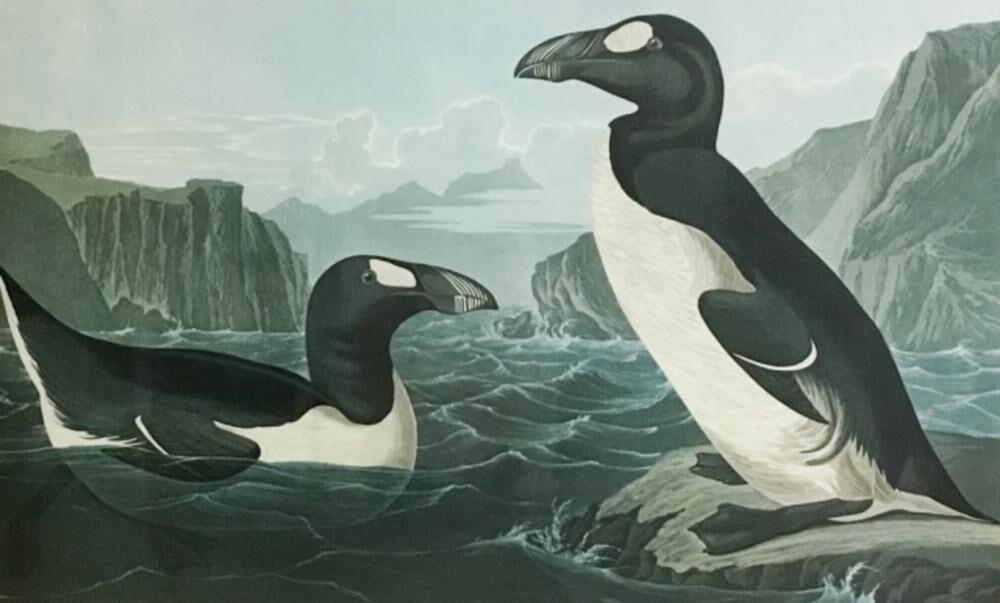
Although he never saw the species in person, famous naturalist and artist John James Audubon painted this pair of great auks about the time the species was heading toward extinction.

It’s summer and the birds are busy nesting in the mountains and valleys of the Southern Appalachians. Eighteen decades ago, during a summer nesting season far away in the North Atlantic, the story of an unusual seabird came to a brutal end.
The last pair of great auks was killed on Eldey, off the coast of Iceland, on June 3, 1844. This little-known tragedy ended the last known breeding attempt for the species 180 years ago this week.


The great auk, also known as the great Northern penguin, once inhabited the Atlantic coasts of both North America and Europe. This flightless bird achieved the status of “great” due to its size. Adult great auks reached a height of about 32 inches and could weigh as much as 11 pounds, making them much larger than any of their close relatives. This bird had a black back and a white belly in a two-tone plumage that does indeed resemble the appearance of many penguins. The bird’s black beak was heavy and hooked, with grooves on its surface, excellent for catching fish.


The great auk belonged to the bird family of Alcidae, which also includes such birds as auks, auklets, murres, murrelets, puffins, razorbills and guillemots. The family is not closely related to penguins, which are only found in the Southern Hemisphere. The great auk’s scientific name – Pinguinus impennis – has reinforced the misconception that penguins and the great auk were closely related.
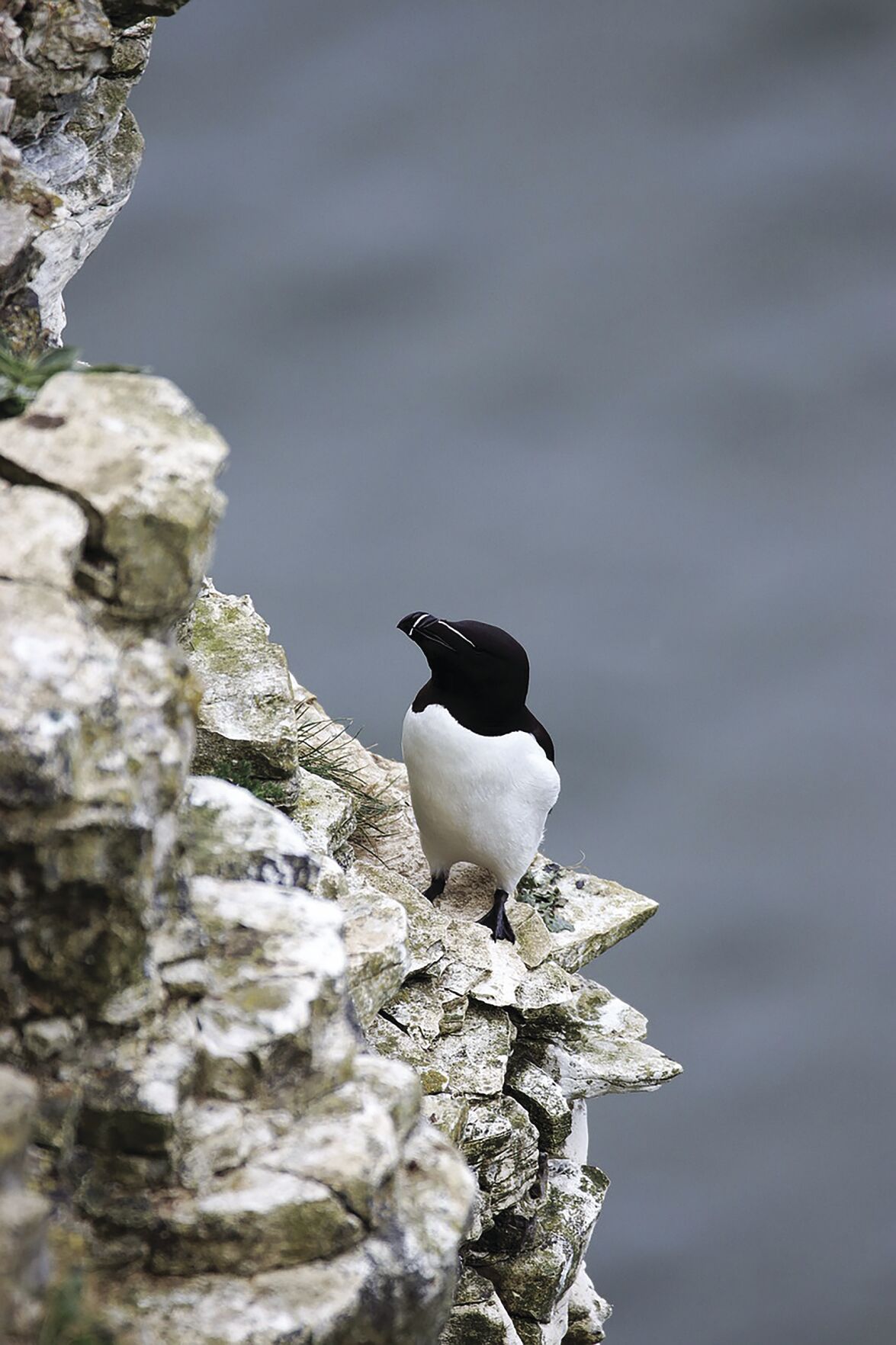
Photo by Kevin/Pixabay • The razorbill, also known as the lesser auk, is probably the member of the Alcidae that most resembles the great auk, albeit on a diminished scale.


Today, one close relative of the great auk still swims in the North Atlantic off the coasts of both North America and Europe. The razorbill (Alca torda) is the sole species in the genus Alca since the extinction of the great auk in the mid-19th century.


Razorbills, as did their larger relative, nest in colonies. Razorbill nesting colonies exist off the coasts of Canada, Iceland, Norway, Wales and the United Kingdom. After the nesting season, razorbills abandon the land and spend the winter months at sea. Razorbills are occasionally spotted as far south as the Carolinas, Georgia and Florida during the winter season.
Razorbills have a body length of almost 17 inches and weigh from one to two pounds, placing them well shy of the size of their extinct relative.


Great auks figured prominently in the cultures of some native sea-going tribes. Although Native Americans did hunt the birds, their efforts had been sustainable.
The coming of European explorers and settlers threw the balance out of whack for this species, which nested in large colonies. Explorers in North America plundered the great auks as a food source and also used the flesh of the birds as fish bait. In Europe, a demand developed for the great auk’s down, those dense, insulating feathers that provided a warm, protective layer against the chill of North Atlantic waters.


These factors quickly led to a steep decline in numbers as early as the 1700s. Sadly, museums and private collectors began to clamor for specimens as the great auk became more rare. The collecting of the birds, as well as their eggs, for this purpose is blamed by some experts with the ultimate extinction of the species.


Pairs of great auk, which mated for life, focused their nesting efforts on raising one chick at a time, which made the species even more vulnerable. A report of a single great auk in 1852 off the Grand Banks of Newfoundland is accepted by some experts, which means this bird was the last known individual of its kind.


The bird’s legacy has lived on, especially with naturalists and birders. The scientific journal of the American Ornithological Society was titled “The Auk” in honor of the species until 2021 when the name of the publication changed to simply “Ornithology.”
The presence of skins and bones in museums around the world have encouraged speculation that modern technological advances in genetics and cloning could possibly revive the great auk from preserved DNA.


Such scenarios seem a little too Hollywood and reminiscent of the “Jurassic Park” and “Jurassic World” films. The reality is that the great auk is part of a lamentable extinction club with such members as Labrador duck, passenger pigeon, Carolina parakeet, Bachman’s warbler and many others, dating back to birds like the moas and the dodos.


It would be nice, especially for birders, if cruises in the North Atlantic could still offer the opportunity to view these fantastic birds swimming in the cold waters. It is still possible to view nesting colonies of birds like the Atlantic puffin, black guillemot and razorbill. If I do get the chance to view these sea-going birds some day, I’ll be thinking of the great auk when I do so.


•••


To share a sighting, make a comment or ask a question, please email me at ahoodedwarbler@aol.com.

Cardinal has rivals when it comes to depiction on Christmas cards

Although many articles have been penned about the demise of the Christmas card, I still receive plenty of these paper greetings each holiday season. My friends and acquaintances, knowing me well, I suppose, often select cards featuring a variety of birds. Regardless of rising postal costs and hectic schedules during a busy season, the Christmas card appears to be an enduring tradition.

Northern_cardinal

Photo by Nathan Rathbun/USFWS • An observation of a bright red male Northern cardinal is sure to put some cheer into the holidays.

Many of the cards I have received this year and in past holiday seasons have featured the Northern cardinal, which has long been one of my favorite birds. During the winter months, particularly during the holiday season, the Northern cardinal seems to take on even more significance. Anyone who received many Christmas cards this year will probably confirm that the cardinal often appears on them. The origins of the cardinal’s affiliation with the holiday of Christmas are a bit murky. After all, the Northern cardinal is a North American bird that would have been unknown in Europe until the 1600s, when the first explorers and settlers arrived from Europe.

Chinstrap5-HR

Photo by Jeff Keller/National Science Foundation • Chinstrap penguins (Pygoscelis antarctica) are also known as the bearded penguin and the ringed penguin. They reach about two feet tall and weigh less than 10 pounds. Chinstraps form strong bonds with their mates and will wait long periods for their mates to return to the breeding ground each year, rather than take a new mate.

The cardinal is hardly the only species of wildlife, let alone bird, that has become closely associated with the holiday. Everything from polar bears and seals to doves and penguins are also popular motifs for designers who craft Christmas cards. In recent years, I’ve even seen other birds — owls, chickadees, and even sandpipers — begin to decorate cards.

Often, when we think of the birds of the winter season, our thoughts focus on some of the less-than-colorful feeder visitors — the brown sparrows and wrens, the black and white chickadees and the drab American goldfinches that are such a contrast in winter to their vibrant summer appearance. The Northern Cardinal, especially the brilliant red male, stands out against a winter backdrop of snow white, deep green or drab gray. Could there be a better bird to brighten a Christmas card?

Well, as it turns out, there are other birds beyond the picture-perfect Northern cardinal that are worthy of gracing the front of Christmas cards. As previously mentioned, penguins are popular featured birds on many a Christmas card. Thanks to major motion pictures like Happy Feet (2006) and Mr. Popper’s Penguins (2011), as well as documentaries like 2005’s March of the Penguins, these dapper birds have enjoyed an enhanced profile in recent years and earned a place on our Christmas cards.

Emperor_Penguins

Photo by Kelly Falkner/National Science Foundation • Two emperor penguins greet each other near Ross Island in Antarctica. Emperors are the largest of all penguins, reaching nearly four feet tall.

Of course, there’s not one single “penguin” species. There are about 20 different penguin species, ranging in size from the emperor penguin, which weighs 75 pounds and stands three feet seven inches tall, to the little blue penguin, also whimsically known as the fairy penguin, which weighs 2.2 pounds and stands about 16 inches tall. Other species include the king penguin, yellow-eyed penguin and macaroni penguin.

While at first glance owls are an unlikely species for depiction on a Christmas card, I can understand why people have embraced these nocturnal birds. With their big eyes and a reputation that has improved as we are less likely to embrace superstitious myths, owls are a good choice for gracing the cover of a card. One species — the snowy owl — is a perfect bird to depict the wintry season. With its white plumage, contrasted with varying amounts of black or brown markings on the body and wings, this owl of the Far North is a good symbol for the Christmas season. It’s no surprise at all to find an image of a snowy owl staring with piercing yellow eyes from the front of a Christmas card. Other species of owls that I’ve seen featured on cards include barn owl, great horned owl, Northern saw-whet owl, and burrowing owl.

In real life, the snowy owl is a denizen of the treeless tundra regions of the Arctic. Some winters see these owls staging massive migrations that bring them south of the Canadian border. While they are more likely to spend the winter months in such Canada-bordering states as Minnesota, Michigan and Wisconsin, snowy owls have surprised and delighted birders by winging their way as far south as Tennessee, Virginia and North Carolina during some winters.

Snowy-OWL

Photo by Tom Koerner/USFWS • This snowy owl was photographed at Sand Lake National Wildlife Refuge in South Dakota. Some winters see great numbers of this owl surge out of the tundra to winter south of the Canadian border.

While owls and penguins are definite contenders, I’d wager that the Northern cardinal is the bird most often depicted on Christmas and other greeting cards. As further evidence to explain the popularity of the Northern cardinal, consider that it’s the official state bird of seven states — Virginia, North Carolina, West Virginia, Ohio, Illinois, Indiana, and Kentucky. Only the Northern mockingbird, which represents five states as official state bird, even comes close to the Northern Cardinal in this respect. Being designated an official state bird is also an honor that’s eluded any species of owl, let alone any of the world’s various penguins.

5-snowy-owl-john-james-audubon

Snowy owl pair painted by John James Audubon.

Finally, one last thing works in favor of the Northern cardinal. Once the holidays are past, and the Christmas cards are packed away, there’s nothing like a glimpse of a Northern Cardinal to add some cheer to a bleak winter day.

•••••

Bryan Stevens lives near Roan Mountain, Tennessee. To learn more about birds and other topics from the natural world, friend Stevens on Facebook at https://www.facebook.com/ahoodedwarbler. If you have a question, wish to make a comment or share a sighting, email ahoodedwarbler@aol.com.

Crozier_Adelie_Penguin_Adult_looking-HR

Photo by Mike Lucibella/National Science Foundation • An adult Adelie penguin turns its head. The Cape Crozier penguin colony is one of the largest known Adelie penguin colonies in the world, home to roughly half a million birds.