Tag Archives: Shorebirds

Noisy killdeer parents have mastered the art of deception

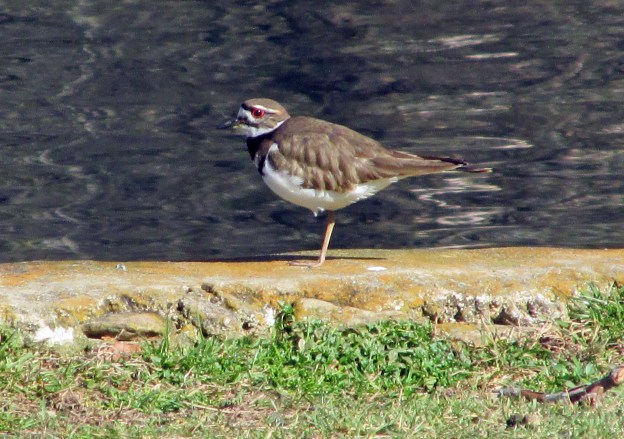
Photo by Bryan Stevens • A killdeer stands near the edge of a stream.

In last week’s column, I focused on the black-necked stilt, an oddity in the shorebird family that few non-birders would have ever heard of. This week, my focus will be on the killdeer, which is probably the shorebird most people know. Even non-birders have probably encountered this wide ranging bird that resides across much of North America.

While killdeers are considered shorebirds, they are certainly not confined to shorelines but can be found in a variety of habitats from school yards to golf courses to prairies and fields.

About 11 inches in length, the killdeer is brown above and white below with two black bands across the white chest. Males and females look alike.

These birds, despite their common name, are not antagonistic toward deer. The name killdeer refers to the loud, strident vocalization these birds produce when alarmed or disturbed. Early naturalists also noticed the noisy nature of killdeer, giving them names such as chattering plover and noisy plover, according to the website All About Birds.

The female killdeer usually lays up to four eggs on a spot on the bare ground that she may or may not have lined with some grass. Both parents attempt to guard the nest from predators. They are reliably zealous in their duties. In fact, the killdeer is famous for faking a display of injury whenever intruders draw too close. The display is meant to lure potential predators away from the location of the nest.
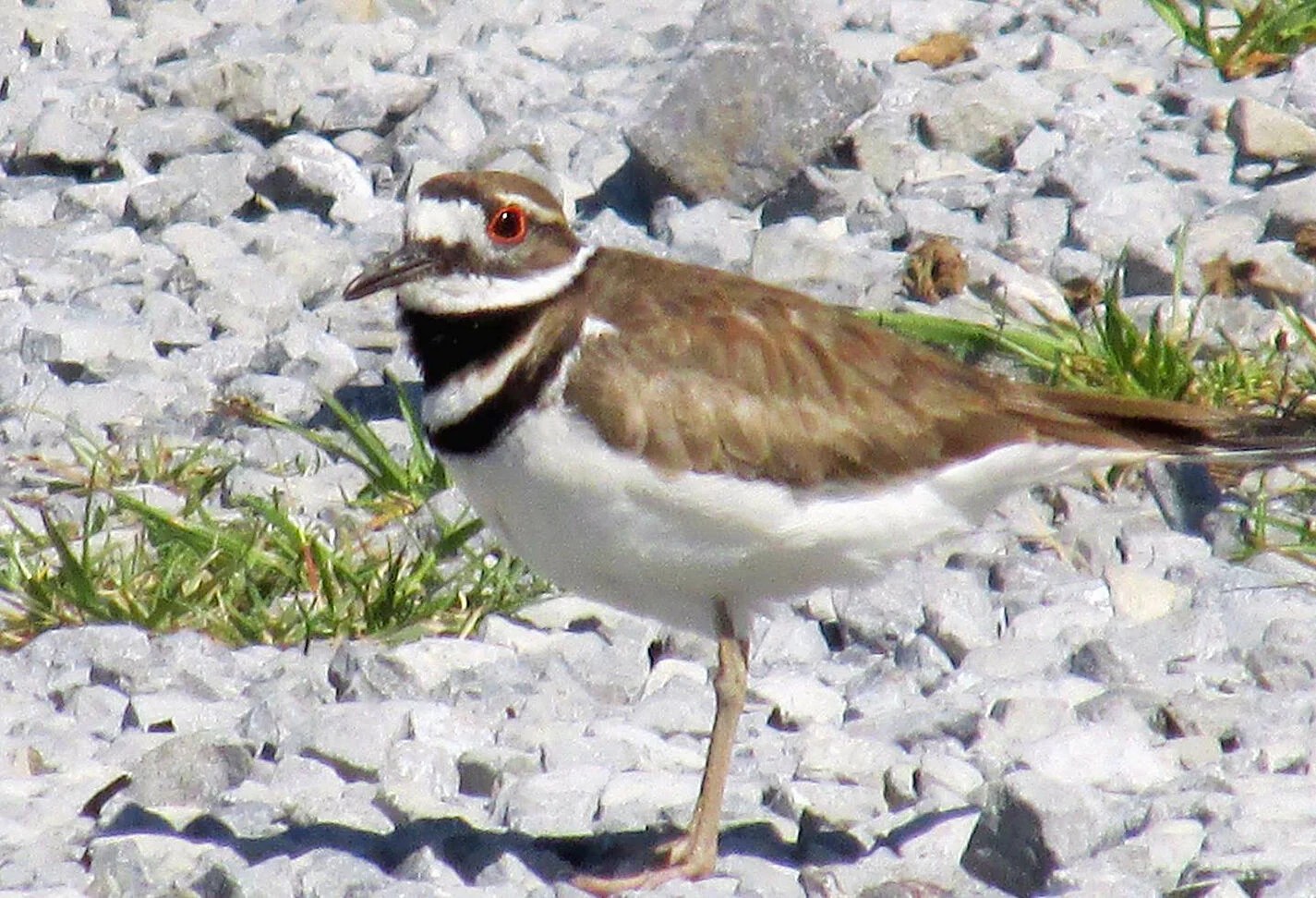
Photo by Bryan Stevens • A killdeer stands sentry duty near its nest in a gravel parking lot.

The predator, thinking the “injured” killdeer will be easy prey, follows the bird away from the nest’s vicinity. Killdeer will also put on the show for humans who venture too close to the nest. They drag their wings in a convincing display of serious injury. Of course, once the ruse has worked, the killdeer miraculously recovers and returns to its nest.

I learned about the killdeer early in life. I had a wise teacher for my first grade year. When a nesting killdeer built its home in the school yard, the teacher turned the discovery of this feathered neighbor into a teaching event.

I remember the bird performing the broken wing display and our teacher patiently explaining the rationale for the bird’s antics. The teacher must have been protective of the bird. I do recall that my fellow students and I were forbidden to approach the nest. Considering the natures of first-grade students, that was probably a smart precaution.
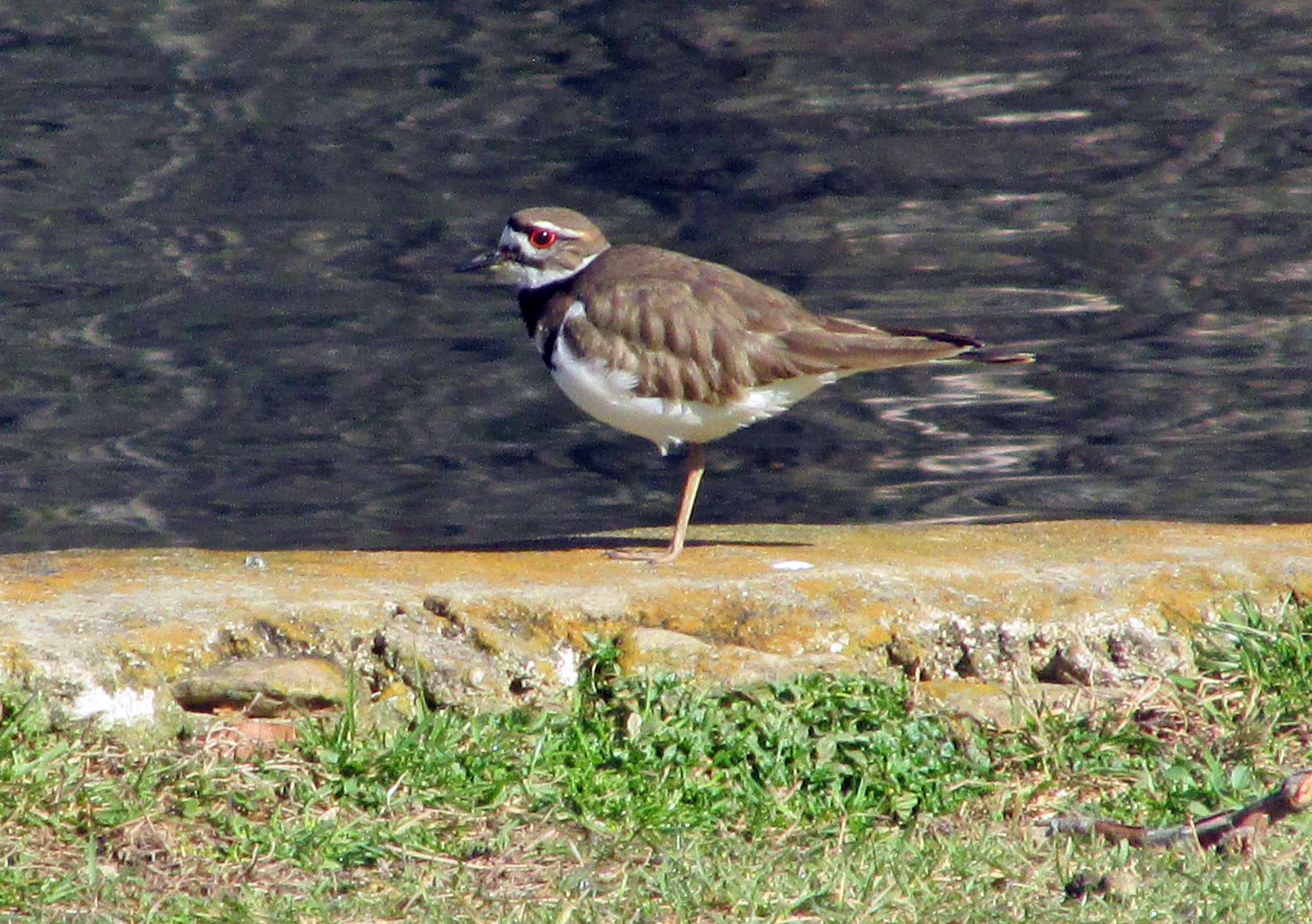
Photo by Bryan Stevens • A killdeer stands at the edge of a large pond at Fishery Park in Erwin, Tennessee.

The class followed the progress of the killdeer family as the eggs hatched and the school grounds became the home turf for the pair of killdeers and their young. I don’t recall a conclusion to the story. Since killdeer nest in spring, I suspect that the school year came to an end ahead of the nesting season.

The killdeer is a member of the plover family, which includes shorebirds distinctly different from related sandpipers.

There are more than 60 species of plovers worldwide, with several different species spending at least part of the year in North America. Close relatives of the killdeer include Wilson’s plover, semipalmated plover, snowy plover, mountain plover and the endangered piping plover.

Killdeers utilize some unusual nesting locations, including gravel parking lots and building rooftops covered with gravel or pebbles. Young killdeers can leave the nest site soon after hatching and follow their parents as they forage for food. They look like fuzzy golf balls with toothpick legs.


I’ll always remember my first encounters with this large, loud plover while a student at Hampton Elementary School many years ago. Observing that killdeer family no doubt planted the seed that eventually sprouted into my enthusiasm for watching birds. Witnessing the trickery the birds deployed to foil predators — and curious kids — away from their nests remains fresh in the memory.

Photo by Bryan Stevens • The killdeer is a plover, placing it within the family of shorebirds. They are more often found on open fields instead of along coastal shores.

Somewhat more recently, I encountered another fuzzy golf ball at rest on the ground toward the back of Erwin Fishery Park. Thinking the tiny bird was dead, I picked it up for a closer look. Even as I handled the bird, it remained motionless in my hand. When I returned the tiny “body” to the ground, however, the bird performed an amazing resurrection and fled the vicinity as quick at those toothpick legs could carry it.

Numerous people have called or written me throughout the years to report unusual nesting locations used by killdeers. I’ve seen nests in hotel parking lots, local parks and construction sites. As I mentioned earlier, the female killdeer is content to lay her eggs directly on bare soil, although she will occasionally line the nest.

These birds are opportunists. The nest lining often consists of what is most readily available. I once inspected a killdeer nest lined with discarded cigarette butts. I’m hopeful the babies didn’t hatch with instant nicotine addictions.

•••

Bryan Stevens has written about birds since 1995. Share a sighting, ask a question or make a comment by emailing him at ahoodedwarbler@aol.com.

Photo by Bryan Stevens • A killdeer covers its egg during a light rain.
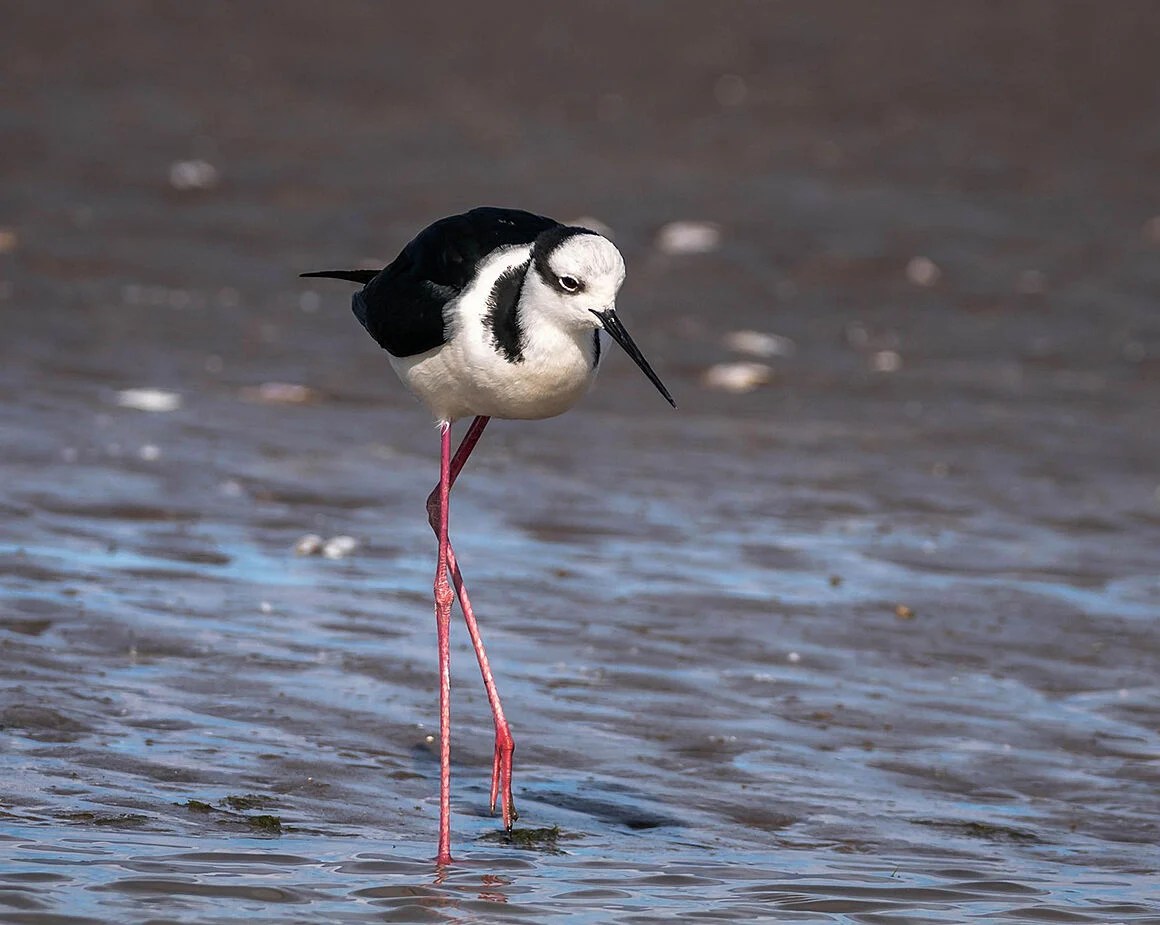
Black-necked stilt a gangly member of the windbird clan

Beto/Pixabay. • A black-necked stilt wades through a wetland area.

I received an email from Brayden Paulk updating me on his new birding adventures since moving to Gulf Shores in Alabama. I wrote a few weeks ago about Brayden and his plans for a Global Big Day of birding.

“I wanted to give you an update on the Big Day,” he wrote, informing me that he has been undergoing a lot of training for a new job and has had lots of 10-plus hour days. But birding has been productive.

“I got down here and I’ve had lots of success,” he wrote. “Where I live there are black-bellied whistling ducks hanging out by the pond, and prothonotary warblers in the swamp behind the apartment,” he said.

Unfortunately, his new job needed him to work on the date of his Big Day.

“So I was not able to do my plans,” he wrote. “However, I did get to go out for a few hours that afternoon to a nearby sod farm. I picked up several good birds, including spotted sandpiper, solitary sandpiper and, most importantly, black-necked stilt.”

Brayden reported that he observed two stilts working the edge of a flooded corner of the field along with dozens of other shorebirds that were too small to identify in low light.

“I was glad that I could do my part to submit one checklist on the Big Day, even if I couldn’t do a 24-hour birding marathon like I had planned,” he added.

He added that his best birding day recently took place two days prior to his planned Global Big Day.

“I got to meet some folks from Alabama Audubon when they came to the Eco Center,” he said. “After the tour, I was invited to go do some sea watching with them at Gulf State Park.”

He noted that the three guys on the impromptu session included Scott Duncan, the director of Alabama Audubon, and two top birders in Baldwin County.

“They were very helpful and wonderful people,” Brayden shared. “While we were out birding, I picked up two lifers: Gull-billed tern and semipalmated sandpiper.”

Bryan Stevens • Black-necked skimmers take flights along the South Carolina coast.

He also reported that they saw lots of other cool coastal birds, such as black skimmer, least tern and osprey.

“The coolest species, though, were two red knots,” he said. “I had only seen them once before, but this was my first time seeing them in breeding plumage. I was very excited to see it, and get two lifers in one day!”

He is also anticipating some future birding.

“My friend Don has a rare shiny cowbird at his house a few miles away from me, as well as Inca doves.”

I enjoyed hearing about Brayden’s sightings of shorebirds, a family of birds also known with a little more creative flair as “wind birds.” They are so named because so many species are capable of incredible long-distance migrations. His success with the black-necked stilts reminded me of how this can be an elusive species for birders.

My last sighting of black-necked stilts took place more than a decade ago in May of 2014 during a South Carolina vacation. I observed three black-necked stilts at Huntington Beach State Park while walking on a marsh boardwalk near the park’s Nature Center. They flew toward the causeway, so I got into my car and drove there to try to re-locate them. I did find two of the stilts feeding along the causeway, but I never managed to re-locate the third bird.

Photo by Bryan Stevens
Two Black-necked Stilts forage along the causeway wetland at Huntington Beach State Park in 2014. 

I watched the two stilts foraging for food in shallow water shared by egrets and alligators. The two birds, despite a somewhat gangly appearance, moved with elegantly efficient strides on their long pink legs.

I have seen this unusual shorebird in Tennessee only once on Oct. 13, 2004, at Austin Springs on Boone Lake in Washington County. The bird, first found by Rick Knight, drew many excited birders to the location for looks at this shorebird before it departed to continue its migration flight south.

As you might imagine, land-locked Tennessee is not an ideal location for finding shorebirds, but spring and fall migration brings a surprising variety of these birds through Northeast Tennessee. Black-necked stilts, however, are a rarity. I have also seen this species of shorebird on Fripp Island, South Carolina, as well as just outside of Wendover, Nevada, on a visit to the Bonneville Salt Flats.

The world of shorebirds has produced many look-alike species, including many of the small sandpipers often collectively labeled as “peeps” by birders. The black-necked stilt, however, is not at all likely to be confused with any other shorebird. It is a slender bird atop a pair of extremely long pink legs. It has a two-tone appearance with black upper parts and white underparts. The black and white dichotomy continues along the bird’s long neck and head. This bird also has a thin, needle-shaped bill that it uses to delicately pluck aquatic insects and other prey from water or mud. The black-necked stilt’s long pink legs are exceptional. In fact, this species has he second-longest legs in proportion to their bodies of any bird, exceeded only by flamingos, according to the website All About Birds.

The black-necked stilt is closely related to the American avocet, another long-legged shorebird. The two species are classified together in the family, recurvirostridae. There’s also a Hawaiian sub-species of the black-necked stilt known as the “aeʻo.”

•••

To share a sighting, make a comment or ask a question, email me at ahoodedwarbler@aol.com.

Plovers among migration champions of vast and varied shorebird clan

0815171646c (1)

Photo by Janice Humble • A killdeer wanders in a grassy area near the Wal-Mart on Volunteer Parkway in Bristol. The killdeer, a species of plover, is one of the more common shorebirds found in the region.

I’m always glad to lend a hand at identifying birds. If you’re uncertain of a bird’s identification and have a photo of the bird in question, assistance is an email away. Janice Humble emailed me seeking some help with identifying the bird in a photograph attached with her message. She noted that the bird was accompanied by a companion in the grassy area near the Wal-Mart on Volunteer Parkway in Bristol. She also noted that the two birds uttered loud “peeps” during her observation.

The bird turned out to be a killdeer, a species of plover native to North America. Plovers belong to the family of shorebirds that include various sandpipers, curlews, dowitchers, stilts, avocets and other species. The killdeer is a rather common shorebird that finds itself at home far from the seashore, often present in habitats such as pastures and golf courses, as well as the grassy areas near the concrete and asphalt jungles that surround Wal-Marts and other such shopping complexes.

The killdeer’s famous for its faking of an injured wing. When its nest or young is threatened, a killdeer will go into an elaborate display, fluttering the “injured” wing and uttering shrill peeps to distract the potential predator. If successful, the bird will lure the predator away from the nest or vulnerable young. Once at a safe distance, the killdeer undergoes a miraculous recovery and takes wing, leaving behind a bewildered and perhaps chagrined predator.

Killdeer_AgainstLog

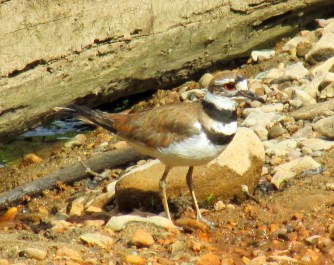
Photo by Bryan Stevens • A Killdeer explores near a stream bank.

Other North American plovers related to the killdeer include American golden-plover, black-bellied plover, Pacific golden plover, Wilson’s plover, piping plover, snowy plover, mountain plover and semipalmated plover. About 70 different species of plovers exist around the world, including such descriptively named birds as little ringed plover, red-capped plover, three-banded plover and white-fronted plover.

Musick’s Campground on Holston Lake has been one of the best area locations for seeking shorebirds during their migrations. The shore near the campground has been a magnet for persuading unusual shorebirds to pause their journey to rest, refresh and refuel. The location’s privately owned, but individual wishing to bird the shoreline can enter by signing the guest book located a small but well-marked kiosk. Some of the most memorable shorebirds I’ve seen at Musick’s Campground over the years include whimbrel, dunlin, sanderling, greater yellowlegs, short-billed dowitcher, American avocet, black-bellied plover and semipalmated plover. In recent weeks, the location has hosted such unexpected shorebirds as red knot and red-necked phalarope.

While the neighboring states of Virginia and North Carolina offer coastal birding opportunities, my native Tennessee remains quite landlocked. This fact poses a challenge for birders looking to capitalize on the seasonal migrations of shorebirds. Fortunately ponds, mudflats on the shorelines of lakes, riverbanks and even flooded fields offer adequate substitute habitat for many shorebirds. While the Mountain Empire region may lack a seashore, migrating shorebirds have learned to make do.

6300749922_099f28ae81_o (1)

Photo by Jean Potter • The American golden-plover, like this individual, is a long-distance migrant among the varied family of shorebirds.

This varied and far-flung family is also known as “wind birds,” a term which is an allusion to the capacity of many species of shorebirds to undertake nothing less than epic migrations. Many of the shorebirds that pass through in the spring are in haste to reach their nesting grounds as far north as the edge of the Arctic tundra. In fall, many of the same birds are eager to return to destinations in Central and South America ahead of cold weather and times of scarcity.

The plovers — the sedentary killdeer excepted — are among the champions of long-distance migration. According to the Audubon website, the black-bellied plover spends the brief summer season nesting in the world’s high Arctic zones but disperses to spend the winter months on the coasts of six of the globe’s seven continents.

The Pacific golden-plover’s twice yearly migrations represent an even more impressive feat. This shorebird often nests in Alaska and winter in Hawaii. The website Phys.org notes that research on this plover has revealed that the bird is capable of flying almost 3,000 miles in a mere four days. The website also reveals that those plovers wintering in Hawaii cannot lay claim to longest migrations. Some Pacific golden-plovers nest even farther south in the Pacific, reaching the Marshall Islands.

Black-belliedPlover

Photo by Jean Potter • A black-bellied plover stands out from most relatives when it wears its nesting season breeding plumage.

Shorebirds represent only a single family of birds migrating through the region in the fall. Songbirds from warblers and thrushes to vireos and flycatchers, as well as raptors and waterfowl, wing their way through the region every fall. Get outdoors with a pair of binoculars and have a look. It’s almost impossible not to see something, which may turn out to be a delightful and unanticipated surprise.

••••••

To learn more about birds and other topics from the natural world, friend Stevens on Facebook at https://www.facebook.com/ahoodedwarbler. To ask a question, make a comment or share a sighting, email him at ahoodedwarbler@aol.com.

Woodcocks, snipe among the more oddball members of a diverse shorebird clan

Photo by Leah Hawthorn/U.S. Fish & Wildlife Service • An American woodcock probes for food among fallen leaves on the woodland floor.

March is traditionally a month of erratic weather, characterized by blustery winds and occasional drenching rainstorms. While the month is also a signal to get ready for the return of migrant songbirds, they are hardly the only birds on the wing each spring. Birds from waterfowl to raptors migrate through the region in March, April and May, but the real migratory champs are the shorebirds.

Known for migrating incredible distances, the shorebirds are often referred to as “wind birds,” a romantic allusion to their habit of taking wing for the epic journeys that astound scientists and birders alike. Among the far-flung family are birds known as sandpipers and plovers, as well as whimbrels, willets, tattlers and turnstones.
Still, among the general public, as well as some birders, the shorebirds are a much misunderstood group of birds. For example, most people could hardly be blamed for believing that shorebirds are inhabitants of only the beach and shore. In fact, some species are at home in an array of habitats, ranging from woodlands and prairies to the Arctic tundra and mudflats. Some are notoriously elusive, their camouflage and low-key behavior allowing them to escape casual notice at most times.
In late winter and early spring, a true oddball among the shorebirds begins courting. The American woodcock, also known by such whimsical names as “bog sucker” and “timberdoodle,” is a shorebird that has completely abandoned the shore in favor of woodlands and fields. Beginning as early as February, American woodcocks in the region conduct nightly courtship displays, starting at dusk, that combines aerial acrobatics with an assortment of unusual acoustical flourishes. Any wet field adjacent to a wooded area could offer a stage for these evening displays, but unless you know where to look and make an effort to do so, the American woodcock might as well remain a phantom of the night.
John-James-Audubon-American-Woodcock.-1.-Male.-2.-Female.3.-Young-in-Autumn

John James Audubon, an early American naturalist and artist, painted this scene of American woodcocks feeding in damp earth.

These mating rituals provide almost the only time that this bird makes itself visible to us. It’s only during this brief window that opens into their lives that we can be assured a glimpse. Even then, our peek at woodcocks often consists of a fuzzy twilight escapade as the bird flings itself heavenward only to make a spiraling descent a few seconds later. The displays begin with a distinct vocalization, a type of “pent,” that also has the quality of sounding like some sort of mechanical buzzer.
Once the displays conclude for the season, the birds assume nesting duties, usually unobserved by humans. The rest of the year, almost nothing but blind, sheer luck would allow a birder to stumble across an American woodcock. It’s almost as if they disappear after these spring flights of fancy.

For the most part, the “wind birds” leave lives in habitats that keep them separate from humans. On occasion, however, one of these shorebirds pays an unexpected visit to members of the public. Tom and Helen Stetler, residents of Elizabethton, Tennessee, shared an account of one such visit in a recent email.

Snipe-Stetler

Photo by Tom Stetler • A Wilson’s snipe visits the yard at the home of Tom and Helen Stetler in Elizabethton, Tennessee.

“We had a visit from a very unusual bird today,” Tom wrote in the email. “It was a woodcock. It stayed quite a while this morning.”
He estimated that the bird stayed in their yard for about 15 to 20 minutes.  “I kept trying to get a good picture of its long bill and finally did,” he said, enclosing a photo of the visiting bird with his email.
He credited his wife, Helen, with having spotted the bird. After seeing the bird, Helen called to her husband to come have a look “at this bird with a very long beak!”
After I examined the photo, I noticed that the unusual visitor was actually not a woodcock but a closely related bird known as a Wilson’s snipe. The confusion of the two birds is quite understandable. The snipe and the woodcock bear a superficial resemblance to each other.

The American woodcock belongs to the genus of Scolopax, a Latin term for this group of eight oddball shorebirds. Other members of the genus include the Eurasian woodcock, the New Guinea woodcock and the Sulawesi woodcock.

Snipe-One

Photo by Bryan Stevens • The Wilson’s snipe is remarkably capable of blending with its surroundings.

Wilson’s snipe, which is closely related to the woodcock, inspired the term “snipe hunt.” Regarded as lessons in futility, these hunts are not seeking some mythical quarry, although some people mistakenly believe there’s no such bird as a snipe. In fact, there are several species of snipes, although only one — Wilson’s snipe — can be found in much of the United States. Some of the world’s other 25 species of snipe include Jack snipe, wood snipe, pintail snipe, noble snipe and imperial snipe.
Any wet field or pasture may conceal hidden snipes during the spring. A few sometimes spend the winter in the region. Flushing a snipe from a tangle of grass right at your feet as you walk through a wet field always works to get the heart pumping faster. Snipe also stage spring mating displays that are not quite as elaborate as those of the woodcock. I suspect that recent heavy rains made the yard at the Stetler home similar enough to a flooded field to attract the visiting snipe.

While both the Wilson’s snipe and American woodcock are elusive birds able to easily conceal themselves from view, other shorebirds definitely stand out in a crowd. For example, the gangly black-necked stilt and the spindly American avocet are surely two of the most striking, almost comical shorebirds in North America.

poster-amerikanische-waldschnepfe-1295823

The American woodcock is also known by such whimsical common names as bogsucker and timberdoodle.

In addition, members of the shorebird family vary greatly in size. North America’s smallest shorebird, appropriately enough, is the least sandpiper, a tiny shorebird less than six inches in length and weighing barely an ounce. The least sandpiper breeds widely across northern Canada and Alaska and winters across the southern United States and Mexico.
The largest shorebird — depending on how “largest” is defined — is either the Far Eastern curlew or the beach thick-knee. The Far Eastern Curlew is a large shorebird most similar in appearance to North America’s long-billed curlew, but slightly larger. This bird definitely has the longest bill of any shorebird and ranks as the world’s largest member of the sandpiper clan. The Far Eastern curlew is 25 inches in body length, although the Eurasian curlew is almost the same size. If it comes down to weight, the heaviest shorebird is the beach thick-knee, a bird native to Australia and the islands of Southeast Asia and India. This unusual shorebird can weigh as much as 2.2 pounds, but is only 22 inches long. The Far Eastern curlew, in comparison, weighs a mere 27 ounces.
In the coming weeks, check the edges of ponds, the banks of rivers and shorelines of lakes for migrating shorebirds. Don’t forget to keep an eye on your yard, too. Spring migration is always full of surprises.
••••••
Bryan Stevens lives near Roan Mountain, Tennessee. To ask a question, share an observation or make a comment, email him at ahoodedwarbler@aol.com.

‘Wind birds’ make their way through region during annual migrations

Since the Volunteer State has no access to the sea, it is sometimes amazing how many birds affiliated with coastal areas can be found if you know when and where to look.

A recent seven-day visit to coastal South Carolina reinforced the romance of a group of related birds known collectively as shorebirds or, in a somewhat more adventuresome context, “wind birds.” This diverse family of birds range in size from sparrow-sized sandpipers to larger species such as American Avocet, Long-billed Curlew and Marbled Godwit.

During daily visits to Huntington Beach State Park, located within five minutes of my brother’s new home on Pawleys Island, S.C., I observed plenty of these “wind birds.” I saw a range of species, including Wilson’s Plover, Short-billed and Long-billed Dowitcher, Greater Yellowlegs, Sanderling, Least Sandpiper, Ruddy Turnstone, Spotted Sandpiper, Semipalmated Sandpiper, Black-bellied Plover, Semipalmated Plover, Dunlin and even the gangly Black-necked Stilt.

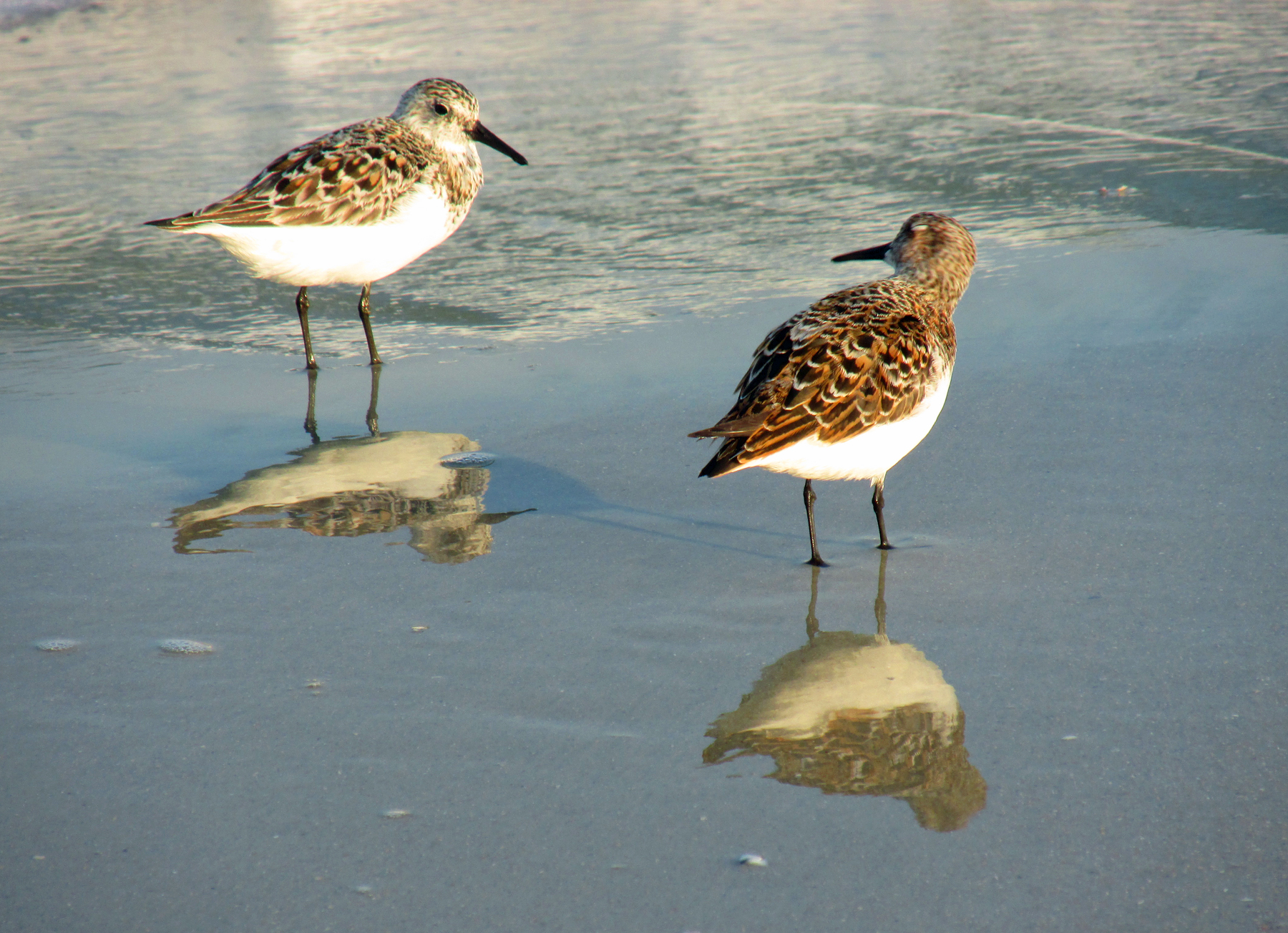
Photo by Bryan Stevens A pair of Sanderlings at surf's edge at Huntington Beach State Park.

Photo by Bryan Stevens
A pair of Sanderlings at surf’s edge at Huntington Beach State Park.

Known as “wind birds” for the propensity of many members of this extended family to stage long-distance migrations, some species fly through Northeast Tennessee each spring and fall as they migrate to and from distant nesting grounds.

I have seen several species — Wilson’s Snipe, Greater Yellowlegs, Pectoral Sandpiper, Least Sandpiper, Solitary Sandpiper and Spotted Sandpiper — in the region this spring. Their stays are usually of brief duration as they are eager to push farther north. Many of them will not stop until they reach the edge of the Arctic tundra.

While I was enjoying seeing a wide range of shorebirds in South Carolina, two Stilt Sandpipers put in a rare appearance in Northeast Tennessee. I hated to miss them. I’ve only seen one other Stilt Sandpiper in the region, and that observation took place back in 2000 at Austin Springs on Boone Lake.

The Stilt Sandpipers were found by Brookie and Jean Potter on the Watauga River at Rasar’s Farm in Elizabethton. The couple reported that it was their first spring sighting of Stilt Sandpipers, as well as their first Carter County sighting of this species. The photo at the start of the column, provided by Jean Potter, shows the two Stilt Sandpipers bordered by a pair of Greater Yellowlegs.

Stilt Sandpipers making migration stops in Tennessee still have a long way to travel. These shorebirds nest on the Arctic tundra beyond the tree line. Wet sedge-meadows with raised ridges and hummocks provide nesting habitat. After the nesting season they fly south as far as northern South America and can be found at fresh water ponds, marshes, lagoons and flooded fields.

This medium-sized sandpiper stands out from most of the sandpipers in its size range. It has long, greenish legs, as well as a long neck and bill, which is drooped at the tip. In breeding plumage, this shorebird has a distinctive chestnut cheek patch.

••••••

During my South Carolina stay, I didn’t encounter any Stilt Sandpipers. I did, however, find three Black-necked Stilts.

The only time I have seen this unusual shorebird in Tennessee took place on Oct. 13, 2004, at Austin Springs on Boone Lake in Washington County. The bird, first found by Rick Knight, drew many excited birders to the location for looks at this shorebird before it departed to continue its migration flight south.

Photo by Bryan Stevens Two Black-necked Stilts forage along the causeway wetland at Huntington Beach State Park.

Photo by Bryan Stevens
Two Black-necked Stilts forage along the causeway wetland at Huntington Beach State Park.

I have also seen Black-necked Stilt on Fripp Island, S.C, as well as in Utah.

The world of shorebirds has produced many look-alike species, including many of the small sandpipers often collectively labeled as “peeps” by birders. The Black-necked Stilt, however, is not at all likely to be confused with any other shorebird. It is a slender bird atop a pair of extremely long pink legs. It has a two-tone appearance with black upper parts and white underparts. The black and white dichotomy continues along the bird’s long neck and head. This bird also has a thin, needle-shaped bill that it uses to delicately pluck aquatic insects and other prey from water or mud.

I first spied the Black-necked Stilts at Huntington Beach State Park while walking on a marsh boardwalk near the park’s Nature Center. They flew toward the causeway, so I got into my car and drove there to try to re-locate them. I did find two of the stilts feeding along the causeway, but I never managed to find the third bird.

I watched the two Black-necked Stilts foraging for food in shallow water shared by egrets and alligators. The two birds, despite a somewhat gangly appearance, moved with elegantly efficient strides on their long pink legs. This bird feeds on an assortment of aquatic creatures, including small fish, insects and tadpoles. The seeds of aquatic plants also provides some of the food in its diet.

I also saw several plovers, another group of shorebirds, while in South Carolina. Wilson’s Plover was one that stood out during my visits to Huntington Beach State Park. Wilson’s Plover is a coastal shorebird that breeds on both coasts of the Americas from the equator northwards. Its range extends north to include much of the U.S. eastern seaboard as well as the Pacific coast of Mexico.

A Wilson's Plover in the dunes at Huntington Beach State Park in South Carolina.

A Wilson’s Plover in the dunes at Huntington Beach State Park in South Carolina.

I’ve observed Wilson’s Plovers on Fripp Island, S.C., in the past, but those sightings have been rather sporadic. I have also observed this bird at one other location — at Douglas Lake in Cocke County back in the late 1990s.

The Wilson’s Plovers at Huntington Beach State Park were nesting in the dunes, which also gave me an opportunity to see some young plovers. A young Wilson’s Plover looks like a ball of downy feathers standing on toothpicks. This plover nests on a bare scrape on sandy beaches or sandbars. To protect the plovers, as well as other nesting species, this section of dunes on Huntington Beach State Park bars the entry of dogs. It is also roped off to prevent accidental intrusion by people.

Photo by Bryan Stevens A pair of Wilson's Plover chicks at Huntington Beach State Park in South Carolina.

Photo by Bryan Stevens
A pair of Wilson’s Plover chicks at Huntington Beach State Park in South Carolina.

Most of the Wilson’s Plovers that spend the summer in the United States retreat each fall, although a few migrate only as far as Florida. The rest spend the winter as far south as Brazil.

For a small shorebird, the Wilson’s Plover sports a thick, blunt and relatively large bill. In fact, this bill — that looks too big for its body — is a good way to identify this shorebird at a glance. The Wilson’s Plover forages for food on beaches. It has a fondness for crabs, which may explain the size and shape of its bill, but this bird will also eat insects, marine worms and other small organisms.

The Wilson’s Plover is larger than the related Semipalmated Plover and Piping Plover but considerably smaller than such relatives as Killdeer and Black-bellied Plover. This shorebird weighs only a couple of ounces, with a length of about eight inches and a wingspan of 19 inches. The Wilson’s Plover has a dark neck ring, grayish-brown upper parts, a white underside and pinkish legs.

This bird was named after the Scottish-American ornithologist Alexander Wilson. Wilson collected the type specimen during a trip in May of 1813 to Cape May, N.J. Other birds named for this pioneering bird expert include Wilson’s Warbler, Wilson’s Phalarope, Wilson’s Snipe and Wilson’s Storm Petrel.

•••••

With a few exceptions, most of the shorebirds that I have found along the Atlantic Coast I have also observed here in land-locked Tennessee during spring and fall migration. It’s one of those little known facts I enjoy sharing with people, who are often surprised that these “beach birds” also make visits to our state.

•••••

Make a comment, ask a question or share an observation by sending an email to ahoodedwarbler@aol.com or posting a comment here on my blog. I am also on Facebook.

A mixed flock of Short-billed and Long-billed Dowitchers and a Ruddy Turnstone at Huntington Beach State Park.

A mixed flock of Short-billed and Long-billed Dowitchers and a Ruddy Turnstone at Huntington Beach State Park.