Tag Archives: warblers

Hooded warbler favorite member from an exceptional family of birds

hooded-hidden

Photo by Bryan Stevens                                   Hooded Warblers, like this male, prefer to remain in the shadows of shrubs and thickets.

hoodedwarbler

A plushie Hooded Warbler.

I watched a male hooded warbler flitting among the branches of a forsythia shrub during a soft rainfall on Sept. 18. As I watched the small bird dash after unseen insects among the thicket formed by the forsythia branches, I marveled at the bird’s exquisite appearance. The gold and green feathers seemed to glow brightly in the dim light as a drizzle of rain wet both bird and leaves. The black hood and bib surrounding the male’s yellow face stood out by virtue of its stark contrast from the brighter feathers.

The appearance of the male bird provides this species with its common name. The female has an identical yellow-green coloration as the male, although she is slightly more drab. She lacks the black hood and bib, although older females may acquire some dark plumage on the head and around the face. Both sexes also show white tail feathers that they constantly flick as the move about in thick vegetation and shrubbery.

I know that every migrant passing through my yard is making its way south and it may be another five to six months before I again see any of my favorite songbirds. The hooded warbler will make itself at home in the forests of Mexico, as well as Belize, Costa Rica and other Central American nations. Most hooded warblers begin returning to their winter haunts as early as mid-September, but lingering individuals continue to entertain birders in the United States throughout October.

hooded-warbler-at

Photo by Jean Potter                                            A male Hooded Warbler perches in a rhododendron thicket.

Like many of the ruby-throated hummingbirds that make their home in the United States for the summer, the hooded warbler’s fall migration takes it across the vast open waters of the Gulf of Mexico, crossing to the Yucatan and then dispersing from there to various points in Central America. That birds as small as hummingbirds and warblers make this incredible migration twice yearly is one of nature’s most phenomenal feats of endurance.

The warblers, also known as wood-warblers, are an exclusively New World family of birds, numbering approximately 116 species. About 50 of these species of warblers make their home in the eastern United States and Canada for the spring and summer, departing in the fall and returning to tropical wintering grounds. Some of them are extremely bright and colorful birds. As I’ve indicated in recent columns, however, some members of the family show more subdued plumages of tan, beige and brown. The hooded warbler would have to be included among the more brightly colored warblers.

Other colorful warblers that share similar tastes in range and habitat with the hooded warbler include the American redstart, black-throated blue warbler and black-throated green warbler. None of the eastern warblers show any true red in their plumage, but red and pink warblers can be found south of the border. The pink-headed warbler, red warbler and red-faced warbler all make their home in Mexico and and Central America.

????????????????????????????????????

Photo by Bryan Stevens                                        A male Hooded Warbler perches in a thicket during a fall migration stopover.

While some of the neotropical migrants that venture into North America boast even brighter kin in the tropics, we need not feel cheated with the warblers that make their home in the United States for half of the year. Some of their relatives are beautiful birds, including the white-faced whitestart, golden-bellied warbler, three-striped warbler and rose-breasted chat, but few can really hold a candle to their relatives that venture north and brighten the lives of the lucky humans fortunate enough to observe them during the summer nesting season or the seasonal migration journeys.

hooded-peek

Photo by Bryan Stevens                                   The male Hooded Warbler isn’t likely to be mistaken for any other warbler.

The hooded warbler has long been my favorite member of this family of interesting, energetic and engaging songbirds. Hooded warblers reside in the woodlands around my home, nesting and rearing young each year. I’ve never found a nest, but many years ago I watched a pair of hooded warblers fend off a song sparrow that ventured too close to one of their fledglings. Of course, the sparrow posed no realistic threat to the young warbler, but that didn’t make the conflict with the hooded warblers any less intense. The poor sparrow looked completely befuddled and uncertain about its offense. After the warblers drove the sparrow from the vicinity, I watched both parents deliver some food to the young bird.

Like most warblers, the hooded warbler feeds almost exclusively on small insects and arachnids. Some warblers will also feed on fruit, seeds and even nectar. The hooded warbler favors habitats featuring woodlands with an understory of smaller trees and shrubs, such as stands of willows or rhododendron thickets. Of course, a tangle of forsythia is enough to attract a visit from a migrating hooded warbler.

9781408134610The warblers have become such popular songbirds that they warrant field guides devoted exclusively to their ranks. My long-time favorite guide is Warblers of the Americas by Jon Curson, David Quinn and David Beadle published in 1994. More recently, other guides have been published, including A Field Guide to Warblers of North America, a book in the Peterson Field Guide series, and the Stokes Field Guide to Warblers. If you want a book to enlighten you about the magic of this family of birds, consider Chasing Warblers, a book by Bob and Vera Thornton about an adventure to find and photograph all 52 species of warblers that nest in the United States.

plate-110-hooded-warbler-final-2

John James Audubon painted this image of Hooded Warblers about two centuries ago.

The warblers are, in short, an incredible family of birds. I’ve seen all but a handful of the species that reside for part of the year in the eastern United States. I still want to see a Connecticut warbler and cerulean warbler, as well as the endangered Kirtland’s warbler of Michigan and the golden-cheeked warbler of Texas. I’ll miss the warblers once fall migration has run its course. For those few months they are here, the warblers belong to us. They seem like “our” birds. They’re only on loan, though. Our winter birds bring their own favorites back to our yards, but I’ll be impatiently awaiting that flash of gold in the shadows of a rhododendron thicket next April.

••••••

To learn more about birds and other topics from the natural world, friend Stevens on Facebook at https://www.facebook.com/ahoodedwarbler. He is always posting about local birds, wildlife, flowers, insects and much more. If you have a question, wish to make a comment or share a sighting, email ahoodedwarbler@aol.com.

hoodedwarbler-inhand

Photo by Bryan Stevens                                                                                             A female Hooded Warbler poses for her picture after being banded at Carver’s Gap on Roan Mountain.

Ovenbird often a difficult bird to get to know

Last week, I discussed the worm-eating warbler, which is one of the more drab warblers in terms of appearance. I think that must have started a trend, because so far this migration season has been dominated by some of the less colorful — but still very interesting — warblers. The opening days of September brought with them the annual fall parade of migrating warblers. As usual, this yearly opportunity to view visiting warblers began as a trickle of species but has picked up in intensity as each day passed.

ovenbird

Photo by Jean Potter                                         Ovenbird sings from an elevated perch in the woodland canopy.

 By Sunday, Sept. 11, I had already observed close to a dozen species of warblers, including hooded warbler, black-throated green warbler, Northern waterthrush, ovenbird, magnolia warbler, chestnut-sided warbler, black-and-white warbler, Tennessee warbler, and American redstart. 
 
One of the first warblers to arrive at my home this spring was the enigmatic ovenbird. With its loud, ringing song — “Teacher! Teacher! Teacher!” — it’s impossible not to notice the arrival of this warbler.  Why describe this warbler as enigmatic? For starters, ovenbirds do not easily permit even stealthy birders to glimpse them. I have gotten good looks at ovenbirds throughout the years, but they are still difficult to observe. They are one of the warblers more easily heard than seen. When they are observed, it’s usually no more than a fleeting look before the bird dives back into heavy cover. That’s not always the case, however.
ovenbird-warbler

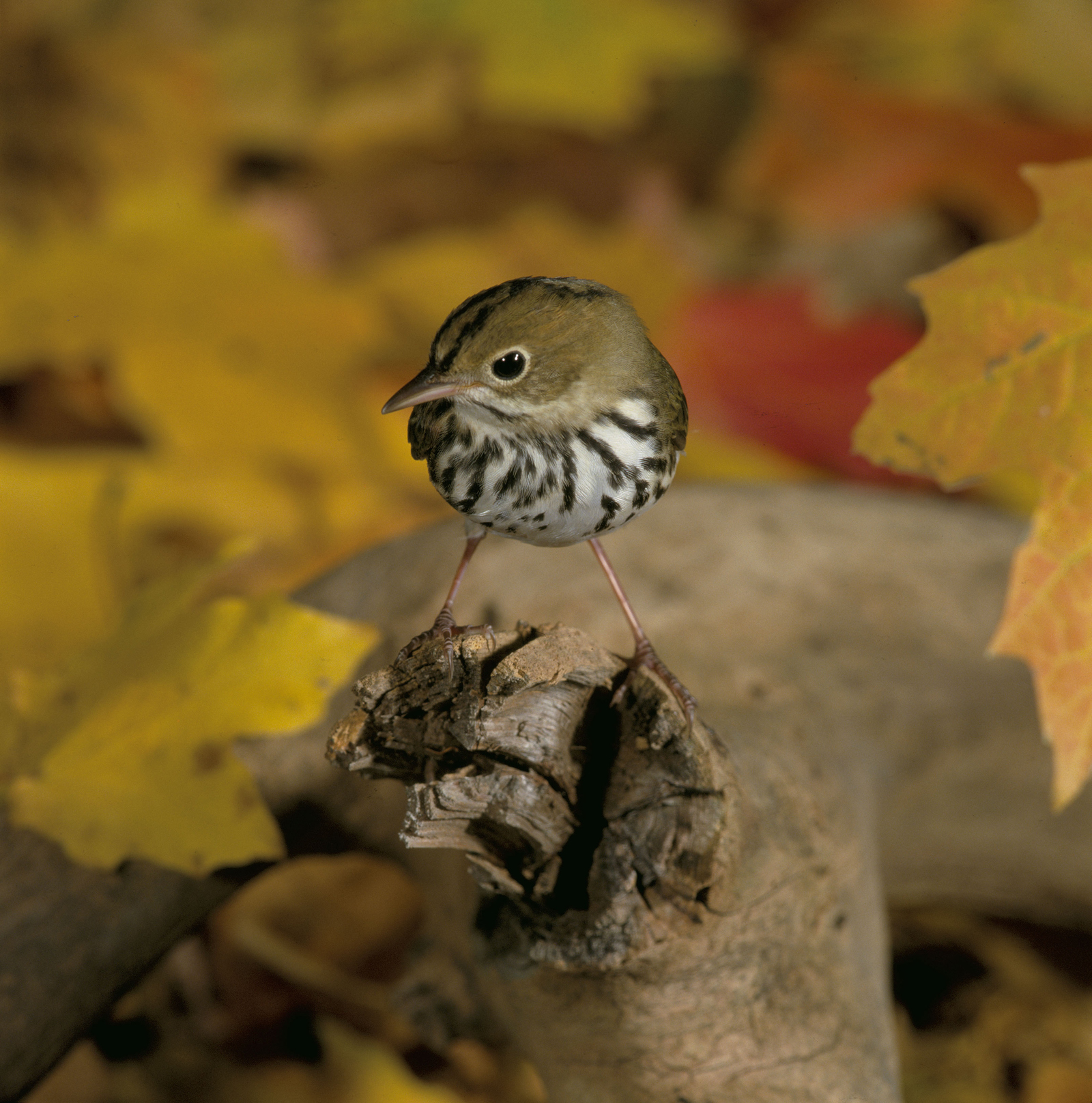
Photo by U.S. Fish & Wildlife Service/Steve Maslowski                      The ovenbird is not named for its plumage or its habitat preference. Instead, its name refers to the shape of its nest. Ovenbirds and other warblers are currently migrating through the region.

 
I’ve actually seen three different ovenbirds this fall, with increasingly good looks at this warbler each time I have encountered it. The ovenbird is not one of the brightly colored warblers, such as black-throated blue warbler or yellow warbler. The ovenbird is a small brown bird with a white breast with dark streaking — an appearance that bears a superficial resemblance to the larger thrushes that share the same woodland habitat. The only hint of color is an orange crown bordered by dark stripes atop the bird’s head. Even this orange crown patch is not easily seen. When agitated, an ovenbird may raise its head feathers, which makes this orange mark easier to detect. The ovenbirds I’ve observed recently have all shown off that orange crown patch to great effect. The ovenbird also has a distinct white ring around its eyes, as well as pink legs and a pinkish bill.
plate-143-golden-crowned-thrush-final

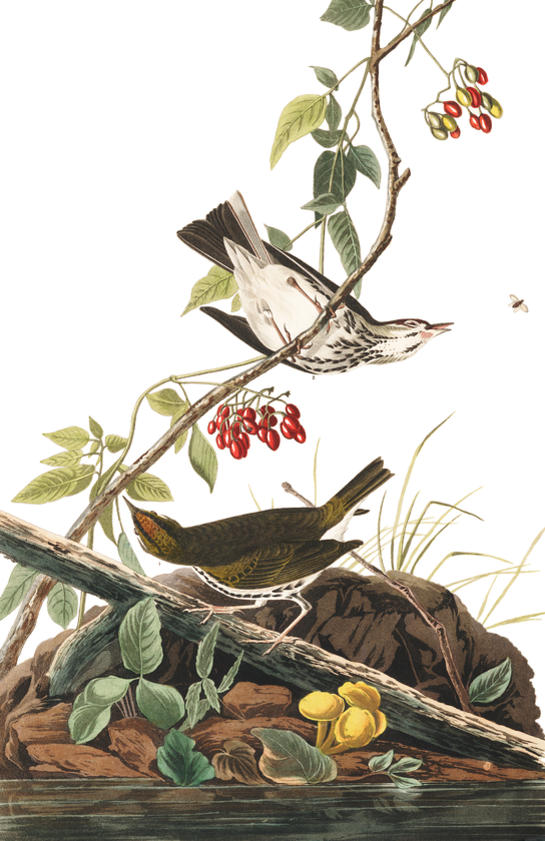
Early naturalist John James Audubon painted a pair of Ovenbirds, which he knew as “Golden-crowned Thrushes.”

 
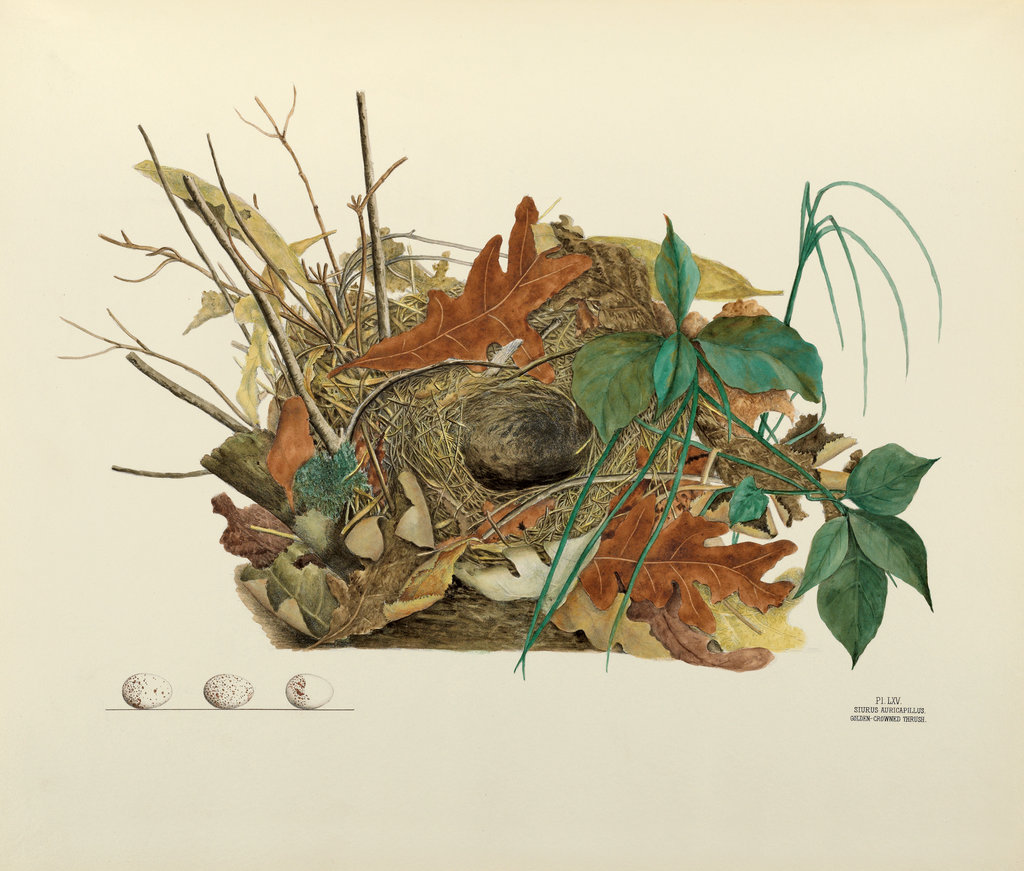
The ovenbird, unlike many warblers, is not named for its appearance. Instead, the bird’s name derives from the shape of the nest it builds. The nest is a domed structure placed on the ground, woven from vegetation and containing a side entrance. Early European settlers in North America thought the nest looked like a Dutch oven, hence the name “ovenbird” for the small warbler with the intricate nest.
 
Rather than hopping along the length of a branch or limb, an ovenbird walks in a deliberate fashion. This bird feeds on insects, spiders and other small prey items foraged from the woodland floor. On rare occasions, a lingering ovenbird shows up at feeders during the winter months.
 
Ovenbirds spend the summer nesting season in mature deciduous and mixed forests across Canada and the eastern United States. They do not make as lengthy a migration as that undertaken by some of their relatives. Ovenbirds migrate each fall to the southeastern United States, the West Indies, and from Mexico to northern South America for the winter season. 
  
The two warblers most closely related to the ovenbird are the Louisiana waterthrush and Northern waterthrush. These atypical warblers share a preference for leading lives spent mostly near the ground adjacent to streams. The Louisiana waterthrush seeks out the rushing water of our mountain streams during early spring while the Northern waterthrush prefers quiet pools of water farther north during its nesting season. The ovenbird, however, is not as closely associated with water.
09audubon-ensha-slide-4jho-jumbo

Amateur ornithologist and artist Genevieve Jones painted this depiction of the Ovenbird’s namesake nest.

 
While I have used the adjective “drab” to describe some of these brown warblers, it is not truly accurate. Although these warblers lack bright colors like orange, yellow and blue, they have an incredible, subtle beauty all their own. In the coming weeks, I will discuss some of the brighter warblers in this fascinating family of migratory songbirds.
 
Warblers are not the only birds migrating through the region. Other notable migrants I’ve observed recently have included common nighthawks, red-eyed vireos and green herons. 
 
•••••
 
Bryan Stevens lives near Roan Mountain, Tennessee. To learn more about birds and other topics from the natural world, friend Stevens on Facebook at https://www.facebook.com/ahoodedwarbler. He is always posting about local birds, wildlife, flowers, insects and much more. If you have a question, wish to make a comment or share a sighting, email ahoodedwarbler@aol.com.

Regional spring bird count sets several new records

IndigoBunt

Photo by Bryan Stevens                                  Newly-arrived migrant birds such as Indigo Bunting were well represented on the 73rd annual Elizabethton Spring Bird Count.

The 73rd consecutive Elizabethton Spring Bird Count, which was held Saturday, April 30, set numerous records for this long-running survey of the region’s birds. The 59 observers in 13 parties (both representing record highs for participation) enjoyed favorable weather over the coverage area, which included Carter County and parts of adjacent Johnson, Sullivan, Unicoi and Washington Counties.


Rose-breastedGrosbeak

Photo Courtesy of Jean Potter                              A total of 166 species of birds, including Rose-breasted Grosbeak, pictured, helped participants in the Elizabethton Spring Bird Count, establish a new record high for this annual survey. The old record of 161 species was set back in 2005.

Long-time count compiler Rick Knight announced that the annual count tallied 166 species, eclipsing the previous record of 161 set in 2005. By comparison, the average number over the last 30 years has been 147 species.

Highlights for this year’s Spring Bird Count included American Golden-Plover and Fish Crow, which were new to this annual survey of birds in the region.

Heron-CandlerMurphy

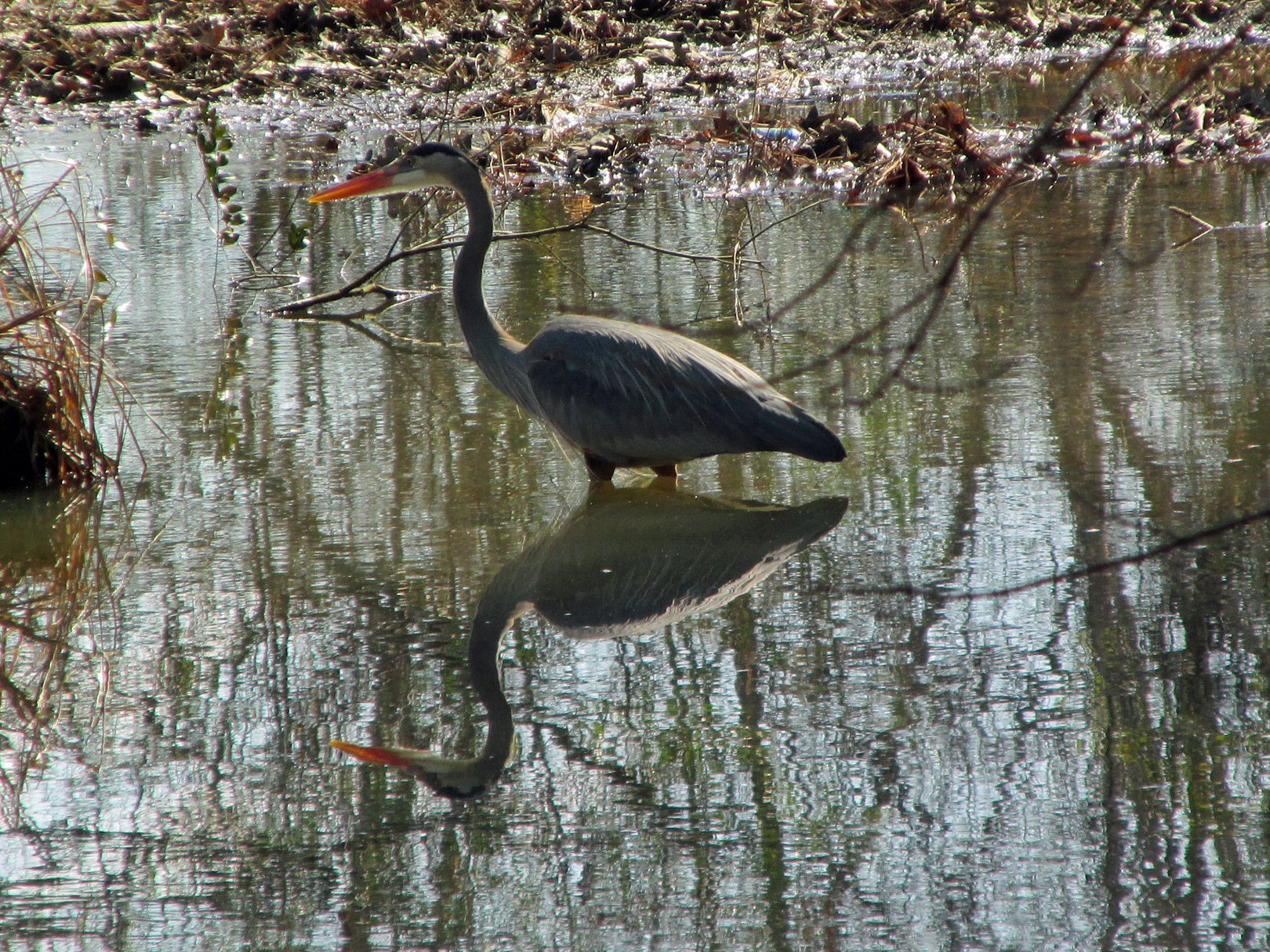
Photo by Bryan Stevens                           The presence of several nesting colonies of Great Blue Herons could help explain a new record-high for this species on this year’s count.

Other notable find included Hooded Merganser (a hen with two young), a lingering pair of Common Mergansers, Virginia Rail, Black-billed Cuckoo, Northern Saw-whet Owl, Peregrine Falcon, Sedge Wren and Cerulean Warbler.

Amazingly, given the long history of this count, 21 species occurred in record high numbers this year. Knight said the increased number of observers and parties certainly contributed to this.

Sora-Jean

Photo Courtesy of Jean Potter                      Although the Sora is rarely found during this annual count, the four individuals found this year represented an all-time high for the species on this yearly survey.

The record highs were for the following species:  Canada Goose (653), Mallard (332), Wild Turkey (57), Great Blue Heron (107), Yellow-crowned Night-Heron (14), Black Vulture (152), Spotted Sandpiper (83), Barred Owl (12), Belted Kingfisher (30), Red-bellied Woodpecker (97), Warbling Vireo (20), Red-eyed Vireo (257), Ovenbird (244), Worm-eating Warbler (39), Yellow-throated Warbler (44), Eastern Towhee (222), Scarlet Tanager (82), and Baltimore Oriole (38). Three species — Orchard Oriole (42), Northern Saw-whet Owl (3) and Sora (4) — tied previous high counts.

Several of these good finds were made by observers counting in Unicoi County at such locations as Rock Creek Recreation Area and Unaka Mountain. The final total follows:

Cardinal_CloseCrop

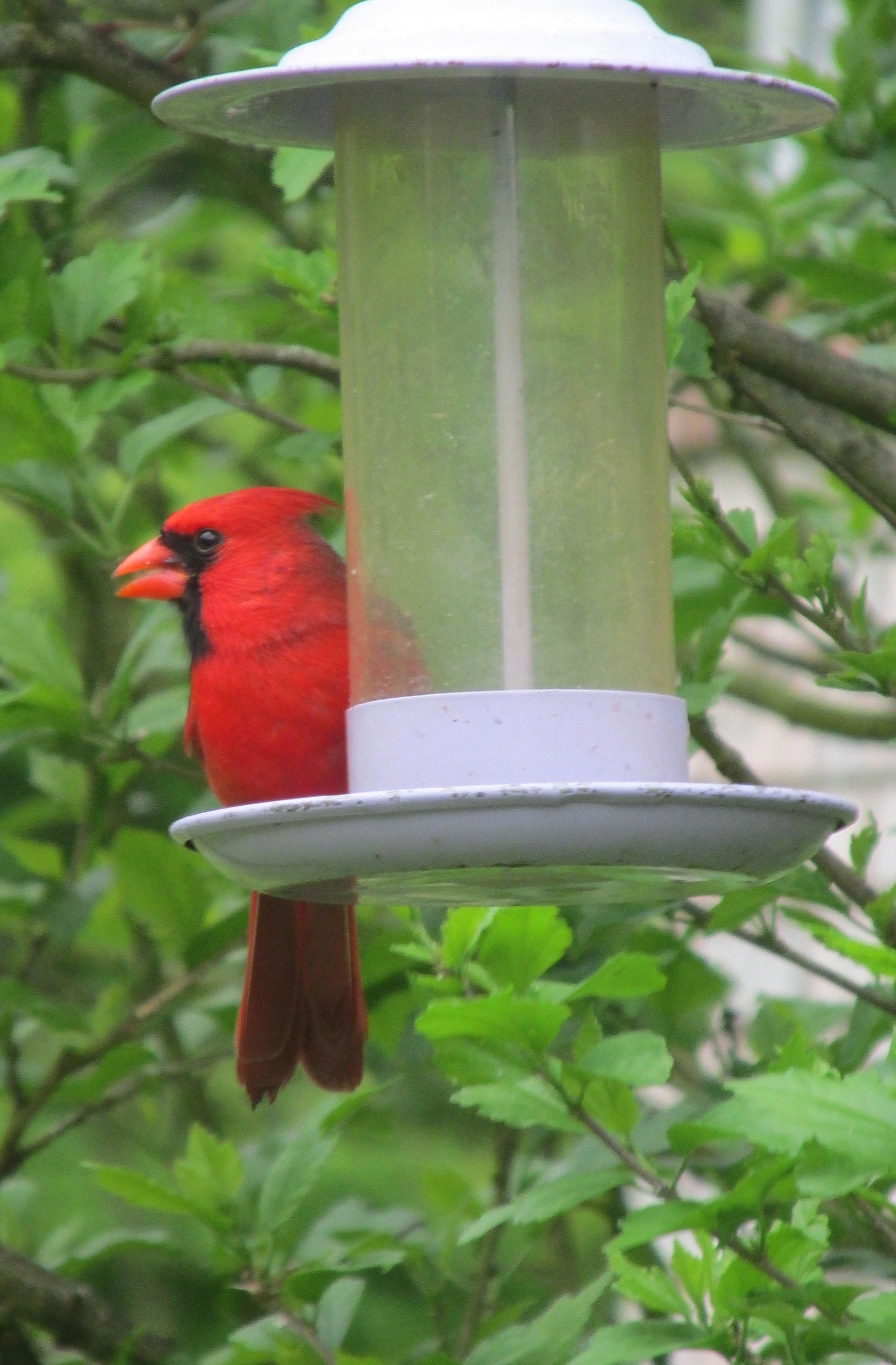
Photo by Bryan Stevens Common backyard birds, such as Northern Cardinal, were among the record-high 166 species found.

Canada Goose,  653; Wood Duck, 85; American Wigeon, 2; Mallard, 332; Blue-winged Teal, 6; Bufflehead, 5; Hooded Merganser, 3; and Common Merganser, 2.
Northern Bobwhite, 1; Ruffed Grouse, 1; Wild Turkey, 57; Common Loon, 1; Pied-billed Grebe, 5; Horned Grebe, 1; and Double-crested Cormorant, 65.
Great Blue Heron, 107; Green Heron, 16; Black-crowned Night-heron, 1; Yellow-crowned Night-Heron, 14; Black Vulture,  152; and Turkey Vulture,  212.
Osprey,  15; Bald Eagle, 10; Sharp-shinned Hawk,  2; Cooper’s Hawk, 7; Broad-winged Hawk, 16; and Red-tailed Hawk,  38.
Virginia Rail,  1; Sora , 4; American Coot, 3; American Golden-Plover, 1; Killdeer,  46; Spotted Sandpiper,  83; Solitary Sandpiper,  34; Greater Yellowlegs,  2; Lesser Yellowlegs , 2; Least Sandpiper, 5; and Pectoral Sandpiper, 2.
Bonaparte’s Gull, 1; Ring-billed Gull, 7; Forster’s Tern, 7; Rock Pigeon, 166; Eurasian Collared-Dove,  3; Mourning Dove,  254; Yellow-billed Cuckoo,  9; and Black-billed Cuckoo, 1.
Eastern Screech-Owl, 10; Great Horned Owl,  6; Barred Owl,  12; Northern Saw-whet Owl, 3; Common Nighthawk, 1; Chuck-will’s-widow, 10; Eastern Whip-poor-will, 32; Chimney Swift , 209; Ruby-throated Hummingbird, 31; and Belted Kingfisher, 30.
Red-headed Woodpecker, 2; Red-bellied Woodpecker,  97; Yellow-bellied Sapsucker, 4; Downy Woodpecker,  37; Hairy Woodpecker, 10; Northern Flicker,  33; Pileated Woodpecker, 43; American Kestrel, 19; and Peregrine Falcon, 1.
Eastern Wood-Pewee,  7; Acadian Flycatcher, 12; Least Flycatcher, 6; Eastern Phoebe, 77; Great Crested Flycatcher, 15; and Eastern Kingbird, 57.
Loggerhead Shrike, 1; White-eyed Vireo, 12; Yellow-throated Vireo, 9; Blue-headed Vireo,  78; Warbling Vireo, 20; Red-eyed Vireo,  257; Blue Jay, 320; American Crow, 338; Fish Crow, 1; Common Raven,  and 14; Horned Lark,  2.
Purple Martin, 81; Tree Swallow, 426; Northern Rough-winged Swallow, 133; Barn Swallow, 217; and Cliff Swallow, 807.
Carolina Chickadee,  173; Tufted Titmouse, 166; Red-breasted Nuthatch, 16; White-breasted Nuthatch, 26; and Brown Creeper,  4.
House Wren,  45; Winter Wren, 4; Sedge Wren, 1; Carolina Wren,  129; Blue-gray Gnatcatcher,  97; Golden-crowned Kinglet, 5; and Ruby-crowned Kinglet, 4.

RedeyedVireo-Jean

Photo Courtesy of Jean Potter                        Vireos, such as this Red-eyed Vireo on a nest, were quite abundant. The numbers of Red-eyed Vireos and Warbling Vireos set all-time highs for the count.

Eastern Bluebird, 157; Veery, 13; Swainson’s Thrush,  2; Wood Thrush, 138; American Robin,  888; Gray Catbird, 55; Brown Thrasher, 45; Northern Mockingbird, 122; European Starling,  986; and Cedar Waxwing, 44.
Ovenbird, 244; Worm-eating Warbler, 39; Louisiana Waterthrush, 32; Golden-winged Warbler, 2; Black-and-white Warbler, 90; Swainson’s Warbler, 6; Nashville Warbler, 1; Kentucky Warbler, 5; Common Yellowthroat, 27; Hooded Warbler, 208; American Redstart, 21; Cape May Warbler, 4; Cerulean Warbler, 2; Northern Parula, 56; Magnolia Warbler, 3; Bay-breasted Warbler, 2; Blackburnian Warbler, 7; Yellow Warbler, 15; Chestnut-sided Warbler, 36; Blackpoll Warbler, 1; Black-throated Blue Warbler, 85; Palm Warbler, 8; Pine Warbler, 10; Yellow-rumped Warbler, 62; Yellow-throated Warbler, 44; Prairie Warbler, 5; Black-throated Green Warbler, 81; Canada Warbler, 44; and Yellow-breasted Chat, 8.
Eastern Towhee, 222; Chipping Sparrow, 126; Field Sparrow, 72; Savannah Sparrow, 1; Grasshopper Sparrow, 4; Song Sparrow, 276; Swamp Sparrow, 5; White-throated Sparrow, 13; White-crowned Sparrow, 11; and Dark-eyed Junco, 63.

Hairy_Male

Photo by Bryan Stevens While some species set record highs, only 10 Hairy Woodpeckers, like this male, were found by participants in the annual Elizabethton Spring Bird Count.

Summer Tanager, 1; Scarlet Tanager, 82; Northern Cardinal, 299; Rose-breasted Grosbeak, 30; Blue Grosbeak, 6; and Indigo Bunting, 126.
Bobolink, 1; Red-winged Blackbird,  480; Eastern Meadowlark, 142; Rusty Blackbird, 2; Common Grackle, 477; Brown-headed Cowbird, 91; Orchard Oriole, 42; and Baltimore Oriole, 38.
House Finch, 56; Pine Siskin, 59; American Goldfinch, 354; and House Sparrow, 80.
•••••

To learn more about birds and other topics from the natural world, friend Stevens on Facebook at https://www.facebook.com/ahoodedwarbler. He is always posting about local birds, wildlife, flowers, insects and much more. If you have a question, wish to make a comment or share a sighting, email ahoodedwarbler@aol.com.

Migrating warblers offer surprises for alert birders


BlackThroated_Green

Photo by Steve Maslowski/U.S. Fish & Wildlife Service Black-throated green warblers are nesting birds in the region. Other warblers wing their way much farther north to habitats where they prefer to nest and raise young.

April kicked off with some excitement when I heard my first warbler of the spring season singing on the first day of the month from the woodlands near my home. Although I never managed to catch sight of the singer, I identified the bird as a black-throated green warbler by the whistled syllables of its song.

The black-throated green warbler is a common nesting bird in the region’s mountains. Warblers are exclusively birds of the New World. The majority of the world’s 118 species of warblers live in Central and South America, as well as in the Caribbean, but about 50 species spend the nesting season in the United States and Canada before retreating to southern strongholds for the winter months.

3481076952_b3ac2ffab6_o (1)

Photo Courtesy of Jean Potter                           A male Hooded Warbler lurks in a thicket of rhododendron.

The warblers have long been one of my favorite bird families, partly because of their ephemeral natures when it comes to visits in the region. Several of these small songbirds only pass through the region for a few weeks each spring and autumn as they migrate from their wintering grounds to breeding habitats spread across North America. The warblers are, for the most part, birds of the fast-moving, insect-eating persuasion.

Many of these energetic birds will bypass the region except for occasional migratory stops as they wing their way quickly to bug-ridden bogs or coniferous forests farther north. Species with names like mourning warbler, bay-breasted warbler and Wilson’s warbler shoot past northeast Tennessee and southwest Virginia in their haste to reach suitable habitat for raising young in the provinces of Canada or the New England states.

Bachman's_Warbler

The last verified sightings of Bachman’s Warbler took place in the 1970s and the species is probably extinct.

A couple of endangered warblers — Kirtland’s warbler of Michigan and the golden-cheeked warbler of Texas — require extensive management by the federal government to protect their nesting habitat and ensure successful nesting. These two warblers, along with a handful of others, are the only members of the warblers nesting in eastern North America that I haven’t added to my birding life list.

BachmanJohnMugColor01t 2

The Rev. John Bachman

Only one of the warblers known to nest in the United States has ever gone extinct. Bachman’s warbler hasn’t been seen since the late 1970s, although there have been sporadic and unconfirmed sightings since the 1980s. The bird was named in honor of the Rev. John Bachman, an early naturalist and friend of John James Audubon. The species was first collected by Bachman in his native South Carolina in the early 1830s. Historically, Bachman’s warbler bred as far north as Virginia, but the bird’s stronghold was in the states along the Atlantic southern coastal plain. Almost the entire population spends the winter months in Cuba. The disappearance of this small, yellowish bird has never been fully explained and will likely linger as a biological mystery. From its discovery to the plunge toward extinction, Bachman’s warbler was known for only slightly more than a century.

BlackNWhite-Warbler

Photo Courtesy of Jean Potter                              A female Black-and-White Warbler gathers nesting materials.


Most warblers have managed to adapt to changing landscapes brought out by human activity. Some, like the yellow warbler and the yellow-rumped warbler, are quite widespread. The yellow warbler nests across most the continental United States and also reaches Alaska. Closer to home, a few of these warblers nest in the woodlands around my house. The expected species each summer include hooded warbler, black-and-white warbler, ovenbird and Northern parula.

I usually have better luck observing migrating warblers in the fall. I think part of the reason rests with the fact that warblers migrating in the spring are in a hurry to reach their destinations. In contrast, the fall migration is a more leisurely activity that affords these tiny birds the luxury of spending a few days in different locations. If one of those locations happens to be my backyard, I take great pleasure in getting my binoculars on species ranging from Kentucky warbler to blue-winged warbler.

13524560525_278623081f_o

Photo Courtesy of Jean Potter                              A Pine Warbler visits a suet feeder. Most warblers ignore feeders, but these energetic songbirds will visit fountains and water features.

Most warblers will ignore offerings at our feeders, although the occasional pine warbler learns the advantages of visiting suet feeders during the cold months. The most reliable means to attract these tiny, energetic birds is with a water feature, such as a bird bath, ornamental pool or even a bubbling fountain or artificial waterfall. On my property, I have a cattail marsh, a fish pond and a modest creek. As a result, I don’t spend much time working on providing supplemental water sources. For those not blessed with such resources, I highly recommend some sort of water source to increase your chances of visits from warblers.

3947702376_eae6a174fc_o (2)

Photo Courtesy of Jean Potter                            A Black-throated Blue Warbler is captured in preparation for banding.

These tiny birds are not the easiest ones to learn to identify. However, only about four dozen species migrate through the region or stop to spend the summer months. With a good field guide and some practice, it’s not that difficult to learn the different species. The reward is that undeniable spark of magic imparted by an observation of a bird as glorious as a fiery-throated Blackburnian warbler or a handsome black-throated blue warbler.

Lawn chair birding entries

Chestnut-sided

Photo by Bryan Stevens                                                        A young Chestnut-sided Warbler conceals itself in a holly tree.

The following are all Facebook posts about my annual lawn chair birding experiences. My mom and I have made lawn chair birding an annual tradition every fall. It’s a great way to enjoy the warblers and other migrants that stream through the yard in late August, September and October. For the most part, you can even avoid the neck sprain that comes with long period of scanning the treetops for glimpses of energetic and evasive warblers.


Aug. 20

Fall-AmRedstart

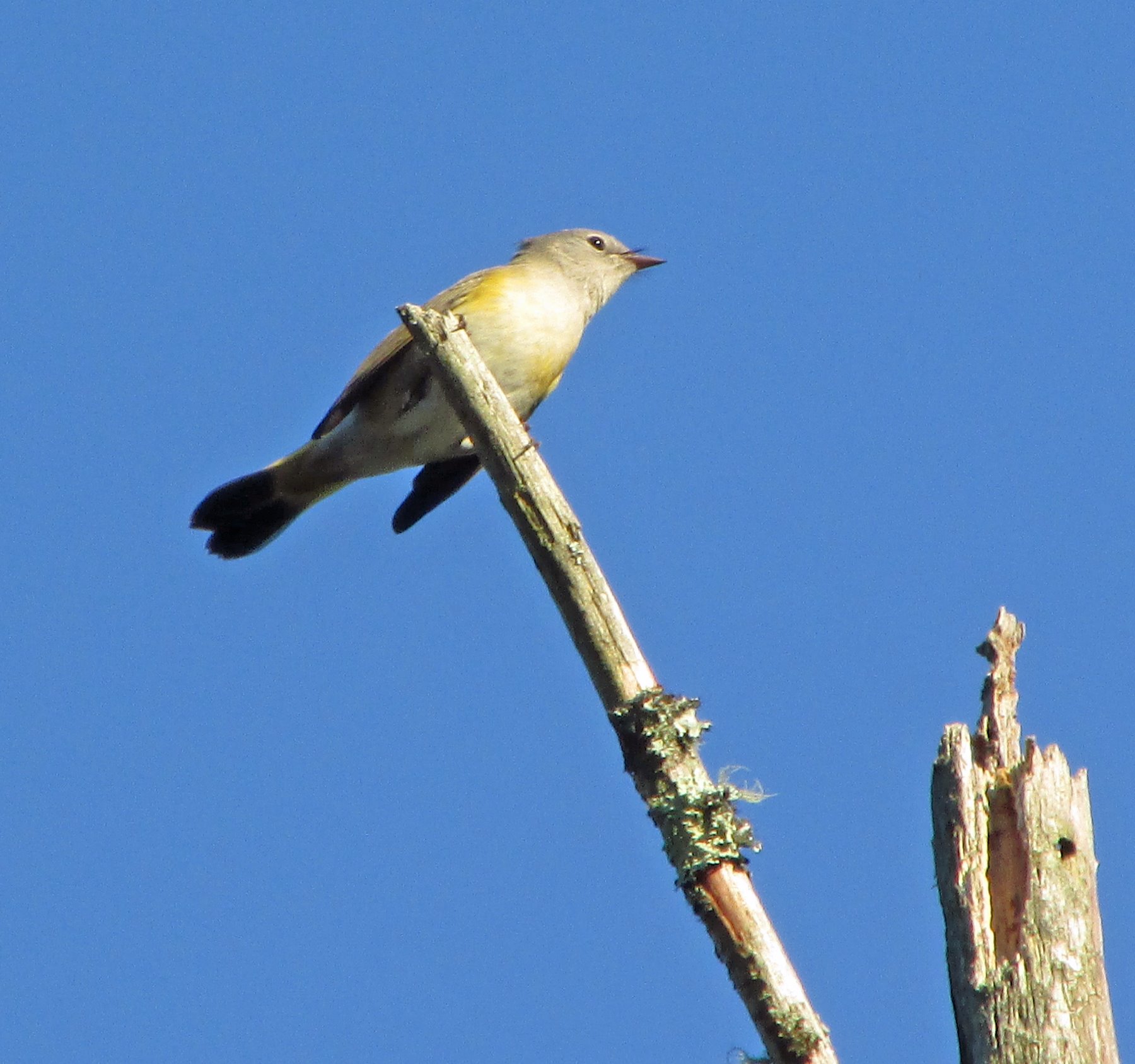
Photo by Bryan Stevens                                                  A young American Redstart selects a perch.

It’s been almost three months since I added a new species to my 2015 yard list. I had last added Chimney Swift back on May 29 and Yellow-billed Cuckoo on June 2. This evening I added White-eyed Vireo as Bird No. 60 for the year. I also saw a pair of Indigo Buntings, two Black-throated Green Warblers, three Blue-gray Gnatcatchers and several Ruby-throated Hummingbirds. I think fall migration must be underway.

Aug. 26

MommyHummer

Photo by Bryan Stevens                                       A Ruby-throated Hummingbird perches on a feeder.

Two new birds for the yard list made appearances today. I have heard a Common Raven calling several times today. Around 7 p.m. my mom called and alerted me to a flock of Wild Turkeys (two adults and eight young birds) in the field. The raven and turkeys are No. 62 and No. 63, respectively, on the list for Yard Birds in 2015.

Aug. 28

The first fall warbler — a young American redstart — showed up this evening, and it’s also a new bird for my 2015 Yard List. The redstart is No. 64 for the year. I also saw Blue-gray Gnatcatcher, Chimney Swifts and Ruby-throated Hummingbirds.

Aug. 29

3936410366_ae853e10a0_o

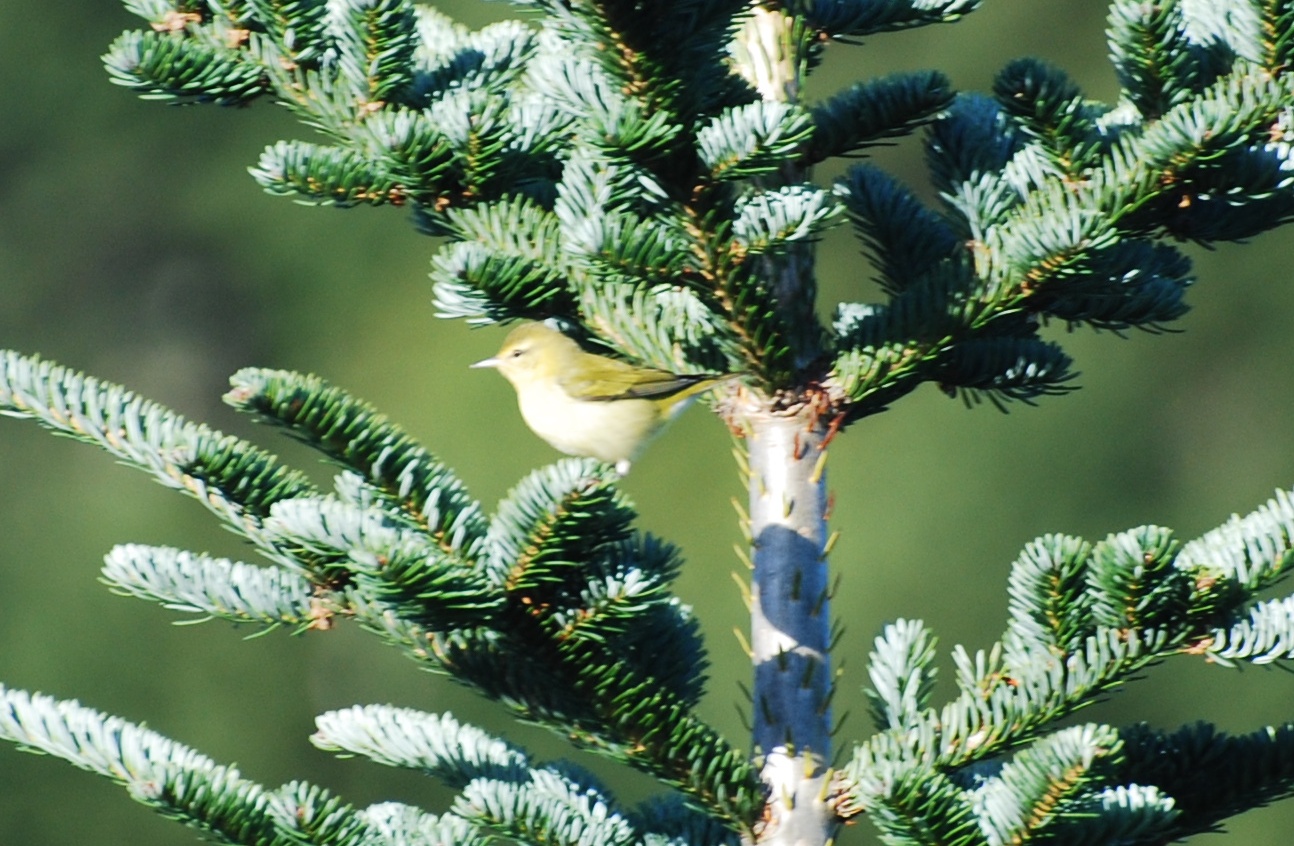
Photo by Jean Potter                                                                A Tennessee Warbler makes a fall migration stop.

Just got in from lawn chair birding with my mom. We enjoyed several warbler sightings, including some new yard birds for 2015. A gorgeous male Canada Warbler treated us to some great views and became Bird No. 65 in the yard this year. Three young Chestnut-sided Warblers will represent Bird No. 66. Finally, a Cape May Warbler is Bird No. 67 for the yard this year. We also saw Black-throated Green Warblers, American Redstarts, Red-eyed Vireos, Ruby-throated Hummingbirds, Blue-gray Gnatcatchers and an Eastern Phoebe. I managed photos of the Cape May and the American Redstart.
Aug. 30

BG-Gnat-April25

Photo by Bryan Stevens                Blue-gray Gnatcatchers are common during fall migration.

I’m closing in on 70 yard birds for the year. This evening, while lawn chair birding with my mom, I added two more new ones. The Magnolia Warbler was Bird No. 68, while the Eastern Wood-Pewee was Bird No. 69 for 2015. I didn’t get photos of the new birds, but I did photograph a young Chestnut-sided Warbler, a young Ruby-throated Hummingbird and a Chipping Sparrow.

Sept. 2

CapeMay-Aug29

Photo by Bryan Stevens                                      A Cape May Warbler perches in a spruce tree.

No new yard birds this evening, but lawn chair birding with mom wasn’t entirely uneventful. We got a look at a Scarlet Tanager, saw several hummingbirds, including an adult male, and Blue-gray Gnatcatchers. Earlier today, mom said she spotted a yellowish warbler but the bird didn’t make a second appearance.

Sept. 5

Lawn chair birding today has produced three new birds for the 2015 yard list. They’re all warblers! Bird No. 70 for the year is a Blackburnian Warbler. Bird No. 71 was a Tennessee Warbler, while Bird No. 72 was an impressive Yellow-throated Warbler. Evening’s still young, so may be some others show up. I also saw a Scarlet Tanager, Ruby-throated Hummingbirds and a Red-eyed Vireo.

3262118976_31abee6bae_o

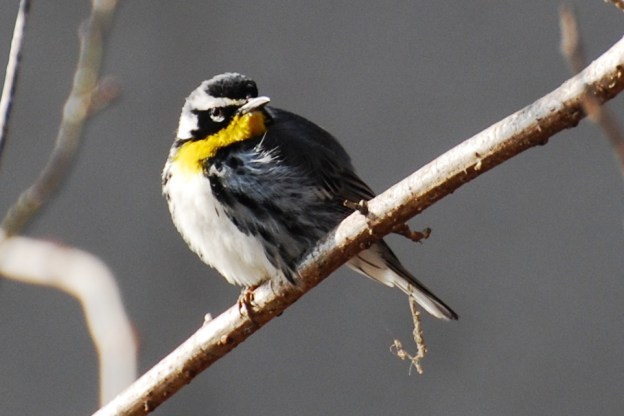
Photo by Jean Potter                                                                                                                              A Yellow-throated Warbler sits on a twig perch.


Annual rally will feature programs by educators from Cornell, ETSU


WoodyNymph

A Common Wood-Nymph photographed in late August in Roan Mountain State Park.

For many naturalists in Northeast Tennessee, heading to Roan Mountain has become an annual trek every September.

Gary Barrigar, long-time director of the Roan Mountain Fall Naturalists Rally, knows that after more than half a century the annual event has become a tradition for many people. For 53 years the Fall Naturalists’ Rally has drawn nature enthusiasts from far and wide to Roan Mountain on the weekend after Labor Day.Top naturalists volunteer their time and energy to make the event both enjoyable and educational for people of all ages.

143_150

Charles Smith

Barrigar said this year’s fall rally will continue to celebrate the natural world by providing two top speakers, retired Cornell naturalist and educator Charles R. Smith and T.J. Jones, an ETSU Behavioral Ecology, Neuroethology and Science educator.


Because of the continued support of the Friends of Roan Mountain, all the Naturalists’ Rallies have the resources they need to prosper and grow and the FORM provides support for research and restoration projects on the Roan. Consider joining the Friends of Roan Mountain, if you are not a member. Members get free admission to all Naturalists’ Rally events and our newsletter, “Friends of Roan Mountain.”

EComma-August

An Eastern Comma suns near a picnic shelter in Roan Mountain State Park.

Barrigar added that many thanks are due to Roan Mountain State Park for its long standing support of the Naturalists’ Rallies, as well as the speakers and the trip leaders who donate their time and expertise.

Evening and lunch programs will take place in Roan Mountain State Park’s Conference Center and field trips will leave from the field on the left before the cabins in the park.

Charles R. Smith will present “This View of Life,” the program for Friday evening. Charles R. “Charlie” Smith was born and raised in Carter County, near Milligan College. He is a naturalist, educator, and conservationist who lives with his wife, Claudia Melin, and their Border Terrier, Brodie, near Ithaca, N.Y. His serious study of natural history did not begin until he was 15 years old, when he joined the Tennessee Ornithological Society, after studying birds on his own for several years.


RedSalamander

Fall rallies offer hikes on a variety of topics from salamanders and mushrooms to butterflies and birds.

About that time, he decided he wanted to attend Cornell University. He earned his undergraduate degree at East Tennessee State University, with a double major in botany and zoology and minor studies in geology, meteorology, physical geography, and photography. Graduate studies at Cornell University concluded with his Ph.D. in wildlife ecology. He retired in 2012 from Cornell University, where he served in various administrative, research, and teaching capacities, including Executive Director of the Laboratory of Ornithology, for nearly 40 years. As an advisor and collaborator on science-based conservation, Smith has worked with a number of state and federal agencies. Though an ornithologist for most of his career, his current interests as a naturalist include studying dragonflies, damselflies, butterflies, and vascular plants; and nature photography. Some of his photographs of butterflies were published in Smokies Life magazine in 2012. Currently he is working with a former student on a field guide to the butterflies of Great Smoky Mountains National Park and the southern Appalachians.

Smith offered his own description for the yearly brochure put out by organizers of the rally to promote his Friday evening program. “A naturalist can be described as a person whose curiosity about nature is boundless,” he said. “This presentation will examine the history, philosophy, and practice of natural history studies from a number of perspectives.”

Now is a great time to be a naturalist, according to Smith.

“Today, we have more good field guides to help us identify plants and animals than ever before,” he added. “With time, persistence, and self-discipline, detailed knowledge of a group of plants or animals is possible for most of us.”

In addition to the personal satisfaction they provide, Smith noted that natural history studies can guide conservation.

CapeMay-Aug29

Cape May atop a spruce tree in Hampton, Tennessee, during fall migration.

“Unless we know what a plant or animal is, where it is found, and how much of it we have, preserving and protecting it can be difficult, if not impossible,” he explained. “We can go beyond just knowing what it is, however, to understanding how plants and animals live, what are their needs, and how we might contribute to their long-term conservation for future generations to enjoy and appreciate.”

He is disappointed by one recent trend in the field of science.

“Ironically, at a time when knowledge and understanding of the needs of plants and animals is more important than ever, it is disappointing that colleges and universities are abandoning the teaching of natural history in the field, and few real field biologists are being schooled,” he said.

Smith said his talk will offer suggestions to help attendees become better naturalists or even be inspired to become a new naturalist. Some of Smith’s photographs will be used to illustrate the talk, and the origin of the title, “This View of Life,” will be revealed at the end of the presentation.


TJ

Thomas “T.J.” Jones

Thomas “T.J.” Jones will present “Elegance and Efficiency: Spiders of Southern Appalachia” as the Saturday evening program. Jones also elaborated on his program for the annual brochure on the rally.

“When I was very young I remember my mother carefully catching a spider that had gotten into the house and tossing it onto the back patio, only to have a bird immediately fly down and carry it off.”

The incident was traumatic for a young boy. “My mother comforted me by explaining that the bird was probably going to use it to feed its babies,” he remembered. “Perhaps that was foreshadowing of my future career studying how spiders negotiate the challenges of world in which they are both predators and prey. I have always been fascinated by animal behavior, and through high school and college worked at zoos, aquariums, and even Sea World.”

Jones has bachelor’s and master’s degrees from Cleveland State University, where he did research on the morphology of ciliated protists and physiological ecology of garter snakes.

“From there I went on to get a PhD from Ohio State University studying the evolution of social behavior in spiders. I continued that work as a post-doc at The University of Tennessee which is where I fell in love with the southern Appalachians, and I am now on the faculty at East Tennessee State University.”

Jones said his research group takes an integrated approach to studying aggression-related behaviors in spiders.
“We are studying how brain chemistry and circulating hormones regulate behaviors, and how these behaviors affect the spider’s success in nature,” he explained. “We currently have projects exploring social behavior, circadian rhythm, and the effect of environmental contaminates on behavior.

Orb-Weaver-August

Spiders will provide the focus for the Saturday evening program by T.J. Jones.

He offered a brief description of his program, which is admittedly about a creature that gives some people the shivers.
“Some say they are beautiful, some say they are terrifying, but most would agree that spiders are fascinating,” Jones said. “Spiders are among the oldest and most diverse group of predators; this is because they are extremely good at what they do.”

His evening program will provide general information on the biology and ecology of spiders including how they use their key adaptations of silk and venom. He will discuss species commonly found in southern Appalachia, including some interesting species which are only found here. Along with photos, there will be live specimens on hand and a guided night hike to follow.

“My hope is that the program will foster appreciation, and perhaps love, for this amazing group of animals,” Jones said.

Redstart-Aug29

An American Redstart photographed in Hampton, Tennessee, during fall migration.

Buffet meals will be served on Friday and Saturday at 6:30 p.m., followed by the evening programs. Reservations are necessary for the meals, which cost $9.50 for adults and $5 for children 12 and under. Deadline for reservations is Tuesday, Sept. 8. For more information, call Barrigar at 423-543-7576 or email him at gbarrigar@friendsofroanmtn.org.

Mail prepaid meal reservations to: Nancy Barrigar, Treasurer, 708 Allen Avenue, Elizabethton, TN 37643.

For a detailed schedule of hikes, programs and other rally activities, visit http://www.friendsofroanmtn.org/Fall%20Rally%20Brochure%20web%202015.pdf

Yellow-breasted chat stands apart from other warblers

I’ve always been a warbler fan, celebrating every opportunity that comes my way for seeing these colorful, energetic feathered sprites. In early May I got to introduce some other bird enthusiasts to some of our warblers during a bird walk at Sycamore Shoals State Historic Park in Elizabethton, Tennessee. Yellow-breasted chat, one of the warblers observed during the morning stroll, always stands out from the rest of the flock.

????????????????????????????????????

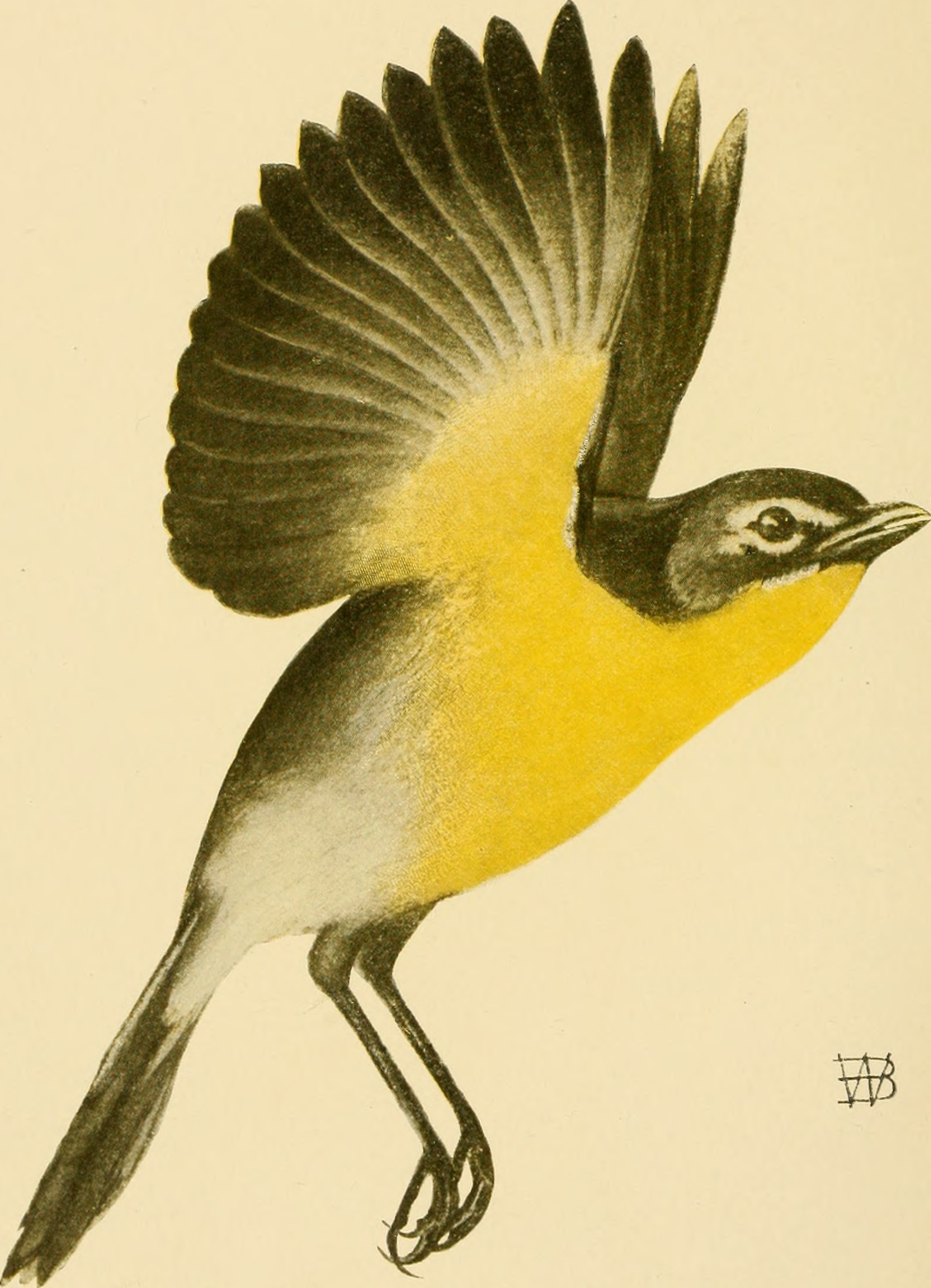
Photo by Roy Knispel                                            Regarded as the world’s largest warbler, the yellow-breasted chat is a noisy oddball among this family of New World birds.

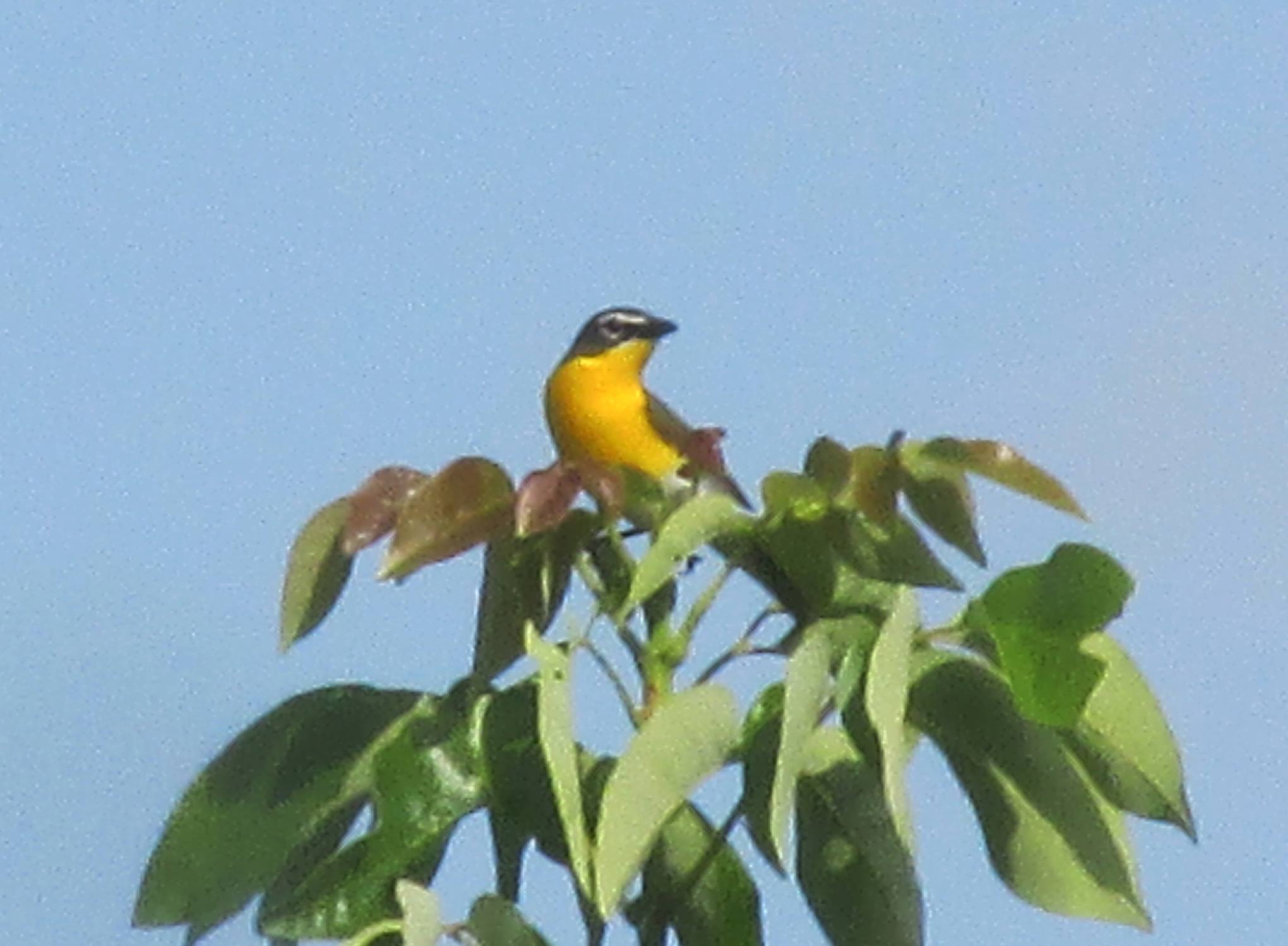
The Yellow-breasted Chat has long held a unique distinction among the New World wood-warblers as the largest member of this diverse family of neotropical birds. Some experts, however, have always questioned whether the Yellow-breasted Chat is truly a warbler. The jury, based on my research, is apparently still out. Personally, I hope the chat continues as a member of the warbler clan because what family doesn’t need its big, goofy oddball? If nothing else, the yellow-breasted chat is truly an the odd bird out among the little birds known as warblers that spend most of their time constantly on the move, flitting from branch to branch in hyperactive bursts of activity.

468551_10200729159303757_215796861_o

Photo by Bryan Stevens                                      A Yellow-breasted Chat perched atop a tree to survey its surroundings.

Yellow-breasted chats aren’t more sedate than other warblers, but they don’t dart about in the treetops in the same way as might a Northern parula or blackpoll warbler. During the spring ritual of attracting a mate, the males are obsessed with constant singing and performing. The performance portion of the program consists of awkward, drooping flights into the open before plunging back into thick cover. Males will also select an elevated perch in the open to proclaim their availability through song for any listening females.

There are many other ways they stand out on the warbler family tree. For instance, yellow-breasted chats are significantly bigger than all other warblers, reaching a length of 7.5 inches with a wingspan of almost 10 inches. The two sexes look alike, which is something else that separates them from many, but not all, warblers, which are generally known for the differences in appearance between males and females. The yellow-breasted chat has olive-green upperparts with white bellies and bright yellow throats and breasts. These chats also have long tails and heavy bills. A prominent characteristic is a spectacle-shaped white eye-ring.

Plate-137-Yellow-breasted-Chat-final 2

Early American naturalist and painter John James Audubon painted this family group of Yellow-breasted Chats.

I have observed yellow-breasted chats in many locations in the region, but during my early years birding this was a very elusive bird for me. It took me a couple of years to get my first satisfactory look at this interesting bird. Chats prefer habitats such as dense thickets and other underbrush, which offers remarkable concealment from prying eyes.

Chats are loud birds at most times, producing a variety of odd vocalizations, which means they are often heard before they are seen. The online Audubon Guide to North American Birds describes these sounds as “a bizarre series of hoots, whistles, and clucks, coming from the briar tangles” and labels them a reliable means for determining the presence of a yellow-breasted chat. By learning these vocalizations, you’ll increase the chances of finding one of these birds during time spent outdoors.

Thrasher-Shrub

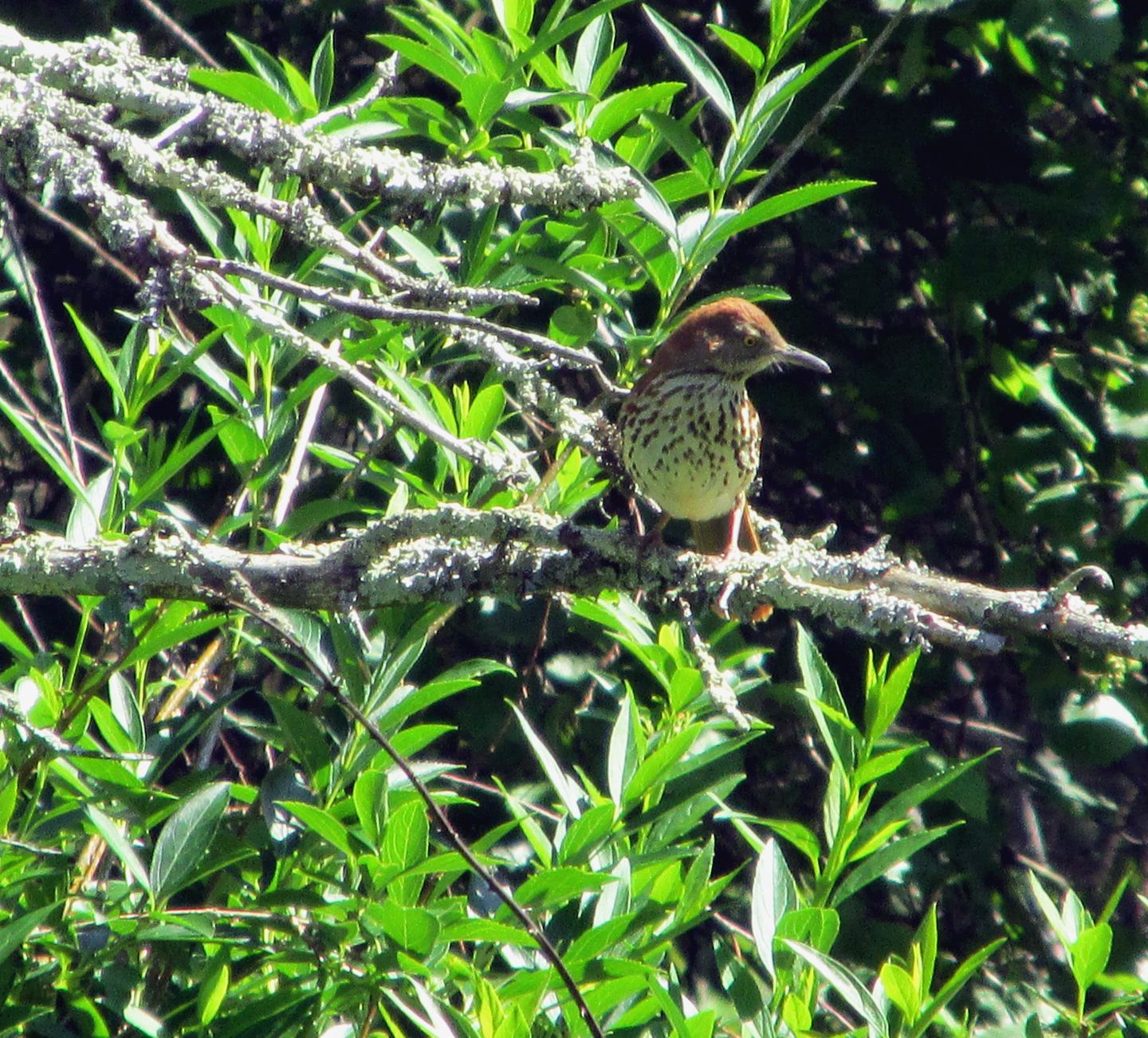
Photo by Bryan Stevens                              Along with such birds as Brown Thrashers, pictured, Yellow-breasted Chats prefer thickets and other brushy, dense habitats.

The chat’s habitat preferences and its repertoire of vocalizations makes it easy to associate these birds with others that share the same dense, brushy habitats and a penchant for making unusual vocalizations. Birds often found in proximity to chats include brown thrashers, gray catbirds, white-eyed vireos and Eastern towhees.

Habitat loss has resulted in a steady decline of yellow-breasted chats in some parts of their range. It is a widely distributed bird, spending the nesting season from southern Canada to Mexico. Most chats retreat to Mexico and Central America for the winter months. This chat mostly feeds on insects, supplementing its diet with berries that ripen during the summer months.

14568928678_8f77bbf7b6_o

The Yellow-breasted Chat is considered the world’s largest warbler.

Female chats usually lay three to four eggs, but both parents care for the young. Young chats are usually ready to leave the nest only eight days after hatching, but they will remain dependent on their parents for food for a couple of weeks. Chats usually nest twice each during the nesting season.

I’ve only observed a yellow-breasted chat on one occasion at my home. That individual, a fall migrant, was a delightful surprise. The yellow-breasted chat is usually a bird that I have to make an attempt to find. It’s worth the effort to gain a good look at this big, brash member of the warbler clan.

Three other chats, all birds of tropical regions, were moved out of the warbler clan in 2009 by the American Ornithologists’ Union. Experts now believe that the rose-breasted chat of South America, the gray-throated chat of Mexico, Guatemala and Belize and the red-breasted chat of the Pacific slope of Mexico are more closely related to cardinals and tanagers than warblers. The AOU, should it one day make that decision for the yellow-breasted chat, is likely to classify this oddball bird as a member of the Cardinalidae family of birds.

920921_10200729160063776_888323380_o

Photo by Bryan Stevens                                                                            Usually retiring and reclusive, the nesting season makes male Yellow-breasted Chats seek elevated perches for producing an array of unusual vocalizations.


May brings Grand Strand birding adventure

Protho-Warbler

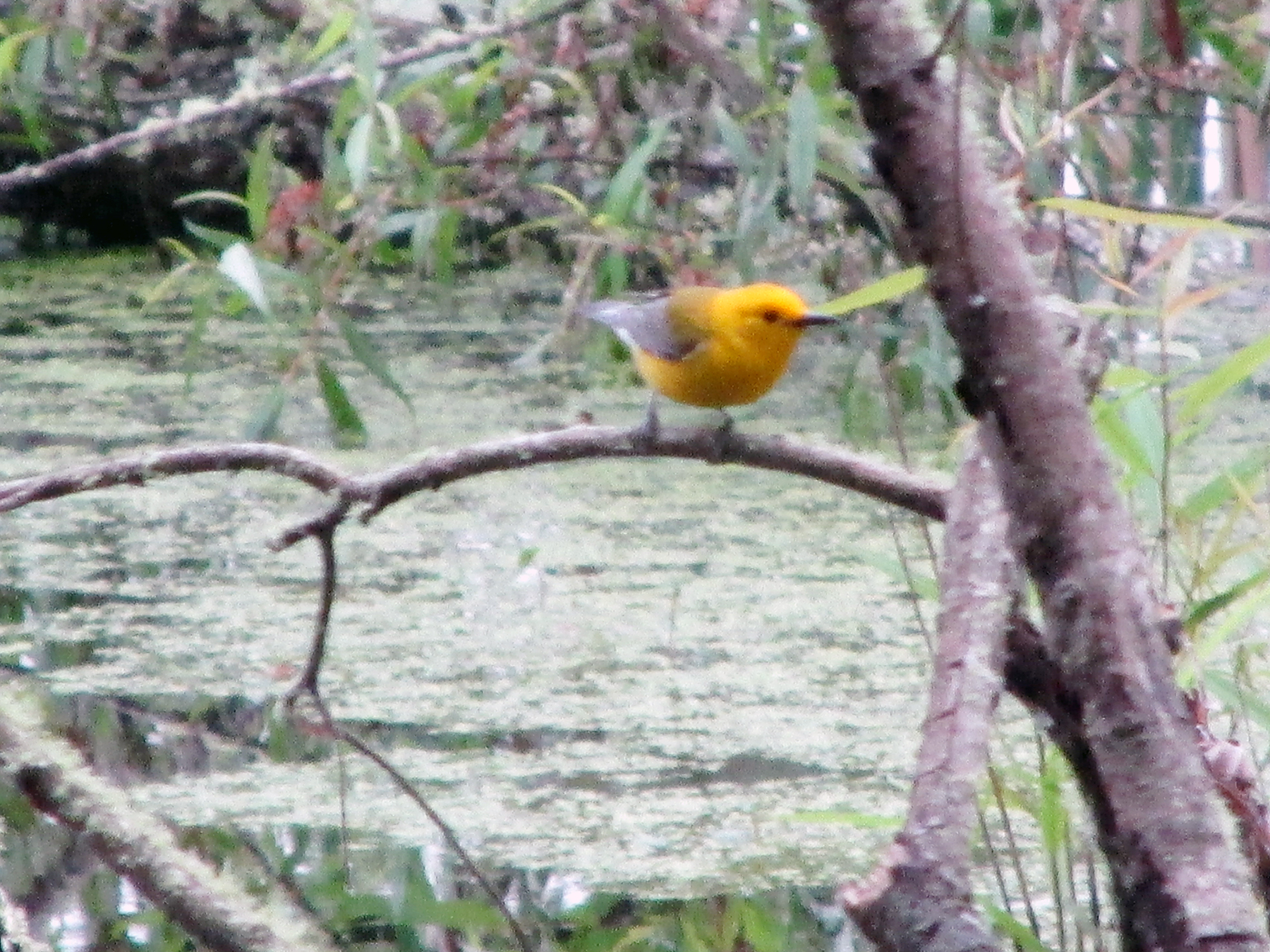
Photos by Bryan  Stevens                                       Among cypress knees in a flooded forest on Huntington Beach State Park, this Prothonotary Warbler made his presence known with his loud, ringing song.

I’ve been vacationing on Pawleys Island, S.C., so this week’s post will be a pictorial tour of some fun birding away from the mountains of East Tennessee.

As much as I like my mountain birds back home, it’s always great to get back to South Carolina. This trip has even managed to add a few new species to my South Carolina State List, including Prothonotary Warbler and Blue Grosbeak.

My favorite birding spots during my stay have included daily visits to Brookgreen Gardens and Huntington Beach State Park.

The 2,500 acre-Huntington Beach State Park rewards visitors with a diverse selection of birds, including shorebirds, wading birds, songbirds, raptors and almost every other feathered friend you care to name.

GeeseSculpture

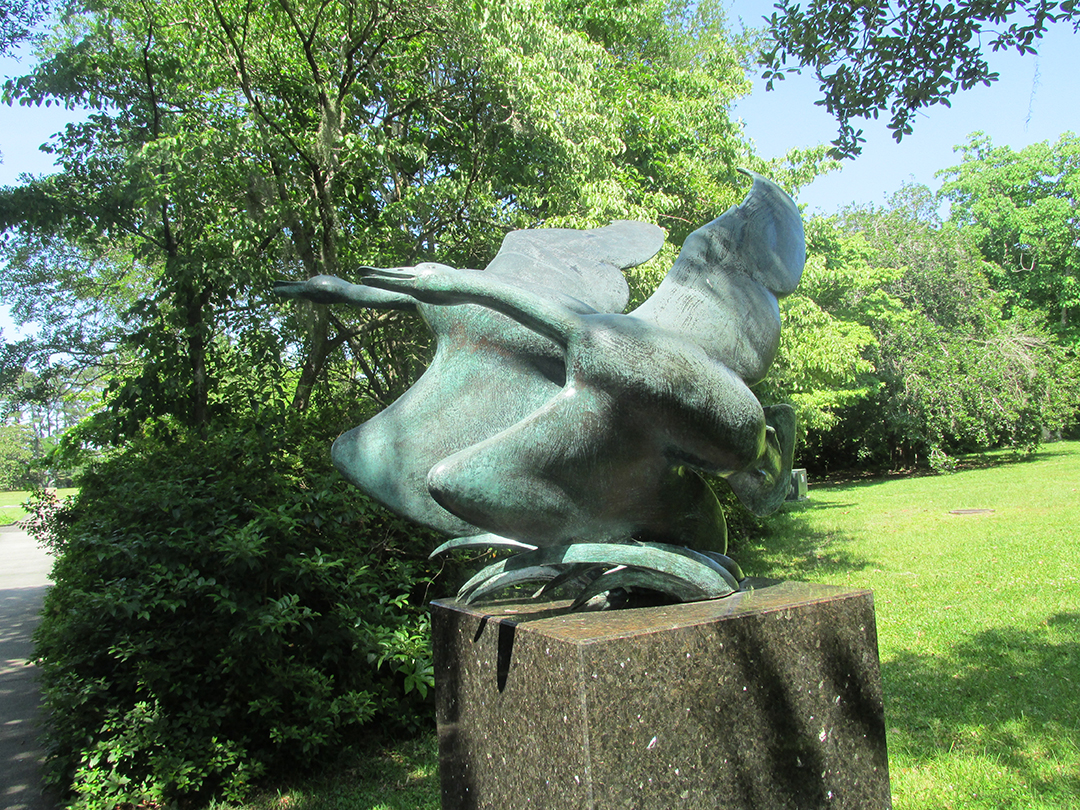
A sculpture of geese titled “Flying Wild Geese” by Marshall M. Fredericks at Brookgreen Gardens. The bronze sculpture was cast in 1967.

The park is located roughly 15 miles from Myrtle Beach, but it offers a much slower pace than the commercially driven tourism of the famous beach.  More than 310 species of birds have been reported from Huntington Beach State Park since 1966. Helping increase bird diversity is varied habitat, including 1,060 acres of salt marsh, 750 acres of woodlands, 90 acres of freshwater/brackish marshes, 400 acres of maritime shrub thicket and 200 acres of sandy beach and dunes.

Anhinga-HUNT

An American Anhinga preens its feathers after taking a swim.

In addition, I have been delighted by the numbers of birds I have found within Brookgreen Gardens, which is a 9,100-acre sculpture garden and wildlife preserve. The attraction offers several themed gardens as a lovely backdrop for American figurative sculptures. There’s also a Lowcountry Zoo, as well as nature trails through a variety of habitats, including old rice plantation fields. Brookgreen Gardens was founded by Archer Milton Huntington, stepson of railroad magnate Collis Potter Huntington, and his wife, Anna Hyatt Huntington. The attraction displays some of the sculptures completed by Anna and her sister, Harriet Hyatt, along with other respected American sculptors. Brookgreen Gardens, which opened in 1932, is built on four former rice plantations, taking its name from the former Brookgreen Plantation.

So, enjoy this week’s pictorial essay on my latest birding trip to South Carolina. I hope you’ll find something to your liking.

MockerFamily

A trio of young mockingbirds follow a parent in hope of a morsel of food.

LittleBlue

Little Blue Heron in a former rice field at Brookgreen Gardens.

Pileated-1

Pileated Woodpecker climbs on a live oak tree at Brookgreen Gardens.

Dowitchers

Dowitchers feed on a tidal flat at Huntington Beach State Park.

Paint-Male

Painted Buntings are quite prominent at Huntington Beach State Park.

FemaleBunting

Female Painted Buntings lack the showy feathers of males.

Painteds

Three male Painted Buntings co-exist at a feeder at the Huntington Beach State Park Nature Center.

Bunting-Male

The male Painted Buntings is one of North America’s most vibrant songbirds.

GREATCrested

Great Crested Flycatcher perches atop a pine tree at Brookgreen Gardens.

Orchard-SecondYearMale

A second-year male Orchard Oriole in a pine tree at Huntington Beach State Park.

Parula=4

A male Northern Parula explores beneath the leaves of the woodland canopy at Brookgreen Gardens.

Red-bellied-May16

A Red-bellied Woodpecker visits a nest cavity in a dead tree at Brookgreen Gardens.

EgretBlog

A Great Egret takes flight from a marsh at Huntington Beach State Park.

Windbird-Flock

A Semipalmated Sandpiper brings up the rear as it tries to catch up to a flock of Sanderlings, one of its larger relatives.

Cuckoo

Cuckoos, such as this Yellow-billed Cuckoo, are more often heard than seen, but they will occasionally cooperate for a photograph.

Grackle-Flood

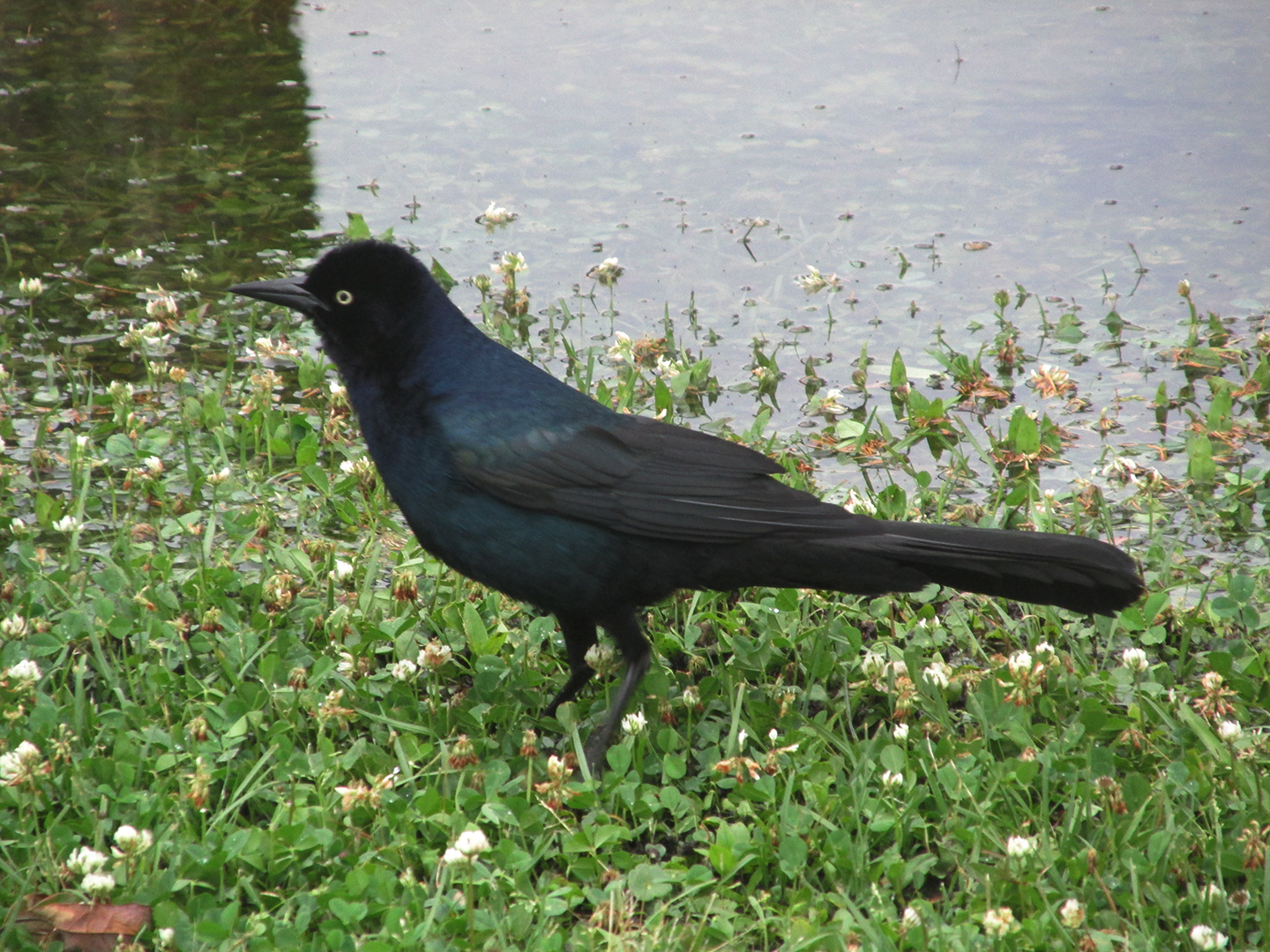
Tropical Storm Ana dumped a lot of rain on Huntington Beach State Park. Flooded lawns areas provided temporary foraging grounds for migrating shorebirds, as well as resident Boat-tailed Grackles.

Dowitcher-Two

A dowitcher uses its unique bill to probe for food in the mud of a tidal flat.

Yellowlegs-Something

Lesser Yellowlegs and Least Sandpipers forage in a puddle created by the rains of Tropical Storm Ana.


More than halfway to my goal of 100 yard birds in 2015

Yellow-Crowns-April19

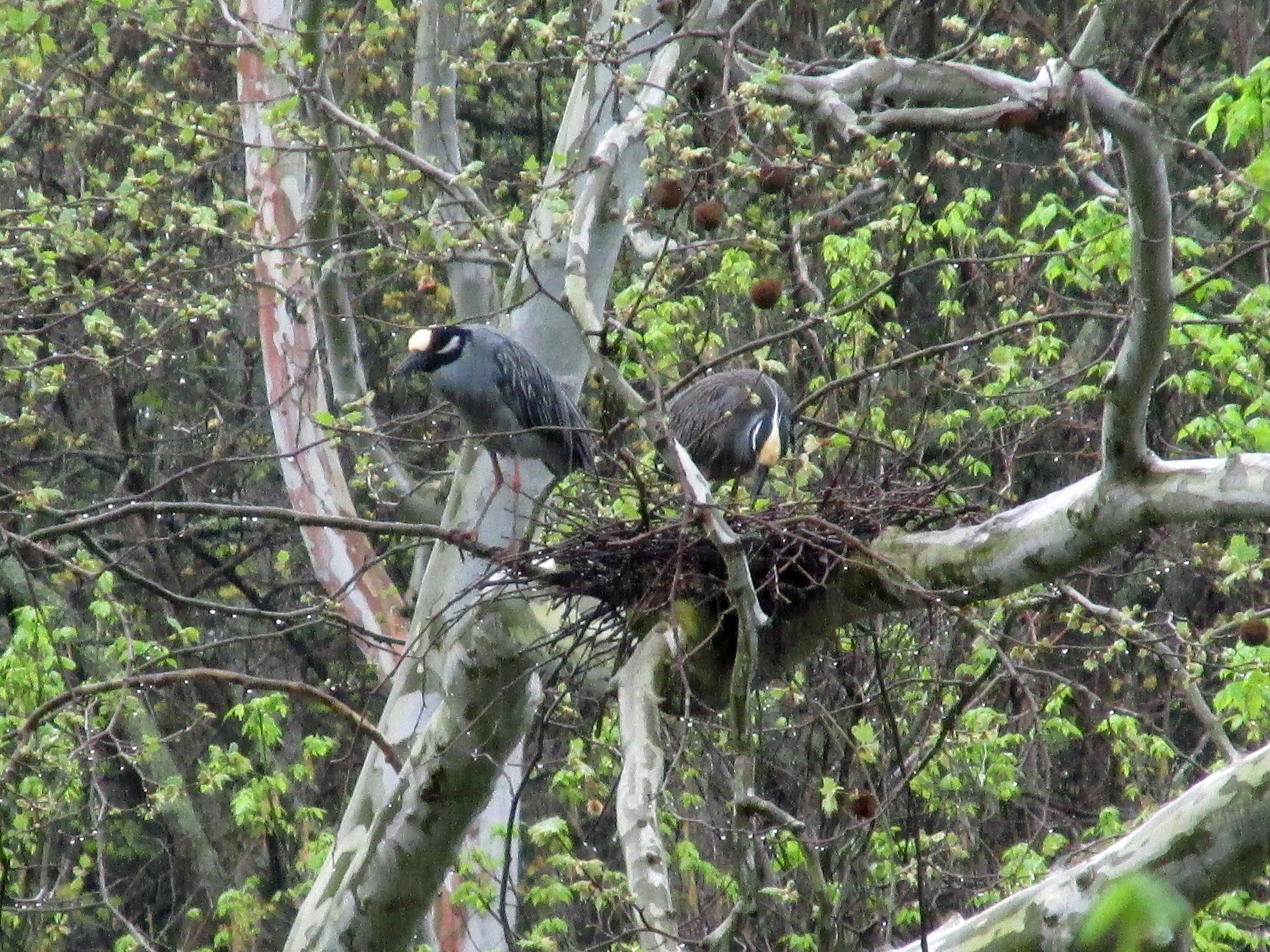
I would love to add Yellow-crowned Night-Heron to my yard list. Great Blue Herons, Black-crowned Night-Herons, Green Herons and Great Egrets have visited the creek and fish pond at my home, but I’ve never had a visit from a Yellow-crowned Night-Heron. I photographed this pair on a nest along the Watauga River on Blevins Road.

On April 19, a singing male Black-throated Green Warbler became the 50th bird species to make an appearance in my yard this year.

Back at the start of this year, I considered trying for another “big year” in the five-county area of Northeast Tennessee that consists of the counties of Carter, Johnson, Sullivan, Unicoi and Washington.

However, such an undertaking requires a lot of travel and expense, as well as an immense dedication of time. After a 2014 marked by many personal upsets, I didn’t feel capable of making an attempt. Considering I last undertook a “big year” effort back in 2013, I felt it was too soon for me to try this again.

BG-Gnat-April25

The Blue-gray Gnatcatcher, an early bird among spring migrants, arrived on Easter Sunday, April 5, this year. It was Bird No. 42 on my yard list for 2015.

Instead, I’ve focused my attention on the birds that come calling to my yard, fish pond, the creek and the surrounding woodlands. Over the years, I’ve enjoyed some amazing visitors from a variety of feathered friends.

It was an amazing winter, with large flocks of Purple Finches and Pine Siskins at my feeders. In fact, these two species remain present even as the calendar moves closer to May. In fact, I saw a Pine Siskin at the feeders on Saturday, April 25.

Hoodie-April22

My favorite warbler, the Hooded Warbler, returned this spring on April 13. The males are currently singing daily from rhododendron thickets in the woodlands around my home.

As is usually the case here at my Simerly Creek home in Hampton, spring migration is proceeding at a slow pace. For some reason, the fall migration is a more “birdy” time. So, any bird I miss seeing this spring, I will hope to pick up while I continue looking for yard birds this autumn.

11174272_10205371493639214_6825911444318051913_o

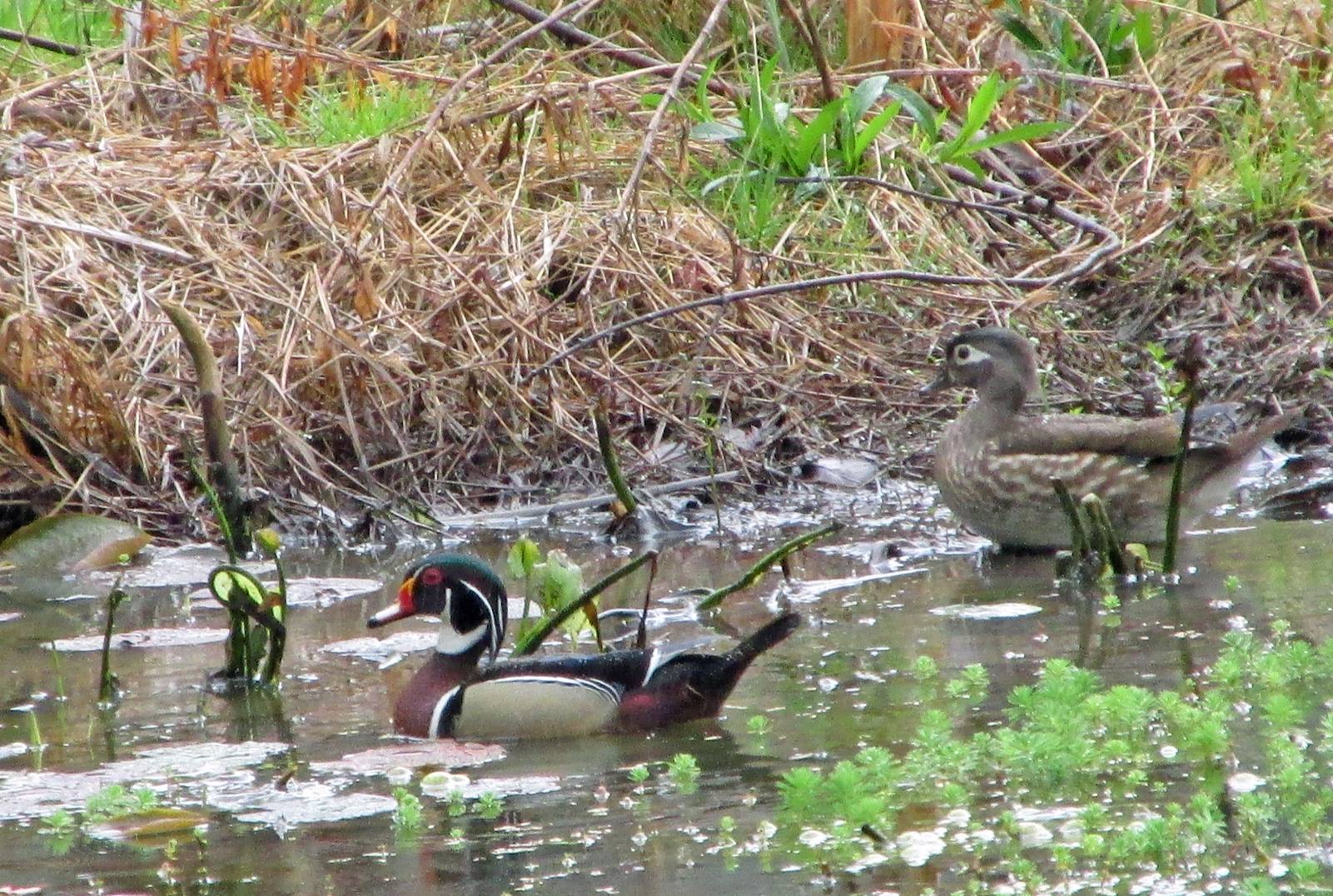
A pair of Wood Ducks visited the pond on a recent rainy morning. Until a decade ago, Wood Ducks were regular spring visitors. For some reason, they have become much more sporadic in their visits over the past 10 years.

Of course, there have been a few spring surprises, including a pair of Wood Ducks that showed up at the fish pond on a rainy morning on Sunday, April 19. Several of the resident warblers have also arrived, including Hooded Warbler, Black-and-white Warbler, Northern Parula, Black-throated Green Warbler and Ovenbird.

As of the time of my sitting down to post this blog entry, I’ve found 52 species in my yard so far this year.

The most recent sightings have been a Wood Thrush (No. 52) and a Northern Parula (No. 53) on my list. These two species showed up on April 20 and April 21, respectively.

Kingbird-ETSU

I have been birding for more than 20 years, but in that time I have only had one Eastern Kingbird visit my yard. Will the second kingbird pay a visit at some point in 2015?

So, wish me luck as I continue this more modest undertaking. Let’s call it a “Big Yard Year.” I am hopeful that I can find 100 species in my yard before Dec. 31. I’ll continue you update occasionally here on my weekly blog.


Orange-crowned Warbler sighting punctuates fall’s parade of migrants

The annual migratory parade of warblers has ended, but not without a few final surprises. By the arrival of the region’s only winter warbler — the Yellow-rumped Warbler — it’s a foregone conclusion that the migration season for this colorful family of birds is almost at an end.

Photo by U.S Fish & Wildlife Service An Orange-crowned Warbler perches on a branch.

Photo by U.S Fish & Wildlife Service
An Orange-crowned Warbler perches on a branch.

There is, however, one final exception. One of the warblers tends to migrate later in the season than its kin. In a family of colorful birds like the Cape May Warbler and the Black-throated Blue Warbler, it’s also at a decided disadvantage when it comes to considerations like appearance.

Although it has a striking name — Orange-crowned Warbler — the patch of orange feathers atop this warbler’s head are rarely seen by observers in the field. In fact, the most conspicuous thing about the Orange-crowned Warbler is its lack of conspicuousness. This is a grayish-greenish warbler with only two dashes of color. It can also show some surprisingly bright yellow plumage under the tail. Only once, however, have I noticed the namesake orange crown patch that is usually kept concealed beneath a layer of gray-green feathers.

“Warblers of the Americas,” an identification guide written by Jon Curson, David Quinn and David Beadle, stipulates that the crown patch that this warbler’s common name derives from is visible only when the warbler raises its crown feathers. This little twist makes the orange crown patch a very unreliable field mark.

Photo by U.S. Fish & Wildlife Service The faint gray streaks on the breast helps distinguish the Orange-crowned Warbler from the related Tennessee Warbler.

Photo by U.S. Fish & Wildlife Service
The faint gray streaks on the breast helps distinguish the Orange-crowned Warbler from the related Tennessee Warbler.

In fact, over the years, I’ve only observed a handful of these warblers. They tend to migrate through the region long after most other warblers. They’re also easily confused with Tennessee Warblers, which are another drab, greenish warbler that migrates through in large numbers in the autumn.

In my limited experience with these warblers, I’ve found they spend less time in trees and more time foraging in tall shrubs, such as Joe-pye weed and goldenrod. In many of my guide books, the text also indicates that this warbler prefers shrubby, weedy habitats.

This is a continent-ranging warbler, but it is much more common in the western United States than it is in the eastern half of the nation. A few of these warblers migrate into the southern United States for the winter. I’ve observed this warbler on a couple of occasions during late winter trips to the coastal areas of South Carolina. Other Orange-crowned Warblers push as far south as Guatemala for the winter season.

The orange-crowned warbler is related to the Tennessee warbler, and both species share a similar appearance. The Tennessee warbler is usually more greenish. The Tennessee also lacks the faint gray streaking that is present on the breast and flanks of the Orange-crowned Warbler.

Orangecrowned_warblerMENKE

Photo by U.S. Fish & Wildlife Service                                                     An Orange-crowned Warbler forages for insects in a shrub’s bare branches.

I usually manage to see an Orange-crowned Warbler once a year, usually in the late fall. This year’s sighting took place during the final bird walk conducted each Saturday during October by members of the Elizabethton Bird Club at Sycamore Shoals State Historic Park in Elizabethton, Tennessee.

Orangecrowned_warbler-Menke

Photo by U.S. Fish & Wildlife Service              The Orange-crowned Warbler is more common in the western half of the United States.

Some other good birds on this final walk of the 2014 season included Common Merganser, White-crowned Sparrow, Swamp Sparrow and Blue-headed Vireo.

Other species found on the walk included Canada Goose, Mallard, Blue-winged Teal, Pied-billed Grebe, Cooper’s Hawk, with captured starling in its talons, Killdeer, Mourning Dove, Red-bellied Woodpecker, Downy Woodpecker, Northern Flicker, American Kestrel, Eastern Phoebe, Blue Jay, American Crow, Carolina Chickadee, Tufted Titmouse, White-breasted Nuthatch, Carolina Wren, Eastern Bluebird, American Robin, Gray Catbird, Brown Thrasher, Northern Mockingbird, European Starling, Cedar Waxwing, Yellow-rumped Warbler, Northern Cardinal, Common Grackle, House Finch and American Goldfinch.

As usual for a late October walk, it was also a very good day for sparrows. We found Eastern Towhee, Field Sparrow, Song Sparrow, Swamp Sparrow, White-throated Sparrow and White-crowned Sparrow.

Photo by Bryan Stevens A Field Sparrow perches on a briar's stem.

Photo by Bryan Stevens
A Field Sparrow perches on a branch.

I suppose it’s a little strange to get so excited about getting a brief look at a bird that I usually see once a year during a rather brief window of a couple of weeks. Of course, it’s that very scarcity of the bird in East Tennessee that makes these typically annual sightings so wonderful to experience.

••••••

I visited Wilbur Lake with my mother on Nov. 8 for the first time this fall. We wanted to see for ourselves that the flocks of Buffleheads had returned. We were rewarded with looks at about 50 Buffleheads, as well as 10 Gadwalls and seven Ring-necked Ducks. Plenty of Canada Geese and Mallards were also present on the lake.

Photo by Bryan Stevens Buffleheads, such as these, have spent the winter on Wilbur Lake for decades.

Photo by Bryan Stevens
Buffleheads, such as these, have spent the winter on Wilbur Lake for decades.