

Photo by Bryan Stevens
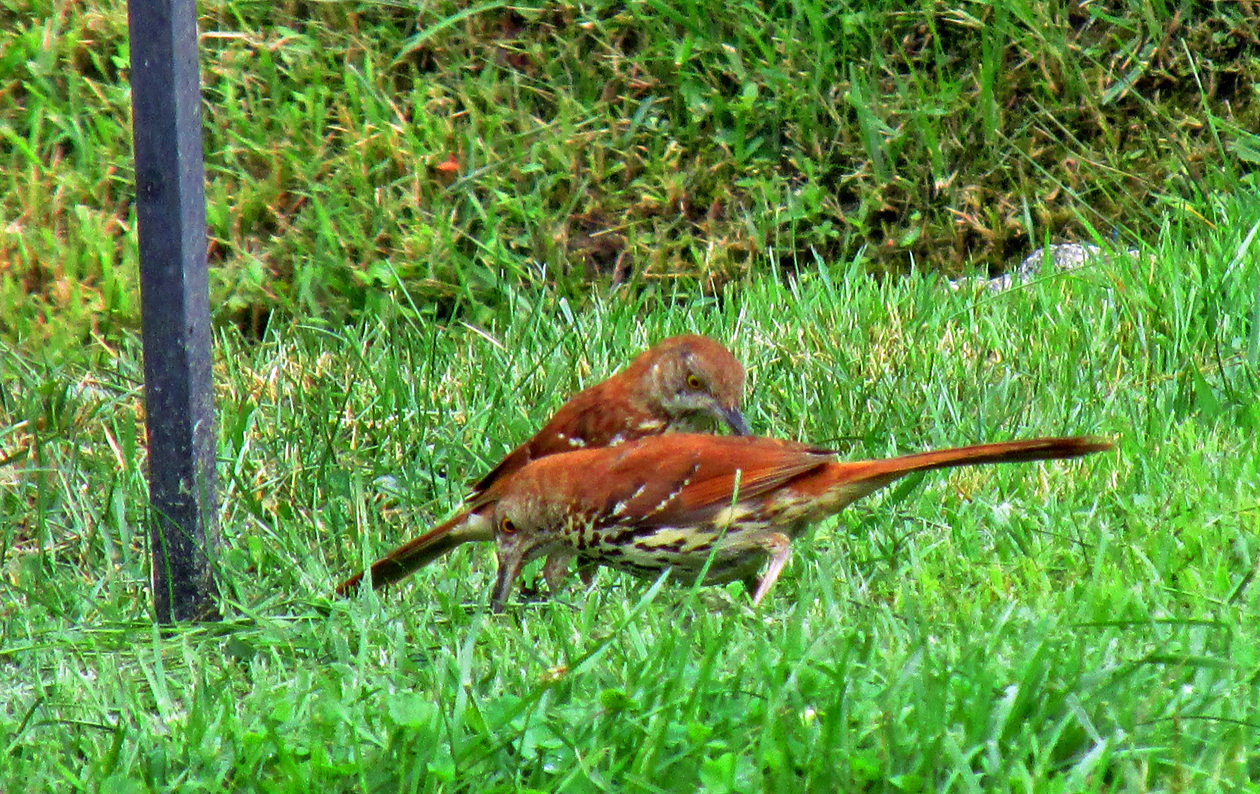
A pair of Brown Thrashers forage for food on the ground below a feeder.
I’ve been enjoying fall migration, but I’ve not seen as many species of birds as I would like. So far, I’ve observed a few warblers, including black-and-white warbler, common yellowthroat, magnolia warbler, Tennessee warbler and American redstart. Other interesting sightings have included wood thrush, several ruby-throated hummingbirds and a gray catbird. I’ve also observed brown thrashers after going most of the spring and summer without seeing any.
Brown thrashers are by nature both bold and reclusive. I was reminded of that fact during some recent lawn chair birding at home. I heard a quarrelsome thrasher calling from a thicket. I produced some squeaks to get the bird’s attention. As a result, the thrasher soon materialized like a feathered ghost deep in the branches of a shrub. I got a brief look in my binoculars at the bird and saw one baleful pale yellow eye staring back at me.
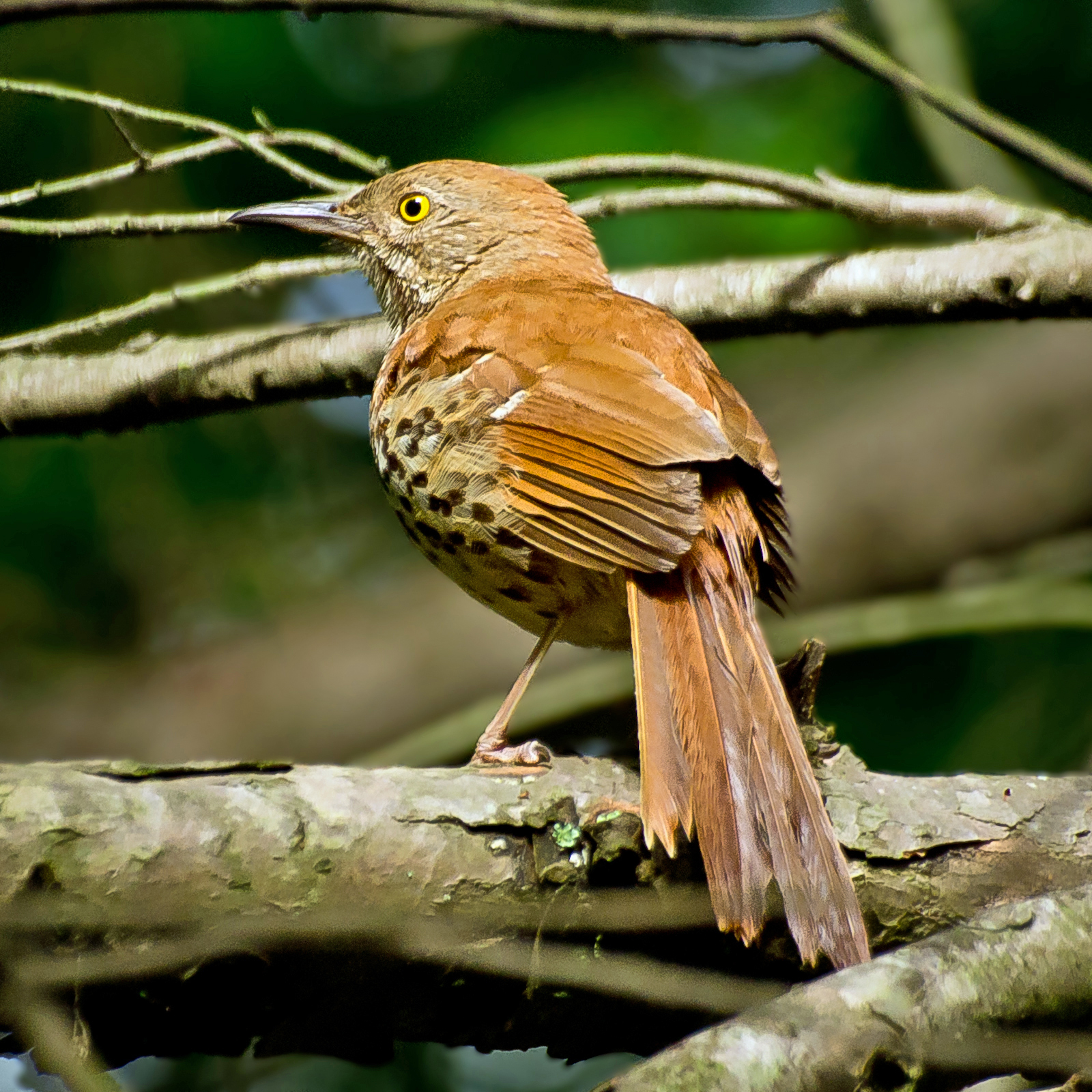
Photo by Ken Thomas
The Brown Thrasher is an alert, sharp-eyed observer of its surroundings.
A few years ago, quite by accident, I experienced a similar sighting when I came across a brown thrasher nest. I hadn’t gone looking for it. The nest, expertly woven into a thicket of honeysuckle vines, was tucked beneath a sheltering eave of an outdoor storage building. I don’t think anything but a fortunate accident could have ever revealed the nest. I still remember peeking into that tangle of vines and seeing a golden eye staring back. The bird didn’t look in the least pleased that I had accidentally stumbled across her nest.
The otherwise extroverted brown thrasher, which prefers to nest in difficult-to-access, tangled messes, found the cluster of vines a perfect location. For those not familiar with brown thrashers — relatives of the Northern mockingbird — they are known for their feisty and fearless protection of their nest and young. I’m probably fortunate the thrasher on her nest decided to choose stealth instead of attack. Sometimes, discretion is truly the better part of valor and the bird probably decided that, if she remained motionless, she would blend in well with her surroundings.
I was probably fortunate to escape with no more than a stern, unhappy glare from the nesting thrasher. According to th website All About Birds, brown thrashers are aggressive in defense of their nest. The birds are known to strike people and dogs hard enough to draw blood.
Brown Thrashers are accomplished songsters that may sing more than 1,100 different song types and include imitations of other birds, including chuck-will’s-widows, wood thrushes and Northern flickers.
The brown thrasher (Toxostoma rufum) belongs to the family of “mimic thrushes,” which provides a label for a group of songbirds capable of imitating the songs of other birds. Mimidae, the Latin root for “mimic,” provides the scientific name for the family, which includes mockingbirds and the New World catbirds, as well as thrashers. The Northern mockingbird is best known for the ability to mimic, but relatives like the gray catbird and brown thrasher are also talented mimics.
The thrasher is a fairly large songbird about 11.5 inches long with a wingspan of 13 inches. Much of the body length comes from the bird’s long tail feathers. A thrasher weighs, however, only about 2.5 ounces.

Early American naturalist and artist John James Audubon painted a dramatic scene of Brown Thrashers defending their nest from an attacking snake.
The brown thrasher is not a picky eater. It’s known to eat everything from berries and nuts to insects and small lizards. It’s also aggressive in defending its nest and young. John James Audubon, a French-American ornithologist, naturalist and painter, painted quite a dramatic scene of a group of brown thrashers valiantly defending a nest from an attacking snake. The painting is so detailed that one must imagine Audubon based his work on a real-life experience. His work, originally painted in the early decades of the 1800s, still holds up today. The scene comes almost alive to the viewer and confirms Audubon’s skill at capturing extremely accurate moment in the lives of the birds he painted.
Incidentally, Audubon knew the brown thrasher as the “ferruginous thrush.” Another former common name for this species was “brown thrush.”
The thrashers are familiar birds in southern gardens. In fact, the brown thrasher is the official state bird of Georgia and also provided the name for Atlanta’s National Hockey League team, the Atlanta Thrashers. The thrasher became Georgia’s state bird due to passage of a Joint Resolution of the Georgia General Assembly in 1970.
Returning to the expressive nature of brown thrashers, I think it’s the bird’s golden eyes that make them seem so alert and attentive. Once they feel secure in a lawn or garden, they become less shy. As one might expect from a large songbird, thrashers have voracious appetites. Among the feeder fare I offer, thrashers seem to prefer suet cakes. They’re not woodpeckers, however, so the awkward attempts of these long-tailed birds to access the suet offer some comic antics for observers.
As a larger songbird, brown thrashers also tend to live a little longer than smaller birds. The oldest brown thrasher on record was at least 10 years, 11 months old, according to All About Birds. This individual was found in Florida in 1978 where it was banded in 1967.
The brown thrasher is the only thrasher that ranges east of the Mississippi River. Other species occur in the western half of the nation, including sage thrasher, long-billed thrasher, California thrasher, Crissal thrasher, LeConte’s thrasher, curve-billed thrasher and Bendire’s thrasher.
As autumn progress, I wish everyone luck with their own birding.
•••
To ask a question, make a comment or share a sighting email me at ahoodedwarbler@aol.com.

Photo by Bryan Stevens
Brown Thrasher perched in a mimosa tree.




 Our Fine Feathered Friends