

Photo by Bryan Stevens A burrowing owl perches on a sign at Antelope Island State Park in Utah in May 2006.
For the past 29 years, I’ve published my first bird column as close to the anniversary date of its initial publication as possible.
I’m not doing that this year. Instead, in a celebration of writing “Feathered Friends” on a weekly basis for the past 30 years, I am devoting this week’s column to personal reflection.
Has it truly been 30 years? It’s the question I’ve asked myself as the date on the calendar approached, marking 30 years since I began writing my weekly “Feathered Friends” column. The column made its debut in the Elizabethton Star’s Sunday lifestyles section, but since that debut on Nov. 5, 1995, the column has appeared in most of the newspapers in the region, plus a couple in North Carolina.
The column ran from 1999 to 2003 in the Herald & Tribune in Jonesborough and began running in The Erwin Record in 2003. It has mostly run each week in Unicoi County’s weekly newspaper since that time. The column began another run in the Elizabethton Star from 2008 to 2014, followed by a run in the Bristol Herald Courier, as well as in Six Rivers Media publications such as The Tomahawk in Mountain City, as well as Johnson City Press and Kingsport Times.
The column went online via WordPress in 2014 and is still posted weekly on Sundays at ourfinefeatheredfriends.com. I’m still staggered by the fact I’ve been writing this column on a weekly basis for 30 years. Readers have followed my accomplishments in birding, including detailed columns every time I’ve added a new species to my life list.
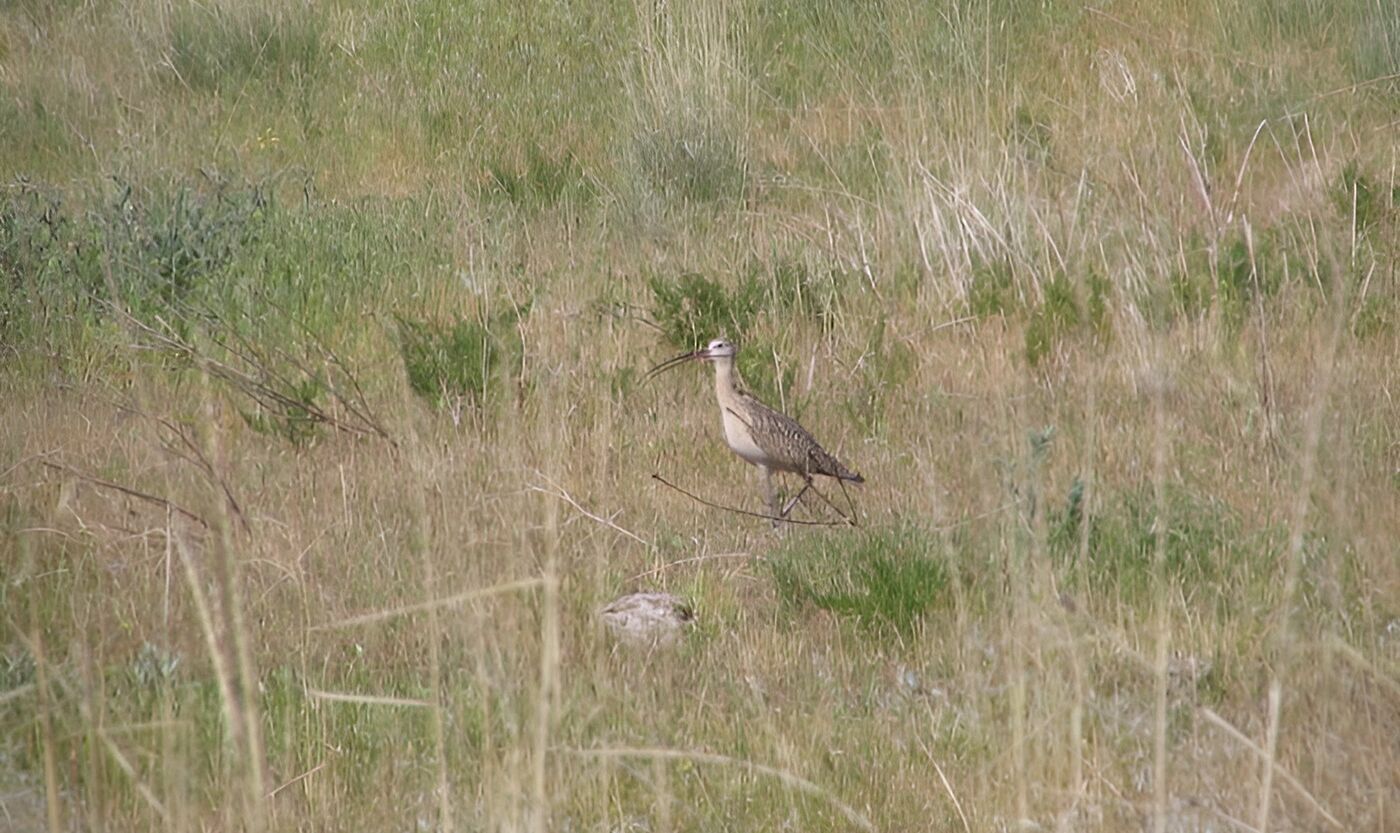
Photo by Bryan Stevens A long-billed curlew calls in a grassland at Utah’s Antelope Island State Park in May 2006.
Those special columns have included birds such as burrowing owl, long-billed curlew, roseate spoonbill, black-necked stilt, Nelson’s sparrow, black rail, swallow-tailed kite, Mississippi kite, grey-cheeked thrush, limpkin, least bittern, American bittern, painted bunting, lazuli bunting, golden eagle, American dipper, Townsend’s solitaire, mourning warbler, clay-colored sparrow, black-headed grosbeak, Western tanager, Northern saw-whet owl, bananaquit and many other memorable species. Just this past summer I added scissor-tailed flycatcher when I observed a female of this species nesting in Jonesborough.
I’ve added several hummingbirds to my list over the years, including Cuban emerald and Bahama woodstar from a trip to the Bahamas in 2000, and black-chinned hummingbird and broad-winged hummingbird from a trip to Utah. I saw a far out-of-range green-breasted mango in Charlotte, North Carolina, and traveled to Nashville to see a Calliope hummingbird, which is also the smallest of North American birds. In Northeast Tennessee, I’ve seen numerous rufous hummingbirds and a couple of Allen’s hummingbirds, both of which are western species with a perplexing habit of migration through the region and showing up in unlikely locations.
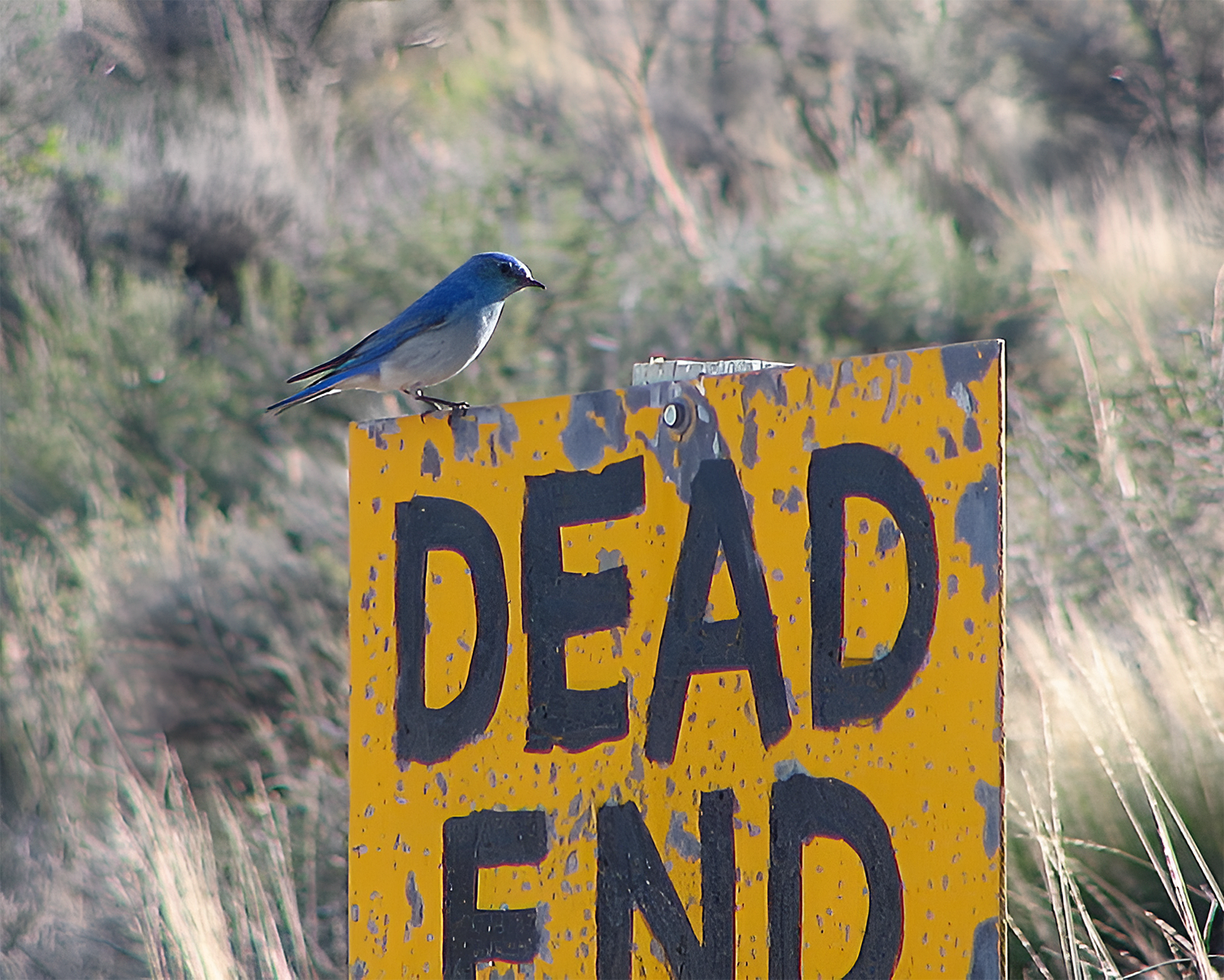
Photo by Bryan Stevens A mountain bluebird at Sweetwater Trailer Park and Campground at Garden City, Utah, on the shores of Bear Lake. Despite the sign, this location was certainly no “dead end” when it came to birding.
Even more than the birds, however, are the people I’ve met through this weekly column. I’ve been able to share stories about birding with people like Howard Langridge, Reece Jamerson, Gilbert Derouen and Wallace Coffey. They’re all gone now, but I have my memories of our time together looking for and finding some memorable birds.
I’ve met people like Brookie and Jean Potter, Tess Cumbie, Gary Wallace, Barbara Lake, Rick Knight, Joe McGuinness, Charles Moore, Fred Alsop, Allan Trently, Brenda Richards, Chris Soto, Rob Biller and Brayden Paulk. I’ve left out names because in all honesty there are too many to list. I’ve shared stories about Tom and Cathy McNeil, a couple who have chased rare birds such as buff-breasted sandpiper, snowy owl and hurricane-displaced American flamingos.
I’ve had adventures. I got stuck in mud at Musick’s Campground with Howard Langridge at Holston Lake as Hurricane Frances passed through the region in 2004, but we got a sooty tern!

Photo by Bryan Stevens A least bittern slips through marsh vegetation at Huntington Beach State Park in South Carolina.
While birding with Reece Jamerson at Austin Springs on Boone Lake, an American bittern walked up to us from a flooded ditch, absolutely fearless, and got so close we didn’t even need binoculars. Of course, we also hadn’t brought cameras.
I stood in freezing conditions for hours with dozens of birders in 2009 Springfield, Tennessee, scanning a field littered with plastic and other debris hoping for a glimpse of a reported snowy owl. Just as everyone was ready to give up hope, the owl, present all along, transformed from a white plastic bag into a fully feathered owl. It even made a short flight as if to reward everyone for their patience.
Visiting Antelope Island State Park in the middle of the Great Salt Lake in May 2006 with David Thometz and his parents, we saw many birds, the highlight being a long-billed curlew. We were driving on a road bordering a huge expanse of grassland facing the Great Salt Lake. I remarked that this looked like great habitat — I had done my homework in advance – for long-billed curlews. The words had barely left my mouth when we heard some whistled notes and saw my first-ever (and, to date, only) long-billed curlew. Even better, I managed to get a photo of the bird. We also saw thousands of horned grebes, as well as a photogenic burrowing owl, Western meadowlarks, chukars, lark sparrows and many other interesting species. Later during that same trip while traveling through Logan Canyon near Salt Lake City, I was mesmerized by an American dipper and then some Townsend’s solitaires that crowded into the scene.

Photo by Bryan Stevens A painted bunting visits feeders at Huntington Beach State Park.
On a November visit to Boone Dam with Wallace Coffey, we scanned a flock of gulls on a sandbar. When these white birds suddenly dispersed, one larger white bird that stayed behind became my first-ever sighting of a snow goose. I think Wallace’s excitement that I had gotten a life bird was even greater than my own.
Of course, my birding memories go farther back than these 30 years I’ve been writing this column. I remember the yellow birds (American goldfinches), the red birds (Northern cardinals) and blue birds (Indigo buntings) that visited each summer of my childhood. I can still hear the nocturnal serenades of whip-poor-wills that called from the woodlands while I saw on the front porch with my paternal grandparents at their home. The headlights of passing vehicles would silence them momentarily, but then one would begin calling again, and soon others rejoined the chorus. When lighting bugs added their visuals to the audio, we had all the makings of a perfect evening in the pre-Internet era.
To offer perspective, my column got its start with a feature on dark-eyed juncos, also known as “snowbirds.” With the recent dip in temperatures, I have a feeling it won’t be long before we start seeing these winter visitors.
I’ve got some plans for digging up some vintage columns as I celebrate 30 years of writing this column during 2026. There may be some other special surprises. Stay tuned and thanks to all who have read these columns over the years.

Photo by Bryan Stevens
Two Black-necked Stilts forage along the causeway wetland at Huntington Beach State Park.
 Our Fine Feathered Friends