Category Archives: Killdeer

Noisy killdeer parents have mastered the art of deception

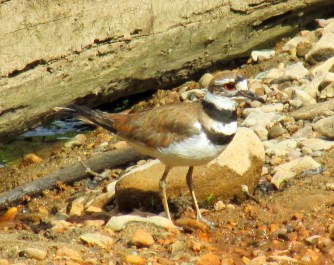
Photo by Bryan Stevens • A killdeer stands near the edge of a stream.

In last week’s column, I focused on the black-necked stilt, an oddity in the shorebird family that few non-birders would have ever heard of. This week, my focus will be on the killdeer, which is probably the shorebird most people know. Even non-birders have probably encountered this wide ranging bird that resides across much of North America.

While killdeers are considered shorebirds, they are certainly not confined to shorelines but can be found in a variety of habitats from school yards to golf courses to prairies and fields.

About 11 inches in length, the killdeer is brown above and white below with two black bands across the white chest. Males and females look alike.

These birds, despite their common name, are not antagonistic toward deer. The name killdeer refers to the loud, strident vocalization these birds produce when alarmed or disturbed. Early naturalists also noticed the noisy nature of killdeer, giving them names such as chattering plover and noisy plover, according to the website All About Birds.

The female killdeer usually lays up to four eggs on a spot on the bare ground that she may or may not have lined with some grass. Both parents attempt to guard the nest from predators. They are reliably zealous in their duties. In fact, the killdeer is famous for faking a display of injury whenever intruders draw too close. The display is meant to lure potential predators away from the location of the nest.
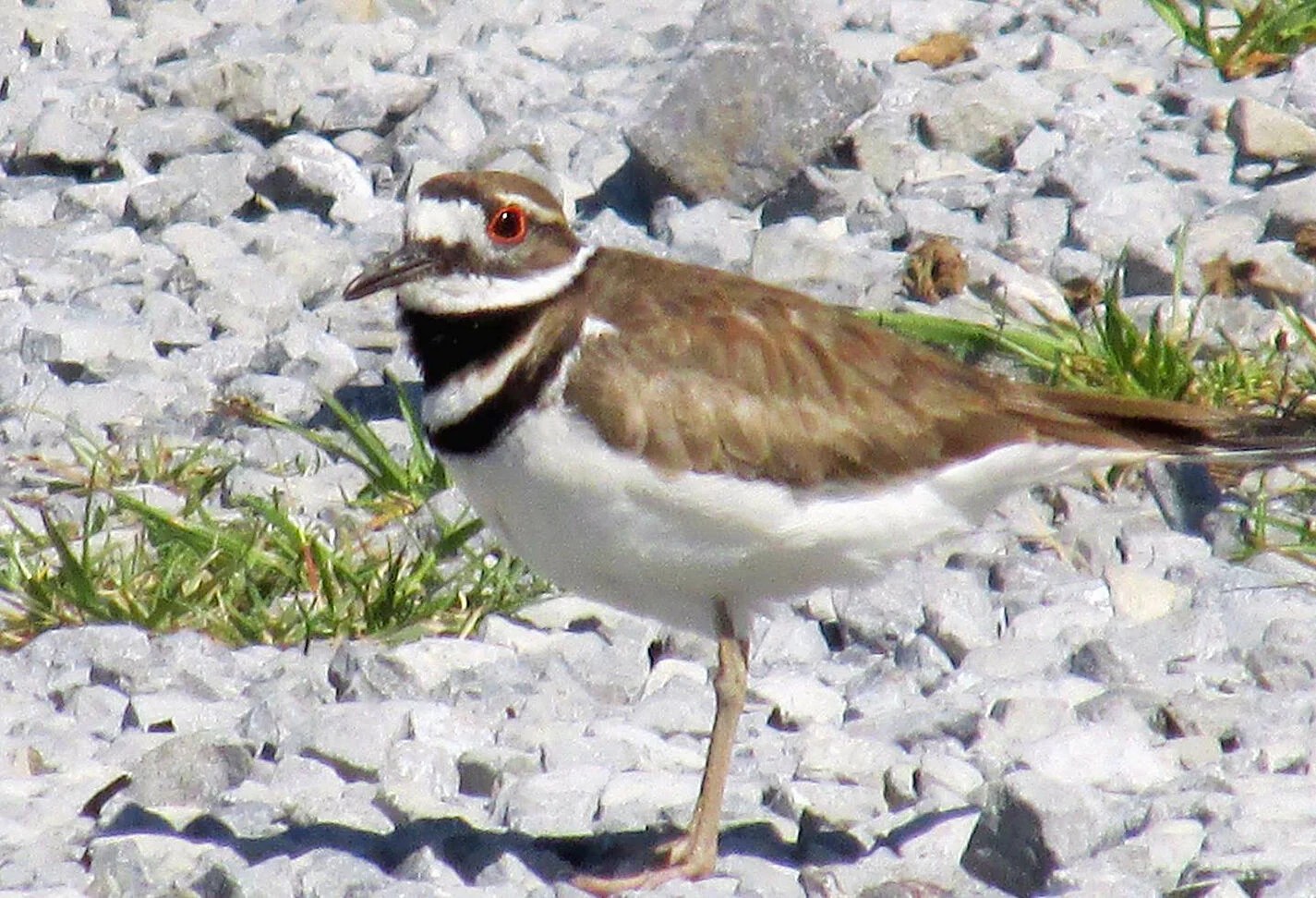
Photo by Bryan Stevens • A killdeer stands sentry duty near its nest in a gravel parking lot.

The predator, thinking the “injured” killdeer will be easy prey, follows the bird away from the nest’s vicinity. Killdeer will also put on the show for humans who venture too close to the nest. They drag their wings in a convincing display of serious injury. Of course, once the ruse has worked, the killdeer miraculously recovers and returns to its nest.

I learned about the killdeer early in life. I had a wise teacher for my first grade year. When a nesting killdeer built its home in the school yard, the teacher turned the discovery of this feathered neighbor into a teaching event.

I remember the bird performing the broken wing display and our teacher patiently explaining the rationale for the bird’s antics. The teacher must have been protective of the bird. I do recall that my fellow students and I were forbidden to approach the nest. Considering the natures of first-grade students, that was probably a smart precaution.
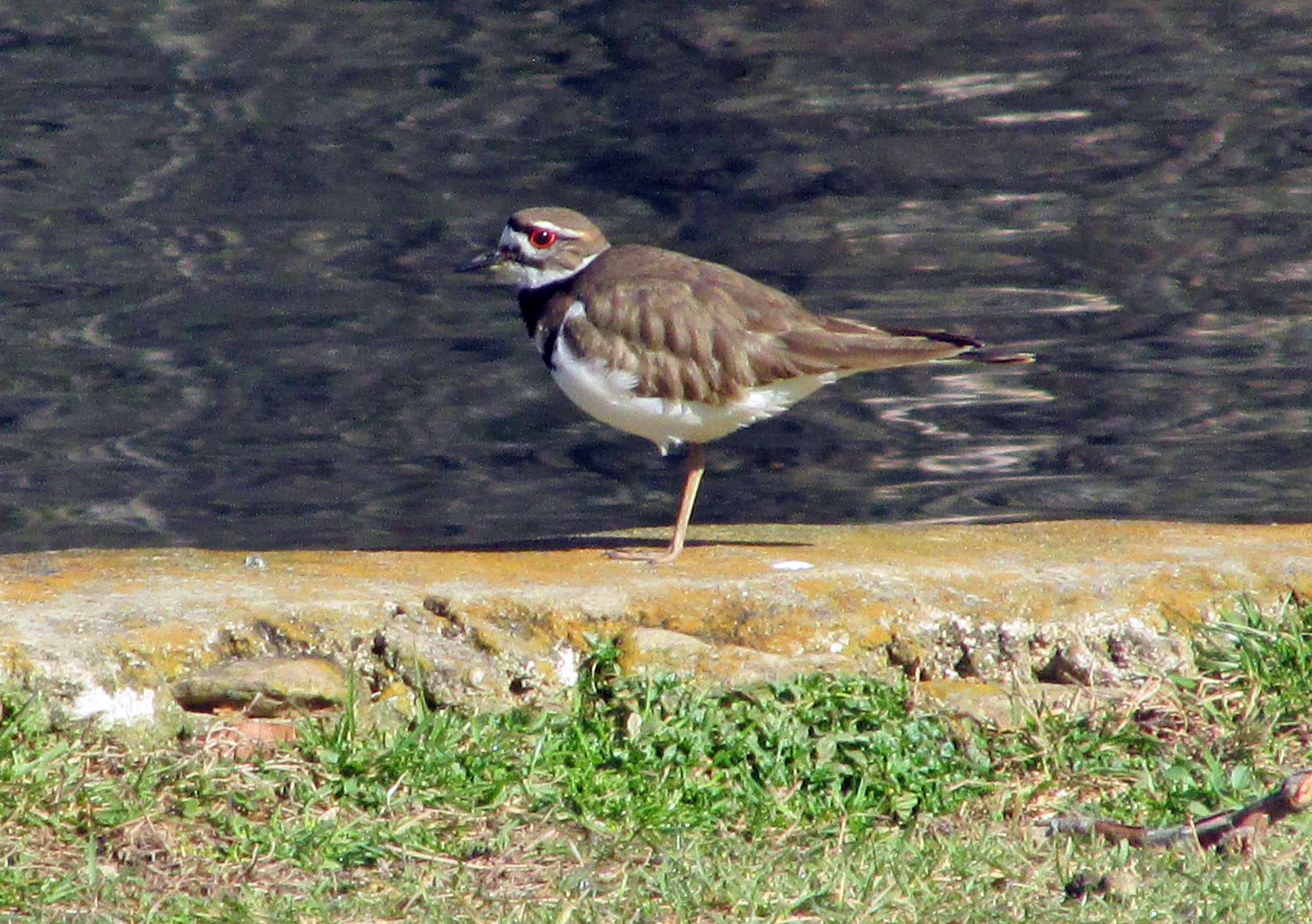
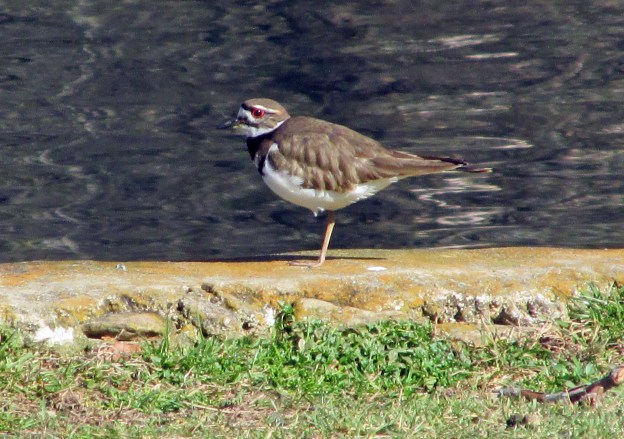
Photo by Bryan Stevens • A killdeer stands at the edge of a large pond at Fishery Park in Erwin, Tennessee.

The class followed the progress of the killdeer family as the eggs hatched and the school grounds became the home turf for the pair of killdeers and their young. I don’t recall a conclusion to the story. Since killdeer nest in spring, I suspect that the school year came to an end ahead of the nesting season.

The killdeer is a member of the plover family, which includes shorebirds distinctly different from related sandpipers.

There are more than 60 species of plovers worldwide, with several different species spending at least part of the year in North America. Close relatives of the killdeer include Wilson’s plover, semipalmated plover, snowy plover, mountain plover and the endangered piping plover.

Killdeers utilize some unusual nesting locations, including gravel parking lots and building rooftops covered with gravel or pebbles. Young killdeers can leave the nest site soon after hatching and follow their parents as they forage for food. They look like fuzzy golf balls with toothpick legs.


I’ll always remember my first encounters with this large, loud plover while a student at Hampton Elementary School many years ago. Observing that killdeer family no doubt planted the seed that eventually sprouted into my enthusiasm for watching birds. Witnessing the trickery the birds deployed to foil predators — and curious kids — away from their nests remains fresh in the memory.

Photo by Bryan Stevens • The killdeer is a plover, placing it within the family of shorebirds. They are more often found on open fields instead of along coastal shores.

Somewhat more recently, I encountered another fuzzy golf ball at rest on the ground toward the back of Erwin Fishery Park. Thinking the tiny bird was dead, I picked it up for a closer look. Even as I handled the bird, it remained motionless in my hand. When I returned the tiny “body” to the ground, however, the bird performed an amazing resurrection and fled the vicinity as quick at those toothpick legs could carry it.

Numerous people have called or written me throughout the years to report unusual nesting locations used by killdeers. I’ve seen nests in hotel parking lots, local parks and construction sites. As I mentioned earlier, the female killdeer is content to lay her eggs directly on bare soil, although she will occasionally line the nest.

These birds are opportunists. The nest lining often consists of what is most readily available. I once inspected a killdeer nest lined with discarded cigarette butts. I’m hopeful the babies didn’t hatch with instant nicotine addictions.

•••

Bryan Stevens has written about birds since 1995. Share a sighting, ask a question or make a comment by emailing him at ahoodedwarbler@aol.com.

Photo by Bryan Stevens • A killdeer covers its egg during a light rain.
Plovers among migration champions of vast and varied shorebird clan

0815171646c (1)

Photo by Janice Humble • A killdeer wanders in a grassy area near the Wal-Mart on Volunteer Parkway in Bristol. The killdeer, a species of plover, is one of the more common shorebirds found in the region.

I’m always glad to lend a hand at identifying birds. If you’re uncertain of a bird’s identification and have a photo of the bird in question, assistance is an email away. Janice Humble emailed me seeking some help with identifying the bird in a photograph attached with her message. She noted that the bird was accompanied by a companion in the grassy area near the Wal-Mart on Volunteer Parkway in Bristol. She also noted that the two birds uttered loud “peeps” during her observation.

The bird turned out to be a killdeer, a species of plover native to North America. Plovers belong to the family of shorebirds that include various sandpipers, curlews, dowitchers, stilts, avocets and other species. The killdeer is a rather common shorebird that finds itself at home far from the seashore, often present in habitats such as pastures and golf courses, as well as the grassy areas near the concrete and asphalt jungles that surround Wal-Marts and other such shopping complexes.

The killdeer’s famous for its faking of an injured wing. When its nest or young is threatened, a killdeer will go into an elaborate display, fluttering the “injured” wing and uttering shrill peeps to distract the potential predator. If successful, the bird will lure the predator away from the nest or vulnerable young. Once at a safe distance, the killdeer undergoes a miraculous recovery and takes wing, leaving behind a bewildered and perhaps chagrined predator.

Killdeer_AgainstLog

Photo by Bryan Stevens • A Killdeer explores near a stream bank.

Other North American plovers related to the killdeer include American golden-plover, black-bellied plover, Pacific golden plover, Wilson’s plover, piping plover, snowy plover, mountain plover and semipalmated plover. About 70 different species of plovers exist around the world, including such descriptively named birds as little ringed plover, red-capped plover, three-banded plover and white-fronted plover.

Musick’s Campground on Holston Lake has been one of the best area locations for seeking shorebirds during their migrations. The shore near the campground has been a magnet for persuading unusual shorebirds to pause their journey to rest, refresh and refuel. The location’s privately owned, but individual wishing to bird the shoreline can enter by signing the guest book located a small but well-marked kiosk. Some of the most memorable shorebirds I’ve seen at Musick’s Campground over the years include whimbrel, dunlin, sanderling, greater yellowlegs, short-billed dowitcher, American avocet, black-bellied plover and semipalmated plover. In recent weeks, the location has hosted such unexpected shorebirds as red knot and red-necked phalarope.

While the neighboring states of Virginia and North Carolina offer coastal birding opportunities, my native Tennessee remains quite landlocked. This fact poses a challenge for birders looking to capitalize on the seasonal migrations of shorebirds. Fortunately ponds, mudflats on the shorelines of lakes, riverbanks and even flooded fields offer adequate substitute habitat for many shorebirds. While the Mountain Empire region may lack a seashore, migrating shorebirds have learned to make do.

6300749922_099f28ae81_o (1)

Photo by Jean Potter • The American golden-plover, like this individual, is a long-distance migrant among the varied family of shorebirds.

This varied and far-flung family is also known as “wind birds,” a term which is an allusion to the capacity of many species of shorebirds to undertake nothing less than epic migrations. Many of the shorebirds that pass through in the spring are in haste to reach their nesting grounds as far north as the edge of the Arctic tundra. In fall, many of the same birds are eager to return to destinations in Central and South America ahead of cold weather and times of scarcity.

The plovers — the sedentary killdeer excepted — are among the champions of long-distance migration. According to the Audubon website, the black-bellied plover spends the brief summer season nesting in the world’s high Arctic zones but disperses to spend the winter months on the coasts of six of the globe’s seven continents.

The Pacific golden-plover’s twice yearly migrations represent an even more impressive feat. This shorebird often nests in Alaska and winter in Hawaii. The website Phys.org notes that research on this plover has revealed that the bird is capable of flying almost 3,000 miles in a mere four days. The website also reveals that those plovers wintering in Hawaii cannot lay claim to longest migrations. Some Pacific golden-plovers nest even farther south in the Pacific, reaching the Marshall Islands.

Black-belliedPlover

Photo by Jean Potter • A black-bellied plover stands out from most relatives when it wears its nesting season breeding plumage.

Shorebirds represent only a single family of birds migrating through the region in the fall. Songbirds from warblers and thrushes to vireos and flycatchers, as well as raptors and waterfowl, wing their way through the region every fall. Get outdoors with a pair of binoculars and have a look. It’s almost impossible not to see something, which may turn out to be a delightful and unanticipated surprise.

••••••

To learn more about birds and other topics from the natural world, friend Stevens on Facebook at https://www.facebook.com/ahoodedwarbler. To ask a question, make a comment or share a sighting, email him at ahoodedwarbler@aol.com.

Grade school encounter with killdeer provides memorable teaching moment

With the arrival of April, the pace of migration will quicken. Throughout the month of March, the “early birds” made their return to my yard, including species like tree swallow, brown thrasher, chipping sparrow and blue-gray gnatcatcher.

Birders know they have a narrow window of opportunity to enjoy the arriving birds in the spring. Some will linger briefly and continue to points farther north, while others will take up residence but turn secretive quickly as they get down to the important business of building nests, incubating eggs and raising young.

Killdeer-CHICK

A young killdeer — looking like a fuzzy golfball on toothpics, is born precocial. They can leave the nest and feed themselves, all while wearing a coat of downy feathers. Photo by Krista Lundgren/U.S. Fish & Wildlife


The task of producing young is the most important one that birds undertake. Even with the most dedicated parents, many birds born this spring will never reach the age of one. Eggs in the nest are vulnerable to opportunist predators, including snakes, mice, squirrels, raccoons and even other birds. Many of the birds that nest in our yards, gardens and woodlands produce altricial young. The term “altricial” is a scientific one meaning the young birds are born helpless and blind, without feathers, with almost non-existent mobility. However, they grow quickly. Since just as many creatures would like to gobble up hatchling birds as like to consume eggs, it doesn’t pay to remain in a nest for any longer than absolutely necessary.

Birds hatched in cup-shaped nests placed in trees, shrubs or even on the ground usually leave their nests within a couple of weeks. On the other hand, cavity-nesting birds produce young that can afford to linger a little longer. Some of their hatchlings may remain inside a nesting cavity for as long as a month. Even after altricial young leave their nests, they will remain dependent on their parents for some time.

kildeer_plover

Painting by John James Audubon of what he called the “Killdeer Plover.”

On the opposite side of the equation, many birds produce precocial young, which are born with their eyes open, bodies with feathers or down, and the mobility to follow their parents almost from the time they leave the egg. Precocial young can also find their own food, although parents may escort them to good foraging areas. Well-known precocial birds include ducks and chickens. Anyone who has ever observed ducklings or chicks following a mother hen is familiar with the attributes of precocial young.

Many wild birds produce precocial young, including shorebirds, grouse and quail, wild turkeys, loons and grebes. The ostrich, the world’s largest bird, also produces precocial young. Closer to home, one of my earliest bird memories involves a bird quite famous for the care and keeping of its precocial young. The killdeer is a North American shorebird that is at home in a variety of habitats, including rooftops, parking lots, golf courses, pastures and, in the case of my remembrance, an elementary school playground.

I don’t remember who discovered the nest, but I know that my teacher at Hampton Elementary School and her fellow faculty members protected the nest once they became aware of it. My teacher also had the wisdom to incorporate the nesting killdeer into her lessons. In other words, she made the discovery of these nesting birds a “teachable moment” for her young students.

Killdeer-Eggs

Photo by Bryan Stevens • Four eggs in a killdeer nest, which is assembled right on the ground.

I can’t think of a better bird for teaching some lessons about the strategies birds use to raise young. The killdeer doesn’t make much of a nest. The female often lays her amazingly well-camouflaged eggs — usually four, but occasionally three or five — in a shallow depression in dirt or gravel. On occasion, they may line the nest with plant materials or other items. I once observed a killdeer nest in a gravel parking lot of a mobile home dealership. The ingenious female killdeer, using an abundant material, had lined her nest with discarded cigarette butts — dozens of them. I’ve always joked that I hoped the young weren’t born with a nicotine addiction.

Killdeer parents are zealous parents in safeguarding their young. Adults are famous for feigning a “broken wing” to distract potential predators away from nests and offspring. They will also call loudly while faking their injury to keep the predator’s attention diverted. It’s the loud call — an exuberant “kill-deer” — that has given this member of the plover family its common name.

Like many memories from childhood, some details of that killdeer family’s fate are a little hazy. As far as I know, the parent killdeers succeeded at raising their young family. Perhaps that moment of learning, which let me glimpse into the private life of a fascinating family of birds, pointed me toward my eventual interest in birds.

Killdeer_AgainstLog

Photo by Bryan Stevens • An adult killdeer is usually a conspicuous, loud bird. 

Later, as an adult and during my early years as a birder, I had an encounter with a baby killdeer. I found the tiny bird limp and lifeless on the ground. Saddened, I reached down to pick up the young bird — it looked like a fuzzy golf ball on matchstick legs — for a closer look. As my fingers started to close around the bird, the baby revived and sprinted off with an impressive display of speed. That’s when I learned that killdeer young have one last defense against would-be predators; they can play possum!

While shorebirds, killdeers are not tied to the shoreline. Although I have observed them along beaches in South Carolina, these birds are just as much at home in cattle pastures, muddy edges of rivers and lakes or even baseball fields. Such terrestrial habitats provide these birds with plenty of food, which includes insects, spiders, centipedes, earthworms and the occasional seed. While many people remain unaware of the world’s shorebirds, the killdeer is the one member of the family that is probably frequently encountered by many Americans. Their fondness for habitats created by humans, from parking lots to gravel-covered rooftops, bring these birds close to us.

••••••

Remember to share your first hummingbird sightings with me. Simply jot down the time and date that you first notice these tiny birds have returned. You can email me at ahoodedwarbler@aol.com or though Facebook. I am increasingly impatient to see my first hummingbirds of the season.