

Shauna Fletche/Pixabay • Some birds, like waxwings, like to present tasty treats to their potential mates.
With Valentine’s Day around the corner, it’s an opportune time to see how courtship is handled among our fine feathered friends. Most birds don’t bring a box of chocolates or a bouquet of roses when they take up courtship of a prospective mate, but birds have several equivalent behaviors that they employ to attract the attentions of the opposite sex. In honor of Valentine’s Day I thought a look at some of the more unusual courtship rituals of some of our feathered friends would be appropriate.
Aerial acrobatics designed to impress
In late winter and early spring, a true oddball begins courting. The American woodcock, also known by such whimsical names as “bog sucker” and “timberdoodle,” is a shorebird that has completely abandoned the shore in favor of woodlands and fields. Beginning as early as February, American woodcocks in the region conduct nightly courtship displays, starting at dusk, that combine aerial acrobatics with an assortment of unusual acoustical flourishes. Any wet field adjacent to a wooded area could offer a stage for these evening displays, but unless you know where to look and make an effort to do so, the American woodcock might as well remain a phantom of the night.
These mating rituals provide almost the only time of the year during which this bird makes itself available for observation. It’s only during this brief window that opens into their lives that we can be assured a glimpse. Even then, our peeks at woodcocks often consist of a fuzzy twilight escapade as the bird flings itself heavenward only to make a spiraling descent a few seconds later. The displays begin with a distinct vocalization, a type of “pent,” that also has the quality of sounding like some sort of mechanical buzzer.
Once the displays conclude for the season, the birds assume nesting duties, usually unobserved by humans. The rest of the year, almost nothing but blind, sheer luck would allow a birder to stumble across an American woodcock. It’s almost as if they disappear after these spring flights of fancy.
Birds bearing gifts
Many birds present small trinkets to a prospective mate. For instance, many male penguins make a present of a stone or pebble to female penguins. There could be more than a simple bribe behind this gift. Female penguins don’t build elaborate nests. In fact, a scrape on the bare ground, perhaps encircled by a collection of pebbles, marks the extent of their nest construction. So, the perfect pebble could be the way to winning a female penguin’s heart.
The way to the heart is through the stomach
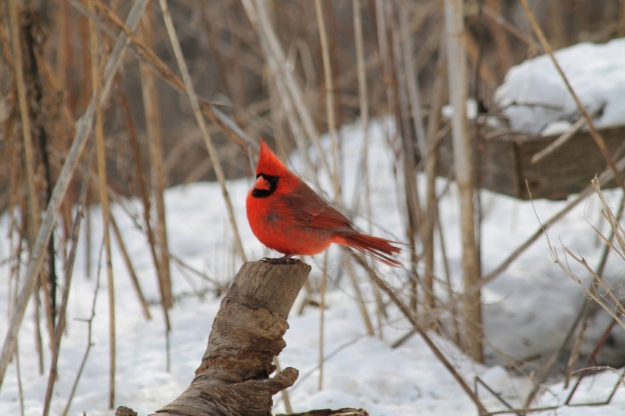
Observant birders may have witnessed a male Northern cardinal slip a female a morsel of food, such as a peanut or a shelled sunflower kernel. It’s a marked change for this bird. During the winter months, a male cardinal is more likely to chase a female away from a feeder rather than share food with her. However, as spring approaches, his behavior undergoes a change and he becomes content to feed next to a female cardinal, often slipping her some choice tidbits.
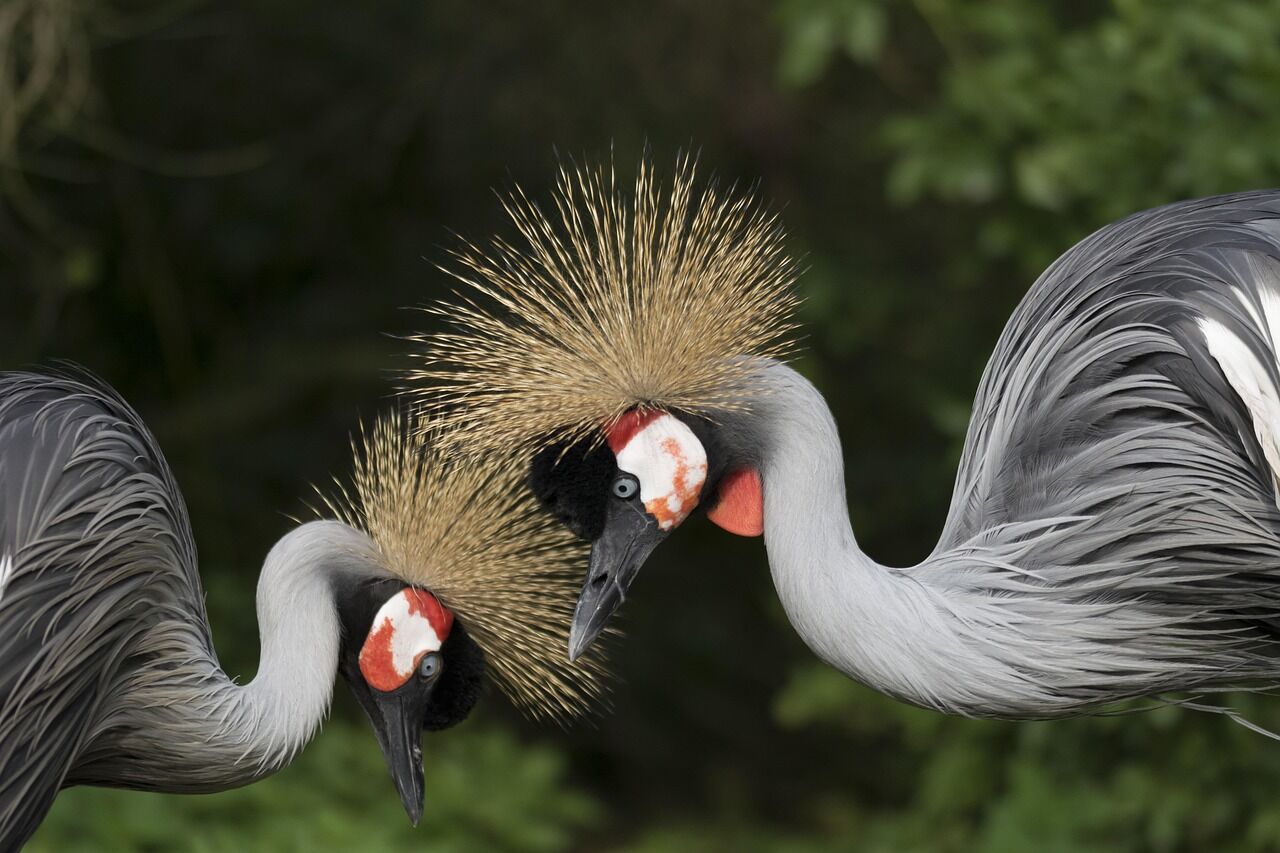
Sabine van Erp/Pixabay • Bow to your partner: Grey-crowned cranes perform an elaborate dance designed to strengthen their bond.
May I have this dance?
Many species of birds perform elaborate and ritualistic dance displays. Among birds known for tripping the light fantastic are flamingoes, cranes, grouse and grebes. Cranes are one of the oldest families of birds on earth. They’re also some of the most accomplished dancers in the animal kingdom. Pairs perform very ritualistic dances that, if the performers were human, would no doubt require the services of an accomplished choreographer. Cranes mate for life and the ritual of dancing is a way to strengthen the bonds between a mated pair. The ability to dance is, apparently, not instinctive. Young cranes must practice their dance moves, a process that can take years before they master the elaborate dance.
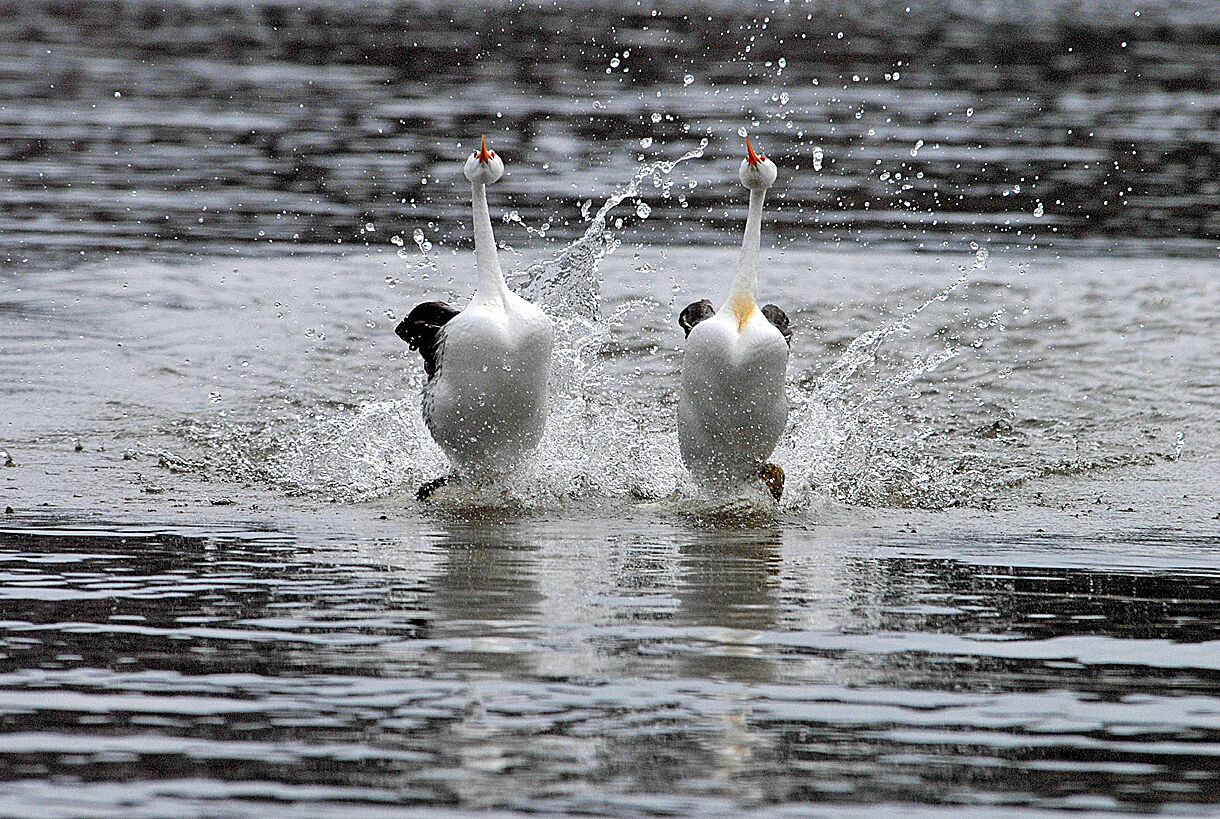
Dave Menke/U.S. Fish & Wildlife Service • A pair of Clark’s Grebes displays in a courtship ritual known as “rushing” or “weed dance.” Birds use a variety of strategies to attract and keep mates.
Synchronized swimming
While many birds dance to impress a mate or strengthen pair bonds, grebes perform a dance that takes place completely on the surface of the water. A pair will engage in this intricate performance, perfectly mirroring the moves of the other as they literally race across the surface of the water. These dances by grebes are also known as “rushing” or “weed dance.” It’s called as a weed dance because at the culmination of the ritual, the birds usually hold some type of aquatic plants in their bills while racing swiftly over the surface of the water. Pairs that perform well together stay together, building a nest and raising young.
Good housekeeping seal of approval
The tropical family of bowerbirds are famous for complex nests built by males and then decorated with bright and colorful objects to catch the eye of a potential mate. The nests of these birds are actually referred to as a “bower.” Usually constructed on the ground, the male will line the approachs to the bower with items such as shells, leaves, flowers, feathers, stones, berries, and even discarded garbage, including plastic scraps or bits of glass. Unusually odd items pressed into these decorative displays have included coins and spent rifle shells. This habit of male bowerbirds must rank as the ultimate in trying to impress a mate with shiny bling.
These are just a few of the inventive ways that birds go about attracting and keeping mates. Perhaps you can pick up some pointers from our feathered friends to ensure you have a great Valentine’s Day this year.
•••
If you have a question, wish to make a comment or share a sighting, email me at ahoodedwarbler@aol.com.




 Our Fine Feathered Friends