

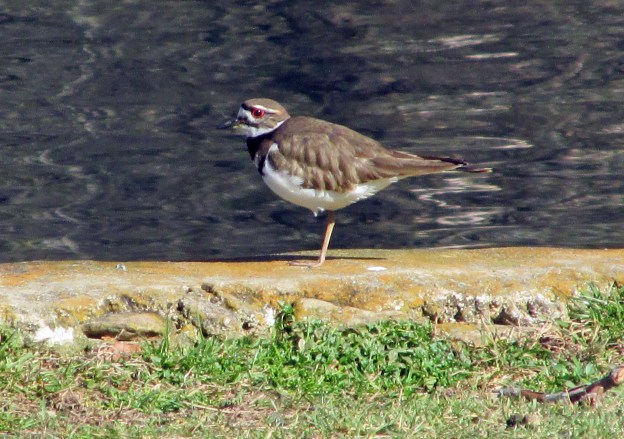
Photo by Bryan Stevens • A killdeer stands near the edge of a stream.
In last week’s column, I focused on the black-necked stilt, an oddity in the shorebird family that few non-birders would have ever heard of. This week, my focus will be on the killdeer, which is probably the shorebird most people know. Even non-birders have probably encountered this wide ranging bird that resides across much of North America.
While killdeers are considered shorebirds, they are certainly not confined to shorelines but can be found in a variety of habitats from school yards to golf courses to prairies and fields.
About 11 inches in length, the killdeer is brown above and white below with two black bands across the white chest. Males and females look alike.
These birds, despite their common name, are not antagonistic toward deer. The name killdeer refers to the loud, strident vocalization these birds produce when alarmed or disturbed. Early naturalists also noticed the noisy nature of killdeer, giving them names such as chattering plover and noisy plover, according to the website All About Birds.
The female killdeer usually lays up to four eggs on a spot on the bare ground that she may or may not have lined with some grass. Both parents attempt to guard the nest from predators. They are reliably zealous in their duties. In fact, the killdeer is famous for faking a display of injury whenever intruders draw too close. The display is meant to lure potential predators away from the location of the nest.
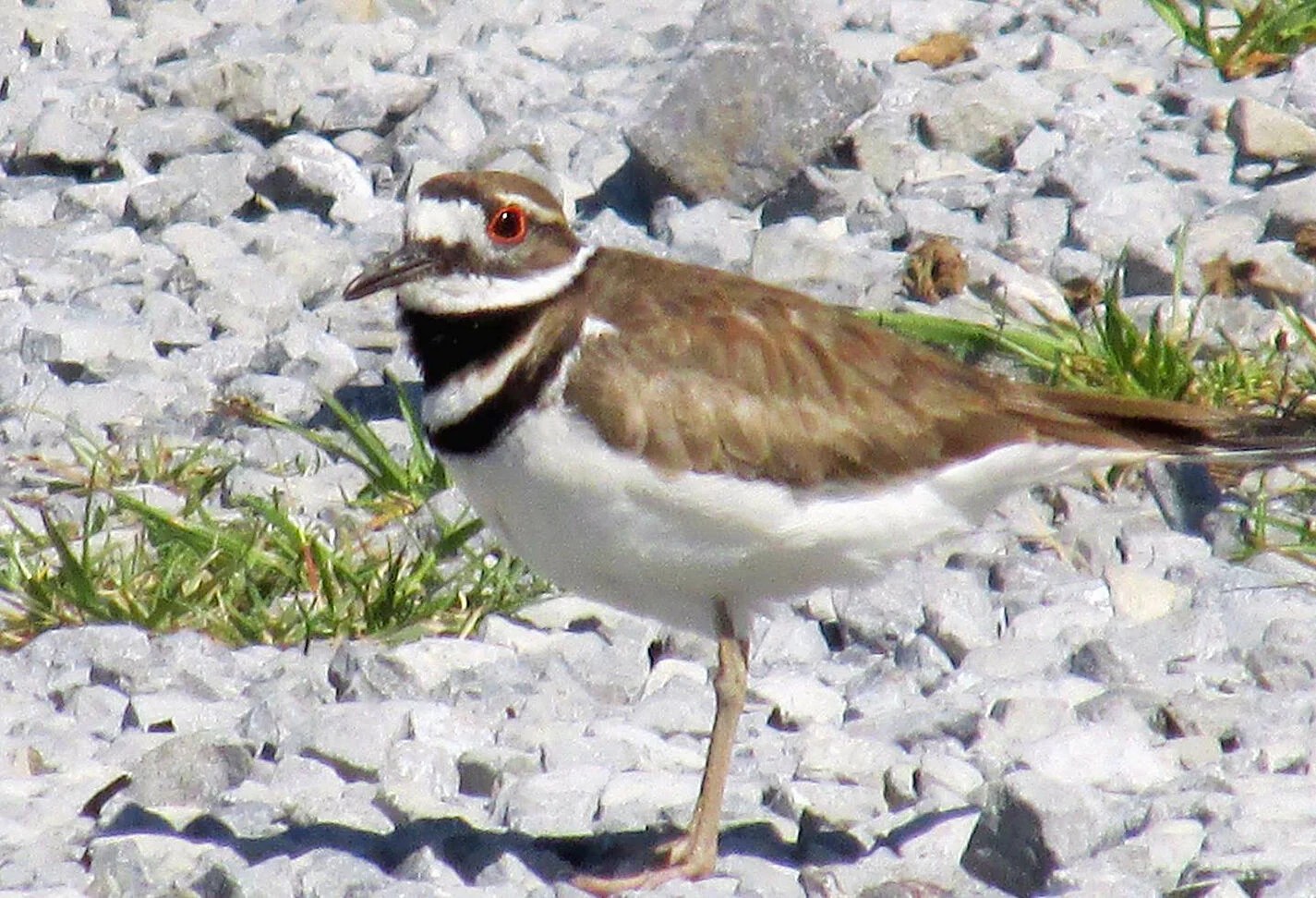
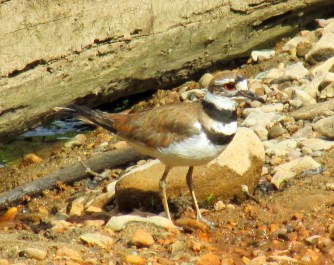
Photo by Bryan Stevens • A killdeer stands sentry duty near its nest in a gravel parking lot.
The predator, thinking the “injured” killdeer will be easy prey, follows the bird away from the nest’s vicinity. Killdeer will also put on the show for humans who venture too close to the nest. They drag their wings in a convincing display of serious injury. Of course, once the ruse has worked, the killdeer miraculously recovers and returns to its nest.
I learned about the killdeer early in life. I had a wise teacher for my first grade year. When a nesting killdeer built its home in the school yard, the teacher turned the discovery of this feathered neighbor into a teaching event.
I remember the bird performing the broken wing display and our teacher patiently explaining the rationale for the bird’s antics. The teacher must have been protective of the bird. I do recall that my fellow students and I were forbidden to approach the nest. Considering the natures of first-grade students, that was probably a smart precaution.
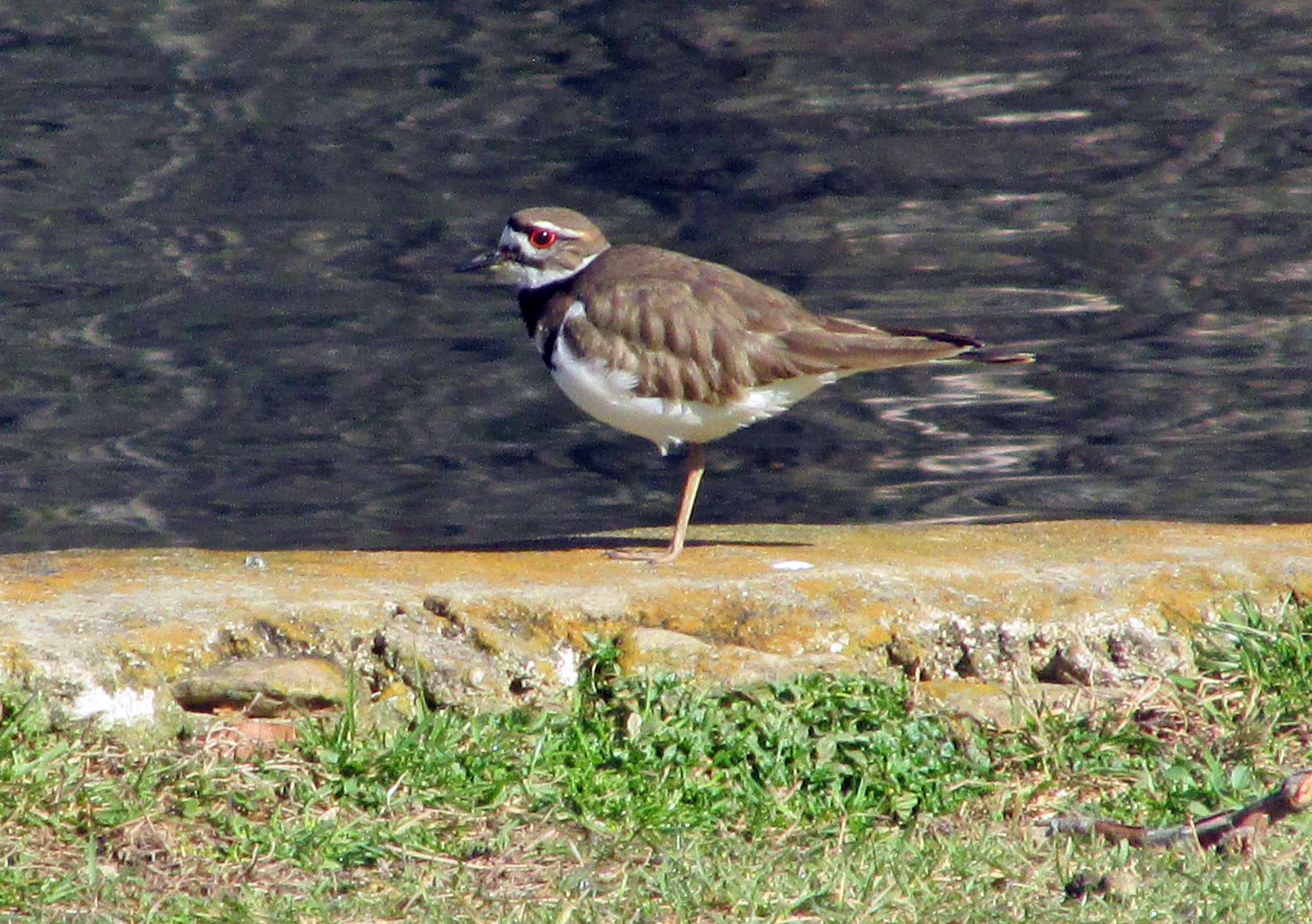
Photo by Bryan Stevens • A killdeer stands at the edge of a large pond at Fishery Park in Erwin, Tennessee.
The class followed the progress of the killdeer family as the eggs hatched and the school grounds became the home turf for the pair of killdeers and their young. I don’t recall a conclusion to the story. Since killdeer nest in spring, I suspect that the school year came to an end ahead of the nesting season.
The killdeer is a member of the plover family, which includes shorebirds distinctly different from related sandpipers.
There are more than 60 species of plovers worldwide, with several different species spending at least part of the year in North America. Close relatives of the killdeer include Wilson’s plover, semipalmated plover, snowy plover, mountain plover and the endangered piping plover.
Killdeers utilize some unusual nesting locations, including gravel parking lots and building rooftops covered with gravel or pebbles. Young killdeers can leave the nest site soon after hatching and follow their parents as they forage for food. They look like fuzzy golf balls with toothpick legs.
I’ll always remember my first encounters with this large, loud plover while a student at Hampton Elementary School many years ago. Observing that killdeer family no doubt planted the seed that eventually sprouted into my enthusiasm for watching birds. Witnessing the trickery the birds deployed to foil predators — and curious kids — away from their nests remains fresh in the memory.

Photo by Bryan Stevens • The killdeer is a plover, placing it within the family of shorebirds. They are more often found on open fields instead of along coastal shores.
Somewhat more recently, I encountered another fuzzy golf ball at rest on the ground toward the back of Erwin Fishery Park. Thinking the tiny bird was dead, I picked it up for a closer look. Even as I handled the bird, it remained motionless in my hand. When I returned the tiny “body” to the ground, however, the bird performed an amazing resurrection and fled the vicinity as quick at those toothpick legs could carry it.
Numerous people have called or written me throughout the years to report unusual nesting locations used by killdeers. I’ve seen nests in hotel parking lots, local parks and construction sites. As I mentioned earlier, the female killdeer is content to lay her eggs directly on bare soil, although she will occasionally line the nest.
These birds are opportunists. The nest lining often consists of what is most readily available. I once inspected a killdeer nest lined with discarded cigarette butts. I’m hopeful the babies didn’t hatch with instant nicotine addictions.
•••
Bryan Stevens has written about birds since 1995. Share a sighting, ask a question or make a comment by emailing him at ahoodedwarbler@aol.com.

Photo by Bryan Stevens • A killdeer covers its egg during a light rain.








 Our Fine Feathered Friends