

Photo by Bryan Stevens • A male hooded warbler perches in a cluster of branches.
Has it been a slow spring? I have felt that it’s been one step forward, two steps back. But April has finally arrived. Although we’re now two days into the month, I’m still waiting on some of my first arrivals among our fine feathered friends.
That’s not an unusual situation. I think the birds like to drag out their springtime arrivals. They know that being tardy is sure to aggravate me as I’m not known for patience.
The first male red-winged blackbird returned to the fish pond in mid-March and has been singing persistently from the tops of the bald cypress trees bordering the pond. I haven’t seen a female red-winged blackbird yet, but they tend to arrive later than males.
Of course, and I don’t think I’m alone in this hope, I’m also eager to welcome back ruby-throated hummingbirds. These tiny flying gems should be back any day now. My sugar water feeders are waiting for them.
I hope readers will once again share the first arrival dates of hummingbirds at their own feeders. Jot down the date and time, as well as any other details you’d like to share, and email me at ahoodedwarbler@aol.com or message me on Facebook at http://www.facebook.com/ahoodedwarbler/
With those preliminary thoughts shared, what else will I look for as the spring advances? Longtime readers will know of my enthusiasm for warblers, also known as New World warblers or wood-warblers.
They’re a group of small, often colorful, passerine birds that make up the family Parulidae. The family, which occurs only in the New World, contains 120 species. They are not closely related to Old World warblers or Australian warblers.
About half of the 120 species reside in Central and South America, but the others migrate north each spring to nest in the United States and Canada. In Northeast Tennessee, we have about two dozen nesting species that make their home with us from April to October.
The warbler I look forward most to seeing is the hooded warbler, partly due to individuals belonging to this species nesting in the woodlands around my home.

Photo by USFWS/A female hooded warbler stays put on her nest.
So, from the time my favorite warbler returns in April until the last individual departs in October, I enjoy regular glimpses of this colorful and interesting bird. Like all warblers, the hooded warbler is quite energetic, dashing after tiny insects in the branches of shrubs and trees. Hooded warblers often forage close to the ground, which makes observing them easier.
Of course, birds are free to break the rules. One of my most memorable sightings of a hooded warbler involved a male singing from the upper branches of a dead pine tree. I’d estimate that the bird was at least 40 feet off the ground, singing his little heart out to attract a mate. I was standing on an elevated rise of land while the tree providing the warbler its perch was lower in a gully that actually placed bird and observer on a roughly level playing field.
That sighting took place 25 years ago, but the image of that male hooded warbler singing so enthusiastically has remained emblazoned in my memory.
This particular bird sang for several moments, which is not always the case with warblers. These birds tend to dash for cover at the slightest disturbance, but this enthusiastic male didn’t seem to pay any heed to the fact that most of its kin prefer to skulk in shrubs and dense rhododendron thickets no more than a few feet off the ground.
It’s one bird unlikely to be mistaken for any other. Every time I behold a hooded warbler, I marvel at the bird’s exquisite appearance. The gold and green feathers seem to glow brightly in the dim light of the shadowy thickets of rhododendron they prefer to inhabit. The black hood and bib surrounding the male’s yellow face stands out by virtue of its stark contrast from the brighter feathers. Large coal-black eyes complete the effect. The appearance of the male bird provides this species with its common name.
The female hooded warbler has an identical yellow-green coloration as the male, although she is slightly more drab. She lacks the black hood and bib, although older females may acquire some dark plumage on the head and around the face. Both sexes also show white tail feathers that they constantly fan and flick as they move about in thick vegetation and shrubbery.
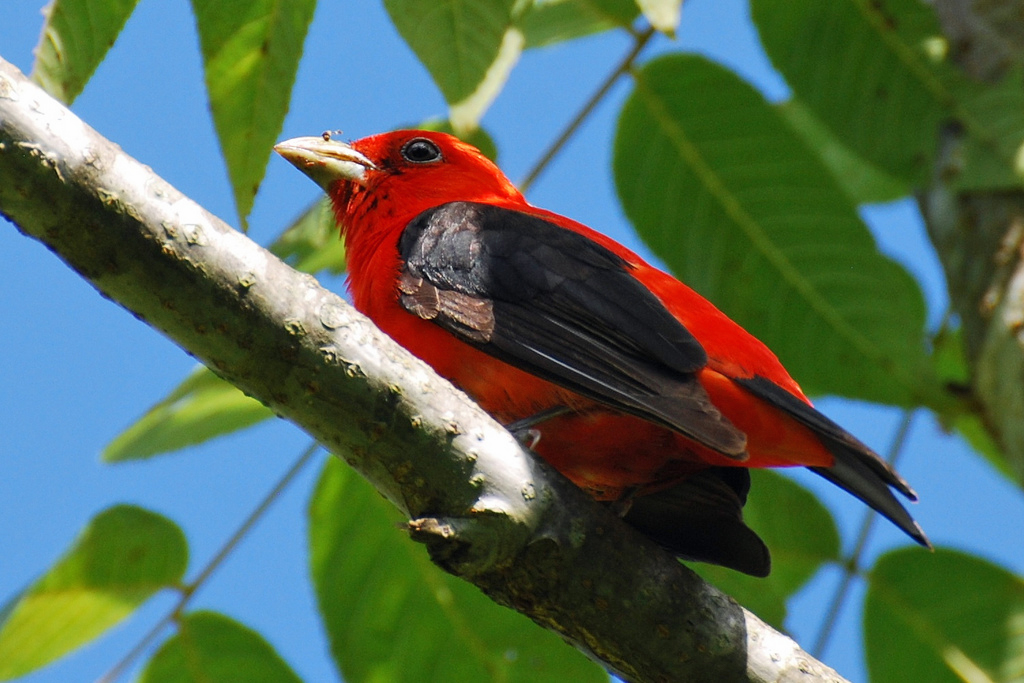
Photo Courtesy of Jean Potter
A male scarlet tanager brightens shadowy woodlands with a flash of tropical colors yet remains mostly inconspicuous in the forest canopy.
In addition to warblers, I also look forward to the return of scarlet tanagers. Males are unmistakable in their bright red plumage accented by black wings. This is one bird that is truly breathtaking when lured into the open for an observation through a pair of binoculars.
During their summer stay in the region, scarlet tanagers largely prey on insects. Although renowned as a fruit-eating bird, the scarlet tanager primarily feeds on fruit during its migration flights and on its wintering range in the tropics. This tanager breeds in deciduous and mixed deciduous-evergreen woodlands across the eastern half of North America. It’s my understanding that oaks are a favorite tree for this woodland dweller.
It’s unlikely that you’ll run across the nest of a scarlet tanager. These birds nest high in trees, often locating their nests 50 feet or more above the ground. After building a nest, a female tanager will incubate her three to five eggs for about two weeks. It’s during this time that her inconspicuous appearance is a plus, helping her blend well with her surroundings.
So, as I wait for warblers, hummingbirds and tanagers, I’ll just have to be a little more patient. I’m also hopeful that the fish pond will attract some nesting birds such as tree swallows and wood ducks. Fingers crossed!
•••
Remember to let me know about your first hummingbird sightings. Email me at ahoodedwarbler@aol.com to notify me of a sighting, ask a question or share a comment.





 Our Fine Feathered Friends