Category Archives: Uncategorized

No native parakeets roam North America

Apologies for the delay in posting.

Photo by Bryan Stevens • Monk parakeets, like this pair at a feeder in Newland, North Carolina, are increasingly common in North America, but they are not a native species.

One hundred and six years ago to the day, the only native North American parakeet went extinct when the last surviving Carolina parakeet died in captivity at the Cincinnati Zoo on Feb. 21, 1918.

This sad historic footnote got me to thinking. What things with feathers are missing from the landscape when birders look back on some of the avian potential lost before Americans became more protective of their wildlife?

Obviously, we lament the loss of birds like the ivory-billed woodpecker or the Labrador duck. Losses of bird life in the Hawaiian islands have been staggering. We also lost tiny birds — dusky seaside sparrow and Bachman’s warbler — that would have gone unnoticed by most people. Other birds to have gone extinct include the heath hen and the passenger pigeon.

Another lost bird was the Carolina parakeet. Many people don’t realize that North America was once home to its own species of parakeet. A few individuals — all that remained of once massive flocks of colorful, noisy native parakeets — made it into the 20th century.

Carolina parakeets once roamed from southern New York and Wisconsin to Kentucky, Tennessee and the Gulf of Mexico, from the Atlantic Seaboard to as far west as eastern Colorado. That’s right – the Carolina parakeet once roamed wild within the borders of the Volunteer State.

As indicated already, the last specimen died in the Cincinnati Zoo on Feb. 21, 1918. That bird, a male by the name of Incas, died alone in the same cage as Martha, the last passenger pigeon.

Martha had died four years earlier on Sept. 1, 1914. The fact that these birds died alone, caged, is not how anyone would like to think of the conclusion of their story.

There are no scientific studies or surveys of Carolina parakeets by American naturalists; most information about the bird is from anecdotal accounts and museum specimens, so details of its prevalence and decline are unverified or speculative.

Although not declared officially extinct until 1939, the population of the Carolina parakeets crashed suddenly and for reasons still not fully understood.

Early American naturalist and artist John James Audubon observed the birds in the wild and painted works inspired by flocks of Carolina parakeets.

For instance, large flocks of these birds still flew free until the final years of the 1800s, but in the first decade of the 1900s, these flocks disappeared.

The survivor at the zoo – Incas – died a year after his mate, who had been named Lady Jane by the zoo’s staff.

The only other native parrot — the thick-billed parrot of the American southwest — no longer flies north of the Mexican border. An attempt to re-introduce this parrot to Arizona in the 1980s ended in disappointing failure.

To look for parrots in the United States, one usually needs to travel to Florida. The Sunshine State has become a place to find exotic wildlife, from pythons to caymans, as well as a multitude of unusual birds that have escaped from captivity and now find the warm climate of Florida suitable for a feral existence.

When it comes to parrots, however, there is one species, perhaps tougher than its kin, that has expanded its range across the country. Called the monk parakeet (or quaker parakeet in the pet trade) this bird is not a native species, but it has proved tenacious in making itself at home in such far-flung locations as Delaware and Michigan, as well as Connecticut and Rhode Island. These green beauties have even made themselves at home in New York City. The monk parakeet has also established colonies in Canada’s British Columbia.

Closer to home, these parakeets have also established colonies in Virginia and North Carolina, although I cannot confirm any such attempts in Tennessee.

I got to see my first monk parakeets in the wild on Feb. 19, 2016, after learning on the Facebook page Carolina Birders that a pair of these parakeets had been found in Newland, North Carolina.

Being only about a 20-minute drive from Roan Mountain, Tennessee, it was not difficult for me to make two trips to Newland to look for these two birds, which were residing at an electrical sub-station. I failed to find them on my first trip on a rainy, windy day. When the weather improved, I tried again and was successful. I saw the parakeets seated on their nest, perched on wires and visiting a feeder at a home near the sub-station.

The origin of feral monk parakeets in the United States dates back to the 1960s when birds brought from their native Argentina for sale in the pet trade escaped and subsequently thrived in various locations in the country.

In researching this bird, I discovered that in North Carolina there are known colonies in Wilmington and Charlotte. Perhaps the pair in Newland are individuals expanding from those colonies. Monk parakeets are most abundant in Florida, but these birds have been found in numerous states, from Texas and Ohio to New Jersey and Delaware. These parakeets have also established feral populations in Europe in Belgium, Spain and Great Britain.

The origin of “monk” for this bird’s name is believed to stem from the gray-colored swath of feathers found on the bird’s breast, throat and forehead. The rest of the bird’s plumage is a bright green in color. The monk parakeet also has an orange bill. The birds are comparable in size to a mourning dove.

Monk parakeets differ from most other parrots, which are almost exclusively cavity-nesting birds. Monk parakeets form nesting colonies and use twigs and branches to build large, bulky nests. Even a single pair of monk parakeets can build a substantial nest. A colony of these nesting birds usually builds a nest featuring several compartments. The pair of parakeets in Newland have already build a large nest among the transformers of an electrical sub-station. The industrious birds create some large stick structures, and nests weighing 90 pounds have been found.

In the wild, these sociable birds form large flocks. In captivity, the monk parakeet can be taught an extensive vocabulary of words. The monk parakeet can live 20 to 30 years, with captive birds usually living longer than wild ones.

I was thrilled to see this pair of monk parakeets, but it also made me somewhat wistful for what might have been.

It would be wonderful to have native parrots still flying free. If only the dawning of a more environmentally aware age had arrived slightly sooner, the Carolina parakeet might have been saved and now keeping company with species like the California condor and whooping crane.

This native parakeet, if it had endured, might today be considered an ordinary backyard bird that flocks to feeders throughout Northeast Tennessee, Western North Carolina and Southwest Virginia.
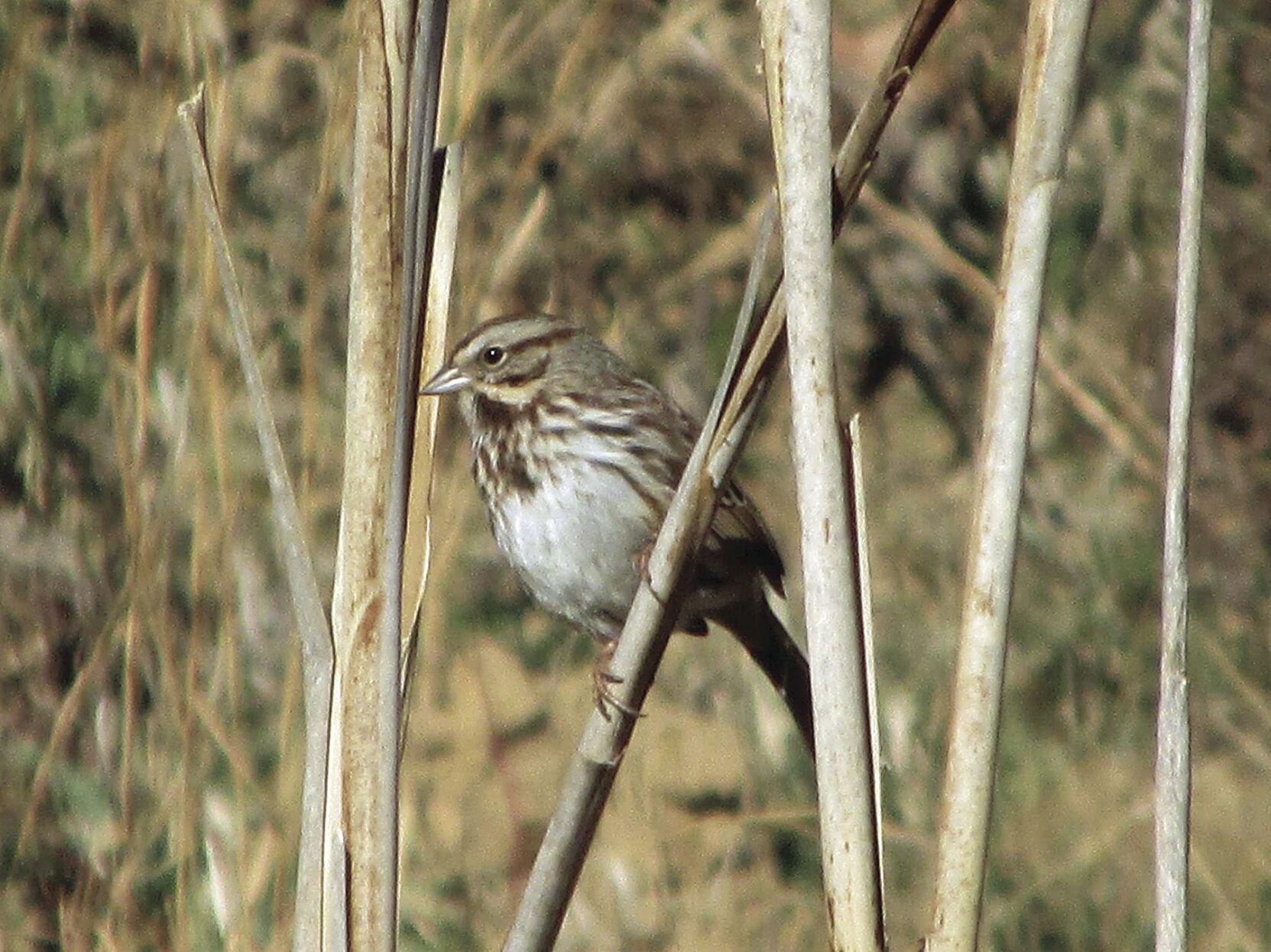
 

Melodic song sparrow makes a good neighbor in any season

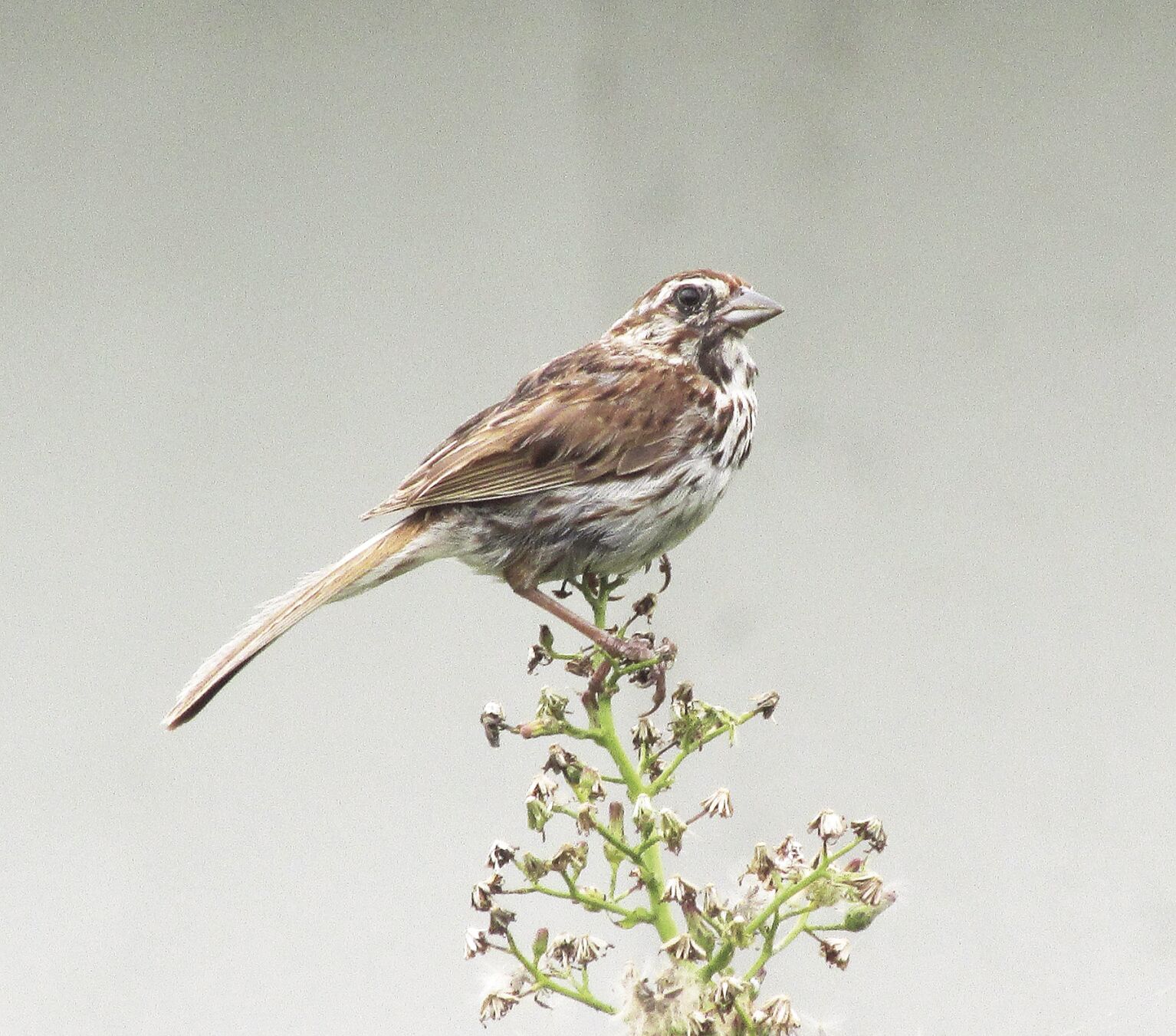
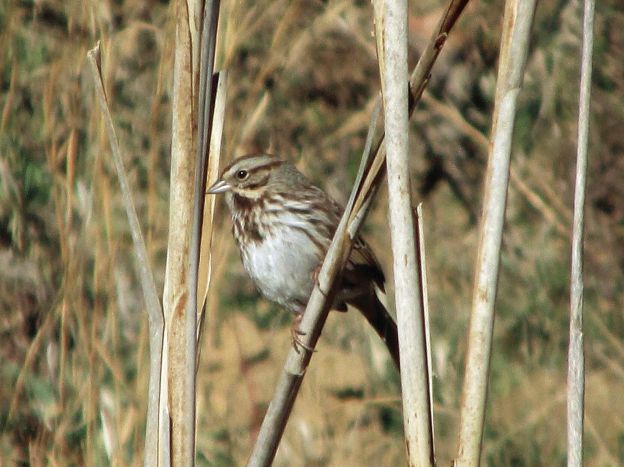
Photo by Bryan Stevens • Song sparrows show a stripe breast that comes together in a large, central dot. This field mark is diagnostic in distinguishing the song sparrow from other little brown birds.

Recent cold and snow meant elevated activity at my bird feeders. Among the birds flocking to my feeders were several species of sparrows, including white-throated sparrow, song sparrow and dark-eyed junco.

Other sparrows in the region include field sparrow, chipping sparrow, swamp sparrow and white-crowned sparrow.

The white-crowned sparrow and the white-throated sparrow are both members of the genus known as Zonotrichia, which refers to two ancient Greek words for zone and hair, which refers to the pattern of streaks on the backs of these five sparrow species. The Zonotrichia sparrows belong to a large group of birds known as Passerellidae, or American sparrows, which also includes birds such as juncos, towhees and brush finches.

The song sparrow, unlike some of the other sparrows that made appearances at my feeders, is a year-round resident in the region.

Song sparrows, according to the website All About Birds, eat many insects and other invertebrates in the summer, as well as seeds and fruits in all seasons.

All About Birds also makes note of the fact that this widespread sparrow occurs in a variety of habitats, including tidal marshes, arctic grasslands, desert scrub, pinyon pine forests, aspen parklands, prairie shelterbelts, Pacific rainforest, chaparral, agricultural fields, overgrown pastures, freshwater marsh and lake edges, forest edges and suburbs.

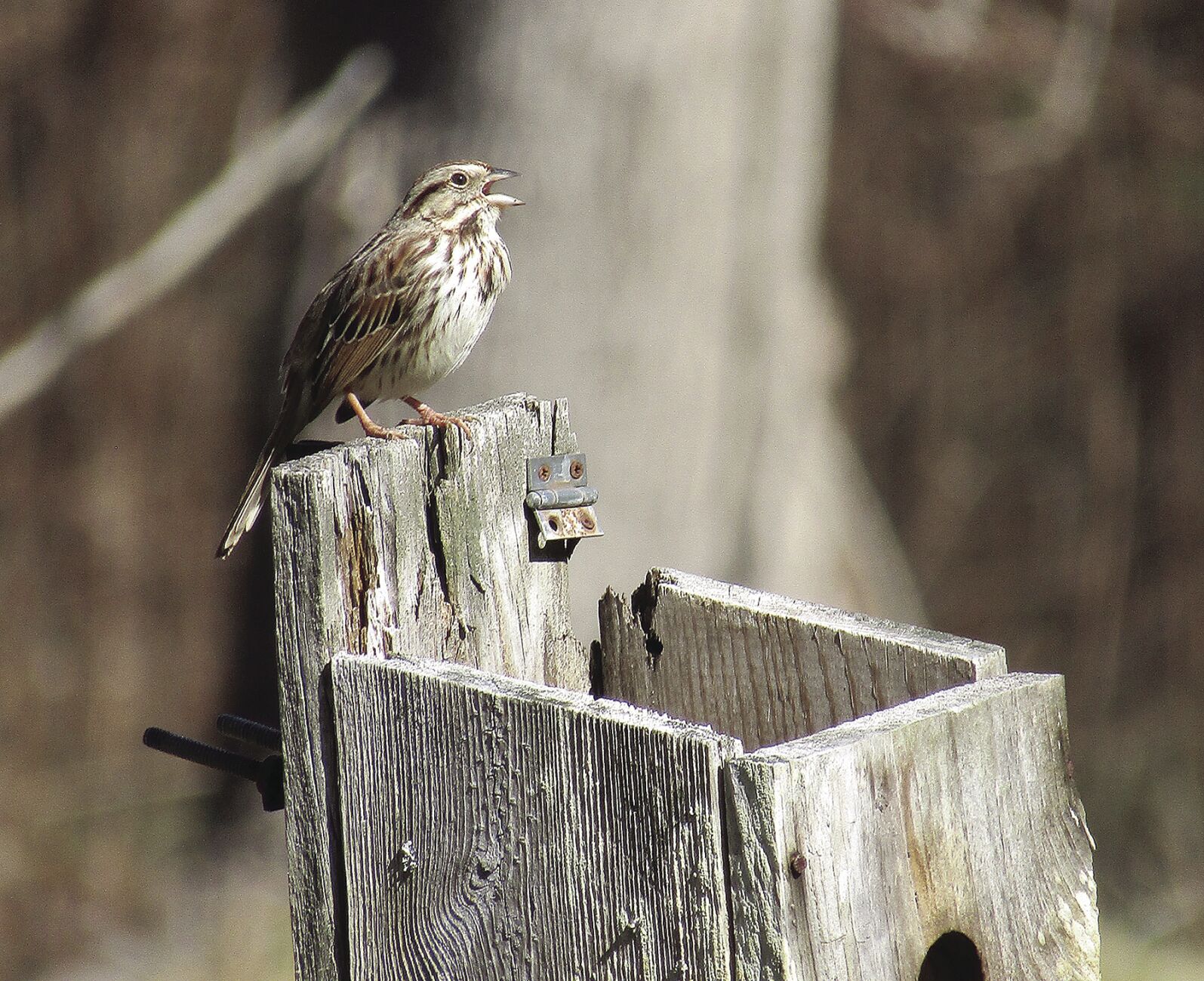
Photo by Bryan • A song sparrow sings from the perch of a dilapidated bird box.

The scientific name for the song sparrow is Melospiza melodia, which translated from the Greek means “melodic song-finch.” It’s an apt name for a persistent, enthusiastic singer. The commonplace nature of the bird also makes it easy to learn to detect and identify the bird by its song alone.

According to All About Birds, male song sparrow use song to attract mates as well as defend territory. Laboratory studies have shown that the female song sparrow is attracted not just to the song itself, but to how well it reflects the ability of the male to learn.

Other sparrows produce well-known songs. Many Americans render the song of the white-throated sparrow as “Ol’ Sam Peabody, Peabody, Peabody.” For those living north of the border, however, the white-throated sparrow sings “O Canada, O Canada, O Canada.”

No matter how you translate this sparrow’s song, it’s a sweet and welcome addition to the spring aural landscape.

Some of the more descriptive names for American sparrows include orange-billed sparrow, white-eared ground sparrow, green-backed sparrow, olive sparrow, cinnamon-tailed sparrow, five-striped sparrow and golden-winged sparrow.

Many sparrows prefer to forage for food on the ground. It’s often helpful to purchase a supply of millet seed. When filling feeders with sunflower seeds, scatter a couple of handfuls of millet seed on the ground beneath the feeders or at the edge of a brushy area. Sparrows like to have quick access to dense cover, so they will feed more securely if the scattered seeds are within quick reach of shelter.

Although they are fairly common winter visitors in the region, white-throated sparrows, dark-eyed juncos and white-crowned sparrows depart the area in spring.

With the song sparrow, it’s not difficult to realize why the sparrows are often lumped together under the categorization of “little brown birds.”

The adult song sparrow has brown upperparts with dark streaks on the back and are white underneath with dark streaking and a dark brown spot in the middle of the breast. That dark spot is often considered a field mark that makes identifying this bird easier in the field. The song sparrow has a brown cap and a long brown rounded tail. Their face is gray with a brown streak through each eye.

White-crowned sparrows, in contrast to the song sparrow, are medium-sized birds with considerable gray on the breast and back of the neck. Adults of both sexes are adorned with bold black and white head stripes, which gives this bird its common name. Thanks to this distinctive feature, this sparrow truly stands out among a family of rather drab birds.

The white-crowned sparrow is known by the scientific name Zonotrichia leucophrys, which translates into English from Ancient Greek as “white eyebrow.”

Sparrows can be a challenge for beginners, but the winter season is a good time to learn how to differentiate these feeder visitors. The lure of food makes it possible to draw the sparrows in close for observation.

The sparrows will eat a variety of seeds, but I’ve had the best luck with black oil sunflower seeds. Just keep in mind that sparrows are ground feeders. It pays to also scatter some seeds directly on the ground for them. They will scratch and kick with their legs as they forage for the seeds we provide them during wintry days.

Once spring arrives, song sparrows will remain in your yards and gardens. They nest several times a season, so there’s the added opportunity of watching these little birds tend their young. They’re never going to compete with our more colorful birds, but song sparrows make great neighbors.

•••

Mary Anna Wheat will present a program on a trip to Arizona, Utah, Colorado and New Mexico in late September and early October 2023 at the next meeting of the Elizabethton Bird Club.

She traveled with a friend and former co-worker from Sept. 19 to Oct. 16, 2023, in those four states. Their focus was on scenery, archeology (Wheat’s friend is an archaeologist with experience doing archaeological work at Canyon de Chelly National Monument) and the annular solar eclipse. Birding was incidental, although Wheat noted that they saw or heard more than 60 species.

The club’s meeting will be held Tuesday, Feb. 6, at the Northeast State Community College’s Elizabethton campus at 7 p.m. The front desk can direct visitors to the meeting room.

•••

Photo by Bryan Stevens • A song sparrow perches on a weed stalk near a river.

Bryan Stevens has been writing about birds and birding since 1995. Email him at ahoodedwarbler@aol.com to ask a questing, share a sighting or make a comment.

Region provides home for several species of hawks

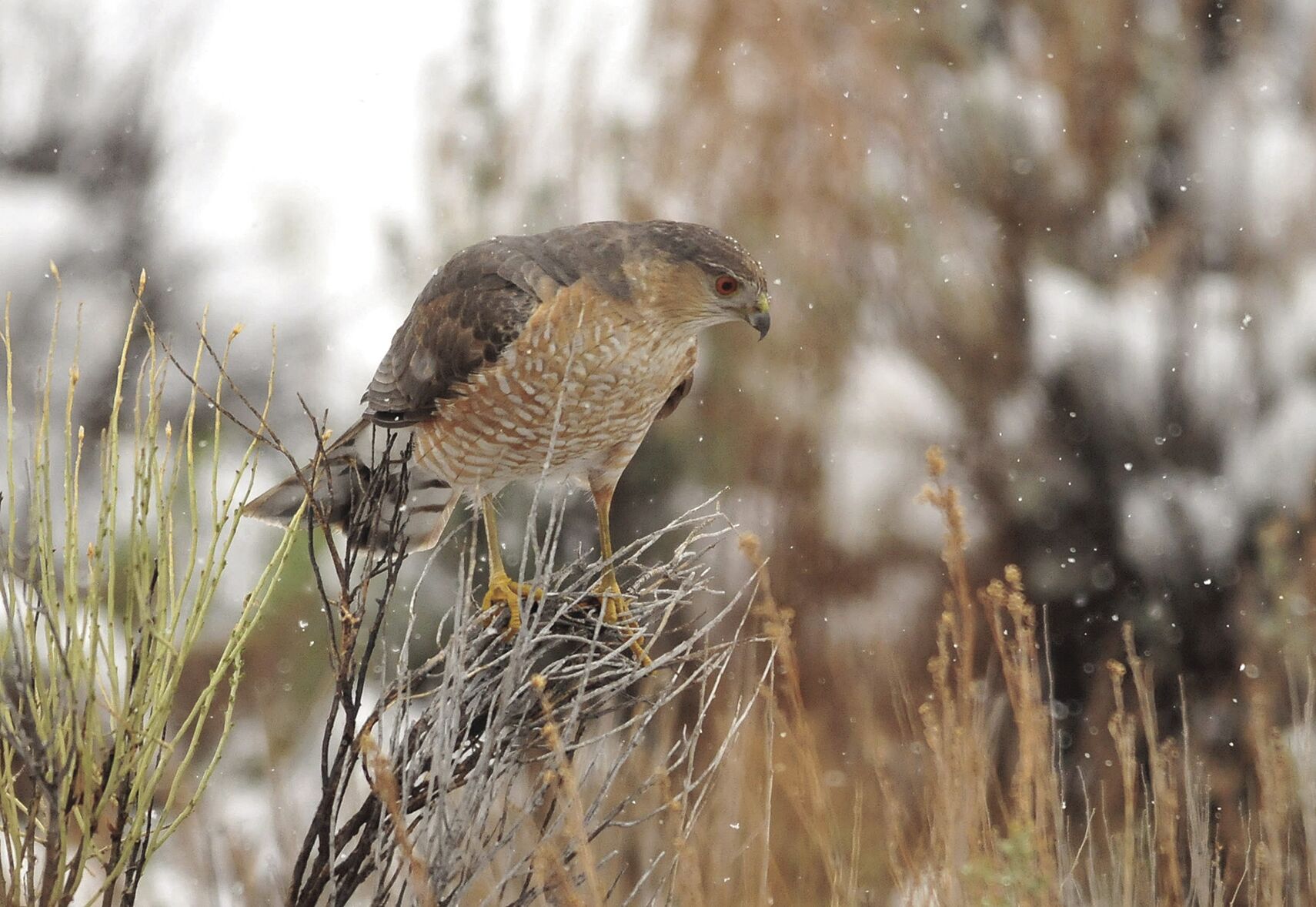
Tom Koerner/USFWS * An adult Cooper’s hawk, such as this individual, is a crow-sized woodland raptor that breeds throughout much of the United States, southern Canada and northern Mexico.

Barbara Lake, a resident in Hampton, emailed me recently to share a sighting of a large hawk in her yard.

“This hawk was in our yard today and flew up to a tree when I opened the door,” she wrote. “(Its) back and the back of the head are black and the rest appears to be white. He didn’t cooperate by turning around.”

Barbara enclosed some photos with her email. I’ve known Barbara for about 20 years. We first met when she invited me to her home to view some nesting bluebirds on a television screen. She had placed nest cams in some of her bluebird nesting boxes, capturing real-time footage of the nesting activity of these songbirds.

I’ve enjoyed some observations of the region’s larger raptors, including red-tailed hawks and red-shouldered hawks, as winter has settled in for the long haul. I’ve also spotted a few American kestrels.

Based on the raptor’s relatively long tail in the photos provided by Barbara, I hazarded a guess that her visiting raptor was a Cooper’s hawk.

Anyone who travels along the region’s Interstate Highway System has probably noticed hawks perched in trees or on utility lines adjacent to the roadway. The section of Interstate 26 that runs between Unicoi and Johnson City is often a productive area for keeping alert for raptors. The raptor I have most often observed along this stretch of road is the red-tailed hawk, although I have also observed Cooper’s hawk, sharp-shinned hawk and American kestrel. In the time of spring and fall migration, it’s also possible to observe broad-winged hawks.

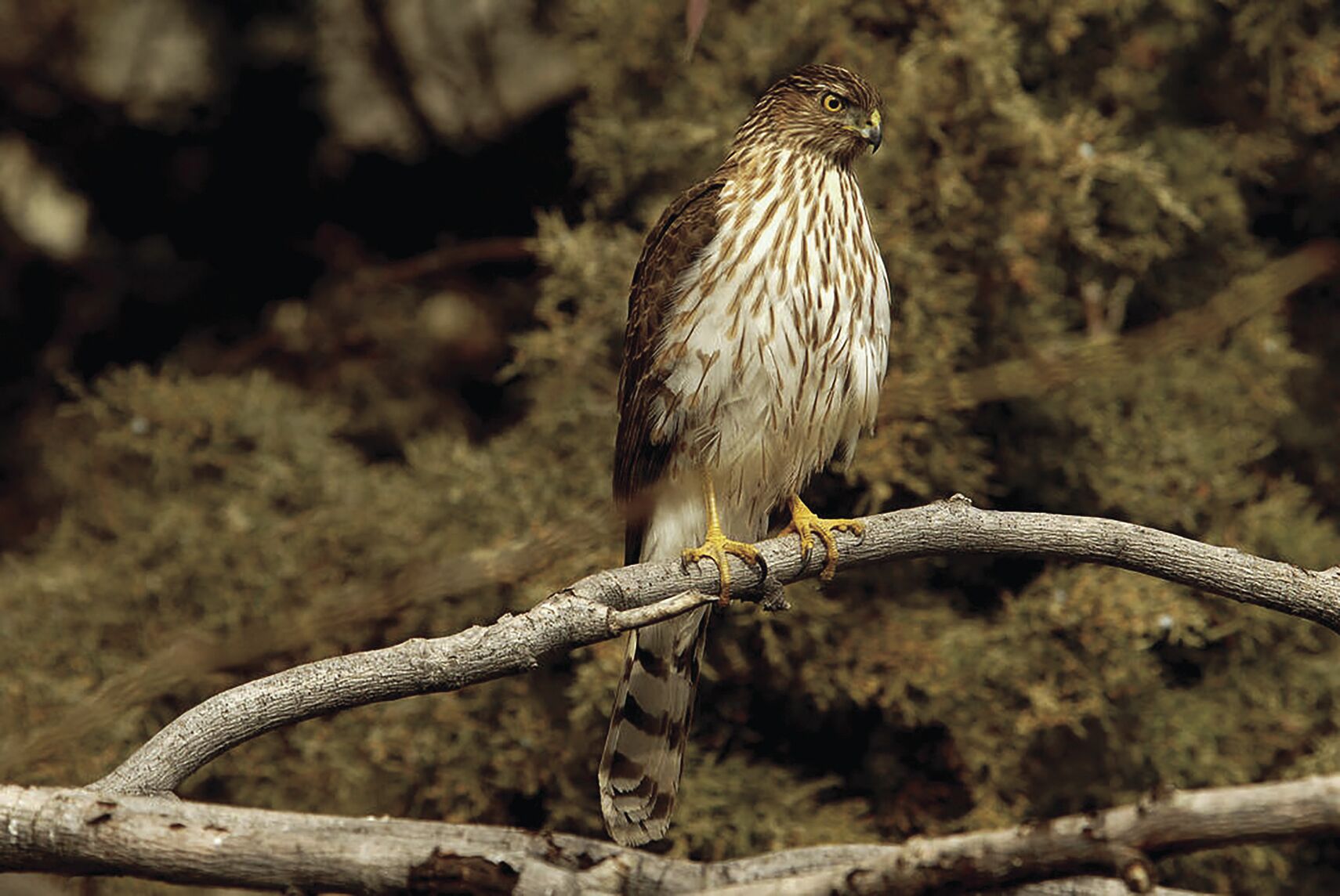
USFWS * An immature Cooper’s hawk perches on a branch in a tree located in the Klamath Basin National Wildlife Refuge Complex.

The red-tailed hawk is named for its prominent red tail. However, only adults show the characteristic red tail. The affinity red-tailed hawks demonstrate for roadsides is a double-edged sword. Viewing a large hawk from your car is an easy way to watch birds. For inexperienced or careless raptors, however, roadside living is often rife with the chance for a collision with a car or truck. The red-tailed hawk, which prefers open countryside, is attracted to the margins of roads and highways because these locations also attract their favorite prey, which includes rodents like rats, squirrels and mice and other small mammals such as rabbits.

Human behavior contributes to some of the problems that hawks encounter in the zone that brings them too close for comfort to motorized vehicles. When people toss trash from a car, the scent of the litter will lure curious and hungry rodents. In turn, hunting hawks are brought to the edges of roads in search of their preferred prey, increasing the likelihood of colliding with automobiles.

The Cooper’s hawk is a large accipiter hawk. A smaller relative, the sharp-shinned hawk, is also found in the region. The accipiter hawks are graceful and aerodynamic, designed to pursue prey through woodlands. Buteo hawks, such as the red-tailed hawk and red-shouldered hawk, are more of an ambush predator and not designed for the agile maneuvers that the accipiters can use to capture prey.

Some of the buteo species have adapted to life on islands, including the Galapagos hawk and the Hawaiian hawk. Some of these hawks have quite descriptive names, including the white-throated hawk, gray-lined hawk, zone-tailed hawk and short-tailed hawk. Outside the United States, raptors in the buteo genus are often known as “buzzards.” When the first European colonists came to the New World, they applied the term buzzard to types of native vultures as well as the large raptors like Swainson’s hawk and broad-winged hawk that reminded them of the ones back in Europe.

Accipiter hawks are also widespread. Accipiter is a genus of birds of prey in the family Accipitridae. With 49 recognized species, it is the most diverse genus in its family. Most species are called goshawks or sparrowhawks, although almost all New World species (excepting the Northern goshawk) are simply known as hawks.

Most accipiter hawks, including Cooper’s and sharp-shinned, prey mostly on other birds. The website All About Birds notes that small songbirds are usually safe around a Cooper’s hawk. Medium-sized birds, however, are not. Studies list European starlings, mourning doves and rock pigeons as common prey. Other birds that are often targeted by Cooper’s hawk include American robins, blue jay, Northern flicker, quail, grouse and pheasants. Cooper’s hawks sometimes rob nests and also eat chipmunks, rabbits, mice, squirrels and bats. According to All About Birds, mammals are more common in diets of Cooper’s hawks in the western United States.

Some of the more descriptively named accipiter hawks include crested goshawk, grey-bellied hawk, spot-tailed sparrowhawk, plain-brested hawk and little sparrowhawk.

All too often, our large hawks don’t receive the love they deserve from the public. They may even run afoul of misinformed individuals who may regard all predatory birds as “bad.” The reality is that all hawks are valuable components of a healthy, working ecosystem, with each species filling a certain niche.

•••

To share a sighting, ask a question or make a comment, email me at ahoodedwarbler@aol.com.


Nuthatches have embraced a topsy-turvy lifestyle

Photo by Jack Bulmer/Pixabay • White-breasted nuthatches live topsy-turvy lifes and are just fine with it.

The passage of Winter Storm Heather delivered the first significant snowfall of 2024 to Unicoi County and the surrounding area. The storm’s wind, snow and ice also brought birds flocking to my feeders.

Ground-feeding dark-eyed juncos, song sparrows and white-throated sparrows jostled with each other while foraging. Carolina chickadees and tufted titmice made repeated sorties to the feeders, grabbed a single sunflower seed or peanut and carried off the prize. Northern cardinals and American goldfinches perched on my hanging feeders, hulling sunflower seeds as quickly as they could. Red-bellied woodpeckers and downy woodpeckers visited special hanging suet feeders. Carolina wrens skulked, scolded and settled for scraps dropped by other birds. Among these feathered visitors was another resident bird that is definitely worth a second look.

The power of flight gives white-breasted nuthatches, like most birds, a perfectly valid reason to disregard the power of gravity. The family of tree-clinging birds known as nuthatches lives an even more topsy-turvy lifestyle than many of their winged kin. Nuthatches prefer a headfirst stance as they search for food in the nooks and crannies in tree trunks and branches.

The United States is home to four species of nuthatches: white-breasted, red-breasted, brown-headed and pygmy. White-breasted nuthatches are probably the most familiar nuthatch to backyard birders in this area.

Because of their gravity-defying antics, the white-breasted nuthatch and other members of the family can provide hours of entertainment at our bird feeders. Individual white-breasted nuthatches will follow a single-minded path along the trunk of a tree or a branch on the way to a feeder. An individual nuthatch rarely varies from this path. It’s amusing to watch the jerky progress along the trunk as this bird prepares for a flight to a feeder holding sunflower seeds or a hanging wire basket of suet.

At my home, nuthatches typically remain aloof from the rivalry always ongoing between the chickadees and titmice. The white-breasted nuthatch is also a no-nonsense visitor. Rarely distracted by disturbances among other birds, this nuthatch is content to hang on to the wire frame of a suet basket and peck off chunks of suet or grab a single sunflower seed and go.

The more numerous titmice and chickadees give way when a white-breasted nuthatch claims a feeder. At times, however, among the frantic activity, a tufted titmouse or a Carolina chickadee will forget itself and fly to a position on a feeder already claimed by a nuthatch. If surprised enough to retreat to a nearby perch, the nuthatch will go through a rather comical little dance to express its displeasure. Wings spread out in a rigid pose, the bird will turn around in tight circles, showing definite resentment at being displaced by an offending chickadee or titmouse.

These displays are usually brief, unless they are directed toward another white-breasted nuthatch. A male-female pair of these nuthatches can peaceably visit a feeding area at the same time. Two male nuthatches — or two female nuthatches for that matter — show little toleration for each other. Their little dances of defiance are in these cases demonstrated for each other. Eventually, one nuthatch will give way, but these are stubborn birds, much more set in their ways than chickadees and titmice.

In our region, the stubby red-breasted nuthatch is another member of the family that occasionally finds its way to our yards. Smaller than the related white-breasted nuthatch and, as far as I can tell, complacent in the company of chickadees and titmice, the red-breasted nuthatch is always a welcome visitor. It has a tell-tale “yank yank” call that it produces when excited that sounds very much like little tin horns. The red-breasted nuthatch, perhaps because it spends so much of the year in more remote areas, can also be amazingly tame when it pays a winter visit.

Both of these nuthatches can be attracted to feeders by offering peanuts, sunflower seeds and suet. They are also cavity-nesting birds, but are more reluctant about accepting a nesting box as a place to rear young. They will gladly accept an old woodpecker hole or other natural cavity in a tree.

The brown-headed nuthatch is a specialist of pine woodlands throughout the southeastern United States, favoring loblolly-shortleaf pines and longleaf-slash pines. This nuthatch requires standing dead trees for nesting and roosting. They forage for food, however, on live pines. The birds are more abundant in older pine stands.

This small nuthatch is not at all common in the region, but there are some records. I’ve had much better luck finding the brown-headed nuthatch during visits to coastal South Carolina or suburban Atlanta in Georgia. In these southern locations, it can be a quite common bird.

These small birds will occasionally forage close to the ground, but they are often in the upper branches of pine trees. Their presence is often revealed by their call, which sounds amazingly like a squeeze toy. They produce their “squeaky toy” call persistently when agitated or curious. Brown-headed nuthatches often associate with mixed flocks in company with Carolina chickadees, tufted titmice, pine warblers and other small songbirds.

I also want to complete my list of North American nuthatches by adding the fourth species — pygmy nuthatch — to my life list. I have made two trips to western North America, where this species ranges, but haven’t managed to find this bird. Both the pygmy and brown-headed are among the smallest members of the nuthatch family.

On the other end of the size scale is the appropriately named giant nuthatch, which reaches a length of almost eight inches. The giant nuthatch ranges through China, Thailand and Burma. This nuthatch is bigger than a downy woodpecker, one of our more common visitors at backyard feeders in our region.

Worldwide, there are about 25 species of nuthatches, some of which have surprisingly descriptive names for birds that spend most of their lives creeping in obscurity along the trunks and branches of trees. Some of the more creative common names for these little birds include beautiful nuthatch, velvet-fronted nuthatch, sulphur-billed nuthatch, chestnut-bellied nuthatch, snowy-browed nuthatch and chestnut-vented nuthatch.

These birds are named “nuthatch” for the habit of some species to wedge a large seed in a crack and hack at it with their strong bills. I like to refer to them as “upside-down birds” because gravity doesn’t seem much of a factor in their daily lives. They are content to walk headfirst down a tree trunk or probe the underside of a large branch. It must give them an interesting perspective on the world around them.

•••

Mary Anna Wheat will present a program on a trip to Arizona, Utah, Colorado and New Mexico in late September and early October 2023 at the next meeting of the Elizabethton Bird Club.

She traveled with a friend and former co-worker from Sept. 19 to Oct. 16, 2023, in those four states. Their focus was on scenery, archeology (Wheat’s friend is an archaeologist with experience doing archaeological work at Canyon de Chelly National Monument) and the annular solar eclipse. Birding was incidental, although Wheat noted that they saw or heard more than 60 species.

The club’s meeting will be held Tuesday, Feb. 6, at the Northeast State Community College’s Elizabethton campus at 7 p.m. The front desk can direct visitors to the meeting room.

•••

Bryan Stevens has been writing about birds and birding since 1995. Email him at ahoodedwarbler@aol.com to ask a questing, share a sighting or make a comment.

Snow goose sighting on Dec. 31 concludes birding year

Photo by Bryan Stevens • A  snow goose hanging out with a flock of Canada geese was found at a well-known Elizabethton pond on the last day of 2023.

The Elizabethton Bird Club’s 2024 calendars arrived just ahead of the new year, so I held a distribution on New Year’s Eve for people wanting to pick up a calendar at the parking lot at the Elizabethton campus of Northeast State Community College.

As I drove into the parking lot with my box of calendars I noticed a lone white goose sticking out like a proverbial sore thumb among several dozen Canada geese foraging in the grassy margins around the parking lot.

After a quick study, I determined the goose was a snow goose – the first that I have seen locally since December of 2022 when Erwin resident Joe McGuiness, who is also a fellow member of the Elizabethton Bird Club, alerted me to the presence of a snow goose at a farm pond along Massachusetts Avenue in Unicoi.

That snow goose, just like the one I saw at Northeast State, was hanging out with a flock of Canada geese.


Everyone arriving to pick up a calendar got to see the goose. In addition, the goose attracted some other onlookers. A driver of a tractor-trailer pulled into the parking lot, rolled down his window and leaned out of the cab of his truck with a pair of binoculars for a look at the snow goose. He had apparently seen the goose while driving past the pond.

Of the geese found in the region, the well-known Canada goose is nearly ubiquitous. Surprisingly, that’s not always been the case. In his book, “The Birds of Northeast Tennessee,” Rick Knight points out that the Canada geese now present throughout the year resulted from stocking programs conducted in the 1970s and 1980s. In earlier decades, the Canada goose was considered a rare winter visitor to the region. Seeing the Canada goose in every sort of habitat from golf courses to grassy margins along city walking trails, it’s hard to imagine a time when this goose wasn’t one of the region’s most common waterfowl.

The snow goose can still be considered an uncommon visitor to the region, but they do show up almost regularly every winter.

The world’s geese are not as numerous as ducks, but there are still about 20 species of geese worldwide, compared to about 120 species of ducks. While both ducks and geese are lumped together as waterfowl, most geese are more terrestrial than ducks. Birders are just as likely to spot geese in a pasture or on the greens of a golf course as they are on a lake or pond.

Photo by Bryan Stevens • A snow goose swims amid Canada geese at the pond at Fishery Park in Erwin, Tennessee.

The snow goose breeds in regions in the far north, including Alaska, Canada, Greenland and even the northeastern tip of Siberia. They may spend the winter as far south as Texas and Mexico, although some will migrate no farther than southwestern British Columbia in Canada.

The snow goose bucks the trends that show many species of waterfowl declining. Recent surveys show that the population of the snow goose exceeds five million birds, which is an increase of more than 300% since the mid-1970s. In fact, this goose is thriving to such a degree that the large population has begun to inflict damage on its breeding habitat in some tundra regions.

A smaller relative to the snow goose is the Ross’s goose, which for all practical purposes looks like a snow goose in miniature. The common name of this goose honors Bernard R. Ross, who was associated with the Hudson’s Bay Company in Canada’s Northwest Territories.

Here’s a quick history lesson. Hudson’s Bay Company is the oldest commercial corporation in North America. The company has been in continuous operation for more than 340 years, which ranks it as one of the oldest in the world. The company began as a fur-trading enterprise, thanks to an English royal charter in back in 1670 during the reign of King Charles II. These days, Hudson’s Bay Company owns and operates retail stores throughout Canada and the United States.

In addition to his trade in furs, Ross collected specimens for the Smithsonian Institution in Washington, D.C. Ross is responsible for giving the goose that now bears his name one of its early common names – the Horned Wavy Goose of Hearne. I wonder why that name never caught on?
Ross repeatedly insisted that this small goose was a species distinct from the related and larger lesser snow goose and greater snow goose. His vouching for this small white goose eventually convinced other experts that this bird was indeed its own species.

Ross was born in Ireland in 1827. He died in Toronto, Ontario, in 1874. He was described by other prominent early naturalists as “enthusiastic” and “a careful observer” in the employ of Hudson’s Bay Company. When John Cassin gave the Ross’s Goose its first scientific name of Anser rossii in 1861, he paid tribute to the Hudson’s Bay Company’s Ross.

•••

The large pond adjacent to the Northeast State Community College’s Elizabethton campus – known by many birders as the “Great Lakes” pond – has been a magnet for some unusual birds. Some of the more unusual birds found at this pond have included canvasback, American avocet, semipalmated plover, great egret, greater white-fronted goose and red-necked grebe. It’s also a reliable location for birds such as great blue herons and killdeers.

•••
To share a sighting, ask a question or make a comment, email me at ahoodedwarbler@aol.com.

Cardinals are wonderful birds to behold in bleak winter.


TParadis/Pixabay • A male Northern cardinal braves snow and ice during the winter months when these birds are frequent visitors to backyard bird feeders.

Christmas 2023 is almost upon us. As is my usual custom, I want to share my enthusiasm for the Northern cardinal, one of my favorite birds.

Earlier in the month, I became concerned when December arrived with not a cardinal in sight at my home.

We’ve had a couple of cold spells, however, and that seems to have motivated my cardinals to return. In particular, one male cardinal has learned that I’m his easy meal ticket. When I arrive home in the evenings, I always add some sunflower seeds to the feeders so all the birds can have a quick treat before heading off to their nighttime roosts. This particular cardinal is usually waiting on the edge of the feeder even before I can get outdoors with a canister containing the sunflower seeds.

I have always enjoyed watching cardinals. The beauty of both male and female cardinals is undeniable. They’re usually nervous, twitchy birds, so it has been fun watching this particular male cardinal grow accepting of my presence.

The Northern cardinal, especially the brilliant red male, stands out against a winter backdrop of snow white, deep green or drab gray. Over the years, the cardinal has also become associated with the Christmas season. How many Christmas cards have you received this holiday season with a cardinal featured in the artwork? I’d wager that at least a few cards in any assortment of holiday greetings will feature the likeness of a Northern cardinal.

There is a possible reason that male cardinals try to outshine each other when it comes to their bright red plumage. According to the website Tennessee Watchable Wildlife, brighter red male cardinals are able to hold territories that have denser vegetation, feed young at higher rates and have greater reproductive success than males with feathers of a duller hue.

Photo by Bryan Stevens • A total of 15 Northern Cardinals were found the day of the Roan Mountain Christmas Bird Count last month.

The Northern cardinal belongs to a genus of birds known as Cardinalis in the family Cardinalidae. There are only two other species in this genus, and they range across North America and into northern South America. The two relatives are the pyrrhuloxia, or Cardinalis sinuatus, of the southwestern United States, and the Vermilion cardinal, or phoeniceus, a bird found in Colombia and Venezuela.

The Northern cardinal is a native and abundant bird. Cardinals are a widespread species, ranging westward to the Dakotas and south to the Gulf Coast and Texas. The southeastern United States was once the stronghold of the cardinal population. In the past century, however, cardinals have expanded their range into New England and Canada.

The cardinal accepts a wide variety of food at feeders. Sunflower seed is probably their favorite, but they will also sample safflower seed, cracked corn, peanuts, millet, bakery scraps and even suet. While we may get the idea that cardinals feed largely on seed, that is a misconception based on our observation of the birds at our feeders. Cardinals away from our feeders eat insects and fruit, including the berries of mulberry, holly, pokeberry, elderberry, Russian olive, dogwood and sumac.

The cardinal uses its large beak to efficiently hull sunflower seeds or deal with other foods foraged in field and forest away from our feeders. The large, heavy beak hints at the cardinal’s kinship with birds such as tanagers and grosbeaks. In fact, some of America’s early naturalists referred to the bird as “cardinal grosbeak.” Other common names include the apt “redbird” moniker and “Virginia nightingale.”

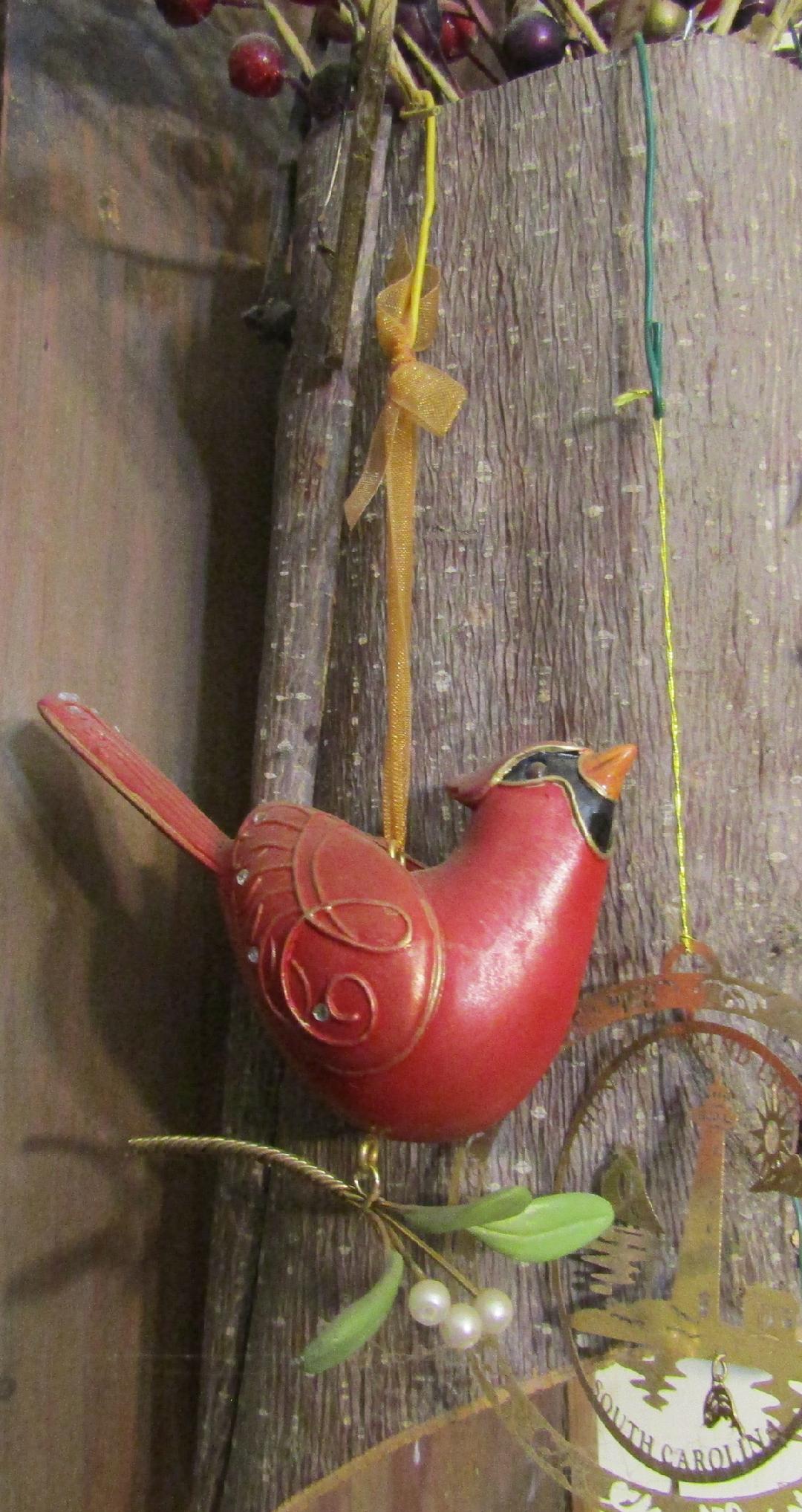
Photo by Bryan Stevens • Northern cardinals are a favorite for makers of Christmas ornaments.

Even once the holidays are past, there’s nothing like a glimpse of a Northern cardinal to add some cheer to a bleak winter day. It’s not surprising that such a popular bird has also become associated with many trappings of the Christmas season.

“You see cardinals on greeting cards, stationery, paper plates, paper napkins and tablecloths, doormats, light switch plates, candles, candle holders, coffee mugs, plates, glasses, Christmas tree ornaments and lights, bookmarks, mailboxes, Christmas jewelry,” writes June Osborne in “The Cardinal,” a book about this popular bird.

“And the list goes on,” Osborne writes. “Cardinals have become an integral part of the way that many people celebrate the holiday season.”

I can be included among such people. My Christmas decorations include an assortment of cardinal figurines and ornaments. There are other birds — doves and penguins for example — associated with the holiday season, but for me the holidays magnify the importance of one of my favorite birds. The cardinal, in its festive red plumage, appears made to order for a symbol of the holiday season.

Merry Christmas to all the readers of this column and best wishes for 2024.

•••

To ask a question, share a sighting or make a comment, email me at ahoodedwarbler@aol.com.


Kinglets among winter’s smallest, friendliest birds

Photo by Jake Bonello/USFWS • A ruby-crowned kinglet living up to its name by displaying its cap of red feathers.

Most of winter’s resident birds have settled in for the season at my home.
From red-shouldered hawk to winter wren to dark-eyed junco and white-throated sparrow, many seasonal residents have all become part of the daily backdrop. These winter arrivals join such year-round residents as Northern cardinal, Carolina chickadee, tufted titmouse, Carolina wren and downy woodpecker.
Some other tiny birds are also a little more abundant this season. I’m hearing kinglets almost everywhere I go.

The ruby-crowned kinglet, one of North America’s smallest birds, is typically about four inches long and doesn’t even weigh half an ounce. A close relative is the golden-crowned kinglet, which is typically just under four inches in length, which makes the species the shortest of North America’s songbirds.

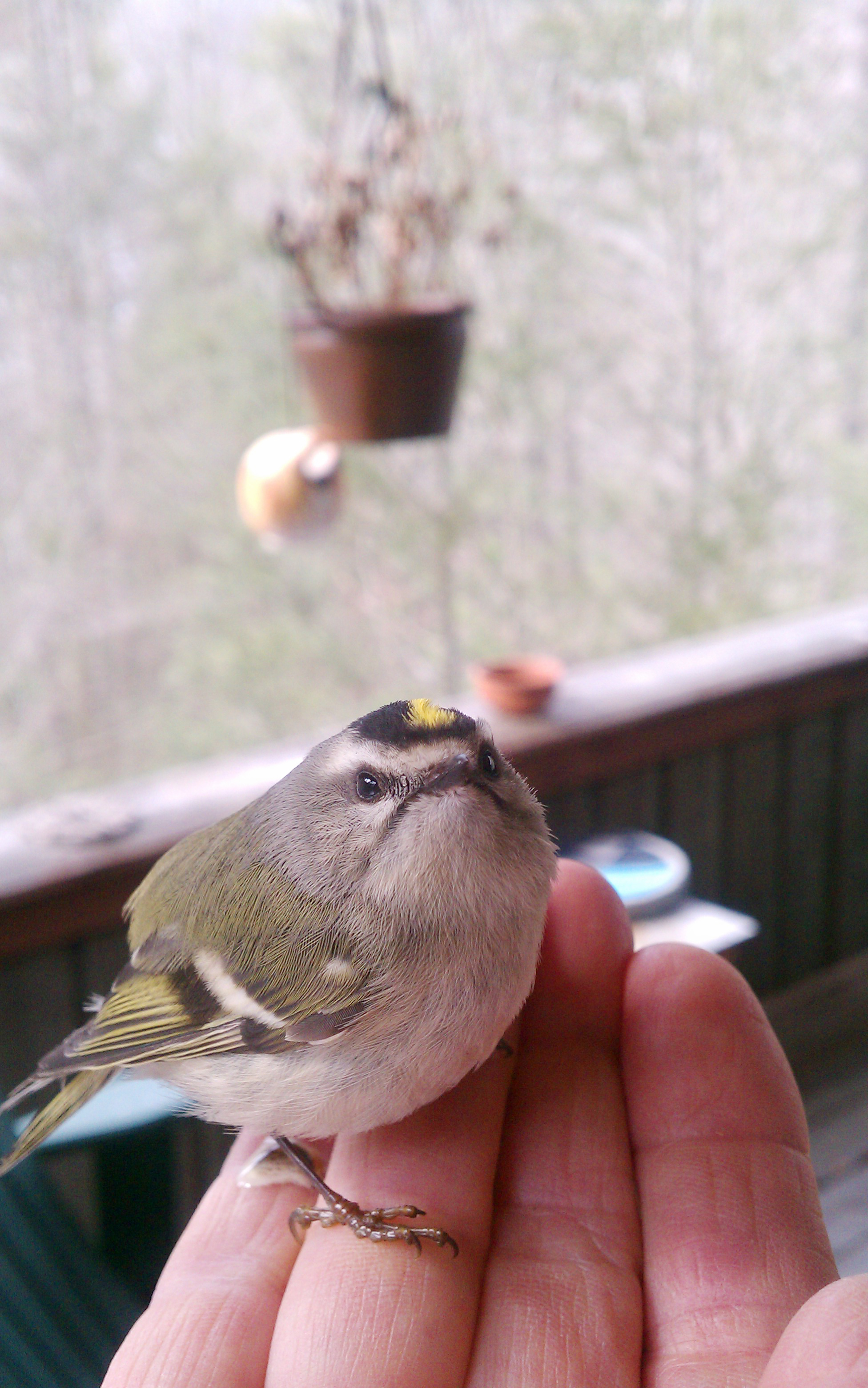
Photo by Beth McPherson • A golden-crowned kinglet being held carefully after a window strike.

How is it that the kinglets, among the smallest of North American birds, invariably choose to spend the harsh cold months of winter in our yards and gardens?
Chickadees, titmice and other familiar winter birds eke out an existence by supplementing some of their diet with fare from bird feeders. Although kinglets often associate with roaming flocks comprise of a mix of different species, the kinglets are not usually interested in the offerings at our feeders.

Kinglets are dedicated to gleaning tiny insects and spiders, as well as insects eggs and larvae, from branches and plantings in our yards. They’re so successful at it that they don’t need to turn to even a well-stocked feeder. A kinglet will on occasion sample an offering of suet or peanut butter, but this bird doesn’t make a habit of visiting feeders.

Kinglets are surprisingly tame at times and often exhibit as much curiosity about us as we display toward them. They’re very active birds, however, constantly moving from perch to perch. These bursts of hyperactivity can make them difficult to observe since they so rarely remain still.

In addition to the two North American species, kinglets, referred to in other parts of the world as firecrests, flamecrests or goldcrests, range throughout temperate North America, Europe and Asia, as well as northernmost Africa, Macaronesia and the Himalayas.

It’s the colorful crest of feathers atop their heads that have given all of them their common names. Kinglets belong to the family, Regulidae, and the genus, Regulus. The family and genus names are derived from a Latin word, regulus, which means “rex,”or “king” The name was apparently inspired by the colorful crown patches, often red, orange or gold, that resemble the royal “crowns” of kings.

This year’s bird calendar features a pair of tree swallows on the cover.

Although small in size, these birds more than compensate for it with a feisty spirit that does them well through the harsher weather of the winter months. It’s that indomitable spirit, curious nature and frantic antics that makes them such welcome companions during the bleak, cold months.

•••

The Lee & Lois Herndon Chapter of the Tennessee Ornithological Society is taking orders for its 2024 bird calendar.

The calendar will feature a photo of a pair of tree swallows on the front cover. The photo was taken by chapter members Eric Middlemas, who also contributed numerous other photographs for the calendar.

The inside pages of the professionally-produced calendar feature dozens more full-color photographs and an informative and educational grid. These calendars sell for $15 plus $2 for shipping. All sales help the club fund birding programs, public park feeders, conservation efforts and other activities in upper Northeast Tennessee. For more information on how to obtain a calendar, email ahoodedwarbler@aol.com.

•••

To share a sighting, ask a question or make a comment, please email me at ahoodedwarbler@aol.com.


Some birds expert at conjuring thrills and chills

Photo from Pixabay • The great tit, a bird related to titmice and chickadees, has acquired a taste for bat brains. Scientists have documented great tits in the mountains of Hungary killing a small species of bat to consume their brains.

NOTE: This column originally ran in November of 2018.

The ultimate coma victim is the fabled zombie, but that’s not likely to afflict any of our feathered friends, right? Well, consider the great tits of Hungary, which are relatives of our tufted titmouse and Carolina chickadee. These birds — at least the Hungarian ones — have apparently acquired a taste for brains.

Not human brains, thankfully. The victims of these brain-hungry great tits are a species of bat — a flying creature often associated with the modern celebration of Halloween, as well as legends about vampires — that shared the habitat of these birds in the Bükk Mountains of Hungary. As it turns out, the tits only hunted bats, in this case a tiny species known as common pippistrelle, out of dire necessity.

Bat ecologists Péter Estók and Björn M. Siemers, after observing the odd behavior of the great tits during some winter seasons, conducted a study to see if great tits are consistent devourers of bats’ brains. They discovered that the birds did hunt the bats and had even learned to detect a special call the bats make as they emerge from hibernation. The ecologists conducted their study over two years and learned that the great tits teach others of their kind the special art of hunting bats. They also learned that the birds made efficient killers, dragging the bats from their roosts and cracking their skulls to get at their brains.

However, when provided with plenty of alternative food, including such favorite items as bacon and sunflower seeds, the great tits chose to eat these items rather than actively hunt bats. The researchers concluded that great tits only resort to harvesting the brains of small bats during times of scarcity during harsh winters. The bizarre story is even featured in the title of a fascinating book by Becky Crew titled “Zombie Birds, Astronaut Fish, and Other Weird Animals.”

So, if humans have nothing to fear from brain-hungry birds, are there any birds that we should fear? Some experts suggest that precautions might be in order if one expects to come into close proximity with a southern cassowary, which is the third-tallest and second-heaviest living bird, smaller only than the ostrich and emu.

The cassowary, a native of New Guinea and northeastern Australia, has developed a reputation as a fearsome bird capable of injuring or killing humans. According to ornithologist Ernest Thomas Gilliard, cassowaries deserve their reputation. In his 1958 book, “Living Birds of the World,” he explained that the second of the three toes of a cassowary is fitted with a long, straight, dagger-like claw which can sever an arm or eviscerate an abdomen with ease. According to Gilliard, there have been many records of natives being killed by this bird.

A thorough study, however, has partly exonerated the cassowary from these misdeeds. In a total of 150 documented attacks against humans, cassowaries often acted in self-defense or in defense of a nest or chicks. The only documented death of a human took place in 1926 when two teenaged brothers attacked a cassowary with clubs. The 13-year-old brother received a serious kick from the bird, but he survived. His 16-year old brother tripped and fell during the attack, which allowed the cassowary to kick him in the neck and sever the boy’s jugular vein.

So we can rest easier knowing that murderous birds that reach a height of almost six feet tall are unlikely to terrorize us should we travel to the lands down under. A more ancient relative of the cassowary, however, might have been a different story had humans lived during the same time period.

Phorusrhacids, also known as “terror birds,” were a group of large carnivorous flightless birds that once had some members reign as an apex predator in South America before they went extinct around two million years ago. The tallest of the terror birds reached a height of almost 10 feet. Titanis walleri, one of the larger species, even ranged into what is now the United States in Texas and Florida.

Terror birds were equipped with large, sharp beaks, powerful necks and sharp talons. Their beaks, which would have been used to kill prey, were attached to exceptionally large skulls. Despite their fearsome appearance, these birds probably fed on prey about the size of rabbits. Perhaps not knowing this, Hollywood has cast these birds as monsters in such films as 2016’s “Terror Birds” and 2008’s “10,000 BC.”

Besides, casting birds as the villains had already been done back in 1963 when Alfred Hitchcock released his film, “The Birds,” based loosely on a short story by Daphne du Maurier. The film, which starred some big Hollywood names such as Rod Taylor, Tippi Hedren, Jessica Tandy, Suzanne Pleshette and Veronica Cartwright, cast a whole new light on a “murder” of crows. Today, the film has achieved the status of a Hollywood classic. I guess it just goes to show that werewolves, zombies and other Halloween monsters have nothing on our fine feathered friends.

Great horned owls become feathered phantoms after sunset

Photo by HMaria from Pixabay • A great horned owl is capable of almost silent flight, which helps this predatory bird take prey by surprise. Many myths and superstitions surround the world’s owls, but the truth about owls is often more fascinating.

Great horned owls become feathered phantoms after sunset

In late September, I began hearing a great horned owl near my home. The sonorous hoots resonated from a distant ridge the other side of the road. The ridge was logged this year and many of the large white pines are gone. I wasn’t at all optimistic the owl would return.

There’s nothing to send shivers traveling along your spine like listening to these haunting hoots from a creature that’s well hidden from human eyes by the cloak of darkness.

Or a cloak of fog and mist, as the case may be. This returning owl calls most often near dawn and dusk. On foggy mornings, of which there has been plenty, the owl’s still been calling as I leave for work.

It’s no wonder that owls have also become popular motifs for the celebration of the Halloween holiday. Just remember there’s more to these creatures of the night than perhaps meets the eye. Owls may be our neighbors, but we’ll never truly belong to their world, which must be why they continue to intrigue us.

While human culture has turned owls into beloved creatures, keep in mind these birds are fierce and ferocious predators. For young American crows in their nests, this owl is the stuff of their avian nightmares. It’s no wonder that crows, some of their numbers no doubt having witnessed their peers taken by the great horned owl as prey when young and helpless, grow up with an abiding hatred of this large nocturnal raptor.

Flocks of adult crows form quickly when an owl is discovered at a roost during the daylight hours. With safety in numbers, the crows mercilessly hound and harry the unlucky owls.

Quite often, a crow’s sharp vision is required to detect a motionless owl at its daytime roost. Great horned owls have a plumage of mottled grays and browns, as well as some white feathers on the chin and throat. This plumage helps them blend into their surroundings. Even when on the move, the great horned owl rarely attracts attention. They can fly in almost perfect silence on wide wings that can stretch out to a wingspan of 4.6 feet.

I know about their silent flight from firsthand experience. Back in the early 2000s I visited Orchard Bog in Shady Valley in Johnson County in early spring for a chance to witness the evening display of American woodcocks. While waiting with other birders for the evening show, I noticed a large shadow moving low over the fields heading toward us. As the bird got closer, it became recognizable as a great horned owl. The owl barely diverted from its flight. In fact, it flew just over our heads, gliding silently on wide wings. I still marvel at how the owl’s wings made no noise whatsoever. The owl continued to glide over the fields until we lost it in the dusk.

On another occasion I also witnessed how, when they want to do so, great horned owls can be absolutely silent. While vacationing on Fripp Island, South Carolina, in the 1990s, I would accompany my family for dusk golf cart excursions. We liked to pull off the side of the road on a causeway that crossed a series of tidal creeks and marsh. On that occasion, a great horned owl flew from nearby woodlands to land on a gnarled snag that rose above the marshland vegetation. Although the owl arrived on silent wings, it soon interrupted the silence with resonant hoots that carried over the marshes. The owl returned to the same snag for two additional evenings during our vacation stay.

I’ve seen other great horned owls over the years in locations from South Carolina and Florida to Utah and and Virginia. I’ve heard many more of these large owls than I have ever been able to get into focus in my binoculars. It’s still a thrill to get even a brief sighting of these impressive birds.

I’ve always thought about trying to locate the owls in residence at my home. I’ve scanned the silhouettes of the tree line in the direction of their hoots, but I’ve not ventured forth on a more methodical search. Perhaps I’ll save that as a Halloween activity this year. I’ll more likely continue to enjoy the owl’s haunting serenade and let a cloak of mystery continue to shroud this fascinating bird.

Photo by Bryan Stevens • A captive rehabilitated great horned owl at Calloway Gardens in Georgia.

Fall Bird Count detects 121 species

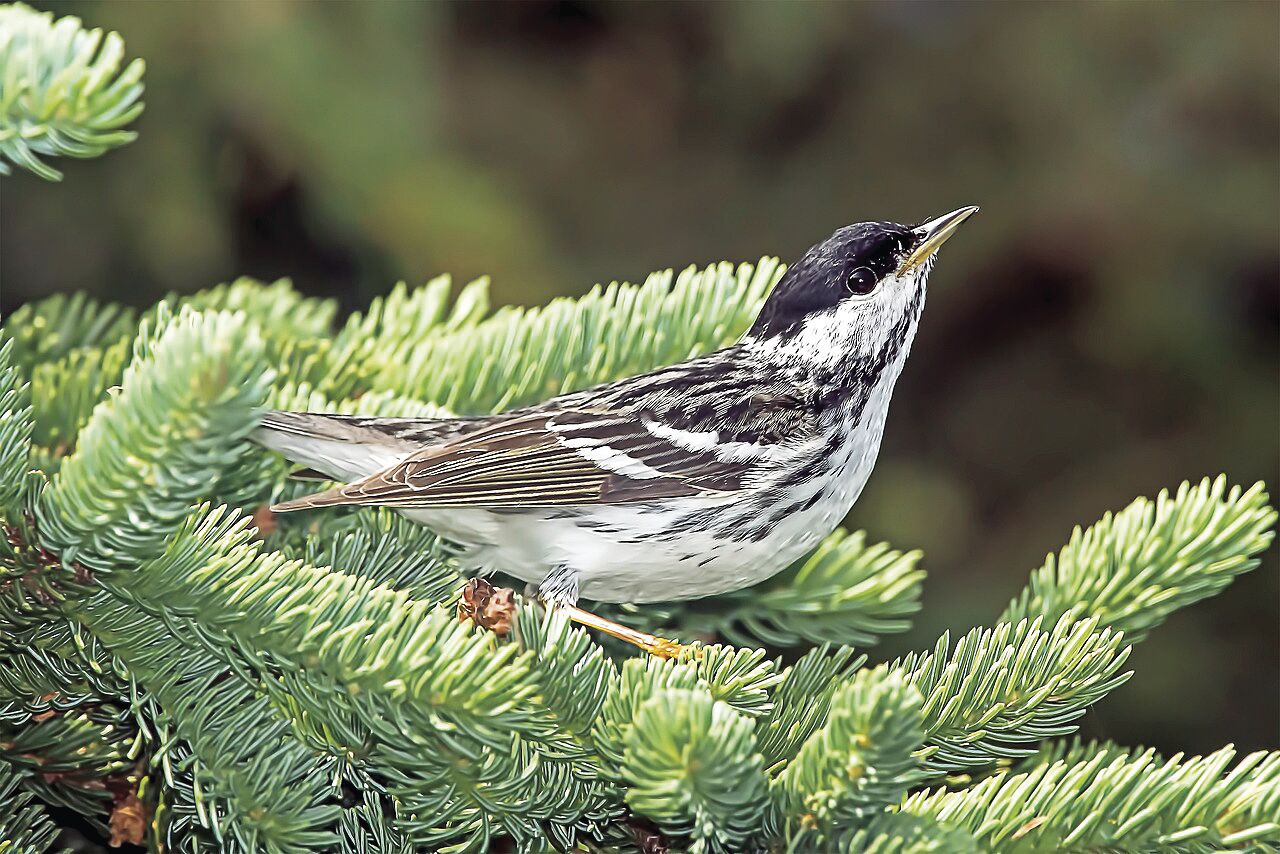
Photo by Hans Room/Pixabay • A blackpoll warbler found during the Fall Bird Count represented a rare appearance by this species on the seasonal count, which has been held for 53 consecutive years. A purple gallinule found in Washington County represented another extremely rare find.

The 53rd consecutive Elizabethton Fall Bird Count was held Saturday, Sept. 30, with 30 observers in about 12 parties. The count area included Carter County, as well as the surrounding counties of Johnson, Sullivan, Unicoi and Washington.

The weather was good, with a temperature range between 54 and 82 F. Participants tallied 121 species, plus one unidentified Empidonax species. The Empidonax flycatchers, or “Empids,” as birders fondly lump them, are birds so similar in appearance they cannot reliably identified in the field unless they are vocalizing. Unfortunately, the Empids are largely silent in autumn.

This total is slightly below the recent 30-year average of 125 species, according to longtime compiler Rick Knight. He noted that the all-time high was 137 species in 1993.

Knight said that a count highlight was a lingering immature purple gallinule in Washington County.

The list:

Canada goose, 850; wood duck, 40; mallard, 179; common merganser, 6; northern bobwhite, 3; ruffed grouse, 1; and wild turkey, 37.

Pied-billed grebe, 4; rock pigeon, 362; Eurasian collared dove, 1; and mourning dove,172.

Yellow-billed cuckoo, 5; black-billed cuckoo, 1; common nighthawk, 2; chimney swift, 246; and ruby-throated hummingbird, 17.

Virginia rail, 1; purple gallinule, 1; killdeer, 45; Wilson’s snipe, 1; and spotted sandpiper, 2.

Double-crested cormorant, 84; great blue heron, 34; great egret, 3; green heron, 3; black vulture, 29; and turkey vulture, 141.

Osprey, 7; northern harrier, 1; sharp-shinned hawk, 5; Cooper’s hawk, 4; bald eagle, 7; red-shouldered hawk, 6; broad-winged hawk, 1; and red-tailed hawk,19.

Barn owl, 2; Eastern screech-owl, 17; great horned owl, 4; barred owl, 4; and Northern saw-whet owl, 1.

Belted kingfisher, 26; red-headed woodpecker, 3; red-bellied woodpecker, 69; yellow-bellied sapsucker, 7; downy woodpecker, 39; hairy woodpecker, 12; northern flicker, 54; and pileated woodpecker, 30.

American kestrel, 16; merlin, 1; great crested flycatcher, 1; Eastern wood pewee, 18; Empidonax species, 1; and Eastern phoebe, 97.

Yellow-throated vireo, 2; blue-headed vireo, 31; red-eyed vireo, 5; blue jay, 438; American crow, 505; fish crow, 7; and common raven, 20.

Tree swallow, 220; barn swallow, 1; Carolina chickadee, 195; tufted titmouse, 168; red-breasted nuthatch, 17; white-breasted Nuthatch, 64; and brown creeper, 3.

House wren, 3; Carolina wren, 177; blue-gray gnatcatcher, 1; golden-crowned kinglet, 5; and ruby-crowned kinglet, 4.

Eastern bluebird, 152; veery, 1; gray-cheeked thrush, 6; Swainson’s thrush, 43; wood thrush, 5; and American robin, 113.

Gray catbird, 38; brown thrasher, 9; Northern mockingbird, 80; European starling, 615; cedar waxwing, 106; and house sparrow, 37.

House finch, 42; pine siskin, 2; American goldfinch, 123; chipping sparrow, 95; field sparrow, 11; dark-eyed junco, 83; Savannah sparrow, 3; song sparrow, 84; and Eastern towhee, 62.

Eastern meadowlark, 17; red-winged blackbird, 10; brown-headed cowbird, 2; and common grackle, 10.

https://www.nps.gov/articles/blackpollmigration.htm

Ovenbird, 6; Northern waterthrush, 3; black-and-white warbler, 2; Tennessee warbler, 73; common yellowthroat, 12; hooded warbler, 13; American redstart, 10; Cape May warbler, 23; northern parula, 11; magnolia warbler, 20; bay-breasted warbler, 28; Blackburnian warbler, 5; chestnut-sided warbler, 6; blackpoll warbler, 1; black-throated blue warbler, 21; palm warbler, 21; pine warbler, 14; yellow-rumped warbler, 6; and black-throated green warbler, 15.

Scarlet tanager, 9; Northern cardinal, 169; rose-breasted grosbeak, 26; blue grosbeak, 3; and indigo bunting, 12.

Observers in this year’s Fall Bird Count included Fred Alsop, Jerry Bevins, Rob Biller, Tammy Bright, Debi and J.G. Campbell, Ron Carrico, Bill and Linda Cauley, Catherine Cummins, Dave Gardner, David and Connie Irick, Rick and Jacki Knight, Roy Knispel, Vern Maddux, Joe McGuiness, Tom McNeil, Alson Ovando, Susan Peters, Brookie and Jean Potter, Lia Prichard, Pete Range, Judith Reid, Judi Sawyer, Bryan Stevens, Kim Stroud and Charlie Warden.

•••

To ask a question, share a sighting or make a comment, email me at ahoodedwarbler@aol.com.